

Bengaluru gets the headlines. Chennai gets the renewals.
That single pattern explains more about the city’s hiring market than any ranking ever will. Enterprises that set up engineering teams in Chennai overwhelmingly extend, expand, and re-sign because the city’s talent is built for the work that can’t afford to break: BFSI platforms, automotive software, manufacturing systems, and global delivery operations that run 24/7. It’s why IT staffing companies in Chennai operate differently from their counterparts in hyper-growth startup hubs: the winning metric here isn’t just speed-to-offer, it’s stability-at-scale.
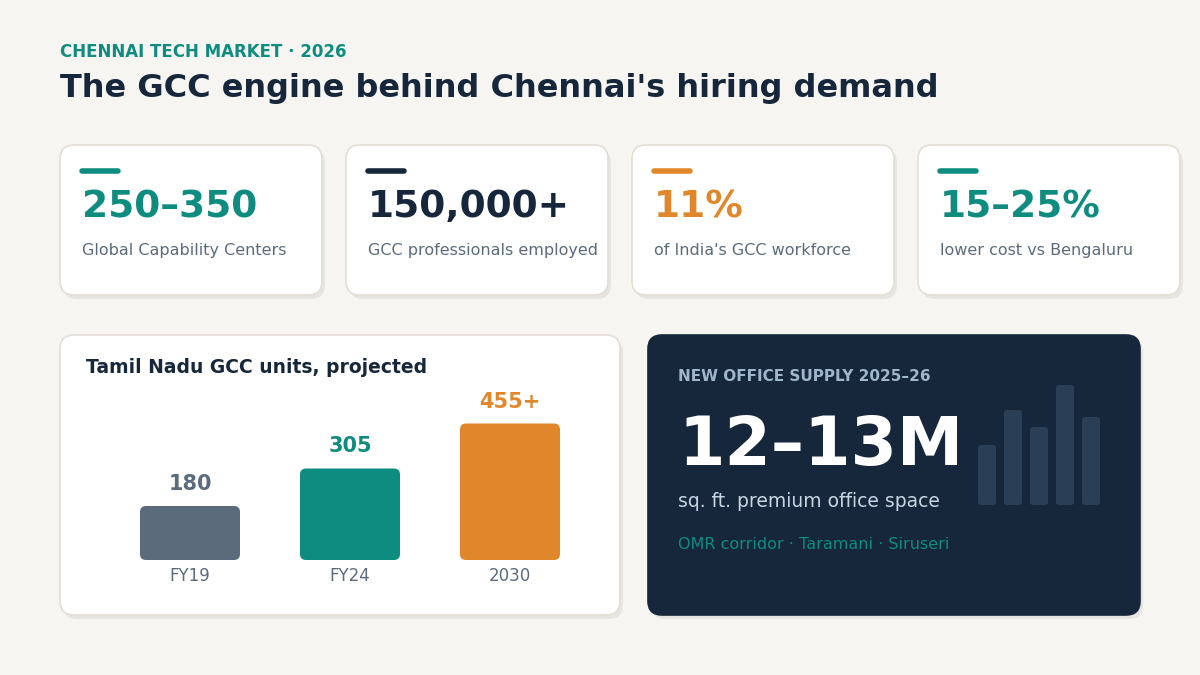
The numbers behind that shift are significant. Chennai now hosts 250–350 Global Capability Centers employing over 150,000 professionals roughly 11% of India’s entire GCC workforce and Tamil Nadu’s payroll subsidy programs and single-window GCC clearances are projected to push the state toward 450+ GCC units by 2030. The city is adding 12–13 million sq. ft. of premium office space across the OMR corridor, Taramani, and Siruseri IT Park to absorb that demand.
India’s technology industry is approaching the $300 billion revenue milestone in FY2026 and added roughly 135,000 net new tech jobs this year, with GCC expansion as the primary hiring engine NASSCOM Strategic Review 2026.
But here’s the tension that makes this guide necessary: demand for cloud, data, AI, and platform engineers in Chennai significantly exceeds supply, offer drop-offs across India’s IT hiring market routinely run 20–30%, and most companies still evaluate staffing partners on nothing more than a sales call and a rate card.
This guide fixes that. You’ll get the ten firms worth shortlisting in 2026, plus the complete operational playbook requirement definition, vetting standards, contract terms, cost bands in ₹ and $, onboarding cadence, delivery KPIs, and exit clauses so you can run the entire process like someone who has done it fifty times.
What Are IT Staffing Companies?
IT staffing companies are specialized firms that source, screen, and deploy technology professionals for client organizations on contract, contract-to-hire, or permanent terms while typically managing payroll, statutory compliance, and replacement risk. They act as an extension of a client’s talent function, converting a job description into a working engineer in days rather than months.
What IT staffing is not:
- Not a freelance marketplace. Marketplaces list self-reported profiles; staffing firms carry accountability for vetting, compliance, and replacement.
- Not an IT services/outsourcing company. A services firm owns project delivery; a staffing firm supplies talent that works under your direction and processes.
- Not a job board or ATS tool. Software surfaces applicants; a staffing partner delivers interview-ready, pre-assessed candidates with verified availability.
Why IT Staffing Matters in Chennai’s 2026 Market
IT recruitment agencies in Chennai have moved from a convenience to a structural necessity, because the market’s economics have changed. The concrete business outcomes at stake:
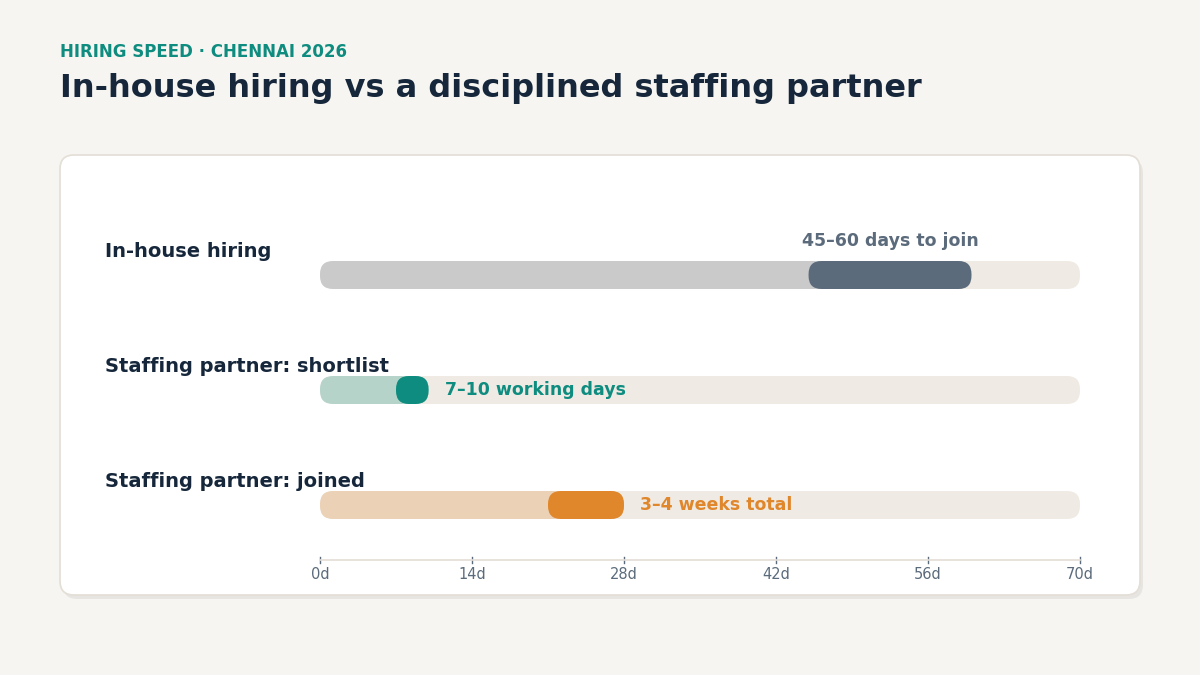
- Speed: In-house hiring for a mid-senior engineer in India averages 45–60 days from JD to join. Strong staffing partners compress the JD-to-shortlist stage to 7–10 working days, cutting total time-to-fill to 3–4 weeks.
- Cost of vacancy: An unfilled senior engineering seat on a revenue-linked platform typically costs ₹1.5–3 lakh per week in delayed delivery, missed sprint commitments, and overloaded team members. A 6-week delay on five roles can quietly burn ₹45–90 lakh in opportunity cost.
- Cost advantage preserved: Chennai offers 15–25% lower operating and talent costs than Bengaluru while drawing from IIT Madras, Anna University, CEG, and 130+ engineering institutions across Tamil Nadu but only if your sourcing engine can actually reach that talent.
- Quality and risk: Structured technical vetting reduces 90-day early attrition and bad-hire write-offs, which cost 1.5 — 2x annual CTC per failed senior hire when you account for re-hiring, lost ramp time, and team disruption.
- Compliance: Contract staffing shifts PF, ESI, gratuity, TDS, and increasingly relevant in 2026 DPDP Act data-handling obligations onto the staffing partner’s books, not yours.
- Elastic capacity: Contract and contract-to-hire models let you scale a delivery team from 5 to 25 engineers for a platform migration, then scale back down, without severance exposure.
The Core Problem: Why IT Hiring in Chennai Breaks Without a System
Most hiring failures in this market follow the same five patterns, and most teams underestimate each one by 2–4x:
- Time-to-fill optimism. Teams budget 3 weeks for a senior data engineer; the realistic in-house median is 8–10 weeks once you account for notice periods (60–90 days is standard in Indian enterprise IT) and interview scheduling drag.
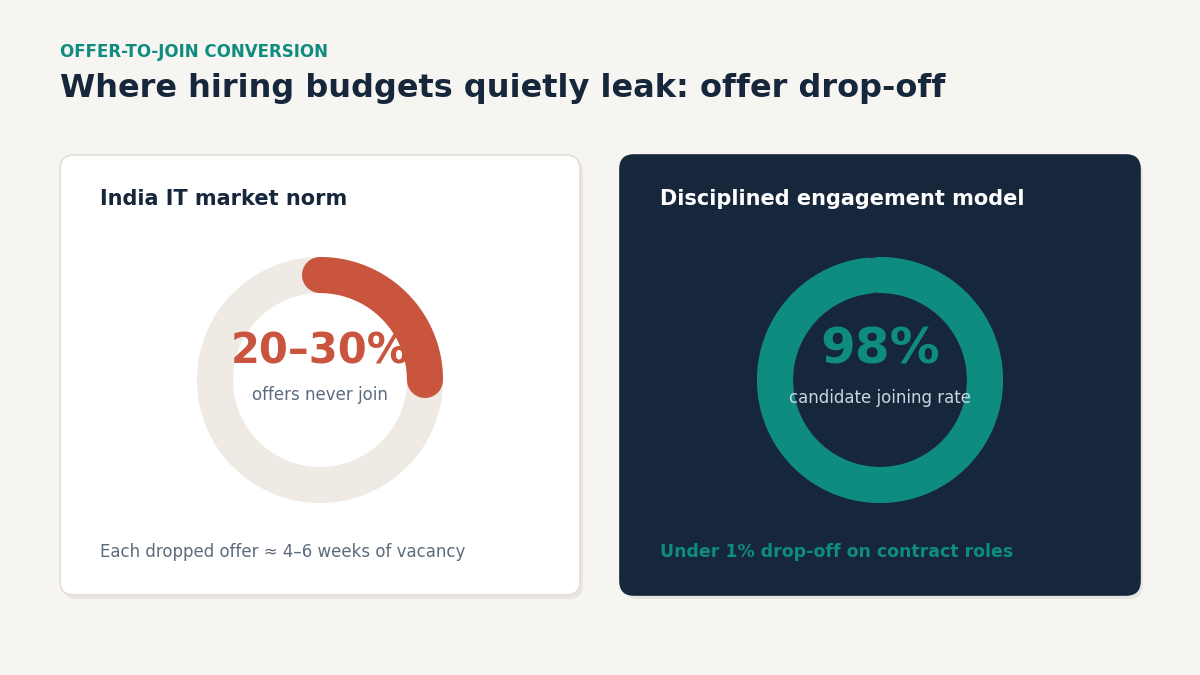
- They offer a drop-off blind spot. Across India’s IT market, 20–30% of accepted offers never convert to joins candidates use offers as counter-offer leverage. Teams that don’t track and manage joining rate lose a month per dropped offer. (For reference, disciplined engagement models can hold drop-off under 1% on contract roles.)
- Vetting theater. A 30-minute “technical chat” passes candidates who fail in week 3 on real codebases. Without structured coding assessments, system design rounds, and project-depth probing, screening accuracy collapses.
- Compliance debt. Companies engaging contractors directly often discover PF/ESI liabilities, misclassification risk, and BGV gaps only during an enterprise client’s vendor audit at which point remediation costs 5–10x prevention.
- The generalist-agency trap. Agencies that staff sales reps on Monday and DevOps engineers on Friday produce keyword-matched resumes, not engineers. In Chennai’s specialist-heavy market (embedded systems, SDV, BFSI platforms, VLSI), domain-blind sourcing wastes 2–3 interview cycles per role.
The pattern underneath all five: hiring is treated as a transaction instead of a process with defined stages, owners, and metrics. The A-to-Z walkthrough later in this guide is the antidote. First, the market context and the shortlist.
Chennai’s IT Staffing Market in 2026: What Changed
The demand side of IT recruitment in Chennai looks meaningfully different than it did even two years ago. Four structural shifts define the 2026 market:
- GCCs became the primary hiring engine. Global Capability Center hiring in Chennai has moved from back-office support to ownership of core engineering: Ford’s technology center now builds software-defined vehicle systems, Hyundai runs one of its largest global R&D operations here, and Standard Chartered, AstraZeneca, Caterpillar, Hapag-Lloyd, and Walmart all run substantial engineering campuses across Taramani, OMR, and DLF Downtown. New GCC mandates arrive with 50–200 seat ramp plans and 3–5 month deadlines exactly the volume-plus-quality problem staffing partners exist to solve.
- AI reshaped the role mix, not the headcount. Despite automation anxiety, India’s tech industry added ~135,000 net new jobs in FY26 but the composition shifted hard toward data engineering, MLOps, GenAI application development, cloud platform engineering, and cybersecurity. India currently faces an AI talent supply gap of roughly 50%, which is why GenAI-capable engineers command a 20–40% salary premium and why keyword-matching recruiters fail in these roles.
- The in-demand role stack for 2026:
- Full-stack and backend engineers (Java, Python, Node.js, .NET) highest volume
- Data engineers and analytics roles (Spark, Snowflake, Power BI) fastest growing
- Cloud and DevOps (AWS, Azure, GCP, Kubernetes, Terraform)
- AI/ML and GenAI application engineers largest supply gap
- Embedded systems, SDV, and VLSI engineers Chennai’s distinctive automotive-tech specialty
- Cybersecurity and platform reliability (SRE) roles across BFSI GCCs
- QA automation and SDET roles supporting regulated delivery
- Compliance stakes rose. The DPDP Act’s enforcement in 2026 means candidate data, BGV records, and contractor project data now carry formal fiduciary obligations. Enterprise vendor audits increasingly test staffing partners’ data-handling maturity, another reason generalist agencies are losing enterprise accounts to specialists with documented compliance stacks.
The net effect for buyers: the supply of resumes went up, the supply of verified, AI-era-relevant engineering skills got tighter. Vetting depth not database size is now the deciding variable between staffing partners.
Top 10 IT Staffing Companies in Chennai (2026)
The best IT staffing companies in Chennai for 2026, evaluated on screening depth, engagement model flexibility, compliance maturity, enterprise track record, and fit for the city’s stability-first hiring culture.
1. Supersourcing Best Overall IT Staffing Company in Chennai
Supersourcing leads this list for organizations building enterprise platforms, product engineering teams, and long-term global delivery centers out of Chennai. Its AI-powered sourcing engine surfaces the top 2% of vetted talent and delivers an interview-ready shortlist in 7–10 working days against an industry norm of 3–6 weeks.
The delivery metrics are what separate it from the field:
- 527+ IT projects delivered across 10+ years, with a 98% candidate joining rate and under 1% drop-off on contract roles in a market where 20–30% offer drop-off is normal
- 8.5 NPS with dedicated account managers and no shared recruiter bandwidth
- Replacement guarantee within 7–10 days if a hire isn’t a fit, plus NDA-backed IP protection on every engagement
- Recognized as a LinkedIn Top 20 Startup (2023 & 2024) and part of the Google for Startups AI Accelerator (2024)
Founded: 2014 Core Services: Contract staffing, contract-to-hire, permanent hiring, RPO, GCC setup, custom software development Specialties: Backend, frontend, mobile, cloud, data, AI/ML, DevOps, QA; offshore development center builds Industry Focus: Enterprise SaaS, fintech, healthtech, e-commerce, manufacturing-tech with a client roster spanning Swiggy, Paytm, Razorpay, Chargebee, Yellow.ai, Adani, Apollo Hospitals, OkCredit, Dunzo, Brillio, Open Money, and Somnoware Best for: Companies that need enterprise-grade engineers fast, with measurable joining rates and retention not just resumes.
2. TeamLease Digital
TeamLease brings the deepest compliance infrastructure in Indian staffing to Chennai’s regulated hiring environments, a genuine advantage for BFSI and public-sector-adjacent technology programs.
Founded: 2002 | Core Services: Temporary staffing, permanent recruitment, payroll management Specialties: Large-scale compliant workforce management, statutory administration Best for: High-volume, compliance-heavy contract programs where audit-readiness matters more than niche-skill depth.
3. Adecco India
Adecco pairs global hiring standards with strong Chennai execution, particularly for multinational manufacturing-tech and enterprise IT accounts.
Founded: 1999 (India operations) | Core Services: Permanent and contract staffing, RPO Specialties: Enterprise IT, digital transformation, cybersecurity roles Best for: MNCs that need a globally consistent vendor across multiple geographies including Chennai.
4. Randstad India
Randstad is a dependable partner for mid-to-senior enterprise and platform engineering searches in Chennai, with a consultative style suited to longer-tenure roles.
Founded: 2008 (India operations) | Core Services: Contract and permanent IT staffing Specialties: Cloud platforms, data engineering, DevOps Best for: Mid-senior enterprise roles where long-term fit outweighs closing speed.
5. Quess Corp
Quess runs some of the largest managed staffing programs in the city and excels at operational scale hundreds of contractors, single point of governance.
Founded: 2007 | Core Services: Contract and permanent staffing, managed workforce services Specialties: High-volume and agile hiring programs Best for: Enterprises running 50+ contractor programs that need process muscle and consolidated invoicing.
6. Xpheno
Xpheno has built a strong specialist-staffing reputation in South India, with data-led market intelligence on salaries and talent supply that enterprise TA teams find genuinely useful.
Founded: 2017 | Core Services: Specialist staffing, direct hire, managed services Specialties: Engineering, product, and deep-tech roles; talent market analytics Best for: Companies that want salary benchmarking and supply-demand data alongside candidate delivery.
7. ABC Consultants
ABC brings five decades of search pedigree to Chennai’s leadership and niche-technology, hiring the firm to call when the role is a CTO, VP Engineering, or a head of platform.
Founded: 1969 | Core Services: Executive search, senior IT recruitment Specialties: Technology leadership, digital transformation leadership Best for: Leadership and hard-to-fill senior mandates, not volume hiring.
8. Ciel HR
Ciel HR is a fast-scaling firm with growing Chennai depth, known for responsiveness and precision on mid-level technology mandates.
Founded: 2015 | Core Services: Permanent and contract IT staffing Specialties: Software development, cybersecurity, project management roles Best for: Mid-market companies that value speed and flexible commercial terms.
9. Kelly Services
Kelly’s relationship-driven model and global vetting standards serve Chennai’s infrastructure, cloud, and engineering-services hiring reliably.
Founded: 1946 globally; 20+ years in India | Core Services: Contract and permanent IT staffing Specialties: Cloud, infrastructure, software engineering Best for: Global enterprises that prefer a legacy vendor with mature account governance.
10. ManpowerGroup India
ManpowerGroup supports Chennai’s enterprise and global delivery centers with scalable staffing across software development, IT management, and data roles.
Founded: Early 2000s (India operations) | Core Services: Contract and permanent IT staffing Specialties: Software developers, IT operations, data roles Best for: Multi-city enterprise programs where Chennai is one node in a national hiring plan.
How to read this list: Ranks 2–10 are strong at specific things: compliance scale, executive search, volume programs. The reason a specialist tech-staffing firm tops the list is the combination Chennai’s market actually demands in 2026: engineering-grade vetting, sub-1% drop-off, and GCC/ODC build capability in a single partner.
The A-to-Z Walkthrough: Hiring Through a Chennai IT Staffing Partner
Tech hiring in Chennai rewards process discipline more than any other Indian metro. The candidates are strong, but the best ones move through structured pipelines, not job-board sprays. This section covers the full lifecycle, from the day you decide you need external help to the day you scale up or exit, with the numbers most guides leave out.
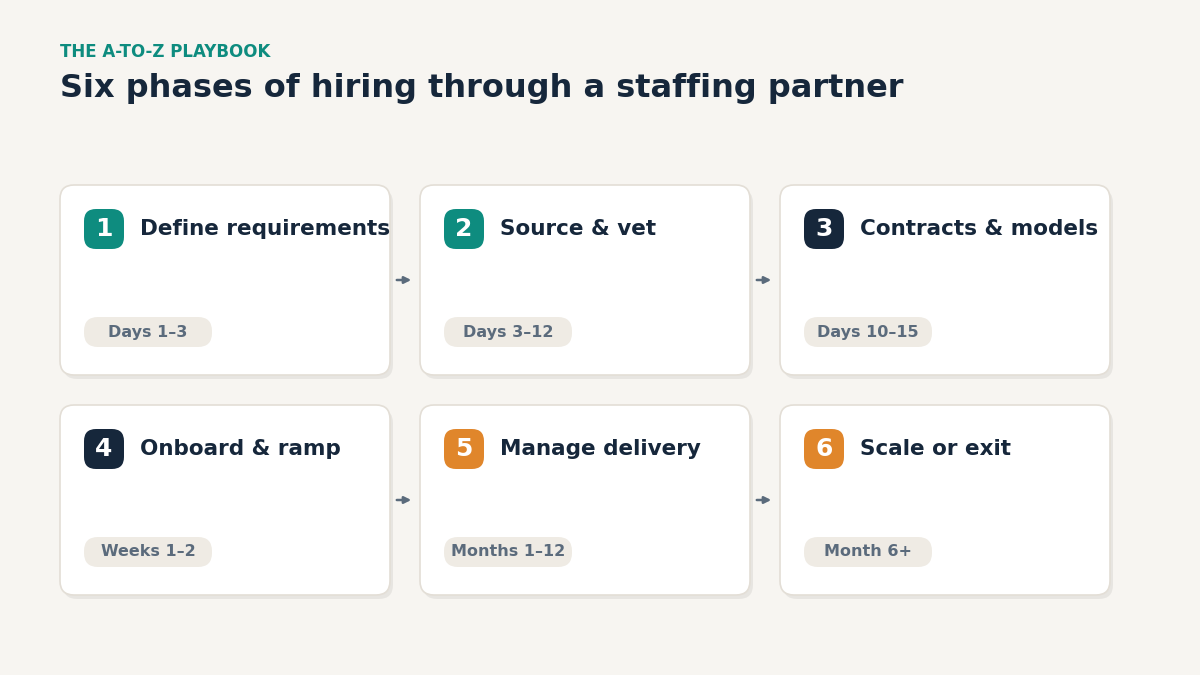
Phase 1 Defining Requirements (Days 1–3)
Vague requirements are the single largest cause of slow, expensive hiring. Before contacting any agency, produce a one-page requirement brief per role:
- Role architecture: Title, seniority band (junior 1–3 yrs / mid 3–6 / senior 6–10 / lead 10+), and whether the role is build-focused, maintain-focused, or platform-migration-focused. These attract different candidates.
- Must-have vs. trainable skills: Cap must-haves at 4–5. A JD demanding React + Node + AWS + Kafka + Terraform + ML as all “mandatory” filters out 90% of genuinely strong engineers.
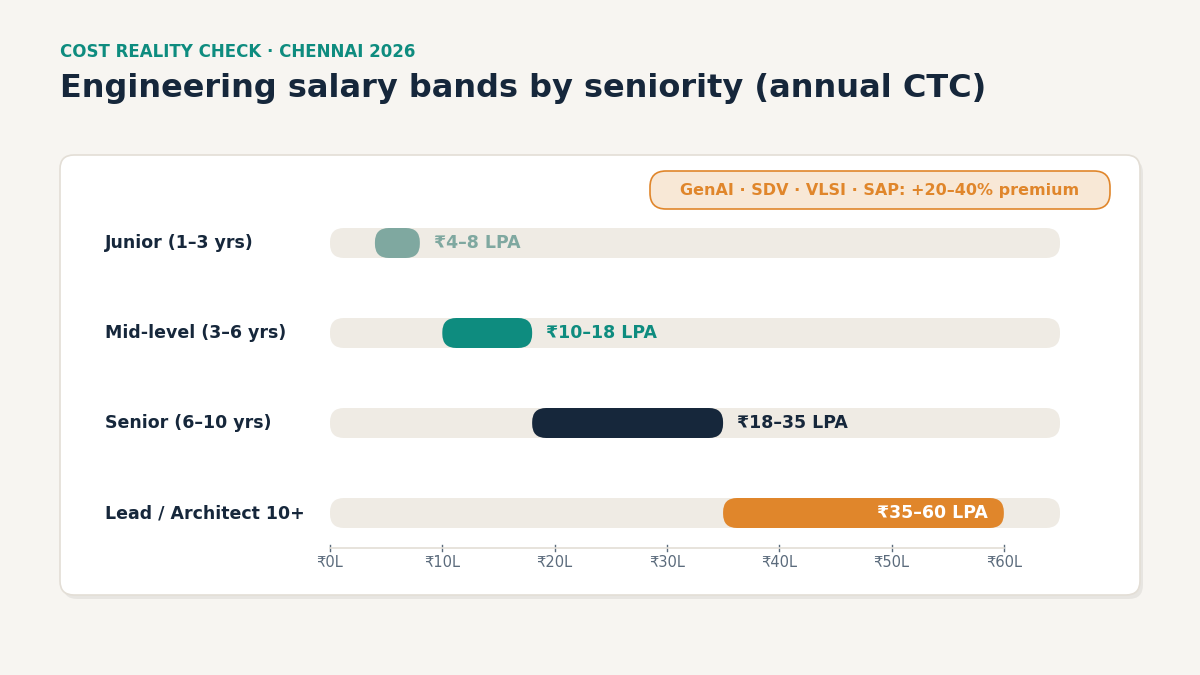
- Budget band (be honest internally): Chennai 2026 reference CTCs junior developers ₹4–8 LPA, mid-level ₹10–18 LPA, senior engineers ₹18–35 LPA, leads/architects ₹35–60 LPA. Niche skills (GenAI/LLM engineering, SDV, VLSI, SAP S/4HANA) command a 20–40% premium.
- Contract vs. permanent decision: Project under 12 months or headcount-frozen → contract. Core platform ownership → permanent or contract-to-hire.
- Timeline and interview capacity: Commit named interviewers and 48-hour feedback SLAs. Agencies deprioritize clients whose panels sit on profiles for a week and candidates drop out.
The 3-day rule: If your internal stakeholders can’t align on the requirement brief within 3 working days, you’re not ready to engage a partner, you’ll churn shortlists and burn goodwill.
Phase 2 Sourcing & Vetting (Days 3–12)
This is where staffing partners genuinely differ, and where you should interrogate hardest before signing.
What good screening looks like the 5-layer standard:
- Profile intelligence: AI-assisted or recruiter-led matching on actual project history, not keyword density
- Structured technical assessment: Live coding or take-home assignment scored against a rubric not a resume conversation
- System design / depth round for mid-senior roles: can the candidate explain trade-offs in systems they claim to have built?
- Communication and cultural evaluation: Especially critical for GCC and client-facing global delivery roles
- Verification: BGV, employment history, education, and the one everyone skips genuine notice-period and counter-offer risk assessment
Red flags when evaluating an agency’s vetting:
- Ten resumes within 24 hours of your brief (that’s a database dump, not sourcing)
- No written assessment artifacts they can show you (test scores, interview notes)
- Recruiters who can’t answer one technical question about the stack they’re hiring for
- No data on their own joining rate or 90-day retention if they don’t measure it, they don’t manage it
A disciplined partner sends 3–5 pre-vetted profiles per role, of which 60–80% should merit a client interview. If you’re interviewing 15 people to make one offer, the vetting layer upstream is broken.
Phase 3 Engagement Models & Contracts (Days 10–15, parallel to interviews)
Contract staffing in Chennai typically runs on one of four commercial structures:
| Model | You pay | Best for | Typical commercial terms |
| Contract / staff augmentation | Monthly bill rate per engineer | Projects 3–18 months, elastic capacity | Cost + 15–30% markup; 30-day exit notice |
| Contract-to-hire | Bill rate, then conversion fee | “Try before you buy” on key roles | Conversion fee 0–8.33% of CTC after 6–12 months |
| Permanent placement | One-time success fee | Core, long-tenure roles | 8.33–16% of annual CTC (1–2 months’ salary) |
| RPO / managed hiring | Monthly retainer + per-hire fee | 15+ hires/quarter, GCC ramp-ups | Custom; 30–50% cheaper per hire at volume |
Contract clauses that actually matter (insist on all six):
- Replacement guarantee: 30–90 days is market standard for permanent hires; the strongest partners replace contract engineers within 7–10 days
- IP assignment and NDA: All work product assigned to you from day one; enforce NDAs at both agency and engineer level
- Data protection: DPDP Act 2026 obligations explicitly allocated who is data fiduciary vs. processor for candidate and project data
- Statutory indemnity: Agency indemnifies you against PF/ESI/misclassification claims for contract staff on their payroll
- Non-solicitation symmetry: If they can’t poach your employees, define your conversion rights over theirs (and the fee)
- Exit terms: Notice period (30 days standard), knowledge-transfer obligations, and no lock-in beyond the active SOW
Phase 4 Onboarding & Ramp-Up (Weeks 1–2 post-joining)
Time-to-productivity, not joining date, is the real finish line. The benchmark for a well-run onboarding is the first meaningful commit within 5 working days for developers.
The 2-week onboarding checklist:
- Before day 1: Laptop/VDI provisioned, repo and environment access requested, licenses assigned, NDA and IP docs signed
- Day 1: Access verified live, codebase walkthrough scheduled, buddy assigned from the existing team
- Days 2–5: Starter ticket shipped (small, real, in-production work not a toy task); architecture and domain-context sessions
- Week 2: First sprint participation with normal (not reduced) ceremonies; written 2-week check-in shared with the account manager
- Communication cadence locked: Daily standup, weekly delivery review, and a monthly three-way review (you + engineer + account manager)
Red flag: If the staffing partner disappears after the joining confirmation, you bought a resume, not a service. The first 30 days are when replacement clauses get exercised your partner should be watching as closely as you are.
Phase 5 Managing Delivery (Months 1–12)
Treat contract engineers as team members with an extra reporting layer, not as vendors. The metrics that predict engagement health:
- Time-to-productivity: First independent feature shipped by week 3–4
- Sprint predictability: Committed-vs-completed within ±15% by month 2
- Retention: 90-day retention above 95% across the contractor pool; below 90% means a sourcing-quality or engagement problem
- Escalation latency: Issues raised to resolved within 5 working days via the account manager
- Quarterly business reviews (QBRs): Rate the partner on fill rate, joining rate, retention, and replacement turnaround with numbers, not adjectives
The 60-day rule: Any performance concern not raised in writing within 60 days becomes your problem, not the partner’s. Document early; replacement clauses have clocks.
Phase 6 Scaling or Exiting (Month 6+)
Scaling up: A partner who has delivered 5 good engineers can usually ramp you to 20–25 within a quarter. This is exactly how offshore development centers and GCC pods in Chennai typically grow, one proven pod at a time. Negotiate volume pricing at 10+ concurrent engineers (markups should compress 3–5 points).
Converting: Exercise contract-to-hire clauses for engineers you want permanently; conversion after 12 months of billing is often free or nominal.
Exiting cleanly the offboarding checklist:
- 30-day written notice per SOW
- Knowledge-transfer document + handover sessions (put KT obligations in the contract at Phase 3, not now)
- Access revocation audit across repos, cloud consoles, and internal tools within 24 hours of last day
- Final invoice reconciliation against timesheets
- Retain the relationship Chennai’s staffing market is small at the quality end, and re-engagement is faster than re-evaluation
Case Studies: What Disciplined Staffing Actually Delivers
100+ engineers for Paytm’s platform scale-up. When Paytm needed to expand engineering capacity across payments and platform teams, the mandate demanded volume without diluting the vetting bar. Structured multi-layer screening and dedicated account management delivered 100+ engineers with joining rates holding near the 98% benchmark proving that speed and selectivity aren’t a trade-off at scale.
7–10 day shortlists for OkCredit’s product engineering. OkCredit’s fintech roadmap required backend and mobile engineers in weeks, not quarters. AI-driven sourcing against a tightly defined requirement briefly produced interview-ready shortlists inside 10 working days per role, compressing total time-to-join to under a month against an in-house baseline of 8+ weeks.
Recruitment automation for Somnoware. The healthtech platform needed to remove recruiter bottlenecks from a continuous-hiring motion. Moving screening and pipeline management onto an AI-assisted RPO model cut manual sourcing effort dramatically while keeping candidate drop-off on contract roles below 1%, the metric that protects delivery timelines more than any other.
The common thread across all three: metrics were defined before sourcing began. Explore more client case studies (/case-studies) for detailed breakdowns.
Decision Framework: Which Hiring Model Fits Your Situation?
Before selecting among IT staffing services in Chennai, decide which model you’re actually buying. Use this comparison:
| Factor | In-house hiring | Freelance marketplace | Staff augmentation (contract) | Dedicated team via staffing partner |
| Speed to first engineer | 6–10 weeks | 1–2 weeks | 2–4 weeks | 2–4 weeks |
| Vetting accountability | Yours entirely | Minimal / self-reported | Partner-owned | Partner-owned, SLA-backed |
| Compliance & payroll burden | Fully yours | Misclassification risk | On partner’s books | On partner’s books |
| IP & data protection | Strong | Weak, hard to enforce | Contractual (NDA/MSA) | Strongest (dedicated + NDA) |
| Cost profile | CTC + 15–20% overhead + recruiter cost | Lowest sticker, highest variance | CTC + 15–30% markup | Volume-discounted at 10+ seats |
| Continuity / attrition risk | Medium | High | Medium, replacement-backed | Low, pod-level redundancy |
| Best when | Hiring < 5 roles/year, strong TA team | Small, low-stakes tasks | Project surges, 3–18 months | Long-term ODC/GCC builds |
The 4-question shortcut:
- Is this work mission-critical or experimental? (Critical → never marketplace)
- Will the need last beyond 18 months? (Yes → dedicated team or permanent)
- Can your team absorb compliance and payroll admin? (No → contract via partner)
- Do you need to scale past 10 engineers? (Yes → partner with RPO/GCC capability, not a placement shop)
The 10-point vendor scorecard. Once the model is decided, score each shortlisted agency 1–5 on these criteria before any pilot; anything averaging below 3.5 shouldn’t reach a pilot:
- Measured joining rate (with data, not claims)
- 90-day contractor retention rate
- Shortlist-to-interview conversion on similar past roles
- Written technical assessment artifacts they can show you
- Named, dedicated account manager (not a shared pool)
- Replacement SLA in days, stated in the MSA
- Statutory compliance documentation (PF/ESI/BGV/DPDP readiness)
- Chennai-specific delivery history in your domain (BFSI, automotive-tech, SaaS)
- Scale proof: largest single-client pod they currently run
- Commercial transparency: markup or fee structure disclosed in writing before the pilot
Score in a shared sheet with your engineering lead and finance stakeholder the disagreements between their scores usually surface the real risk areas.
What Most Teams Get Wrong
Patterns observed across hundreds of engagements the mistakes that repeat regardless of company size:
They shop on markup percentage and lose on joining rate. A partner charging 18% markup with a 75% joining rate is far more expensive than one charging 25% with 98% every dropped offer costs you 4–6 weeks of vacancy. The cheapest rate card routinely produces the highest total cost of hire.
They run five agencies in parallel and get everyone’s leftovers. Spraying a role across five vendors signals low commitment; every agency deprioritizes you, candidates get triple-submitted, and your employer brand takes damage in a talent market that talks. Two committed partners with clear role allocation outperform five casual ones consistently.
They treat notice periods as a candidate problem. In Chennai’s enterprise market, 60–90 day notice periods are the norm. Teams that refuse buyout discussions or don’t maintain engagement during the notice window are the ones feeding the 20–30% national drop-off statistic.
They skip the pilot. Signing a 20-seat annual commitment off a sales deck is how bad partnerships get locked in. Run 2–3 roles as a 4-week pilot, measure shortlist quality, time-to-interview, and joining conversion then scale.
They confuse Chennai with Bengaluru and overpay. Importing Bengaluru salary bands into Chennai negotiations inflates costs 15–25% unnecessarily; importing Bengaluru’s churn expectations undervalues the city’s biggest asset retention. Chennai engineers stay longer. Price and plan for that.
They ignore the account management layer. The recruiter who sourced your engineer is not the person who’ll fix a month-4 performance issue. If a partner can’t name your dedicated account manager before signing, escalations will route to a ticket queue.
Cost & Timeline Reality Check (Chennai, 2026)
The section most guides omit. Real bands, in both currencies:
Salary / CTC bands (Chennai, 2026):
| Seniority | Annual CTC (₹) | Approx. ($) |
| Junior developer (1–3 yrs) | ₹4–8 LPA | $5k–10k |
| Mid-level engineer (3–6 yrs) | ₹10–18 LPA | $12k–22k |
| Senior engineer (6–10 yrs) | ₹18–35 LPA | $22k–42k |
| Lead / architect (10+ yrs) | ₹35–60 LPA | $42k–72k |
| Niche premium (GenAI, SDV, VLSI, SAP) | +20–40% on band |
What you actually pay the partner:
- Contract staffing: Engineer CTC + 15–30% markup, billed monthly. A ₹20 LPA senior engineer bills roughly ₹1.9–2.2 lakh/month all-in.
- Permanent placement: One-time 8.33–16% of annual CTC (one to two months’ salary), usually with a 30–90 day free-replacement window.
- RPO: Retainer + per-hire fee; at 15+ hires/quarter, effective cost per hire drops 30–50% versus per-role agency fees.
Realistic timelines by scenario:
- Single mid-level role, common stack: shortlist in 7–10 working days; joined in 3–5 weeks (immediate-joiner or short-notice candidate)
- Senior/lead role, standard 60–90 day notice: joined in 8–12 weeks plan backward from project dates accordingly
- 10-engineer contract pod: fully staffed in 4–8 weeks with a capable partner
- GCC/ODC first-25 ramp: 3–5 months including entity, infrastructure, and leadership hiring via GCC setup (/global-capability-center) support
What drives cost up: niche skills, immediate-joiner requirements (expect a 10–20% premium or buyout costs), excessive interview rounds (each added round costs ~1 week and drops conversion), and Bengaluru-benchmarked offers.
What drives cost down: volume commitments (10+ seats), contract-to-hire conversion after 12 months, flexible seniority mixes (1 senior + 2 mid instead of 3 senior), and RPO services (/recruitment-process-outsourcing) for continuous hiring.
Next Step: Turn This Playbook Into a Shortlist
If you’re mid-decision, don’t start with a vendor pitch start with your Phase 1 requirement brief from this guide. One page per role: seniority, must-haves capped at five, budget band, and model (contract, contract-to-hire, permanent, or RPO).
Then pressure-test it against real market data. Supersourcing’s team will review your requirement briefly, benchmark your budget bands against live Chennai market rates, and map a realistic 7–10 day sourcing plan whether you’re filling two roles or standing up a 25-engine offshore pod. You can also hire vetted software developers (/hire-software-developers) directly or scope end-to-end custom software development (/it-services) if the project calls for delivery ownership rather than staffing.
Book a consultation: https://supersourcing.com/contact-us/
FAQs
Which are the best IT staffing companies in Chennai?
The strongest 2026 shortlist includes Supersourcing (best overall for vetted tech talent and GCC/ODC builds), TeamLease Digital (compliance-heavy volume programs), Adecco and Randstad (MNC enterprise hiring), Quess Corp (large managed programs), Xpheno (specialist roles with market analytics), and ABC Consultants (technology leadership search). Match the firm to your hiring model. No single agency is best at everything.
How much do IT staffing agencies in Chennai charge?
Contract staffing runs at engineer cost plus a 15–30% markup billed monthly. Permanent placement fees run 8.33 — 16% of annual CTC as a one-time fee. RPO engagements use retainer-plus-per-hire pricing and cut effective cost per hire 30–50% at volumes above 15 hires per quarter.
How fast can IT roles be filled in Chennai?
With a disciplined partner, expect an interview-ready shortlist in 7–10 working days and a joined engineer in 3–5 weeks for immediate-joiner candidates. Senior roles carrying standard 60–90 day notice periods realistically take 8–12 weeks end to end budget timelines accordingly.
Is Chennai cheaper than Bangalore for tech hiring?
Yes operating and talent costs run 15–25% lower than Bengaluru at comparable skill levels, and attrition is structurally lower, which compounds the savings. The trade-off is a thinner pool for hyper-niche startup-ecosystem skills, where sourcing reach matters more.
What is contract-to-hire and when should I use it?
Contract-to-hire places an engineer on the staffing partner’s payroll for 6–12 months with a pre-agreed right to convert them to your permanent headcount, often at a reduced or zero fee. Use it for key roles where you want performance evidence before committing permanent headcount, or when internal hiring freezes block direct offers.
Do staffing companies in Chennai handle payroll and compliance?
Yes, for contract engagements, the partner is the employer of record and carries PF, ESI, gratuity, TDS, and BGV obligations. Verify that your MSA includes statutory indemnity and explicit DPDP Act data-handling allocation; strong partners provide compliance documentation proactively for client audits.
What is a good candidate joining rate for IT hiring in India?
The national market loses 20–30% of accepted offers to drop-off. Anything above 90% joining is strong; the best-run engagement models sustain ~98% joining with under 1% drop-off on contract roles. Always ask a prospective partner for their measured joining rate; a partner who doesn’t track it can’t defend it.
Should I run a pilot before committing to a staffing partner?
\Yes, and structure it: 2–3 real roles over 4 weeks, measuring shortlist-to-interview conversion (target 60–80%), time-to-shortlist (target under 10 working days), and offer-to-join conversion. If the pilot hits those numbers, scale; if you’d like a benchmark of what those numbers should look like for your specific stack and seniority mix, a short consultation call is the fastest way to get one.
