

Mumbai employers now report an 82% hiring-difficulty rate, one of the highest of any major economy globally even as white-collar hiring across the city grew roughly 8% year-on-year. That is not a contradiction. It means demand for tech talent is up, but the supply of qualified, notice-period-ready, domain-fit engineers has not kept pace. For a BFSI-heavy market like Mumbai, where compliance, security, and scale requirements filter out most generalist candidates, that gap is wider than the national average.
This is the operating environment every technology leader in Mumbai is hiring into right now. A payments platform needs a backend engineer who understands PCI-DSS. A GCC needs 40 engineers onboarded before a fiscal-year deadline. A Series B fintech needs a senior architect who won’t walk in eight months. None of these are “post a job and wait” problems. They are the reason IT staffing companies in Mumbai exist as a distinct category of vendor, separate from generic job boards and separate from executive search.
This guide ranks the top 10 IT staffing companies in Mumbai and unlike most listicles on this topic walks through the entire hiring lifecycle end to end: how to define a role correctly, what good vetting looks like, what a fair contract contains, how onboarding should run, and what “well-managed delivery” looks like six months in. If you finish this guide and can execute the hire yourself, it has done its job.
Top IT staffing companies in Mumbai are specialized recruitment partners that source, screen, and place technology talent contracts, contract-to-hire, or permanent for enterprises, GCCs, and product companies operating in Mumbai’s BFSI-dense, compliance-heavy hiring market.
Mumbai’s IT Staffing Market: What’s Actually Driving Demand
Mumbai’s hiring dynamics don’t look like Bengaluru’s or Hyderabad’s, and treating them as interchangeable is one of the fastest ways to misjudge a hiring timeline. Four forces shape demand here:
- A dense BFSI and fintech base. Mumbai is home to the country’s largest concentration of banks, NBFCs, insurers, asset managers, and payments companies, all of which need engineers who can work inside regulatory and audit constraints, not just write clean code.
- A growing Global Capability Center footprint. India now hosts over 2,100 GCCs employing roughly 2.36 million professionals and generating close to $98.4 billion in annual revenue, with 32% growth in GCC count since FY2021 and Mumbai captures a meaningful share of the finance- and insurance-aligned centers within that footprint, per the Nasscom-Zinnov GCC Landscape 2026 report.
- Media, e-commerce, and consumer-tech scale-ups. These companies compete for the same senior engineering talent pool as BFSI, often on faster hiring timelines and more flexible compensation structures.
- Consulting and system-integration firms. These add steady, high-volume demand for mid-level engineers, cloud specialists, and delivery leads.
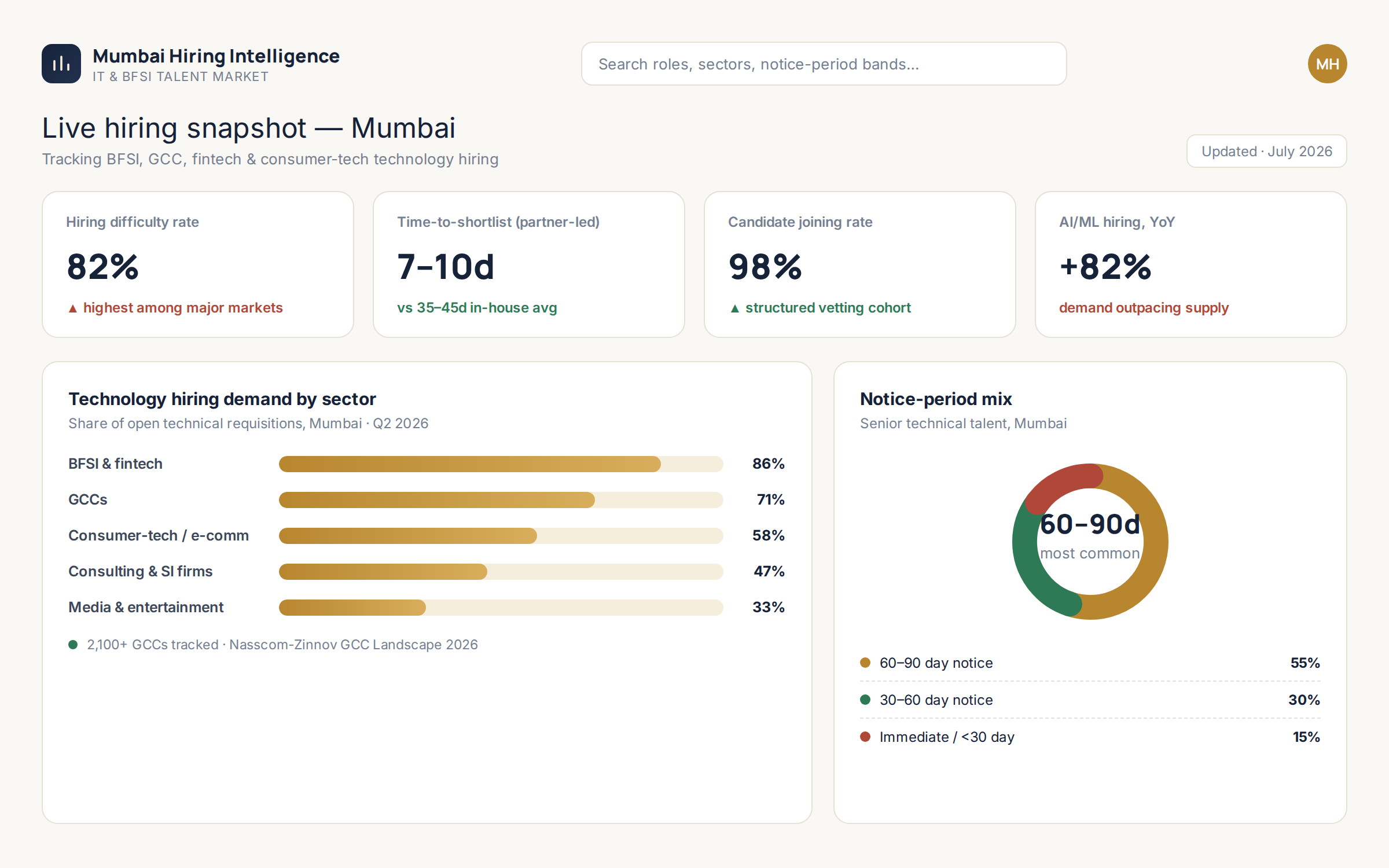
Unlike pure startup hubs, Mumbai’s hiring market rewards domain fluency over raw technical breadth. An engineer who has only ever built for consumer apps will often stumble in a first BFSI technical round not because they lack skill, but because compliance, audit trails, and uptime guarantees change how “good code” is judged. This is precisely why generalist sourcing underperforms here and why IT recruitment agencies in Mumbai built around domain-specific screening consistently outperform broad-spectrum agencies on joining rate and retention.
IT staffing firms operating in this market typically support four engagement types: permanent technology hiring, contract and contract-to-hire staffing, project-based and short-term teams, and RPO for enterprises and GCCs running high-volume hiring programs. Most companies end up needing more than one of these across a single year, which is why partner flexibility, not just partner size matters when you’re shortlisting vendors.
What Is IT Staffing, and What It Gets Confused With
IT staffing is the practice of sourcing pre-vetted technology professionals for a client company on a contract, contract-to-hire, or permanent basis, with the staffing firm handling sourcing, screening, and often payroll or compliance for the duration of the engagement.
It is frequently confused with three adjacent services:
- Executive search / headhunting focused on senior, often confidential leadership mandates, not high-volume or mid-level technical hiring.
- Recruitment Process Outsourcing (RPO) the staffing firm embeds inside your hiring function and runs your entire recruitment process, not just individual req fulfilment.
- Staffing marketplaces / freelance platforms self-serve platforms with little to no screening, vetting, or accountability if a hire doesn’t work out.
Most Mumbai enterprises actually need a blend: contract staffing for short-term scale, RPO for high-volume GCC ramp-ups, and permanent placement for core leadership roles.
Why This Decision Matters: The Business Case
The choice of staffing partner is not an HR line item it directly affects delivery timelines, burn rate, and technical risk. Concrete outcomes at stake:
- Speed: A structured staffing partner can compress a 35–45 day national average time-to-hire down to a 7–10 working day shortlist-to-interview cycle for well-defined roles.
- Cost of a bad hire: Replacing a mid-level engineer who doesn’t work out typically costs 1.5–2x their annual CTC once you factor in lost productivity, re-hiring, and ramp-up time.
- Compliance exposure: BFSI and fintech roles carry regulatory and data-security obligations; a staffing partner without domain screening can pass through candidates who fail background or compliance checks late in the process.
- Retention: Firms with structured vetting report candidate joining rates in the 95%+ range and drop-off on contract roles under 1–2%, versus industry-wide offer-decline rates that can run considerably higher for senior technical roles.
- Talent scarcity premium: With India’s AI/ML hiring up roughly 82% year-on-year among Indian MNCs as of early 2026, competition for the same narrow pool of qualified candidates is intensifying, making sourcing speed and reach a genuine competitive advantage rather than a convenience.
- Hidden internal cost: In-house recruiters juggling technical roles alongside general hiring typically spend 15–25 hours per technical requisition on sourcing and first-round screening alone hours that a specialized staffing partner absorbs, freeing internal teams to focus on final-round decisions rather than resume triage.
- Budget predictability: Fixed monthly billing or percentage-of-CTC fee structures make staffing costs easier to forecast against a hiring budget than the variable, often invisible cost of prolonged in-house search (extended job-board spend, recruiter overtime, delayed project start dates).
None of this is abstract. Every week a critical engineering seat sits open and has direct, measurable cost delayed feature releases, overworked existing teams, and in BFSI/fintech specifically, sometimes delayed regulatory or audit deliverables. The right staffing partner turns hiring from a recurring fire drill into a predictable, repeatable process.
The Core Problem Most Buyers Face
Most companies underestimate what “hiring in Mumbai” actually requires. Common failure patterns:
- Timelines slip 2–3x because the job description was written by engineering but never validated against actual market salary bands, so no qualified candidate accepts the offer.
- Costs balloon when a company runs recruitment in-house without market-rate benchmarking, ending up 20–30% over budget on senior BFSI/fintech roles simply from bidding against better-informed staffing partners.
- Vetting gaps surface post-joining a candidate who looks strong on a resume and clears a generic technical round turns out to lack the specific domain exposure (real-time payments, trading systems, regulatory reporting) the role actually required.
- Compliance and IP exposure contract hires brought on without clear NDA, IP assignment, and payroll compliance terms create legal and audit risk months later, particularly for GCCs subject to global parent-company data policies.
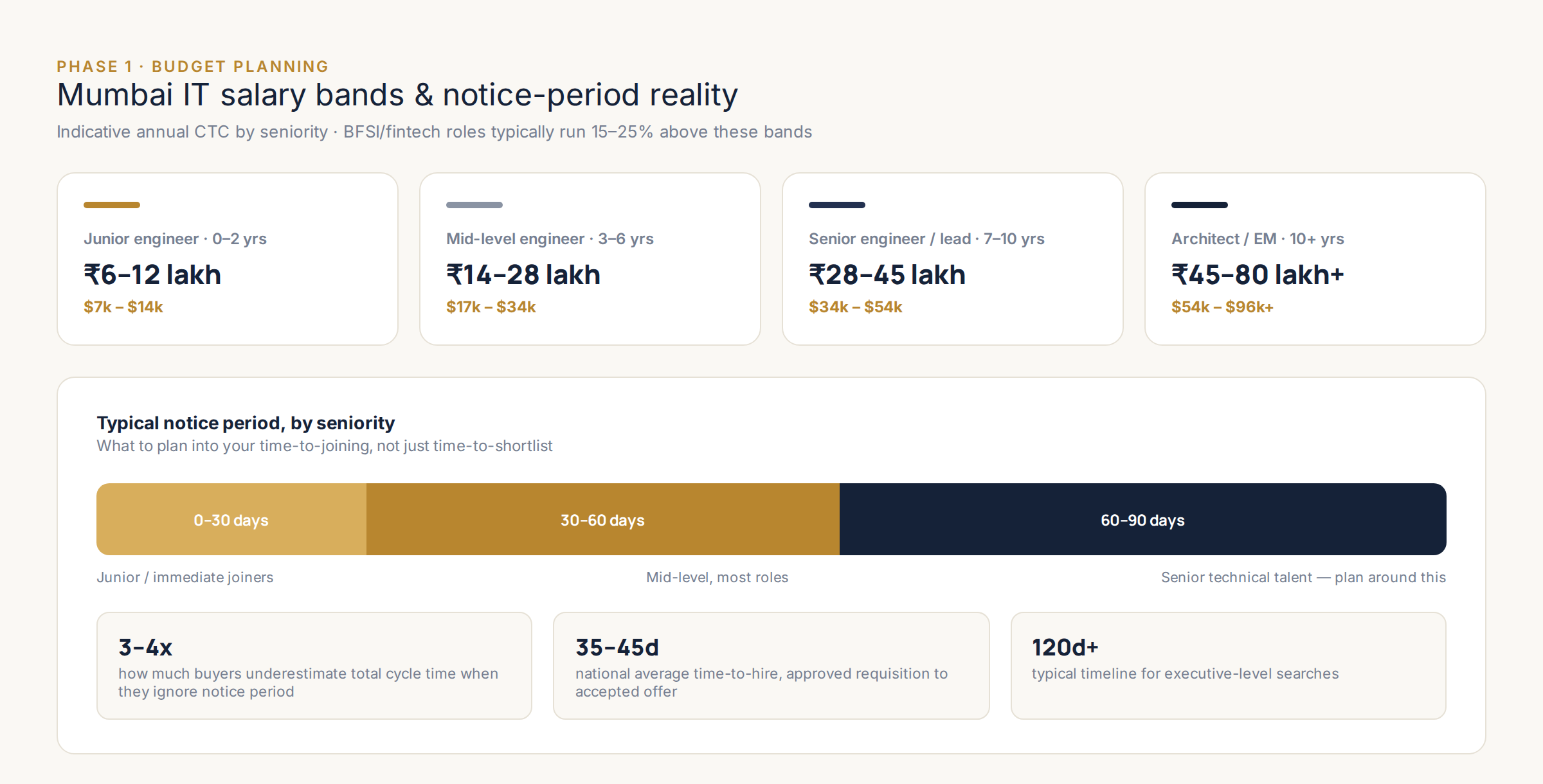
- Notice period mismatch Mumbai’s senior technical talent pool typically serves 60–90 day notice periods; buyers who don’t plan around this consistently blow through their own hiring deadlines.
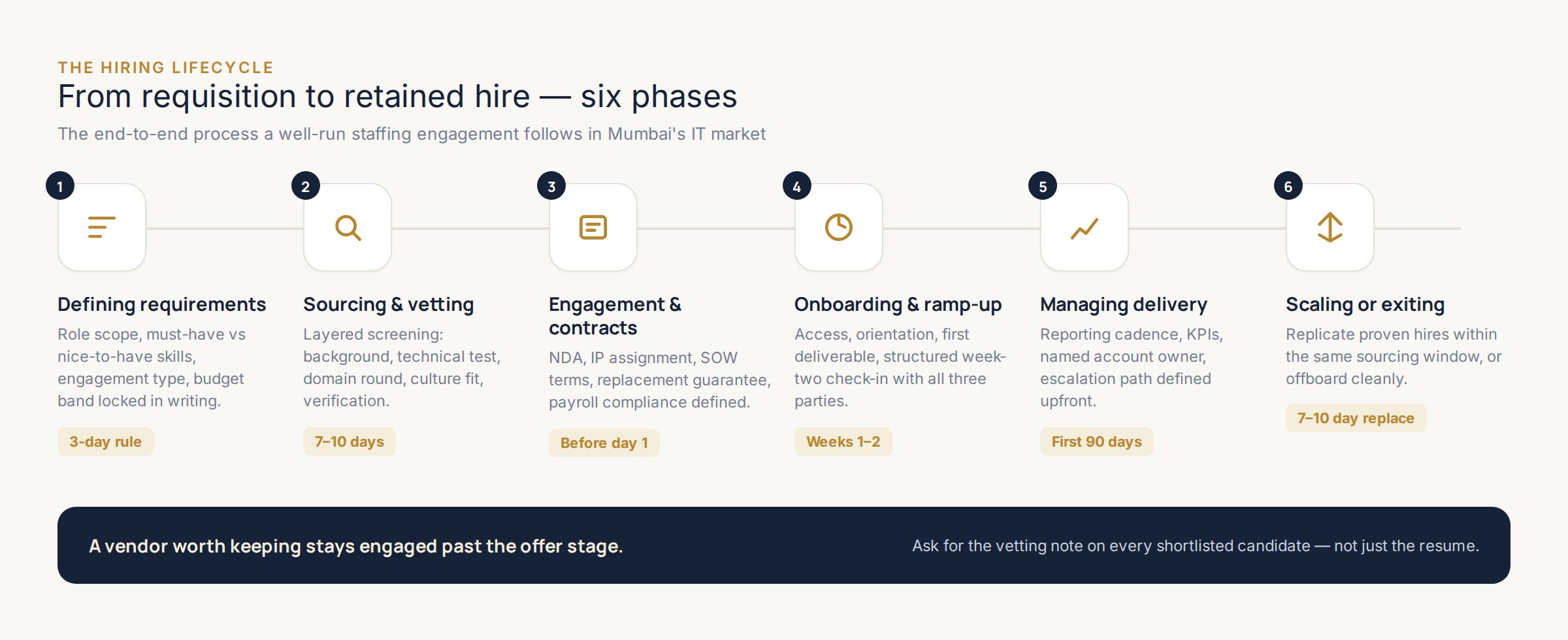
Most teams underestimate the total cycle time by 3–4x when they plan purely off “days to shortlist” and ignore everything downstream of it, offering negotiation, background verification, notice period, and onboarding.
A staffing partner’s real value isn’t just faster sourcing; it’s owning the entire pipeline so none of those downstream stages become a surprise. According to India-wide 2026 recruitment data, the national average time-to-hire sits around 35–45 days from approved requisition to accepted offer, climbing to 50–70 days for senior AI/ML, cybersecurity, or niche technical roles, and beyond 120 days for executive searches.
Buyers who benchmark their own hiring plans against these ranges rather than against best-case anecdotes build far more realistic project timelines.
Top IT Staffing Companies in Mumbai
1. Supersourcing Best IT Staffing Company in Mumbai
Supersourcing is built specifically around the problem above: AI-powered sourcing that surfaces the top 2% of a pre-vetted talent pool, with a typical hiring cycle of 7–10 working days from job description to interview-ready shortlist. The firm’s model is engineered for BFSI platforms, fintech products, enterprise systems, and offshore/GCC development teams, the exact profile of role that stalls in Mumbai’s tighter general hiring market.
- Founded: 2014
- Core services: Contract staffing, contract-to-hire, permanent IT staffing, RPO, GCC setup, custom software development
- Track record: 527+ IT projects delivered, 98% candidate joining rate, under 1% candidate drop-off on contract roles, 8.5 NPS
- Engagement model: No shared bandwidth, dedicated account managers, NDA-backed IP protection, replacement guarantee within 7–10 days
- Recognition: LinkedIn Top 20 Startup (2023 & 2024); Google for Startups AI Accelerator (2024)
- Client base: Includes Swiggy, Paytm, OkCredit, Dunzo, Chargebee, Razorpay, Yellow.ai, Adani, Apollo Hospitals, Brillio, Open Money, and Somnoware
- Why it stands out in Mumbai: Domain-aligned sourcing for BFSI and fintech specifically, fast turnaround, and a scalable model used across 1,000+ companies.
2. TeamLease Services
A strong fit for large enterprises with high-volume, compliance-heavy staffing needs.
- Founded: 2002
- Core services: Temporary staffing, permanent recruitment
- Specialties: Workforce management, high-volume IT hiring
- Industry focus: IT, BFSI, telecom, public sector
- Highlight: Strong statutory compliance framework and nationwide reach.
3. Adecco India
Global recruitment methodology applied to Mumbai’s enterprise and BFSI hiring market.
- Founded: 1999 (India operations)
- Core services: Permanent and contract staffing, RPO
- Specialties: Software engineering, IT consulting, cybersecurity
- Industry focus: BFSI, IT services, telecom, manufacturing
- Highlight: Data-driven recruitment backed by global best practices.
4. Randstad India
Positioned for mid-to-senior technology roles where retention matters as much as speed.
- Founded: 2008 (India operations)
- Core services: Contract and permanent IT staffing
- Specialties: Cloud, data engineering, DevOps
- Industry focus: Enterprise IT, SaaS, finance
- Highlight: Strong emphasis on skill-and-culture matching for retention.
5. Quess Corp
Built for scale, large, multi-role staffing programs run with operational discipline.
- Founded: 2007
- Core services: Contract and permanent staffing, workforce management
- Specialties: High-volume and agile hiring
- Industry focus: IT, BFSI, telecom, manufacturing
- Highlight: Technology-enabled recruitment operations at scale.
6. ABC Consultants
India’s most established name in leadership and specialized technology search.
- Founded: 1969
- Core services: Executive search, IT staffing
- Specialties: Enterprise IT, cybersecurity, digital leadership
- Industry focus: Technology, consulting, enterprises
- Highlight: Decades of domain depth for senior and leadership mandates.
7. Kelly Services
A long-established global staffing brand with tailored technical hiring in Mumbai.
- Founded: Global since 1946; 20+ years in India
- Core services: Contract and permanent IT staffing
- Specialties: Cloud, infrastructure, software engineering
- Industry focus: IT, healthcare, engineering
- Highlight: Strong candidate vetting and relationship-driven hiring.
8. Ciel HR
A fast-growing firm built around speed without sacrificing precision.
- Founded: 2015
- Core services: Permanent and contractual IT staffing
- Specialties: Software development, cybersecurity, project management
- Industry focus: IT services, fintech, e-commerce
- Highlight: Speed-focused hiring with a strong accuracy track record.
9. Sutra HR
The go-to for startup and product-company hiring in newer tech stacks.
- Founded: 2008
- Core services: Tech hiring for startups
- Specialties: AI, machine learning, blockchain
- Industry focus: Startups, product companies
- Highlight: Strong cultural alignment with startup hiring cycles.
10. ManpowerGroup India
Global scale paired with local execution for enterprise-grade staffing programs.
- Founded: Early 2000s (India operations)
- Core services: Contract and permanent IT staffing
- Specialties: Software development, IT management, data roles
- Industry focus: Enterprise IT, finance, GCCs
- Highlight: Global reach with consistent local delivery.
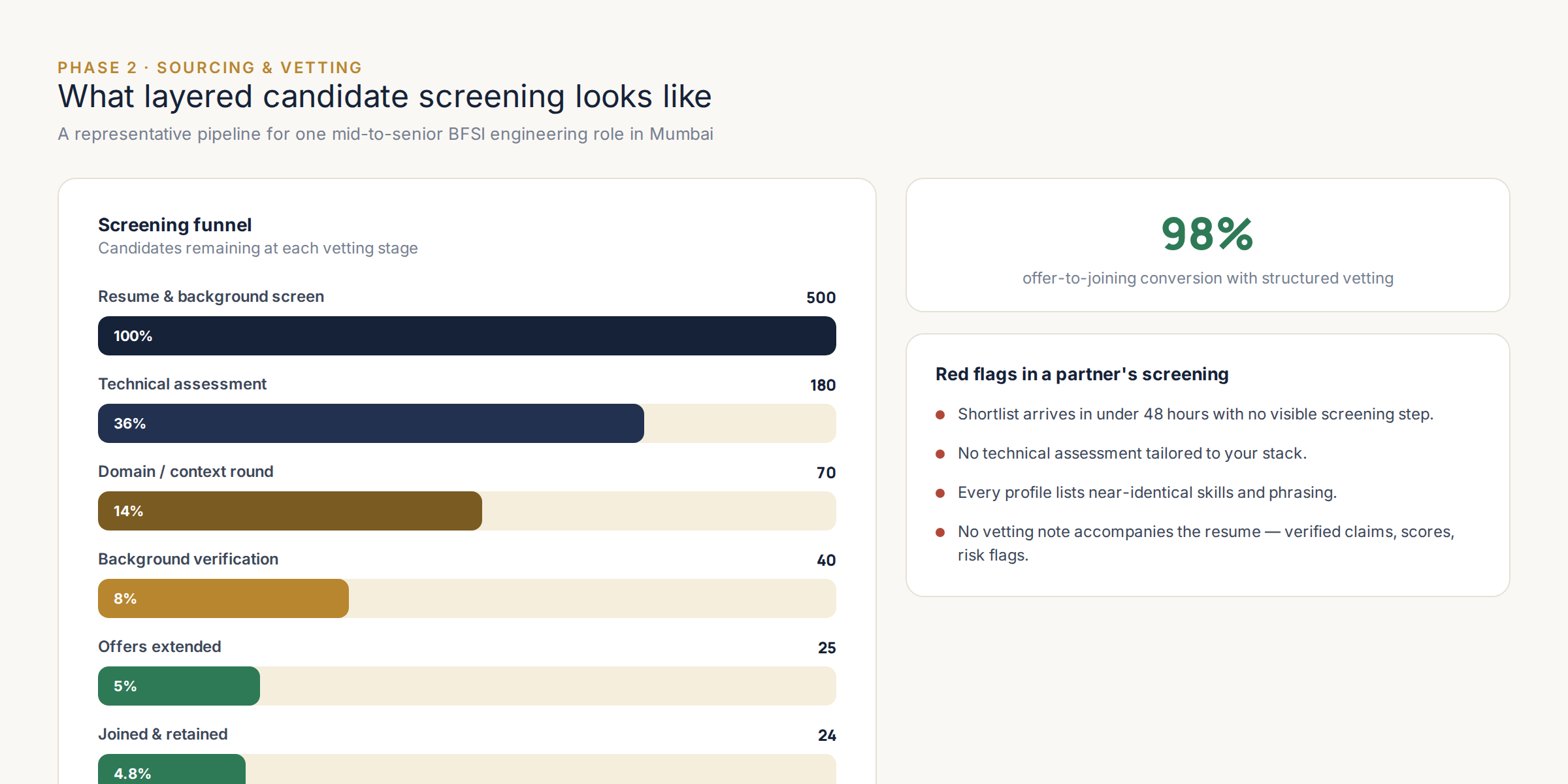
The A-to-Z Hiring Lifecycle: From Deciding You Need Help to Managing Delivery
This is the part most guides skip. Below is the full lifecycle, the same process a staffing partner should walk you through, broken into six phases so you can run it yourself or evaluate whether a vendor is doing it properly.
Phase 1 Defining Requirements
Before any sourcing starts, lock down:
- Role scope is this a build role, a maintain role, or a scale role? Each attracts a different candidate profile.
- Skill non-negotiables vs. nice-to-haves separate “must have shipped production Kafka pipelines” from “familiarity with Kafka is a plus.” Vague requirements are the single biggest cause of slow hiring.
- Engagement type contract, contract-to-hire, or permanent (see Phase 3 for how to decide).
- Timeline realistic expectation for Mumbai mid-level roles is 2–3 weeks to shortlist, 4–6 weeks to offer acceptance including notice period negotiation.
- Budget band indicative Mumbai IT salary ranges by seniority:
| Role level | Annual CTC (₹) | Approx. USD equivalent |
| Junior engineer (0–2 yrs) | ₹6–12 lakh | $7k–14k |
| Mid-level engineer (3–6 yrs) | ₹14–28 lakh | $17k–34k |
| Senior engineer / lead (7–10 yrs) | ₹28–45 lakh | $34k–54k |
| Architect / Engineering Manager (10+ yrs) | ₹45–80 lakh+ | $54k–96k+ |
BFSI and fintech roles typically sit 15–25% above these bands due to domain premium and compliance requirements.
The 3-day rule: If a hiring manager and a staffing partner cannot agree on a written role scope, skill non-negotiables, and budget band within three working days of the kickoff call, the search is almost guaranteed to slip. Ambiguity at this stage compounds at every downstream step vague requirements produce vague shortlists, which produce longer interview cycles, which push offers past the point where strong candidates have already been accepted somewhere else.
Phase 2 Sourcing & Vetting
Good screening is layered, not a single interview:
- Resume and background screen role-relevant experience, employment gaps, notice period confirmed upfront.
- Technical assessment role-specific (system design for seniors, hands-on coding tests for engineers), not generic aptitude tests.
- Domain/context round for BFSI/fintech, this is where compliance and scale exposure gets validated.
- Cultural and communication fit especially critical for contract and remote/offshore roles.
- Background verification education, employment history, and reference checks completed before offer, not after joining.
Red flags to watch for in a staffing partner’s process:
- Shortlists arrive in under 48 hours with no visible screening step usually means resumes are being forwarded unfiltered.
- No technical assessment tailored to your stack.
- Reluctance to share vetting methodology or sample scorecards.
- Every candidate on the shortlist claims the exact same skill set, phrased almost identically often a sign of resume padding rather than genuine screening.
What good screening looks like in practice: each shortlisted profile should arrive with a short vetting note, not just a resume covering what was verified, what the technical assessment scored, and any risk flags (short tenure history, notice period uncertainty, salary expectation gaps). If a partner can’t produce that note, ask for it before moving to interviews; it’s the single fastest way to judge whether real screening happened.
Phase 3 Engagement Models & Contracts
| Model | Best for | Typical duration | Who handles compliance |
| Staff augmentation | Short-term scale, specific skill gaps | 1–12 months | Staffing firm |
| Contract-to-hire | De-risking a permanent decision | 3–6 months, then convert | Staffing firm, transfers on conversion |
| Dedicated team | Sustained offshore/GCC delivery | 12+ months | Staffing firm |
| Permanent placement | Core, long-term roles | N/A direct employment | Client |
Contracts should always specify:
- NDA and IP assignment work product ownership transfers fully to the client.
- SOW/MSA terms deliverables, rate card, escalation path.
- Replacement guarantee typically 7–10 days if a placed hire isn’t a fit within an agreed window.
- Payroll and statutory compliance PF, ESIC, and tax handling responsibility clearly assigned.
Red flag: any staffing contract that is vague on who owns IP created during a contract engagement. This detail is frequently glossed over in verbal negotiations and only becomes visible as a gap when a dispute arises and it’s written into the SOW before the engagement starts, not amended afterward.
Choosing between these models is less about company size and more about certainty. If you know a role is temporary (a 6-month migration project, a compliance audit sprint), staff augmentation is cleaner than hiring permanent. If you’re unsure whether a role will still exist in a year, contract-to-hire gives you a structured off-ramp either way. If you’re building a long-term GCC delivery function, a dedicated team model gives you continuity without the administrative overhead of direct payroll in a new entity.
Phase 4 Onboarding & Ramp-Up
The first two weeks determine whether a hire ramps in 30 days or 90:
- Day 1–2: Access provisioning (systems, repos, communication tools), documentation walkthrough.
- Week 1: Codebase/architecture orientation, introduction to team rituals (standups, sprint cadence).
- Week 2: First small deliverable assigned to validate fit and surface any gaps early.
- End of Week 2: Structured check-in between hiring manager, staffing partner, and new hire.
Red flag: if a staffing partner’s involvement ends the moment the offer letter is signed, ramp-up risk shifts entirely onto your internal team. A partner worth retaining stays engaged through at least the first 30 days, checking in on fit and flagging early friction before it becomes a resignation or a performance issue.
Phase 5 Managing Delivery
Ongoing management should include:
- Reporting cadence weekly for contract/dedicated teams, monthly for permanent placements during the first 90 days.
- KPIs delivery velocity, code quality metrics, attendance/availability for contract roles.
- Account management structures a named point of contact at the staffing firm, not a rotating support queue.
- Escalation path defined in the SOW for performance issues, before they become termination decisions.
For dedicated or contract teams sourced for sustained delivery, monthly reporting should go beyond attendance and include qualitative signals of the hire asking good questions, are they blocked on access or context, is velocity trending toward the ramp-up curve the partner originally projected. A staffing partner that only reports “resource is present and billed” is providing administration, not account management.
Phase 6 Scaling or Exiting
- Adding headcount: A proven staffing partner should be able to replicate a successful hire’s profile within the same 7–10 day sourcing window.
- Replacement policy: Confirm what triggers a free replacement (performance vs. attrition) and the window (industry standard: 7–10 days from flagging the issue).
- Offboarding: Access revocation, IP handover, and knowledge transfer documentation should be defined in the original contract, not improvised at exit.
Case Studies
Scale-up hiring under deadline pressure: A fast-growing consumer platform needed dozens of engineers onboarded within a compressed hiring window to support aggressive product scale-up. The bottleneck wasn’t candidate availability, it was screening throughput; internal recruiters simply couldn’t run enough qualified technical rounds per week to hit the deadline. Structured sourcing paired with parallel-track screening (multiple candidates moving through technical and domain rounds simultaneously rather than sequentially) compressed what would typically be a multi-month hiring cycle into a matter of weeks, without lowering the technical bar on any individual hire.
Fintech engineering hiring: A digital payments and lending platform needed engineers who understood both software craftsmanship and financial compliance context, a combination generalist sourcing consistently misses, because standard technical interviews don’t probe for regulatory or transaction-integrity awareness. Adding a dedicated domain/context vetting round ahead of the final technical interview filtered for this combination directly, which measurably cut down the number of late-stage technical-round rejections that had previously been eating into the hiring timeline.
Recruitment automation for a healthtech platform: A healthcare-technology company needed to reduce manual recruiter effort across a high volume of technical requisitions without compromising candidate quality. AI-assisted shortlisting surfacing only the top percentile of applicants against role-specific criteria rather than keyword-matching resumes reduced the manual screening workload substantially while holding joining-rate quality steady, freeing internal recruiters to spend their time on final-round conversations instead of resume triage.
Across all three patterns, the common thread isn’t a single silver-bullet tool; it’s a structured process: clear role definition upfront, parallel or domain-specific screening, and a partner that stays accountable past the offer stage.
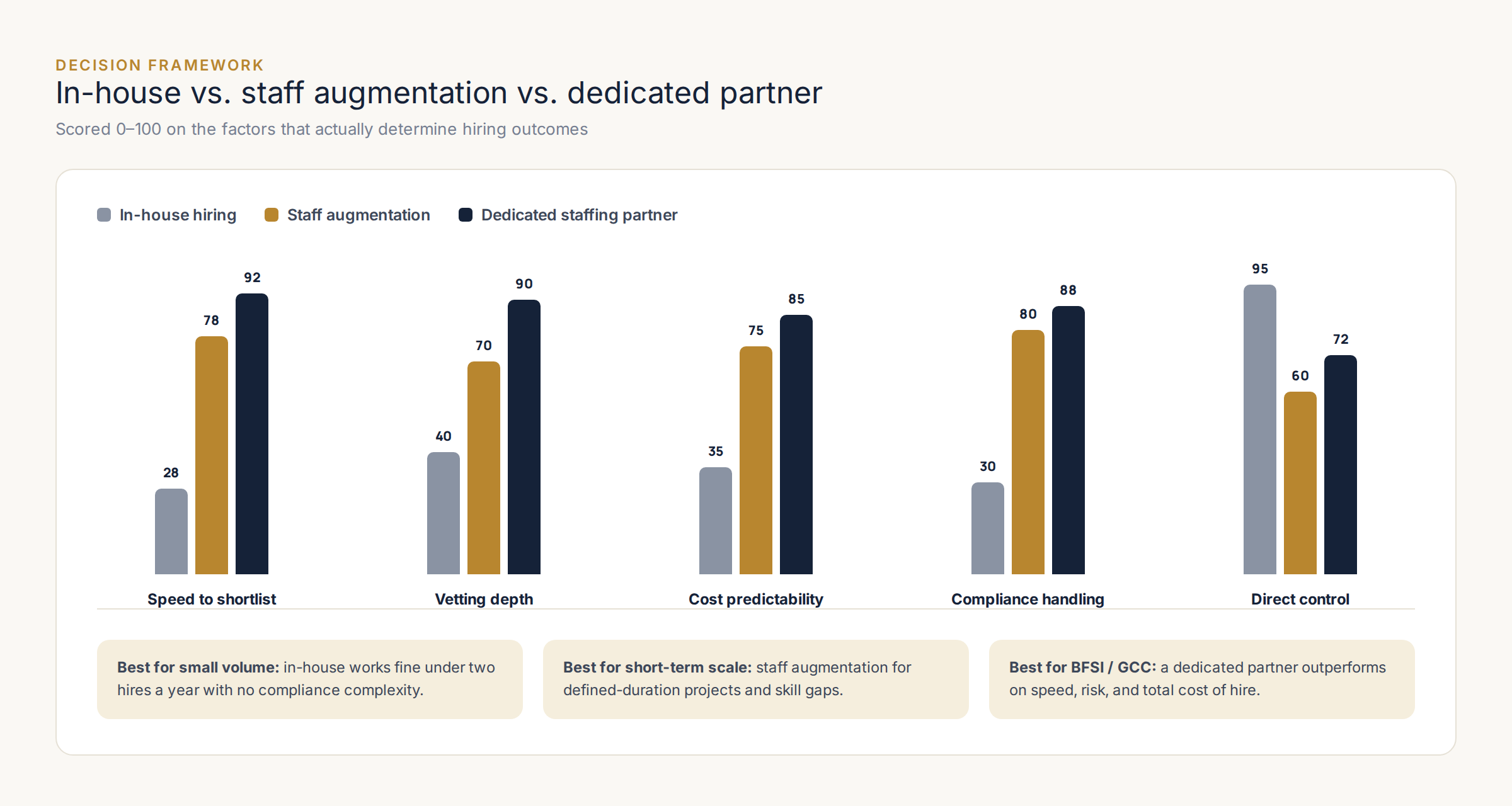
Comparison / Decision Framework
| Factor | In-house hiring | Freelance platforms | Staff augmentation | Dedicated staffing partner |
| Speed | Slow (35–45+ days) | Fast but inconsistent | Fast (7–10 days for shortlist) | Fast (7–10 days for shortlist) |
| Vetting depth | Variable | Minimal | Structured | Structured, domain-specific |
| Cost predictability | Low (hidden recruiter time cost) | Low upfront, high risk cost | Predictable | Predictable |
| Compliance handling | Internal burden | None | Handled by firm | Handled by firm |
| Control over delivery | Full | Low | High | High, with account management |
| Best for | Small, infrequent hiring | One-off, low-risk tasks | Short-term scale-ups | Sustained BFSI/GCC/fintech hiring |
Quick framework: If you’re hiring fewer than 2 roles a year with no compliance complexity, in-house may suffice. If you’re hiring against a deadline, in a regulated domain, or scaling a GCC, a dedicated staffing partner consistently outperforms on speed, risk, and total cost.
A useful gut-check when a vendor pitch starts sounding better than reality allows: ask what happens on their worst-case placement, not their best one. Every credible staffing partner has had a hire that didn’t work out. What separates a strong partner from a weak one is how fast they surfaced the problem, what the replacement process looked like, and whether the client ended up better or worse off for having used them. A vendor who only talks about success stories, with no honest account of how they handle a miss, hasn’t been tested enough to trust with a critical hire.
What Most Teams Get Wrong
- They optimize for the lowest fee, not lowest total cost. A cheaper staffing markup that delivers a 60% joining rate costs more in re-hiring than a premium partner with a 95%+ joining rate.
- They skip domain-specific vetting for “generalist” technical roles. A backend engineer for a trading platform is not the same hire as a backend engineer for a content app treating them the same is the most common source of post-joining mismatch.
- They negotiate rate cards before scope. Locking pricing before requirements are fully defined leads to scope creep disputes mid-engagement.
- They underestimate notice periods. Senior Mumbai technical talent commonly serves 60–90 day notice periods; hiring plans built around 30-day assumptions consistently slip.
- They treat replacement guarantees as boilerplate. The actual trigger conditions and window length vary significantly between vendors and are worth negotiating explicitly, not assuming.
- They evaluate a staffing partner only on the first hire. One good placement doesn’t confirm a repeatable process; ask for evidence of consistency across multiple roles and multiple quarters before committing to a long-term relationship.
- They don’t separate “hard to find” from “poorly defined.” A role that’s genuinely staying open for 60+ days because the skill is scarce needs a different strategy (wider sourcing, relocation support, upskilling an adjacent candidate) than a role that’s stuck because the job description itself is unclear. Conflating the two wastes months.
Red flag worth repeating: if a staffing partner never pushes back on an unrealistic budget or timeline, they’re optimizing for winning the mandate, not for delivering the hire. The partners worth keeping are the ones willing to tell you when a request needs adjusting before they start sourcing.
Cost & Timeline Reality Check
Typical staffing fee structures:
- Contract/staff augmentation: billed monthly per resource, typically inclusive of sourcing, payroll, and compliance.
- Permanent placement: one-time fee, commonly a percentage of the candidate’s annual CTC.
- RPO: retainer or per-hire pricing depending on volume commitment.
Realistic timelines by scenario:
| Scenario | Typical timeline |
| Single mid-level engineer, well-defined role | 7–10 working days to shortlist, 3–4 weeks to joining |
| Senior/architect role | 2–3 weeks to shortlist, 6–8 weeks to joining (notice period-dependent) |
| GCC ramp-up (20+ roles) | 6–10 weeks for full team onboarding, phased |
| BFSI compliance-heavy role | Add 1–2 weeks for background verification and compliance checks |
What drives cost up: narrow niche skills (e.g., real-time trading systems), compressed deadlines requiring premium sourcing effort, and senior/leadership mandates. What drives cost down: well-defined requirements upfront, flexibility on engagement model (contract vs. permanent), and batching multiple similar roles into one sourcing cycle.
A note on hidden costs: the cheapest-looking rate card isn’t automatically the lowest total cost. Factor in the cost of a failed hire, lost ramp-up time, re-sourcing, team disruption against the fee difference between vendors. A partner charging a modestly higher fee but delivering a 95%+ joining rate typically works out cheaper over a year of hiring than a lower-fee vendor with a 70% joining rate, once re-hiring cycles are accounted for.
It’s also worth planning hiring budgets with some seasonal awareness. Indian white-collar hiring activity, per Naukri’s JobSpeak index, tends to build through the first half of the fiscal year as companies commit annual headcount budgets, meaning sourcing can take slightly longer in that window simply due to higher overall market demand for the same talent pool. Building a small buffer into early-fiscal-year hiring plans avoids mistaking a seasonal slowdown for a partner performance issue.
Benefits of Partnering With an IT Staffing Firm in Mumbai
Pulling the guide’s threads together, the concrete, recurring benefits of working with a specialized partner rather than running search entirely in-house are:
- Faster access to domain-aligned talent sourcing that’s already filtered for BFSI, fintech, or GCC context rather than generic technical fit.
- Reduced hiring risk and cost overruns structured vetting and replacement guarantees limit the downside of a mis-hire.
- Flexibility across contract and permanent hiring the ability to scale a team up for a project and convert or wind down without renegotiating a new vendor relationship each time.
- Support for offshore, remote, and GCC teams compliance, payroll, and IP handling managed by a partner already familiar with cross-border and regulatory requirements.
- Improved outcomes on critical roles measurable in joining rate, drop-off rate, and time-to-productivity rather than just time-to-hire.
Choosing the Right Partner: What to Do Next
If you’re mid-decision, the fastest way to validate a shortlist of staffing partners is to send the same role brief to two or three firms and compare: time to first shortlist, depth of the vetting notes that come back with each candidate, and clarity of their contract terms on replacement guarantees and IP assignment. The partner that answers all three clearly, without vague language, is usually the one that will perform once the engagement starts.
If you’re actively hiring for BFSI, fintech, or a GCC build-out in Mumbai and want a shortlist within days rather than weeks, you can share your requirements here: https://supersourcing.com/contact-us/
Frequently Asked Questions
Which are the best IT staffing companies in Mumbai?
Leading options include Supersourcing, TeamLease Services, Adecco India, Randstad India, and Quess Corp, each with different strengths across BFSI hiring, high-volume staffing, and enterprise-scale programs.
How much do IT staffing agencies in Mumbai charge?
Pricing typically follows either a monthly billing model for contract resources (inclusive of compliance and payroll) or a percentage-of-CTC fee for permanent placements. Rates vary by role seniority and domain complexity, so request a rate card tied to your specific requirements.
How long does IT recruitment take in Mumbai with a staffing partner?
Well-defined mid-level roles typically move from job description to interview-ready shortlist in 7–10 working days, with total time-to-joining of 3–6 weeks depending on the candidate’s notice period.
Can IT staffing agencies in Mumbai support BFSI-focused hiring?
Yes. Firms with dedicated BFSI/fintech vetting tracks screen specifically for compliance, security, and scale exposure that generalist technical rounds typically miss.
What is the difference between staff augmentation and RPO?
Staff augmentation adds individual contractors to your existing team under your management. RPO hands the staffing firm ownership of your recruitment process end-to-end, typically for high-volume or sustained hiring programs.
Do staffing companies in Mumbai offer replacement guarantees?
Most established firms do, typically within a 7–10 day window if a placed candidate isn’t performing as expected. Confirm the exact trigger conditions in the contract before signing.
What should a Mumbai-based startup look for in a staffing partner?
Speed of shortlist delivery, flexibility on engagement model, transparent pricing, and for regulated-sector startups evidence of domain-specific vetting rather than generic technical screening.
Do IT staffing firms in Mumbai help with GCC setup?
Some do. GCC setup requires staffing partners who can handle bulk hiring, compliance, and often entity-structuring guidance worth confirming this is a core service line, not an occasional add-on, before committing to a partner for a GCC build-out.
