

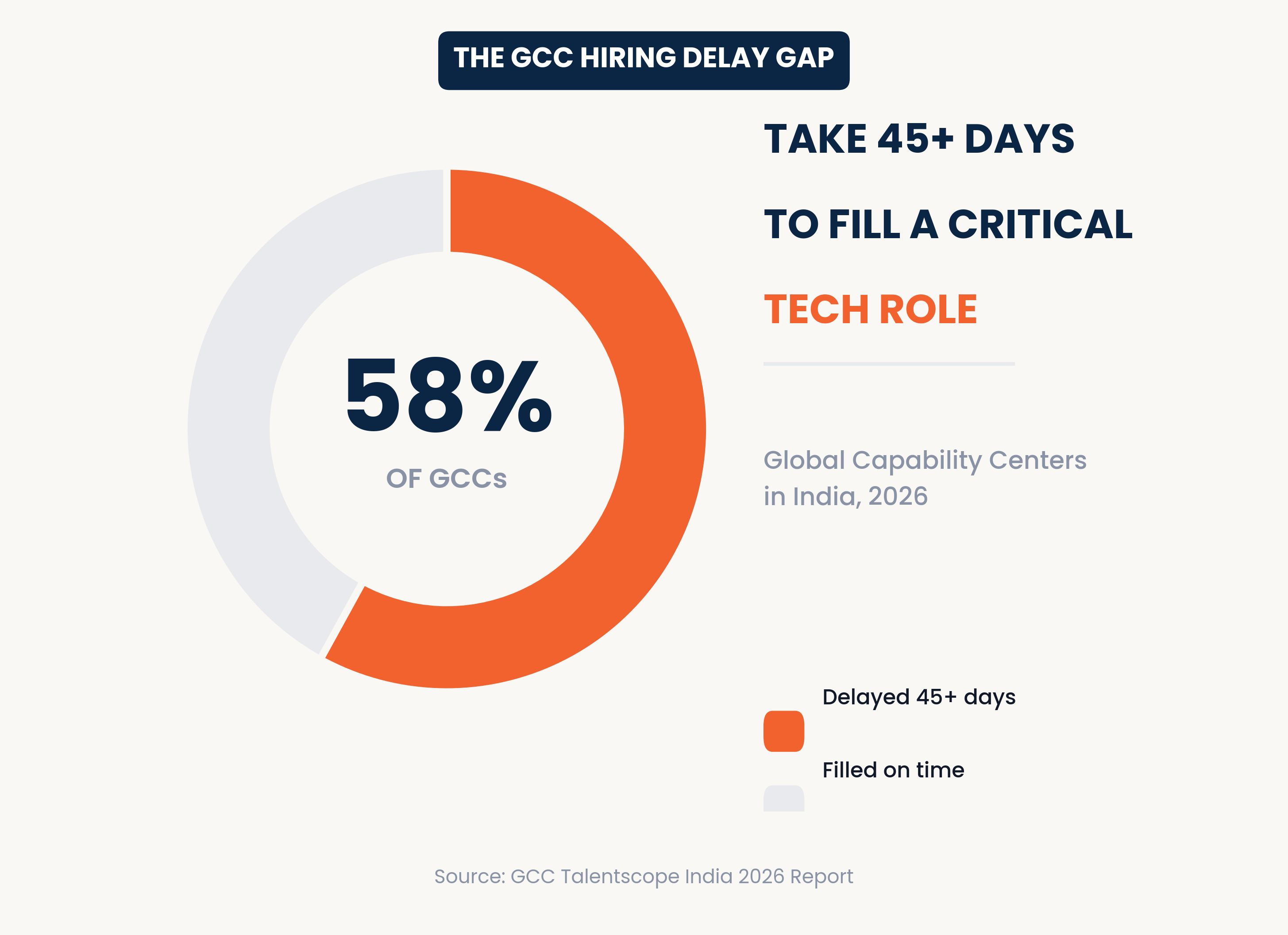
More than 58% of Global Capability Centers in India now take longer than 45 days to fill a critical technical role, according to the GCC Talentscope India 2026 report. For a hiring manager in Gurgaon or Noida trying to stand up an AI engineering pod or backfill a senior data role before the quarter closes, that number is the difference between hitting a roadmap and missing one.
Delhi NCR isn’t a single hiring market, it’s three overlapping ones. Gurgaon pulls consulting, BFSI, and enterprise-software talent. Noida holds deep product-engineering benches around HCL, Adobe, and Samsung’s Sector 62-63 corridor. South and Central Delhi carry boutique consulting and design talent. A staffing partner that works well in one pocket can underperform badly in another, which is why “best IT staffing companies in Delhi NCR” is a more complicated question than a ranked logo list can answer.
Hiring delays are becoming a critical bottleneck for global teams scaling engineering talent. A recent report highlights that 58% of Global Capability Centers (GCCs) take more than 45 days to fill critical tech roles, signaling a widening gap between demand and available talent. This growing delay underscores why companies are rethinking traditional hiring models and turning to faster, more flexible solutions.
The region now hosts roughly 270 Global Capability Centers, accounting for 15-18% of India’s total GCC ecosystem making NCR one of the country’s three largest GCC hubs, according to Flexiple’s 2026 GCC tracking data. That density is exactly why hiring here has gotten both more competitive and more specialized: startups, GCCs, and consulting majors are often bidding for the same senior engineers within a five-kilometer radius of Cyber City.
This guide is built to answer the question fully not with a static directory, but with the mechanics: what IT recruitment agencies in Delhi NCR actually do differently, how to define a role so a vendor can source against it correctly, what a fair contract looks like, what things cost by seniority band, and what almost every first-time buyer gets wrong. Read it end to end and you should be able to run the entire hiring process yourself, whether you use a vendor or not.
What Is IT Staffing?
IT staffing is the process of sourcing, vetting, and deploying technology professionals through contract, contract-to-hire, or permanent placement for companies operating across Delhi, Gurgaon, and Noida, typically managed by specialized recruitment agencies with local delivery networks and pre-vetted talent pools.
IT staffing is not the same as:
- General recruitment agencies, which often work across all industries and lack deep technical screening capability for specialized roles like MLOps or platform engineering.
- Job portals or freelance marketplaces, which surface candidates but leave sourcing, vetting, compliance, and replacement risk entirely with the hiring company.
- Full project outsourcing, where a vendor owns delivery of a defined scope of work rather than supplying individual professionals who work inside your team and processes.
Why It Matters: The Business Case for Getting This Right
Choosing the wrong hiring model or the wrong partner in Delhi NCR isn’t a minor inefficiency it compounds across cost, speed, and risk:
- Cost of a bad hire. Industry estimates commonly put the fully loaded cost of a failed technical hire (recruiting spend, onboarding time, lost productivity, and re-hiring) at 1.5x to 2x the role’s annual cost, before counting the delay to the roadmap.
- Speed to productivity. A staff-augmentation or contract hire sourced through a specialized IT staffing partner can typically be interview-ready in 7-10 working days, versus 6-10 weeks for a from-scratch internal search for a niche skill.
- Compliance exposure. Companies that manage contract talent directly, without PF, ESI, and labor-law compliance handled by a staffing partner or Employer of Record, carry direct liability if a contractor is later found to be misclassified.
- Attrition-driven cost creep. GCCs and enterprises with weak screening processes report contract candidate drop-off rates of 8-15% in the first 90 days, each one restarting the sourcing clock.
- Scale bottlenecks. Companies scaling a GCC or engineering pod from 10 to 50 people inside two quarters routinely underestimate the parallel sourcing capacity required; a single internal recruiter can typically run 4-6 active technical searches at once, not 20.
The Core Problem Most Buyers Face
The gap between what buyers expect and what actually happens is usually a timeline and quality mismatch, not a total hiring failure.
Timelines slip by 3-4x more than planned. A buyer expects a senior backend engineer role to close in two weeks. In practice, sourcing depth for niche stacks (Rust, platform engineering, MLOps) in Delhi NCR is thinner than in Bengaluru or Hyderabad, and a search that isn’t running through a partner with an existing bench can stretch to 6-8 weeks.
Screening depth is inconsistent across vendors. Many staffing firms in the region still rely on keyword-matched resumes and a single generalist interview round. This is how buyers end up with candidates who pass a resume screen but fail a live coding or system-design round, a pattern that shows up disproportionately in GCC and fintech hiring, where domain knowledge (payments, regulatory reporting, core banking) matters as much as raw coding ability.
Contracts are underspecified. Buyers frequently sign staffing agreements without clarity on IP assignment, replacement windows, or notice-period terms, and only discover the gap when a placed candidate underperforms or a contractor’s code ownership becomes ambiguous during an audit.
Post-hire management gets no attention. Most guidance on this topic stops at the offer letter. In reality, the first 90 days onboarding cadence, access provisioning, reporting rhythm determine whether a contract hire becomes a long-term asset or a 60-day churn statistic.
The A-to-Z Walkthrough: From First Decision to Long-Term Team
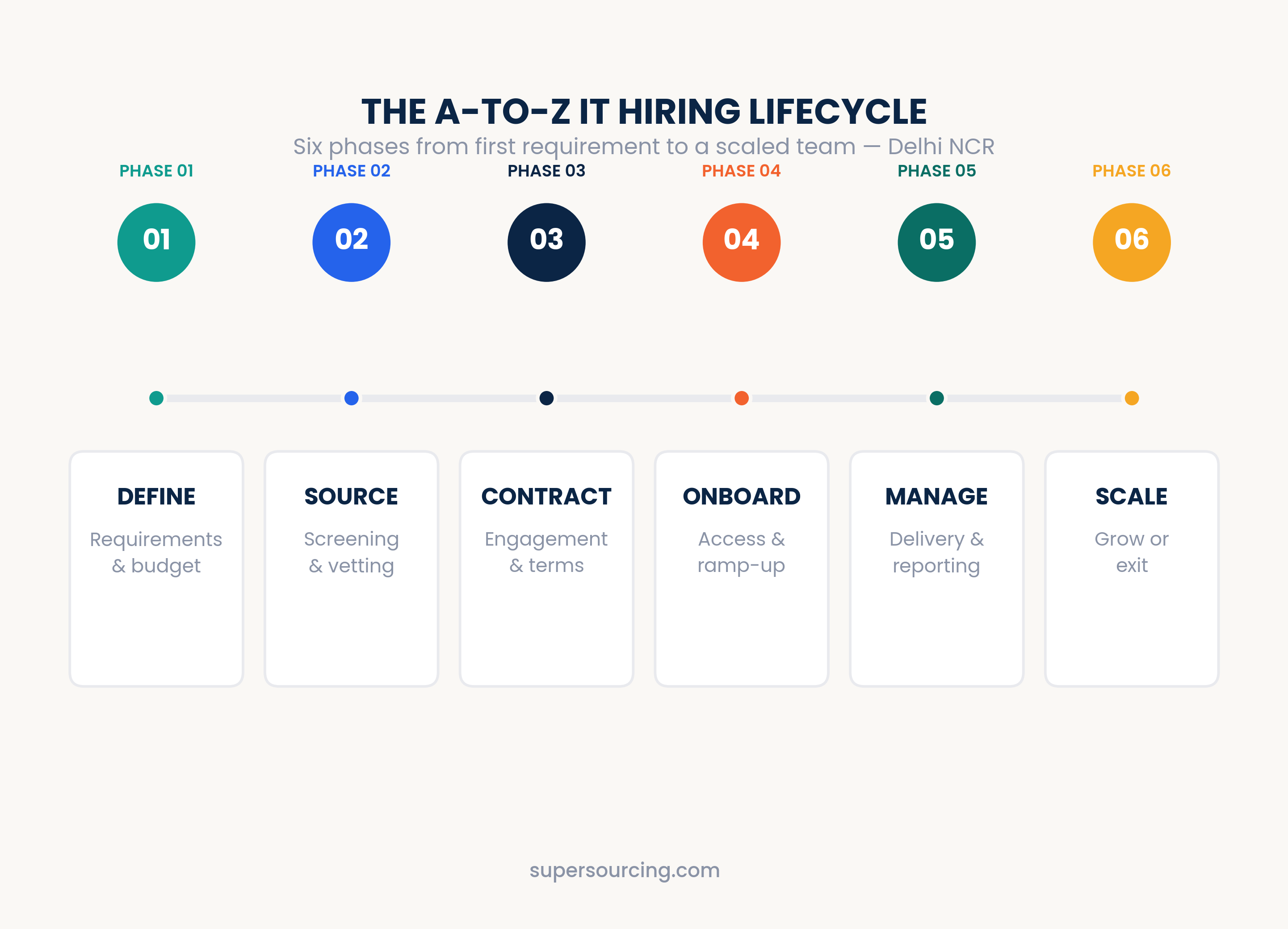
This section covers the complete lifecycle of hiring through IT staffing services in Gurgaon and Noida from defining a role to scaling or exiting an engagement. No phase is optional; skipping any one of these is where most hiring timelines actually break.
Phase 1 Defining Requirements
Before contacting any vendor, a hiring team needs a requirements document that goes beyond a job title. This is the single biggest lever on both timeline and cost.
What a complete requirement includes:
- Role title and seniority band (junior / mid / senior / lead)
- Core technical stack (languages, frameworks, cloud platform, specific tools)
- Domain context (fintech, healthtech, BFSI, e-commerce) if domain knowledge is non-negotiable
- Engagement type (contract, contract-to-hire, permanent, project-based)
- Location constraint (Gurgaon-only, Noida-only, hybrid, fully remote)
- Budget band and currency (₹ or $, monthly or annual)
- Start-date urgency and expected engagement duration
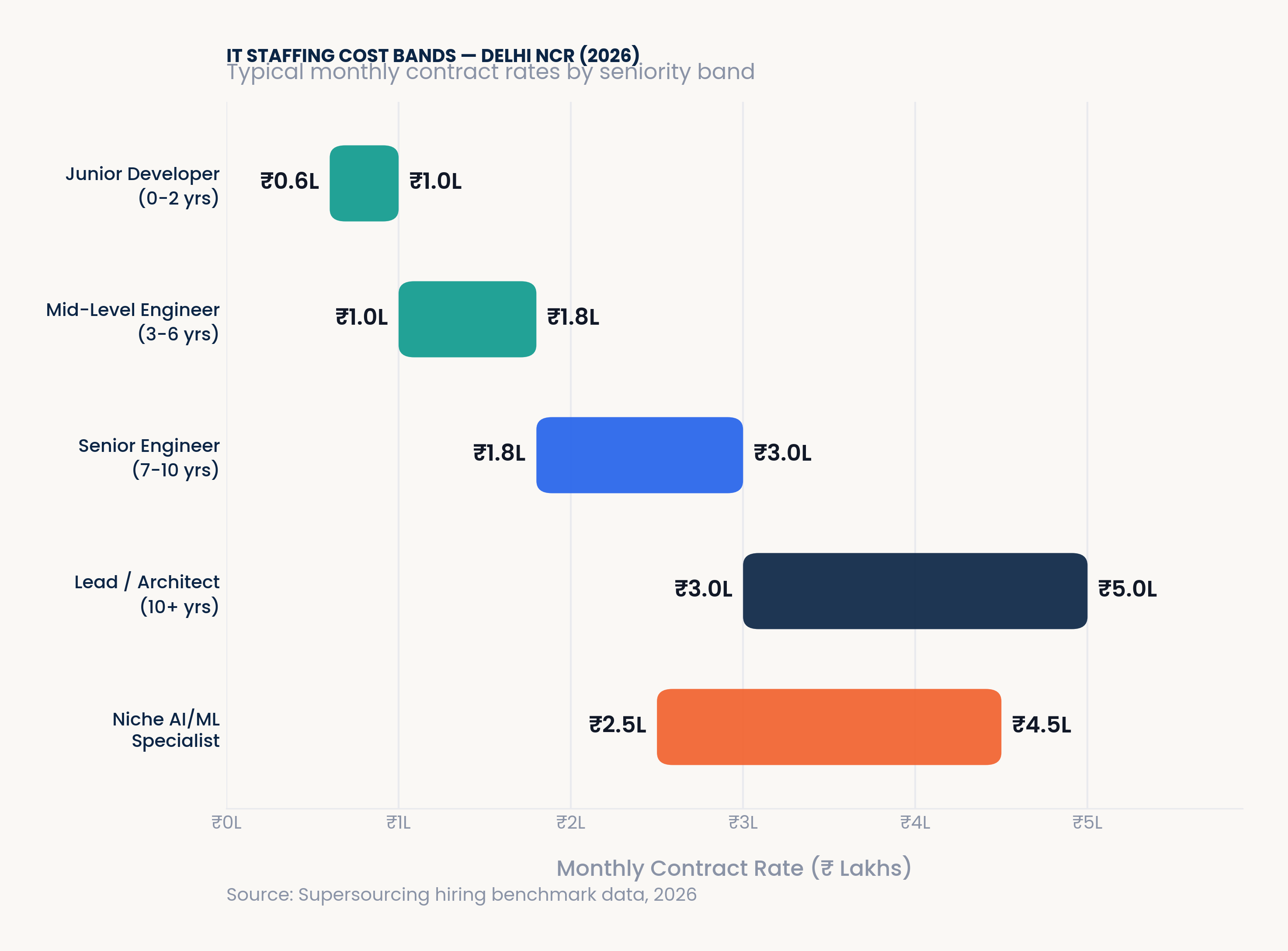
Typical budget bands for Delhi NCR technology roles (2026, monthly contract rates):
| Role Band | Typical Monthly Rate (Contract) | Typical Annual CTC (Permanent) |
| Junior developer (0-2 yrs) | ₹60,000 – ₹1,00,000 | ₹6-10 lakhs |
| Mid-level engineer (3-6 yrs) | ₹1,00,000 – ₹1,80,000 | ₹12-22 lakhs |
| Senior engineer (7-10 yrs) | ₹1,80,000 – ₹3,00,000 | ₹25-40 lakhs |
| Lead / architect (10+ yrs) | ₹3,00,000 – ₹5,00,000+ | ₹40-70 lakhs+ |
| Niche AI/ML or platform specialist | ₹2,50,000 – ₹4,50,000+ | ₹35-65 lakhs+ |
Red flag at this stage: a vendor that starts sourcing before agreeing on a written requirement. That gap is where mismatched candidates come from.
Phase 2 Sourcing and Vetting
This is where the quality of an IT recruitment agency in Delhi NCR is actually decided not in the sales pitch.
What good screening looks like:
- A technical screen conducted by someone who has actually worked in the relevant stack, not a generalist recruiter reading off a checklist
- A live coding round or system-design discussion for mid-to-senior roles, not a resume-only pass
- Domain-specific probing questions for regulated industries (e.g., asking a fintech candidate to walk through a reconciliation or settlement flow)
- Cultural and communication fit assessment, especially for roles embedded inside a client’s existing team
- Background and employment verification before an offer is extended, not after joining
Red flags to watch for in a vendor’s process:
- Shortlists arrive within 24 hours of a brief with no technical screen visible
- Candidate profiles are recycled across multiple client briefs in the same week
- No structured interview scorecard is shared alongside the shortlist
- The vendor cannot explain their source-to-shortlist ratio (a healthy ratio for a mid-to-senior technical role is typically 15-25 sourced candidates to 1 shortlisted)
AI-powered sourcing tools now let a strong vendor surface a much narrower band of pre-vetted, top-tier candidates rather than a wide, unscreened net; this is the difference between a shortlist of 5 relevant profiles and a stack of 40 resumes to sift through manually.
Phase 3 Engagement Models and Contracts
Delhi NCR buyers typically choose between four models. Each has different cost, control, and risk trade-offs.
- Contract staffing the vendor employs the professional; you direct the work. Lowest commitment, fastest to start, best for defined-duration projects.
- Contract-to-hire same as above, with a pre-agreed conversion window (commonly 3-6 months) to bring the person onto permanent payroll.
- Direct/permanent placement of the vendor sources and vets; the candidate joins your payroll directly. Higher upfront recruitment fee, no ongoing markup.
- Staff augmentation / dedicated team, a vendor-managed team embedded inside your delivery process, often used for GCC ramp-up or offshore development center (ODC) buildout.
Contract terms to insist on, regardless of model:
- Clear IP assignment clause all work product belongs to the client, not the staffing vendor or the individual contractor
- NDA coverage for both the vendor and the placed professional
- A defined replacement window if a hire isn’t a fit 7-10 working days is a reasonable industry benchmark, not 30+
- Transparent markup or fee structure (contract staffing markups in India commonly run 15-30% over base compensation; permanent placement fees commonly run 8.33%-16.67% of first-year CTC)
- Exit and notice-period terms clearly stated for both sides
Phase 4 Onboarding and Ramp-Up
The first two weeks determine whether a hire becomes productive on schedule or drags into month two before shipping anything meaningful.
A working first-two-weeks checklist:
- Access provisioning (VPN, repo access, ticketing system) ready on day one, not day five
- A named onboarding buddy or lead assigned before the start date
- Codebase or systems walkthrough scheduled in week one
- First small, shippable task assigned within the first 3-5 working days
- Communication cadence defined (daily standup, weekly 1:1, async updates) from day one
- Tooling and environment setup completed before, not during, the first week
Teams that skip structured onboarding routinely see ramp-up stretch from an expected 2-3 weeks to 6-8 weeks for the same role.
Phase 5 Managing Delivery
Once a hire or team is embedded, ongoing management determines whether the engagement holds up over 6-12 months.
Reporting cadence and KPIs that work well for contract technical talent:
- Weekly delivery check-ins against sprint or milestone goals
- Monthly account review with the staffing vendor if a dedicated account manager is part of the engagement
- Clear escalation path if performance or fit concerns arise ideally within the first 30 days, not the 90th
- A single point of contact on the vendor side, not a rotating account handler
Why a dedicated account manager matters: engagements with no shared bandwidth and a consistent point of contact see materially lower miscommunication and faster issue resolution than pooled-support models, particularly for GCC-scale engagements running 10+ contract hires in parallel.
Phase 6 Scaling or Exiting
When adding headcount:
- Reuse the Phase 1 requirements template for every new role don’t let scope drift between hires
- Ask an existing vendor for their available bench before opening a fresh search; a partner with pre-vetted talent in the pipeline can often fill a repeat role in under a week
- Set a standing monthly or quarterly hiring forecast if scaling a GCC, so sourcing capacity is planned ahead of need rather than reactive
When offboarding or ending an engagement:
- Confirm IP and access revocation timelines in writing before the last working day
- Complete a documented knowledge-transfer handover, especially for contract-to-hire conversions that didn’t proceed
- Review the replacement guarantee terms if the engagement is ending due to fit issues rather than project completion
Case Studies
Fintech scale-up hiring (Swiggy). A high-growth consumer-tech company needed to scale engineering capacity quickly across multiple product lines without slowing delivery velocity. A structured contract staffing approach sourcing against tightly defined role briefs rather than generic job postings compressed what would typically be a multi-month hiring cycle into weeks per role, while keeping technical bar consistency across a large, distributed hiring push.
Engineering hiring for a fintech platform (OkCredit). A fintech company building core lending and bookkeeping infrastructure needed engineers who understood both distributed systems and financial data integrity, not just general backend skills. Domain-specific technical screening rather than keyword-matched sourcing reduced mismatched hires and shortened time-to-productivity for new joiners.
Recruitment automation for a healthtech firm (Somnoware). A healthtech company needed to scale its technical team while maintaining strict compliance and data-handling standards typical of the sector. AI-assisted sourcing narrowed a wide candidate pool down to a small set of domain-qualified, pre-vetted profiles, cutting the manual screening load on the internal hiring team significantly.
Comparison and Decision Framework
Use this framework to decide which hiring model fits a given role, rather than defaulting to whatever a single vendor pitches first.
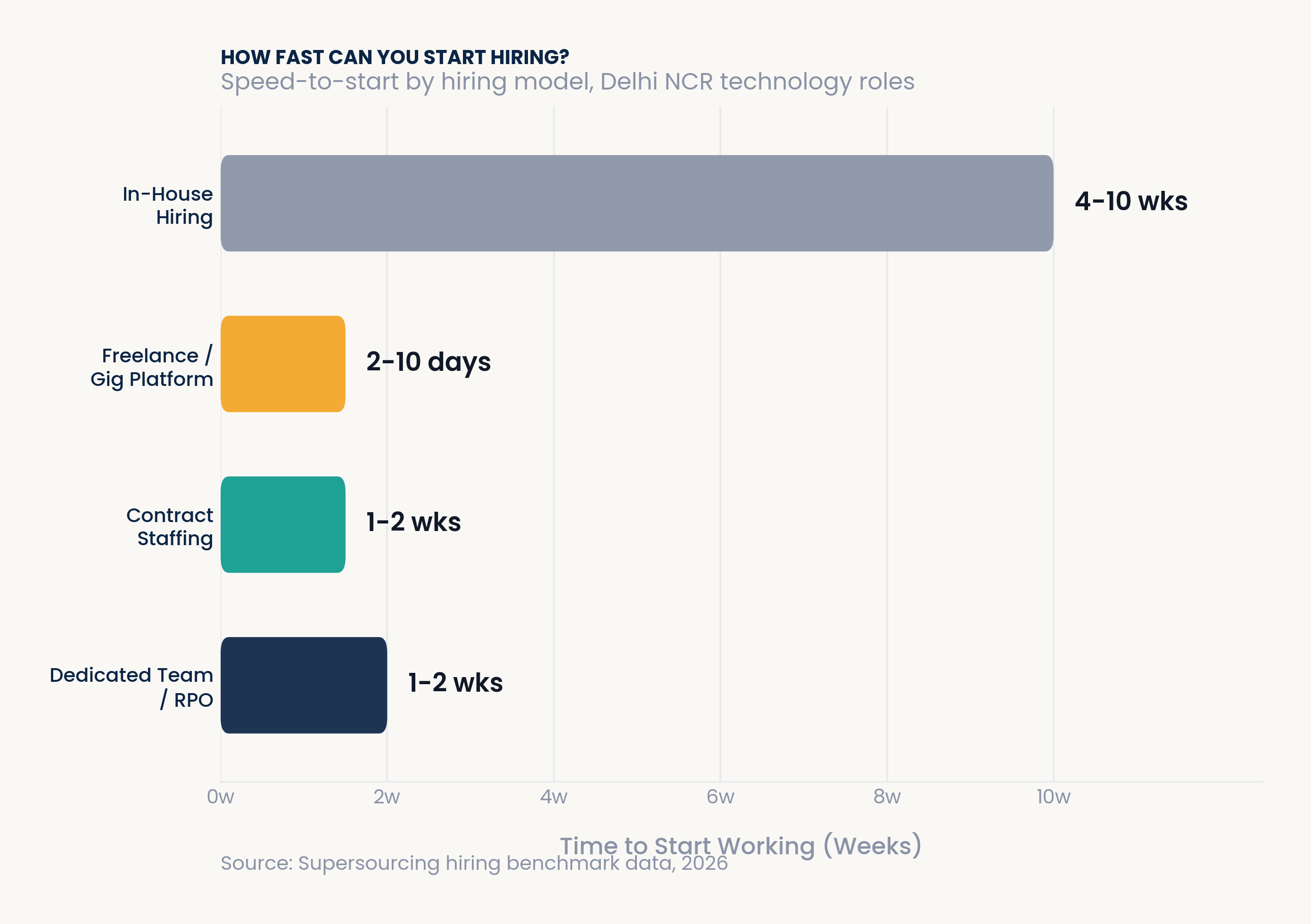
| Factor | In-House Hiring | Freelance / Gig Platform | Contract Staffing | Dedicated Team / RPO |
| Speed to start | Slow (4-10 weeks) | Fast (days) but unverified | Fast (7-10 days) | Fast (1-2 weeks for full team) |
| Screening depth | Depends entirely on internal team | Minimal, self-reported skills | High, if vendor is specialized | High, standardized process |
| Cost predictability | High fixed cost, hiring risk | Low cost, high variability | Predictable monthly rate | Predictable, scales with volume |
| Compliance handling | Fully internal responsibility | Buyer’s responsibility | Vendor-managed | Vendor-managed end-to-end |
| Control over work | Full | Limited, transactional | High, embedded in team | High, with account management |
| Best fit for | Long-term core roles | Short, narrowly scoped tasks | Scaling teams, project surges | GCC setup, large parallel hiring |
How to apply it: if the role is core to long-term IP and you have internal bandwidth to run a rigorous search, in-house hiring is often still right. If you need volume, speed, and compliance handled without building an internal recruiting bench, contract staffing or a dedicated team model through a specialized GCC hiring partner in Delhi NCR is usually the faster, lower-risk path.
What Most Teams Get Wrong
- They optimize for time-to-shortlist, not time-to-productivity. A vendor that sends five resumes in 48 hours looks impressive until three of them fail a technical round. The metric that actually matters is how fast a hire is shipping meaningful work, not how fast a name lands in an inbox.
- They treat every open role the same way. A junior React developer and a platform architect need completely different sourcing depth, interview panels, and timelines. Buyers who apply one generic process to both consistently overpay for simple roles and under-vet complex ones.
- They underestimate the cost of a mismatched vendor relationship, not just a mismatched hire. Switching staffing partners mid-scale-up because a vendor’s Gurgaon bench doesn’t translate to Noida’s engineering talent pool, for instance quietly costs more in lost momentum than most buyers budget for.
- They skip the contract details until something goes wrong. IP assignment, replacement windows, and notice terms are the least exciting part of the process and the most common source of disputes six months in.
- They don’t ask for source-to-shortlist ratios or drop-off data. A vendor unwilling to share basic screening metrics is usually one without a rigorous process behind the shortlist.
Cost and Timeline Reality Check
Cost drivers that push spend up:
- Niche or emerging skill sets (AI/ML, platform engineering, cybersecurity) command a 20-40% premium over standard full-stack roles
- Urgent (sub-two-week) timelines often carry an expedited-sourcing surcharge
- Senior and leadership-band roles require executive-search-style sourcing, not standard staffing
Cost drivers that bring spend down:
- Longer-term contract commitments (6+ months) typically unlock lower monthly markups
- Batch hiring (5+ roles at once for a GCC ramp-up) usually compresses per-role cost through economies of scale in sourcing
- Working with a vendor that already has a warm, pre-vetted bench in the required stack, avoiding a from-scratch search
Realistic timelines by scenario:
| Scenario | Realistic Timeline |
| Standard mid-level developer, common stack | 7-10 working days to interview-ready shortlist |
| Senior or niche specialist (AI/ML, platform) | 2-4 weeks |
| GCC ramp-up, 10-20 roles in parallel | 6-10 weeks for full team, phased |
| Contract-to-hire conversion decision | 3-6 months from start date |
| Executive or leadership search | 6-10 weeks |
What to Do Next
If you’re mid-decision on a hiring model for Delhi NCR comparing contract staffing against building an internal recruiting function, or trying to scope a GCC ramp-up the fastest next step is usually a structured requirements conversation, not another vendor call. Supersourcing works with enterprises, fintech platforms, and GCCs across Gurgaon and Noida on exactly this kind of scoping, with a typical 7-10 working day cycle from job description to interview-ready shortlist.
If you have a specific role or team open right now, get in touch with the requirement and timeline, and start from Phase 1 of the framework above.
Frequently Asked Questions
What is IT staffing and how is it different from recruitment?
IT staffing typically refers to sourcing technology professionals for contract, contract-to-hire, or temporary engagements, where the staffing firm often remains the employer of record. General recruitment more commonly refers to sourcing candidates for direct, permanent placement on the client’s own payroll.
Which are the best IT staffing companies in Delhi NCR?
The right answer depends on role type and scale. Large staffing majors like TeamLease, Adecco, Randstad, and Quess Corp offer broad national coverage and compliance infrastructure, while specialized technology-focused staffing partners tend to offer deeper technical screening and faster turnaround for niche engineering, GCC, and fintech roles. Evaluate against the criteria in the decision framework above rather than a fixed ranking.
How much does IT staffing cost in India?
Contract staffing markups commonly run 15-30% over base compensation, while permanent placement fees typically range from 8.33% to 16.67% of first-year CTC, varying by role seniority, urgency, and skill scarcity.
How long does it take to close a technical role in Delhi NCR?
A standard mid-level role can be interview-ready in 7-10 working days with a specialized partner and a well-defined brief. Senior or niche specialist roles typically take 2-4 weeks, and GCC-scale parallel hiring runs 6-10 weeks for a full team.
Can staffing agencies help set up a GCC in Gurgaon or Noida?
Yes. Several staffing and consulting partners in the region offer end-to-end GCC setup support entity structuring guidance, initial team hiring, and operational scaling alongside standard staffing, which is useful for global companies entering NCR for the first time.
What is the difference between contract staffing and contract-to-hire?
Contract staffing keeps a professional on the vendor’s payroll for the duration of an engagement with no obligation to convert. Contract-to-hire includes a pre-agreed window, commonly 3-6 months, during which the client can convert the person to direct, permanent employment.
What should a company check before signing with a staffing vendor?
Confirm the replacement guarantee window, IP assignment terms, markup or fee transparency, compliance handling (PF, ESI, labor law), and ask for their source-to-shortlist ratio and candidate drop-off data before signing.
What happens if a placed candidate doesn’t work out?
Reputable staffing partners include a replacement guarantee, commonly within 7-10 working days of flagging a fit issue, at no additional sourcing cost. Always confirm this is written into the contract, not implied verbally.
