

The $1.8M Snowflake Program That Built a Warehouse Nobody Could Govern
A US-based retail company DBT $1.4B revenue, 340 stores, migrating from an on-premise Teradata warehouse to Snowflake on AWS DBT approved a $1.8M data platform modernisation program. The brief: migrate 14TB of Teradata data to Snowflake, build a medallion architecture for retail analytics, implement data sharing with 12 supplier partners using Snowflake Data Sharing, and establish a governance framework using Snowflake’s access controls. Fourteen months. Eight India-based Snowflake engineers.
The vendor had Snowflake partner status. The CVs listed Snowflake certifications, Teradata migration experience, and data engineering depth.
Hiring Snowflake Engineers from India is no longer just about finding teams who can migrate data or write transformations. It requires evaluating whether engineers understand RBAC, data security, cost optimization, and enterprise-grade governance—the areas where most implementations break.
This challenge is growing in 2026. According to Statista, the global data warehousing market is projected to reach over $60 billion by 2027, reflecting rapid enterprise adoption of cloud platforms like Snowflake.
The retail company’s new Chief Data Officer DBT joining from a company with a mature Snowflake deployment DBT spent her first two weeks auditing DBTplatform. Her finding: “We have a functional data warehouse and a compliance liability.”
The PII access gap was a potential CCPA violation. The supplier data sharing misconfiguration was a potential contractual breach. The uncontrolled warehouse compute was generating $42,000/month in unnecessary Snowflake costs.
Remediation: RBAC redesign (6 weeks), row-level security implementation (4 weeks), dynamic data masking for PII (3 weeks), warehouse consolidation and auto-suspend configuration (2 weeks). Total remediation cost: $185K plus $210K in unnecessary compute costs that had accumulated over 7 months.
Nobody intended harm. The engineers built what was asked. Nobody asked for governance. Nobody specified PII masking requirements. Nobody set a cost governance target. The readiness checklist in Section 3 would have surfaced every one of these gaps before the first pipeline was built.
TL;DR DBT 8 Answers Before You Read Further
| Question | Answer |
| What does a Senior Snowflake Data Engineer cost from India? | $42–68/hr fully loaded. A Snowflake Architect runs $78–115/hr. Section 5 has the full rate stack. |
| What's the single most important thing to verify? | Production Snowflake experiences DBT not Snowflake on a personal account or a training sandbox. Named enterprise deployment, user count, data volume, and governance design. |
| Which Indian city has the deepest Snowflake talent? | Bangalore dominates. Highest concentration of cloud-native data engineers with production Snowflake experience from product companies and US tech GCCs. |
| What certification actually matters? | SnowPro Core for baseline verification. SnowPro Advanced Architect for architect roles. SnowPro Advanced Data Engineer for senior engineering roles. Verify at learn.snowflake.com. |
| What's the CV inflation problem in Snowflake? | High. Snowflake's free trial and personal accounts make it easy to add "Snowflake experience" after completing tutorials. The gap between tutorial experience and enterprise production governance design is enormous. |
| Snowpark DBT How many Indian engineers have production experience? | Approximately 1,400 engineers in India have delivered production Snowpark workloads. Most "Snowflake engineers" in India have SQL and DBT experience DBT not Snowpark Python/Java application development. |
| What's typical attrition for Snowflake specialists? | 17–22% annually. High demand, transferable skills to Databricks and other cloud data platforms, and a growing market create strong lateral options. |
| What's the single biggest hiring mistake? | Hiring Snowflake data engineers without a Snowflake architect to own governance. A team of 8 engineers with no architect produces a functional but ungovernable platform DBT exactly the failure in Section 1. |
Are You Actually Ready for This?
Snowflake programs fail for two distinct reasons: technical quality (hiring engineers) and governance gaps (nobody owns RBAC, cost controls, and data security). Score yourself.
Score each: 0 (not in place), 2 (partially), 4 (done).
| # | Criterion | Score |
| 1 | Named Snowflake platform owner with data governance authority | 0/2/4 |
| 2 | Cloud provider confirmed DBT AWS, Azure, or GCP (Snowflake behaves differently on each for networking) | 0/2/4 |
| 3 | Data governance requirements defined DBT RBAC model, PII fields, row-level security requirements | 0/2/4 |
| 4 | Cost governance target defined DBT monthly Snowflake credit budget, warehouse sizing policy | 0/2/4 |
| 5 | Data sharing scope confirmed DBT internal sharing, external sharing with partners, or Snowflake Marketplace | 0/2/4 |
| 6 | Transformation framework decided DBT DBT, Snowpark, stored procedures, or combination | 0/2/4 |
| 7 | Interview panel with production Snowflake experience available within 5 business days | 0/2/4 |
| 8 | Legal SLA under 15 days for MSA review | 0/2/4 |
| 9 | Snowflake account provisioned for offshore team (non-production) | 0/2/4 |
| 10 | Data pipeline orchestration decided DBT Airflow, Prefect, Dagster, or Snowflake Tasks | 0/2/4 |
| 11 | KPIs defined: query performance SLA, data freshness, pipeline reliability, cost per TB processed | 0/2/4 |
| 12 | CISO signed off on offshore access to Snowflake with PII data classification | 0/2/4 |
| 13 | Escalation path: vendor PM → your Data Platform Lead → your CDO/CTO | 0/2/4 |
| 14 | IP ownership for DBT models, Snowpark applications, and pipeline code in MSA | 0/2/4 |
| 15 | Finance can process USD-denominated invoices within 30 days | 0/2/4 |
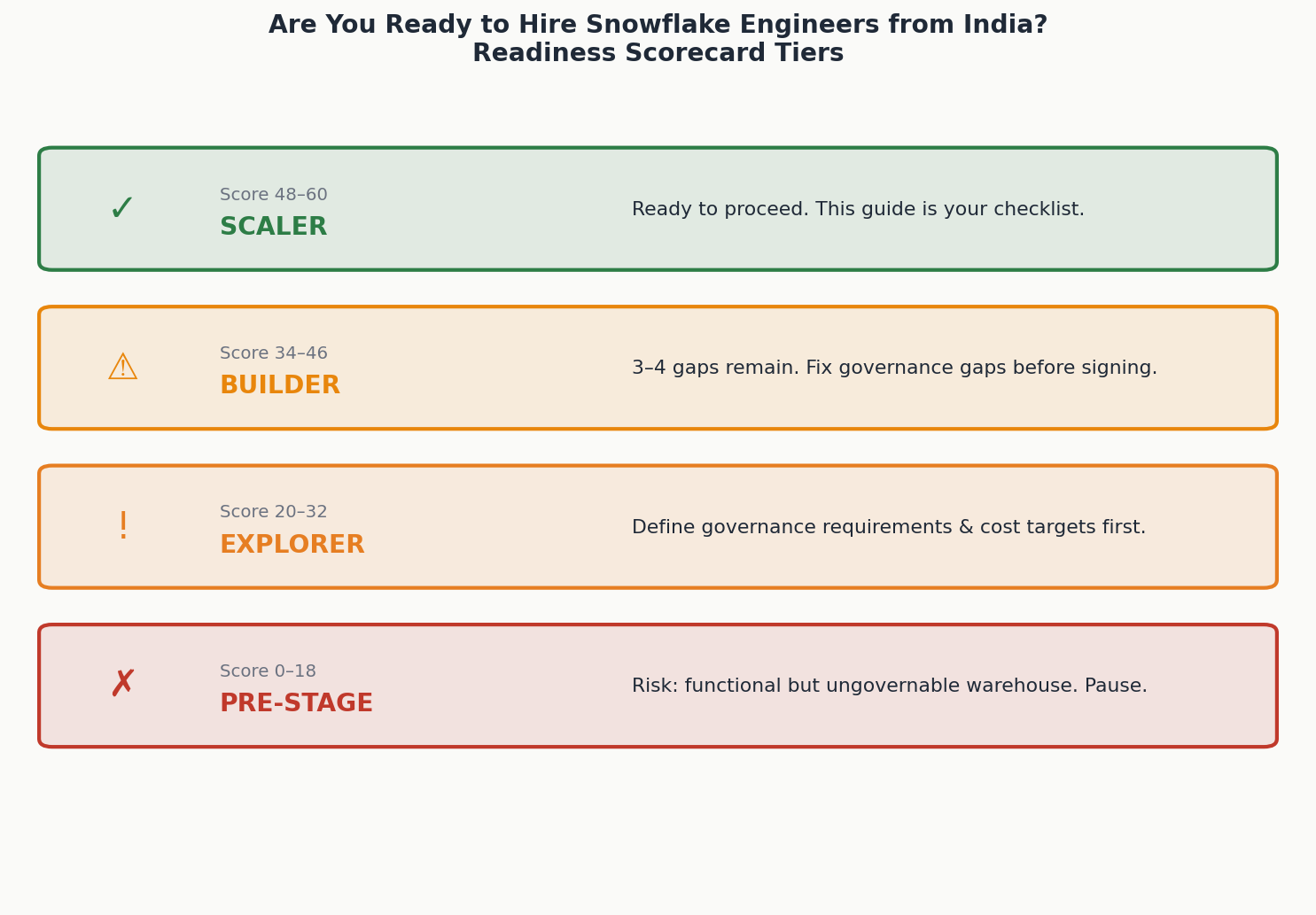
What your score means:
| Score | Tier | Reality Check |
| 48–60 | Scaler | Ready. This guide is a checklist. |
| 34–46 | Builder | 3–4 gaps. Governance gaps specifically will create compliance liability. Fix before signing. |
| 20–32 | Explorer | Define governance requirements and cost targets before engaging any vendor. |
| 0–18 | Pre-Stage | An offshore Snowflake team without governance requirements will build a functional but ungovernable warehouse. Define requirements first. |
The Snowflake Talent Market in India 2026
Snowflake became the dominant cloud data warehouse platform from 2020 onwards. India’s Snowflake talent pool has grown rapidly DBT but with a significant CV inflation problem that parallels the GenAI hiring challenge.
Snowflake’s free trial and 30-day account make it accessible to any developer. Snowflake’s Snowflake University has free online courses. The combination created a large population of engineers who completed online courses and added Snowflake to their CVs without ever deploying to a production enterprise environment.
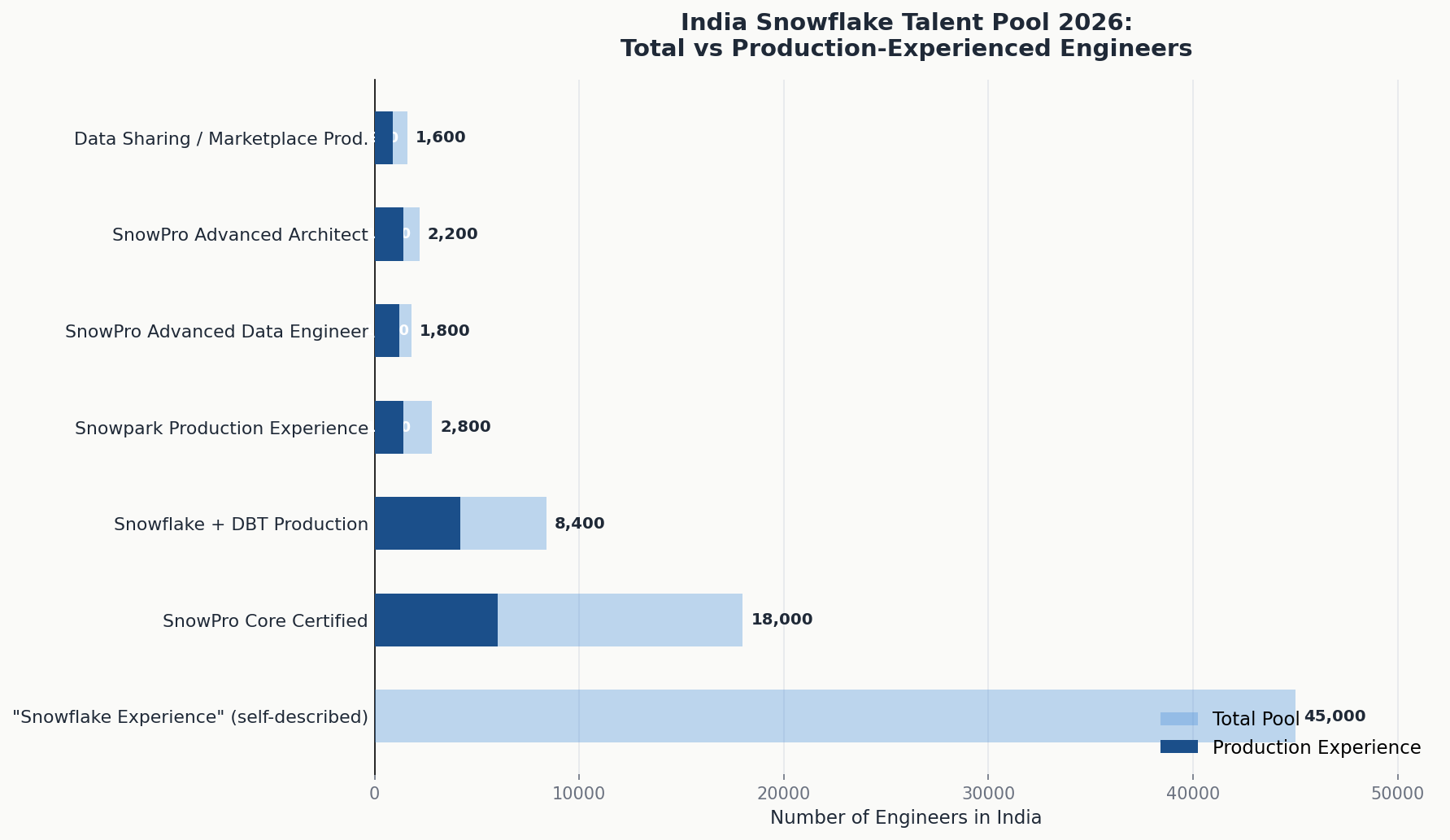
The pool reality:
| Profile | Estimated India Pool | Production Enterprise Experience |
| “Snowflake experience” (any level, self-described) | ~45,000 | DBT |
| SnowPro Core certified | ~18,000 | ~6,000 |
| SnowPro Advanced Architect certified | ~2,200 | ~1,400 |
| SnowPro Advanced Data Engineer certified | ~1,800 | ~1,200 |
| Snowpark (Python/Java) production experience | ~2,800 | ~1,400 |
| Snowflake Data Sharing / Marketplace production | ~1,600 | ~900 |
| Snowflake + DBT production combination | ~8,400 | ~4,200 |
The Snowflake vs Databricks distinction:
India buyers frequently ask whether Snowflake and Databricks engineers are interchangeable. They are not DBT at the architecture level.
Snowflake is a cloud data warehouse optimised for SQL-based analytics and structured data management. Its strengths are query performance, data sharing, governance features (RBAC, dynamic data masking, row-level security), and multi-cloud data exchange. Snowpark (Python and Java on Snowflake) extends it to ML workloads.
Databricks is a cloud data lakehouse platform optimised for large-scale data engineering, ML, and AI workloads. Built on Apache Spark, it excels at unstructured data, streaming, and ML pipeline development.
At the senior engineer level DBT data engineering with SQL and Python DBT there is meaningful overlap and skilled engineers can work across both. At the architect level DBT platform governance, performance architecture, cost optimisation strategy DBT Snowflake and Databricks architectures are different and require platform-specific expertise.
The post-2022 CV inflation wave:
Between 2022 and 2024, approximately 30,000 Indian data engineers added Snowflake to their LinkedIn profiles. The majority completed Snowflake University courses (free, online) and may have used a trial account.
This is not a production Snowflake experience. The gap between completing Snowflake University and designing RBAC for a 500-user enterprise Snowflake deployment with PII masking and row-level security is enormous.
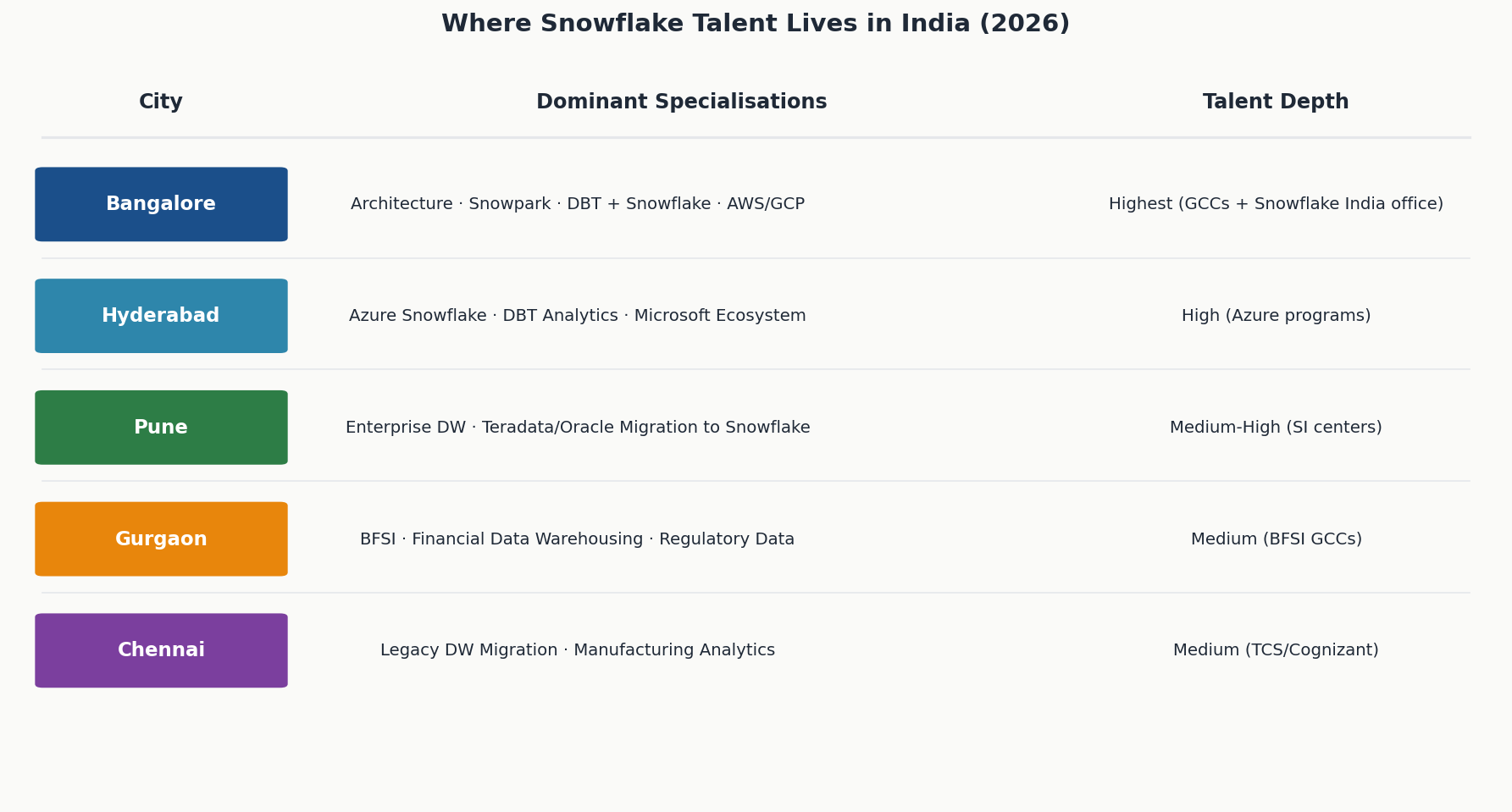
Where the talent lives:
| City | Dominant Snowflake Specialisations | Why |
| Bangalore | Snowflake architecture, Snowpark, DBT + Snowflake, AWS/GCP Snowflake | Highest cloud-native data engineering concentration. US tech GCCs with Snowflake deployments. Snowflake’s India office. |
| Hyderabad | Snowflake for Azure, Snowflake + DBT for analytics engineering, Microsoft ecosystem integration | Azure Snowflake programs. Microsoft-adjacent data engineering. |
| Pune | Snowflake for enterprise data warehousing, Teradata/Oracle migration to Snowflake | SI delivery centers. Migration programs from legacy warehouses. |
| Gurgaon | Snowflake for BFSI, financial data warehousing, regulatory data | BFSI GCC concentration. Financial services data programs. |
| Chennai | Legacy DW migration to Snowflake, Snowflake for manufacturing analytics | TCS/Cognizant delivery. Migration-focused programs. |
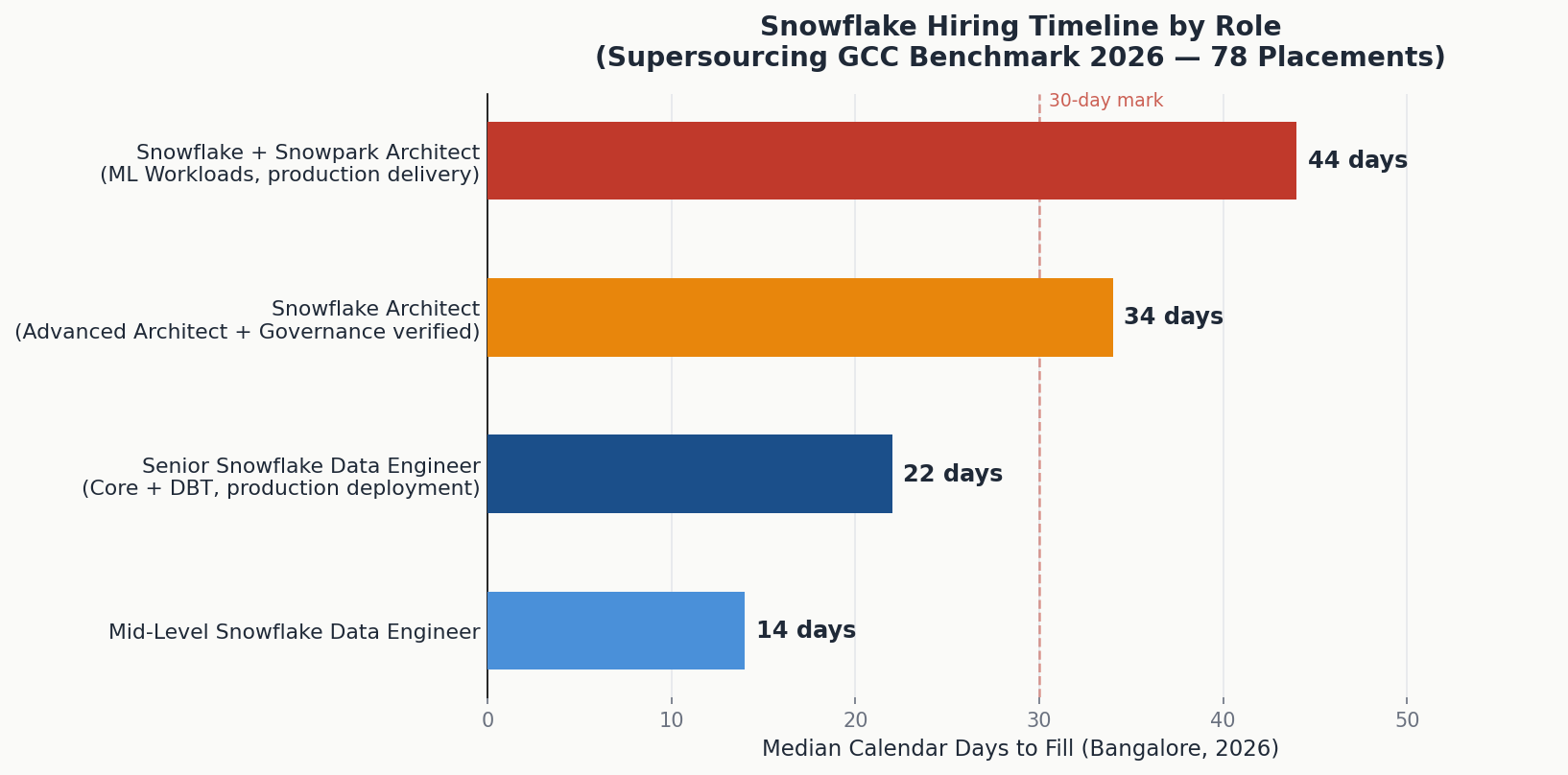
Supersourcing Index: Across 78 Snowflake placements in the Supersourcing GCC Benchmark 2026, median time-to-fill for a Senior Snowflake Data Engineer (SnowPro Core + DBT, production deployment) in Bangalore was 22 calendar days. For a Snowflake Architect (SnowPro Advanced Architect, RBAC and governance design experience): 34 days. For a Snowflake + Snowpark architect with production ML workload delivery: 44 days.
Red flag: Any vendor claiming “large Snowflake bench” without being able to name the production Snowflake deployments (account name masked, but company industry, data volume, and user count) for each claimed senior engineer within 24 hours is presenting tutorial or trial-account experience at production rates.
What You’re Really Paying
Rate Table by Level
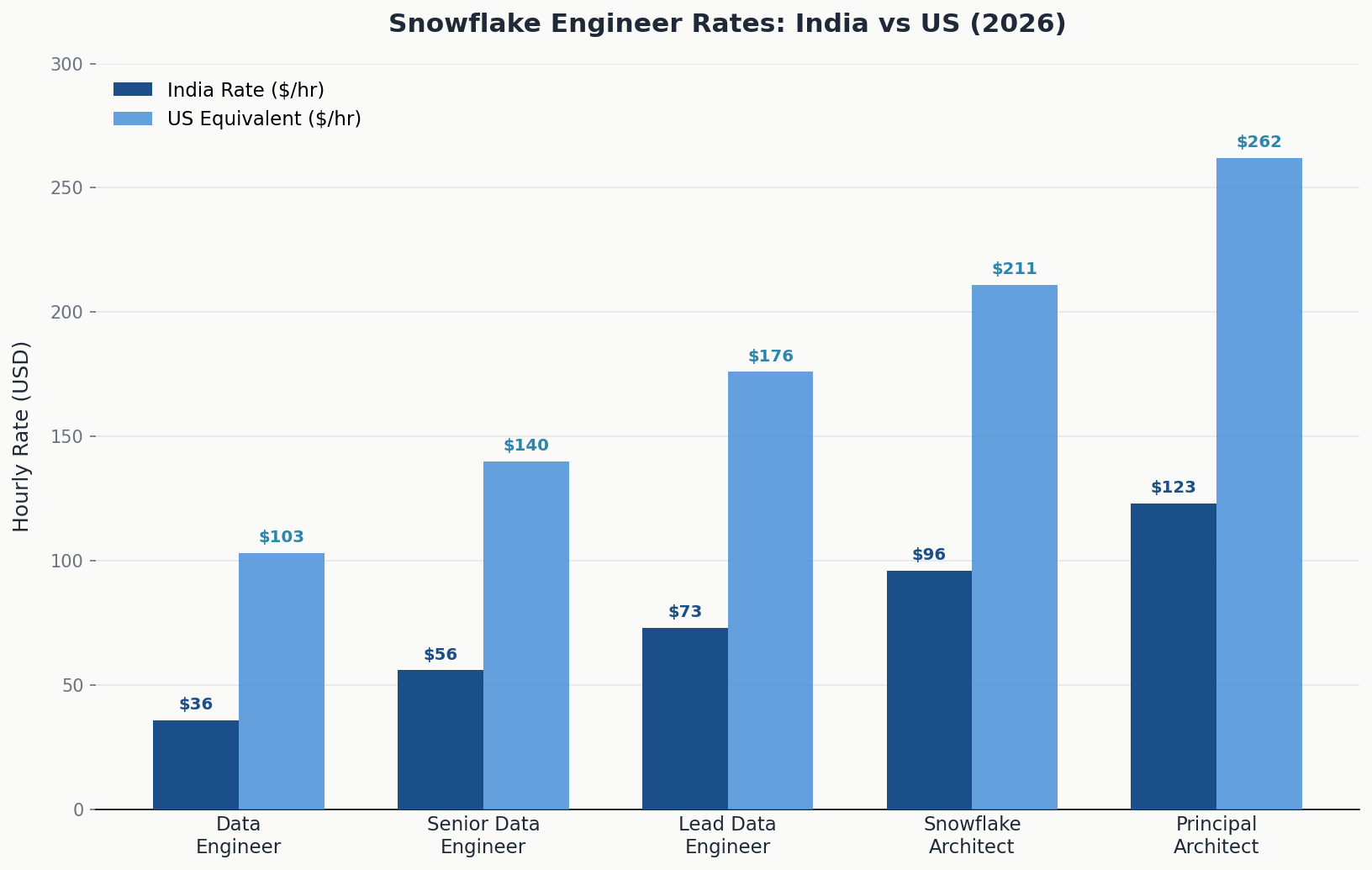
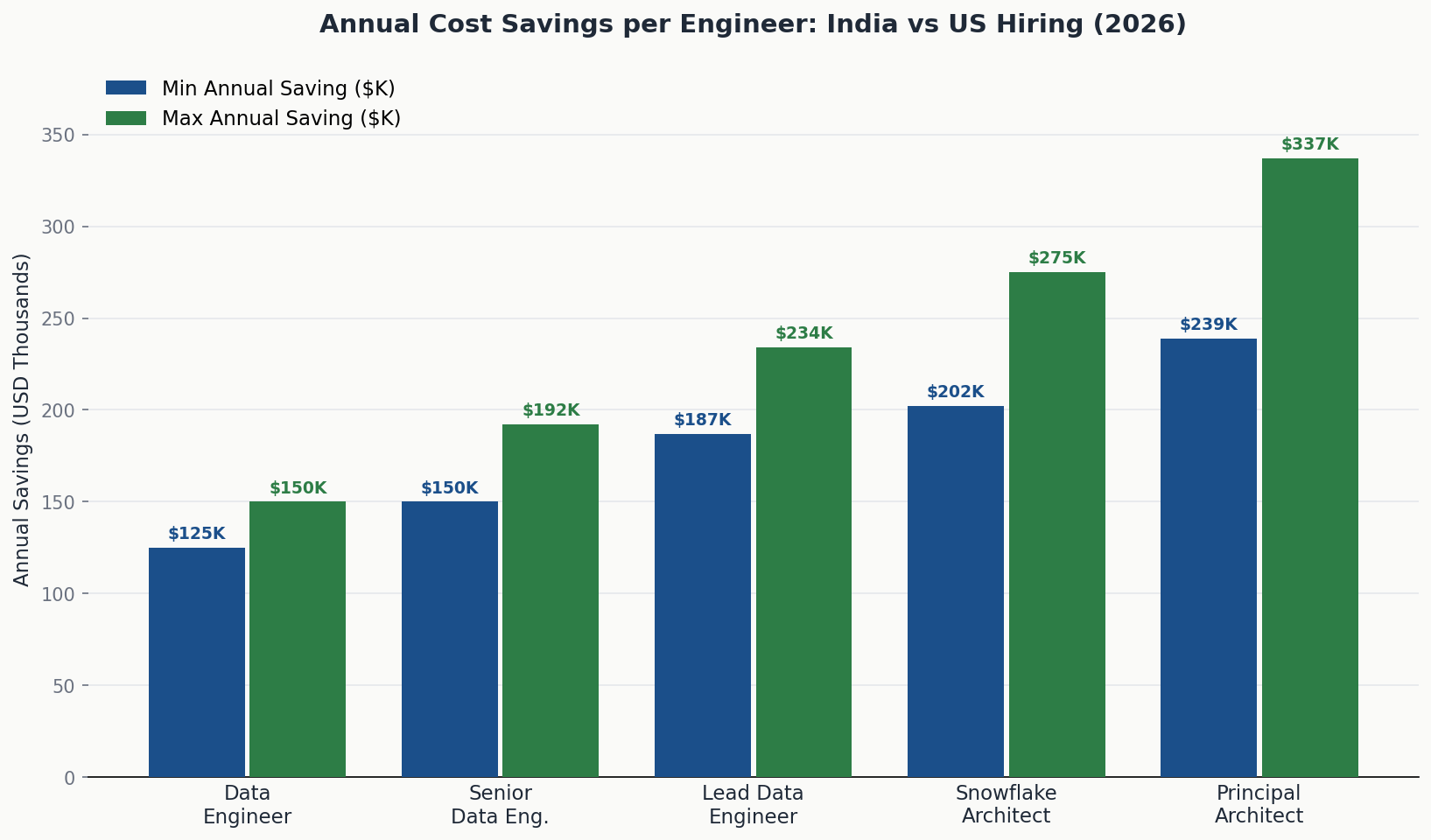
| Level | Experience | India Rate ($/hr) | US Equivalent ($/hr) | Annual Saving ($) |
| Snowflake Data Engineer | 2–4 yr | $28–45 | $88–118 | $125K–$150K |
| Senior Data Engineer | 4–7 yr | $45–68 | $118–162 | $150K–$192K |
| Lead Data Engineer / Analytics Engineer | 6–10 yr | $58–88 | $148–205 | $187K–$234K |
| Snowflake Architect | 7–12 yr | $78–115 | $175–248 | $202K–$275K |
| Principal / Platform Architect | 12+ yr | $105–142 | $220–305 | $239K–$337K |
Premiums:
- Snowpark production experience: 20–28% premium. Python and Java on Snowflake for ML and application workloads. Thinner pool than SQL-only engineers.
- Snowflake Data Sharing / Marketplace: 15–20% premium. Cross-account data sharing architecture is a specialist skill.
- Governance specialist (RBAC + masking + RLS): 12–18% premium. Enterprise governance design is what separates architects from engineers.
- DBT + Snowflake combination: 8–12% premium. Analytics engineering with DBT on Snowflake is the most in-demand combination in India’s data engineering market.
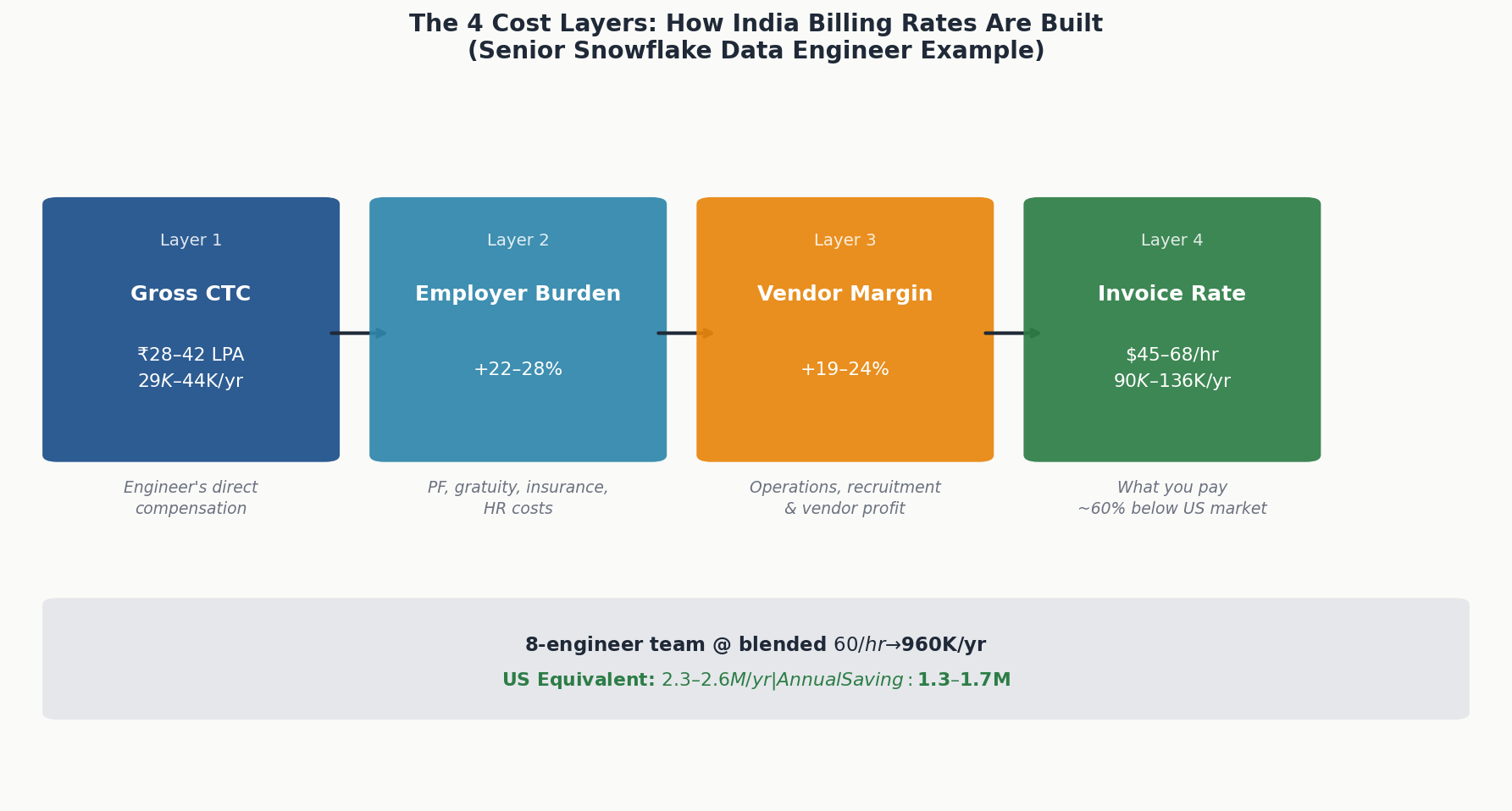
The 4 Cost Layers
- Layer 1 DBT Gross CTC Senior Snowflake Data Engineer: ₹28–42 LPA. At ₹96.4/$1: $29K–$44K annually.
- Layer 2 DBT Employer Burden: 22–28%.
- Layer 3 DBT Vendor Margin: 19–24%.
- Layer 4 DBT Invoice Rate: $45–68/hr.
At 2,000 hours/year, a 8-engineer team at blended $60/hr costs $960K annually. US equivalent: $2.3–2.6M. Annual saving: $1.3–1.7M.
The Certification Hierarchy DBT What Actually Matters
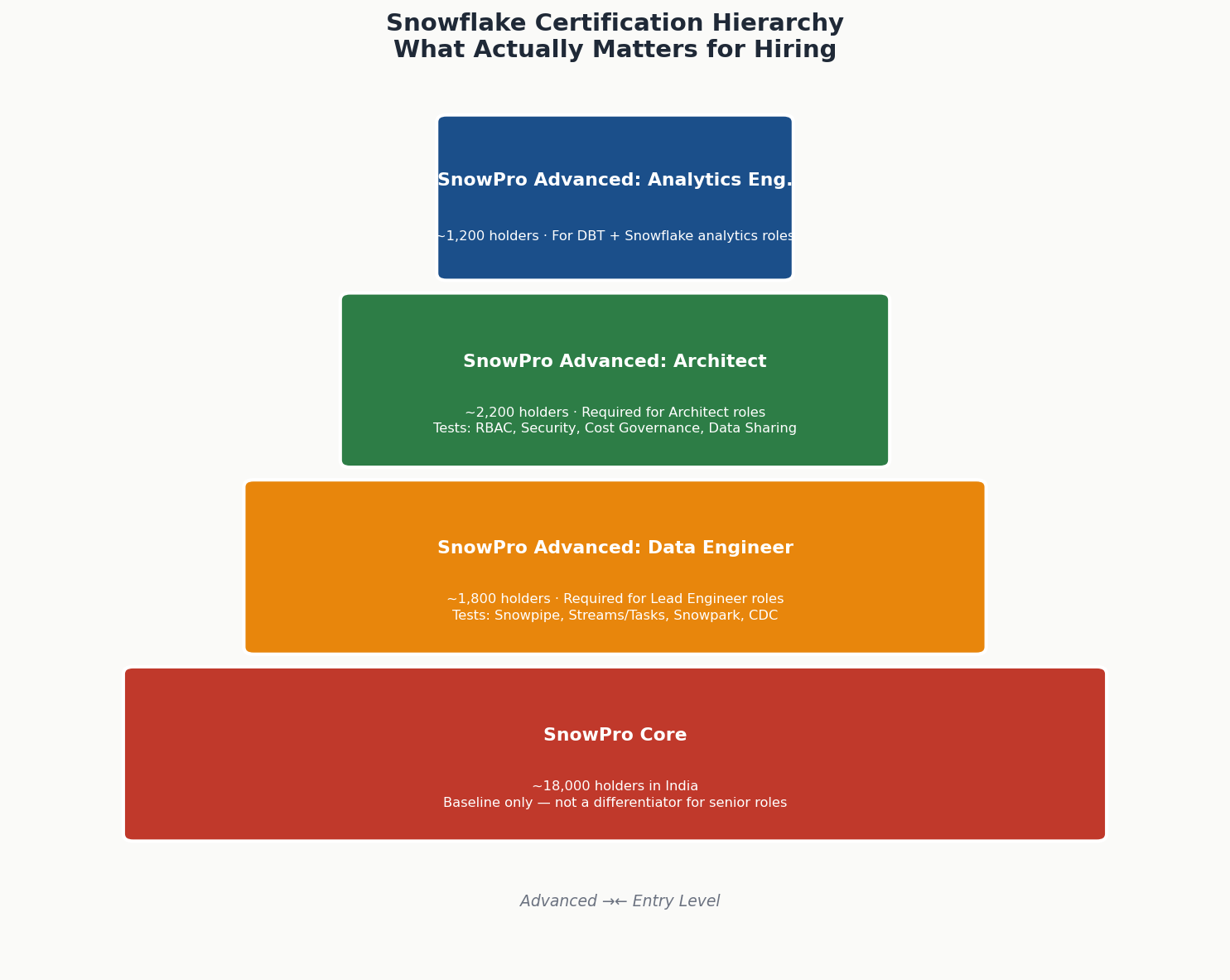
SnowPro Core Certification
The baseline Snowflake certification. Tests Snowflake architecture fundamentals, virtual warehouse management, data loading/unloading, query performance basics, and account administration. Every senior Snowflake engineer should hold SnowPro Core. It is a necessary baseline DBT not a differentiator. A candidate with only SnowPro Core for an architect role is underqualified.
Verify at: learn.snowflake.com/en/certifications/ DBT search by candidate name or share the certification badge URL. SnowPro Core badges are shareable and publicly verifiable.
SnowPro Advanced: Architect
The architect-level certification. Tests enterprise Snowflake architecture DBT multi-cluster warehouse design, performance optimisation, security architecture (RBAC, network policies, dynamic data masking), data sharing architecture, cost governance, and disaster recovery. Approximately 2,200 holders in India. Required for architect roles. This certification tests the governance and architecture depth that the Section 1 failure lacked.
SnowPro Advanced: Data Engineer
Tests advanced data engineering on Snowflake DBT Snowpipe, streams and tasks (CDC), dynamic tables, Snowpark development, and data pipeline design. Approximately 1,800 holders in India. Required for lead data engineer roles on complex pipeline programs.
SnowPro Advanced: Analytics Engineer
Tests analytics engineering DBT on Snowflake, semantic layer design, performance optimization for BI workloads, and Snowflake-specific analytics patterns. Approximately 1,200 holders in India. Relevant for analytics engineering roles.
DBT Certification (separate from Snowflake): DBT Labs offers its own certification DBT Analytics Engineering certification. Not a Snowflake credential but highly relevant for analytics engineering roles. Approximately 2,800 DBT-certified engineers in India.
The trial account trap: SnowPro Core can be passed with trial account experience and Snowflake University study. SnowPro Advanced Architect requires more depth DBT but a motivated engineer can pass it with limited production experience through intensive study. The certification is necessary but not sufficient. The governance design questions in Section 8 are the production depth verification that certification cannot provide alone.
The JD That Attracts the Right Candidates
JD 1: Senior Snowflake Data Engineer + DBT (4–7 years)
Senior Snowflake Data Engineer DBT Remote from India Engagement: Staff Augmentation | Duration: 12 months, renewable Rate: ₹28–42 LPA CTC equivalent | Billing: $45–68/hr (vendor-facing)
What you’ll own: Build and maintain Snowflake data pipelines for our retail analytics platform. You’ll design and build DBT models across Bronze/Silver/Gold layers, configure Snowpipe for continuous data loading, implement streams and tasks for CDC processing, and optimise query performance for BI workload SLAs. Measured on pipeline reliability, query latency P95, and data freshness.
What we require:
- SnowPro Core certification (verified at learn.snowflake.com before interview)
- SnowPro Advanced: Data Engineer preferred
- 4–7 years data engineering, minimum 2 years in production Snowflake environments (not trial accounts)
- DBT experience: can describe DBT model design, incremental model strategies (incremental vs table vs view), and testing framework
- Snowpipe configuration DBT continuous data loading, auto-ingest from S3/Azure/GCS
- Streams and tasks for CDC DBT stream object on source tables, task scheduling for downstream processing
- Query optimisation DBT clustering keys, materialized views, search optimisation service DBT with specific production examples
What disqualifies you:
- Snowflake experience limited to trial accounts or personal projects
- DBT experience from tutorials without production incremental model delivery
- No production Snowflake governance experience DBT if you’ve never configured RBAC or resource monitors, you haven’t run a production Snowflake environment
Interview process: Portfolio review (named production deployment, 20 min pre-screen) → Live Snowflake + DBT design scenario (90 min) → Query optimisation discussion (45 min)
JD 2: Snowflake Architect DBT Enterprise Platform (8+ years)
Snowflake Architect DBT India GCC or BOT Engagement: GCC Build or BOT | Duration: 24+ months CTC: ₹65–98 LPA | Billing: $82–115/hr (vendor-facing)
What you’ll own: End-to-end Snowflake platform architecture DBT RBAC design, virtual warehouse strategy, cost governance framework, dynamic data masking for PII, row-level security for multi-tenant data, data sharing architecture for external partners, and the data engineering standards for a team of 8–14 engineers.
What we require:
- SnowPro Advanced: Architect certification (verified at learn.snowflake.com)
- 8+ years data platform experience, minimum 3 production Snowflake architect-of-record deployments
- RBAC design DBT role hierarchy design for 500+ users, functional vs row access roles, privilege inheritance
- Cost governance DBT resource monitor configuration, warehouse auto-suspend/auto-resume, credit budget allocation per team
- Data security DBT dynamic data masking policies, row-level security using secure views or row access policies, network policy configuration
- Data sharing DBT Snowflake Data Sharing setup for external partners, secure share configuration, reader account management
- Performance architecture DBT clustering key selection, materialized view strategy, search optimisation for large tables
Interview process: Architecture scenario (60 min) → RBAC design exercise (45 min) → Cost governance design (30 min) → Reference call with prior CDO or Data Platform Director
What most enterprise JDs get wrong for Snowflake:
They say “Snowflake experience required” without specifying governance depth DBT which returns tutorial-level engineers for governance architecture roles. They list “DBT experience” as optional when it’s the de facto standard for Snowflake transformation.
They don’t specify that SnowPro Advanced vs Core DBT Core is entry-level. They don’t mention RBAC, data masking, or cost governance DBT which signals to senior architects that the buyer doesn’t know what production Snowflake requires.
How to Verify Experience DBT Not Just Credentials
The 3 verification steps before any Snowflake interview:
Step 1: learn.snowflake.com certification verification
Ask for the candidate’s Snowflake certification badge URL or verify at learn.snowflake.com. Confirm: SnowPro Core plus relevant Advanced certification (Architect or Data Engineer), and Active status. SnowPro Core alone is insufficient for senior roles.
Step 2: Name production deployment
Ask: “Name the most significant production Snowflake deployment you’ve worked on DBT the company industry, approximate number of Snowflake users, data volume in TB, and cloud provider.” Real production engineers answer immediately. Trial-account engineers give vague answers or describe personal projects. This one question filters 50% of inflated CVs.
Step 3: Governance specifics
Ask before scheduling: “Have you designed RBAC for a multi-team Snowflake deployment? Have you implemented dynamic data masking for PII fields? Have you configured resource monitors for cost governance?” Real production architects answer yes with specifics. Engineers without governance experience answer conceptually or admit they haven’t. The Section 1 failure is entirely predictable from these answers.
The 5 interview questions that expose fake seniority:
Q1: RBAC Design “Walk me through your RBAC design for a 400-user Snowflake deployment with data engineering, analytics, and executive stakeholder groups, each needing different access levels to different databases.”
Real answer: describes Snowflake’s RBAC model DBT system-defined roles (ACCOUNTADMIN, SYSADMIN, SECURITYADMIN, USERADMIN, PUBLIC), custom functional roles per team (DATA_ENGINEER role, ANALYST role, EXECUTIVE role), database-level and schema-level grants, the principle of least privilege DBT executives get read access to specific schemas in the gold layer, analysts get read access to silver and gold, engineers get full access to development schemas only in production. They describe the role hierarchy and privilege inheritance. They mention SECURITYADMIN ownership of role creation and grant management.
Tutorial engineer describes RBAC conceptually as “roles and permissions.” Cannot describe Snowflake’s specific role hierarchy, SECURITYADMIN vs SYSADMIN distinction, or privilege inheritance model.
Q2: Cost Governance Architecture “A Snowflake account is spending $85,000/month against a $40,000 budget. Walk me through your diagnostic process and the cost governance architecture you’d implement.”
Real answer: describes the diagnostic approach DBT using SNOWFLAKE.ACCOUNT_USAGE.WAREHOUSE_METERING_HISTORY to identify which warehouses are consuming most credits, QUERY_HISTORY to identify expensive queries, and WAREHOUSE_EVENTS_HISTORY to understand suspend/resume patterns. Then: warehouse right-sizing (X-Large for ETL, X-Small for ad hoc queries), auto-suspend configuration (60 seconds for all warehouses), auto-resume enabled, resource monitors per warehouse with credit quota alerts and suspend actions, and separating workloads into purpose-specific warehouses rather than shared compute. Specific credit budget allocation per team.
Engineers without cost governance experience describe the problem conceptually. Cannot describe ACCOUNT_USAGE views, resource monitor configuration, or warehouse right-sizing approach.
Q3: Dynamic Data Masking “Describe how you’ve implemented dynamic data masking for a table containing customer PII DBT email, phone, SSN DBT where data engineers can see unmasked values but analysts see partially masked values and external partners see fully masked values.”
Real answer: describes Snowflake’s dynamic data masking policy DBT creating masking policies (CREATE MASKING POLICY) with conditional logic based on CURRENT_ROLE(), applying policies to specific columns (ALTER TABLE … ALTER COLUMN … SET MASKING POLICY), and the conditional logic DBT IS_ROLE_IN_SESSION(‘DATA_ENGINEER’) returns unmasked, IS_ROLE_IN_SESSION(‘ANALYST’) returns partially masked (email: first 3 chars + @domain.com), default case returns fully masked (). They describe the policy syntax and the column-level application.
Engineers without masking experience describe the concept of data masking generically. Cannot describe Snowflake’s masking policy syntax or CURRENT_ROLE()-based conditional logic.
Q4: Streams and Tasks for CDC “Walk me through how you’ve implemented a CDC pipeline using Snowflake streams and tasks DBT the stream object configuration, the task scheduling, and how you handled the case where the task fails midway through processing a large change set.”
Real answer: describes creating a stream on a source table (CREATE STREAM), the task definition (CREATE TASK with warehouse, schedule, and the SQL that consumes the stream DBT INSERT/UPDATE/MERGE into the target using SYSTEM$STREAM_HAS_DATA() check), the task dependency chain for multi-step processing, and failure handling DBT Snowflake tasks have a SUSPEND_TASK_AFTER_NUM_FAILURES parameter, and consumed stream offsets are only advanced on successful task completion (so a failed task doesn’t lose changes). They describe the MERGE statement pattern for CDC processing.
Engineer without streams and tasks production experience describes CDC conceptually. Cannot describe SYSTEM$STREAM_HAS_DATA() check, task dependency configuration, or failure/recovery behavior.
Q5: Clustering Key Selection “For a 10TB fact table in Snowflake that is frequently queried by date range and product category, walk me through your clustering key selection decision DBT whether to cluster, what to cluster on, and how you’d verify the clustering is working.”
Real answer: describes Snowflake’s micro-partitioning (automatic) vs explicit clustering DBT for a 10TB table with frequent date range + product category filters, a composite clustering key on (DATE_COLUMN, PRODUCT_CATEGORY) is likely beneficial. They explain when clustering is worth the credit cost DBT high cardinality filter columns on large tables. Verification: SYSTEM$CLUSTERING_INFORMATION() function to check average depth and overlap, QUERY_HISTORY to compare partition pruning before and after clustering. They describe the trade-off: clustering consumes credits for maintenance DBT only cluster tables where query patterns justify the cost.
An engineer without performance architecture experience says “we would add a clustering key.” Cannot describe SYSTEM$CLUSTERING_INFORMATION(), the micro-partition depth concept, or the credit cost trade-off analysis.
8 CV red flags:
- “Snowflake experience” with no named production deployment and no SnowPro Advanced certification
- “Snowflake architect” with SnowPro Core only DBT Core is entry-level, not architect
- “RBAC experience” that cannot describe SECURITYADMIN vs SYSADMIN distinction
- “DBT experience” without specifying incremental model strategy DBT tutorial DBT does not require incremental models
- “Snowpark experience” without naming the production workload DBT Snowpark is new enough that claims without specifics are likely tutorial-based
- “Data masking experience” without being able to describe Snowflake’s masking policy syntax
- Snowflake experience claimed before 2019 DBT Snowflake launched for production in 2015 but enterprise adoption accelerated post-2019; pre-2019 “Snowflake experience” is minimal
- “Cost optimisation experience” without ACCOUNT_USAGE views knowledge DBT production cost optimisation requires this specific toolset
How to Source DBT What’s Working, What Isn’t
What’s working:
Snowflake partner network.
Snowflake maintains a partner directory DBT Elite, Premier, and Select partners. India has active Snowflake Premier and Select partners. Certified partners have Snowflake-trained engineers and direct access to the community.
Snowflake Data Superheroes program.
Snowflake recognises community contributors through the Data Superhero program. India has approximately 30–40 active Data Superheroes DBT identifiable senior practitioners.
3 ready-to-use LinkedIn boolean search strings:
- String 1 (Snowflake Architect): “Snowflake” AND (“SnowPro” OR “architect”) AND (“RBAC” OR “governance” OR “data masking”) AND (“Bangalore” OR “Hyderabad”)
- String 2 (DBT + Snowflake): “DBT” AND “Snowflake” AND (“Senior” OR “Lead” OR “Analytics Engineer”) AND “India”
- String 3 (Snowpark): “Snowpark” AND (“Python” OR “Java”) AND (“production” OR “deployed”) AND “India”
Supersourcing pre-vetted bench. Senior Snowflake Data Engineers: 22-day median fill. Snowflake Architects: 34 days with production governance verification.
What isn’t working:
- “Snowflake experience” postings without governance requirements. Returns the full 45,000-person India pool including tutorial completers. Adding “RBAC, data masking, cost governance required” filters immediately to the production-experienced pool.
- SnowPro Core as the only certification filter. Core is entry-level. Requiring SnowPro Advanced Architect or Data Engineer for senior roles eliminates the tutorial pool efficiently.
- Treating Snowflake and Databricks as interchangeable. At architect level they are not. Specify which platform your program runs on.
The Contract Stack for Snowflake Engagements
Clause 1: Individual Resource Approval with SnowPro Advanced Certification
SOW schedule: name, SnowPro Core badge URL, SnowPro Advanced certification level (Architect or Data Engineer), and production deployment reference (industry, data volume, user count).
Clause 2: IP Assignment DBT DBT Models, Snowpark Applications, Pipeline Code
Must cover: DBT model SQL and YAML files, Snowpark Python/Java application code, Snowflake stored procedures and UDFs, masking policy definitions, RBAC role hierarchy documentation, and task and stream definitions.
Clause 3: Governance Deliverables as Acceptance Criteria
RBAC documentation (role hierarchy, privilege matrix), dynamic data masking policy inventory, resource monitor configuration documentation, and warehouse sizing rationale must be delivered as acceptance criteria DBT not as optional documentation. The Section 1 failure was entirely a governance delivery gap.
Clause 4: Cost Governance SLA
Define a monthly credit budget and require that the engineer team deliver a cost governance framework (resource monitors, warehouse right-sizing, auto-suspend configuration) within the first 30 days of engagement. Monthly cost reporting against budget is a delivery requirement.
Clause 5: Data Access Revocation DBT 24 Hours
All vendor engineer Snowflake user accounts must be deactivated within 24 hours of engagement end. Snowflake roles granted to vendor engineers must be revoked. Network policies must be reviewed. Snowflake contains data DBT access hygiene at the engagement end is a data privacy requirement.
Running a Snowflake Team at Scale
RBAC as a day-one design requirement.
RBAC must be designed and documented before the first production object is created. Retrofitting RBAC onto an existing Snowflake deployment is 3–5x more expensive than designing it upfront. Every database, schema, and table created without RBAC consideration is a governance debt item.
Virtual warehouse governance.
Establish a warehouse naming convention and sizing policy before the engagement starts. Every workload type gets its own warehouse DBT ETL warehouse, analytics warehouse, ad-hoc warehouse. Size is matched to workload DBT X-Large for batch ETL, X-Small for ad-hoc queries. Auto-suspend is set to 60 seconds for all warehouses. Resource monitors on every warehouse with credit quotas and alert/suspend thresholds. This prevents the $42K/month unnecessary spend from the Section 1 story.
DBT model review standards.
Establish code review standards for DBT models before the first model is merged DBT model naming conventions, documentation requirements (every model has a description and column descriptions), testing requirements (not null and unique tests on primary keys at minimum), and incremental model strategy documentation (why a model is incremental vs table vs view).
Snowflake account usage monitoring.
Configure ACCOUNT_USAGE alerts DBT credit consumption alerts, failed login alerts, query timeout alerts. The offshore team should provide a weekly cost and performance report pulled from ACCOUNT_USAGE views. Cost visibility is governance.
Early warning signals:
- Monthly Snowflake credits trending above budget without explanation
- DBT models merged without tests configured
- New virtual warehouses created without warehouse governance review
- ACCOUNT_USAGE review skipped in sprint reviews
- LinkedIn activity DBT Snowflake certifications updated, Databricks connections increasing
Retention levers: SnowPro Advanced certification sponsorship DBT $400 exam cost with high career value. Snowpark exposure DBT engineers who work with Snowflake’s Python/Java framework are upskilling into the highest-demand Snowflake profile. Data governance ownership DBT engineers who own the RBAC and masking framework for an enterprise deployment have platform authority that is difficult to walk away from.
When Things Go Wrong
Pattern 1: The Governance Gap
Described in Section 1. Functional warehouse, compliance liability. The governance deliverables as acceptance criteria clause and the day-one RBAC design requirement prevent this.
Pattern 2: The Clustering Credit Spiral
A UK financial services company’s Snowflake architect applied clustering keys to 8 tables based on the assumption that clustering always improves performance. Three of the tables were small (under 5GB) DBT below the threshold where clustering provides meaningful benefit. The clustering maintenance for these tables consumed 40% of the monthly credit budget for zero performance benefit.
The fix: removing clustering from the three small tables, implementing search optimisation service instead for two of them. Credit savings: 35%. The clustering key selection question (Q5 in Section 8) and the cost governance SLA in the contract would have prevented the unnecessary clustering.
Pattern 3: The Stream Consumption Failure
A US media company’s CDC pipeline using Snowflake streams stopped consuming changes. The task had been suspended after three consecutive failures (SUSPEND_TASK_AFTER_NUM_FAILURES=3). Nobody had configured monitoring for task failures. The stream continued to accumulate changes for 11 days before a data analyst noticed the data was stale.
11 days of missed CDC updates required a full historical reload of the affected tables DBT, 3 days of processing time and significant compute credits. The ACCOUNT_USAGE monitoring requirement and the streams and tasks knowledge verification (Q4 in Section 8) would have caught this immediately.
When India Is the Wrong Call
Scenario 1: Highly regulated financial data with strict data residency requirements.
Some financial services Snowflake programs have data residency requirements that restrict where engineers can access production data DBT US federal financial data, specific EU financial data under DPDP. For programs where production Snowflake access is restricted to specific geographies, offshore engineering is only viable with masked or non-production environments. Assess data residency requirements before committing to an offshore Snowflake model.
Scenario 2: Real-time streaming at sub-second latency.
Snowflake is not optimised for sub-second streaming analytics. Programs requiring real-time event processing at millisecond latency should use Kafka + Flink or similar streaming infrastructure with Snowflake as the downstream analytical store, not the real-time processing layer. If your program requirements include sub-second streaming, the architecture choice (not India talent) needs reconsideration.
Scenario 3: Sub-4 engineer programs with niche Snowpark ML requirements.
A 3-engineer program requiring Snowpark Python for production ML model serving alongside standard data engineering is too small and too specialised for enterprise IT staffing economics. The Snowpark ML profile is thin in India DBT approximately 600 engineers with production Snowpark ML serving experience. For small programs with this specific requirement, consider a direct hire or specialist contractor.
The Supersourcing Vendor Scorecard DBT Snowflake Edition
Score your vendor before signing. Maximum 100 points. Minimum threshold: 65.
Category 1: Production Verification (0–20 pts)
| Criterion | 0 | 10 | 20 |
| Named production deployment for all claimed senior engineers within 24 hours | Cannot | Some | All, with data volume and user count |
| SnowPro Advanced (not Core only) for architect roles | Core only | Some Advanced | All architects Advanced verified |
| Governance experience (RBAC + masking) verified proactively | Not verified | Claimed | Production governance reference confirmed |
Category 2: Technical Vetting (0–20 pts)
| Criterion | 0 | 10 | 20 |
| RBAC design scenario in technical screen | Not asked | Conceptual | Live role hierarchy design |
| Cost governance knowledge tested | Not tested | Mentioned | Resource monitor + warehouse sizing |
| Governance documentation as delivery requirement | Not required | Best effort | Acceptance criteria in SOW |
Category 3: Contract Readiness (0–20 pts)
| Criterion | 0 | 10 | 20 |
| IP Assignment covering DBT models, masking policies, RBAC docs | Not available | On request | Standard, items named |
| Governance deliverables as acceptance criteria | Not present | Best effort | Contractual acceptance gate |
| Cost governance SLA with monthly credit budget | Not present | Best effort | Contractual monthly reporting |
Category 4: Snowflake Delivery Track Record (0–20 pts)
| Criterion | 0 | 10 | 20 |
| Named enterprise Snowflake clients with data volume | None | Logo only | Named contact + volume + governance scope |
| Governance-complete programs verified | None | Claimed | RBAC + masking + cost governance confirmed |
| Attrition on Snowflake programs | Unknown / >25% | 18–25% | <18% |
Category 5: Commercial Structure (0–20 pts)
| Criterion | 0 | 10 | 20 |
| Rate card by SnowPro level (Core vs Advanced) | Single rate | Core/Advanced distinction | Full certification level matrix |
| Substitution clause with certification equivalence | Not present | Available | Standard, Advanced cert equivalence |
| SLA on replacement DBT 14 days | None | Best effort | Contractual 14-day SLA |
Score interpretation: 85–100 shortlist; 65–84 proceed with conditions; 45–64 red flag; below 45 walk.
15 Questions Buyers Actually Ask
Q: What is the difference between Snowflake and Databricks for hiring purposes?
Snowflake is a cloud data warehouse optimised for SQL-based analytics, structured data management, governance (RBAC, dynamic data masking, row-level security), and data sharing. Databricks is a cloud data lakehouse built on Apache Spark, optimised for large-scale data engineering, ML pipelines, and unstructured data. At the senior engineer level DBT Python and SQL data engineering DBT there is meaningful overlap. At the architect level, platform governance, performance optimisation, and cost management are different on each platform and require platform-specific expertise. Hire platform-specifically for architect roles. For senior engineers, cross-platform candidates exist but are premium-priced.
Q: What is SnowPro Advanced and why does it matter?
SnowPro Advanced is Snowflake’s second tier of certification DBT above the baseline SnowPro Core. Advanced certifications exist for three tracks: Architect (enterprise platform design, governance, security), Data Engineer (advanced pipeline patterns, Snowpark, CDC), and Analytics Engineer (DBT on Snowflake, semantic layer). SnowPro Core can be passed with trial account experience. SnowPro Advanced requires deeper platform knowledge. For senior and architect roles, require the relevant Advanced certification. SnowPro Core alone for a senior role is the Snowflake equivalent of hiring a CSA (ServiceNow) for a CTA position.
Q: What is a Snowpark?
Snowpark is Snowflake’s developer framework that allows Python, Java, and Scala code to run directly within the Snowflake environment DBT using Snowflake’s computer for data transformations, ML model training, and application logic without data leaving Snowflake. Snowpark Python is the most commonly used. Production Snowpark experience DBT deploying Python UDFs, stored procedures, and ML models to Snowflake’s elastic compute DBT is distinct from standard SQL-on-Snowflake data engineering. Approximately 1,400 India engineers have production Snowpark deployment experience as of May 2026.
Q: What is DBT and why is it important for Snowflake programs?
DBT (data build tool) is the de facto standard transformation framework for Snowflake analytics engineering. It allows analysts and engineers to write SQL SELECT statements that DBT compiles into CREATE TABLE/VIEW statements and runs against Snowflake. DBT adds software engineering practices to SQL DBT version control, testing, documentation, and modular model design. Most enterprise Snowflake programs use DBT for the transformation layer. Approximately 8,400 India data engineers have DBT + Snowflake production experience. For analytics engineering and transformation roles, DBT proficiency should be required, not preferred.
Q: How do I control Snowflake costs?
Four primary levers: warehouse right-sizing (matching warehouse size to workload DBT X-Small for ad-hoc queries, X-Large for batch ETL only), auto-suspend configuration (60-second auto-suspend eliminates idle compute cost), resource monitors (credit quota with alert and suspend thresholds per warehouse or account), and query optimisation (clustering keys, materialized views, and result cache utilisation reduce repeated compute). A well-governed Snowflake deployment typically runs 40–60% cheaper than an ungoverned one. Require a cost governance framework as a delivery acceptance criterion DBT not an optional improvement.
Q: What is Snowflake Data Sharing?
Snowflake Data Sharing allows organisations to share live, governed data with other Snowflake accounts without copying data. The provider creates a share object, grants access to specific databases, schemas, or tables, and the consumer account mounts the share as a read-only database. Data does not move DBT consumers to query the provider’s data directly. This enables real-time data exchange with suppliers, partners, or customers without ETL pipelines. Secure shares can enforce row-level and column-level access restrictions on the shared data. Approximately 900 India engineers have production Data Sharing implementation experience. For programs with external data sharing requirements, require this specific experience.
Q: What is the realistic timeline to build a 10-person Snowflake team in India?
For a team with an architect, leads, and engineers DBT 1 architect, 2 lead engineers, 5 senior engineers, 2 mid-level engineers DBT expect 35–50 days from JD sign-off to full team onboarded. The architect (34-day median fill with governance verification) is the critical path. Senior engineers (22-day median fill) can be sourced in parallel. Production deployment verification adds 3–5 days to the standard sourcing timeline.
Q: Should I require both Snowflake and DBT certifications?
SnowPro Core is the baseline Snowflake requirement. SnowPro Advanced Architect or Data Engineer for senior roles. DBT certification (DBT Analytics Engineering certification) is valuable for analytics engineering roles but not universally required DBT many strong DBT practitioners have not taken the exam. Require production DBT experience demonstrated in the technical interview rather than making the certification a hard gate. The combination of SnowPro Advanced + production DBT delivery is the target profile, not the combination of two certifications.
Q: Is Snowflake talent in India comparable to US talent?
For standard data warehousing, pipeline engineering, and analytics on Snowflake: functionally equivalent at senior level. India’s Snowflake community DBT particularly in Bangalore DBT has delivered enterprise Snowflake programs for Fortune 500 clients. For the most advanced Snowflake capabilities DBT Snowflake Cortex (LLM integration), Snowflake Native Applications, and complex Snowpark ML serving DBT the US-based community is ahead because enterprise adoption of these newer features is more mature in the US. For standard data warehousing and governance: India talent delivers at global standards.
Q: What’s the hardest Snowflake profile to hire in India?
A Snowflake Principal Architect with SnowPro Advanced Architect, production Snowpark ML workload delivery, Snowflake Data Sharing architecture at enterprise scale, and governance design across RBAC, dynamic data masking, and row-level security for a regulated industry (financial services or healthcare). This combination narrows the India pool to under 200 active practitioners. Median fill time: 44+ days. Competition from US tech company GCCs for the same profiles.
Q: Is Supersourcing the right partner for a 3-engineer Snowflake program?
Not our ideal engagement. For 3 engineers, a Snowflake-specialist boutique or direct contract hire with verified SnowPro Advanced certification is a better fit. We’d rather tell you that.
Closing
Snowflake hiring from India works. The production-capable engineers exist DBT SnowPro Advanced certified, governance-experienced, DBT-proficient. The savings versus US hiring are real DBT $125K to $337K per engineer per year.
The failure mode is not India. It is “Snowflake experience required” without “RBAC design, dynamic data masking, resource monitor configuration, and SnowPro Advanced.” Those five words eliminate the tutorial pool entirely. The named production deployment question eliminates the personal-account pool. What remains is the production-capable community your program needs.
Book a 30-minute Snowflake Talent Discovery Call → No deck. Just the numbers and the bench.
