

Forty-four percent. That is the global average level of test automation Capgemini has tracked in its World Quality Report which means more than half of all software testing still happens by hand, even inside enterprises that have spent years and crores chasing automation maturity. The bottleneck is rarely the tooling. It is the shortage of engineers who can architect, write, and maintain automated suites that survive contact with a real release pipeline.
That single statistic is why the decision to hire QA automation engineer India teams has moved from a nice-to-have into a board-level conversation. Companies are not short on Selenium licenses or Cypress tutorials; they are short on people who know which tool to reach for, why, and how to keep the suite green when the application changes weekly.
The implication for hiring managers is direct. A candidate who can record-and-replay a happy path is not the same hire as one who can design a fault-tolerant framework that runs across 200 browser-device combinations on every commit. Treating them as interchangeable is the single most expensive mistake in this market.
The demand is accelerating. According to Statista software testing market forecast, the global software testing market is projected to exceed $70 billion by 2026, driven by continuous integration, DevOps, and faster release cycles.
This guide breaks down the tool landscape, maps each technology to a skill level and a seniority band, lays out 2026 salary ranges grounded in current data, and gives you interview questions that separate the framework architects from the script recorders. By the end, the choice to hire QA automation engineer India professionals should feel like an engineering decision rather than a gamble.
What Is a QA Automation Engineer?
A QA automation engineer is a software professional who designs, builds, and maintains automated test suites that validate an application’s functionality, performance, and stability without manual execution. They write code in languages such as Java, Python, or JavaScript, integrate tests into CI/CD pipelines, and own the frameworks that catch regressions before users do.
The role sits at the intersection of development and quality. Unlike a manual tester who executes predefined steps, an automation engineer treats test code as a first-class product versioned, reviewed, and refactored. The most senior version of this role, often titled SDET, is effectively a developer whose product happens to be the testing infrastructure itself. Understanding that spectrum is the first thing any team should internalize before it sets out to hire QA automation engineer India professionals, because a single job title can hide a fourfold difference in capability and cost.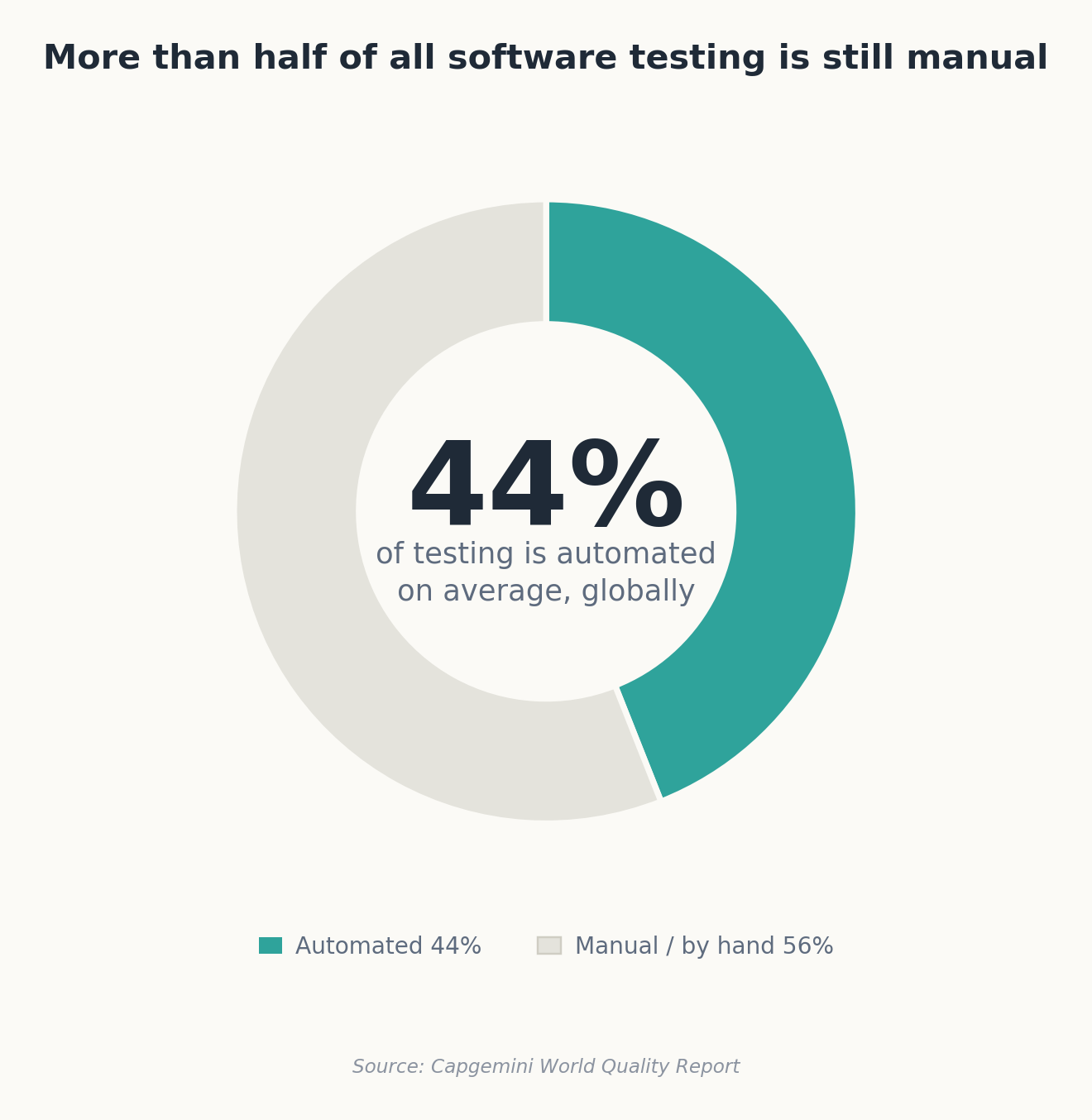
The Core Problem: Most Hiring Briefs Describe the Wrong Person
The trouble begins before the first interview. A typical job description lists six tools, three languages, and two cloud platforms, then offers a mid-level salary and expects a unicorn. When you set out to hire test automation engineer candidates this way, you filter for résumé keyword density rather than engineering judgment and you end up with someone who has touched everything and mastered nothing.
The cost of getting this wrong is measurable. A poorly designed automation suite typically produces flaky tests that pass and fail intermittently without a code change. Teams running flaky suites routinely waste 20–30% of their CI compute and, worse, start ignoring red builds entirely. Once a team stops trusting its own tests, the automation investment is not just wasted; it is actively harmful, because it creates false confidence. This is the failure mode that makes leadership reluctant to hire QA automation engineer India teams a second time, even though the first attempt failed on staffing rather than on the idea.
There is also a timeline problem most teams underestimate by 3–4x. Standing up a maintainable framework from scratch with a page object model, reporting, parallel execution, and pipeline integration is rarely a two-week task. For a mid-complexity web and API product, expect 8–12 weeks of focused work before the suite delivers reliable signal. Hiring a junior and hoping they will figure it out usually stretches that to two or three quarters.
The deeper issue is that automation is not one skill. It is a stack: programming fundamentals, framework design, the specific tool, the CI/CD layer, and the testing strategy that decides what to automate in the first place. A candidate can be strong at one layer and hopeless at the next, and a generic interview will never surface the gap. Teams that hire QA automation engineer India talent on the strength of a keyword-matched résumé inherit exactly this hidden weakness, then spend a quarter discovering it.
The Tool Landscape: Mapping Technology to Skill and Seniority
This is where most hiring decisions are made on instinct and should instead be made on a model. Each tool in the modern stack signals a different competency, and the tool a candidate reaches for first tells you a great deal about how they think. A clear-eyed test automation tools comparison is the fastest way to translate a résumé into a seniority estimate.
The principle is simple: the tool is a proxy for the problem the engineer is comfortable solving. Someone whose entire career is UI record-and-replay is solving a different problem than someone who has built an API testing layer with REST Assured underneath a thin UI suite. Below is how the major tools map to skill and level and it is the lens we recommend any manager apply before they hire QA automation engineer India candidates against a live stack.
Selenium: The Baseline That Reveals Fundamentals
Selenium WebDriver remains the most widely deployed browser automation tool, and for good reason it is language-agnostic, supports every major browser, and underpins a huge share of legacy and enterprise suites. Because it gives you almost no structure out of the box, Selenium is an excellent skill probe.
A candidate who is strong in Selenium has usually had to build everything themselves: waits, the page object model, TestNG or JUnit runners, reporting, and cross-browser testing grids. That self-assembly is exactly the framework-design muscle you want. A weak Selenium user, by contrast, litters code with hard-coded sleeps and brittle XPath selectors that surface within minutes of a code review.
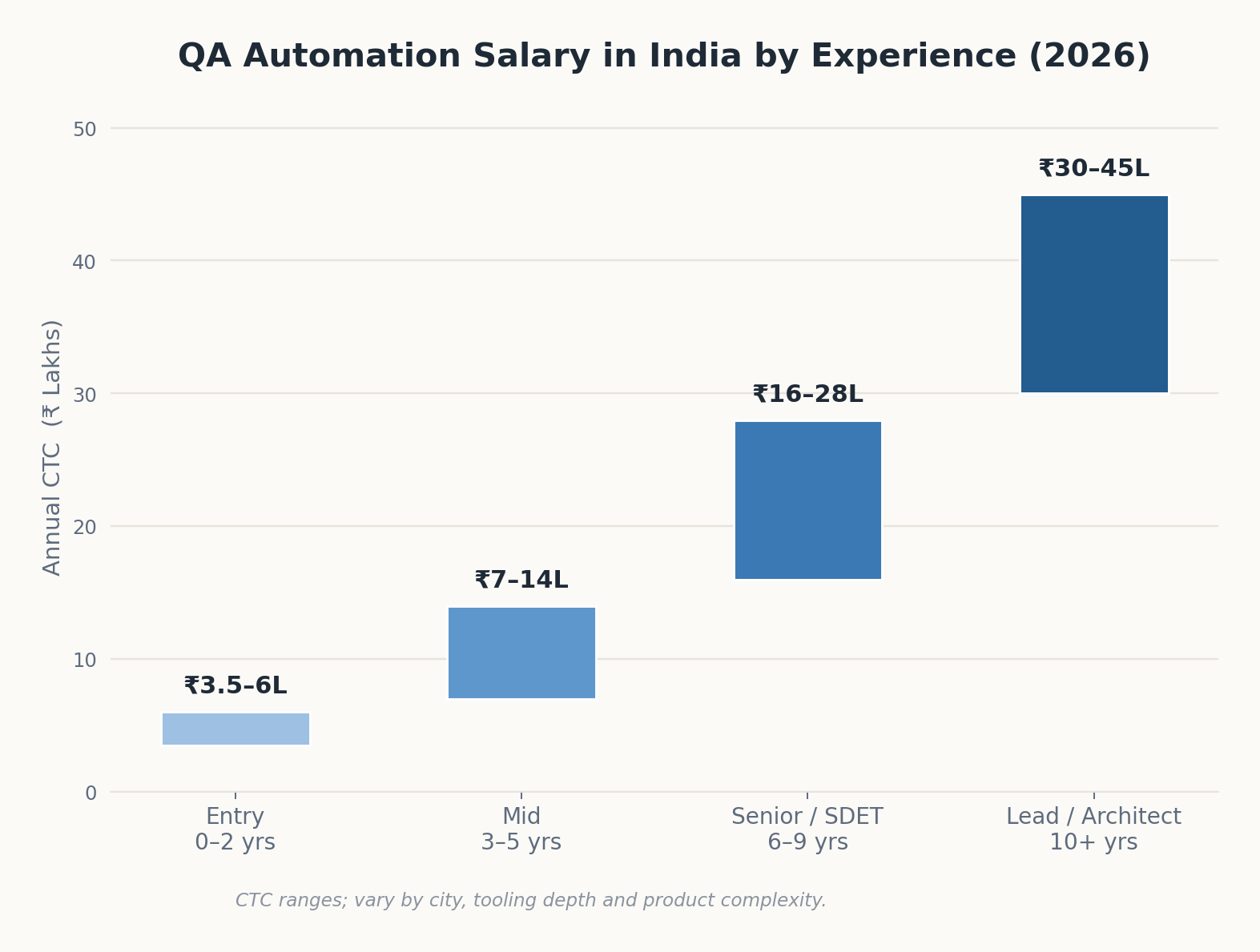
Selenium expertise maps to mid-level and above. Junior engineers can write Selenium scripts; only experienced ones can architect a Selenium framework that does not collapse under its own weight at 500+ tests. When you hire QA automation engineer India teams to maintain a large legacy suite, this distinction is the one that decides whether the investment compounds or quietly rots.
Selenium vs Cypress Developer: Choosing the Modern Web Stack
The Selenium-versus-Cypress question is the one hiring managers ask most, and the honest answer is that the two are not competing for the same job. Cypress runs inside the browser’s event loop, which gives it fast, reliable execution and superb debugging for modern JavaScript front-ends but it historically constrains you to a single browser tab and a JavaScript-only ecosystem.
A Cypress specialist is typically a front-end-adjacent engineer comfortable in the React or Vue world. A Selenium specialist is more often a backend-leaning or polyglot engineer working across IT services. Hiring the wrong one for your stack means months of friction.
Playwright has become the third pole of this decision and increasingly the default for greenfield web projects. It offers multi-browser support out of the box, auto-waiting, network interception, and parallel execution effectively Selenium’s reach with Cypress’s developer experience. A candidate who reaches for Playwright on a new project, and can articulate why, is usually operating at a senior level.
When You Need Appium: Mobile Test Automation
If your product has a native or hybrid mobile app, Appium is the standard, and it is a meaningfully harder skill than web automation. Mobile test automation involves device farms, emulators versus real devices, OS-version fragmentation, and gestures that web tooling never has to model.
Engineers who can stabilize an Appium suite are scarce and command a premium. Mobile automation maturity is a strong seniority signal on its own to treat Appium depth as roughly equivalent to a senior web automation skill set, and budget accordingly. If your roadmap is mobile-first, plan to hire QA automation engineer India specialists with demonstrable device-farm experience rather than web engineers who list Appium as an afterthought.
k6 and the Performance Frontier
Functional automation answers “does it work?” Performance tooling answers “does it work under load?” k6 a modern, JavaScript-scriptable load testing tool sits at this frontier alongside JMeter and Gatling. Candidates who can design a k6 load model, interpret latency percentiles, and correlate them with infrastructure metrics belong in a different and higher band.
Performance skills rarely overlap fully with functional automation skills, and conflating the two is a common scoping error. If your real risk is scale rather than correctness, you are hiring for a different person than a Cypress front-end specialist.
How to Map Tools to a Hiring Decision
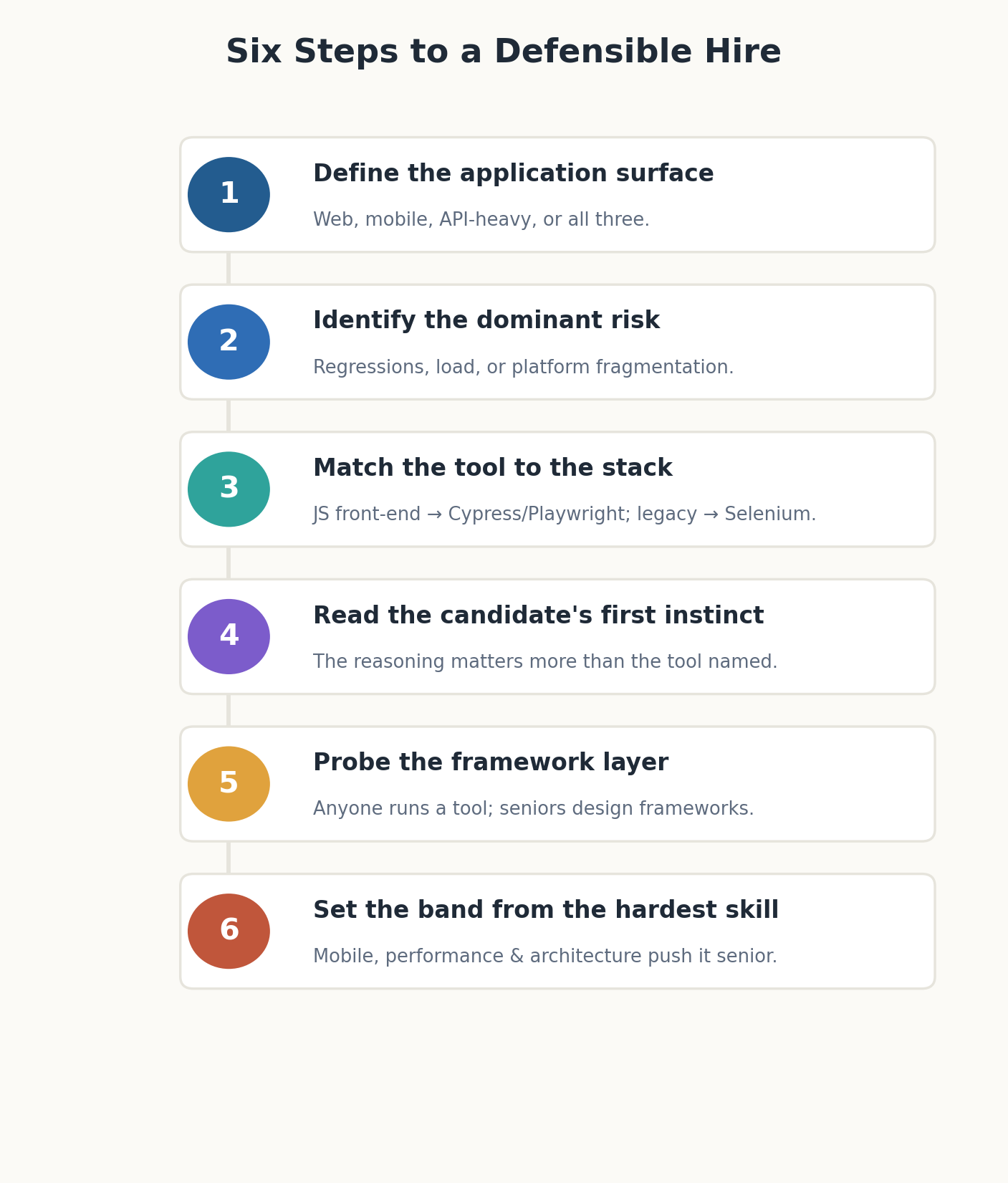
Use this sequence to convert the tool landscape into a defensible level and offer. It is also the list that wins a featured snippet, so it is worth getting right internally:
- Define the application surface. Web-only, mobile, API-heavy, or all three this narrows the tool set before you read a single résumé.
- Identify the dominant risk. Functional regressions, performance under load, or cross-platform fragmentation each point to different primary tools.
- Match the tool to the stack. JavaScript front-end leans Cypress or Playwright; polyglot or legacy enterprise leans Selenium; native mobile requires Appium.
- Read the candidate’s first instinct. Ask what they would choose for a new project and why; the reasoning matters more than the tool named.
- Probe the framework layer. Anyone can run a tool; only senior engineers design maintainable frameworks, CI integration, and reporting around it.
- Set the band from the hardest skill required. Mobile, performance, and framework architecture push the role and the salary into senior territory.
A Decision Framework for Tool, Skill and Seniority
When a table is clearer than prose, use one. The matrix below maps the primary tools to the engineer profile and the seniority you should expect to pay for. It is the fastest reference for anyone preparing to hire QA automation engineer India candidates against a specific stack.
| Tool | Primary use | Typical engineer profile | Seniority signal |
| Selenium WebDriver | Cross-browser web, enterprise/legacy | Polyglot, framework builder | Mid to senior |
| Cypress | Modern JS front-end (React/Vue) | Front-end-adjacent, JS-native | Junior to mid |
| Playwright | Greenfield multi-browser web | Senior, design-minded | Mid to senior |
| Appium | Native / hybrid mobile apps | Mobile specialist | Senior |
| k6 / Gatling | Load & performance testing | Performance engineer | Senior to lead |
The table is a starting filter, not a verdict. A brilliant engineer can cross these boundaries but if a candidate claims all five at expert level on a mid-level salary expectation, that is a flag to probe, not a bargain to grab.
QA Automation Salary 2026: Budgeting the Hire Realistically
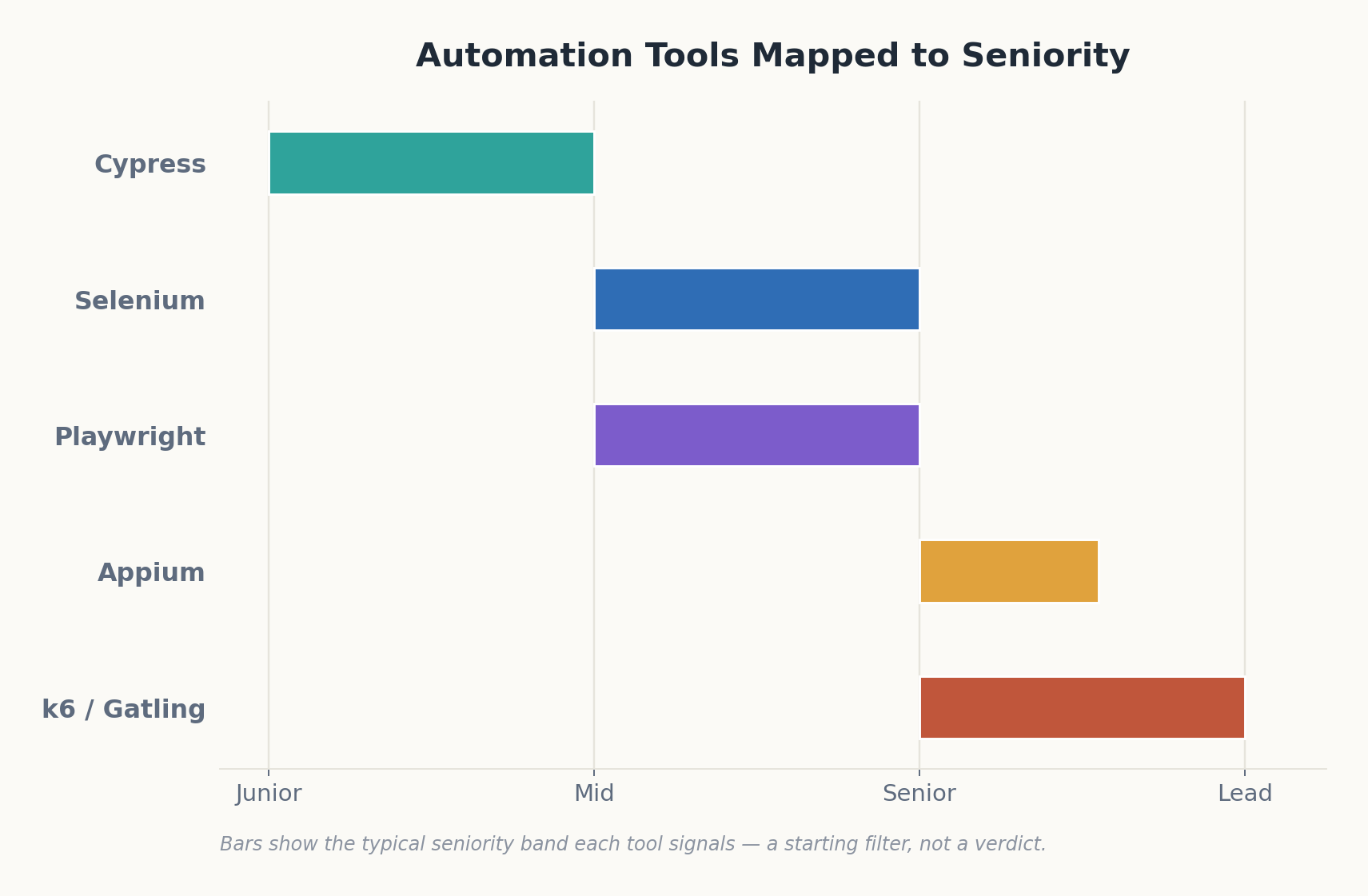
Compensation is where briefs and reality collide most often. The pay picture for these roles in India spreads across a wide band, and anchoring to a single average will either price you out of good candidates or attract the wrong ones. The figures below are CTC ranges drawn from current market data and vary by city, tooling depth, and product complexity.
Entry-level automation engineers (0–2 years) typically land between ₹3.5 — 6 lakhs per annum. At this stage you are paying for scripting ability and the capacity to extend an existing framework, not to design one.
Mid-level engineers (3–5 years) generally fall in the ₹7–14 lakhs range. Glassdoor’s February 2026 data puts the median QA automation engineer around ₹7 lakhs with the 75th percentile near ₹10 lakhs, while strong framework owners push toward the top of the band. This is the most competitive segment of the market.
Senior engineers and SDETs (6–9 years) command roughly ₹16–28 lakhs, with the strongest profiles combining framework architecture, CI/CD ownership, and a second specialism like Appium or k6 at the upper end. Leads and automation architects (10+ years) frequently exceed ₹30 lakhs and can reach ₹45 lakhs or more in product companies.
Two adjustments matter. First, automation engineers consistently earn 50–100% more than manual testers at the same experience level, so do not benchmark against legacy QA salaries. Second, performance testing (k6, Gatling) and SDET-grade development skills carry a distinct premium on top of the bands above. Budgeting without these adjustments is the fastest route to a stalled search. Build the band from the hardest skill the role genuinely requires, and treat the offer as the price of avoiding a rebuild that single reframing changes how most dedicated teams approach the decision to hire QA automation engineer India specialists.
QA Automation Engineer Interview Questions That Reveal Real Skill
A résumé tells you what someone has been near. Strong QA automation engineer skills only surface under questions that force design decisions and trade-offs. Skip the trivia (“what is an implicit wait?”) and ask questions that cannot be memorized. The goal when you hire QA automation engineer India candidates is to watch them reason about trade-offs in real time, because that is the skill that does not show up on a résumé.
Framework and Design Questions
Ask the candidate to walk you through a framework they built from scratch and, critically, what they would change about it now. Engineers who can critique their own past work think in trade-offs. Follow up on how they structured the page object model, handled test data, and kept the suite under a sane runtime through parallel execution.
A revealing prompt: “Your suite of 800 tests takes 90 minutes and 12 of them fail intermittently. Walk me through your first week.” The answer separates people who chase individual flaky tests from those who attack root causes selector strategy, waiting model, environment stability, and test isolation.
Pipeline and Strategy Questions
Probe how they integrate tests into a CI/CD pipeline: when tests run, what blocks a merge, and how they balance fast feedback against coverage. Then ask what they would not automate. Senior engineers have a clear answer: exploratory testing, rapidly changing UI, and one-off checks because they understand automation has a maintenance cost, not just a build cost.
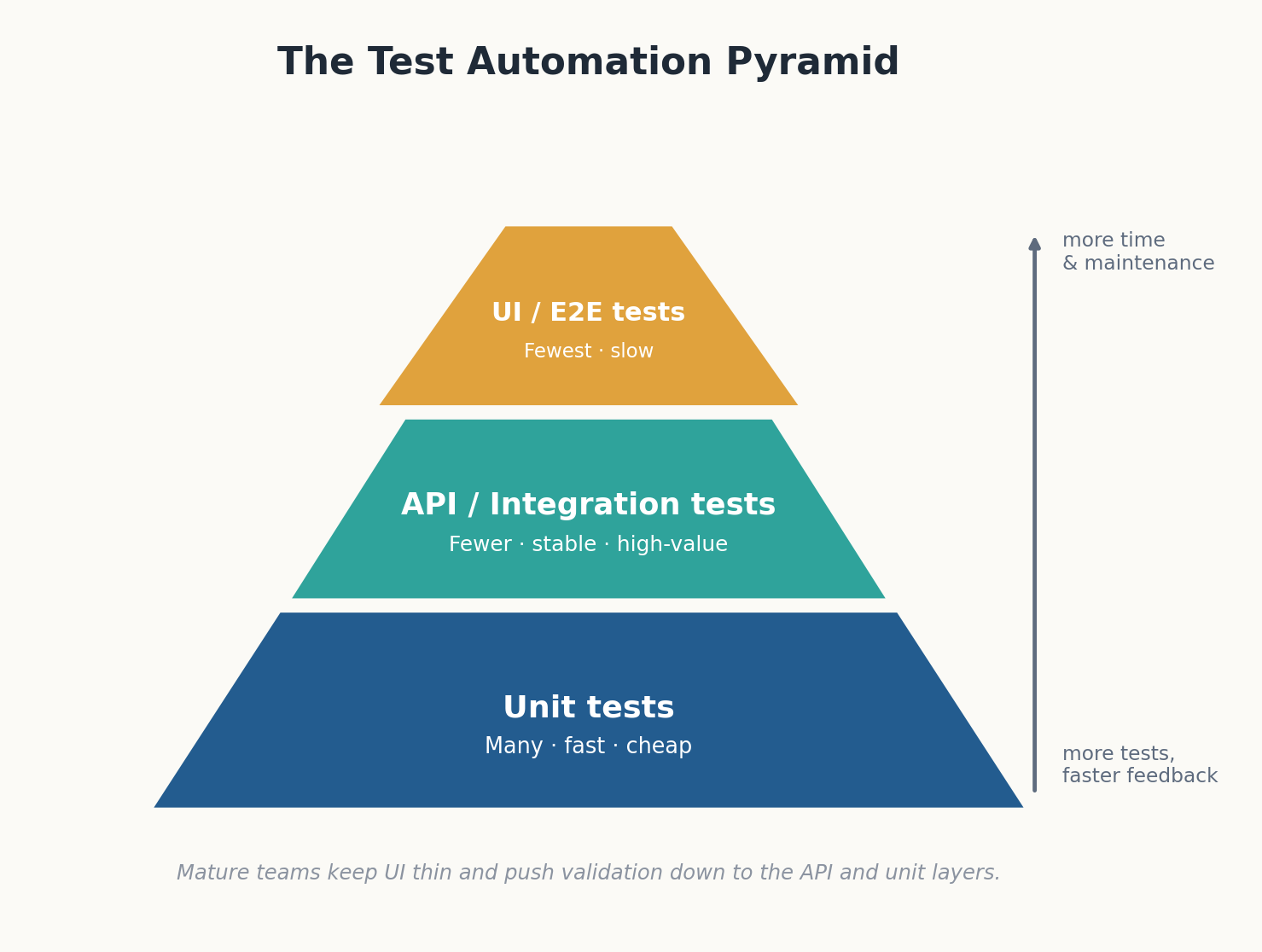
For backend-heavy roles, dig into API testing strategy and where they draw the line between UI and service-level checks. The mature answer favors a heavy API and unit layer with a thin, high-value UI suite, the inverted pyramid that keeps regression testing fast and stable.
Coding and Tool-Specific Questions
For any serious role, include a live or take-home coding exercise. Reviewing real code surfaces hard-coded waits, copy-paste duplication, and weak error handling far faster than conversation. Tailor tool questions to your stack BDD and Cucumber familiarity for business-readable suites, Playwright’s auto-waiting model for modern web, or device-farm strategy for mobile.
Real-World Application: What Good Hiring Produces
A mid-stage fintech running a sprawling, flaky Selenium suite replaced two generalist testers with one senior SDET. Within a single quarter the engineer rebuilt the framework around stable selectors and parallel execution, cut suite runtime from 70 minutes to 18, and pushed reliable signal into every pull request. Release confidence rose enough that the team moved from fortnightly to weekly deployments.
In a second case, a consumer app team struggling with mobile crashes brought in an Appium specialist on a defined three-month scope. By building a real-device test layer covering the top 15 device-OS combinations, they caught a category of gesture-handling defects that had been reaching production for months, reducing crash-related support tickets by an estimated 40% over the following quarter. Both outcomes came from matching the specific skill to the specific risk, not from hiring more headcount. In each case the team chose to hire QA automation engineer India talent against a clearly named problem, which is why a single well-placed engineer outperformed a larger, vaguer team.
What Most Teams Get Wrong
The most common and costly error is hiring for tools instead of for design ability. A team will reject a strong engineer because their résumé says Selenium when the stack is Cypress, then hire a weaker Cypress user and discover six months later that the weaker engineer built an unmaintainable suite. A capable framework architect learns a new tool in weeks; framework judgment takes years and does not transfer in a quick course. The lesson for anyone about to hire QA automation engineer India talent is to weigh design ability over tool-name matching every time the two conflict.
The second mistake is treating automation as a cost center to minimize rather than an engineering function to IT staffing properly. Teams that lowball the role get junior output, accumulate flaky tests, lose trust in their pipeline, and eventually rip the whole suite out paying twice. The cheap hire is almost always the expensive one.
The third, more subtle error is automating the wrong things. Insider pattern: the teams with the highest automation maturity automate less of the UI than their peers, not more. They push validation down to the API and unit layers, keep a thin and deliberate UI suite, and reserve human attention for exploratory work. When you interview, the candidates who instinctively want to automate everything are usually the ones who have not yet maintained a large suite through a year of product change.
In-House, Freelance, or Agency: Choosing the Engagement Model
The hiring conversation usually fixates on the candidate and skips the question that determines half the outcome of how you engage them. The right model depends on whether your automation needs is a one-time build or a permanent capability, and getting this wrong wastes the budget regardless of how strong the individual is.
A full-time in-house hire is the correct call when automation is woven into your release cadence and the suite needs continuous maintenance. Frameworks are living systems: selectors break, the application evolves, and the CI/CD pipeline changes. Someone has to own that drift, and a contractor who disappears after the build leaves you with an orphaned suite that degrades within months.
A freelance or contract developer fits sharply scoped, deliverable-bound work building a framework from scratch, standing up a mobile test layer, or running a focused performance testing audit with k6. The trap is using a short-term contractor for what is structurally a long-term responsibility, then watching regression testing coverage erode the moment they roll off.
An agency or partner model suits teams that need senior judgment without committing to a permanent senior salary, or that want a vetted shortlist rather than a months-long open search. The strongest pattern many teams adopt is hybrid: bring in senior expertise to architect the framework and define the standards, then hire a mid-level engineer in-house to maintain and extend it. This is frequently the most cost-effective way to hire QA automation engineer India capability, because you pay senior rates only for the work that genuinely demands them. Whichever route you choose, anchor it to the duration of the need, not the urgency of the moment, urgency pushes teams toward whoever is available, and availability is a poor proxy for fit.
Frequently Asked Questions
How much does it cost to hire a QA automation engineer in India?
Expect ₹3.5–6 lakhs for entry level, ₹7–14 lakhs at mid level, and ₹16–28 lakhs for senior engineers and SDETs, with leads and architects often above ₹30 lakhs. Costs rise with mobile, performance, or framework-architecture requirements, and automation engineers earn well above manual testers at equivalent experience, so benchmark accordingly. Most teams that hire QA automation engineer India professionals find that tooling depth and seniority, not city alone, drive the final number.
Is Selenium or Cypress better for test automation?
Neither is universally better; they suit different stacks. Cypress excels for modern JavaScript front-ends with fast, reliable in-browser execution, while Selenium offers broader language and browser support for polyglot or enterprise systems. For new web projects, Playwright increasingly wins by combining wide browser coverage with a strong developer experience. Match the tool to your application, not to hype.
What skills should a QA automation engineer have?
Beyond a specific tool, look for solid programming fundamentals, framework design ability, CI/CD integration experience, and a clear testing strategy that decides what to automate. The page object model, API-level testing, and version-controlled, reviewed test code separate genuine engineers from script recorders. Judgment about trade-offs matters more than the length of the tool list.
What is the difference between an SDET and a QA automation engineer?
An SDET (Software Development Engineer in Test) is effectively a developer whose product is the testing infrastructure they build tooling, frameworks, and harnesses and often contribute to application code. A QA automation engineer focuses primarily on designing and maintaining test suites. SDET roles sit at the senior end of the band and command correspondingly higher compensation.
Should you hire a freelance or full-time QA automation engineer?
Freelance or contract hires fit time-boxed work, a framework build, a mobile suite, or a performance audit with a clear deliverable. Full-time hires make sense when automation is continuous and embedded in your release cadence, because framework maintenance is ongoing rather than one-and-done. Many teams use a senior contractor to establish the framework, then a full-timer to maintain and extend it. As a rule of thumb, if you plan to hire QA automation engineer India talent for a long-lived product, default to full-time and reserve contractors for the initial build.
How long does it take to hire a QA automation engineer?
For a well-scoped mid-level role, a focused search typically runs 3–6 weeks from brief to offer; senior SDET and specialist roles often take 6–10 weeks given the thinner candidate pool. The fastest path is a tight, stack-specific brief and a practical coding evaluation rather than a broad keyword-driven posting that attracts volume over fit.
Before You Hire QA Automation Engineer India Talent
If you are about to hire QA automation engineer India talent and want to pressure-test your approach before signing an offer or a vendor contract, the highest-leverage move is to validate the brief first: the right stack, the right seniority band, and an evaluation that tests design judgment rather than tool trivia. Teams that define the problem precisely naming the application surface, the dominant risk, and the hardest skill the role genuinely requires hire faster and keep their suites green far longer than teams that lead with a salary figure and a list of tools.
A practical next step costs nothing but an afternoon: take the framework in this guide and run your own situation through it. Map your current stack, your release cadence, and your biggest quality risk to a seniority band and a budget before you talk to a single candidate. That exercise alone surfaces most of the mismatches that derail a search later, and it sharpens every conversation you have with a recruiter, an agency, or a candidate.
If you would rather pressure-test that mapping against engagements that have already been through it across web, mobile, and performance-critical products the worked examples and the scoping-and-vetting approach behind this guide are documented at supersourcing.com. And if it is simpler to just talk it through, you can write to Mayank directly at mayank@engineerbabu.com: bring your stack and your timeline, and the goal of the conversation is to sanity-check the brief, not to sell you a headcount. Either way, the decision to hire QA automation engineer India professionals gets easier once the problem is defined as precisely as the people you are trying to hire.
