

India added more than 16 new Global Capability Centers in a single quarter of 2026, and a striking share of them opened with a quality-engineering pod as one of the first functions stood up. That ordering is the tell. Testing used to be the last hire on a roadmap; now it is among the first, because release velocity without a quality gate is just faster failure.
For engineering leaders outside India, the math has shifted from “should we” to “how fast.” The talent depth, the cost spread, and the working-hours overlap with Western teams have made the country the default answer for scaling test capacity, and the operational question for anyone planning to build QA team India units is now one of design rather than feasibility. The harder question is structural: who do you hire first, which tools actually earn their license cost, and what does a credible team really run per month once you load in management and infrastructure?
This guide answers those three questions directly. The plan to build QA team India capacity well is less about finding cheap testers and more about sequencing roles, picking a sane toolchain, and budgeting for the full cost rather than the headline rate. Get the sequence wrong and you end up with five manual testers and no automation strategy, watching regression cycles balloon. Get it right and a small pod can hold quality for a product shipping weekly.
What follows is a working blueprint: the role architecture, a tool stack chosen with reasoning rather than brand loyalty, fully-loaded cost breakdowns for 3, 5, and 8-person pods, and the quiet mistakes that inflate budgets. The first decision team shape drives every number after it, which is why leaders who build QA team India structures around a clear architecture consistently spend less for more coverage.
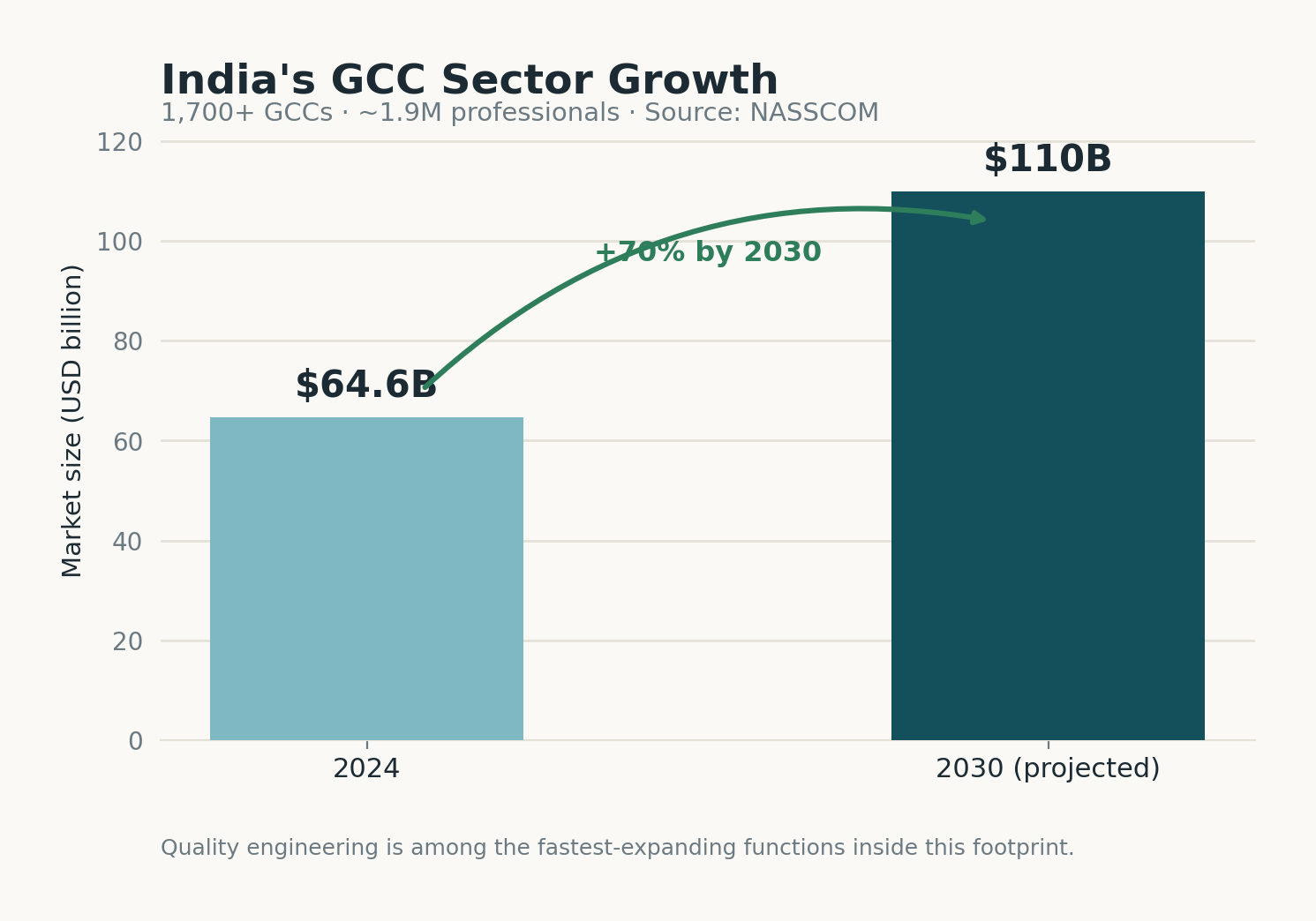
Data point worth anchoring on: India’s Global Capability Center sector now spans over 1,700 GCCs employing roughly 1.9 million professionals, and is projected to grow from $64.6 billion in 2024 to about $110 billion by 2030. Quality engineering is one of the fastest-expanding functions inside that footprint.
What It Means to Build a QA Team in India
To build QA team India capacity is to assemble a remote quality-engineering unit typically a QA Lead, manual testers, and automation engineers that owns test strategy, execution, and release sign-off for a product, operating from India under a direct-hire, captive GCC, or augmentation model. It is a delivery structure, not a single hire.
That definition matters because “QA” still gets used loosely. Some teams mean one tester clicking through screens before a release; others mean an engineering discipline with automation coverage, CI integration, and defect analytics. The model you choose decides which one you get, and most regret choosing the first by accident.
The Real Challenge Isn’t Cost It’s Sequencing and Scope
Leaders almost always underestimate the ramp, not the rate. The instinct is to hire the cheapest testers available and add structure later. In practice that gets the order backwards and costs more, which is why the teams that build QA team India pods successfully start with architecture, not headcount.
Here is the uncomfortable pattern. A team hires three manual testers because they are inexpensive, ships for two quarters, then discovers regression takes four days of manual clicking before every release. Now they need automation engineers, but there is no framework, no CI hooks, and no one who designed the test architecture. The rework to retrofit automation onto an ad-hoc manual suite routinely runs three to four times the cost of building it correctly from the start.
The second misjudgment is scope. A pod that is told to “test the app” with no defined coverage targets, no defect-density baseline, and no ownership of the pipeline drifts toward low-value, repetitive checking. Without scope, headcount grows while quality metrics stay flat, the worst possible outcome to defend at a budget review. Defining scope before you build QA team India capacity is the cheapest control available. This is the single most common reason a remote QA team India initiative stalls in its second quarter.
Timelines get compressed in people’s heads too. A functioning pod will not live in two weeks. Sourcing, technical screening, notice periods (still 30 to 60 days for many Indian candidates), onboarding, and the first stable automation suite realistically take three to four months for a direct-hire build. Augmentation compresses that, but not to zero. Planning for two weeks and getting four months is how QA initiatives lose executive support before they prove value.
There is also a quality-of-hire trap. Because the rates look low from a Western vantage point, buyers sometimes skip rigorous technical screening and assume any tester will do. The cost of a weak QA Lead is not their salary it is six months of misdirected automation work. Treating the build as an architecture decision rather than a procurement exercise is what separates the pods that pay back from the ones that quietly bloat. That architecture starts with roles.
How to Build a Remote QA Team in India: Roles, Tools, and Cost Architecture
This is where most of the leverage lives. A well-shaped pod of five can out-deliver a poorly-shaped pod of ten, because the constraint in QA is rarely hands-on strategy, automation coverage, and clean handoffs. Leaders who build QA team India units around this principle treat every hire as a multiplier on the ones before it.
The Core QA Team Structure
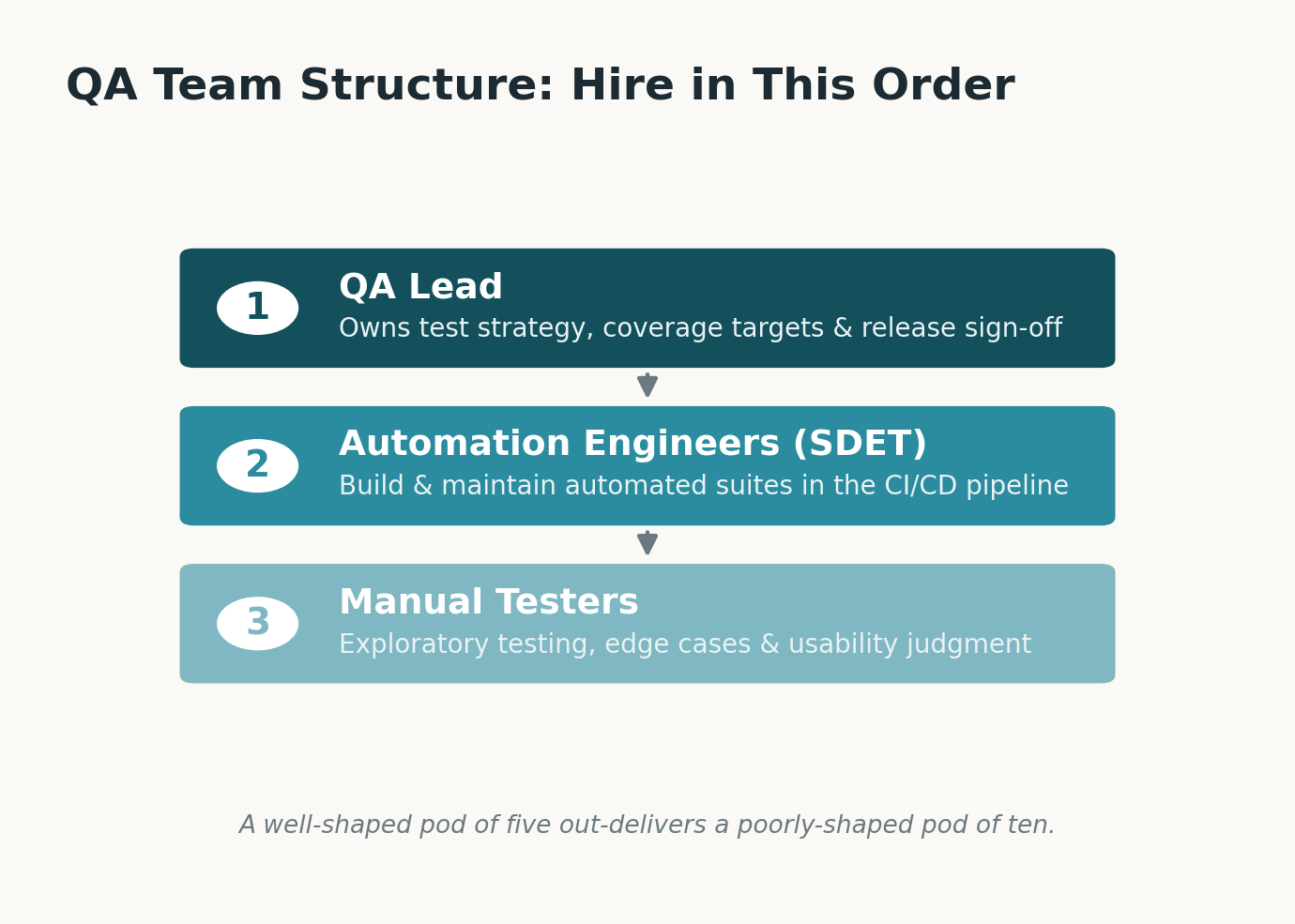
A durable QA team structure has three layers, and you staff them in this order of priority rather than all at once.
The QA Lead is the first and most important hire. This person owns test strategy, defines coverage targets, designs the automation architecture, runs release sign-off, and is the single point of accountability to engineering and product. Hiring testers before a lead is the most common sequencing error; it produces activity without direction. A strong lead in India typically carries 8–12 years of experience and commands a meaningfully higher band than the rest of the pod, which is exactly right.
Automation engineers often titled SDET, software development engineers in test build and maintain the automated test suites that make weekly or daily releases survivable. They write code, integrate tests into the build, and own flakiness, parallelization, and run times. These engineers earn 50–100% more than manual testers in the Indian market, per salary benchmarks compiled for 2026, and that premium is the best money in the budget, because every reliable automated check removes recurring manual cost forever.
Manual testers still matter, and dismissing them is its own mistake. They own exploratory testing, edge cases, usability judgment, and the new-feature verification that has not yet been automated. The goal is not zero manual work; it is manual effort pointed at what humans do better than scripts, with everything repeatable pushed into automation. A balanced pod typically runs more automation engineers than manual testers as it matures, but rarely zero of either, and getting that balance right is most of what it takes to build QA team India pods that actually reduce release risk.
A Sane Tool Stack Chosen by Reasoning, Not Brand
Tooling decisions should follow team shape, not the other way round. Here is a defensible default stack and why each piece is on it. Teams that build QA team India toolchains around this list rather than around whatever a vendor is reselling tend to spend less and break less.
- Test management: TestRail or Zephyr to hold test cases, runs, and traceability. Without this, coverage is a guess.
- Automation framework (web): Playwright for new builds, Selenium where an existing suite or broad legacy-browser support already exists. Playwright’s auto-waiting and parallelism cut flakiness and run time materially.
- API testing: Postman/Newman or RestAssured, wired into the pipeline so contract checks run on every commit.
- Mobile: Appium for cross-platform native coverage, with a device cloud such as BrowserStack or LambdaTest instead of a physical device lab.
- CI/CD integration: Tests must run inside the CI/CD pipeline GitHub Actions, GitLab CI, or Jenkins. Automation that only runs on someone’s laptop is not automation.
- Defect tracking and analytics: Jira plus a simple defect density and escape-rate dashboard so quality is measured, not asserted.
The reasoning thread across all of it: invest in test automation infrastructure early, use a managed device cloud to avoid capex, and make test coverage and defect metrics visible so the pod is judged on outcomes rather than activity.
Cost Breakdown: 3, 5, and 8-Person Pods
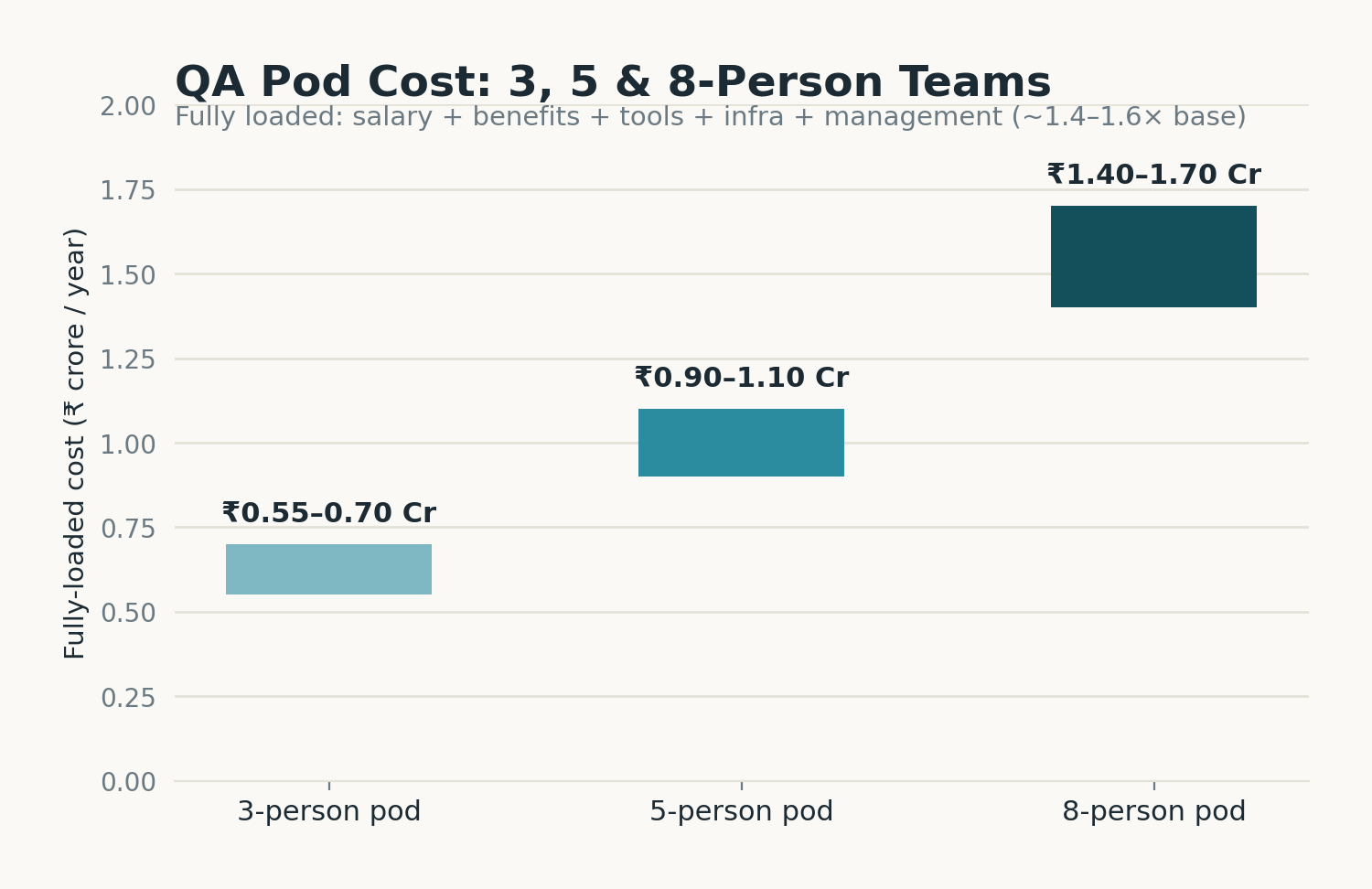
Now the numbers leaders actually want. These are fully-loaded annual ranges for a dedicated team India built in-house or via a captive GCC base salary plus benefits, infrastructure, tools, and management overhead, which together run roughly 1.4 — 1.6× base pay. For context, Indian QA salaries run from about ₹3–10 LPA for manual testers up to ₹8–28 LPA for senior automation and SDET roles, with leads higher. These bands are the starting point whenever you build QA team India budgets from scratch.
3-person pod 1 QA Lead, 1 manual tester, 1 automation engineer. This is the minimum credible unit: enough to own strategy, run exploratory testing, and stand up a first automation suite. Fully-loaded budget lands around ₹55–70 lakh per year, roughly ₹4.5–5.8 lakh per month. Below three people you do not have a team; you have a tester with no backup.
5-person pod 1 QA Lead, 2 manual testers, 2 automation engineers. The sweet spot for a single product shipping on a regular cadence; automation depth improves and manual coverage widens. Fully-loaded budget is roughly ₹90 lakh–1.1 crore per year. This is the configuration most mid-market teams should model first when they build QA team India capacity for a single core product.
8-person pod 1 QA Lead, 1 senior SDET, 3 automation engineers, 3 manual testers. This supports multiple workstreams or a platform with several services, with enough automation capacity for genuine continuous testing. Fully-loaded budget is roughly ₹1.4 — 1.7 crore per year.
If you instead hire QA team augmentation through a vendor on a blended monthly rate, the framing changes: you pay a per-engineer monthly rate that already includes infrastructure, benefits, and a managed-delivery layer. As a planning band, an augmented pod runs roughly $8,000–15,000/month for three people, $13,000–24,000 for five, and $20,000–38,000 for eight, depending on seniority mix and city. Independent benchmarks put mid-size SaaS QA-outsourcing spend at $6,000–12,000 per month for a small dedicated pod, which aligns with the lower end here.
Why the Offshore QA Team Cost Math Holds
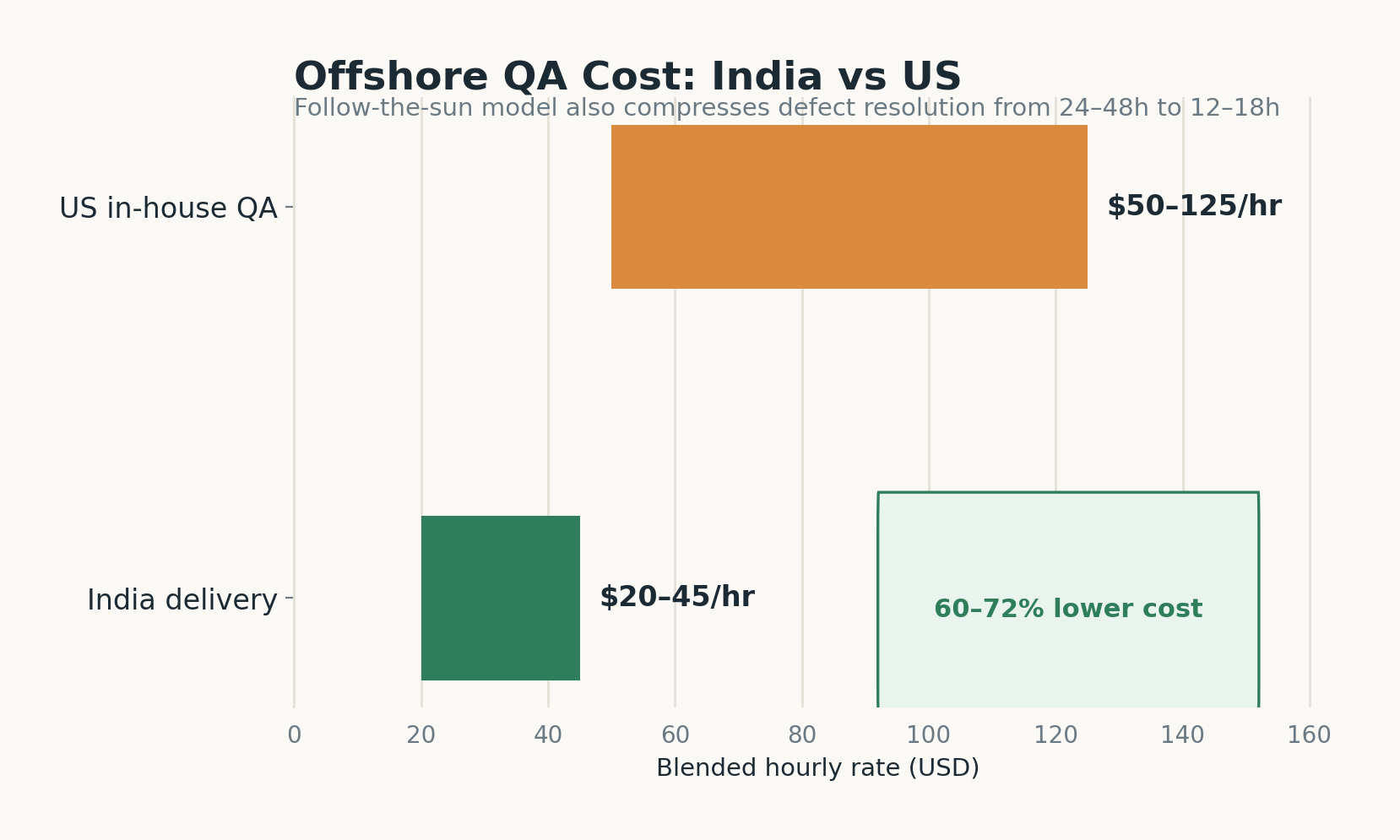
The reason these figures attract Western buyers is the spread against home-market rates. The headline offshore QA team cost advantage is real: QA engineers in the US bill roughly $50–125 per hour, while comparable India delivery sits around $20–45 per hour, and analyses of QA outsourcing to India report 60–72% cost reductions versus US in-house teams.
Two structural advantages compound that. India’s follow-the-sun model, a 9.5 to 12.5-hour offset from US business hours, lets test suites run overnight and deliver results by the next standup, compressing defect resolution from 24–48 hours toward 12–18. And salary escalation has cooled to about 7% in 2026, which means predictable budgeting rather than the volatile spikes of 2021–22. Predictability, not just the rate, is why finance teams sign off on India when they build QA team India budgets for multi-year products.
How Long the Ramp Actually Takes
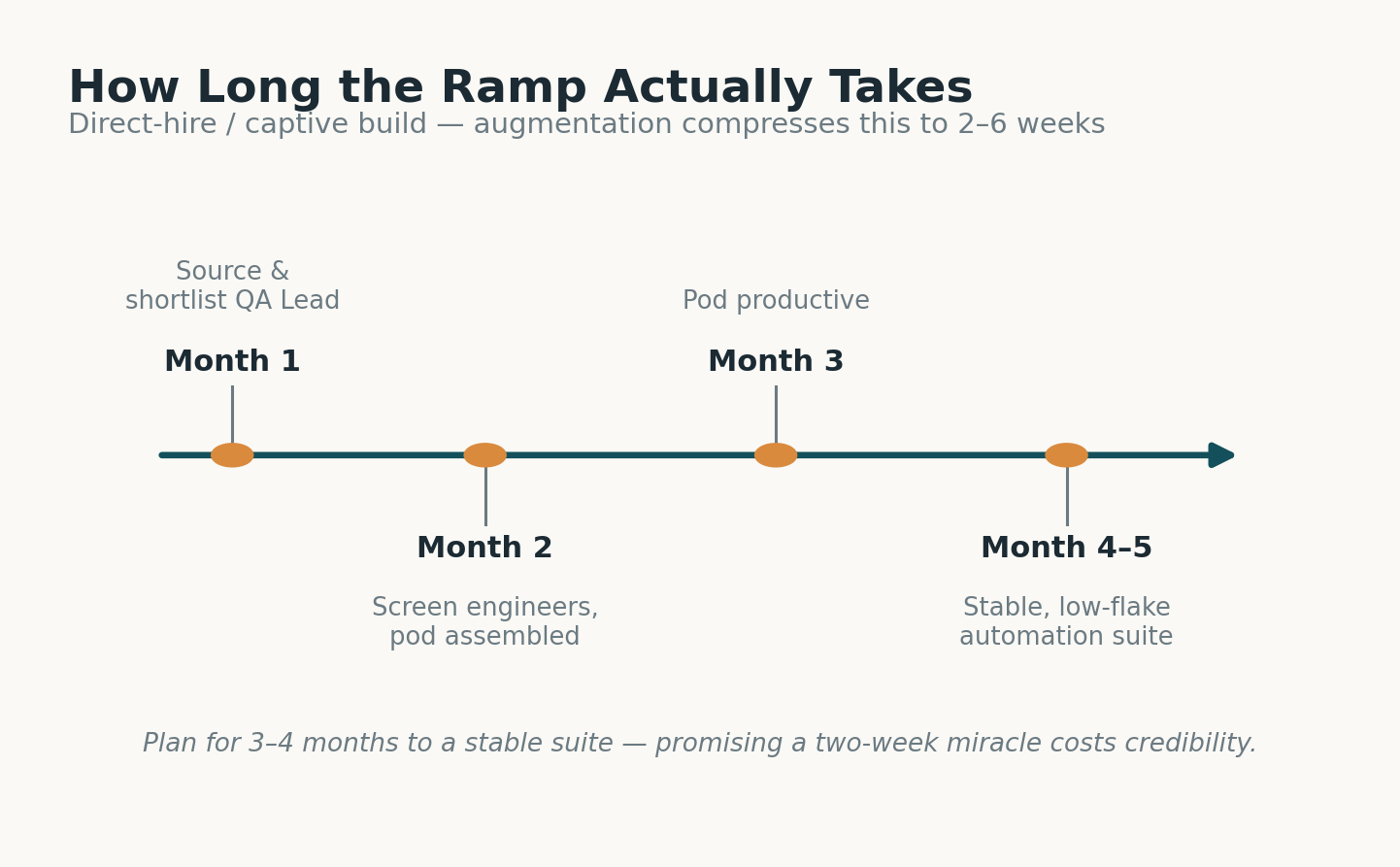
A realistic timeline keeps expectations honest. Sourcing and shortlisting a QA Lead takes two to four weeks; technical screening of engineers another two to three. Factor in 30–60 day notice periods, and a direct-hire pod is typically assembled by month two to three, productive by month three to four, and running a stable, low-flakiness automation suite by month four to five.
Augmentation collapses much of that because the talent and infrastructure already exist; a vendor can field a pod in two to six weeks. The trade is that you inherit their hiring standard, so the screening rigor moves from you to them and must be verified. Either way, teams that build QA team India pods and plan around these windows avoid the credibility hit that comes from promising a two-week miracle.
Metrics That Prove the Pod Is Working
Headcount is an input, not a result. Judge a pod on regression testing cycle time, escaped-defect rate, automation coverage of critical paths, and defect density per release. A pod that cuts regression from days to hours and drives escaped defects down quarter over quarter is earning its budget regardless of how many test cases it logs. Making these numbers visible from week one is the cheapest insurance you can buy when you build QA team India capacity, because it turns budget conversations into evidence rather than opinion, and it is what lets you defend the decision to build QA team India capacity quarter after quarter.
Compliance and Integration You Cannot Skip
For regulated products, scope data handling before the first test runs. A pod testing healthcare, fintech, or EU-resident data needs clarity on test-data masking, access controls, and where test environments are hosted, mapped to HIPAA, PCI-DSS, or GDPR as applicable. Retrofitting compliance into a live test environment is painful; designing for it upfront costs almost nothing and prevents an audit scramble later, and it is a step the most disciplined teams bake in before they build QA team India environments at all.
Real-World Application
Two anonymized patterns illustrate the difference sequencing makes.
A North American fintech SaaS company stood up a five-person captive in India, leading with a senior QA Lead and two automation engineers before adding manual capacity. Within four months the team had automated the core regression suite, cutting a previously three-day manual regression cycle to under four hours and enabling weekly releases that had previously slipped to monthly.
A mid-market e-commerce platform took the augmentation route to handle seasonal load. By scaling an offshore pod from three to seven engineers in roughly six weeks for a peak season and scaling back afterward they absorbed a traffic surge without permanent headcount, and reported test-execution cost per release falling by more than half against their prior onshore arrangement, a result that came directly from how deliberately they chose to build QA team India coverage for peak load. Both outcomes came from how they chose to build QA team India structures, not from finding unusually cheap testers.
Decision Framework: Augmentation vs. Captive GCC vs. Direct Hire
The model you pick should follow your time horizon and control needs, not just the lowest sticker price.
| Model | Time to productive | Control & IP | Best when |
| QA team augmentation | 2–6 weeks | Vendor-managed delivery | You need speed, flexible scaling, or a pilot before committing |
| Captive GCC pod | 3–6 months | Full, in-house | QA is core, long-term, and you want to own the talent and roadmap |
| Direct remote hire | 3–4 months | Full, but you carry HR/ops | You want control without a registered entity and can manage payroll/EOR |
A common and sensible play is to start with augmentation to validate scope and quality, then convert the proven pod into a captive structure once the function is core. That sequence buys speed early and ownership later, without betting the whole budget on day one and it is how a surprising number of GCCs first build QA team India pods before formalizing them.
What Most Teams Get Wrong
The recurring failure is treating QA as an IT staffing problem when it is an engineering-architecture problem. Teams optimize for the lowest per-head rate, fill the pod with manual testers, and then wonder why velocity does not improve. Cheap hands without a test strategy produce more clicking, not more quality.
The second mistake is hiring the lead last. When automation engineers arrive before someone owns the test architecture, they build locally-scoped suites that do not compose, and six months later the “automation” is a pile of brittle scripts no one trusts. The lead is the hire that makes every subsequent hire worth more, which is why disciplined teams build QA team India pods from the top of the org chart down.
Third, almost everyone under-budgets the non-salary load. Base pay is the visible number; infrastructure, device clouds, tool licenses, attrition backfill, and management overhead are the 35–45% the sticker rate hides. Budgeting on base salary alone is how a pod that looks affordable becomes a quarterly overrun.
Fourth, teams forget that attrition is real and plan as if every hire is permanent. India’s QA market is competitive, and a pod with no backfill plan loses project knowledge the moment a key engineer leaves. Building a thin layer of redundancy and documentation into the QA staff augmentation or captive plan from the start is far cheaper than the months-long ramp of an unplanned replacement.
The teams that get it right do the unglamorous things: hire the lead first, fund automation infrastructure before scaling manual headcount, define coverage and defect targets on day one, and measure the pod on escaped defects and cycle time rather than test-case count. None of that is exotic. It is just sequenced correctly, and it is exactly how the strongest QA pods for GCCs are assembled.
Frequently Asked Questions
How much does it cost to build a QA team in India?
Fully-loaded, a 3-person pod runs roughly ₹55–70 lakh per year, a 5-person pod ₹90 lakh–1.1 crore, and an 8-person pod ₹1.4 — 1.7 crore figures that include benefits, tools, infrastructure, and management, not just salary. Via vendor augmentation, expect roughly $8,000–38,000 per month depending on size and seniority. Against US in-house teams, total savings commonly land at 60–72%, which is the core reason cost-conscious leaders build QA team India pods in the first place.
What roles do you need in a QA team?
At minimum, a QA Lead who owns test strategy and sign-off, automation engineers (SDETs) who build and maintain automated suites, and manual testers for exploratory and edge-case work. The order of hiring matters as much as the mix: lead first, then automation, then manual capacity as coverage demands grow. A common ratio at maturity is more automation engineers than manual testers, anchored by a single accountable lead. The sequence matters more than the count when you build QA team India structures.
Is it cheaper to outsource QA to India?
Usually yes on a pure-rate basis India QA delivery runs about $20–45 per hour versus $50–125 in the US but the honest answer accounts for total cost of outcome. Once you add management overhead and the cost of asynchronous communication, real savings are strong but smaller than the headline rate, typically still well above 50% for a well-run engagement, which is why so many firms decide to build QA team India teams rather than staff onshore.
How long does it take to set up a remote QA team?
A direct-hire or captive build realistically takes three to four months once you account for sourcing, screening, 30–60 day notice periods, onboarding, and standing up a first stable automation suite. Augmentation through an existing vendor compresses that to two to six weeks because the talent and infrastructure already exist, so the speed to build QA team India capacity depends heavily on the model you choose.
What is the difference between QA team augmentation and a managed QA team?
Augmentation places engineers into your team and processes you direct the work and own delivery. A managed QA team takes outcome ownership: the vendor owns the test strategy, staffing, and quality metrics against an agreed scope. Augmentation gives you control; management gives you offloaded accountability. Many teams start with augmentation and graduate to managed or captive as QA matures, refining how they build QA team India delivery as the function proves its value.
How do you manage a remote QA team across time zones?
Use the offset as an advantage rather than fighting it. India’s overnight overlap supports a follow-the-sun model where suites run while your team sleeps and results arrive by the next standup. Define clear written handoffs, keep one to two hours of live overlap for blockers, and measure on outcomes escaped defects and cycle time rather than presence. Run this way, the time-zone gap becomes the strongest argument to build QA team India coverage rather than the weakest.
What tools should an offshore QA team use?
A defensible default is a test-management layer (TestRail or Zephyr), Playwright or Selenium for web automation, Appium plus a device cloud for mobile, API testing wired into CI, and Jira with a defect-density dashboard. The non-negotiable is that automation runs inside the CI/CD pipeline, not on individual machines. This stack is the same one most teams reach for when they build QA team India automation from a clean slate.
Before You Commit, Pressure-Test the Plan
If you are evaluating how to build QA team India capacity and want to validate the role mix, tool stack, and cost model before you sign with a vendor or open a captive entity, the highest-leverage step is to map your release cadence and coverage gaps to a specific pod shape first. The difference between a 3-person and an 8-person pod is not headcount, it is what you are actually trying to protect at release.
Run that mapping before you write a single job description. Most overruns trace back to a pod sized by budget rather than by risk: teams approve five seats, fill them with whoever is available, and only later discover they needed one senior SDET and a sharper coverage target instead of three more pairs of hands. A short look at your release frequency, your current escaped-defect rate, and the parts of the product that simply cannot break is usually enough to tell you whether three, five, or eight is the right number and, more importantly, which role to hire first.
The plan to build QA team India structures that hold up under weekly releases comes down to sequencing the lead first, funding automation before manual scale, and budgeting the full load rather than the sticker rate. If you want a second set of eyes on your specific numbers and team shape before committing, Supersourcing has run this scoping process across dozens of engagements and can pressure-test your approach in a short working session. Send the shape of your product and your release cadence to mayank@engineerbabu.com, or start at supersourcing.com no pitch, just a straight read on whether your pod plan holds up before you spend on it.
