

A senior software engineer hired in India has a median time-to-hire of 41 days and that figure does not include the 60-to-90-day notice period the candidate still has to serve before writing a single line of your code. Stack those together and a “two-month” plan quietly becomes a five-month reality. That gap is the single most misunderstood number in tech hiring timelines India, and it derails roadmaps in nearly every engineering org that scales here.
Most hiring plans are built on the interview calendar first round, technical round, and offer. But the calendar that actually governs delivery is the one that ends when an engineer commits production code, not the one that ends when they sign. The distance between those two dates is where budgets slip and launch windows close.
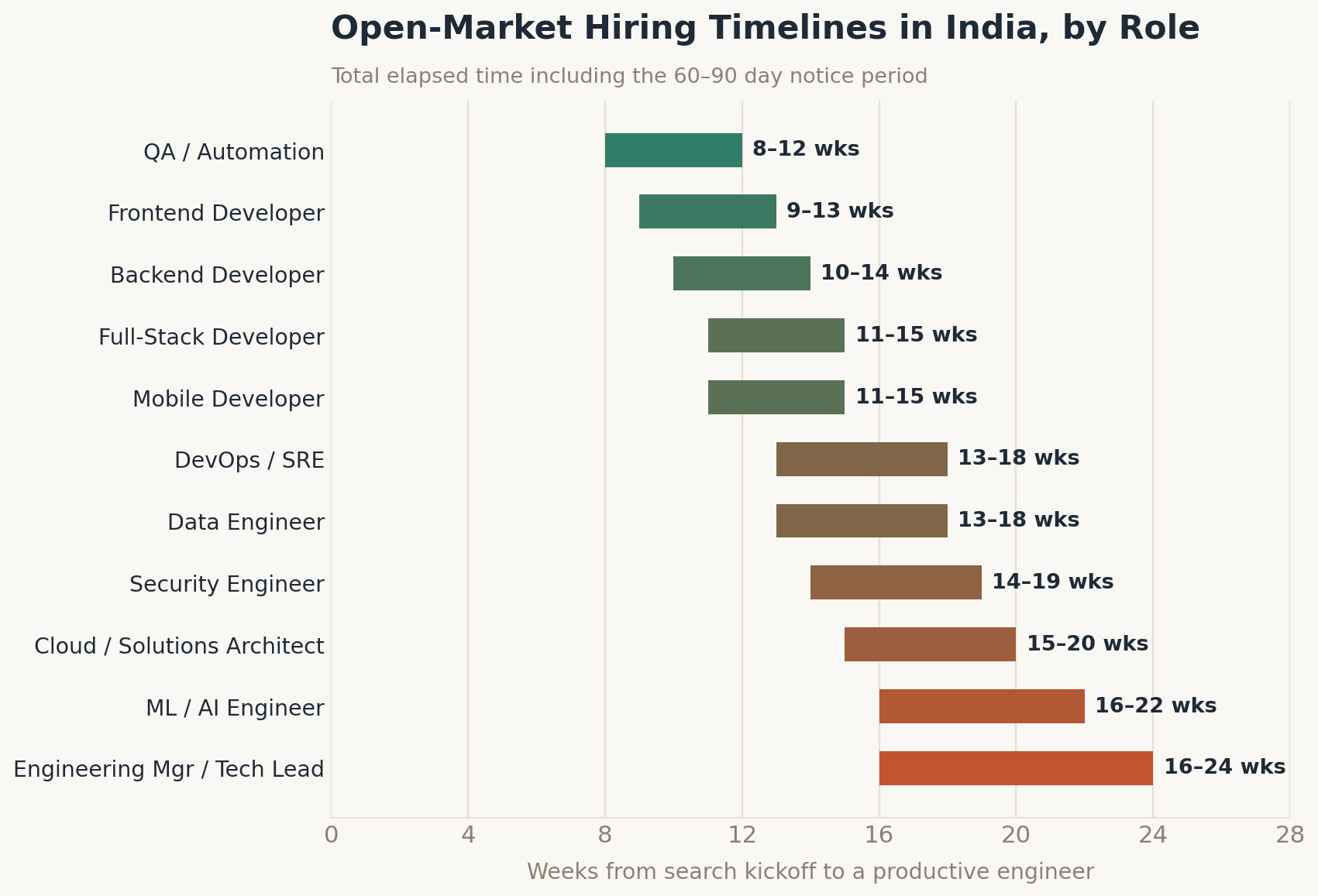
India’s technical hiring market is currently defined by elongated recruitment cycles. Filling standard engineering roles takes 8 to 14 weeks, while specialized positions (e.g., AI/ML) require up to 18 weeks. These longer timelines are driven by mandatory notice periods, rigorous technical assessments, and an emphasis on highly specific skills.
This article breaks down realistic timelines role by role, explains exactly where the weeks disappear, and shows how teams compress months into days without lowering the bar. The numbers below come from open-market benchmarks and live placement data, not optimistic vendor brochures.
The reason this matters now is supply. India’s developer population crossed an estimated six million in 2026, fed by more than 1.5 million STEM graduates a year yet the competition for genuinely production-ready, senior engineers has never been fiercer. Abundant supply at the entry level coexists with acute scarcity at the top, and that split is exactly what makes tech hiring timelines India so counterintuitive: there are millions of résumés and still a months-long wait for the right hire.
What “Time to Hire” Actually Means in India
Tech hiring timelines India refers to the total elapsed time from the moment a role opens to the day the hired engineer is productive spanning sourcing, screening, interviews, offer negotiation, the notice period served at the previous employer, and onboarding ramp. It is not the interview-to-offer window alone.
That distinction matters because two of the largest delays, the notice period and the onboarding ramp, sit entirely outside the interview process most teams track. Measure only what you can see in your applicant tracking system, and you will underestimate the real number by weeks.
The Core Problem: Teams Underestimate Timelines by 2–3x
The planning error is consistent and predictable. A hiring manager budgets four to six weeks because that is roughly how long interviews take, then discovers the real time to hire a developer India figure runs three to four months once notice periods and ramps are added in.
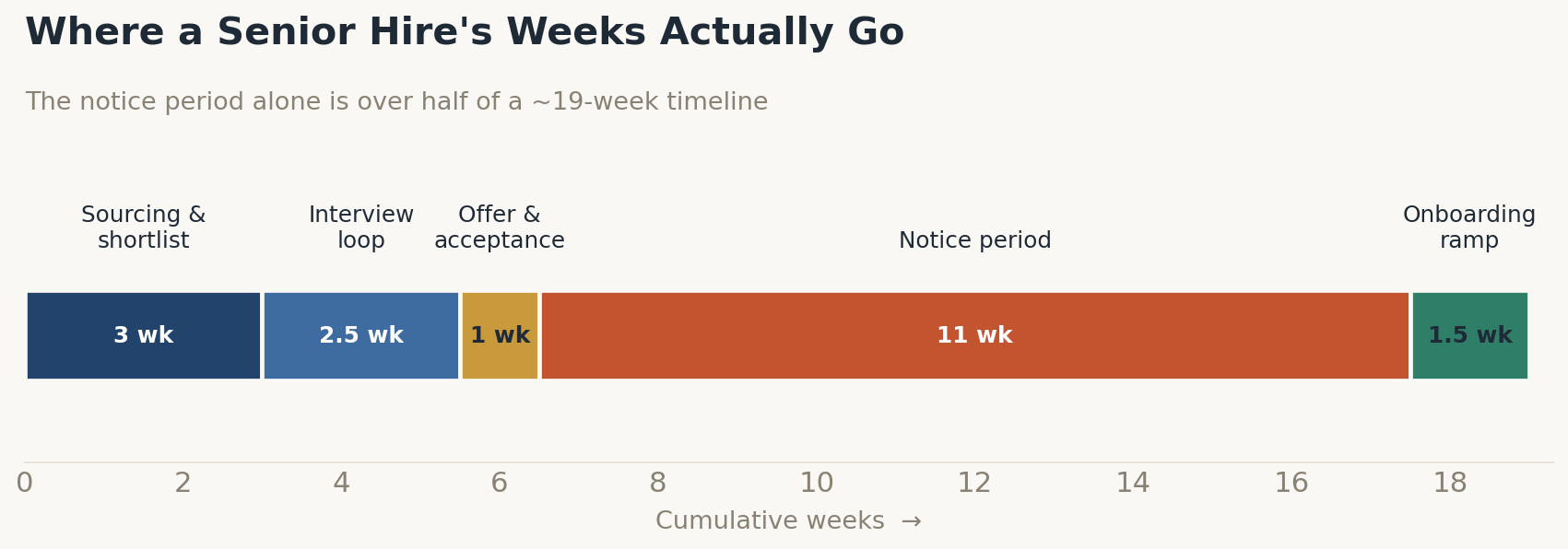
Here is where the weeks go. Sourcing and shortlisting a quality candidate in a competitive market takes two to four weeks. Interview loops add another two to three. Offer negotiation and acceptance burn several days to a week, often longer when counteroffers enter the picture. Then the notice period, the dominant variable, adds 60 to 90 days for most mid-to-senior engineers.
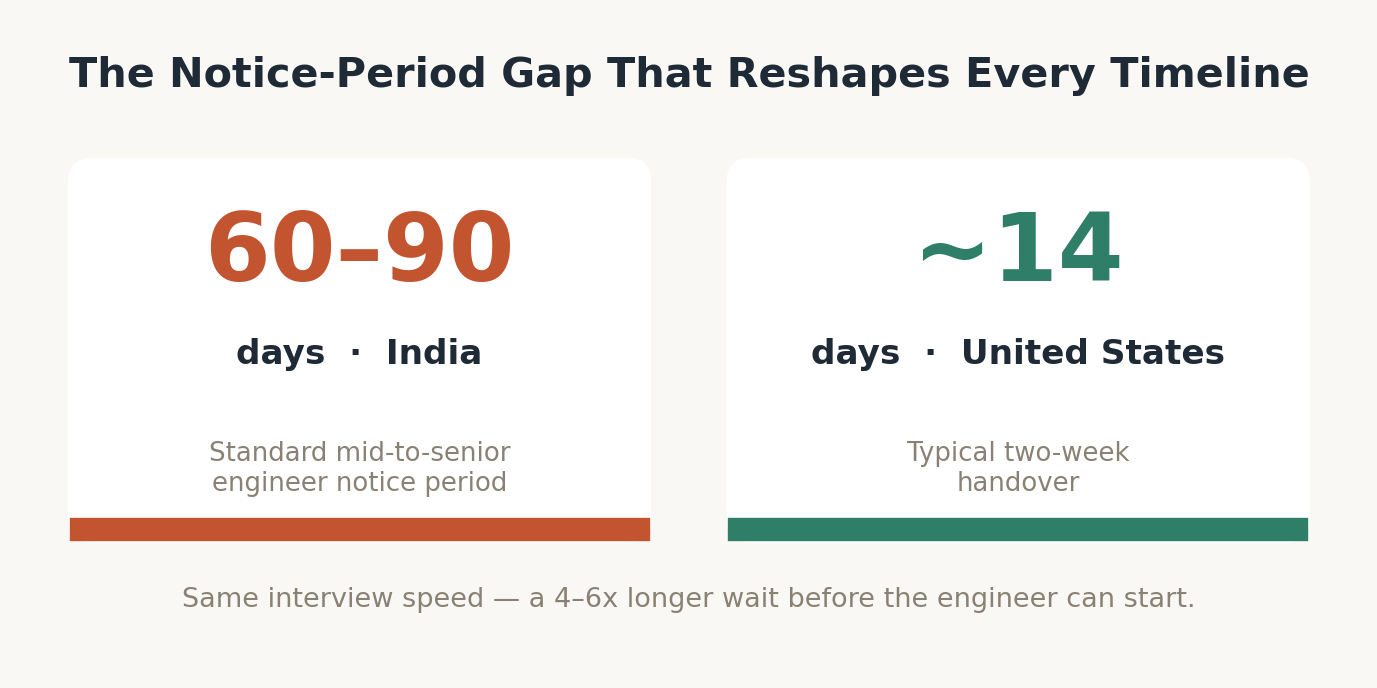
The notice period is non-negotiable in a way Western hiring managers rarely anticipate. A two-week handover is standard in the US; in India, two to three months is the norm, written into employment contracts and enforced. That single factor is why tech hiring timelines India look so different from headline US benchmarks, even when the interview process itself is faster.
Cost compounds the delay. Deloitte’s recruitment research pegs the average carrying cost of an unfilled role at roughly $500 per day for a high-demand backend or ML seat, a four-month vacancy quietly burns $40,000–$60,000 in lost throughput and delayed revenue before the engineer even starts.
There is also a quieter, second-order cost: every extra week a req stays open is another week a competitor can extend a counteroffer or a faster employer can close your candidate first. Speed is not a nice-to-have in this market; it is a retention mechanism applied before the person has even joined.
Geography adds another layer of variance. Tier-1 hubs like Bangalore, Hyderabad, and Pune hold the deepest talent pool India offers, but they are also the most competitive, so strong candidates routinely juggle three or four offers at once. That competition lengthens the negotiation phase and raises the counteroffer risk precisely for the engineers you most want. Tier-2 cities can be faster to close but thinner on niche skills, which pushes sourcing time back up. Either way, a realistic time to hire developer India plan should assume the candidate is being actively courted by someone else the entire time.
The counteroffer dynamic deserves its own line in the plan. A 60-to-90-day notice window gives the candidate’s current employer ample runway to respond with a raise, a promotion, or a retention bonus. Drop-off after signing candidates who accept and then renege is a real and underbudgeted risk, which is why a healthy offer-to-join ratio and constant engagement during the notice period are not optional niceties but core to hitting any timeline at all.
The Deep Breakdown: Realistic Timelines by Role
Not all roles move at the same speed. Scarcity, the depth of the Indian tech talent offers for that skill, and the seniority bar all change the math. The ranges below assume an open-market hire your own sourcing or a traditional recruiter measured from search kickoff to a productive engineer, notice period included. Read them as the honest baseline for tech hiring timelines India before any optimization is applied.
How Long to Hire a Backend or Frontend Developer in India
Generalist web roles are the most liquid part of the market, so they move fastest. A mid-level frontend developer runs roughly 9–13 weeks end to end; a backend developer at mid-to-senior level lands around 10–14 weeks. Full-stack hires sit slightly higher at 11–15 weeks because you are screening two skill sets against one bar.
The sourcing and interview portion here is genuinely quick, often two to four weeks but the notice period reasserts itself the moment you make an offer. Even the easiest hire is gated by those 60–90 days.
Why Does Hiring a DevOps or Data Engineer Take So Long
Infrastructure and data roles are where the developer hiring timeline 2026 stretches noticeably. A DevOps / SRE hire typically runs 13–18 weeks, and a data engineer lands in the same 13–18 week band. The bottleneck is not the notice period it is supplied. Genuinely production-ready candidates are scarce, so sourcing-to-shortlist alone can consume four to six weeks before interviews begin.
These roles also carry a higher false-positive rate in screening. Many résumés claim Kubernetes or Spark depth that evaporates under a real architecture conversation, which is why the offer-to-join ratio drops and why teams burn extra interview cycles.
The Hardest Seats: ML, Cloud Architecture, and Engineering Leadership
At the top of the scarcity curve, timelines balloon. An ML / AI engineer realistically takes 16–22 weeks, a cloud / solutions architect runs 15–20 weeks, and a security engineer lands at 14–19 weeks. Engineering leadership as a tech lead or engineering manager is the slowest of all at 16–24 weeks, because cultural and architectural judgment cannot be screened quickly or cheaply.
For these roles, the interview process itself legitimately needs more time. Rushing an architect or an EM hire is how you create an eighteen-month problem to save four weeks.
What About QA, Mobile, and Specialist Front-of-Stack Roles
Quality and mobile engineering sit in the middle of the curve. A QA / automation engineer is among the faster hires at 8–12 weeks, because the screening signal is relatively clear and the supply is healthy. Mobile developers iOS, Android, or Flutter run 11–15 weeks, closer to full-stack territory, since strong native and cross-platform candidates are in steady demand from product companies.
The thing that trips teams up here is assuming “specialist” automatically means “scarce.” It does not. A clear, well-scoped QA or mobile role with a tight brief can close faster than a vaguely defined full-stack req, because ambiguity in the job description is itself a major driver of long tech hiring timelines India. The clearer the bar, the faster the funnel moves.
The Compliance and Onboarding Layer Nobody Budgets
Beyond sourcing and notice, there is a final stretch teams consistently forget: the legal and administrative ramp. Employment contracts, statutory contributions like provident fund and gratuity, background verification, equipment provisioning, and access management all take real time. Run them after the engineer’s start date and you lose one to two productive weeks at the very end of an already long process.
This is also where the choice of engagement model changes the timeline. A direct permanent hire means your team owns all of this. A staff augmentation or employer-of-record arrangement offloads payroll, compliance, and onboarding logistics to a partner, which is part of why those models report faster effective ramp even when the underlying notice period is identical. The work still happens, it just happens in parallel rather than in sequence.
The Role-by-Role Timeline Table
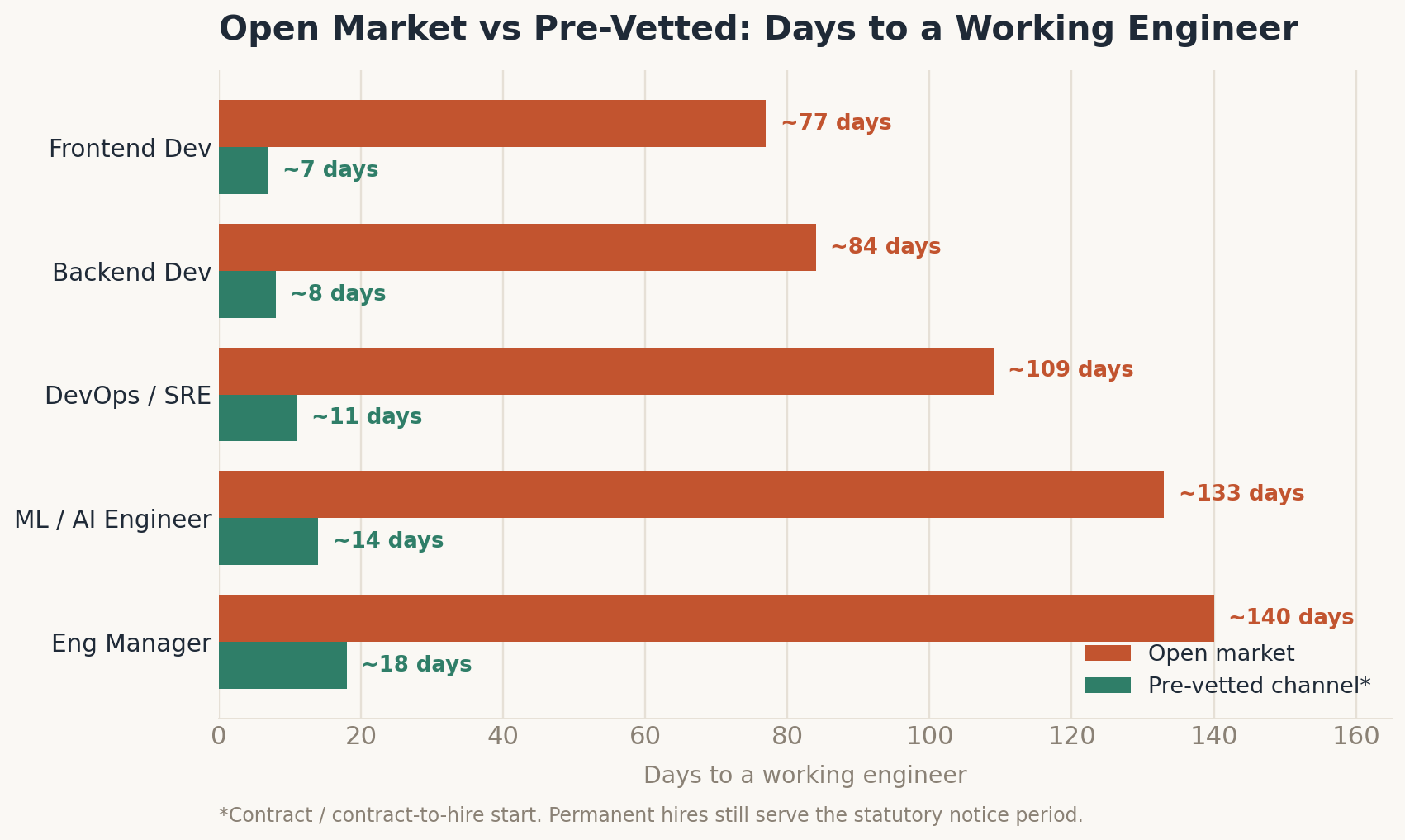
The table below maps each role against a realistic open-market timeline and the timeline achievable through a pre-vetted channel that maintains a continuously screened bench. The faster column assumes a vetted platform that shortlists from an existing pool rather than sourcing cold.
| Role | Open-Market Timeline (kickoff → productive) | Vetted-Channel Timeline |
| Frontend Developer (mid) | 9–13 weeks | Shortlist 24–48 hrs · interview days 2–5 · start 3–10 days* |
| Backend Developer (mid–senior) | 10–14 weeks | Shortlist 24–48 hrs · start 5–10 days* |
| Full-Stack Developer | 11–15 weeks | Shortlist 2–4 days · start 5–12 days* |
| Mobile Developer (iOS/Android/Flutter) | 11–15 weeks | Shortlist 2–4 days · start 5–12 days* |
| QA / Automation Engineer | 8–12 weeks | Shortlist 24–48 hrs · start 3–10 days* |
| DevOps / SRE | 13–18 weeks | Shortlist 3–6 days · start 7–14 days* |
| Data Engineer | 13–18 weeks | Shortlist 3–6 days · start 7–14 days* |
| ML / AI Engineer | 16–22 weeks | Shortlist 4–7 days · start 10–18 days* |
| Cloud / Solutions Architect | 15–20 weeks | Shortlist 4–7 days · start 10–18 days* |
| Security Engineer | 14–19 weeks | Shortlist 4–7 days · start 10–18 days* |
| Engineering Manager / Tech Lead | 16–24 weeks | Shortlist 5–8 days · start aligned to notice |
*Contract and contract-to-hire models start fastest because the candidate is already engaged through the platform. Permanent placements still serve the statutory notice period, but the search-and-select phase compresses from weeks to days.
The Process That Compresses the Timeline
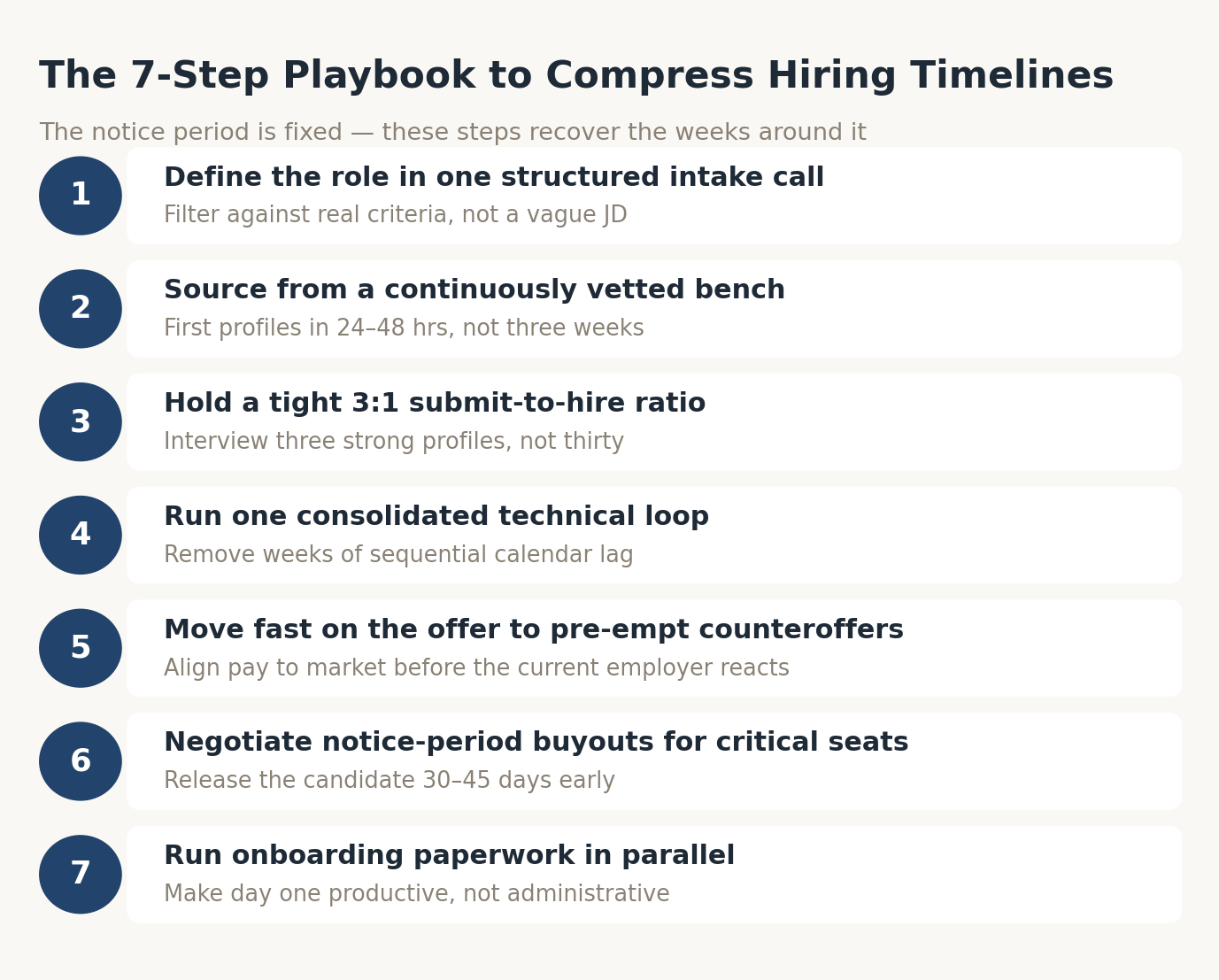
When teams cut tech hiring timelines India dramatically, they almost always change the front of the funnel, not the back. The notice period is fixed; the sourcing, screening, and decision phases are where weeks are recoverable. A repeatable compression process looks like this:
- Define the role in one structured intake call skills, seniority, budget band, and culture markers so shortlisting filters against real criteria, not a vague JD.
- Source from a continuously vetted bench, not a cold market, so the first profiles arrive in 24–48 hours instead of three weeks.
- Apply a tight submit-to-hire ratio aim for roughly 3:1 so hiring managers interview three strong profiles rather than wading through thirty mediocre ones.
- Run a single consolidated technical loop instead of sequential rounds spread across weeks of calendar lag.
- Make the offer fast and pre-empt counteroffers by aligning compensation to market before the candidate’s current employer can react.
- Negotiate notice-period buyouts for critical seats, paying to release the candidate 30–45 days early when the role economics justify it.
- Start onboarding paperwork in parallel with the notice period, not after it, so day one is productive rather than administrative.
Steps two through five are where a staff augmentation or contract-to-hire model wins: the bench already exists, so the slow sourcing phase effectively disappears. That is the structural reason a vetted channel can move in days while open-market hiring measures in months.
Case Studies: When the Timeline Was the Constraint
A sleep-diagnostics health platform serving more than 200 hospitals hit a hiring bottleneck that was actively slowing its expansion. By moving sourcing and screening onto an AI-assisted, pre-vetted pipeline, the company cut its hiring cycle by roughly 50% and resumed scaling without dropping its quality bar.
In a separate engagement, a large infrastructure-and-energy enterprise needed senior DevOps talent fast to stand up automated CI/CD pipelines. Hiring from the top 2% of a vetted talent pool India maintained, the team filled the seats quickly and went on to cut deployment time by 50% in a case where compressing the hire directly compressed the delivery timeline behind it.
The pattern across both is the same: the binding constraint was never the candidates’ ability to do the work. It was the calendar between “we need this person” and “this person is shipping.”
A third example shows the compounding effect at scale. A fast-growing SaaS company trying to staff several reqs at once found that running them sequentially through a traditional recruiter meant each hire’s notice period stacked end to end, pushing a full team build past two quarters. Parallelizing the search across a vetted pipeline shortlisting all roles at once rather than one at a time collapsed the effective build time without rushing any single decision. The lesson generalizes: at team scale, the enemy of good tech hiring timelines India is sequential processing, not slow individuals.
A Simple Decision Framework
Choosing how to hire comes down to three honest questions: how scarce is the skill, how fast do you need delivery, and how much hiring infrastructure do you already own. The short framework below maps those answers to an approach.
| If your situation is… | Best approach | Why |
| Common skill, no urgency, strong in-house recruiting | Direct open-market hire | Lowest cost per hire when time isn’t the constraint |
| Scarce skill or hard deadline | Vetted bench / staff augmentation | Removes the multi-week sourcing phase entirely |
| Uncertain long-term need or want to de-risk fit | Contract-to-hire | Validate performance before committing to a permanent seat |
| Building an entire team or GCC at once | Managed / RPO model | Parallelizes many reqs that would otherwise run sequentially |
Use the framework to match the model to the constraint. The most common and costly mistake is defaulting to direct open-market hiring for a scarce, deadline-bound role paying months of delay for a process designed for situations where time was cheap. Aligning the model to the role is the cheapest way to improve your tech hiring timelines India without touching anything else.
What Most Teams Get Wrong About Hiring Speed
The instinctive fix for a slow hire is to widen the funnel post on more boards, screen more résumés, run more interviews. That is almost always the wrong lever. More volume adds screening load, lengthens decision-making, and rarely touches the two phases that actually dominate the timeline: notice period and sourcing quality.
The teams that hire fast do the opposite. They narrow the funnel ruthlessly and raise the quality of what enters it, so that fewer, stronger candidates move through faster. A 3:1 offer-to-join discipline beats a 30:1 résumé pile every time, because the bottleneck in senior hiring is decision confidence, not candidate quantity. Widening the top of the funnel is the most common way teams accidentally lengthen their tech hiring timelines India while believing they are shortening them.
The second blind spot is treating the notice period as dead time. It is the single best window you have to run onboarding logistics, set up access, and align the engineer on architecture yet most teams wait until day one to start, then lose another two weeks to ramp. The notice period is not a delay to endure; it is a runway to use.
The third mistake is optimizing for the lowest cost per hire while ignoring the cost of the vacancy. At roughly $500 a day in carried cost, shaving six weeks off a hire is often worth far more than the fee difference between hiring channels. Time-to-fill is a P&L line, not just an HR metric and teams that internalize that stop treating speed as a luxury.
The fourth, and most expensive over time, is treating every hire as permanent by default. A meaningful share of urgent roles exist to de-risk a decision the team has not fully made yet: a new product bet, an unproven architecture, a scaling experiment. Forcing those through a permanent, notice-gated process buys months of delay for flexibility you did not need. A contract-to-hire model lets the engineer start in days, proves the fit on real work, and converts to permanent only when the bet pays off. Matching the engagement model to the certainty of the need is the highest-leverage decision in the entire developer hiring timeline 2026 conversation, and it is the one most teams skip.
How Fast Can You Hire in India Compared to the US and Europe
A common assumption is that India is universally slower to hire. The interview process actually is not Glassdoor’s cross-country study that found India had one of the shortest application-to-interview windows of the 25 countries measured. The headline US benchmark from LinkedIn’s recent hiring data sits around 36 days from job posting to offer, and Indian interview loops are often comparable or quicker.
The divergence is entirely on the back end. US engineers typically give two weeks’ notice; Indian engineers serve 60 to 90 days. So while the decision phase can be faster in India, the availability phase is dramatically longer, which is why the true average time to hire engineers in India lands above the US once you measure to a productive start date rather than to offer acceptance.
This reframes the whole problem. If your interview-to-offer is already fast, pouring effort into trimming interview rounds yields almost nothing. The recoverable time lives in two places: the weeks before sourcing produces a strong shortlist, and the notice-period weeks you could be using for onboarding. Teams that understand how fast you can hire in India really stop optimizing the visible middle of the funnel and start attacking those two hidden ends. That single shift in focus is what separates a four-month hire from a three-week one for the roles where it is achievable.
FAQ’S
How long does it actually take to hire a developer in India?
For a typical mid-level web developer, plan on 9–14 weeks from search kickoff to a productive engineer through the open market, with the bulk of that being the 60–90 day notice period. Scarcer roles like ML engineers or cloud architects stretch to 16–22 weeks. A pre-vetted channel can compress the search-and-select phase to days, though permanent hires still serve statutory notice.
What is the average notice period for software engineers in India?
Most mid-to-senior engineers in India serve a 60-to-90-day notice period, written into their employment contracts and enforced. This is the dominant variable in any timeline and the main reason Indian hiring runs longer than US benchmarks despite a faster interview process. For urgent senior roles, a notice-period buyout can release a candidate 30–45 days early.
Why does hiring take longer than companies expect?
Teams budget against the interview calendar typically four to six weeks but the real timeline includes sourcing, the notice period, and onboarding ramp, none of which show up in an applicant tracking system. Those hidden phases routinely push the true number to two or three times the original estimate.
Which tech roles take the longest to fill?
Engineering leadership, ML/AI engineers, cloud architects, and security specialists are the slowest, running 15–24 weeks in the open market. The constraint is supply, not notice period production-ready candidates in these areas are genuinely scarce, so sourcing-to-shortlist alone can take four to six weeks.
Can you hire a developer in India in under two weeks?
Yes, for contract or contract-to-hire engagements drawing from an existing pre-vetted bench, where shortlisting happens in 24–48 hours and an engaged candidate can start in days. A permanent hire from a fresh open-market search cannot realistically beat the notice period, which is why the model you choose matters as much as the role.
How do you reduce time-to-hire without lowering the quality bar?
Narrow the funnel rather than widen it: source from a vetted pool, hold a tight 3:1 submit-to-hire ratio, consolidate interviews into a single loop, and run onboarding in parallel with the notice period. Quality and speed are not a trade-off here; most of the delay in tech hiring timelines India comes from low-signal sourcing and sequential scheduling, not from being thorough.
What does a slow tech hire actually cost?
At roughly $500 per day in carried cost for a high-demand role, a four-month vacancy can quietly cost $40,000–$60,000 in delayed delivery and lost throughput often dwarfing any fee difference between hiring channels. That is why time-to-fill belongs on the P&L, not just the HR dashboard.
Pressure-Test Your Hiring Plan Before You Commit
If you are scoping a roadmap and the dates depend on engineers who are not hired yet, the most valuable thing you can do is stress-test your assumed tech hiring timelines India against the role-by-role realities above before a slipped hire slips the launch. Map each open seat to its honest open-market timeline, then decide where a vetted or contract-to-hire model is worth the trade.
A useful exercise takes about twenty minutes. List every open req, assign each one its realistic kickoff-to-productive range from the table, and add the notice period the candidate will actually serve. Then mark which seats are on the critical path for a launch or a customer commitment. Those are the roles where a faster channel earns its keep; the rest can often run through a standard open-market search without hurting anything. This is the difference between a plan built on hope and one built on the way time to hire developer India actually behaves.
The same exercise also tells you where not to spend money. If a role has no hard deadline and the skill is common, paying a premium to compress the timeline is a wasted budget. Speed is only valuable where delay is expensive and knowing which seats those are is half the battle.
Supersourcing has run this compression process across hundreds of placements, from single specialist hires to full team builds, and can benchmark your specific roles against live placement data rather than industry averages. If you want a second read on whether your timeline is realistic before you commit to an approach, you can start a conversation at supersourcing.com or reach out directly to mayank@engineerbabu.com with the roles you are trying to fill. A short benchmarking call usually surfaces one or two timeline assumptions worth correcting which is often enough to keep a roadmap on schedule.
