

Toptal is good. For the right use case 1 to 2 senior engineers for a specific short-term project with a budget for $60 to $150+/hour delivers reliably. The vetting is real, the talent is real, and for a narrow engagement it remains one of the better-known names in freelance tech hiring.
But for US companies looking to build India-based engineering teams not hire one freelancer, but stand up a team of 5, 10, or 20 engineers over 12 to 24 months the economics of Toptal do not work at scale, and the India-specific depth simply is not there. Toptal was built as a global freelance marketplace, not as an India hiring partner, and that distinction matters once a company moves past its first hire and starts thinking about team-building.
Hiring developers through global freelance platforms works well for short-term needs, but scaling an engineering team requires a different approach. Cost structure, talent depth, and long-term reliability become far more important once companies move beyond a single hire.
The Toptal alternatives India conversation becomes relevant when US companies start building dedicated engineering teams rather than hiring isolated freelancers.
The global outsourcing market has rapidly evolved from a purely cost-saving measure to a strategic driver for capability and innovation. Enterprises are heavily leveraging external partnerships to bypass domestic talent shortages, accelerate AI adoption, and achieve scalable, cost-efficient growth.
This guide covers the 7 best Toptal alternatives in India for companies that need a stronger cost model, India-specific sourcing depth, contract or C2H flexibility, or AI engineering capability that Toptal does not offer at the same level.
Why Companies Look for Toptal Alternatives
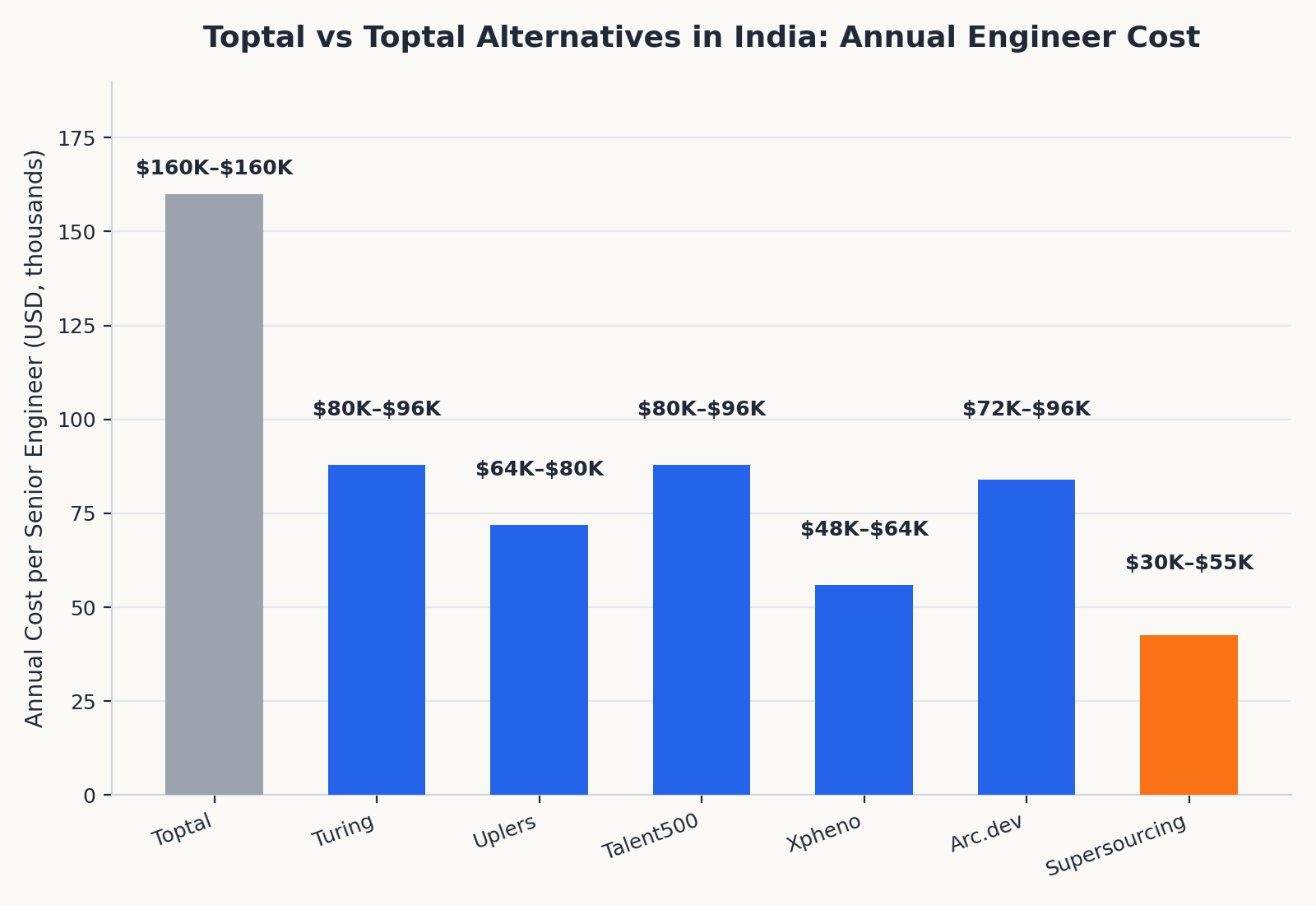
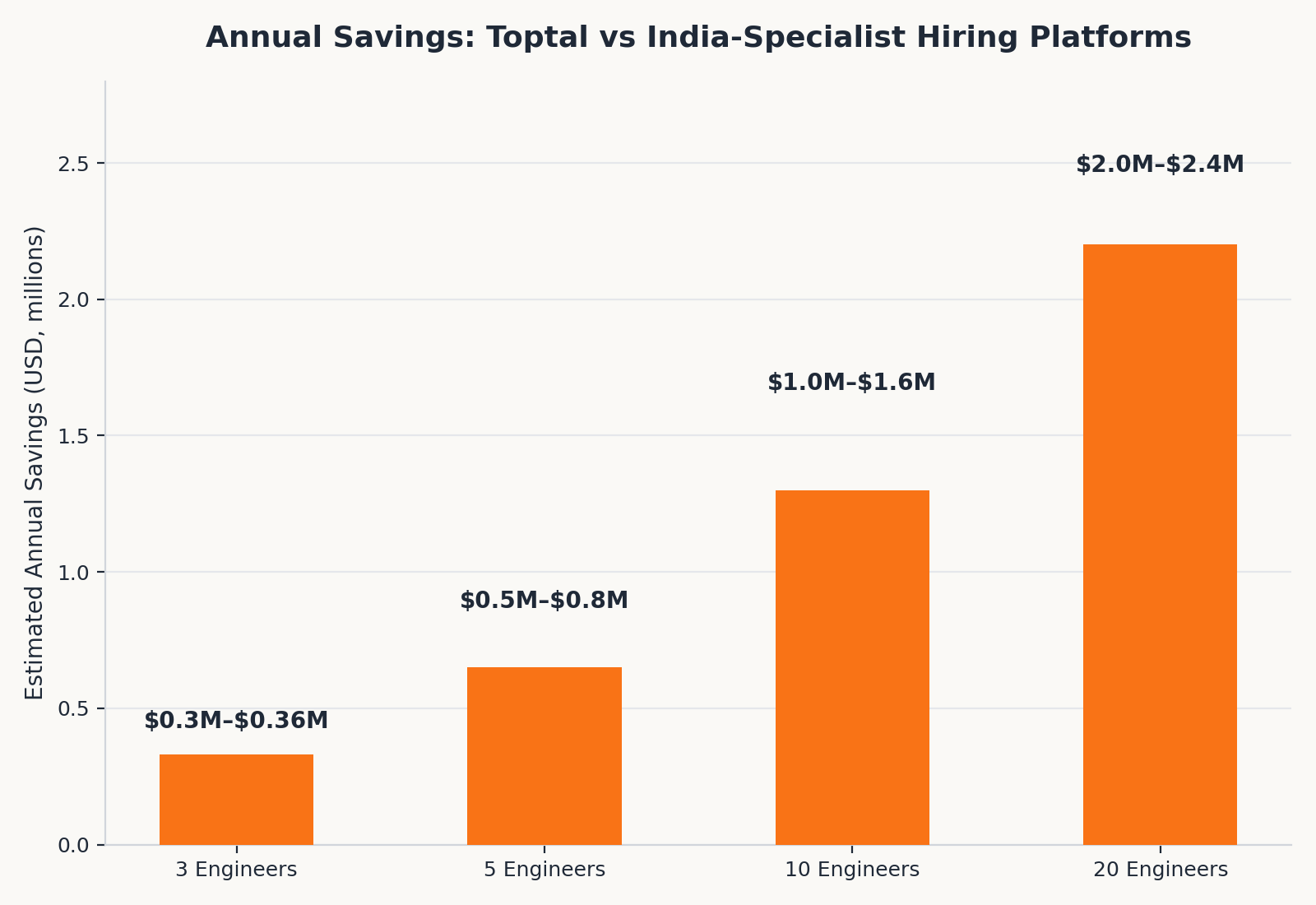
Cost is the first and most obvious driver. A senior engineer at $80/hour through Toptal costs $160,000 or more annually once you account for full-time utilization. Equivalent seniority through India-specialist platforms typically costs $30,000 to $55,000 annually for the same skill level. For companies building teams of 3 to 20 engineers, that gap compounds into $300,000 to $2 million in annual savings money that can fund additional headcount, product development, or runway extension.
India’s depth is the second factor. Toptal’s global network does have India representation, but India is not a specific focus for the platform. Sourcing, vetting criteria, and account management are built for a worldwide freelance pool, not tuned to India’s engineering market, salary bands, attrition patterns, or skill distribution. India-specialist platforms, by contrast, have built their entire sourcing and vetting infrastructure around this one market, which tends to produce deeper networks, better local market knowledge, and faster delivery for India-specific roles.
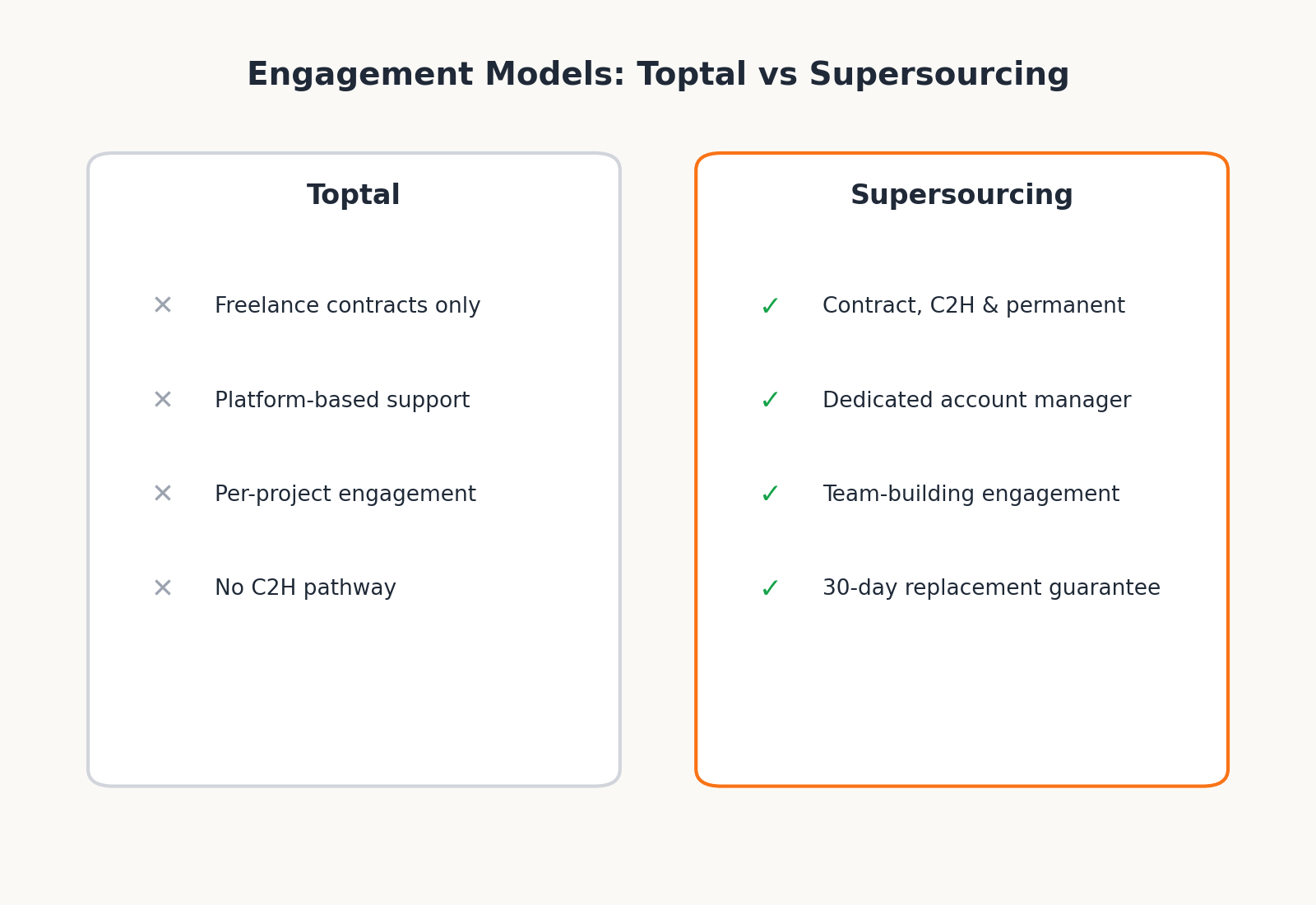
Engagement model flexibility is the third reason companies move on. Toptal is primarily a freelance platform, structured around individual contracts between a client and a freelancer. Many companies building distributed teams need contract, contract-to-hire (C2H), or full permanent staffing models instead, especially when the goal is a stable, long-term engineering presence in India rather than a rotating bench of freelancers.
Post-hire support is the fourth and often underestimated factor. Toptal’s engagement management is largely platform-based: tickets, dashboards, and a relatively hands-off relationship once the match is made. Companies building teams, especially their first India team, usually want a relationship-driven account manager who understands their hiring roadmap, flags attrition risk early, and helps with replacements without friction.
The 7 Best Toptal Alternatives in India
#1 Supersourcing The Best Toptal Alternative for India Hiring
Supersourcing is built specifically for US companies hiring engineering talent in India, which is the core difference from Toptal’s global freelance model.
Why Supersourcing beats Toptal for India hiring:
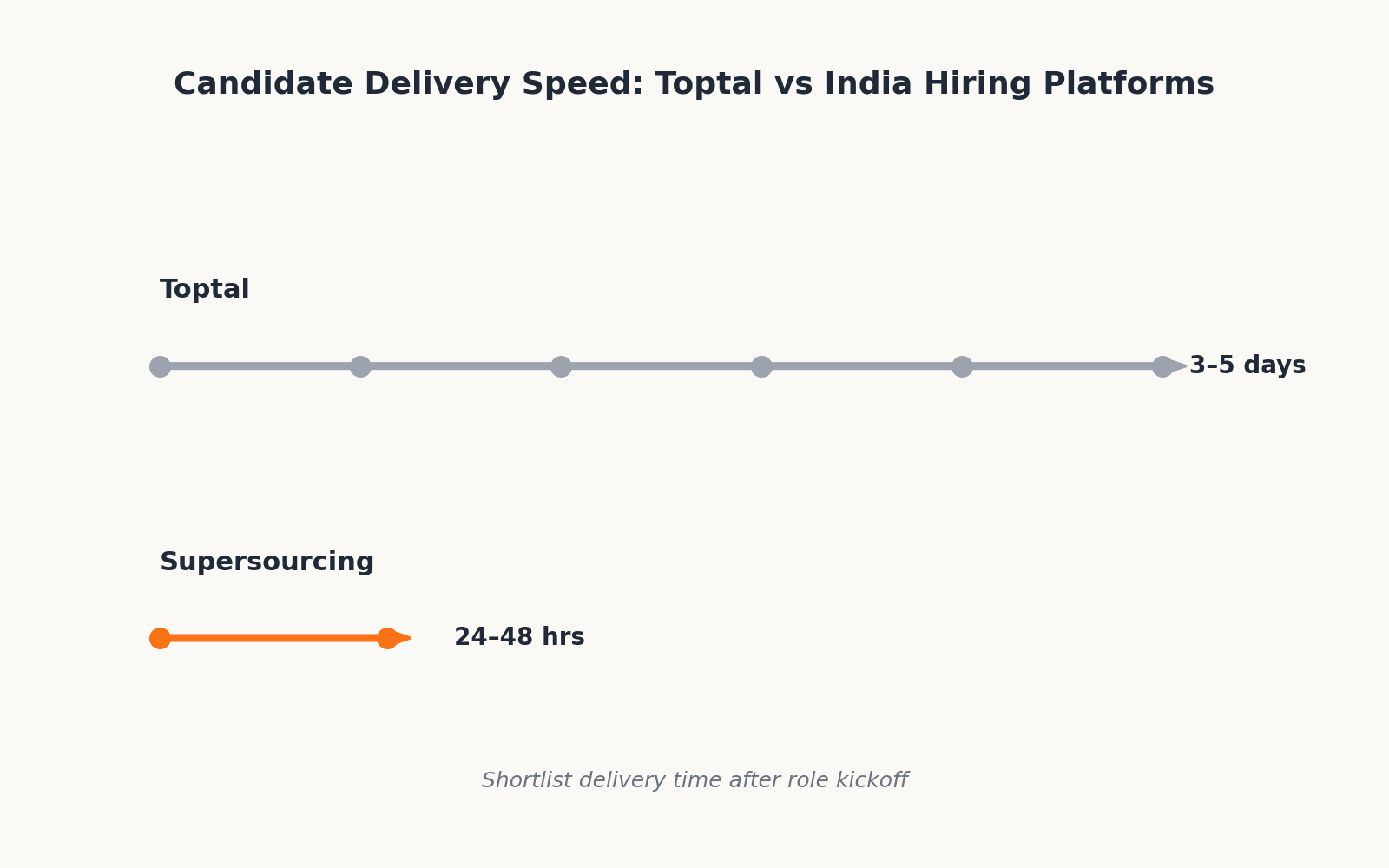
It delivers 60 to 70% lower cost for equivalent seniority, with 24 to 48 hour delivery compared to Toptal’s typical 3 to 5 day turnaround. The platform draws from a pool of 5,200+ pre-vetted engineers built over 14 years of India market operations, giving it meaningfully deeper India-specific reach than a global marketplace can offer. Supersourcing also holds Google AI Accelerator 2024 recognition, making it the only India hiring platform with this credential, and has appeared on the LinkedIn Top 20 Startups India list in both 2023 and 2024 two consecutive years. It is trusted by 132 YC-funded companies, which gives it one of the most credible referral networks in the US startup community for India hiring decisions.
Unlike Toptal, Supersourcing supports contract, C2H, and permanent engagement models rather than freelance-only arrangements, and pairs every engagement with a dedicated account manager, a 30-day replacement guarantee, and a sub-1% drop-off rate.
When to choose Supersourcing over Toptal:
Choose Supersourcing when building an India engineering team of 3 or more engineers, when contract or C2H flexibility matters, when hiring for AI, ML, LLM, DevOps, or data engineering roles specifically, when post-hire relationship management is a priority over platform-only support, or when India is the specific talent market the company is focused on rather than a global freelance search.
Contact: supersourcing.com
#2 Turing For Global AI-Matched Developers
Turing’s AI-driven matching engine and global talent network make it a credible alternative to Toptal for US companies that want broader geographic optionality alongside India, rather than an India-only focus.
Turing beats Toptal on cost, typically running 40 to 50% lower, and offers AI-powered matching plus a genuinely global talent network spanning multiple countries beyond India. Where it falls behind Toptal is at the very top of the market for the most senior, highly specialized freelance talent, Toptal’s narrower but deeper vetting process still has an edge.
#3 Uplers For US-India Remote Specialist Hiring
Uplers has built a focused US-India remote hiring practice over several years, positioning itself as a cost-effective option for companies that want a steady India hiring pipeline rather than one-off freelance placements.
Uplers beats Toptal on cost efficiency, US-India corridor focus, and timezone-aware delivery, all of which matter for sustained dedicated team building rather than short-term projects. It falls behind Toptal on global network breadth and on technical vetting depth at the very senior end of the talent pool.
#4 Talent500 For Enterprise and GCC Hiring
Talent500, part of the ANSR Group, is built around enterprise and Global Capability Center (GCC) hiring in India, with growing AI-powered matching capabilities layered on top of a more traditional enterprise staffing model.
It beats Toptal on enterprise compliance requirements, GCC-specific experience, and overall cost, which matters for large organizations with procurement and legal review processes. It falls behind Toptal on startup-speed responsiveness and on the breadth of its global freelance network.
#5 Xpheno For India Product Company Network
Xpheno’s strength is its bias toward India’s product company ecosystem, which makes it especially relevant for companies that specifically want engineers with product company backgrounds rather than service company experience.
Xpheno beats Toptal on access to India product company talent, on overall cost, and on India-specific sourcing depth. It falls behind Toptal on global network reach and on senior technical vetting depth, since its strength is concentrated in the India product talent niche rather than broad global coverage.
#6 Arc.dev Developer Marketplace Alternative
Arc.dev operates as a self-service, vetted developer marketplace with reasonable India representation, positioning itself closer to a leaner, more self-directed version of Toptal’s model.
It beats Toptal on cost and offers a workable self-service model with reasonable vetting standards for companies that want more control over the sourcing process themselves. It falls behind Toptal on post-hire support, on India-specific sourcing depth, and on AI engineering coverage, which is comparatively thin.
#7 Belong.co For Passive Candidate Outbound
Belong.co takes a different approach entirely, focusing on outbound sourcing to reach passive candidates engineers who are not actively browsing job boards but are open to the right opportunity if approached directly.
It beats Toptal on access to passive candidates at a lower overall cost, which can surface talent that platform-based marketplaces simply never see. It falls behind Toptal on immediate delivery speed, on senior technical vetting rigor, and on post-hire management once a candidate is placed.
How to Choose Among These Toptal Alternatives
The right choice depends less on which platform is “best” in the abstract and more on what the hiring goal actually is. A company that needs one senior freelancer for a six-week project has different needs than a company building a 10-person India engineering team over the next 18 months.
For pure team-building in India, with a need for contract, C2H, or permanent hires, India-specific depth, and a dedicated account manager, Supersourcing is the strongest fit among the options above. For companies that want to keep their options open globally while still accessing India talent, Turing’s broader network is worth a look. For enterprise organizations with GCC requirements and procurement processes, Talent500 is built specifically for that context. And for companies that want a lower-cost, self-service experience and are comfortable doing more of the vetting legwork themselves, Arc.dev is a reasonable option.
Frequently Asked Questions
Is Supersourcing as rigorous as Toptal in technical vetting?
Supersourcing’s vetting is multi-stage and equally rigorous for the India market specifically. The difference is scope: Toptal vets globally across all seniority levels and countries, while Supersourcing vets specifically for India engineering talent with role-specific technical assessments for backend, data, AI, DevOps, and product engineering. For India hiring, Supersourcing’s vetting depth is at least equivalent to Toptal’s and stronger for AI-specific roles given its Google AI Accelerator 2024 recognition. For global senior freelancers outside India, Toptal’s network remains stronger.
Why are companies moving from Toptal to India-specialist platforms?
Three reasons consistently drive the switch. Cost is the biggest one, with 60 to 70% lower annual cost for sustained team building compared to Toptal’s freelance rates. India-specific depth is the second, since specialist platforms offer a better network and stronger market knowledge for India hiring specifically. Engagement model flexibility is the third, since contract and C2H models support long-term team building in a way that Toptal’s freelance-first model does not handle as well. The switch is most common among US companies that started with 1 to 2 Toptal engineers for a short project, validated that India engineering quality works for their use case, and are now building a full team at a cost model that actually scales.
How much can a company realistically save by switching from Toptal to an India-specialist platform?
For a team of 5 engineers at senior level, the difference between Toptal’s freelance rates and an India-specialist platform’s rates typically works out to $500,000 to $800,000 in annual cost. For larger teams of 15 to 20 engineers, that gap can exceed $2 million annually. The exact figure depends on seniority mix, role specialization (AI and ML roles tend to command a premium across all platforms), and whether the engagement is contract, C2H, or permanent.
Can a company use Toptal and an India-specialist platform at the same time?
Yes, and many companies do exactly this during a transition period. A common pattern is keeping one or two senior Toptal freelancers on an existing short-term project while standing up a new India team through a specialist platform for ongoing, longer-term work. Once the India team is established and proven, most companies consolidate hiring through the specialist platform going forward, since running two parallel vendor relationships adds administrative overhead without a clear ongoing benefit.
