

A fully loaded full-time developer in the US costs roughly 1.3-1.4x their base salary once benefits are added according to the U.S. Bureau of Labor Statistics, benefit costs alone account for 29.9% of total private-sector compensation, on top of wages. Most hiring managers know this number exists. Almost none use it when they’re deciding whether to bring on a contractor or make a full-time offer.
That gap is the entire reason this guide exists. The hire contract developers vs full-time decision is treated as a gut call “contractors for short stuff, full-time for real work” when it’s actually a math problem with a handful of variables: total cost of ownership, time-to-productivity, IP exposure, and how long the work will realistically last. Get the inputs right and the answer becomes obvious almost every time.
This guide walks through all of it: the real cost breakdown of each model, a phase-by-phase hiring playbook from scratch to onboarded, contract terms you need in writing, and a decision framework you can apply to your next hiring call without a spreadsheet.
It’s worth being upfront about who this is for. If you’re a founder deciding how to staff your first MVP, an engineering manager covering a headcount gap, or a talent lead evaluating whether to build an internal recruiting motion or outsource it, the underlying math is the same, only the inputs (budget, timeline, risk tolerance) change. This guide is built so you can plug your own numbers into the frameworks below rather than borrow someone else’s rule of thumb.
What Is Contract vs Full-Time Developer Hiring?
Contract developer hiring is engaging a software developer for a defined scope, timeline, or project under a services agreement, without adding them to permanent payroll or benefits. Full-time hiring is bringing a developer onto permanent payroll with a salary, benefits, and an open-ended employment relationship.
This is not the same as:
- Freelance marketplace hiring informal, often unvetted engagements found on open platforms, with no dedicated account management or replacement guarantee.
- Outsourced project delivery where an external firm owns delivery and manages its own team, versus a contractor who works inside your team under your direction.
- Interns or apprentices time-boxed learning arrangements, not a cost-optimized delivery model.
Why This Decision Matters: The Business Case
The engagement model you pick affects four things that compound over a project’s lifetime, not just the invoice:
- A full-time senior developer in the US typically costs $120,000-$180,000/year in salary plus another 30-40% in benefits, payroll tax, and overhead, versus a contract rate of $50-$150/hour with zero benefits load.
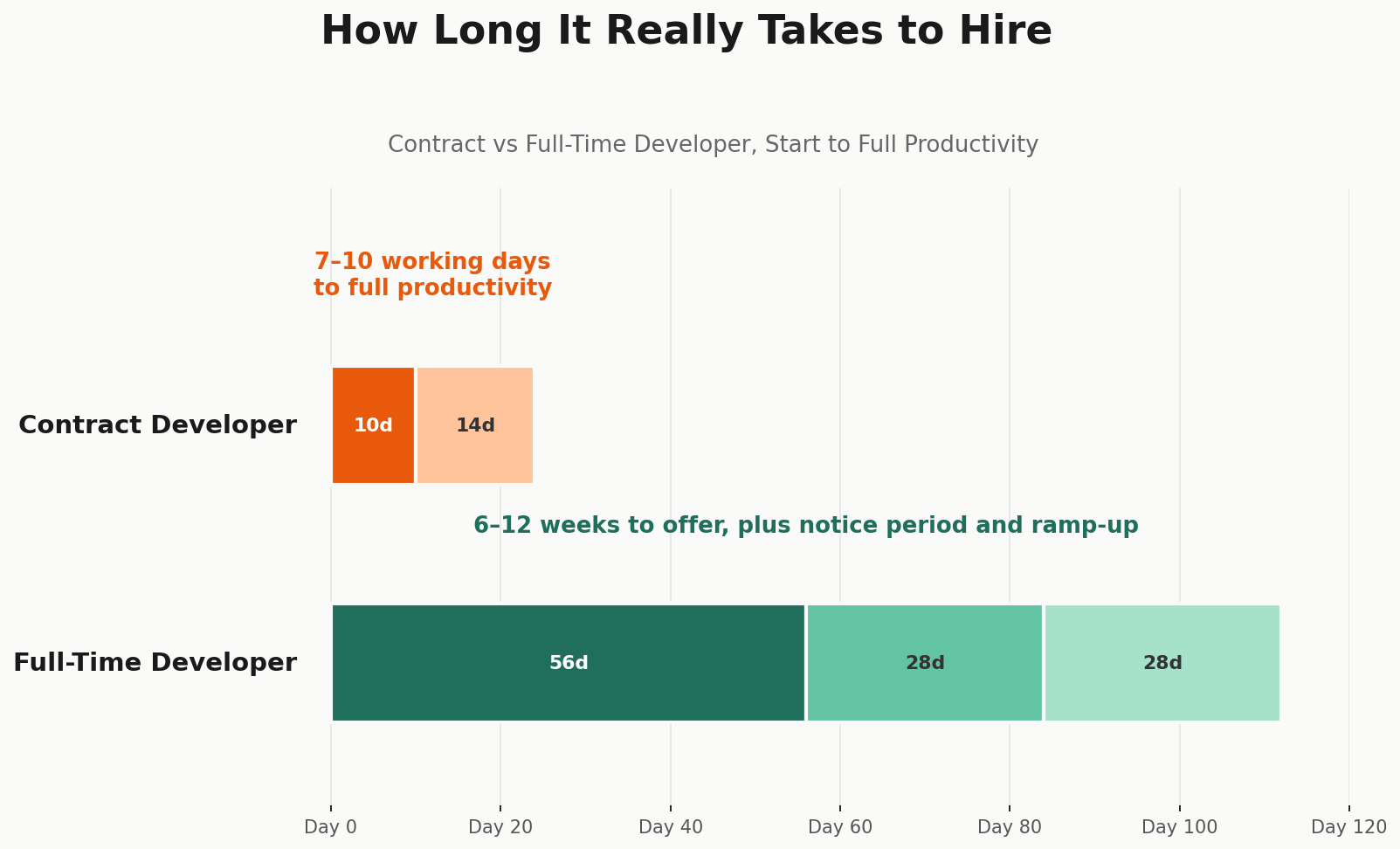
- A well-run sourcing pipeline can produce an interview-ready shortlist of vetted contract developers in 7-10 working days; a full-time search with interview loops, offer negotiation, and notice periods routinely runs 6-12 weeks.
- Flexibility Contractors can be scaled up or down within a sprint or two; full-time headcount reductions involve severance, morale impact, and (in many jurisdictions) legal notice requirements.
- Full-time hires carry lower IP and continuity risk but higher fixed-cost risk; contractors carry the reverse, and mismanaging the difference is where most legal and delivery problems originate.
None of these factors is “better” in isolation. The right model depends on how long the work will last, how core it is to your product, and how much certainty you have about scope. A team that treats this as a binary choice “we’re a contractor shop” or “we only hire full-time” is almost always leaving either money or delivery speed on the table, because most engineering organizations need both models running at different points in the same year.
The Core Problem Most Buyers Face
Most first-time buyers make the decision backwards: they pick a model based on urgency, then discover the cost and risk implications months later.
- Teams underestimate full-time hiring timelines by 3-4x budgeting for a 2-week hire when the realistic cycle, including notice periods and offer negotiation, is 6-10 weeks.
- Teams underestimate the loaded cost of full-time hires by ignoring benefits, payroll tax, tooling, and management overhead, sometimes by 25-40% of the quoted salary.
- Teams over-index on contractor hourly rates without comparing them to fully loaded full-time costs, concluding contractors are “expensive” when a like-for-like comparison often shows the opposite for short-to-medium engagements.
- Teams skip IP and NDA paperwork with contractors because “it’s just a short project,” then discover ambiguous code ownership when they try to raise funding or sell the company.
- Teams treat contract-to-hire as informal, without a documented conversion path, and lose good contractors to competitors who make a real offer faster.
Each of these is fixable with process, not luck which is what the rest of this guide covers.
Each of these mistakes is procedural, not a matter of judgment or experience which means each one is fixable by putting a checklist or contract clause in place before the next hire, not by hiring smarter people. That’s the lens for the rest of this guide.
Total Cost of Ownership: A Worked Example
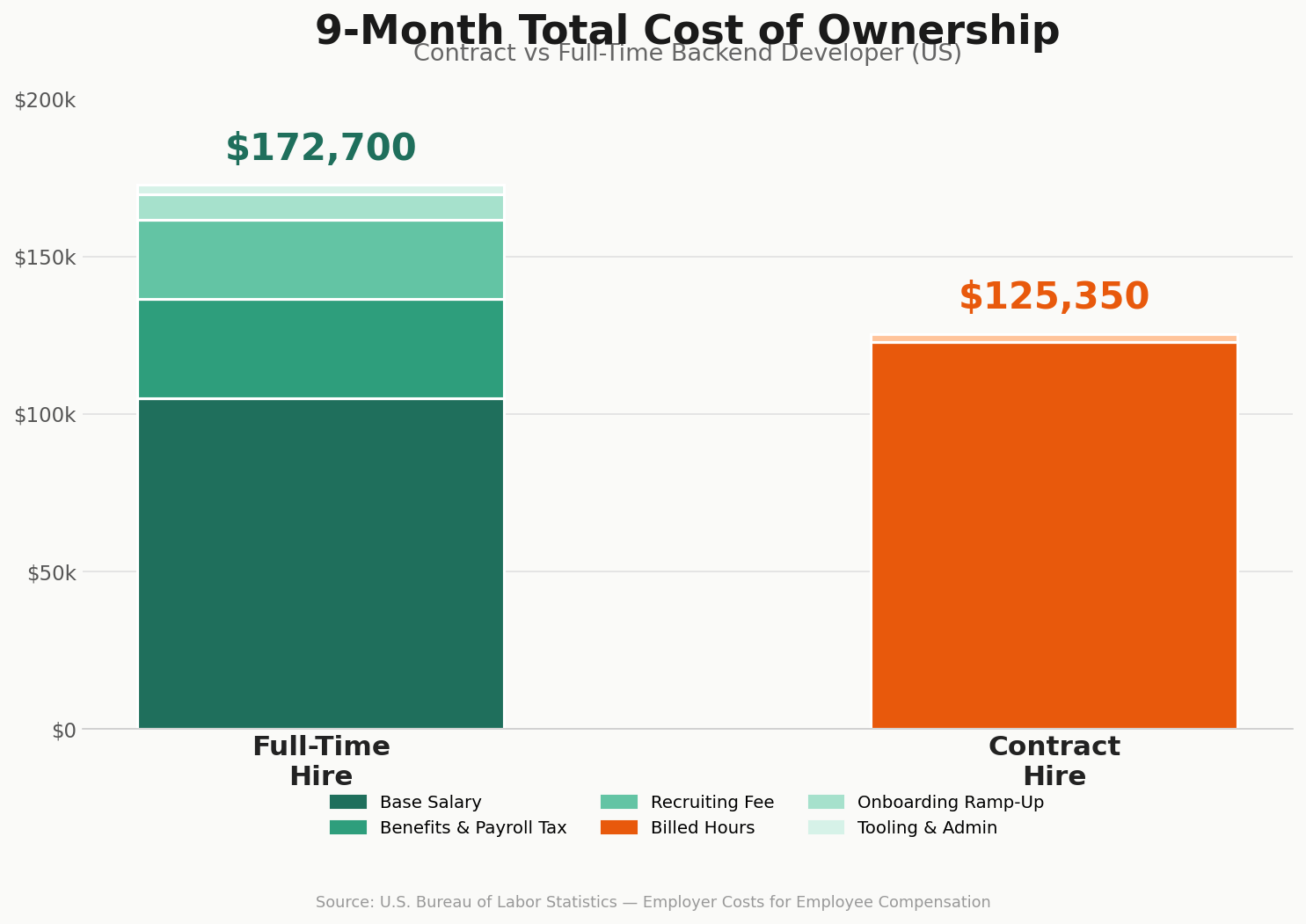
Most cost comparisons stop at “salary vs hourly rate,” which is exactly the mistake called out above. Here’s what a full total cost of ownership comparison actually looks like for a mid-level backend developer over a 9-month project, using US figures.
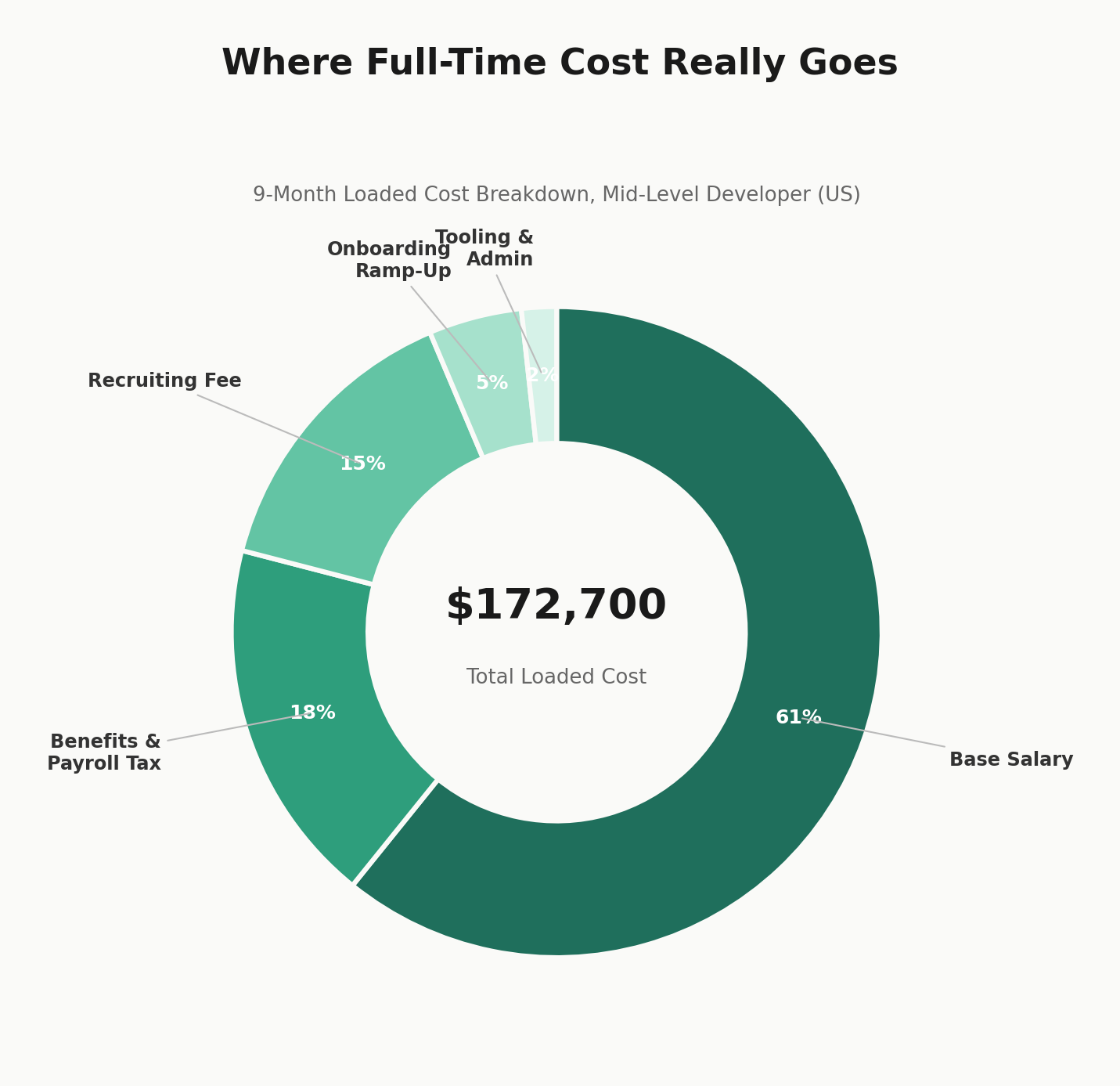
Full-time hire, 9 months:
- Base salary (annualized $140,000, prorated): $105,000
- Benefits and payroll overhead at ~30% (per BLS employer compensation data): $31,500
- Recruiting/agency fee (18% of first-year salary, one-time): $25,200
- Onboarding ramp-up cost (4-6 weeks at reduced output, estimated at 50% productivity): ~$8,000 in lost output
- Equipment, tooling, and admin overhead: ~$3,000
- Estimated 9-month loaded cost: ~$172,700
- If the role ends at 9 months: severance or notice-period obligations may apply depending on jurisdiction, adding further cost the contract model doesn’t carry.
Contract hire (dedicated model), 9 months:
- Billing rate: $90/hour at 35 hours/week average utilization
- 9 months (~39 weeks): $122,850
- No benefits, no payroll tax overhead, no recruiting fee
- Onboarding ramp-up cost (1-2 weeks): ~$2,500 in reduced output
- Estimated 9-month loaded cost: ~$125,350
For this specific 9-month scenario, the contract model runs roughly 27% cheaper once every cost line is accounted for not because the hourly rate is low, but because the full-time model carries fixed costs (recruiting, benefits, ramp-up, potential severance) that don’t scale down with a shorter engagement. Flip the timeline to 3+ years and the comparison usually reverses, since the full-time recruiting and ramp-up costs amortize across a much longer productive period while contract billing continues at the same rate indefinitely.
The rule of thumb this produces: the shorter and more clearly bounded the engagement, the more the math favors contract or dedicated hiring. The longer and more open-ended the need, the more it favors full-time provided attrition risk stays low, since losing a full-time hire after 18 months resets the ramp-up cost with no severance offset.
Beyond One-Off Hires: When to Consider RPO or a GCC
Everything above assumes you’re filling one role or a small handful of roles. Once hiring volume crosses a certain threshold, the calculus changes again, and it’s worth knowing where that threshold typically sits.
Recruitment Process Outsourcing (RPO) makes sense once you’re hiring developers repeatedly, say, 8-10+ technical roles a year and the internal cost of running sourcing, screening, and pipeline management starts rivaling the cost of outsourcing that function entirely. An RPO partner absorbs the sourcing and vetting workload while you retain final hiring decisions, which is a different trade-off than either contract or full-time hiring on its own: it’s about who runs the process, not who does the work.
A Global Capability Center (GCC) a dedicated, wholly owned offshore team operating as an extension of your organization rather than a vendor becomes relevant once headcount needs are large and durable enough (typically 20-50+ engineers) to justify standing up dedicated infrastructure, management layers, and compliance in a lower-cost geography. India’s GCC sector alone spans more than 1,760 centers generating upward of $64.6 billion in export revenue, a scale that reflects how mainstream this model has become for sustained engineering build-out rather than one-off staffing [2].
Where this fits the contract-vs-full-time decision: a GCC doesn’t replace the contract-vs-full-time question, it inherits it at scale every seat inside a GCC still needs to be classified, contracted, onboarded, and managed using the same phases covered above. The difference is that a GCC is built for a specific answer to that question: long-term, full-time-equivalent capacity delivered through a structure designed to make years-long retention and IP protection straightforward, rather than negotiated deal by deal. Teams that reach this scale without ever having built a strong contract and full-time hiring hygiene tend to inherit every shortcut they took early on which is another reason to get the fundamentals right at one or two hires, not just at fifty.
The A-to-Z Walkthrough: From Deciding to Hiring to Managing Delivery
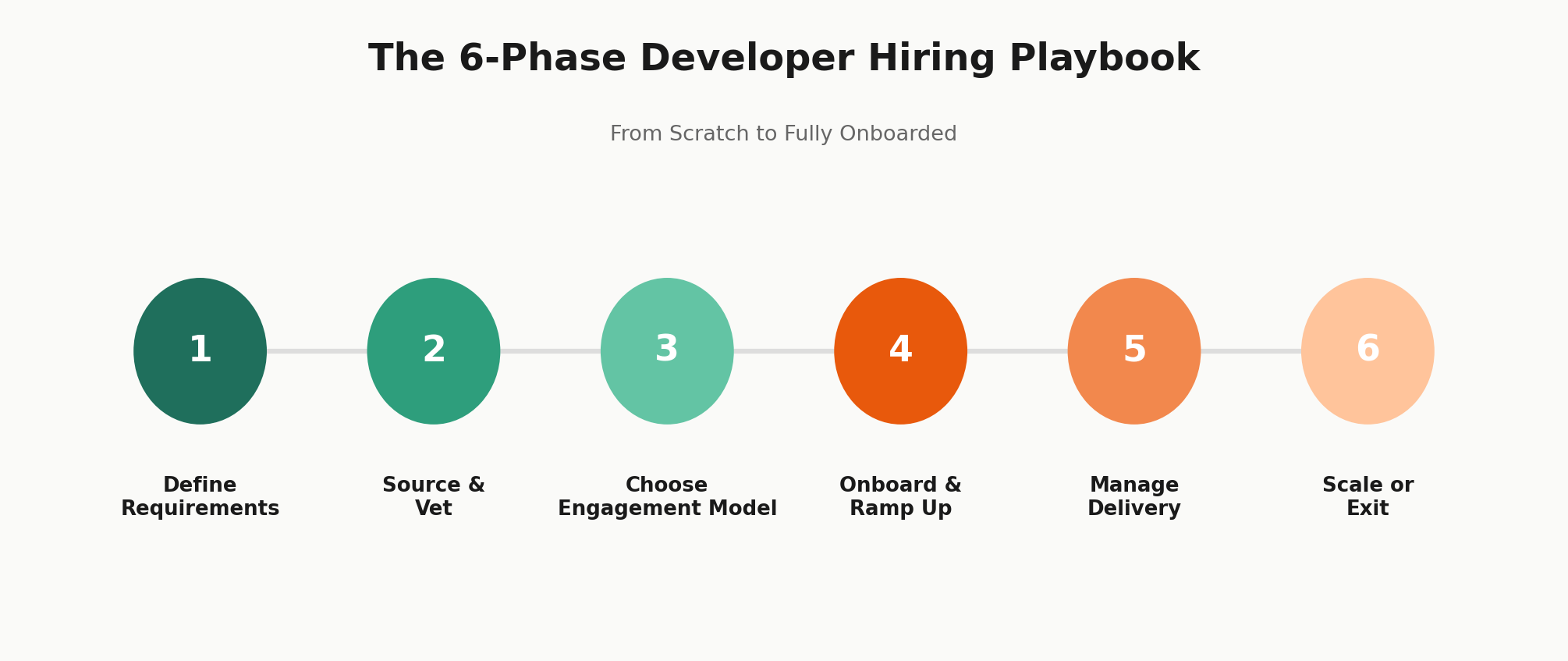
Phase 1 Defining Requirements
Before sourcing anyone, nail down four things in writing. Skipping this step is the single biggest cause of mismatched hires.
- Scope type Is this a defined project (build feature X), an ongoing capacity need (a permanent seat on the team), or a spike (cover a launch, a migration, a temporary gap)?
- Skill specificity List the exact stack, seniority level, and any domain knowledge (fintech compliance, healthcare data handling, etc.) required. Vague requirements (“a good full-stack developer“) are the top cause of slow, low-quality shortlists.
- Timeline Set a real start date and, for contract roles, an end date or renewal checkpoint.
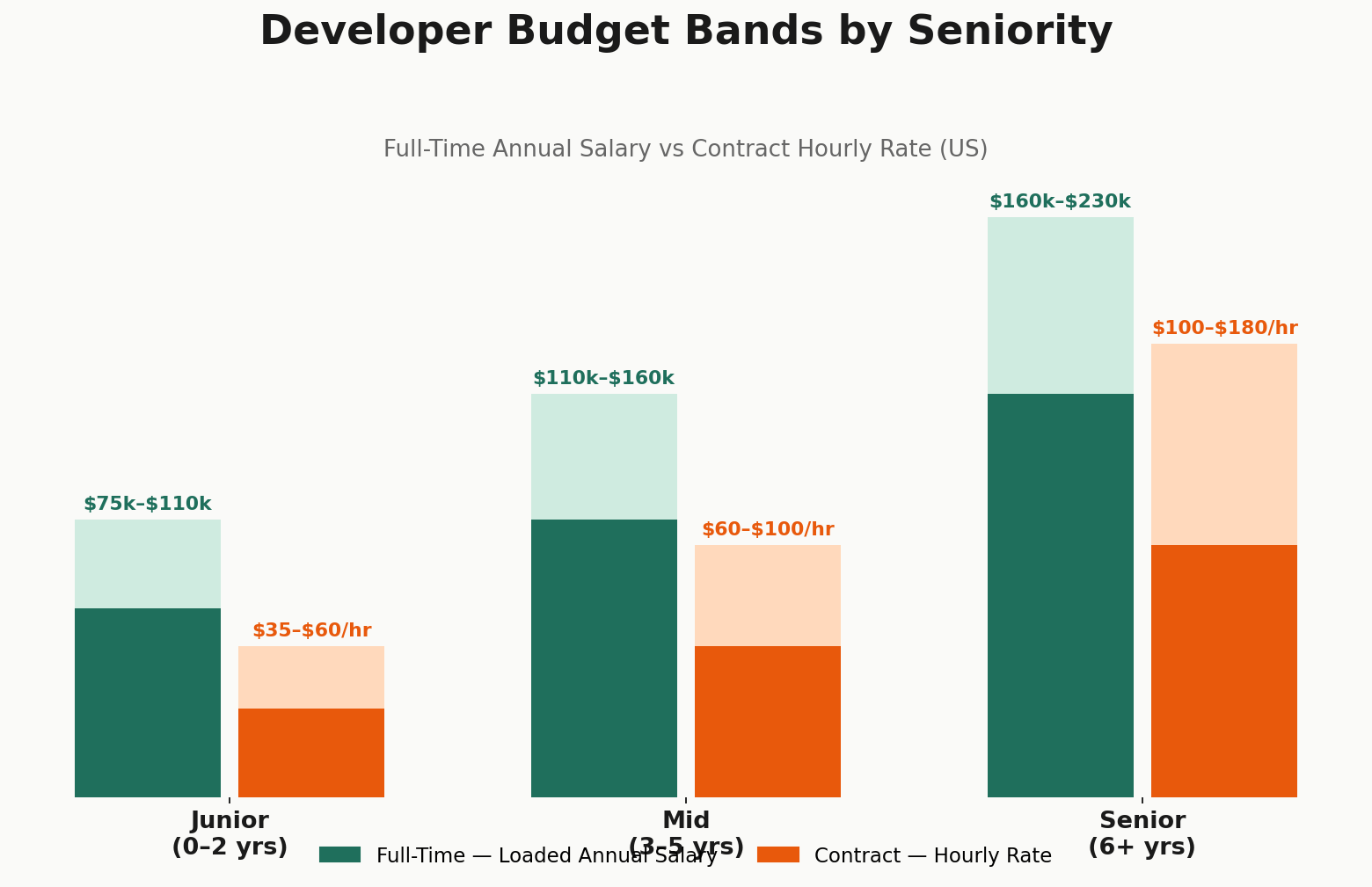
- Budget bands Know both numbers before you talk to anyone:
| Role Level | Full-Time (US, loaded/year) | Full-Time (India, loaded/year) | Contract (US, hourly) | Contract (India, hourly) |
| Junior (0-2 yrs) | $75k-$110k | ₹6-12 lakh | $35-$60 | ₹800-1,800 |
| Mid (3-5 yrs) | $110k-$160k | ₹12-25 lakh | $60-$100 | ₹1,800-3,500 |
| Senior (6+ yrs) | $160k-$230k | ₹25-45 lakh | $100-$180 | ₹3,500-6,500 |
Loaded figures include estimated benefits and payroll overhead on top of base salary; contract figures are billing rates with no additional overhead.
Checklist before moving to sourcing:
- Scope type decided (project / ongoing / spike)
- Must-have vs nice-to-have skills separated
- Start date and (if contract) end date set
- Budget band approved internally
- Decision-maker and interview panel identified
Phase 2 Sourcing & Vetting
This is where cost and quality diverge fastest between models.
What good screening looks like:
- A technical screen matched to the actual stack, not a generic algorithm test, contractors especially should be evaluated on production-code habits (testing, documentation, PR hygiene), not whiteboard puzzles.
- A short paid trial task or code review exercise for contract roles, since you can validate fit before any long-term commitment.
- A culture/communication screen for full-time roles, since retention risk is higher and onboarding cost is sunk if the hire doesn’t stick.
- Reference or past-client checks for contractors ask specifically about reliability under deadline pressure, not just technical skill.
Red flags to screen out, regardless of model:
- Inability to explain past project decisions, only outcomes
- No verifiable past work or references
- Rate or salary expectations wildly inconsistent with stated experience (often signals either desperation or misrepresentation)
- Reluctance to sign standard NDA/IP terms before starting
Speed reality check: An AI-assisted sourcing pipeline that pre-filters for the top 2% of vetted talent against your exact stack can realistically produce an interview-ready shortlist in 7-10 working days. Manual sourcing through job boards alone typically takes 3-4x longer to reach the same shortlist quality, because most of that time is spent filtering unqualified inbound applications rather than interviewing.
Why is the gap so large? A typical job-board posting for a mid-level developer role draws hundreds of applications, and manually reading resumes to find genuinely qualified candidates is where the weeks disappear, not in the interviews themselves. AI-assisted sourcing collapses that step by matching against the stack and experience profile before a human reviewer ever sees a resume, which is why the shortlist timeline compresses so dramatically without lowering the bar; this is the approach Supersourcing’s sourcing pipeline is built around. The interviews you do run should still be conducted by someone technical enough to catch surface-level pattern-matching (a candidate who name-drops the right frameworks without demonstrable depth) outsourcing sourcing doesn’t mean outsourcing judgment on the final call.
Phase 3 Engagement Models & Contracts
Pick the structure before you pick the person retrofitting a contract type after someone has started creating disputes.
Dedicated hiring (contract, embedded in your team):
- Works under your direction, your tools, your standups
- Billed hourly or monthly retainer
- Best for: ongoing product work where you want contractor speed but in-house-like control
Staff augmentation:
- Similar to dedicated hiring but typically sourced and managed through an IT staffing partner, with a replacement guarantee if the person isn’t a fit
- Best for: filling a specific skill gap on an existing team without the overhead of running your own vetting pipeline
Project-based / statement of work (SOW):
- Fixed scope, fixed price or fixed timeline, deliverable-based
- Best for: well-defined projects with clear acceptance criteria (e.g., “migrate this service to Kubernetes”)
Full-time employment:
- Indefinite term, salary + benefits, subject to local labor law on termination and notice
- Best for: core product ownership, roles requiring deep institutional knowledge over years
Contract terms you must have in writing, regardless of model:
- NDA signed before any code or business information is shared, not after.
- IP/work-for-hire assignment clause explicitly stating the company owns all code, designs, and documentation produced. Without this clause, default ownership rules vary by jurisdiction and can leave a contractor with legal claim to their output.
- Scope and change-order process how scope changes are priced and approved, to prevent silent scope creep on fixed-price work.
- Termination and notice terms how either party can end the engagement, and on what notice.
- Confidentiality survival clause NDA obligations that continue after the engagement ends.
Red flag: any contractor or staffing vendor unwilling to put IP assignment in writing before work begins. This is non-negotiable, not a nice-to-have.
Misclassification risks the term nobody mentions until it’s a problem. Tax and labor authorities in most jurisdictions distinguish between genuine independent contractors and employees who are simply labeled “contractor” to avoid benefits obligations. The typical tests look at control (do you dictate hours and methods, or just outcomes?), integration (is this person embedded in your team long-term doing the same work as employees?), and exclusivity (do they work for you alone, full-time, indefinitely?).
A contractor who has worked 40 hours a week, exclusively for you, under your direct daily supervision, for two years, looks a lot like an employee to a labor authority regardless of what the contract says. If a contract engagement is drifting into that territory, it’s usually a sign the role should convert to full-time, staff augmentation through a registered employer of record (EOR/PEO), or a properly structured project-based SOW not a reason to ignore the risk.
Practical takeaway: for genuinely short, bounded, or project-based work, direct contracting is fine. For long-running, full-time-equivalent engagements, route them through a staffing partner or EOR that carries the compliance burden, rather than contracting directly and hoping it doesn’t get flagged.
Phase 4 Onboarding & Ramp-Up
The first two weeks determine whether you get full value from either model.
Days 1-3:
- Provision access: repo, ticketing system, communication channels, environment credentials
- Walk through architecture and coding standards documentation (if none exists, this is itself a red flag worth fixing before scaling hiring further)
- Assign a single point of contact for questions ambiguity here is the top cause of slow ramp-up
Days 4-10:
- First small, well-scoped ticket assigned and shipped to production or staging
- Daily async check-in (not necessarily a meeting) to catch blockers early
- Pairing session with an existing team member on at least one task
Weeks 2-4:
- Full sprint participation
- Formal check-in on fit and output quality this is the natural point to flag issues before they compound
Onboarding checklist:
- Access provisioned same-day as start
- Point of contact assigned
- First ticket scoped and ready before day 1
- Documentation reviewed together, not just linked
- 2-week fit check-in scheduled in advance
Phase 5 Managing Delivery
Ongoing management looks different by model but should never be absent for either.
- Reporting cadence: Weekly async status updates minimum; daily standups for contractors embedded in sprint teams.
- KPIs to track: cycle time (ticket start to merge), code review turnaround, defect rate on shipped work, and for contractors specifically invoice-to-output consistency.
- Account management structure: For staff-augmented or dedicated contract hires sourced through a staffing partner, insist on a named account manager, not a rotating support queue this is standard practice at firms like Supersourcing precisely because it’s what makes a 7-10 day replacement guarantee actually enforceable if a hire doesn’t work out.
- Documentation habit: Require architecture decisions and non-obvious code choices to be documented as they happen, not reconstructed later this matters more for contractors, since institutional memory walks out the door when the engagement ends.
A note on management overhead that’s easy to underestimate. Every hire, contract or full-time, consumes management bandwidth. Someone has to review their work, unblock them, and evaluate whether the engagement is worth continuing. Teams that hire five contractors to “move faster” sometimes discover they’ve simply relocated the bottleneck to the one person now reviewing five people’s output instead of writing code themselves.
Before adding headcount of either type, confirm there’s enough management capacity to actually direct and evaluate the new hire otherwise the throughput gain on paper doesn’t show up in shipped work.
Phase 6 Scaling or Exiting
- Adding headcount: Contract models scale in days once a vetting pipeline exists; full-time scaling should be paced to actual pipeline capacity, since rushed full-time hiring is the top cause of bad long-term fits.
- Contract-to-hire conversion: If a contractor is being considered for a permanent offer, define the conversion path (timeline, fee if applicable) in the original contract negotiating it after the fact creates friction and can violate non-compete terms with staffing vendors.
- Replacement policy: A 7-10 day replacement guarantee for a non-performing contract hire should be a standard term with any staffing partner, not something negotiated after a bad hire is already three weeks in.
- Offboarding: Revoke access immediately on end date, conduct a documentation handoff session, and confirm final IP assignment covers all deliverables this is where unclear contracts create the most legal exposure.
Case Studies
Real hiring outcomes are more useful than hypothetical ones, so here are three scenarios drawn from real project patterns across fintech, healthtech, and merchant-platform hiring.
Fintech scale-up, engineering hiring surge. A fast-growing Indian fintech platform needed to scale engineering headcount rapidly to support product expansion. By combining AI-assisted sourcing with a structured technical vetting pipeline, the company moved from job description to interview-ready shortlists inside a 7-10 working day window per role, avoiding the multi-month backlog typical of traditional recruiting cycles during a period when hiring speed directly affected product launch timing.
Merchant platform, engineering team build-out. A merchant-focused fintech company needed engineering capacity without slowing down its own product roadmap to manage a lengthy hiring process. A dedicated-hiring model with an assigned account manager let internal engineering leadership stay focused on delivery while sourcing, screening, and contract logistics were handled externally with a <1% candidate drop-off rate on placed contract roles, meaning almost every shortlisted hire that accepted an offer actually started and stayed through onboarding.
Healthtech automation platform, recruitment process modernization. A healthtech company automating clinical workflows needed to modernize how it sourced technical talent without building an internal recruiting function from scratch. Adopting an RPO-style engagement gave the company a repeatable, AI-assisted sourcing process instead of ad hoc job-board posting, cutting time-to-shortlist while maintaining a 98% candidate joining rate on offers extended a meaningful gap-closer given how often offers quietly fall through between acceptance and start date in manual hiring processes.
Comparison / Decision Framework
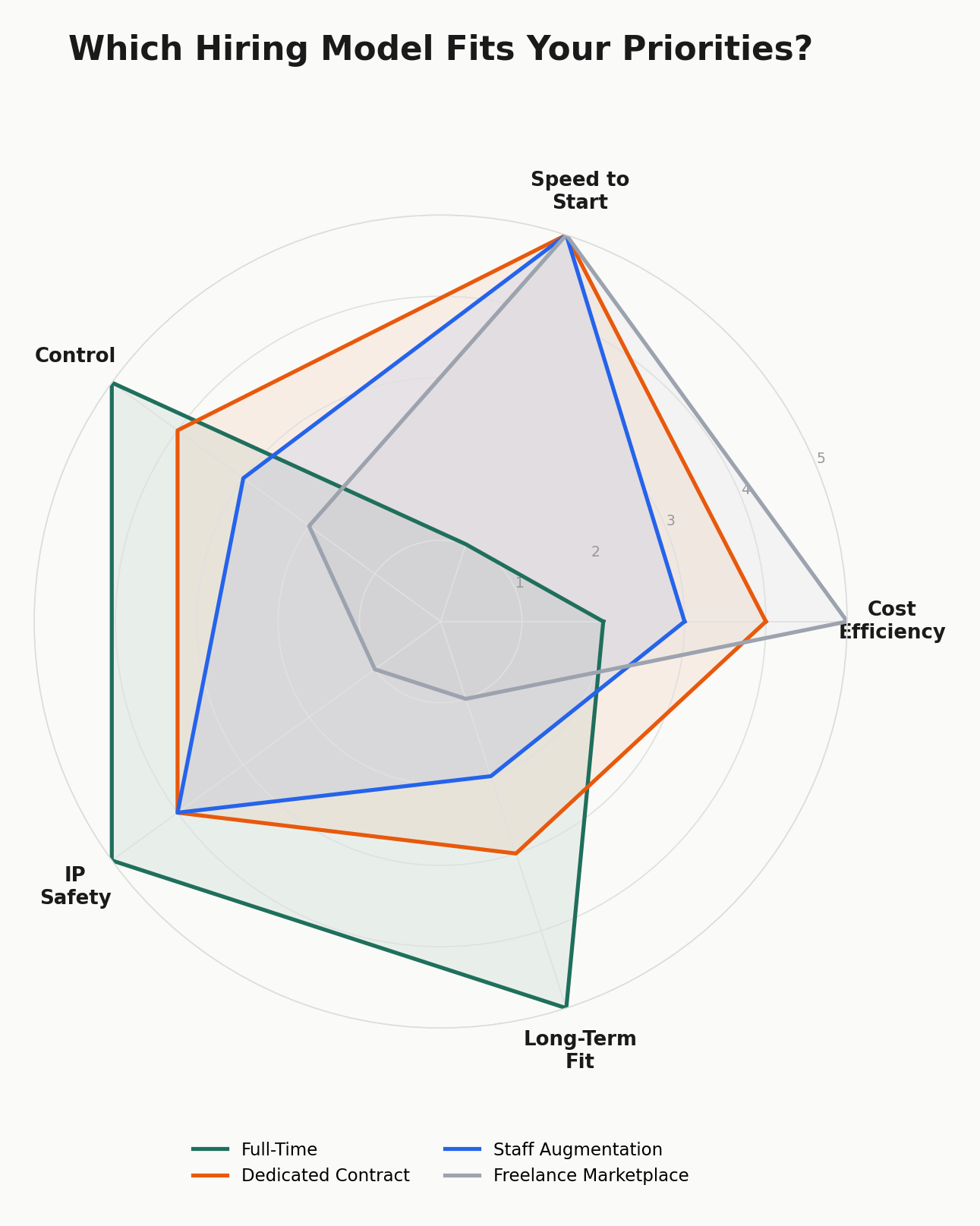
Use this table to map your situation to a starting model, then adjust based on budget and risk tolerance. No framework replaces judgment about your specific situation, but most teams skip even this basic mapping step and default to whatever hiring model they used last time which is how mismatches compound across a growing team.
| Factor | Full-Time | Dedicated Contract | Staff Augmentation | Freelance Marketplace |
| Cost (relative) | Highest fixed cost, best long-run value for multi-year roles | Medium no benefits load | Medium includes vendor margin | Lowest hourly rate, highest hidden risk |
| Speed to start | Slowest (6-12 weeks) | Fast (7-10 days with a pipeline) | Fast (7-10 days) | Fastest, but unvetted |
| Control | Full | High (embedded in your team) | High | Low |
| IP/ownership risk | Lowest | Low, if contracts are signed correctly | Low, vendor typically handles paperwork | Highest often no enforceable IP clause |
| Best for | Core product ownership, long-term roles | Ongoing work needing speed + control | Backfilling a specific skill gap fast | One-off, low-stakes tasks |
Decision matrix by scenario:
- MVP build (unproven product, 3-6 month horizon): Contract or dedicated-hire model. Full-time hiring before product-market fit locks in fixed cost against unproven demand.
- Seasonal or launch spike (temporary, defined end date): Staff augmentation. You need speed and a clean exit, not a permanent relationship.
- Long-term core dedicated team (multi-year, product-critical): Full-time, once scope and roadmap are stable enough to justify the fixed cost and retention investment.
- Niche skill gap (e.g., a one-time migration): Project-based SOW contract pay for the deliverable, not the relationship.
What Most Teams Get Wrong
- They compare hourly rate to hourly rate instead of loaded cost to loaded cost. A $100/hour contractor working 1,000 hours on a project ($100,000) is routinely cheaper than a $140,000 full-time hire once benefits, payroll tax, and management overhead are added, especially when the work has a defined end date.
- They treat “contract” as synonymous with “lower quality.” Vetting quality is a function of the sourcing process, not the employment classification. A poorly vetted full-time hire is a much more expensive mistake than a poorly vetted contractor, because exiting a full-time hire is slower and costlier.
- They skip the IP assignment clause because the relationship feels informal. The most common post-hoc legal cleanup in due diligence for acquisitions or funding rounds is unclear IP ownership from early contractor work; this is preventable with a one-page clause signed on day one.
- They under-invest in onboarding for contractors on the theory that “they should already know what they’re doing.” Ramp-up time is a function of context, not raw skill. Even a senior contractor needs a documented codebase and a clear first ticket to be productive quickly.
- They wait too long to convert a good contractor to full-time, assuming the option will always be there. Good contractors get competing offers; if conversion terms aren’t pre-negotiated, you lose leverage exactly when you need it most.
- They benchmark against “market rate” instead of their own scope. A senior contractor at $150/hour who ships a feature in three focused weeks is often cheaper in total dollars than a $90/hour contractor who takes nine weeks to reach the same result because they need heavier direction. Rate is a poor proxy for cost; total delivered output per dollar is the number that matters, and it requires actually tracking cycle time and rework, not just invoicing.
- They apply the same interview process to contractors and full-time hires and wonder why contract hiring doesn’t feel faster. A six-round interview loop designed to de-risk a multi-year employment decision is overkill for a bounded, exit-able engagement and it erodes the speed advantage that’s the whole point of hiring a contractor in the first place. Match the rigor of the process to the actual switching cost of getting it wrong.
Cost & Timeline Reality Check
This is the section most competing guides skip entirely, because concrete numbers are harder to write (and easier to be wrong about) than general advice. The ranges below are directional, not quoting actual figures shifted by geography, seniority, and market conditions but they’re specific enough to budget against, which is the point.
Cost drivers that push full-time cost up:
- Benefits and payroll tax overhead (roughly 30-40% on top of base salary in the US, per BLS compensation data)
- Recruiter/agency fees for full-time search, often 15-25% of first-year salary
- Onboarding and ramp-up time before the hire is fully productive (typically 4-8 weeks of reduced output)
Cost drivers that push contract cost up:
- Premium rates for niche or urgent skill requirements
- Extended engagements without a conversion plan, where cumulative contract spend eventually exceeds full-time loaded cost
- Vendor margin on staff-augmented placements (typically built into the billed rate, not itemized separately)
Typical timelines by scenario:
| Scenario | Realistic Timeline |
| Vetted contract shortlist (AI-assisted sourcing) | 7-10 working days |
| Vetted contract shortlist (manual job-board sourcing) | 3-5 weeks |
| Full-time hire, offer to accepted | 6-12 weeks |
| Full-time hire, accepted to start date (notice period) | 2-8 weeks additional |
| Contractor onboarding to full productivity | 1-2 weeks |
| Full-time onboarding to full productivity | 4-8 weeks |
Where to Go From Here
If you’re mid-decision on this right now, don’t try to solve it in the abstract. Write down your actual scope, timeline, and budget band using the Phase 1 checklist above, then run it against the decision matrix. Most of the ambiguity in this decision disappears once those three numbers are on paper.
If you’d rather have a vetted shortlist in front of you than keep modeling scenarios, Supersourcing’s team can walk through your specific requirement project scope, timeline, or team-scaling plan and tell you candidly which engagement model fits before any sourcing starts. There’s no advantage to us steering you toward a more expensive model than you need; a mismatched hire costs everyone more in replacement time and lost momentum than getting the model right the first time. Start that conversation here.
FAQ
Is it cheaper to hire a contractor or a full-time developer?
It depends on duration. For engagements under roughly 6-9 months, contractors are usually cheaper once you account for the full-time loaded cost of benefits, payroll tax, and recruiting fees. Beyond that horizon, full-time hiring typically wins on cost per hour of output, assuming low attrition.
What’s included in the true cost of a full-time developer?
Base salary plus benefits (health insurance, retirement contributions, paid leave), payroll taxes, recruiting costs, equipment and tooling, and management overhead. In the US, benefits alone average close to 30% of total compensation according to BLS data, meaning the fully loaded cost is roughly 1.3-1.4x the quoted salary.
How fast can you onboard a contract developer?
With a pre-vetted sourcing pipeline, a technically screened, interview-ready shortlist can be ready in 7-10 working days, with the hire starting productive work within another 1-2 weeks of onboarding.
Who owns the IP when a contractor writes the code?
Ownership depends entirely on the contract. Without an explicit IP/work-for-hire assignment clause signed before work begins, default ownership rules vary by jurisdiction and can leave ambiguity that surfaces during due diligence. Always get this in writing on day one.
Can a contract developer become a full-time hire later?
Yes, and it’s a common practice often called contract-to-hire. It works best when the conversion path (timing, any conversion fee owed to a staffing partner) is defined in the original agreement, rather than negotiated informally after the fact.
What’s the difference between staff augmentation and a dedicated team?
Staff augmentation typically fills a specific, often narrower skill gap on an existing team through a staffing partner. A dedicated contract hire is usually embedded more deeply and works under your direct management for an extended period, closer to how a full-time employee would operate day to day.
What happens if a contract developer isn’t a good fit?
With a reputable staffing partner, a replacement should be provided within 7-10 days at no additional cost, provided this guarantee is written into the original agreement. Without that clause, you’re exposed to the full cost and delay of resourcing on your own.
When does it make sense to build a full-time core team instead of hiring contractors?
Once scope stabilizes, the work becomes central to long-term product ownership, and you need institutional knowledge to compound over multiple years rather than reset with every contract renewal; that’s the point where full-time hiring’s fixed cost starts paying for itself.
How do you decide between staff augmentation and going through an RPO partner?
Staff augmentation is the right call when you need one or a few specific roles filled quickly on an existing team. RPO makes more sense once you’re hiring repeatedly enough roughly 8-10 or more technical roles a year that running your own sourcing and screening pipeline in-house is costing more in time and management attention than outsourcing that process would.
