

A single missed index on a production table can turn a 200ms query into a 40-second one and take a checkout page down with it. That’s not a hypothetical; it’s the kind of failure that shows up in post-mortems at companies that hired a database administrator based on a resume full of certifications and nothing else. Most teams don’t budget for this risk because they’ve never had to price it.
The U.S. The Bureau of Labor Statistics currently projects overall employment of database administrators and architects to grow 4% from 2024 to 2034 about as fast as the average for all occupations with roughly 7,800 openings projected each year. Demand isn’t collapsing under AI automation the way some headlines suggest it’s shifting toward administrators who can also handle cloud architecture, security, and performance work at scale.
This guide walks through the entire process of hiring database administrators from deciding you need one, to writing the job spec, to vetting for the skills that actually matter, to structuring the contract, to managing the DBA once they’re on your team. It’s built for technical and semi-technical hiring managers who are past the “what is a DBA” stage and need a working process.
TL;DR
This guide is for engineering leads, CTOs, and hiring managers who need to hire database administrators whether that's a single PostgreSQL specialist or a small MongoDB developer hiring pod and want a repeatable process instead of a one-off job posting.
The biggest number to remember: a mis-hired DBA typically costs a company 3-4 months of salary in lost productivity, re-hiring effort, and incident cleanup before the mistake is caught and corrected. A properly vetted hire, by contrast, can be sourced and interview-ready in 7-10 working days when the requirements are scoped correctly.
By the end, you'll be able to write a precise DBA job spec, run a technical interview that filters out resume-only candidates, choose the right engagement model for your stage of growth, and set up the reporting cadence that keeps a remote or offshore DBA accountable long after the hire is made.
What Is a Database Administrator?
Database administrator (DBA) is the person responsible for the performance, availability, security, and integrity of an organization’s databases including installation, configuration, backup and recovery, access control, and performance tuning across relational or NoSQL systems.
A DBA is often confused with, but is not the same as:
- A data engineer, who builds and maintains data pipelines and ETL/ELT workflows for analytics rather than managing the operational database itself.
- A database developer, who writes application-facing queries and schema logic but doesn’t own uptime, backups, or security posture.
- A cloud/DevOps engineer, who may manage the infrastructure a database runs on without owning the database engine’s internal performance or data integrity.
DBA Skills Checklist by Database Type
Because “database administrator” spans several genuinely different specializations, use this DBA skills checklist to match the candidate’s actual depth to your stack, not just their job title.
PostgreSQL DBA must demonstrate:
- Query plan reading (EXPLAIN / EXPLAIN ANALYZE) and index strategy for both B-tree and specialized index types (GIN, GiST)
- Autovacuum and bloat management on high-write tables
- Streaming replication setup and failover testing (physical and logical replication)
- Connection pooling configuration (PgBouncer or equivalent) for high-concurrency workloads
- Point-in-time recovery (PITR) using WAL archiving
MySQL/MariaDB DBA must demonstrate:
- InnoDB storage engine tuning (buffer pool sizing, redo log configuration)
- Replication topology design (source-replica, group replication) and failover procedures
- Query cache and index optimization for read-heavy OLTP workloads
- Binary log management for point-in-time recovery
- Online schema change tooling (e.g., gh-ost or pt-online-schema-change) for zero-downtime migrations
MongoDB DBA must demonstrate:
- Replica set design, election priority configuration, and failover testing
- Sharding strategy shard key selection and re-sharding trade-offs at scale
- Aggregation pipeline optimization and index strategy for document queries
- Schema design trade-offs specific to document stores (embedding vs. referencing)
- Backup strategy for sharded clusters, not just single-replica-set backups
SQL Server / Oracle DBA must demonstrate:
- Execution plan analysis and index/statistics maintenance
- High-availability configuration (Always On Availability Groups for SQL Server; RAC/Data Guard for Oracle)
- License-aware capacity planning (a real cost lever on these engines specifically)
- Backup strategy including differential and transaction log backups
- Security and compliance configuration relevant to regulated industries (row-level security, TDE)
Cross-engine skills every senior DBA should have regardless of specialization:
- Incident response under pressure can they describe a real outage and what they changed afterward?
- Capacity planning ahead of predictable growth events (seasonal traffic, funding-driven scale-up)
- Comfort working alongside a hire cloud engineers function when the database sits on managed cloud infrastructure
- Written documentation habits runbooks, not just tribal knowledge
Why Hiring the Right DBA Matters: The Business Case
The decision to hire database administrators affects four measurable outcomes, not just “keeping the lights on”:
- Uptime and revenue protection: an unoptimized query pattern or missed replication failover can cause outages that directly cost transaction revenue, not just engineering time.
- Query and infrastructure cost a DBA who tunes indexes, connection pooling, and query plans can often cut cloud database spend by a meaningful margin on compute-heavy workloads, without adding hardware.
- Compliance and security exposure DBAs who implement role-based access control, encryption at rest, and audit logging reduce the blast radius of a breach and the cost of compliance reviews (SOC 2, HIPAA, PCI-DSS).
- Engineering velocity when schema design and migrations are owned by a specialist instead of ad hoc by backend engineers, feature teams ship faster because they’re not debugging database locks mid-sprint.
The cost of getting this wrong, in concrete terms: a mis-hired or under-skilled DBA typically shows up first as a slow accumulation of small incidents, a missed index here, a delayed migration there before culminating in one larger outage that forces a re-hire. By the time the mismatch is caught, most teams have absorbed roughly 3-4 months of salary in lost productivity, incident cleanup, and the re-hiring cycle itself. That number is the real argument for spending more time on vetting up front rather than filling the seat quickly and hoping for the best.
Where the DBA decision intersects with broader hiring strategy: companies scaling a GCC or offshore engineering hub in India often bundle DBA hiring into a broader global capability center build-out rather than hiring the role in isolation this typically improves both cost and continuity, since the DBA sits inside an existing operational and compliance structure rather than being a lone remote hire without local escalation support.
The Core Problem Most Buyers Face
Most first-time buyers underestimate two things at once: how narrow “DBA” actually is as a skill category, and how long a bad hire stays invisible.
- Skill mismatch: A candidate strong in Oracle or SQL Server administration may have never run a MongoDB replica set failover or tuned a PostgreSQL vacuum strategy; these are not interchangeable skill sets, despite similar job titles.
- Vetting gaps: Certifications (OCP, MongoDB DBA cert) test theoretical knowledge, not judgment under a live incident. Teams that vet on certifications alone routinely discover the gap only during the first production incident often 60-90 days in.
- Cost blindness: Teams frequently budget for base salary and skip the cost of onboarding, tooling access, and the 2-3 week ramp period before a DBA is fully productive then are surprised when “time to value” runs 4-6 weeks longer than planned.
- Scope creep: A DBA hired for “database work” without a written scope often ends up absorbing data engineering, DevOps, and even BI reporting duties diluting the one job they were actually hired to do.
DBA vs Data Engineer: Why This Confusion Costs Teams Time
This is one of the most common mis-hires in the entire category, so it’s worth spelling out beyond the definition-section bullets above.
- Ownership boundary: a DBA is accountable if a production database goes down or loses data. A data engineer is accountable if an analytics pipeline breaks or delivers stale/incorrect data to a dashboard. These are different failure modes with different response playbooks.
- Tooling overlap, different depth: both roles touch SQL and schema design, but a DBA goes deep on engine internals (storage, replication, locking behavior), while a data engineer goes deep on orchestration tooling (Airflow, dbt, Spark) and pipeline reliability.
- Where teams get the hire wrong: a startup that needs someone to “own the database” often posts a “data engineer” role because it sounds more modern, then wonders why the hire can build a pipeline but can’t diagnose a locking issue during a traffic spike. The title on the job posting should match the actual failure mode you’re hiring to prevent.
- When you need both: once your analytics needs (dashboards, reporting, ML feature pipelines) grow independently of your operational database needs, that’s the signal to hire a data engineer alongside not instead of your DBA, rather than expecting one hire to cover both indefinitely.
The Walkthrough: From First Decision to Fully Managed DBA
This full lifecycle treats each phase as a checklist, not a suggestion.
Phase 1 Defining Requirements
Before writing a job description, answer these five questions in writing:
- Which database engine(s)? PostgreSQL, MySQL, MongoDB, SQL Server, Oracle, or a mixed environment specialization matters more than a generic “SQL” requirement.
- What’s the primary workload? OLTP (transactional, low-latency) vs. OLAP (analytical, batch-heavy) call for different tuning skills.
- What’s the environment? Self-managed on VMs, or a managed cloud service (Amazon RDS, Google Cloud SQL, MongoDB Atlas)? Managed services shift some ops burden but not the tuning or schema-design responsibility.
- What’s the engagement needed? One full-time dedicated DBA, a fractional/part-time DBA, or a small pod alongside hire cloud engineers for infrastructure-adjacent work?
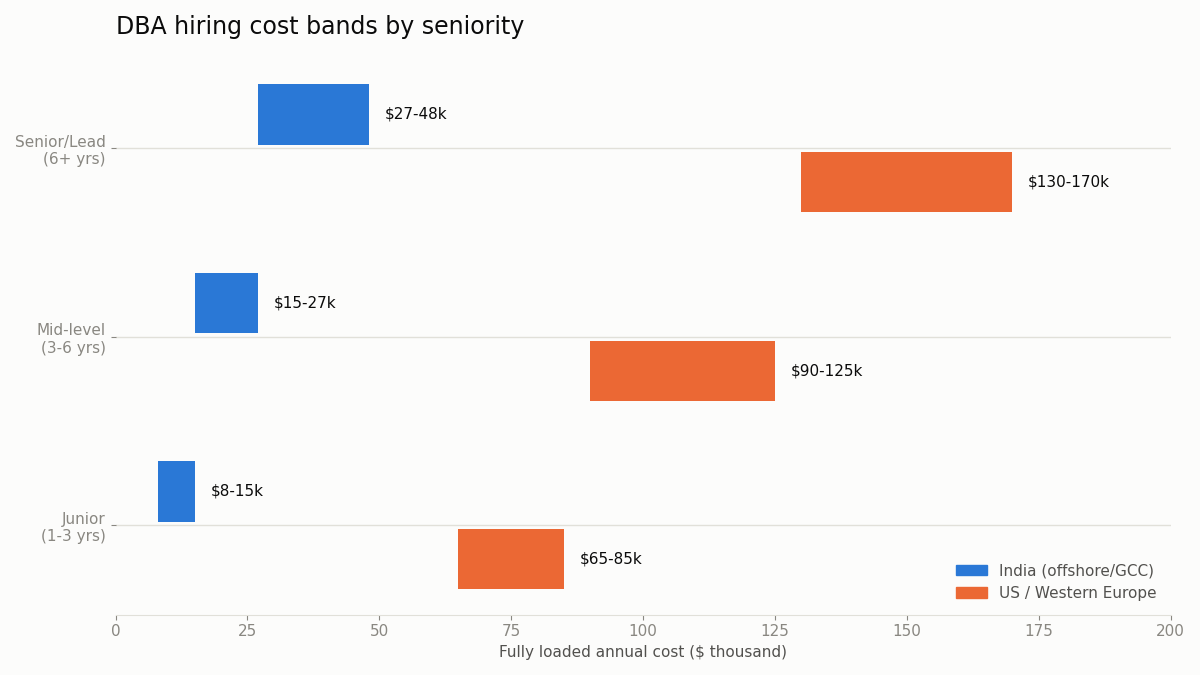
- What’s the budget band? For context, fully loaded costs typically run:
| Experience Level | India (Offshore/GCC) | US/Western Europe |
| Junior DBA (1-3 yrs) | ₹6-12 lakhs/year (~$8k-15k) | $65k-85k/year |
| Mid-level DBA (3-6 yrs) | ₹12-22 lakhs/year (~$15k-27k) | $90k-125k/year |
| Senior/Lead DBA (6+ yrs) | ₹22-40 lakhs/year (~$27k-48k) | $130k-170k/year |
Red flag before you even source: if you can’t answer question 2 and 3 above, you’re not ready to write the job description yet you’ll end up interviewing candidates against a moving target.
Two questions teams routinely skip, and shouldn’t:
- What’s your actual data volume and growth curve? A DBA who’s only worked with datasets under 50GB will approach indexing and partitioning differently than one who’s managed multi-terabyte tables ask for this number before sourcing, not during the interview.
- Who owns the decision if the DBA’s recommendation conflicts with an engineering team’s roadmap? Without a named escalation path, a DBA’s performance-tuning recommendations (e.g., “this table needs partitioning before launch”) get deprioritized indefinitely, and the DBA gets blamed for outages the recommendation would have prevented.
A written job spec built from these seven inputs: engine, workload type, environment, engagement model, budget band, data volume, and escalation ownership is what separates a 7-10 day shortlist from a six-week search that still ends in a mismatched hire.
Phase 2 Sourcing & Vetting
- Sourcing channels: internal referrals, specialized DBA communities (PostgreSQL/MongoDB user groups), staffing partners with a pre-vetted talent pool, and direct outreach in that order of typical fit-quality for senior roles.
- Technical vetting should test, in order:
- Query optimization on a live, deliberately slow query (not a whiteboard question).
- A backup-and-recovery scenario: “walk me through restoring to a specific point in time after a bad migration.”
- A failover/HA scenario specific to the engine (replica set selection for MongoDB; streaming replication failover for PostgreSQL).
- Security judgment: how they’d design role-based access for a multi-tenant schema.
- Red flag: a candidate who can recite normalization theory but can’t describe a real incident where a query plan changed unexpectedly after a data volume shift. Real DBAs have war stories; theoretical ones don’t.
- Cultural/communication evaluation: DBAs often work cross-functionally with backend, security, and compliance teams test written incident-report clarity, not just technical depth, especially for remote hires.
Database administrator interview questions worth asking directly:
- “Walk me through the last time a query that used to be fast suddenly got slow. What did you check first?”
- “Describe a schema migration you ran on a live production table with zero downtime. What was your rollback plan?”
- “How do you decide when a table needs to be partitioned or sharded versus just re-indexed?”
- “Tell me about a time your backup strategy was tested by an actual incident, not a drill. What did you learn?”
- “How would you design access control for a database shared across three teams with different compliance requirements?”
- “What’s your process for validating that a restored backup is actually usable, not just that the restore command succeeded?”
Why question 6 matters more than it looks: a shocking number of “we have backups” answers fall apart here teams routinely discover their backup files were corrupt, incomplete, or untested for months, and only a candidate who’s built restore-verification into their routine will have a concrete answer.
Timeline expectation: two structured technical rounds plus one scenario-based round is typically enough to separate strong candidates from resume-only ones stretching this to 4-5 rounds usually signals unclear requirements more than diligence, and it’s the single biggest reason strong candidates drop out of a hiring process before an offer is made.
Phase 3 Engagement Models & Contracts
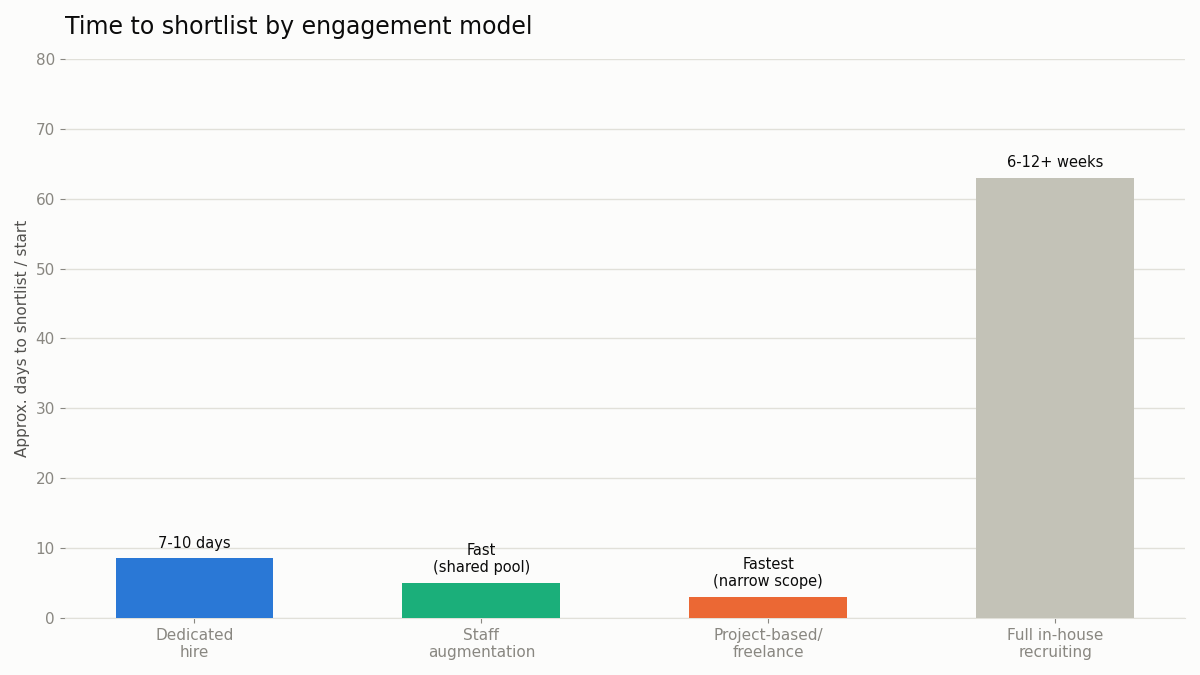
| Model | Best For | Control | Speed | IP/Contract Notes |
| Dedicated hire (staffing partner) | Ongoing, full-time ownership | High | 7-10 working days to shortlist | NDA-backed, dedicated resource, no shared bandwidth |
| Staff augmentation | Filling a skills gap on an existing team | Medium-High | Fast, but candidate pool is shared | Contract typically monthly/quarterly renewable |
| Project-based/freelance | One-time migration or audit | Low-Medium | Fastest for narrow scope | IP terms must be spelled out per deliverable, not assumed |
| Full in-house recruiting | Long-term, core infrastructure role | Highest | Slowest (6-12+ weeks typical) | Standard employment IP assignment |
- NDA and IP protection terms should explicitly cover access to production data, schema designs, and any tooling/scripts built during the engagement, not just “confidential information” boilerplate.
- Replacement clauses matter more than people expect: ask any staffing partner what happens if the DBA isn’t a fit in the first 30-60 days. A 7-10 day replacement guarantee is a meaningful signal of vetting confidence that vague “we’ll look into it” language is not.
- Data access clauses to get in writing before day one: whether production data can be exported or copied locally during troubleshooting, how long access logs are retained, and what happens to any scripts, dashboards, or runbooks the DBA builds these should be assigned to the hiring company by default, not left ambiguous.
- On-call terms: if the role includes after-hours incident response, the contract should specify compensation or time-off-in-lieu for on-call rotations; this is one of the most common sources of mid-engagement disputes when it’s left unwritten.
Phase 4 Onboarding & Ramp-Up
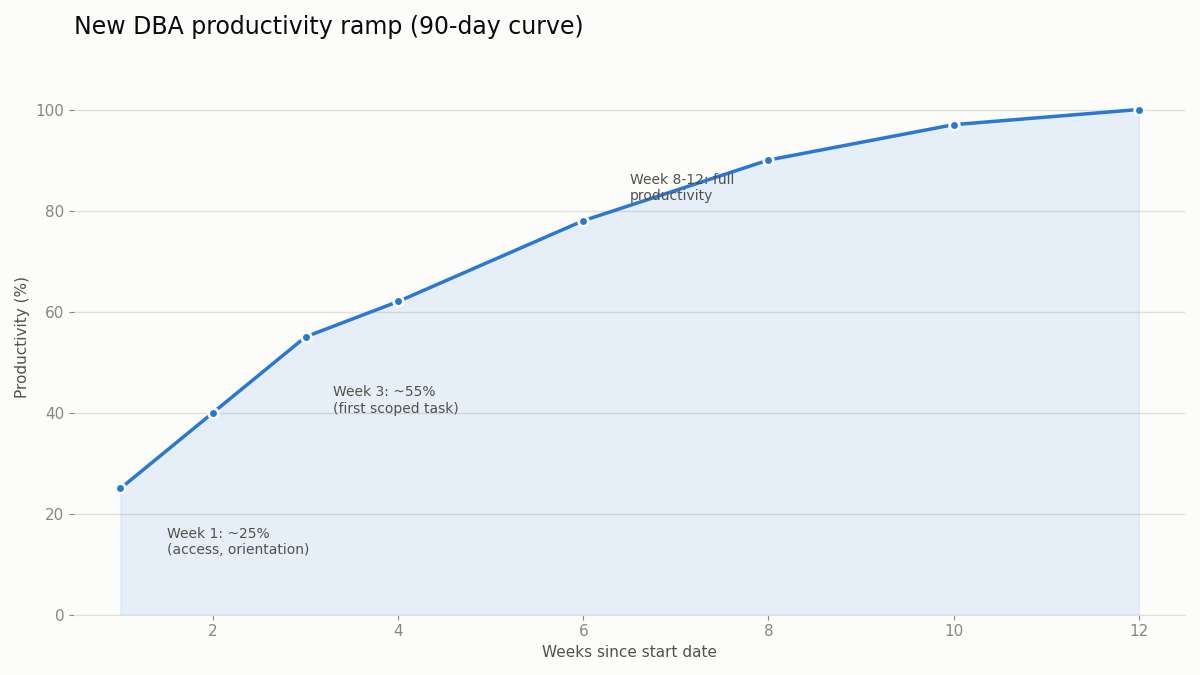
- Week 1: Access provisioning (read-only production access first, elevated access after a supervised review), documentation walkthrough, shadow an existing on-call rotation if one exists.
- Week 2: First supervised change of a low-risk index addition or a staging-environment migration, reviewed before it touches production.
- Weeks 3-4: Independent ownership of a scoped task (e.g., a backup strategy audit or a query performance review) with a defined deliverable and review checkpoint.
- The 3-day rule: if a new DBA hasn’t been granted the access they need to do real work within 3 business days of start date, ramp-up is already behind schedule; this is the single most common onboarding failure teams underestimate.
Onboarding checklist to hand a new DBA on day one:
- Architecture diagram of every database instance they’ll touch, including which ones are production versus staging
- A list of every existing scheduled job (backups, batch jobs, cron-triggered maintenance) so nothing gets accidentally duplicated or disabled
- Contact list for the escalation path defined back in Phase 1
- Access to the incident-history log or post-mortem archive, so they understand what’s already broken before and why
A realistic 90-day ramp curve: expect roughly 20-30% productivity in week one (access, orientation, shadowing), 50-60% by week three (first independent scoped task), and full productivity meaning independent ownership of the on-call rotation and proactive tuning work, not just reactive tickets by week eight to twelve depending on system complexity. Dedicated teams that expect full productivity in week two are setting the DBA and themselves up for a rushed, error-prone first production change.
Phase 5 Managing Delivery
- Reporting cadence: weekly written status (uptime metrics, slow-query log review, backup verification status) plus a monthly deeper review of capacity trends and cost optimization.
- KPIs that actually matter: mean time to recovery (MTTR) on incidents, backup restore test success rate (tested, not assumed), query latency percentiles (p95/p99) on critical paths, and patch/upgrade cadence adherence.
- Account management structure: for outsourced or staff-augmented DBAs, insist on a dedicated account manager as an escalation point not just a ticket queue so performance issues surface before they become contract issues.
- The quarterly review most teams skip: beyond weekly status and monthly capacity reviews, run a quarterly review specifically on cost trends (is cloud database spend tracking with actual usage growth or drifting ahead of it?) and on whether the DBA’s scope has silently expanded into data engineering or DevOps work that was never part of the original contract.
- Documentation debt is a leading indicator of risk: if runbooks and architecture docs aren’t being kept current as part of normal delivery, that’s a signal worth raising in the monthly review, not something to discover during the DBA’s next vacation or eventual departure.
Phase 6 Scaling or Exiting
- Scaling signals: when a single DBA is spending more than 30-40% of their time on reactive firefighting instead of proactive tuning, it’s time to add headcount or split relational vs. NoSQL ownership is often also the point teams bring in a hired data scientists function that depends on clean, well-modeled data.
- Offboarding checklist: revoke access same-day, rotate any shared credentials the DBA had, transfer documentation and runbooks to the successor or team lead, and confirm backup/DR ownership has a named successor before the exit date not after.
- Replacement policy: confirm in writing, before onboarding starts, what the process and timeline looks like if a hire doesn’t work out mid-engagement.
Case Studies
- Fintech scale-up hiring (Razorpay-scale environment): A fintech engineering team scaling transaction volume needed PostgreSQL specialists who understood both performance tuning and PCI-DSS-adjacent access controls. Structured technical vetting against live query-optimization scenarios rather than resume screening alone cut mis-hire risk and got specialists into on-call rotation within the standard 7-10 working day sourcing window.
- E-commerce hiring scale-up (Swiggy-scale environment): A high-growth e-commerce/food-delivery platform facing seasonal traffic spikes needed database reliability engineers who could handle both MySQL/PostgreSQL tuning and cloud infrastructure coordination. A dedicated hiring model rather than shared-bandwidth freelancers meant on-call continuity through peak traffic periods instead of a rotating cast of contractors relearning the schema each quarter.
- Fintech engineering hiring at volume (Paytm-scale environment): Hiring 100+ engineers across a fintech stack required a repeatable technical-vetting rubric so database and backend specialists were evaluated consistently, not on interviewer-to-interviewer variance a pattern that matters as much for a single DBA hire as it does at 100-engineer scale.
Comparison / Decision Framework: Which Hiring Model Fits You?
Use this framework to decide, not just to compare:
- Choose a dedicated hire if the DBA role is core to your product’s reliability and you need continuity for 12+ months.
- Choose staff augmentation if you have an existing team that needs a specific skill gap filled (e.g., a MongoDB specialist to support a team of otherwise-SQL engineers) for a defined stretch of time.
- Choose project-based/freelance if the work is a bounded deliverable: a one-time migration, a security audit, a performance review with a clear start and end date.
- Avoid full in-house recruiting as a first move if you need someone productive within a month; the sourcing-to-onboarding cycle for a specialized DBA role through general recruiting channels routinely runs 6-12+ weeks, versus a 7-10 working day shortlist through a specialized staffing partner.
A practical way to apply this: map your situation against three questions before choosing a model. First, is this ongoing or bounded work ongoing points toward dedicated hiring or staff augmentation, and bounded points toward project-based engagement. Second, do you already have someone in-house who can supervise the work technically?
If not, a dedicated hire with a strong account management structure matters more than it would for a team that already has senior database judgment on staff. Third, how quickly you need someone productive, anything under four weeks generally rules out full in-house recruiting as a realistic first option, regardless of how strong your employer brand is.
A note on remote and offshore hiring specifically: for remote DBA hiring, the model choice matters less than the vetting rigor and the account management structure behind it. A well-vetted offshore DBA on a dedicated engagement, with a clear escalation path and weekly reporting, routinely outperforms a rushed local hire evaluated only on a resume and a single culture-fit call. The risk with remote hiring isn’t distance; it’s skipping the same technical vetting bar you’d apply locally because the process feels less immediate.
What Most Teams Get Wrong
The single biggest mistake is treating “DBA” as one job when it’s actually 3-4 different specializations wearing the same title. A candidate who’s spent five years tuning SQL Server for a reporting-heavy OLAP workload will not automatically know how to reason about MongoDB’s eventual-consistency trade-offs and interviewers who don’t probe for engine-specific judgment end up hiring generalists for specialist problems.
The second-biggest mistake: skipping the backup-restore test during vetting. Almost every candidate will say “yes, I manage backups.” Far fewer can walk through an actual point-in-time restore under simulated pressure and this gap is invisible until the first real data-loss incident, which is exactly the wrong time to discover it.
The third: hiring a DBA and giving them ownership of data engineering and analytics reporting duties by default, because “it’s all databases.” This dilutes accountability for the one thing they were hired to guarantee data availability and integrity and is a common reason DBA hires quietly underperform against expectations that were never actually written down.
The fourth: assuming a managed cloud database removes the need for a DBA entirely. Managed services like Amazon RDS or MongoDB Atlas absorb patching and infrastructure provisioning, but they do nothing about a poorly designed schema, an unindexed query pattern, or an access-control policy that hasn’t been reviewed since launch. Teams that skip this hire because “the cloud handles it” tend to discover the gap only once query costs or latency start climbing without an obvious cause.
The fifth, and most avoidable: not defining what “done well” looks like before the engagement starts. Without agreed KPIs MTTR, backup restore success rate, query latency targets there’s no shared basis for evaluating whether the hire is actually working out, which means problems get noticed only when something breaks rather than when a metric quietly drifts in the wrong direction.
Cost & Timeline Reality Check
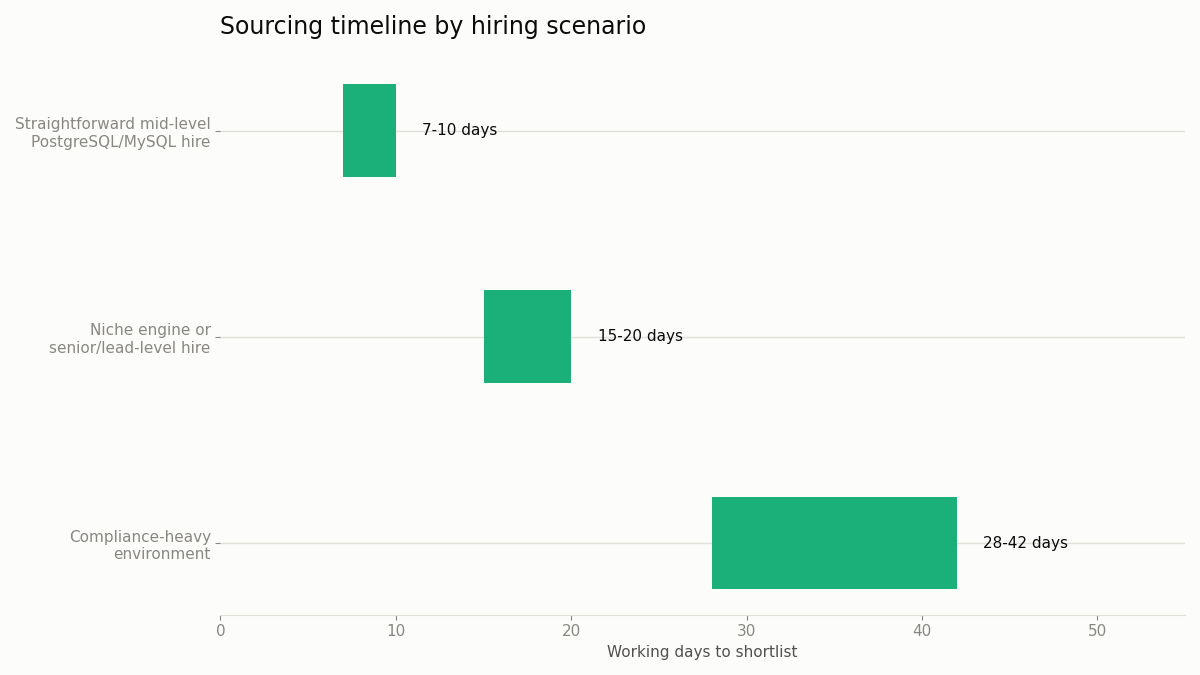
- Typical sourcing-to-shortlist timeline: 7-10 working days for a specialized DBA role when requirements are scoped per Phase 1 above; 3-5x longer through generic job-board postings without pre-vetting.
- What drives cost up: niche engine expertise (e.g., Cassandra, specialized time-series databases), compliance-heavy environments (healthcare, fintech) requiring security-cleared or audit-experienced candidates, and urgent (sub-2-week) start dates.
- What drives cost down: flexibility on engine version/cloud provider, willingness to consider remote/offshore talent, and bundling the role into a staff augmentation or GCC-based hiring model rather than a one-off local search.
- Cost tiers recap:
- Junior: ₹6-12 lakhs/year (India) / $65k-85k/year (US)
- Mid-level: ₹12-22 lakhs/year (India) / $90k-125k/year (US)
- Senior/Lead: ₹22-40 lakhs/year (India) / $130k-170k/year (US)
- Hidden cost most teams miss: a 2-4 week productivity ramp period is normal and should be budgeted into the “time to value” calculation, not treated as a delay.
- Fractional/part-time DBA option: for teams too small to justify a full-time hire, a part-time or fractional DBA arrangement (typically 10-20 hours/week) can cover routine monitoring, backup verification, and periodic tuning reviews at 25-40% of full-time cost a sensible middle ground before workload justifies a dedicated hire.
- Timeline by scenario:
- Straightforward mid-level PostgreSQL or MySQL hire, common cloud stack: 7-10 working days to shortlist
- Niche engine (Cassandra, specialized time-series databases) or senior/lead-level hire: 3-4 weeks
- Compliance-heavy environment requiring audit history or security clearance: 4-6 weeks
- Urgent sub-1-week start date: possible through staff augmentation, but typically limits the candidate pool and pushes cost toward the higher end of the relevant band
What to Do Next
If you’re mid-decision on whether to hire a single DBA, build a small pod, or set up broader IT staffing services support around your data infrastructure, the next useful step is usually to get your requirements reviewed against real candidate availability for your specific database engine and budget band not to post a generic job description and see what comes in. Supersourcing’s team can walk through your requirements and typical timeline for your exact stack at supersourcing.com/contact-us.
Frequently Asked Questions
What does a database administrator actually do day to day?
A DBA monitors database performance and uptime, manages backups and recovery testing, tunes queries and indexes, controls access permissions, and plans capacity ahead of growth. On any given day this could mean reviewing slow-query logs, testing a failover, or reviewing a schema change before it ships to production.
What’s the difference between a DBA and a data engineer?
A DBA owns the operational health, security, and integrity of the database itself. A data engineer builds pipelines that move and transform data for analytics or machine learning. The roles overlap on data modeling but diverge on ownership: a DBA is accountable for uptime and recovery; a data engineer is accountable for pipeline reliability and data quality downstream.
How much does it cost to hire a database administrator?
Costs vary by seniority and geography roughly ₹6-40 lakhs/year in India or $65k-170k/year in the US, depending on experience level and engine specialization. Compliance-heavy industries and urgent timelines typically push costs toward the higher end of these bands.
How long does it take to hire a qualified DBA?
With a scoped requirement and a pre-vetted talent pipeline, an interview-ready shortlist typically takes 7-10 working days. General job-board recruiting for a specialized DBA role often takes 4-8 weeks or longer, especially for niche database engines.
Should I hire a DBA in-house, offshore, or through staff augmentation?
It depends on duration and criticality: long-term core infrastructure ownership favors a dedicated hire; a defined skills gap favors staff augmentation; a bounded project (migration, audit) favors project-based or freelance engagement. Offshore and GCC-based dedicated hiring can match in-house quality at a lower fully-loaded cost when vetting is rigorous.
What skills should a PostgreSQL DBA have versus a MongoDB DBA?
A PostgreSQL developer hiring search should prioritize query planning (EXPLAIN ANALYZE fluency), vacuum/autovacuum tuning, and streaming replication experience. A MongoDB developer hiring search should prioritize replica set and sharding design, schema modeling for document stores, and aggregation pipeline optimization; these are not interchangeable skill sets despite the shared “database administrator” title.
What interview questions actually separate strong DBAs from resume-padded ones?
Ask them to walk through a real point-in-time recovery scenario, describe a specific incident where a query plan changed unexpectedly, and explain how they’d design role-based access for a multi-tenant application. Theoretical answers about normalization or indexing definitions without a concrete incident attached are a reliable signal of shallow hands-on experience.
Do I need a dedicated DBA if I already use a managed cloud database like RDS or Atlas?
Yes, for anything beyond a small workload. Managed services handle infrastructure provisioning and patching, but query optimization, schema design, access control policy, and capacity planning still require a DBA’s judgment. Managed services reduce operational toil, not the need for database expertise.
What happens if a hired DBA turns out to be a bad fit?
This is exactly what a replacement clause should cover, ideally agreed before onboarding starts. Under a dedicated hiring model with a 7-10 day replacement guarantee, a mismatched hire is typically identified within the first 30-60 days and replaced without restarting the entire sourcing process from scratch which is the main advantage of a structured engagement over an unstructured direct hire.
When should a growing company move from one generalist DBA to a specialized team?
The clearest signal is time allocation: once a single DBA is spending more than 30-40% of their week on reactive firefighting instead of proactive tuning and capacity planning, it’s usually time to split relational and NoSQL ownership or add a second hire rather than expecting one person to keep absorbing the growing workload indefinitely.
