

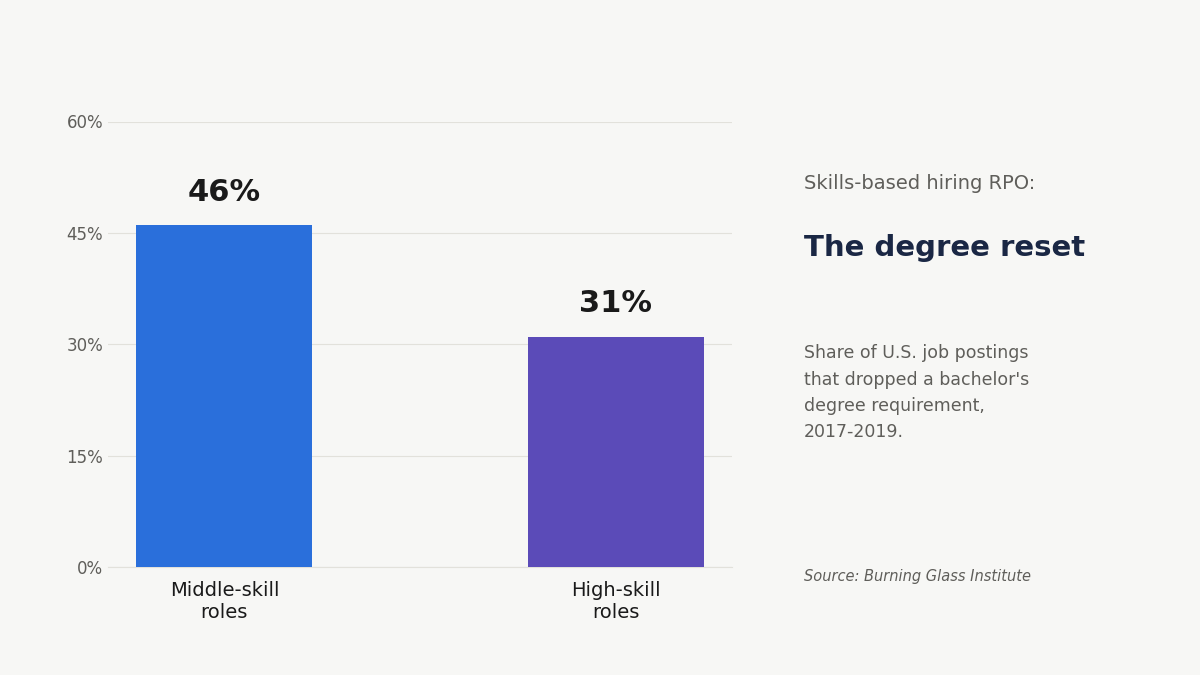
Forty-six percent of middle-skill roles and 31% of high-skill roles in the U.S. underwent a structural “degree reset” between 2017 and 2019, according to a widely cited Burning Glass Institute analysis of over 51 million job postings and the researchers behind it found that most of that shift was permanent, not a pandemic-era blip. Most companies read that number, agree with it in principle, and then do nothing operational about it beyond deleting a line from a job posting template.
That gap between agreeing skills-based hiring is right and actually running it is where most skills-based hiring RPO conversations start. A TA leader has usually already made the philosophical decision. What they haven’t done is build the competency framework a real assessment needs, figured out how an outsourced recruiting partner prices and staffs this differently from resume-matching RPO, or worked out what happens when a hiring manager six weeks into the rollout quietly starts filtering by university name again.
This guide is built for that exact gap. It’s not another argument for why skills matter more than degrees. That case has been made, repeatedly, by labor economists with far better data than a blog post can offer. It’s the operational playbook: how to define competencies role by role, how to structure a vetting process that actually measures skill instead of disguising a resume screen, how to contract and manage an RPO partner through this model, and how to know with numbers, not vibes, whether it’s working.
TL;DR
This guide is for VPs of Talent Acquisition, HRBPs, and founders who've decided skills-based hiring is the right direction but haven't figured out how to actually run it, especially through a skills-based hiring RPO partner rather than building it alone. It covers the full lifecycle: defining competencies, sourcing without a degree filter, structuring assessments, contracting an RPO partner, onboarding, and managing the engagement long-term.
The single biggest number to know going in: research from the Burning Glass Institute found that 46% of middle-skill and 31% of high-skill occupations underwent a structural degree reset between 2017 and 2019 and most of that shift has been held, not reversed. That's the scale of the market you're moving into.
By the end, you'll be able to build a competency framework for a real role, brief an RPO partner on a skills-first recruitment mandate, evaluate whether their assessment process is rigorous or theater, and know exactly what it should cost and how long it should take.
What Is Skills-Based Hiring RPO?
Skills-based hiring RPO is a recruitment process outsourcing model in which the outsourced partner sources, screens, and shortlists candidates against demonstrated competencies and validated work samples instead of degree pedigree or prior job titles. It is not the removal of standards, it’s the replacement of a proxy (the degree) with a direct measure (the skill).
What it is often confused with:
- A relaxed hiring bar. The assessment stage in a skills-based model is usually more rigorous than a resume screen, not less it just measures something different.
- Blind resume screening. Removing names or photos addresses bias in identity; skills-based hiring addresses bias in the criteria themselves (degree, pedigree, tenure).
- “We don’t require a degree” as a job-post line. Without a competency framework and assessment behind it, dropping the requirement from a posting changes nothing about who actually gets hired.
Why It Matters: The Business Case
Skills-based hiring changes outcomes on four fronts that a CFO or CHRO actually tracks:
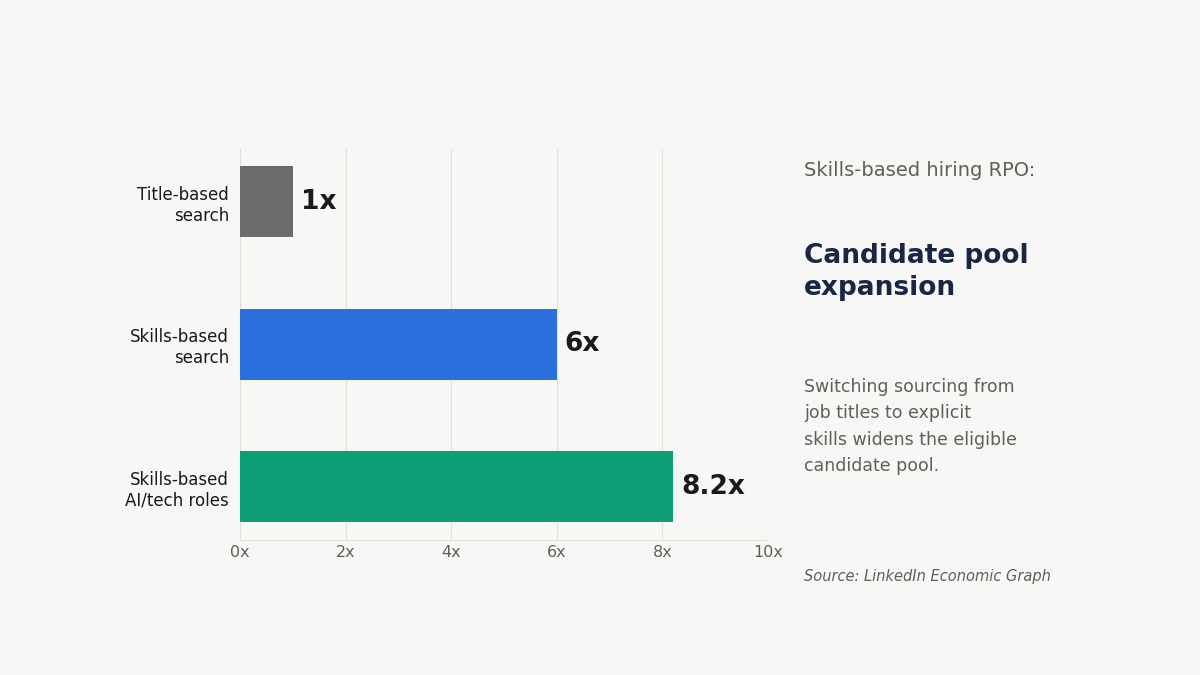
- Talent pool size. LinkedIn’s Economic Graph research found that switching a search from job titles to explicit skills can expand the eligible candidate pool roughly six-fold and for AI and technical roles specifically, the multiplier runs closer to 8.2x, because job titles lag far behind the hybrid, self-taught skillsets people are actually building.
- Cost of mis-hire. A degree-filtered pipeline for a mid-level engineering role in India typically yields 15–20 shortlisted resumes per requisition; a skills-first pipeline of the same size yields comparable volume but a measurably lower false-positive rate at the interview stage, because candidates have already cleared a work-sample bar rather than a keyword-match bar.
- Speed. Structured, rubric-based assessments cut decision cycles because hiring managers argue less over “gut feel” disagreements get resolved against a scorecard instead of a subjective debate.
- Diversity and retention. Multiple labor-market studies including the Burning Glass Institute’s degree-reset research link degree-free hiring pathways to broader, more representative pipelines and, in several tracked cohorts, comparable or better retention once role-fit is assessed directly rather than assumed from credentials.
None of this is “significant savings” language; it’s measurable in requisition data within one or two hiring cycles, which is exactly why it’s become a boardroom-level TA metric rather than a recruiting-team preference.
The risk side of the business case matters just as much:
- Legal exposure from degree requirements you can’t defend. Several U.S. states have already dropped degree requirements for public-sector roles, and disparate-impact scrutiny on unnecessary credential filters is only increasing a documented competency-based rationale is a defensible position in a way “we’ve always required a degree” is not. Gartner’s research on skills-first hiring makes the same point from a workforce-planning angle: expanding the talent pool by cutting unnecessary degree filters is increasingly treated as a core HR risk-and-supply strategy, not a diversity add-on.
- Employer brand in a tight technical labor market. Candidates increasingly screen employers the same way employers screen candidates: a job posting that still lists a degree requirement for a role where the actual work doesn’t need one signals an organization that hasn’t updated its hiring logic, which shows up in application quality before it shows up in any metric.
- Faster reskilling of the existing workforce. Once competency frameworks exist for external hiring, the same frameworks double as internal mobility and reskilling maps, a benefit almost no team budgets for upfront but nearly every team ends up using within a year.
The Core Problem Most Buyers Face
Here’s what actually goes wrong when a company decides to “go skills-based” without a structured process behind it:
- The job posting changes; the hiring manager doesn’t. A company removes “bachelor’s degree required” from 200 postings, and six weeks later the same hiring managers are still filtering resumes by university name because no replacement criteria were ever defined.
- Assessments get built once and never validated. A coding test written by one senior engineer, in one afternoon, becomes the permanent bar for a role with no correlation check against actual on-the-job performance six months later.
- Most dedicated teams underestimate the assessment-design effort by 3–4x. Writing a single, reliable technical assessment with a defensible rubric one that actually predicts performance rather than just filtering for test-taking speed typically takes 15–25 hours of senior engineering time per role family, not the 3–4 hours most teams budget.
- Time-to-fill silently increases in month one. Removing a familiar filter (degree, brand-name employer) without a replacement filter that recruiters trust just means more resumes get manually reviewed, not fewer the pipeline gets slower before it gets faster.
- Legal and compliance ambiguity. In regulated functions (finance, healthcare, safety-critical engineering), removing credential requirements without documenting the competency-equivalent evaluation creates audit risk, not agility.
- Hiring managers give the “trainable” bucket. Without a clear non-negotiable-versus-trainable split defined upfront, hiring managers quietly move every competency into the “must-have on day one” column, which recreates the same narrow filter the framework was built to remove just with different words.
- Recruiters revert to keyword matching under pressure. When a requisition sits open too long, the fastest thing a recruiter under quota pressure can do is fall back to resume keyword search which is exactly the behavior a skills-based mandate was meant to retire. Without an RPO partner or internal process actively monitoring this, the reversion happens quietly, requisition by requisition.
These are the failure patterns an experienced RPO partner has already priced into their process; they are not hypothetical.
The Walkthrough: From Deciding You Need This to Running It at Scale
Phase 1 Defining Requirements and Competency Frameworks
Before sourcing a single candidate, the requirement itself needs to be rebuilt. A degree requirement is a single line; a competency framework is a structured replacement.
What a real competency framework includes, per role family:
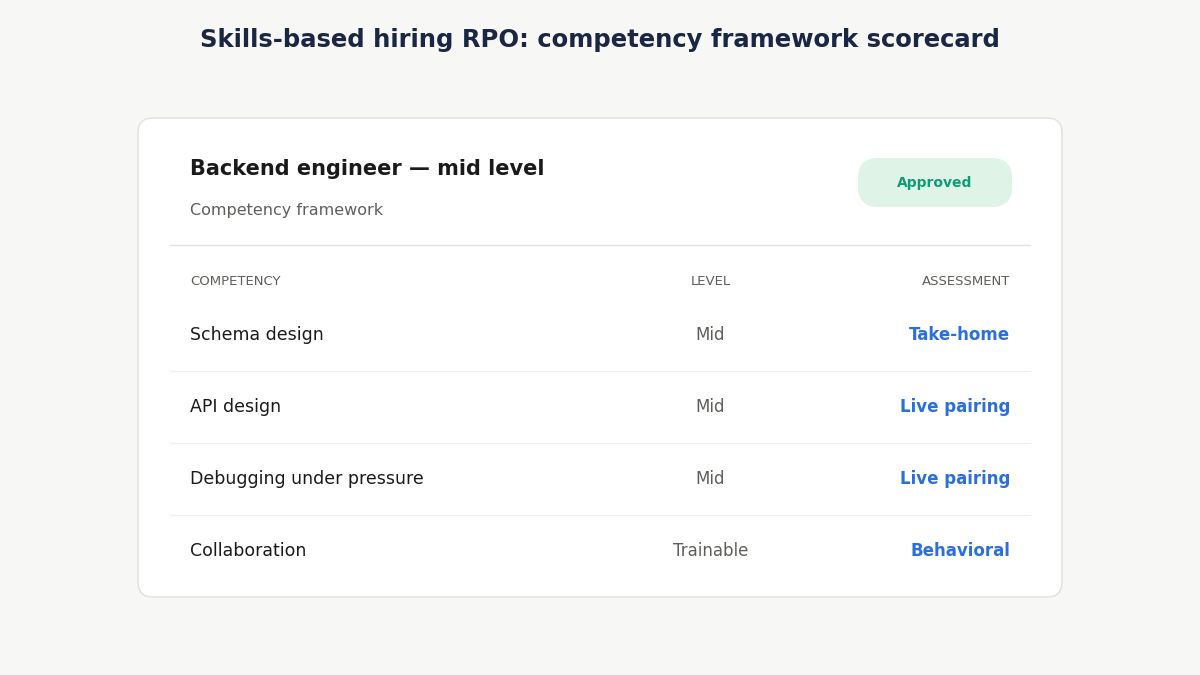
- Core technical competencies (3–5 max) the specific, observable skills the role actually requires (e.g., “can design a normalized relational schema for a 10+ table system,” not “strong SQL knowledge”).
- Proficiency levels junior / mid / senior thresholds for each competency, defined in behavioral terms, not years of experience.
- Assessment method per competency work sample, structured interview, take-home, live pairing session, or portfolio review.
- Non-negotiable vs. trainable which competencies must exist on day one versus which can be built in the first 90 days.
- Budget and realistic compensation ranges tied to the competency tier, not the degree tier. For India-based mid-level engineering roles this typically lands between ₹12–22 lakhs/year; for senior/staff-level, ₹28–45 lakhs/year; U.S. remote equivalents typically run $45k–75k and $95k–140k respectively, depending on stack and specialization.
Who should actually build this and a common mistake in getting it wrong: the framework is often delegated entirely to HR or an RPO partner without a senior technical stakeholder co-authoring it, which produces a document that sounds rigorous but doesn’t actually reflect what strong performance looks like on the team.
The most reliable frameworks we’ve seen come from a working session between the hiring manager, one senior individual contributor already doing the job well, and the recruiter or RPO lead who will run the assessment not from a template filled in by HR alone and sent to engineering for a rubber-stamp approval.
Checklist is your competency framework ready to hand to an RPO partner?
- Each competency is observable and testable, not adjective-based (“collaborative,” “detail-oriented” need behavioral anchors)
- Assessment method is assigned per competency, not one generic test for the whole role
- Proficiency thresholds are documented for junior/mid/senior
- Budget bands are set before sourcing begins, not negotiated per candidate
- A named hiring manager has signed off on the framework not just HR
Phase 2 Sourcing & Vetting Without a Degree Filter
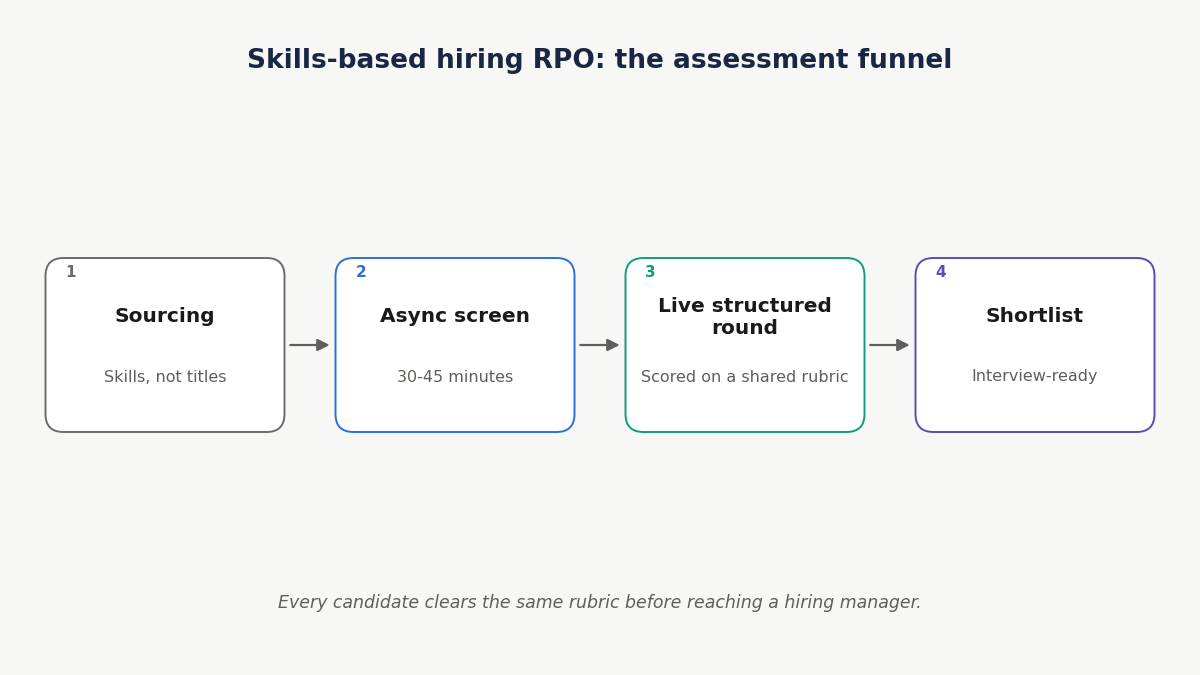
This is where skills assessment RPO design either works or collapses. Good screening in this model looks structurally different from resume-keyword matching.
What good screening looks like:
- Sourcing queries built around skills and tools, not job titles or “years of experience” this is exactly the shift that unlocks the 6–8x pool expansion referenced earlier.
- A first-pass skills inference step: parsing GitHub activity, portfolio work, certifications, or project history for signal, rather than filtering on employer brand name.
- A two-stage assessment: a short, automated or async screen (30–45 minutes) to filter volume, followed by a live, structured technical or scenario-based round for shortlisted candidates only.
- Structured, not free-form, interviews every interviewer scores against the same rubric and competency list, so two interviewers reach comparable conclusions independently.
Red flags in a skills-based vetting process (from your side or an outsourced partner’s):
- The “skills assessment” is just a disguised resume review with a scoring template bolted on.
- No calibration exists between interviewers; two panels reach wildly different verdicts on the same candidate.
- Assessments take candidates more than 90 minutes total; this filters for time availability, not competence, and disproportionately screens out strong candidates with existing jobs.
- There’s no cultural/collaboration evaluation at all; pure technical scoring without any team-fit signal produces technically strong hires who don’t function in the actual work environment.
For technical hiring specifically, this is also the natural point to bring in specialized sourcing teams looking to fill backend roles under this model often lean on partners who can hire Node.js developers against a competency brief rather than a degree-filtered one, and the same logic extends to infrastructure hiring through a dedicated pipeline to hire DevOps engineers.
Before signing off on any outsourced vetting process, it’s worth running it against a standard IT staffing agency vetting process checklist many partners market “skills-based” screening that, on inspection, is still a resume-first funnel with a test appended at the end rather than a genuinely competency-led pipeline.
Phase 2b Assessment Tooling and Formats
Which format to use depends on the competency being tested; a common mistake is running every role through the same test type regardless of what’s actually being measured.
Format-to-competency matching that works in practice:
- Take-home, timed work sample best for evaluating code quality, architecture decisions, or written analysis where reflection time genuinely matters (e.g., system design, data pipeline design).
- Live pairing sessions are best for evaluating the debugging process, communication under pressure, and how a candidate actually thinks out loud, not just the final answer.
- Async scenario/case-study response best for product, QA, or operations roles where judgment and prioritization matter more than raw output speed.
- Portfolio or contribution-history review best for roles with visible prior output (open-source contributions, design portfolios, published writing), where the work itself is the strongest signal available.
- Structured behavioral interview with scenario prompts used alongside any of the above to assess collaboration and communication, never as a replacement for a technical competency check.
A note on AI-assisted candidate submissions: with generative AI now embedded in most candidates’ workflows, async take-home tests are easier to complete with outside help than they were even two years ago.
The practical fix isn’t banning AI tools, it’s weighting live, synchronous rounds (pairing sessions, structured interviews) more heavily in the final scoring than any purely async submission, and asking candidates to walk through their own take-home solution live as a verification step.
Phase 3 Engagement Models & Contracts
Once the framework and vetting process are defined, the contracting decision determines how the relationship actually runs day to day.
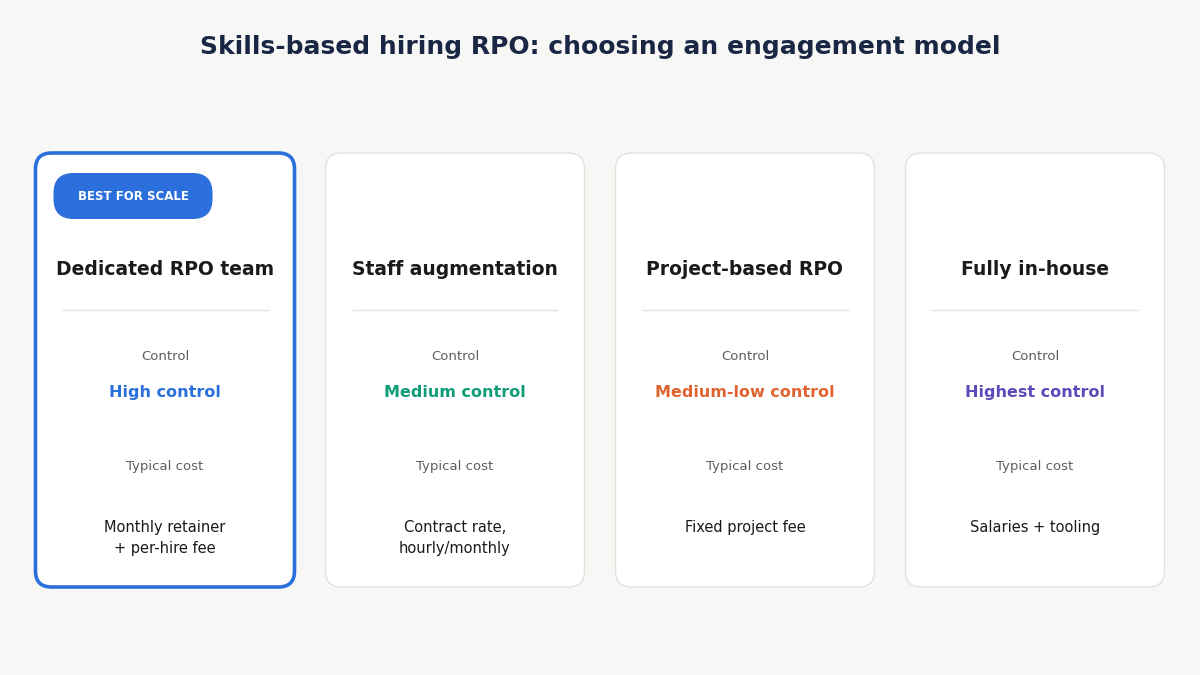
| Model | Best for | Control | Typical cost structure |
| Dedicated RPO team | Sustained hiring volume (10+ roles/quarter) | High embedded recruiters, your process | Monthly retainer + per-hire fee |
| Staff augmentation | Filling specific skill gaps fast | Medium | Contract rate, hourly/monthly |
| Project-based RPO | One-time hiring surge (e.g., new team build-out) | Medium-low | Fixed project fee |
| Fully in-house | Long-term, high-control, high-volume hiring | Highest | Full-time recruiter salaries + tooling |
Contract terms that matter more in a skills-based model than a traditional one:
- NDA and IP protection covering any proprietary assessment content, take-home exercises, or scoring rubrics the RPO partner builds for you these become reusable IP and should be contractually yours.
- Replacement guaranteeing a 7–10 day replacement window if a placed hire doesn’t meet the competency bar within the probation period is a reasonable, checkable clause; anything vaguer than that is a red flag.
- No shared bandwidth clause confirms whether recruiters are dedicated to your account or split across clients; split bandwidth is the single biggest cause of missed SLAs in RPO engagements.
- Assessment IP ownership who owns the competency framework and test bank once the engagement ends matters more here than in resume-based RPO, because the framework itself is the differentiator.
Phase 4 Onboarding & Ramp-Up
The first two weeks determine whether a skills-based hire actually performs the way the assessment predicted.
- Week 1: access provisioning (repo, tools, environments), a structured 1:1 with the hiring manager mapping the competencies assessed to the actual first-sprint tasks, and a named onboarding buddy.
- Week 2: first real (small) deliverable tied directly to one of the assessed competencies; this is the fastest way to validate whether the assessment was predictive.
- Communication cadence: daily async check-ins for the first two weeks, moving to the team’s standard cadence by week three.
Checklist onboarding signals that the assessment worked:
- The new hire’s first-sprint output matches the competency level scored in the assessment
- No major skill gap surfaces that the assessment should have caught
- Hiring manager confirms the role-fit within the first 10 working days
- Any gap identified gets fed back into the competency framework, not just the individual’s performance review
Phase 5 Managing Delivery
Ongoing management of a competency-based recruitment outsourcing engagement runs on different KPIs than a traditional RPO relationship.
Reporting cadence and KPIs that actually matter here:
- Time-to-shortlist (not just time-to-fill) measures whether the sourcing funnel is working, independent of how fast the client-side interview loop moves.
- Assessment-to-offer conversion rate at a very low rate signals the assessment bar may be miscalibrated, not that candidates are weak.
- 90-day performance correlation: do candidates who scored highest on the assessment also perform best on the job? This is the single most important long-term metric and the one most RPO relationships never actually track.
- Offer acceptance rate skills-based candidates with strong assessment scores often have multiple offers; a low acceptance rate here usually points to compensation banding, not sourcing quality.
Account management structure should include a named point of contact who reviews these metrics monthly, not just a shared inbox for requisition requests.
A simple reporting cadence that works for most engagements:
| Cadence | What gets reviewed | Who’s in the room |
| Weekly | Open requisition status, sourcing volume, assessment throughput | Dedicated recruiter + hiring manager |
| Monthly | Time-to-shortlist, assessment-to-offer conversion, offer acceptance rate | Account manager + TA lead |
| Quarterly | 90-day performance correlation, framework refresh needs, headcount forecast | RPO leadership + CHRO/VP TA |
Skipping the quarterly review is the most common gap; we see weekly and monthly cadences track whether the pipeline is moving, but only the quarterly review catches whether the assessment itself is still predictive, or quietly drifting out of date as the role evolves.
Phase 6 Scaling or Exiting
- Adding headcount: once a competency framework and assessment are validated for one role family, extending the same skills-based hiring RPO model to adjacent roles is largely a template exercise; this is where the model pays for itself.
- Replacement policy: confirm in writing what triggers a replacement (performance vs. fit vs. attrition) versus what falls outside the guarantee.
- Offboarding an RPO partner: the competency frameworks, assessment banks, and scorecards built during the engagement should transfer to you in full; this is non-negotiable IP, and it’s why the NDA/IP clause in Phase 3 matters as much as pricing.
Case Studies
Fintech engineering scale-up. A fintech company scaling backend engineering headcount moved from a degree-filtered pipeline to a competency-based one for its payments team. The switch to skills-first sourcing and structured technical assessments compressed the job-description-to-interview-ready-shortlist cycle to 7–10 working days, with a 98% candidate joining rate on offers extended comparable to the standard RPO benchmark, but drawn from a materially broader, non-traditional candidate pool.
The competency framework built for the payments team was subsequently reused, with minor adjustments, for two adjacent backend squads without needing a second design cycle.
Healthtech contract engineering team. A healthtech company running contract-based engineering hiring needed technical rigor without brand-name-university filtering, given the small talent pool available for its specialized stack.
Structured work-sample assessments replaced resume screening as the primary filter, holding contract-role drop-off below 1% across the engagement at a materially lower rate than the team’s prior degree-filtered process. The dedicated account management model, rather than shared-bandwidth recruiters, was flagged internally as the main reason SLA timelines held up under a compressed contract-role timeline.
Recruitment automation for a healthtech scheduling platform. A healthtech scheduling and automation company needed to scale its own engineering team quickly while keeping vetting quality high across dedicated and staff-augmented hires.
AI-assisted sourcing combined with structured competency screening surfaced a top 2% vetted talent pool, cutting manual resume-review time significantly while preserving the technical bar the team needed for a compliance-sensitive product.
Because the roles involved handling scheduling data for healthcare providers, the competency framework also had to document evaluation criteria clearly enough to satisfy the client’s internal compliance review, a requirement that shaped how the assessment rubric was written from the outset.
Comparison / Decision Framework
Use this framework to decide whether skills-based hiring should run in-house, through staff augmentation, or through a dedicated RPO partner.
| Factor | In-house build | Staff augmentation | Dedicated skills-based RPO |
| Speed to first hire | Slow (framework + tooling from scratch) | Medium | Fast (7–10 working days typical) |
| Assessment design expertise | Depends entirely on internal team | Limited augments headcount, not process | Built-in this is the partner’s core competency |
| Cost predictability | Variable (internal recruiter time + tooling) | Predictable, per-contract | Predictable, retainer + per-hire |
| Control over process | Full | Medium | High, but shared |
| Best for | Companies hiring at very high volume, long-term | Short-term skill gaps | Companies scaling teams or entering new markets/GCCs |
Decision rule of thumb: if you’re filling fewer than 5 roles a quarter, in-house or staff augmentation is usually more cost-efficient. Past that volume especially when building out a new function, team, or GCC in India a dedicated RPO partner with an existing competency-framework library typically reaches quality-at-scale faster than building the muscle internally from zero.
Signs it’s time to buy this capability rather than build it internally:
- Your internal recruiting team has never designed a validated technical assessment before, and you need one live within the next hiring cycle, not next quarter.
- You’re hiring across multiple, unrelated role families at once (e.g., engineering, data, and support simultaneously) and don’t have bandwidth to build separate frameworks for each.
- You’re standing up a new team or entity, a GCC, a new product line, a new geography where there’s no existing hiring process to retrofit, making it cheaper to adopt a proven framework than invent one.
- Your current time-to-fill is already slipping and a degree-requirement removal without a replacement process would make it worse before it gets better.
Signs in-house is the better call:
- You’re hiring at low volume (under 5 roles/quarter) in a single, well-understood role family where an internal recruiter can build and iterate the assessment directly with the hiring manager.
- You have in-house technical leaders with bandwidth to co-design and calibrate assessments; the scarce resource in this model is senior time, not recruiting headcount.
- Compliance or IP sensitivity makes an external partner impractical for this specific role family, even if it’s used elsewhere in the org.
What Most Teams Get Wrong
- They treat “remove the degree requirement” as the whole strategy. The requirement is the easy part to change; the assessment infrastructure behind it is the actual work, and most teams stop at the job-posting edit.
- They let one interviewer’s gut feeling override a structured score. The entire point of a competency framework is that disagreements resolve against rubric teams that let a senior hiring manager’s subjective override the scorecard have quietly rebuilt degree-based bias with different inputs (usually pedigree of previous employer instead of university).
- They never validate the assessment against actual performance. Almost no team we’ve seen tracks whether high assessment scorers actually outperform low scorers after 90 days without that loop; you have no idea if your “skills-based” process measures anything real.
- They apply the same framework to every role level. A junior-level competency bar copied onto a senior requisition either massively under-qualifies senior hires or, more often, gets quietly abandoned and reverts to resume-based screening for anything above mid-level.
- They underinvest in interviewer calibration. A rubric is only as good as the consistency of the people scoring against it. Teams that skip calibration sessions end up with the same interviewer-dependent variance a resume screen has, just with extra paperwork.
- They don’t budget for the assessment to get easier to play over time. Once a take-home test circulates among candidates on forums or through word of mouth which happens faster than most teams expect its predictive value drops. Assessments need a refresh cadence built in from the start, not a one-time build.
Cost & Timeline Reality Check
Typical timelines by scenario:
- Single mid-level technical hire, established competency framework already in place: 7–10 working days from requisition to interview-ready shortlist.
- First role in a new competency framework (framework design + sourcing): 3–5 weeks, most of which is framework and assessment design, not sourcing.
- Full team build-out (5–10 roles) for a new GCC function: 8–14 weeks, depending on specialization and location.
Cost drivers what pushes cost up:
- Highly specialized or emerging-tech competencies (AI/ML, LLM engineering) requiring bespoke assessment design rather than templated tests.
- Senior/staff-level roles requiring live, multi-round technical evaluation rather than async screening.
- Compliance-heavy functions requiring documented competency-equivalence evidence for audit purposes.
Cost drivers what pushes cost down:
- Reusing a validated competency framework across multiple similar roles.
- Async, tool-based first-round screening instead of live interviewer time for every applicant.
- Dedicated account management with no shared bandwidth, which reduces re-work from miscommunicated requirements.
Typical budget bands (India-based technical roles, RPO-managed):
- Mid-level engineering: ₹12–22 lakhs/year compensation band; RPO fee structures vary by retainer vs. per-hire model.
- Senior/staff engineering: ₹28–45 lakhs/year compensation band.
- U.S. remote-equivalent roles: $45k–75k (mid) and $95k–140k (senior), commonly staffed through offshore or GCC-based skills-based pipelines for cost arbitrage.
Where this connects to GCC strategy: teams setting up or scaling a GCC in India almost always run into the degree-vs-skills question at the exact moment they’re building a new function locally there’s no legacy hiring bar to fight against, which makes it the easiest point in a company’s lifecycle to start skills-based from day one rather than retrofitting it onto an existing team later.
Organizations already running IT staffing services or evaluating a broader recruitment process outsourcing partner for a GCC build-out should raise the competency-framework question in the very first scoping conversation, not after the first cohort is hired.
Where to Go From Here
If your team is already sold on skills-based hiring but hasn’t built the competency framework, assessment rubrics, or the RPO relationship to run it at scale, that’s the gap worth closing before the next hiring cycle, not after it. Supersourcing works with enterprise TA teams on exactly this: building the framework, running the assessments, and staffing the pipeline through a dedicated account team with a 7–10 day replacement guarantee if a hire doesn’t hold up. If you’re mid-decision, the fastest next step is a scoping conversation, not another vendor deck: talk to the team.
Frequently Asked Questions
What is skills-based hiring?
Skills-based hiring is a recruitment approach that evaluates candidates against demonstrated, job-relevant competencies through work samples, structured interviews, or assessments instead of relying primarily on degrees, job titles, or years of experience as proxies for capability.
How is skills-based hiring different from traditional degree-based hiring?
Traditional hiring filters candidates using credentials (degree, university, prior job titles) as a proxy for ability. Skills-based hiring tests the ability directly, using competency frameworks and assessments, which typically produces a larger and more accurately ranked candidate pool for the same role.
What does an RPO partner actually do in a skills-based model?
Beyond standard sourcing and screening, a skills-based hiring RPO partner builds and maintains the competency framework, designs and calibrates assessments, runs structured interviews against shared rubrics, and tracks whether assessment scores actually correlate with on-the-job performance over time.
How do you assess skills reliably without a degree filter?
Use a mix of async work-sample tests for initial screening, live structured interviews scored against a shared rubric for shortlisted candidates, and relevant portfolio or contribution history review. Reliability comes from interviewer calibration and periodic validation against real performance data, not from any single test format.
Which roles and industries suit skills-based hiring best?
Technology, fintech, e-commerce, business services, and most enterprise SaaS functions adapt well, since job titles in these fields change faster than degree curricula. Regulated fields like medicine, law, and certain engineering disciplines still require formal credentials as a legal or safety baseline alongside any competency assessment.
Does removing degree requirements lower the hiring bar?
Not done properly, it raises the bar, because candidates are tested directly on the skill rather than assumed to have it based on a credential. The risk of a lower bar only appears when the degree requirement is removed without a validated assessment replacing it.
What does skills-based RPO cost compared to traditional RPO?
Base RPO retainer and per-hire fee structures are usually comparable. The added cost sits in assessment design time upfront typically 15–25 hours of senior technical time per role family which is recovered quickly once the framework is reused across multiple hires in the same role family.
How long does a skills-based hiring cycle take end to end?
For a role with an existing, validated competency framework, 7–10 working days from requisition to interview-ready shortlist is realistic. Building the framework for a brand-new role family adds 3–5 weeks upfront, one time.
What assessment tools and formats actually work?
Async coding or scenario-based tests for initial screening, live pairing or case-study sessions for shortlisted candidates, and structured scorecards shared across all interviewers. Portfolio and contribution-history review works well for roles with visible output (engineering, design, content).
What happens when a hiring manager still insists on a degree?
This is best handled by involving them in building the competency framework itself, rather than presenting it as a policy change. Hiring managers who help define the competencies they actually care about tend to trust the assessment more than a mandate to “stop asking for degrees.” If you’re mid-decision on whether to run this in-house or bring in a partner to build that framework with you, that’s exactly the conversation worth having before your next hiring cycle starts.
