

Most companies sign an RPO contract to fix a broken hiring engine. Far fewer plans for the day the engine is fixed and that’s where the real money gets lost.
Here’s the uncomfortable pattern: the global recruitment outsourcing market keeps compounding at double-digit rates, yet a meaningful share of enterprise buyers renegotiate, restructure, or exit their contracts at renewal. Both things are true at once because RPO done well is often supposed to end. A provider that builds your processes, stabilizes your metrics, and documents everything has, by definition, made itself easier to replace. The failure mode isn’t exciting, it’s exciting without a plan, and watching time-to-fill blow out by 30–60 days while two teams argue over who owns the candidate database.
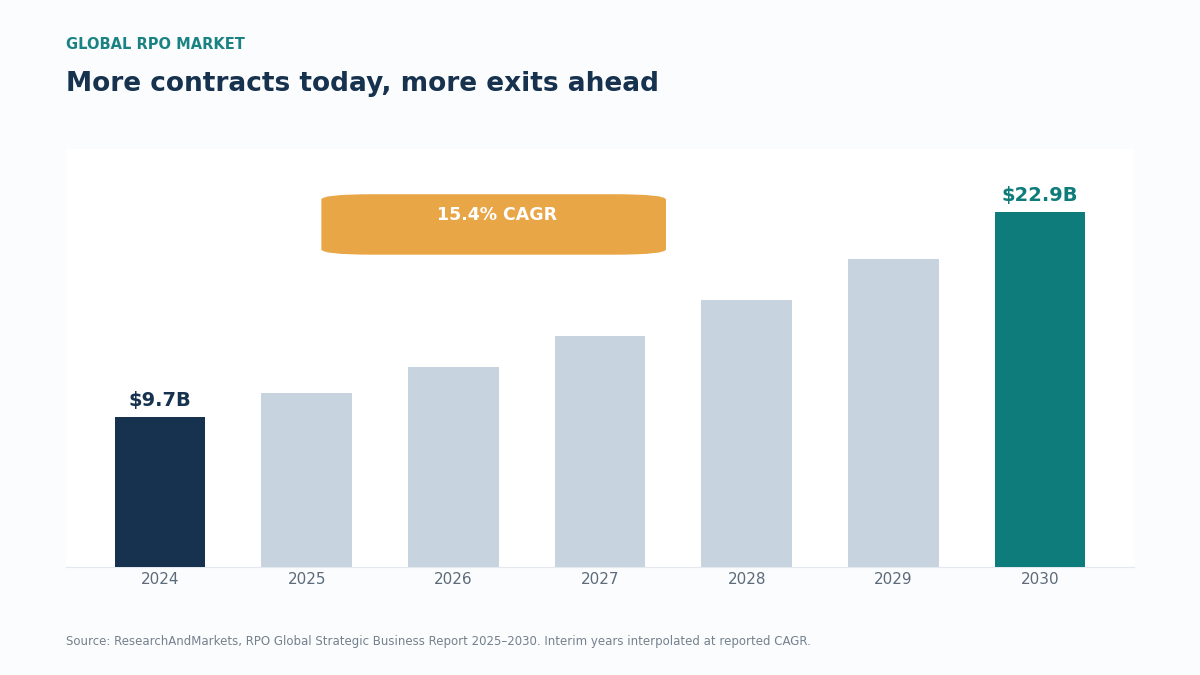
Forward-looking stat: The global RPO market is projected to grow from US$9.7 billion in 2024 to US$22.9 billion by 2030, a 15.4% CAGR. Translation: more contracts signed today means a larger wave of renewals, restructures, and exits over the next 3–5 years and most buyers will face this decision unprepared.
A pro buyout insourcing decision touches contracts, data, people, technology, and live offer pipelines simultaneously. Get it right and companies typically stabilize hiring within one to two quarters at a lower run-rate cost. Get it wrong and you inherit an empty ATS, zero documented process, and a hiring freeze you didn’t choose.
This guide is the playbook we wish every buyer had before signing their original RPO contract: when insourcing makes sense (and when it doesn’t), what your exit clauses actually say, how to value a buyout, how to rebadge recruiters, how to migrate candidate data legally, and how to run the 90–180 day transition without dropping a single live offer.
TL;DR
This guide explains how to plan and execute an RPO buyout, the structured process of ending an RPO contract and bringing recruitment back in-house. It's written for HR, TA, and finance leaders who are 6–12 months from a renewal decision, or already sure they want out.
The single most important number in it: a clean RPO to in-house transition takes 90–180 days end to end, and companies that skip the parallel-run phase typically see time-to-fill degrade 30–60 days before recovering. The exit itself is rarely the expensive part; the unmanaged gap after it is.
By the end, you'll be able to audit your contract's exit terms, build a defensible in-house TA budget, negotiate data and rebadging terms, and run the cutover on a timeline your CFO and your hiring managers can both live with.
What Is an RPO Buyout?
An RPO buyout is the planned exit from a recruitment process outsourcing contract, in which a company ends or buys out the remaining term, takes back ownership of recruiting processes, technology, and candidate data, and transfers delivery to an in-house talent acquisition team sometimes rehiring (rebadging) the provider’s recruiters directly.
What it is not:
- Not a hostile termination. Most buyouts are negotiated exits at or before renewal, often with the provider’s cooperation a well-run provider expects some clients to graduate.
- Not the same as switching vendors. Moving from one RPO to another is a re-tender; a buyout specifically means you insource recruitment and own delivery yourself. (Some teams call the whole motion reverse RPO.)
- Not an overnight switch. The contract may end on a date; the operational transition is a 90–180 day project with its own budget, owner, and risk register.
Why Insourcing Recruitment Matters: The Business Case
The decision to insource recruitment is fundamentally a total-cost-of-ownership and control decision, not an ideology. The concrete outcomes it affects:
- Cost per hire at steady volume. RPO pricing (management fee + per-hire fee, typically $2,000–$8,000 per technical hire depending on seniority and geography) is efficient at volatile or high volume. At a stable 50–150 hires/year, a right-sized internal team usually beats its SHRM benchmarks US median cost-per-hire at roughly $4,700 for non-executive roles, and mature in-house teams in India commonly land at ₹40,000–₹1.2 lakh per tech hire all-in.
- Employer brand ownership. Every outreach message, careers-page interaction, and rejection email shapes your brand. In-house teams close the loop between candidate experience and brand in a way a shared-service model structurally can’t. (See our breakdown of the impact of RPO on employer brand for the flip side of this argument.)
- Institutional knowledge retention. Sourcing intelligence which companies to poach from, which pitch converts, which comp bands clear walks out the door at contract end unless you deliberately capture it.
- Speed at low-to-mid volume. Below ~10 hires/month, an internal recruiter who knows the hiring managers personally typically fills roles faster than a pooled RPO desk juggling multiple accounts.
- Risk and compliance posture. Owning your ATS instance and candidate data outright removes an entire category of data-processing and vendor-lock-in risk.
The honest counterweight: none of this holds if your hiring volume is spiky, your leadership won’t fund recruiter headcount through a downturn, or you’re entering markets where you have zero sourcing presence. Insourcing trades a variable cost for a fixed one.
That trade is only smart when the volume justifying the fixed cost is durable.
The Core Problem: Why Most RPO Exits Go Sideways
The pattern across failed transitions is remarkably consistent, and almost none of it is the provider’s fault. It’s a planning gap on the buyer’s side.
Most dedicated development teams underestimate the transition by 3–4x. They budget 4–6 weeks for something that takes 4–6 months, because they mentally model it as “cancel the contract, post the jobs ourselves.” What actually has to move:
- Live requisitions and offer pipelines candidates mid-process don’t pause because your vendor changed. A single dropped offer on a senior role costs you 60–90 days of restart time.
- The ATS and candidate database if the RPO ran recruiting on their ATS instance (very common), you may contractually own the data but not the system, the workflows, the templates, or the integrations.
- Sourcing channel access, job-board contracts, LinkedIn Recruiter seats, and referral-program tooling are often held in the provider’s name at their negotiated rates.
- People and knowledge of the two recruiters who actually know your hiring managers are the provider’s employees, not yours.
- Process documentation intake forms, interview rubrics, SLA definitions, comp-approval workflows. If these live in the provider’s playbook, they leave with the provider.
Red flag you’re already behind: if you can’t answer “who legally owns our candidate database, and in what format can we export it?” Today, you are not 90 days from a clean exit, you’re 90 days from discovering your exit costs.
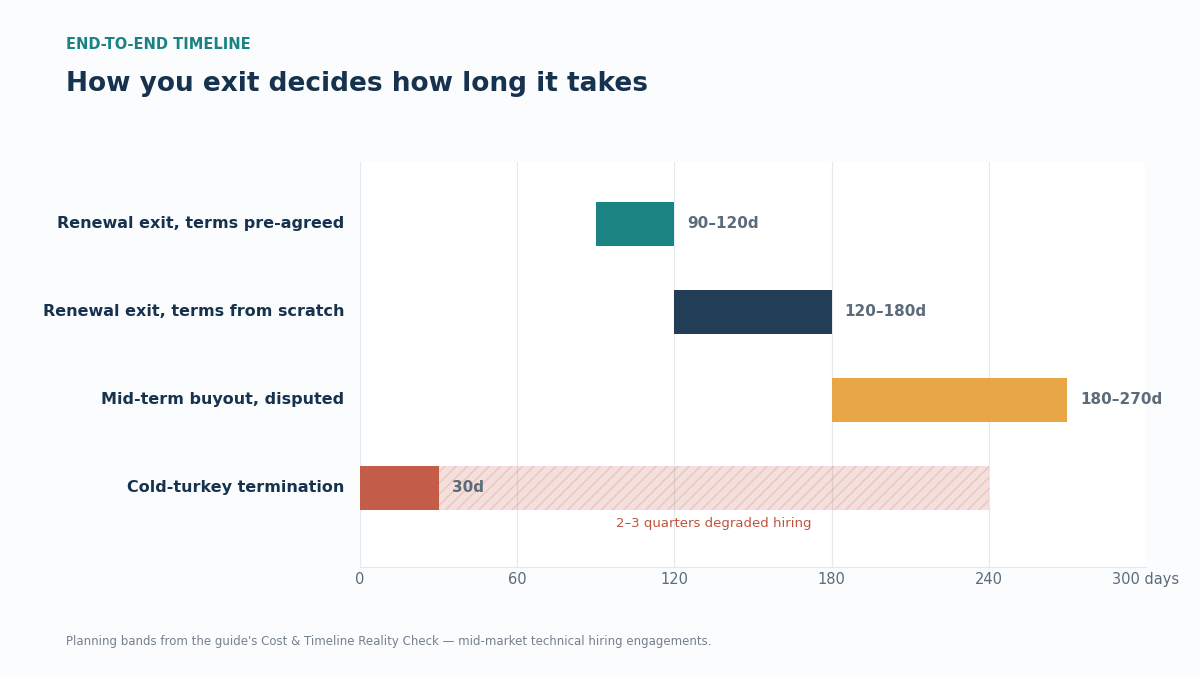
The second-order problem is metric collapse. Teams that cut over without a parallel run typically watch time-to-fill degrade by 30–60 days for one to two quarters, offer-acceptance rates dip as candidate communication gets clumsy, and hiring-manager satisfaction crater which is exactly the ammunition an under-resourced insourcing plan cannot afford, because it invites the “see, we should have kept the RPO” verdict before the internal team was ever fairly resourced.
The RPO to In-House Transition: A Phase-by-Phase Walkthrough
What follows is the full lifecycle from first deciding to end an RPO contract through steady-state in-house operation. Treat it as a project with a named owner (usually the future Head of TA), a budget, and a weekly steering cadence. Total elapsed time for a mid-size engagement (30–150 hires/year): 90–180 days.
Phase 1 Decide: Is Insourcing Actually the Right Call? (Weeks 1–3)
Run the numbers before running the exit. The decision test has four parts:
- Volume durability. Pull 24 months of hiring data. If monthly requisition volume varies by more than ±40% around the mean, a fixed internal team will be idle half the year and drowning the other half a hybrid or project-RPO model may fit better than full insourcing.
- True RPO cost. Sum management fees + per-hire fees + pass-through costs (job boards, tools) + your internal time spent managing the vendor. Most buyers only count the first two.
- True in-house cost. Recruiter salaries (₹8–25 lakh/year in India; $70k–$130k in the US per recruiter, fully loaded), ATS licence ($6k–$60k/year by tier), sourcing tools and LinkedIn seats ($10k–$25k/year per seat pair), employer-brand spend, and management overhead.
- Capability honesty. Do you have, or can you hire, a TA leader who has built a function before, not just run one? This single hire predicts transition success more than any other variable.
The break-even heuristic: at a steady state of roughly 40–60 hires/year per would-be internal recruiter, insourcing usually pays back within 12–18 months. Below ~25 hires/year total, it rarely does.
Decision output: a one-page memo with the 3-year TCO comparison, the go/no-go call, and critically the conditions under which you’d reverse it. Boards respect an exit plan that includes its own exit plan.
Phase 2 Audit the Contract and the Engagement (Weeks 2–6)
Before any conversation with the provider, know exactly what your contract says. The clauses that decide whether this is a ₹10 lakh project or a ₹1 crore one:
- Term and notice period. Most enterprise RPO contracts run 2–3 years with 60–120 day notice. Exiting mid-term triggers early-termination provisions; exiting at renewal usually doesn’t.
- Early termination / buyout clause. Typical structures: (a) pay remaining management fees for the term, (b) pay a stepped-down percentage (e.g., 50–75% of remaining fees), or (c) a fixed break fee. This number anchors your entire negotiation.
- Data ownership and return. Look for language on candidate data, format of return (a raw CSV dump is very different from a structured ATS export with notes and history), and deletion obligations. Under GDPR and India’s DPDP Act 2023, you also need a lawful basis to keep contacting those candidates after handover.
- IP and work product. Who owns the intake templates, scorecards, sourcing playbooks, and email sequences built during the engagement? If it’s silent, negotiate it into the exit.
- Non-solicitation of provider staff. This is the clause that governs rebadging, hiring the RPO’s recruiters onto your payroll. Typical terms bar solicitation for 6–12 months or set a conversion fee of 15–25% of the recruiter’s first-year salary. Both are negotiable at exit.
- Transition assistance. The best contracts pre-commit the provider to 30–90 days of exit support (knowledge transfer, warm handover of live reqs). If yours doesn’t, this becomes a paid transition services agreement (TSA).
Checklist pull these documents in week one:
- Master services agreement + all amendments and SOWs
- The current SLA and pricing schedule
- ATS contract (whose paper is it on?)
- Job board / LinkedIn / tooling contracts and renewal dates
- Data-processing agreement (DPA)
- Last 12 months of provider performance reports
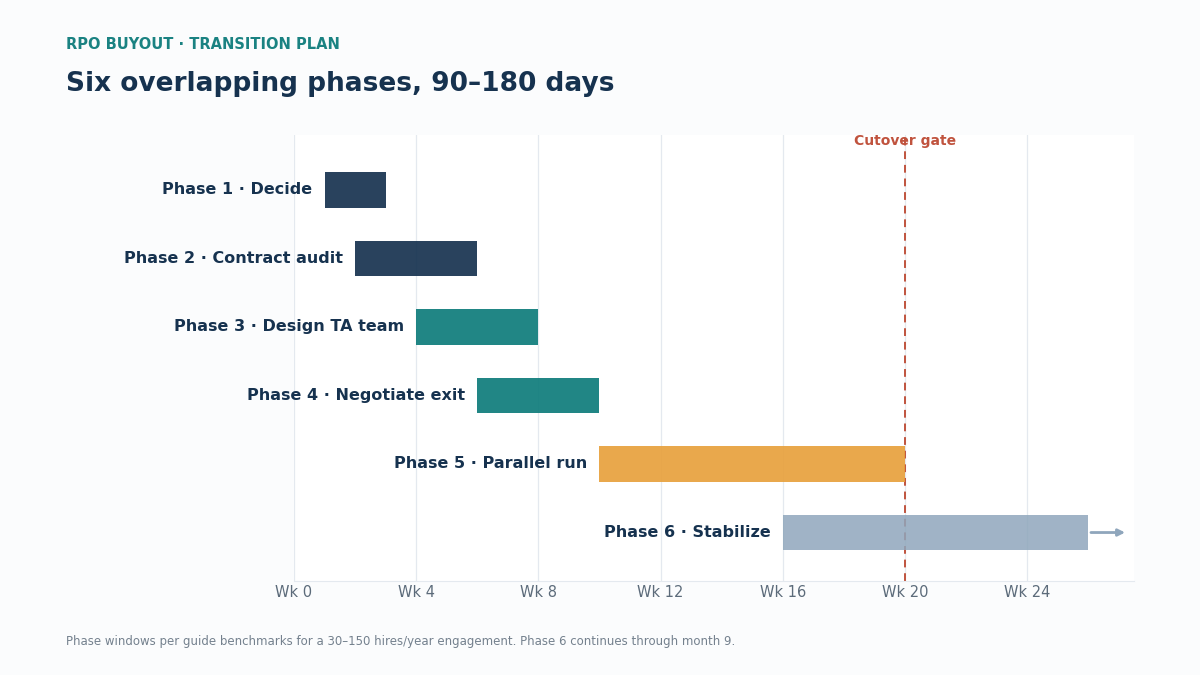
Phase 3 Design the In-House TA Function (Weeks 4–8, parallel to Phase 2)
Design the target before dismantling the current state. A credible in-house talent acquisition team design covers:
Team structure and ratios. Working norms from technical hiring:
- 1 recruiter per 15–25 open technical requisitions (SHRM’s median across industries is ~15–25 reqs per dedicated recruiter; complex engineering roles sit at the low end)
- 1 sourcer per 2–3 recruiters if you hire for niche skills (ML, platform, security)
- 1 coordinator per 3–4 recruiters once interview volume passes ~60 interviews/month
- A working TA lead until ~5 team members; a dedicated head above that
Tech stack decisions (make these early procurement lead times bite):
- ATS: own instance, on your paper, before cutover never inherit a live transition on a system you’re simultaneously procuring
- Sourcing: LinkedIn Recruiter seats, one niche channel per hard skill family
- Scheduling + assessment tooling
- Analytics: define your metric baseline now from the provider’s reports (time-to-fill, offer-accept rate, joining rate, source mix) so post-transition performance has an honest comparator
Budget bands (annual, steady-state, India-centric with US equivalents):
- Lean (25–50 hires/yr): 1–2 recruiters + tools ≈ ₹25–50 lakh ($90k–$200k)
- Mid (50–150 hires/yr): 3–5 person team + stack ≈ ₹60 lakh–1.5 crore ($250k–$600k)
- Scale (150+ hires/yr): 6+ team, brand budget, analytics ≈ ₹1.5 crore+ ($600k+)
Where a skill family is genuinely scarce, say you’re standing up a platform team and need to hire DevOps engineers or hire machine learning engineers at pace, plan for a specialist channel (agency, contract sourcer, or on-demand support) rather than assuming the new internal team absorbs it in month one. Insourcing the function doesn’t mean insourcing every search.
Phase 4 Negotiate the Exit (Weeks 6–10)
Approach the provider with a plan, not an ultimatum. The negotiation has four workstreams:
- The commercial exit. If you’re mid-term, trade things the provider values against the break fee: a longer notice period, a reference/case-study right, a smaller retained scope (e.g., keep them on executive search or a specific geography), or a signed TSA. Providers routinely discount break fees 30–50% against a cooperative, referenceable exit.
- Data and IP. Agree the export format (full structured export with notes, tags, and activity history not a flat résumé dump), the delivery date, a verification window, and deletion certification. Get the sourcing playbooks and templates assigned to you in writing.
- Rebadging. Identify the 1–3 provider recruiters your hiring managers actually rate. Negotiate a waiver of non-solicitation or a capped conversion fee. A rebadged recruiter carries the relationships, the pipeline context, and the tribal knowledge, usually the single highest-ROI move in the whole transition.
- The handover SLA. Written commitments for the transition window: live requisitions worked to completion or formally handed over with candidate-by-candidate status notes; weekly joint pipeline reviews; named counterpart on each side.
Negotiation red flag: a provider who stalls on data-export specifics or claims the candidate database is “commingled” with other clients’ data. Escalate immediately this is either a contractual breach or a data-protection problem, and every week of delay lengthens your parallel run.
Phase 5 Parallel Run and Cutover (Weeks 10–20)
This is the phase most teams skip to save money, and the phase that determines whether the transition is invisible or infamous. Run both engines simultaneously for 4–8 weeks:
- Week 0: Internal team hired/rebadged, ATS live, data imported and verified (spot-check 5% of records for completeness of notes and status).
- Weeks 1–2: New requisitions open on the internal team only; the provider works existing pipelines to close. Joint weekly pipeline review with a single shared tracker.
- Weeks 3–4: Candidate-by-candidate handover of any reqs the provider won’t close in-window each with status, next step, comp expectations, and a warm intro email so no candidate experiences a cold reassignment.
- Weeks 5–6: Provider moves to advisory-only; internal team owns 100% of live volume. Freeze any ATS/process changes during this window one variable at a time.
- Cutover gate: exit the parallel run only when (a) 100% of live candidates have a named internal owner, (b) data verification is signed off, and (c) hiring managers have been introduced to their new recruiter. Date-driven cutovers fail; criteria-driven cutovers don’t.
The one metric to watch weekly: candidate response latency. If time-to-first-touch on new applicants slips past 3 business days during transition, your funnel is silently dying two months before time-to-fill will show it.
Phase 6 Stabilize, Then Decide What Stays Hybrid (Months 4–9)
A steady state is not “the RPO is gone.” It’s the internal team hitting the baseline you documented in Phase 3:
- Time-to-fill within 10–15% of the provider-era baseline by month 3 post-cutover, and beating it by month 6
- Offer-acceptance and joining rates held flat through the transition (this is the earliest indicator of candidate-experience damage)
- Hiring-manager satisfaction surveyed at day 30, 90, and 180
And honestly assess what should remain external. Most successfully insourced functions keep a deliberate hybrid edge: executive search, sudden project surges, or new-geography hiring.
If you later set up an offshore engineering hub or a global capability center, for instance, first-market hiring is usually faster through a partner with an existing local bench than through a remote internal team learning a new talent market from scratch. Insourcing the core and renting the spikes is the mature end state, not a compromise.
The Layer That Runs Through Every Phase: Communication and Change Management
Contracts and data migrations fail loudly; communication failures fail silently, then show up in your offer-acceptance rate. Three audiences need a deliberate plan:
Hiring managers. They don’t care whose payroll their recruiter is on, they care that Tuesday’s pipeline review still happens. Announce the transition to them only once the internal owner for their roles is named, introduce recruiter and manager in a working session (not an email), and keep the intake and review cadence identical through cutover. Changing the operating rhythm and the operator at the same time doubles perceived disruption for zero benefit.
Candidates in process. Every live candidate should experience the handover as an upgrade “you’ll now be working directly with our internal team” delivered by the person they already know, with the new owner copied. A cold “your point of contact has changed” email from an unfamiliar address reads like organizational chaos, and senior candidates quietly re-engage their other options the same week.
The provider’s delivery team. The recruiters working your account will know an exit is coming long before its announced staffing plans leak. The professional move is a joint announcement with the provider, clear dates, and (where rebadging is on the table) early, direct conversations. An account team that feels ambushed does the contractual minimum for its final 90 days; one treated as future alumni often does its best work on the way out.
The 3-day rule: during the entire transition window, no candidate email, application, or scheduling request goes unanswered for more than three business days, no matter which team technically owns it. Assign a single escalation inbox monitored by both sides. This one rule prevents most of the silent funnel decay that makes post-transition metrics look worse than the team actually is.
The Consolidated RPO Exit Plan (Print This)
Everything above, compressed into the checklist the steering meeting runs against:
- Decision memo signed 3-year TCO, go/no-go, reversal conditions (Phase 1)
- Contract audit complete notice period, break fee, data terms, non-solicit, IP clauses mapped with dates (Phase 2)
- TA leader in seat hired or promoted 60–90 days before notice is served (Phase 3)
- Target design approved team structure, ratios, tech stack, year-one budget including one-offs (Phase 3)
- Exit negotiated in writing commercial terms, structured data export spec, rebadging terms, handover SLA, TSA if needed (Phase 4)
- Baseline documented provider-era time-to-fill, offer-accept, joining rate, source mix, agreed with finance and hiring leadership (Phase 3/4)
- Parallel run executed shared tracker, weekly joint reviews, candidate-by-candidate warm handovers (Phase 5)
- Cutover gate passed on criteria, not dates every live candidate owned, data verified, hiring managers introduced (Phase 5)
- Stabilization reviews held day 30/90/180 metric and satisfaction reviews against the documented baseline (Phase 6)
- Hybrid boundary decided a written line on what stays external (exec search, surges, new geographies) and who to call when volume spikes (Phase 6)
If you can tick all ten, the transition is a project. If you can tick fewer than five and notice has already been served, pause and renegotiate the timeline a 30-day extension is cheaper than a quarter of broken hiring.
Case Studies: What a Clean Exit (and a Messy One) Looks Like
A note on sourcing: the engagements below are drawn from patterns across Supersourcing’s delivery work 527+ IT projects, a 98% candidate joining rate, and RPO engagements explicitly designed to be excitable. Where a client hasn’t publicly disclosed transition details, the scenario is anonymized and figures are given as ranges rather than invented precision.
- Fintech scale-up: RPO through hypergrowth, insourced at plateau. A Series C fintech used an outsourced recruiting engine to triple engineering headcount over ~18 months, then saw hiring volume settle to a steady 4–6 hires/month. The exit was planned two quarters ahead of renewal: two provider-side recruiters were rebadged onto the client payroll, the full ATS history transferred with notes intact, and a 6-week parallel run covered live pipelines. Time-to-fill moved less than a week through cutover, and the client’s steady-state cost per hire dropped roughly 30–40% against the per-hire fee model. The enabling factor was boring: the data-export and rebadging terms had been written into the original contract.
- Healthtech platform: automation-first engagement, handed over by design. For a sleep-diagnostics company (Somnoware) engagement focused on recruitment automation, the mandate from day one was to build screening and pipeline processes the internal team would eventually run themselves. Because playbooks, scorecards, and tooling were documented as client-owned work products throughout, the eventual handover was a training exercise, not a rebuild. The lesson generalizes: an engagement structured around a transferable process is cheap to exit; one structured around a provider’s black-box “secret sauce” is expensive to exit permanently.
- The counter-example: the cold-turkey cutover. A mid-market SaaS company (anonymized) terminated at renewal with 30 days’ notice, no parallel run, and no data-verification window. The export arrived as flat résumé files with no activity history; 11 candidates in late-stage processes went silent during the handover gap. Time-to-fill degraded by ~45 days for two consecutive quarters, and the company re-signed a (different) RPO within a year at worse rates, because it was now hiring under pressure. The total cost of skipping a ~₹15–20 lakh parallel run was several multiples of that in vacancy cost and re-onboarding fees.
Decision Framework: Insource, Stay, Switch, or Go Hybrid
Before defaulting to a full buyout, score your situation against the four realistic paths. The table earns its place here because the trade-offs are genuinely multi-dimensional:
| Factor | Full insourcing | Stay with RPO | Switch RPO vendor | Hybrid (insource core + on-demand) |
| Best when volume is… | Stable, 40+ hires/yr | Volatile or surging | Stable but service is poor | Stable core + spiky projects |
| Cost profile | Fixed; cheapest at steady volume | Variable; efficient at high/spiky volume | Variable + switching cost | Fixed core + variable edge |
| Control of brand & candidate experience | Full | Shared | Shared | Full on core roles |
| Speed to change course later | Slow (headcount is sticky) | Fast | Medium | Fast |
| Transition risk | Highest (90–180 days) | None | Medium (re-tender + migration) | Medium-low |
| Typical breakeven | 12–18 months | n/a | 6–12 months | 6–12 months |
How to use it: score each row 1–5 for your situation, weight cost and control by whatever your board actually optimizes for, and force a written rationale for the winning option.
In our experience, teams that run this exercise honestly land on hybrids more often than they expect. Full reverse RPO is the right answer for a stable core, and almost never for surge or first-time-market hiring.
Three-question shortcut if you don’t have time for the matrix:
- Will hiring volume stay within ±40% of today’s level for 24 months? (No → don’t fully insure.)
- Can you hire or promote a TA leader who has built a function before? (No → fix this first.)
- Is your dissatisfaction about cost or about quality? (Quality problems often follow you in-house; they’re usually process problems wearing a vendor costume.)
What Most Teams Get Wrong About Ending an RPO Contract
Quotable block (74 words): The biggest misconception about ending an RPO contract is that the contract is the hard part. It isn’t.
The hard parts are the candidate database you don’t actually control, the two recruiters who hold all the hiring-manager relationships and work for your vendor, and the 90-day operational gap between “contract ended” and “internal team performing.”
Companies that plan for those three things exit cleanly; companies that plan only the termination letter don’t.
The recurring mistakes, in rough order of expense:
- Treating exit planning as adversarial. Buyers hide their intent until notice day, forfeiting months of cooperative knowledge transfer. A provider confident in its model one that publishes its metrics and documents its process will help you leave, because graduated clients become references and boomerang buyers.
- Confusing data return with data usability. “You’ll get your data” can mean a structured ATS export with six years of notes, or 40,000 PDFs in a zip file. Only one of those is an asset. Specify format, fields, and a verification window in writing.
- Ignoring rebadging until it’s contractually impossible. Waiting until after notice is served often means the non-solicitation clock is already running and the provider has redeployed your best recruiter to another account.
- Benchmarking the new internal team against fantasy numbers. If the provider averaged 38-day time-to-fill, the internal team’s success bar for quarter one is ~42–45 days not 25. Set the baseline from the provider’s own reports before cutover, or every post-transition metric becomes a political argument.
- Insourcing the spikes along with the core. The internal team gets sized for peak demand, then carries idle cost for three quarters. Size for the median; rent the peaks through contract IT staffing or on-demand support.
- Underfunding year one. The first-year budget must carry transition one-offs (parallel run, migration, tooling setup, rebadging fees) on top of steady-state cost. Presenting only the steady-state number to finance guarantees a mid-transition budget fight.
Cost and Timeline Reality Check
Concrete ranges, because “it depends” isn’t a plan. Figures reflect typical mid-market technical hiring engagements (30–150 hires/year); label them as planning bands, not quotes.
One-time transition costs:
- Early termination / buyout fee (if exiting mid-term): commonly 50–100% of remaining management fees often negotiable to 30–50% with a cooperative exit
- Transition services agreement (30–90 days of provider support): ₹5–25 lakh ($6k–$30k) depending on scope
- Rebadging conversion fees: 0–25% of first-year salary per recruiter (frequently waived at renewal-time exits)
- ATS procurement + migration + data verification: ₹5–30 lakh ($6k–$36k) including implementation effort
- Parallel-run overlap (paying both engines for 4–8 weeks): typically the largest single line item budget 1.5–2 months of current RPO cost
Steady-state annual costs (from Phase 3): ₹25–50 lakh lean / ₹60 lakh–1.5 crore mid / ₹1.5 crore+ at scale ($90k–$600k+ US-equivalent), against which SHRM’s ~$4,700 median cost-per-hire and the 6x executive multiplier are useful sanity checks for the per-hire math.
Timeline by scenario:
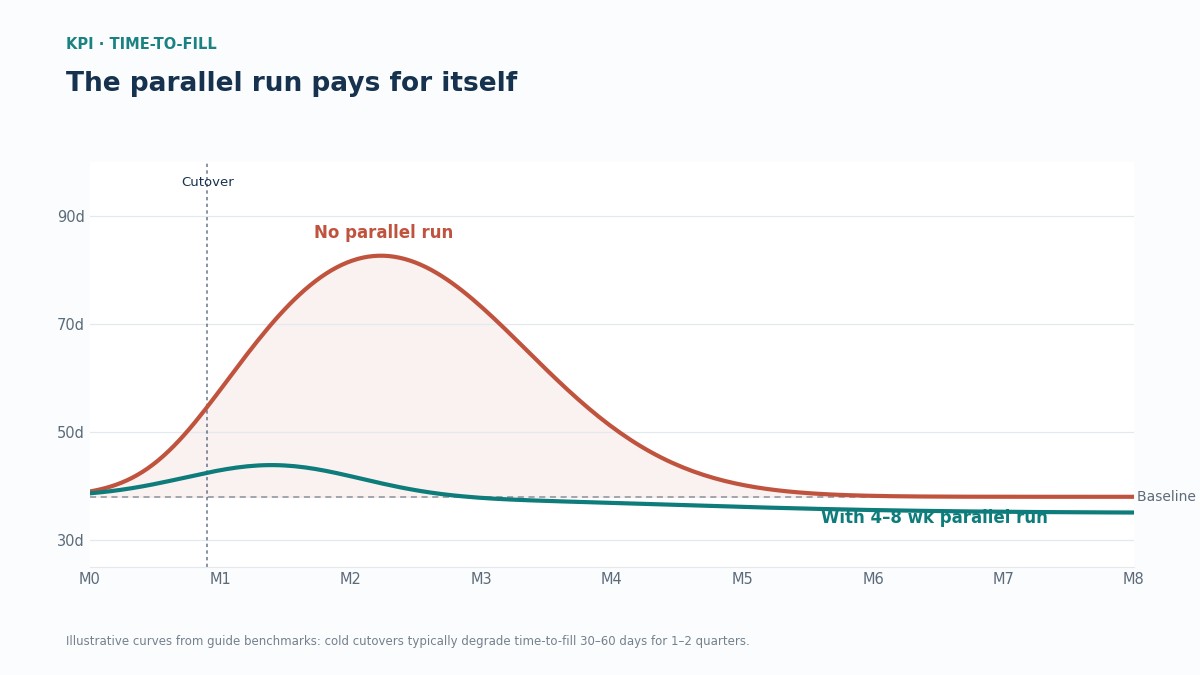
| Scenario | Realistic end-to-end timeline |
| Exit at renewal, cooperative provider, data terms pre-agreed | 90–120 days |
| Exit at renewal, terms negotiated from scratch | 120–180 days |
| Mid-term buyout with disputes over data/fees | 180–270 days |
| Cold-turkey termination, no parallel run | 30 days followed by 2–3 quarters of degraded hiring |
What drives cost up: commingled or poorly structured candidate data, ATS on the provider’s paper, niche-skill dependence on provider sourcers, and any live executive searches mid-transition.
What drives it down: exit terms written into the original contract, rebadging your top provider-side recruiter, and a TA leader hired 60–90 days before notice is served.
If You’re Mid-Decision: The Next Step
The right time to plan an exit is before you need one ideally two full quarters ahead of renewal, while every clause is still negotiable and your best provider-side recruiter is still on your account.
If you’re inside that window, do three things this month: pull the six documents from the Phase 2 checklist, build the 3-year TCO comparison from Phase 1, and pressure-test both against someone who has sat on the delivery side of these transitions. Supersourcing has spent a decade building recruiting engines that are designed to be handed over dedicated (not shared) delivery teams, client-owned documentation, and NDA-backed IP terms which also means we’ve seen exactly where exits break.
Bring your contract and your hiring plan to a 30-minute working session, and leave with a straight answer on whether a buyout, a hybrid, or staying put is the better call for your numbers: supersourcing.com/contact-us
FAQ
What is an RPO buyout?
It’s the negotiated exit from a recruitment process outsourcing contract paying out or ending the remaining term, reclaiming ownership of recruiting processes, candidate data, and tooling, and moving delivery to an internal talent acquisition team. It differs from a vendor switch, where delivery simply moves to another provider rather than in-house.
When should a company insource recruitment?
When three conditions hold: hiring volume is durable (roughly 40+ hires/year, within ±40% month to month), leadership will fund fixed recruiter headcount through slow quarters, and you can put an experienced TA leader in place before the transition starts. If any one fails, a hybrid model usually beats a full buyout.
Who owns the candidate data in an RPO contract?
Whatever the contract says which is why you read the data-return and DPA clauses before serving notice. Ownership on paper is also not the same as usability: insist on a structured export with notes, statuses, and activity history, plus a verification window and deletion certification, and confirm your lawful basis to keep contacting candidates under GDPR or India’s DPDP Act.
How long does an RPO to in-house transition take?
Plan for 90–180 days from decision to stabilized internal delivery: 3–6 weeks of contract audit and design, 4–6 weeks of negotiation, and a 4–8 week parallel run before cutover. Only a renewal-timed exit with pre-agreed data and transition terms lands at the fast end of that range.
Can you rebadge the RPO’s recruiters onto your own payroll?
Usually, yes subject to the non-solicitation clause, which typically bars it for 6–12 months or attaches a conversion fee of 15–25% of first-year salary. Both are negotiable, especially at renewal. Rebadging one or two recruiters who already know your hiring managers is often the highest-ROI move in the entire transition.
Is insourcing recruitment cheaper than RPO?
At stable volume, generally yes steady-state savings of 25–40% versus per-hire fee models are common once the team matures. But year one is usually more expensive than staying, because you carry transition one-offs plus overlap costs. Model a 3-year TCO, not a year-one comparison, or the business case will collapse at the first budget review.
What happens to live requisitions and candidates during the exit?
They’re the transition’s highest-risk asset. The handover SLA should commit the provider to working existing pipelines to completion or transferring each candidate with full status notes and a warm introduction. Watch time-to-first-touch weekly; if it slips past three business days, the funnel is degrading even if headline metrics look fine.
Do companies go back to RPO after insourcing?
Some do usually those that insourced spiky volume, or exited without a parallel run and never let the internal team stabilize. Many more land on a deliberate hybrid: an in-house core with on-demand external support for surges, executive search, or new markets. If you’re unsure which side of that line you’re on, that’s exactly the question worth pressure-testing with a partner before serving notice.
