

Gartner’s forecast for the next 18 months isn’t a growth number. It’s a failure number: by 2027, 40% of enterprises will demote or decommission autonomous AI agents because governance gaps only surfaced after a production incident.
By 2027, 40% of enterprises will demote or decommission autonomous AI agents due to governance gaps identified only after production incidents occur. Gartner, May 2026
Read that as a staffing problem, because that’s what it is. Anyone preparing to hire applied AI team capability this year should read it as a sequencing problem as well. Agents don’t get decommissioned because the model was wrong, they get decommissioned because nobody owned the failure taxonomy, nobody scoped the tool permissions, and nobody could prove, with numbers and before the incident, what the system did and didn’t do reliably.
That ownership gap is a hiring-order problem. Most organisations staffing agent work recruit the most impressive AI résumé they can afford, then discover six months later that the bottleneck was never modelling. It was tool plumbing, retrieval quality, evaluation infrastructure, permission scoping, and cost-per-task accounting none of which appear on a data science job description.
Teams that ship agents into production are structurally different from data science orgs: different roles, different sequencing, different definition of done. This guide is the build order of the nine roles that matter, which four you need in month one, what each costs in India and the US, how to interview for skills that didn’t exist in 2023, and where the timeline slips if you don’t plan for it.
TL;DR
This is a practitioner's build order for anyone who needs to hire applied AI team capability engineering leaders, CTOs, and heads of platform with an approved agent initiative and no proven template for staffing it. It covers the nine applied AI team roles, the order to hire them in, cost bands in ₹ and $, the interview loop, the contract terms, and the KPIs that tell you whether it's working.
The single number to hold onto: the first four hires get you 80% of the way to a production agent, and the second of those four should be an evaluation engineer not a second builder, and definitely not a research scientist. Teams that invert that order typically spend three to four extra months debating whether their agent is good enough, because they built no instrument capable of answering the question.
By the end you'll be able to write the job descriptions, sequence the requisitions, set defensible budget bands, run an interview loop that filters for production judgment over vocabulary, and negotiate a contract that leaves you owning the assets that compound your eval sets and your traces.
What Is an Applied AI and Agent-Engineering Team?
An applied AI and agent-engineering team is a product-embedded engineering group that builds, evaluates, and operates LLM-powered systems in production including agents that call tools and take actions. It owns the orchestration layer, retrieval, evaluation harness, guardrails, and cost-and-latency performance of AI features, rather than researching or training foundation models.
What it is commonly confused with, and is not:
- Not a data science team. Data science produces analysis and models measured on held-out datasets. An applied AI team produces running software measured on task success, latency, cost, and incident rate.
- Not an ML research team. Research advances model capability; applied AI extracts reliable behaviour from capability that already exists, mostly through context, tooling, and evaluation.
- Not an “AI centre of excellence.” A CoE advises other teams and owns no production surface. An agent engineering team is on call for something.
- Not a prompt-engineering function. Prompting is one tactic inside a larger system; no serious team today has a headcount line called “prompt engineer.”
Why It Matters: The Business Case for Staffing This Correctly
McKinsey’s global survey found 88% of organisations report regular AI use in at least one function, while only about a third have begun scaling and the strongest differentiator among high performers is fundamental workflow redesign, which is a staffing act, not a procurement one. An applied AI team’s composition decides four things:
- Speed to first production agent. A correctly sequenced pod of four ships, a scoped agent behind a feature flag in 8–12 weeks. A miscomposed team of six commonly takes 6–9 months, most of it building evaluation tooling that should have been hire 2’s week-one deliverable.
- Unit economics. Cost per resolved task is the number your CFO will eventually ask for. Teams without a platform owner routinely run 2–4x higher inference cost than necessary, nothing cached, no cheap-model routing, nobody profiling tokens per call path.
- Incident exposure. Prompt injection, over-scoped tool permissions, and exfiltration through retrieval are the failure class behind Gartner’s decommissioning forecast, and they’re prevented at design time by a role most teams staff a year late.
- Retention of the compounding asset. Models change every few months; your golden datasets, failure taxonomy, and trace history don’t get more valuable. Builder-only teams lose this asset on every staffing change.
One number to hold: a scoped internal workflow typically reaches 60–80% autonomous resolution. The gap between 60% and 80% is almost never the model of its retrieval quality and eval-driven iteration, which is to say two specific hires.
The Core Problem: Four Ways This Hiring Goes Wrong
Market conditions make mistakes expensive. AI engineer is the fastest-growing role in the US by LinkedIn’s 2026 ranking, with LangChain, RAG, and PyTorch as its most common skills and a median of just three years’ prior experience. Highest demand plus shallowest average experience is exactly the condition under which title inflation outpaces capability. What goes wrong, in order of frequency:
- The title tells you nothing. “AI engineer” spans someone calling a hosted API from a route handler to someone who has run post-training on a 70B model. Two candidates with identical titles and ask-rates can differ by an order of magnitude in production capability.
- Requirements are written for a model, not a workflow. Job descriptions list frameworks instead of the decision boundary the agent must own, producing candidates who match the stack and can’t say what should happen when the agent is 70% confident.
- Evaluation is deferred and then never built. The most predictive failure of all. Without an eval harness, “is it good enough to ship?” becomes a weekly meeting instead of a measurement. Most teams underestimate this build by 3–4x they budget a sprint; a harness with a labelled golden set, judge calibration, and a CI regression gate is closer to 6–10 engineer-weeks.
- The offer-to-join gap is ignored. Senior engineers at Indian services firms carry 60–90 day notice periods and, in AI roles, an elevated counteroffer rate. A plan that budgets “eight weeks to hire” and forgets notice is a sixteen-week plan wearing a disguise.
The compounding effect: these aren’t independent. A vague requirement produces a title-matched hire with no eval instrument, so nobody can prove the agent fails on a specific input class, so the fix becomes “try a better model” which costs a quarter and resolves nothing. Sequencing exists to break that chain.
The 9 Applied AI Team Roles and What Each One Actually Owns
Get the applied AI team roles wrong and you end up with a group that can prototype anything and ship nothing. The nine roles below are the complete surface area of production agent work. You will not hire all nine, and you should not try the sequencing section explaining which four carry the load.
| Role | Owns | Hire when | India (annual CTC) | US (annual base) | |
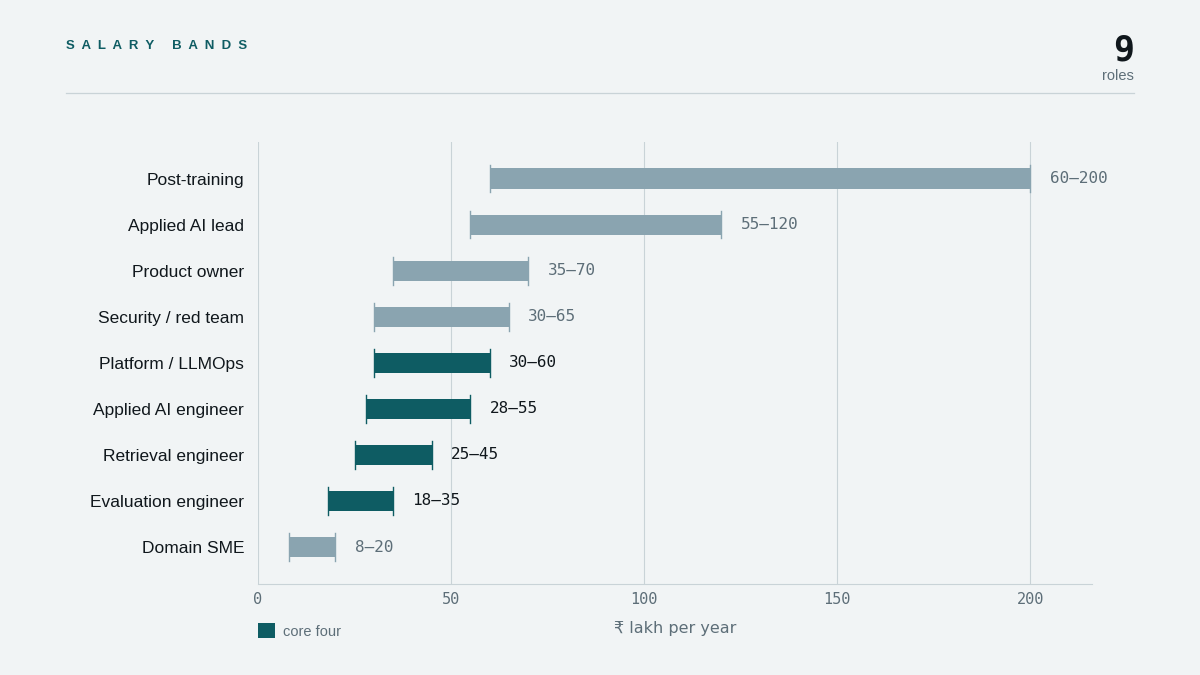
| Applied AI / agent engineer | Orchestration, tool calling, context assembly, retries, state | Day one | ₹28–55L (mid), ₹55L–1.2Cr (lead) | $150–210K (mid), $220–350K (senior) | |
| AI evaluation engineer | Golden datasets, LLM-as-judge calibration, regression gates | Before the second builder | ₹18–35L | $130–185K | |
| AI platform / LLMOps engineer | Gateway, routing, caching, tracing, prompt versioning, secrets | Agent 2 or environment 2 | ₹30–60L | $160–230K | |
| Context / retrieval engineer | Chunking, embeddings, hybrid search, rerankers, permission-aware retrieval | Retrieval becomes the top failure class | ₹25–45L | $150–200K | |
| AI product owner | Task boundaries, acceptance thresholds, escalation policy | Scope disputes exceed one per week | ₹35–70L | $170–240K | |
| Domain SME / annotation lead | Rubrics, labelling, inter-annotator agreement, ground truth | Alongside hire 2 | ₹8–20L | $70–110K | |
| AI security / red-team engineer | Prompt injection defence, tool-permission scoping, exfiltration testing | Before any write-scope tool goes live | ₹30–65L | $170–250K | |
| Applied research / post-training engineer | Fine-tuning, distillation, preference optimisation | Eval curve plateaus and cost forces it | ₹60L–2Cr | $250–500K+ | |
| Data engineer (shared) | Event capture, context stores, trace warehousing | Usually already on staff | ₹18–45L | $140–200K |
On the numbers: these bands reflect public compensation aggregates cross-referenced against offers we’ve seen close recently. Treat them as planning bands, not quotes. Two adjustments apply consistently: a 15–30% metro premium for Bengaluru, Hyderabad, Pune and Delhi NCR, and a demonstrable-production-agent premium that pushes candidates to the top of a band regardless of years served. If you’re benchmarking a requisition before you hire Generative AI developers, price against the top third; the bottom third is where availability lives, not capability.
Role 1 Applied AI / agent engineer
The load-bearing role: a strong backend engineer who has internalised one hard idea: the system is non-deterministic, so every design decision must assume the model will occasionally be wrong and the software has to stay correct anyway. What they build:
- Tool and function definitions with tight schemas and validated arguments
- The orchestration loop planning, tool selection, retries, timeouts, partial-failure recovery
- Context assembly: what enters the window, in what order, under what token budget
- State and memory across multi-turn or long-running tasks
- Fallbacks and degradation paths, including the deterministic path for when the agent gives up
What they are not: a modeller. Well over 80% of the work here is systems engineering, and the strongest hires often come from distributed systems or platform backgrounds rather than from ML.
Role 2 AI evaluation engineer
The most under-hired role in the market and the highest-leverage second hire. An AI evaluation engineer builds the instrument that converts opinion into measurement. First-90-days deliverables:
- A failure taxonomy for the specific task the 8–15 named ways this agent goes wrong
- A golden dataset of 150–500 labelled cases covering every failure class, including adversarial edges
- An offline eval harness that runs in CI and blocks merges on regression
- Calibrated LLM-as-judge scoring, validated against human labels you check the judge before you trust the judge
- Online eval: sampled production traces scored continuously, so drift shows up in a dashboard rather than in a customer complaint
Red flag when interviewing this role: a candidate who describes evaluation as running some test cases and eyeballing the output. The correct answer names a denominator, a labelling process, and an inter-annotator agreement number.
Role 3 AI platform / LLMOps engineer
Cost discipline and observability live here closest in temperament to an SRE, which is why teams that already hire DevOps engineers at a strong bar often find their best internal transfer in that pool. Scope: a model gateway with routing rules (cheap model for classification, frontier model for synthesis), prompt and config versioning, distributed tracing with token and latency attribution per span, exact and semantic caching, plus sandboxing and secret management for tool execution.
The cost lever nobody staffs for: in most engagements the first two weeks of a competent platform hire routing, caching, killing redundant retrieval calls cuts inference spend 30–60% with no measurable quality loss.
Role 4 Context / retrieval engineer
When an agent is confidently wrong, retrieval is usually the culprit, not the model. This role owns what the model knows at inference time: chunking, embeddings, hybrid keyword-plus-vector search, reranking, freshness, and permission-aware retrieval so the agent can’t surface a document the requesting user isn’t entitled to see.
Specific friction we see repeatedly: teams ship retrieval without row-level permission filtering, then discover in a security review that the agent will happily summarise an HR document for the wrong employee. Retrofitting entitlements into a live retrieval layer is a multi-sprint rebuild.
Roles 5 and 6 AI product owner, and domain SME / annotation lead
The AI product owner is not a generic PM. This person decides what engineers cannot decide alone: which tasks the agent owns end to end, the confidence threshold at which it escalates, what separates an acceptable error from an unacceptable one, and where the agent sits on the autonomy ladder read-only → suggest → act-with-approval → act-and-notify → autonomous. If engineers are relitigating scope weekly, you needed this role a month ago.
The domain SME exists because ground truth is a human product. Someone writes the rubric, labels the golden set, and holds labelling consistent as the definition of “correct” sharpens a domain expert, not a generalist, in claims, diagnostics, credit or compliance work. Cheapest role on the list, most frequently skipped, and the reason so many teams own an eval suite that measures the wrong thing precisely.
Roles 7, 8 and 9 security, post-training, and data
AI security / red-team engineer: prompt-injection testing against untrusted content, tool-permission scoping to least privilege, exfiltration paths through retrieval and logs, agent identity and audit trails, and a documented, tested kill switch. Developer caution here is well founded in Stack Overflow’s survey, 87% of respondents reported concern about agent accuracy and over 80% about security and data privacy.
Applied research / post-training engineer: hire late, genuinely late. Fine-tuning and preference optimization answer a narrow set of problems: an eval curve plateaued with prompting and retrieval exhausted, or cost and latency targets only a smaller distilled model can meet. Both require an eval suite to even detect. When the trigger fires you’re looking at people who’d clear the bar to hire machine learning engineers at senior level.
Data engineer: usually already in the building. Agents need event capture, a context store, and trace warehousing. Borrow 20–30% of an existing engineer if your data platform is healthy; if it isn’t, fix that before promising anyone an agent roadmap.
Why an Agent Engineering Team Is Not a Data Science Team
An agent engineering team and a data science org differ on every axis that matters operationally, which is why moving the requisition from one to the other rarely works. This is the distinction most reorganisations get wrong.
| Dimension | Data science org | Applied AI / agent engineering team |
| Primary artifact | Notebook, model file, analysis | Running service in the request path |
| Definition of done | Metric beats baseline on held-out data | Task success at target rate, within latency and cost budget |
| Core metric | AUC, RMSE, F1 | Task success rate, escalation rate, cost per resolved task, p95 latency |
| Failure mode | Data drift, degraded accuracy | Tool misfire, prompt injection, hallucinated action, runaway cost |
| Iteration loop | Retrain on new data | Change context, tools, or policy; re-run eval suite |
| Skill centre of gravity | Statistics, modelling | Distributed systems, API design, evaluation methodology |
| Dominant cost | Training compute, data acquisition | Inference tokens, eval runs |
Applied AI engineer vs data scientist: the practical screen
Ask both candidates the same question: “Your agent resolves 68% of tickets autonomously. Get it to 85%.”
- The data scientist’s answer tends toward better data, feature work, a stronger or fine-tuned model.
- The applied AI engineer answers the 32% into failure classes first, then attacks whichever class is largest, usually retrieval misses or a missing tool, occasionally an ambiguous escalation policy, rarely the model.
Neither answer is wrong in the abstract. Only one ship in a quarter which is the entire reason this team is staffed separately.
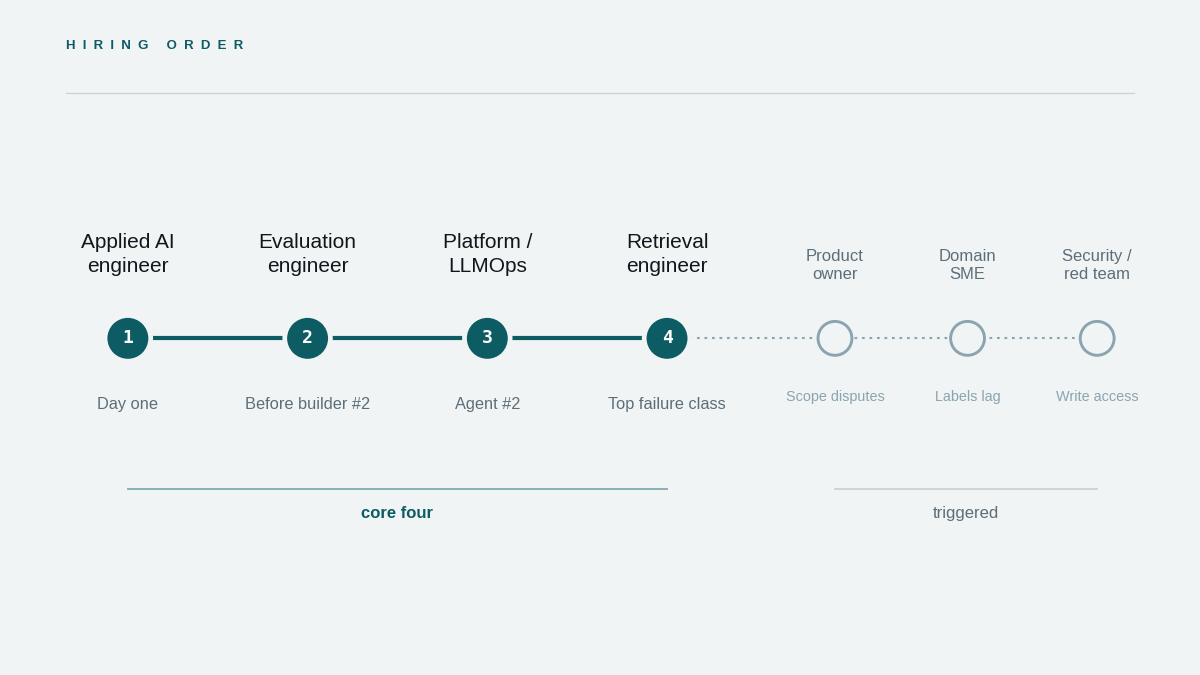
The Hiring Order: Who to Hire First for an AI Agent Team
Sequencing is the part no job board can help with. Every applied AI team hire below has an explicit trigger hire against the trigger, not against the org chart you eventually want.
Hire 1 Senior applied AI engineer (the vertical slice)
Start with one senior engineer who can own an end-to-end slice, not a team lead who coordinates.
The vertical-slice rule: within 30 days, hire 1 ship, one real task end to end into staging behind a flag, one workflow, two or three tools, real data, real permissions, logged traces. Not a demo, not a framework evaluation. One slice that runs.
A vertical slice surfaces every structural problem you’d otherwise meet in month five: the API with no sandbox, the document store with no entitlements model, the workflow whose “obvious” happy path has four undocumented exceptions. Organisations looking to hire LLM developers for this slice should optimise for breadth of production ownership over depth of ML theory.
Hire 2 AI evaluation engineer (before the second builder)
The contrarian call, and the one we’d defend hardest. The instinct is to double build capacity. Resist it.
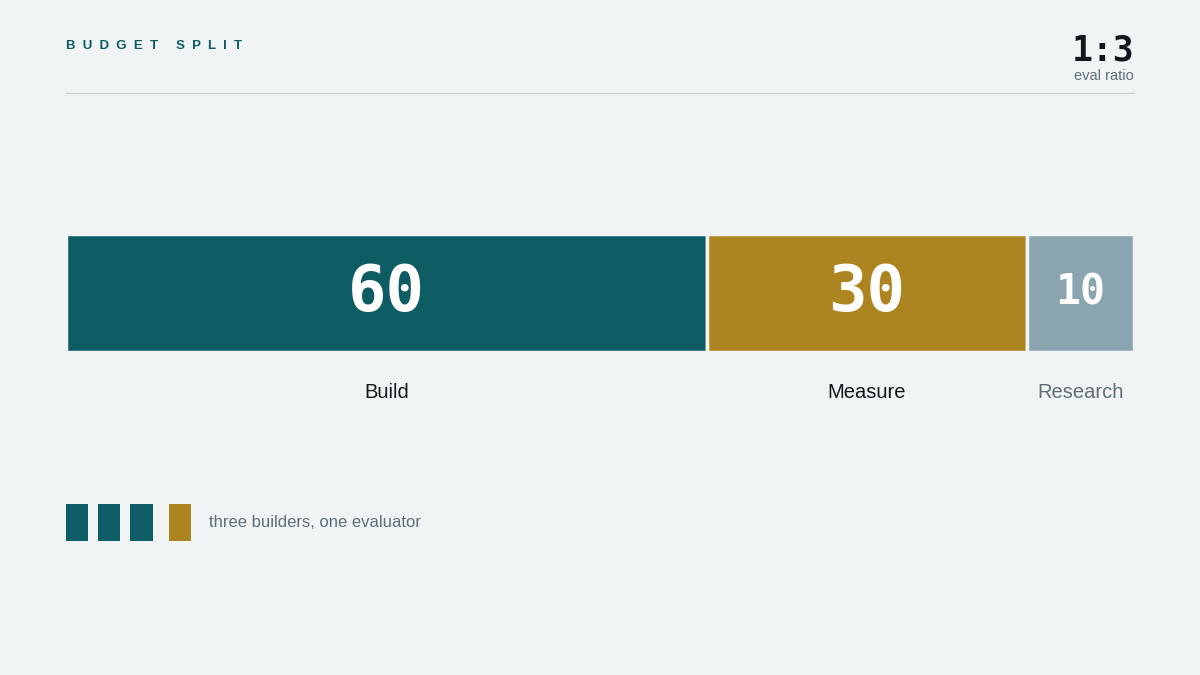
The 1:3 eval ratio: one evaluation-focused engineer per three agent builders and hire the first when you have exactly one builder. Below that ratio quality is a matter of debate; above it you’re over-instrumenting a system that isn’t shipping.
The mechanism: without evaluation, your second builder’s output can’t be verified any faster than your first builder’s. You’ve doubled cost and left throughput flat, because the bottleneck was never writing code, it was knowing whether the code made things better.
Hire 3 AI platform / LLMOps engineer
Trigger: the second agent, the second environment, or the first month your inference bill surprises you. Before that, one engineer’s scripts and a hosted tracing tool are adequate. After it, every builder reinvents gateway, caching, and prompt-versioning logic locally, and you accumulate four incompatible ways of doing the same thing.
Hire 4 Context / retrieval engineer
Trigger: retrieval failures become the largest single class in your failure taxonomy which you now know, because hire 2 built it. That’s the payoff of eval-first sequencing: you hire against measured evidence rather than a guess. Teams working in reverse routinely staff a retrieval specialist for a system whose dominant failure was a missing tool.
Hire 5 AI product owner
Trigger: more than one scope dispute per week, or two engineers implementing contradictory escalation behaviour. Can be a strong existing PM with two weeks of immersion. What can’t be borrowed is decision authority if they need a steering committee to set an escalation threshold, the role is decorative.
Hires 6 triggered, not scheduled
- Domain SME / annotation lead when hire 2 needs labels faster than they can produce them, typically week 3–6. Often part-time, often an internal transfer from operations, and almost always better value than another engineer at that moment.
- AI security / red-team engineer the day someone proposes giving an agent write access to a database, payment rail, outbound channel, or ticketing system. Fractional or shared with your existing security function is fine; absent is not. This is the specific gap behind Gartner’s decommissioning forecast.
- Applied research / post-training engineer after two consecutive months of plateaued eval scores despite context and tooling work, or a hard latency/cost ceiling only a smaller distilled model can meet. If neither has fired, this hire solves problems you don’t have at the highest salary on the team.
Hire 7 Second pod, not a bigger pod
Trigger: the first pod owns two or more production agents and the review meeting no longer fits in an hour.
The pod-splitting principle: agent teams degrade past roughly seven people because context-sharing cost rises faster than throughput. Split into a second pod with its own builder-plus-eval core and a shared platform layer, rather than growing one team to twelve.
The 60/30/10 budget split
Across a mature applied AI team, a healthy allocation of engineering cost looks like:
- 60% build agent engineers, retrieval, platform
- 30% measure evaluation engineering, annotation, domain SMEs
- 10% research fine-tuning and post-training, and only once triggered
Teams that show up at 90/10/0 are the ones that spend the following two quarters unable to answer whether their agent works.
The Walkthrough: From Zero to a Working Applied AI Team
Six phases to a working applied AI team, with the artefacts each should produce. Starting at Phase 1 skipping to sourcing is exactly what produces the title-matched, workflow-mismatched hire described above.
Phase 1 Define the work before you define the roles
Requirements are where a build GenAI engineering team effort becomes tractable or stays permanently vague. The unit of definition is not a role; it’s a task the agent will own. Write a one-page agent charter before any requisition opens, containing exactly seven things:
- The task, in one sentence “Resolve tier-1 billing queries end to end for logged-in customers.” Specificity is the point.
- Tools the agent needs every API, database, and service, with read and write scope stated separately.
- Autonomy level on the ladder read-only, suggest, act-with-approval, act-and-notify, or autonomous. Almost everyone should start to suggest.
- Success bars the numeric threshold authorising production: e.g. ≥80% task success on the golden set, ≤2% harmful-error rate, p95 under 8 seconds.
- Escalation policy: what happens at low confidence, who receives it, what the human sees.
- Unit economics ceiling maximum acceptable cost per resolved task, in currency. If nobody will state this, you have a demo, not a product.
- Blast radius is the worst realistic outcome of a wrong action, and whether it’s reversible.
The line item everyone forgets: eval runs. A regression suite firing on every merge across 300 golden cases and a judge model commonly consumes 20–40% of total inference spent during active development. Budget it explicitly, or your platform engineer will quietly cut eval coverage to control precisely the wrong trade. Full scenario ranges are in the Cost and Timeline section below.
Phase 2 Sourcing and vetting: how to vet AI agent developers
When you set out to hire AI agent developers, the screening problem is separating production experience from vocabulary. Both candidates read the same blog posts; only one has been paged at 2am because an agent looped 400 times against a rate-limited API.
The interview loop that predicts performance (5 stages, 5–8 working days):
- Screen (30 min). One question carries the stage: “Describe a failure mode you personally debugged in an LLM system, and how you found it.” Production candidates answer with traces, token counts, and a specific input class. Others answer with generalities about hallucination.
- Broken-agent exercise (90 min, live or paid take-home). Hand over a small repo with a deliberately broken agent and its traces a tool with a schema mismatch, a retrieval step returning stale documents, an unbounded retry loop. Ask them to diagnose and fix. Highest signal-to-time ratio of anything we run, because trace-reading can’t be faked.
- Eval design (45 min). “Design the evaluation for this task.” Listen for golden-set size and sampling, a failure taxonomy, how they’d validate a judge model against human labels, and what would block a release.
- Cost and latency whiteboard (30 min). “Estimate cost per task and p95 latency for this call path.” You’re testing whether they think in tokens and milliseconds. Strong candidates raise caching and model routing unprompted.
- Domain and collaboration (30 min). With the SME or product owner. Can they interrogate an unfamiliar workflow and identify where human judgment is irreducible?
Red flags the specific ones, from real loops:
- The missing denominator. “We got to 94% accuracy.” On how many cases, labelled by whom, against what rubric? An unqualified accuracy number is the most reliable single tell.
- Benchmark-only portfolio. Strong public-benchmark results, nothing that ran against messy internal data with permissions and rate limits.
- Framework identity. Every architectural answer is a framework name. Frameworks change annually; failure-mode reasoning doesn’t.
- Fine-tuning as a first resort. Reaching for post-training before retrieval, context, or tooling signals someone optimising for résumé interest over outcome.
- Cannot describe a rollback. If they’ve never had to turn an agent off in a hurry, they’ve never shipped one that mattered. A related tell: ask what write access they’d grant in week one, and treat “whatever the product needs” as a fail.
What good screening looks like upstream. A five-stage loop only stays tight if it runs on 4–6 serious profiles rather than 40 a sourcing problem before it’s an interviewing one. The Supersourcing model uses AI-assisted sourcing to surface roughly the top 2% of vetted talent, turning a job description into an interview-ready shortlist in 7–10 working days, with drop-off under 1% and a 98% joining rate on contract roles. In this market a candidate who accepts and doesn’t join costs you a full cycle.
Regional context: in the nasscom–Indeed study, 58% of employers cited low applicant volume and 40% now prefer demonstrable AI skills over a formal degree weight the loop toward the broken-agent exercise and away from credentials.
Phase 3 Engagement models and contracts
Four models. The choice changes speed, cost, and what you own at the end.
- In-house FTE best for long-horizon core IP, slowest to assemble at 8–16 weeks per senior hire once notice periods count.
- Dedicated pod (staff augmentation) a named team on your roadmap only, inside your standups and repos. Shortlists in 7–10 working days, running team inside 4–6 weeks.
- Project-based fixed scope, fixed price. Workable for a bounded first agent; poor fit for eval-driven work where scope legitimately shifts as the taxonomy sharpens.
- Freelance marketplace fine for a two-week spike, not for anything requiring on-call, permissions, or continuity of the eval asset.
Contract clauses specific to AI work the five most contracts miss:
- Eval asset ownership. Golden datasets, rubrics, and the failure taxonomy are the compounding assets. Name them explicitly as client-owned deliverables. Silence here is how teams lose two quarters of measurement work at contract end.
- Trace and log ownership, with retention terms. Traces hold your data and your behavioural history. Specify who stores them, where, for how long, and what happens on termination.
- Fine-tuned weights and derived artefacts. If post-training happens, state who owns the resulting weights and adapters. Default vendor terms often don’t.
- Model and subprocessor disclosure. Which models, providers, and regions and whether your data can be used for provider-side training. A data-protection question, not a preference.
- Replacement and continuity. A defined replacement window is 7–10 days plus handover that includes eval sets and trace access, not just code.
Standard protections remain non-negotiable: NDA coverage, full IP assignment, no shared bandwidth, and a signed DPA wherever personal data touches the pipeline.
A negotiation point most buyers miss: senior AI candidates commonly hold two or three live offers, and comp alone rarely wins. Written scope does the specific agent, the autonomy level, eval ownership, reporting line. Candidates accept the offer where they can picture the first 30 days, so put the agent charter in the offer packet.
Phase 4 Onboarding and ramp-up: the first two weeks
Ramp-up is where timelines quietly die, and the friction is almost never skillful. An excellent agent engineer sits for 8–12 days waiting on sandbox credentials for three tools while their onboarding “productivity” is measured in documentation read.
The day-zero access pack assemble before they start:
- Repo access, CI permissions, and a documented local setup path
- Sandbox credentials for every tool in the charter, with a non-production data set
- A read-only replica or masked snapshot of the data the agent retrieves from
- Model API keys with their own budget alert and rate limits
- Tracing access from hour one never retrofitted
- The charter, the escalation policy, and any eval assets that already exist
- A named SME who owes them two hours a week, on the calendar
The two-week ramp benchmark:
- Days 1–2: environment running, first trace produced locally
- Days 3–5: first merged PR, however small if this hasn’t happened, the blocker is access, not the hire
- Days 6–10: one tool integrated end to end with tests and traces
- Days 11–14: first eval cases contributed, plus a written list of the three biggest risks they see in the charter
Cadence for distributed pods: a 15-minute daily standup in the overlap window, a weekly 45-minute eval review walking through scores and regressions, and a fortnightly charter review where scope changes get made explicit rather than absorbed silently.
The two-week trace test: by day 14, can the new engineer pull up a staging trace and narrate what the agent did and why, step by step, unaided? If yes, they’re ramped. If not, the gap is almost always missing observability rather than missing ability to fix your problem, not theirs.
Phase 5 Managing delivery: LLMOps team structure and KPIs
A working LLMOps team structure puts the eval review, not the sprint demo, at the centre of the operating rhythm. Demos show the happy path; eval reviews show the distribution.
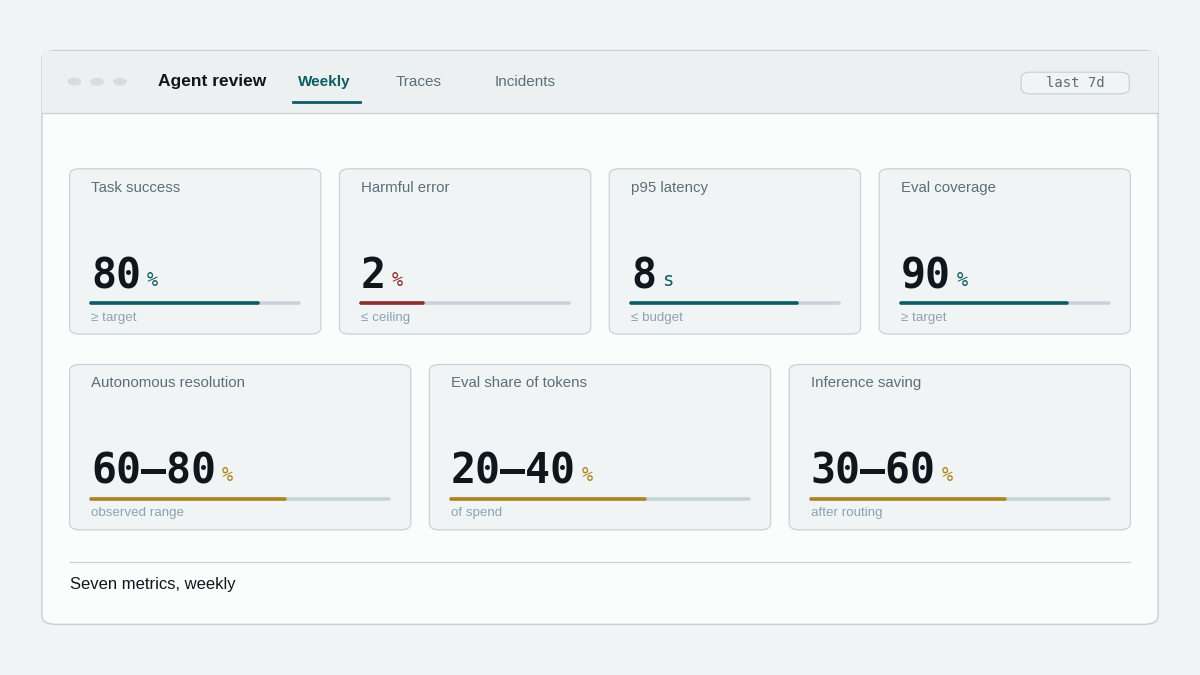
The seven metrics to review weekly:
- Task success rate on the golden set and on sampled production traffic, reported separately. They diverge, and the gap is informative.
- Escalation rate how often the agent hands off. Falling escalation with flat success is a warning, not a win: the agent is getting bolder, not better.
- Harmful-error rate wrong actions with real consequences, tracked apart from benign errors. This is the number with a hard ceiling.
- Cost per resolved task trending, against a target. Rising cost per task alongside rising volume is the normal failure mode of an unmanaged agent.
- p95 and p99 latency per call path, never averaged across the system.
- Eval coverage share of the failure taxonomy with at least five golden cases. Above 90% before expanding autonomy.
- Incidents and near-misses including anything a guardrail caught. Near-misses are your leading indicator.
Governance that scales with autonomy. Gartner’s finding is that uniform governance across all agents is itself a failure mode: treating every agent as either locked down or fully trusted is what produces the decommissioning outcome. Tier controls to the autonomy level instead:
- Read-only: eval gate in CI, sampled review
- Act-with-approval: full audit trail, approvals logged, weekly review of overridden approvals
- Act-and-notify or autonomous: least-privilege tool scoping, per-tool rate limits, a kill switch tested quarterly, and a red-team pass before each scope expansion
Reporting structure that holds up: one accountable engineering owner per agent, a shared platform layer serving all agents, and an eval function reporting independently of the builders because an evaluation engineer who reports to the person whose work they grade will, over time, produce more comfortable numbers.
Phase 6 Scaling, replacing, or exiting
Scaling triggers, in order:
- First agent holds its success bar for 60 consecutive days → expand autonomy one rung; don’t add agents yet
- Two agents in production, platform work contended → hire the second platform engineer before the third builder
- Three or more agents → split into pods with a shared platform and independent builder-plus-eval cores
- Multiple pods plus a multi-year roadmap → the point where a global capability center beats continued augmentation on cost per engineer, typically past 25–40 engineers
Replacement, handled properly. A mis-hire in a four-person pod is a 25% capability loss, so the replacement clock matters more than it would in a twenty-person team. Insist on a defined window 7–10 days is achievable with a warm pipeline and require handover to include eval sets, trace access, and a written state-of-play, not just a repo walkthrough.
The offboarding runbook, run in this order:
- Rotate every credential their agents used tool credentials, not just SSO
- Confirm eval sets, golden data, and rubrics sit in your repository, not a personal workspace
- Export and archive traces per your retention policy
- Reassign the accountable-owner label on every agent they owned, before the last day
- Run one eval suite post-handover to give the incoming engineer a clean baseline
Case Studies: What Fast Engineering Hiring Actually Looks Like
A note on honesty first: these are engineering-hiring engagements, not all of them agent-engineering builds. What transfers to an applied AI pod is the machinery requisition parallelisation, vetting depth, joining reliability and we’d rather say that plainly than retrofit an AI narrative onto older work.
Paytm 100+ engineers hired into an active roadmap. The constraint wasn’t candidate volume but sequencing: a hundred-plus requisitions across multiple stacks, filled without stalling the teams absorbing them. Parallel pipelines under one dedicated account manager, at a consistent 7–10 working-day shortlist cadence per role, kept absorption steady rather than lumpy. The lesson for AI pods is narrower than it looks; pipeline parallelism only helps if the receiving team has onboarding capacity, which is exactly what the day-zero access pack protects.
Swiggy engineering scale-up under consumer-scale load. Hiring against a live high-traffic platform sets the bar at production temperament, not algorithmic ability: engineers who have run systems where a bad deployment is visible to millions in minutes. That screen maps almost directly onto agent engineering, where the equivalent question is whether someone has ever had to turn something off fast.
Somnoware recruitment automation in regulated healthtech. Healthcare adds a constraint most hiring processes handle badly: data-handling requirements that can’t be waived for speed. Automating that workflow without loosening the constraints is the same problem as a regulated-domain agent, where the SME and the audit trail are load-bearing parts of the system rather than paperwork bolted on afterwards.
Across 527+ delivered IT projects, the two numbers Supersourcing tracks hardest for pods of this shape are a 98% joining rate and under 1% drop-off on contract roles, both of which matter disproportionately when a single no-show is a quarter of your pod.
Should You Hire an Applied AI Team In-House, Augment, or Outsource?
Four realistic paths, compared on the dimensions that decide the outcome. Apply the scorecard underneath.
The five-question decision scorecard
Score each 0 or 1.
- Will this capability still be core to your product in three years?
- Do you already have an engineer who could credibly own 1’s vertical slice?
- Can you tolerate 4–6 months before a production agent exists?
- Is your compensation band inside the top third of the market for this role?
- Do you have an internal SME who can commit two hours a week for six months?
- 4–5 → build in-house. You have the time, money, and internal anchor.
- 2–3 → dedicated pod. The most common honest answer: augment now, convert to in-house once the charter is proven.
- 0–1 → project-based proof of value first. Buy a bounded outcome, learn your real requirements, then staff against evidence.
The hybrid that works most often: keep hiring 1 and hire 5 in-house; the senior engineer and the product owner both need long-term institutional context and augment hires 2, 3, and 4. Evaluation, platform, and retrieval work is highly transferable and benefits from people who have built the same instrument several times.
What Most Teams Get Wrong
The quotable version: most teams staffing agents hire a second builder when they should hire an evaluation engineer, and hire a research scientist when they should hire a platform engineer.
The result is a team that can generate output nobody can verify and pay for infrastructure nobody is optimising. Evaluation capacity, not build capacity, is the binding constraint on shipping agents.
The specific patterns behind that, in the order they cost the most:
- Confusing an assistant with an agent. Gartner has a word for the market version of this agentwashing. Internally the same confusion shows up as a charter that says “agent” while describing a chatbot with a search box. If nothing in your charter has a write scope, you’re staffing an assistant, and you need fewer of these roles than you think.
- Treating evaluation as QA’s job. QA validates deterministic expectations; evaluation measures a distribution of outcomes against a rubric. Handing eval to an existing QA function without an eval engineer produces test cases that pass while the agent degrades.
- Granting write access in week one. Start at suggest, earn each rung of the autonomy ladder with 60 days of eval data, and require a red-team pass before every promotion.
- Budgeting headcount but not tokens. Every applied AI budget we review that came out of a pure HR planning process omits inference and eval compute typically 10–25% of total programme cost during active build.
- Organising as a centre of excellence. A CoE that advises and owns no production surface produces frameworks, standards documents, and no shipped agents. Embed the pod in the team that owns the workflow.
- Hiring for model knowledge over failure reasoning. Developer scepticism is high and rising 46% of developers actively distrust AI tool accuracy, against 33% who trust it. The engineers you want share that scepticism and build systems that assume it. The ones who don’t ship agents that trust themselves.
The one-line diagnostic: ask your team what percentage of agent runs failed last week and why. If you get a confident answer with a breakdown by failure class, your structure is sound. If you get a conversation, you’re missing hire 2.
Cost and Timeline Reality Check
Most content on this topic is heavy on role lists and silent on money. Here is what an applied AI team actually costs, caveats attached.
Cost by scenario, 6-month horizon
| Scenario | Team | India (all-in) | US (all-in) |
| Proof of value, one narrow agent | 2 (builder + eval, part-time SME) | ₹35–70L | $180–320K |
| First production agent | 4 (builder, eval, platform, retrieval) | ₹90L–1.8Cr | $450–800K |
| Multi-agent programme | 7–9 across two pods | ₹1.8–4Cr | $900K–1.8M |
| Fine-tuning capability added | +1 senior research engineer | +₹60L–2Cr/yr | +$250–500K/yr |
Figures include inference, tooling, and annotation, and assume dedicated-pod rates rather than in-house loaded cost with benefits and real estate. Cost arbitrage between an India-based pod and a US in-house team runs roughly 50–70% at comparable seniority, real only if your organisation can absorb distributed working. A pod that waits six hours a day for approvals is not cheaper.
Timeline by scenario
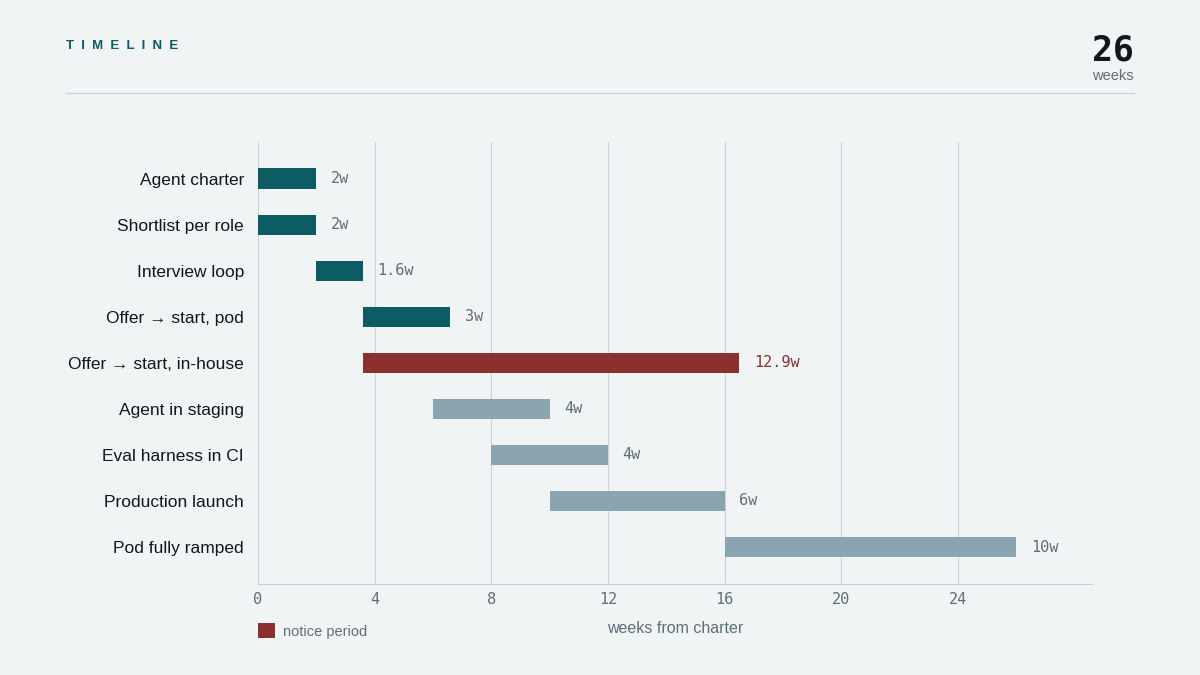
| Milestone | Realistic elapsed time |
| Agent charter written and signed off | 1–2 weeks |
| Interview-ready shortlist per role | 7–10 working days |
| Interview loop complete | 5–8 working days |
| Offer to start date (India, senior) | 30–90 days notice period is the variable |
| Offer to start date (augmented pod) | 1–3 weeks |
| First merged PR | Day 3–5 after start |
| First agent in staging behind a flag | Week 6–10 |
| Trustworthy eval harness in CI | Week 8–12 |
| Production launch at suggest-level autonomy | Week 10–16 |
| Four-person pod fully ramped | 4–6 months |
What drives cost and timeline up
- Notice periods at Indian services firms 60–90 days for senior engineers, the largest single schedule risk in an in-house plan, compounded by AI-role counteroffer rates
- Missing sandbox environments, which turn a 2-week ramp into a 6-week ramp
- Retrofitting permission-aware retrieval after launch: 3–6 extra sprints
- Regulated domains, where SME time and audit requirements add 20–40% to the schedule
- Frontier-model-only architectures with no routing or caching: 2–4x the necessary inference bill
What drives them down
- A signed agent charter before sourcing opens eliminates most re-scoping cycles
- Eval-first sequencing, which removes the recurring “is it good enough” debate
- A day-zero access pack, worth 5–10 working days per hire
- Warm pipelines and a defined 7–10 day replacement window instead of restarting a search
- Starting at suggest-level autonomy, which cuts the security and governance work required for launch without capping the roadmap
Where to Start This Week
If you’re mid-decision on how to hire an applied AI team, the highest-value move is not opening a requisition. It’s writing the agent charter from Phase 1 one task, its tools and scopes, an autonomy rung, a numeric success bar, an escalation policy, a cost ceiling, a stated blast radius. That one page tells you which of the nine roles you need, in what order, and whether you’re staffing an agent or an assistant.
Once the charter exists the staffing question gets concrete: which two roles first, and in-house or augmented while the charter proves out. If you want that sequencing pressure-tested against realistic bands and timelines for your market, it’s a conversation we have most weeks with leaders in exactly this position. Bring the charter, or bring the workflow you think should become an agent.
One next step: start a 30-minute scoping conversation. No pitch deck, we’ll work through the charter, tell you which roles you need first, and tell you plainly if augmentation isn’t the right answer for your situation.
FAQ
What roles are needed to build AI agents?
Nine cover the full surface: applied AI engineer, evaluation engineer, platform/LLMOps engineer, retrieval engineer, product owner, domain SME, security engineer, post-training engineer, and data engineer. Most organisations need only the first four to reach production; the rest are triggered by specific conditions: write access, scope disputes, or an eval plateau.
Who should be the first hire on an agent engineering team?
One senior applied AI engineer who can own a vertical slice end to end within 30 days one workflow, two or three tools, real data, logged traces. Not a manager, not a researcher. The second hire should be an evaluation engineer, before a second builder, because verification capacity is the real bottleneck.
How much does it cost to hire an applied AI team in India?
A four-person pod delivering a first production agent typically lands between ₹90 lakh and ₹1.8 crore all-in over six months, inclusive of inference, tooling, and annotation. Individual bands run ₹28–55 lakh for a mid-level applied AI engineer and ₹18–35 lakh for an evaluation engineer, plus a 15–30% metro premium.
How long does it take to hire AI agent developers?
A shortlist is achievable in 7–10 working days and the interview loop in another 5–8. The variable is offer-to-start: 30–90 days for senior in-house hires in India because of notice periods, versus 1–3 weeks for an augmented pod. Plan backwards from your launch date, not forwards from the requisition.
Do we need a PhD or research scientist to build agents?
Usually not. Over 80% of production agent work is systems engineering tool design, orchestration, retrieval, evaluation, cost control. A post-training specialist earns their seat when the eval curve plateaus despite context and tooling work, or when latency and cost targets demand a smaller distilled model.
How do you interview an agent engineer?
A five-stage loop: failure-mode screen, broken-agent debugging exercise with real traces, eval design exercise, cost-and-latency whiteboard, and a domain conversation. The debugging exercise carries the most signal, because reading traces can’t be faked. Avoid pure algorithm loops and prompt-engineering quizzes.
Should we build in-house or use staff augmentation?
Score five questions: three-year strategic importance, whether you have an internal anchor engineer, tolerance for a 4–6 month runway, compensation competitiveness, and available SME time. High scores favour in-house; the common middle answer is a hybrid. If you’d like that scored against your own charter, a 30-minute consultation usually settles it.
