

Global capability centers accounted for 45.5% of all office space leased across India’s top seven cities in Q1 2026 the largest occupier segment in the country’s strongest-ever first quarter, per JLL’s India Office Market Dynamics. Read that as a signal of demand, not as a template. The leasing number tells you how large enterprises build. It says nothing about how the fastest-moving segment of the market now builds.
That segment is asking a different question: what is a virtual gcc, and can it deliver the same control, IP ownership, and talent depth as a leased captive center without the 12–18 month build cycle that a physical site drags behind it? The answer is yes, for most functions, most of the time provided the operating model is designed deliberately rather than assembled by default.
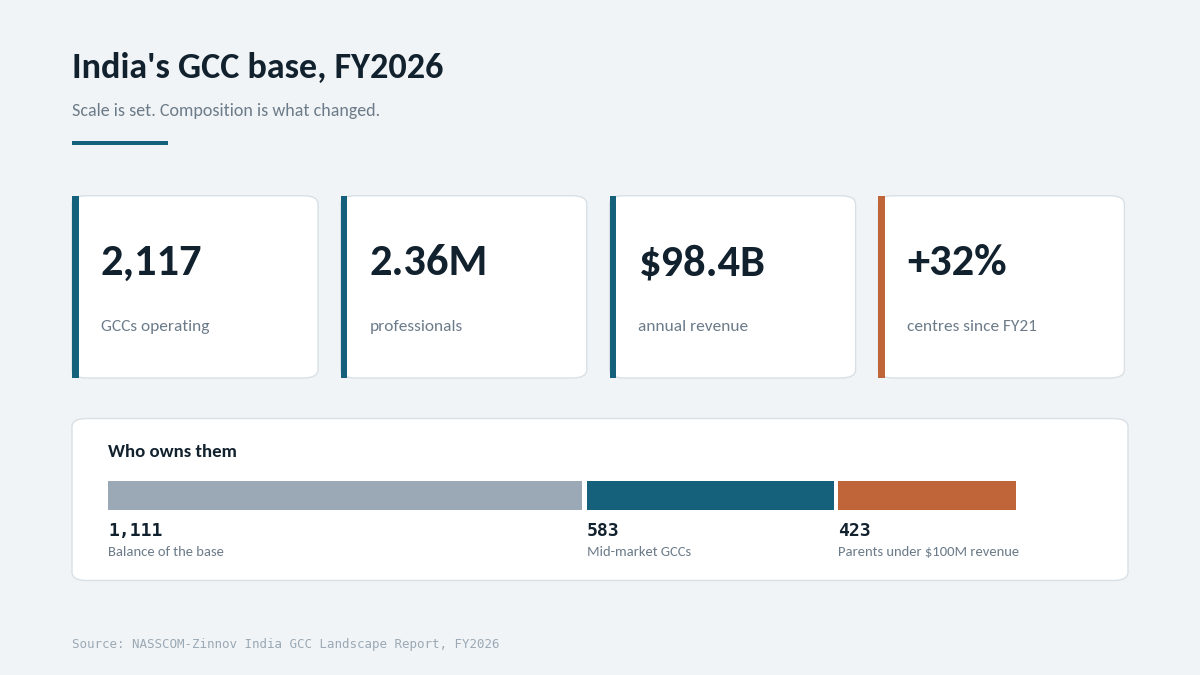
India crossed 2,117 GCCs, 2.36 million professionals, and $98.4 billion in revenue in FY2026 32% growth in center count since FY2021, per the NASSCOM–Zinnov India GCC Landscape Report. The composition matters more than the headline: 583 of those are mid-market centers, and 423 belong to parents under $100 million in revenue. Small parents are running real capability centers now.
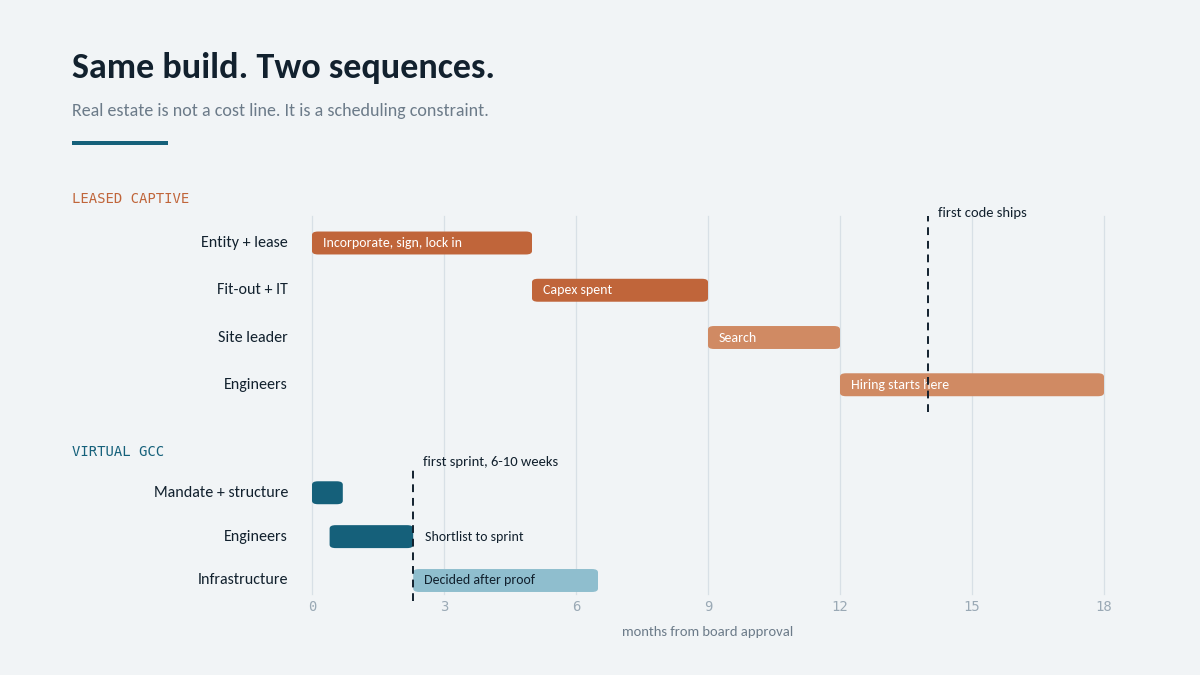
The old sequence was: sign a lease, do the fit-out, hire a site leader, then hire engineers. Every step blocked the next, and the first line of code shipped 14 months after board approval. The inverted sequence hires the engineers first, formalising the infrastructure around proven output is what this guide covers.
TL;DR
This guide explains what is a virtual gcc, how the model is architected, what it costs, and where it breaks. It is written for CTOs, COOs, and heads of engineering evaluating an India capability build who do not want to commit to a nine-year lease before they have validated the talent thesis.
The headline number: a conventional captive build runs 12–18 months from decision to first productive sprint. A virtual global capability center compresses that to 6–10 weeks, because the two slowest items real estate and entity incorporation are removed from the critical path rather than sequenced ahead of hiring.
By the end you will be able to decide which of the four operating models fits your stage, price the build within a defensible range, and know the three failure patterns that kill these teams in month seven.
What Is a Virtual GCC?
A virtual GCC is a wholly controlled, dedicated offshore team that performs the same functions as a traditional captive center product engineering, data, platform, support but operates without a company-leased office. Staff work remotely or from flex space, employment sits with the parent entity or an employer of record, and IP and management control stay in-house.
The distinction that matters is control, not geography. Vendors sell outcomes and own their delivery process. A virtual GCC gives you the people, the roadmap, the standups, and the code the same authority you would have over a badge-access floor in Bengaluru, minus the floor.
Why the Office Is the Most Expensive Line Item You Haven’t Justified Yet
Real estate is not just a cost in a GCC build. It is a sequencing constraint that forces every other decision to happen in the wrong order.
A conventional captive setup requires a legal entity, a lease, a fit-out, IT infrastructure, facilities vendors, and a leadership hire commonly 7–10 vendor relationships to manage before headcount one. Market guidance puts that build at 12–18 months and a minimum viable investment historically in the $3–5 million range, which is precisely why the model belonged to Fortune 500 balance sheets for two decades.
Then there is the commitment shape. Grade-A leases in Bengaluru, Hyderabad, and Pune typically run three to nine years with lock-in periods, and fit-out capex is spent before you know whether your India engineering thesis holds. You are underwriting a headcount forecast with a nine-year instrument.
The talent math is worse. Teams routinely underestimate ramp by 3–4x: they model a 40-person team hitting full productivity in one quarter, then discover that senior engineering leadership in Indian metros takes 60–90 days to close alone, and that the tenth hire is materially harder than the third because your employer brand does not exist yet locally.
The result is a build where the irreversible decisions get made first and the reversible ones last. An asset light gcc inverts that: prove talent density and delivery velocity, then decide what infrastructure the proof actually justifies.
Which is why the buyers asking what is a virtual gcc are rarely asking about remote work policy. They are asking whether captive-grade control is available without captive-grade commitment.
How a Remote GCC Model Is Actually Architected
Get past the marketing and the remote gcc model is four decisions: employment structure, talent acquisition engine, security posture, and governance rhythm. Everything else is downstream.
Do You Need a Legal Entity to Start?
No and starting with one is usually the wrong call. A wholly owned subsidiary (Private Limited via SPICe+, 100% FDI under the automatic route) gives you the cleanest long-term structure, but it brings resident-director requirements, statutory payroll compliance, and transfer pricing documentation from day one, since every rupee you send your India team is a related-party transaction.
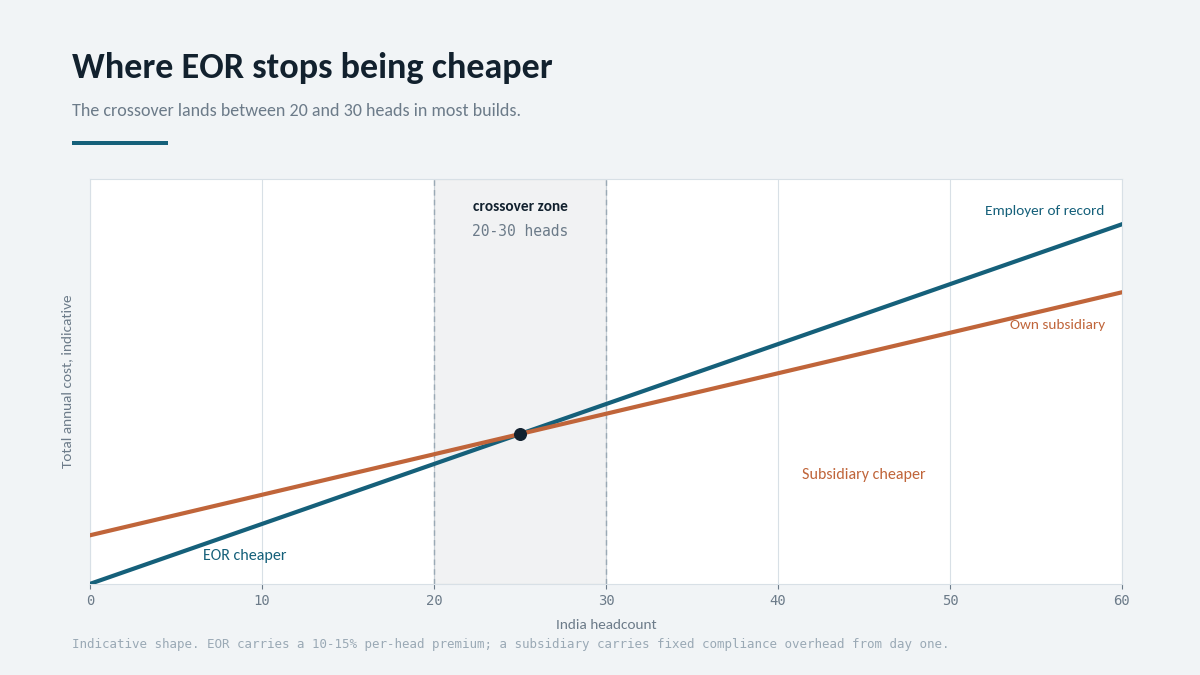
The pragmatic path for most first builds is employer of record for the first 15–25 hires, then incorporate. EOR carries a per-head premium typically 10–15% over direct employment cost but it converts a six-figure fixed setup into a variable line you can stop paying in 30 days. Build-operate-transfer sits in between: someone else runs the entity and staff, with a contractual conversion path once the team is proven.
Model the crossover explicitly. In most engagements, EOR stops being cheaper somewhere between 20 and 30 heads. Incorporate before that point and you pay for compliance you don’t need; incorporate after it and you burn margin on a premium you’ve outgrown.
The Talent Layer Is Where Distributed Capability Centers Actually Break
Everything above is solvable with a good lawyer. Hiring is not. A distributed capability center competes for the same senior engineers as every funded product company in Bengaluru, and it does so without an office to show, a team to meet, or a local brand anyone recognizes.
Three things move the outcome:
- Lead with the mandate, not the perk. Ownership of a global product surface beats a foosball table. Senior candidates screen hard for whether the India team owns a roadmap or absorbs tickets.
- Hire the first engineering leader before the tenth engineer. Without local technical leadership, remote teams degrade into ticket-takers within two quarters, and your best hires leave first.
- Widen the geography. Pune, Hyderabad, Indore, Ahmedabad, and Coimbatore give 15–25% lower cost and lower attrition than Bengaluru and in a remote model, the constraint that used to force metro hiring is gone.
This is where an AI-assisted sourcing layer earns its cost: screening for the top 2% of vetted candidates and holding a shortlist inside 7–10 working days from job description, versus the 4–6 weeks a cold in-house search takes when you have no local recruiting team. If your build is infra-heavy and you need to hire DevOps engineers alongside product engineers, run both pipelines in parallel from week one sequencing them adds a full month.
Security, IP, and Compliance Without a Badge-Access Floor
The objection is always the same: how do you protect IP without a controlled physical perimeter? By replacing perimeter security with identity and device security, which is what every serious enterprise has already done anyway.
The working stack: company-owned or MDM-enrolled endpoints with full-disk encryption, SSO with hardware-key MFA, zero-trust network access instead of a flat VPN, private code repositories with branch protection and mandatory review, DLP on egress, and a logged VDI for anything touching regulated data.
Contract structure carries the rest. Insist on a present-tense IP assignment clause in every individual employment or contractor agreement, not just in the master IT services agreement with your partner. Parent-level assignment with no individual-level chain is the single most common defect we see in inherited contracts, and it is the one that surfaces during acquisition diligence, when it is expensive.
For regulated workloads, decide data residency before the first hire, not after: whether India-based staff access production data or only masked non-production environments changes your architecture, your audit surface, and your cost.
The Seven-Step Build Sequence
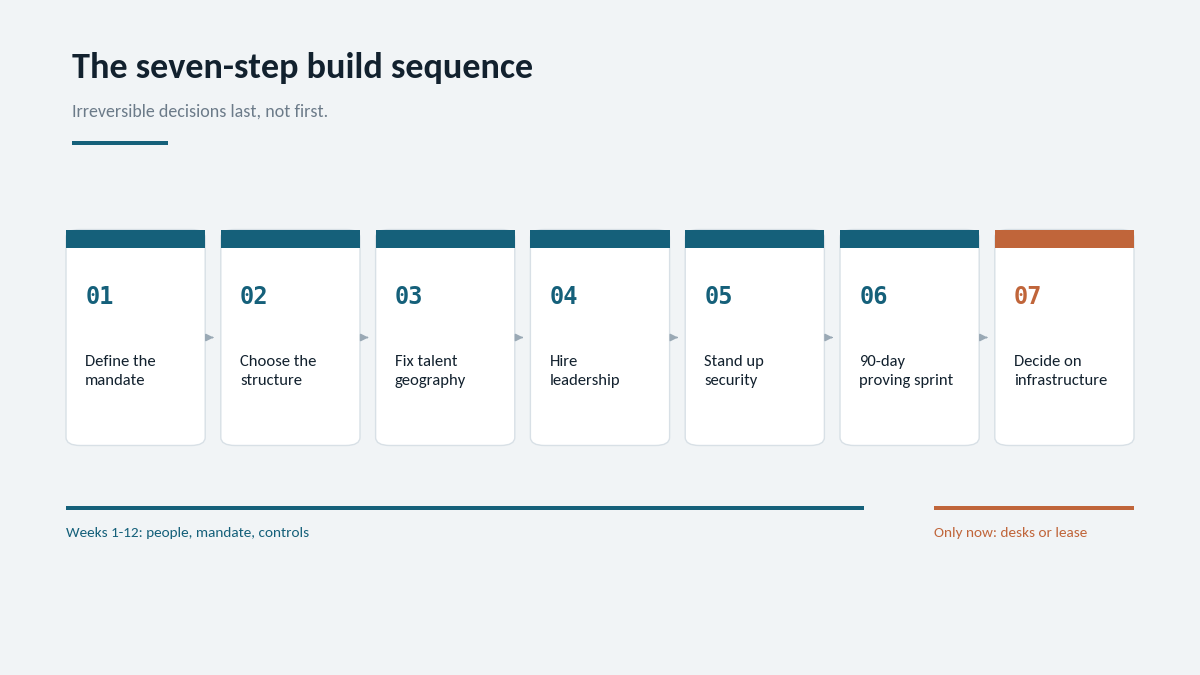
- Define the mandate. Name the product surfaces, systems, or functions the team will own outright. If you can’t name them, you’re building a staffing pool, not a capability center.
- Choose the employment structure. EOR for speed, subsidiary for permanence, BOT for a contracted path between them.
- Fix the talent geography. Pick two cities, not five. Set salary bands against local benchmarks, not HQ-adjusted ones.
- Hire leadership first. One engineering lead and one talent partner before bulk hiring starts.
- Stand up the security posture. Identity, devices, access tiers, and IP paperwork before code access not after.
- Run a 90-day proving sprint. Pod of 5–8 engineers, one real roadmap item, measured on cycle time and defect escape rate.
- Decide on infrastructure. Only after the proving sprint do you evaluate flex desks, managed offices, or a lease sized to a headcount you’ve now observed instead of forecast.
How Much Does a Virtual GCC Cost?
Ranges, not point estimates, anyone quoting a single number hasn’t asked about your seniority mix.
Fully loaded cost per mid-to-senior engineer through EOR typically lands in the ₹18–35 lakh per year band depending on stack and city, with AI/ML and platform-security roles above it. Add 10–15% for the EOR premium, and 8–12% of first-year salary as a one-time acquisition cost if you’re using an external hiring engine.
Against that, a subsidiary carries roughly ₹8–15 lakh a year in fixed compliance, audit, and statutory overhead regardless of headcount, plus ₹120–200 per sq ft per month for Tier-1 managed workspace if you take one. The capex-versus-opex swing is the entire argument: a virtual build converts a multi-year fixed obligation into a per-head variable cost you can size monthly.
What This Looks Like in Practice
A Series-B fintech needed a nine-person backend and platform pod in India while its India entity paperwork was still in process. The team was sourced, contracted through EOR, and running its first sprint before incorporation completed the entity conversion happened four months later, with the same nine people transferring across, no rehiring, no delivery gap.
In another engagement, an enterprise SaaS company had tried twice to hire senior engineers into an unbranded India team and stalled both times at the offer stage. Reframing the mandate the India pod owning an entire product module rather than supporting a US team changed the acceptance pattern immediately. Across our contract engagements, candidate drop-off stays under 1% and the joining rate holds at 98%, which is largely a function of how the mandate is positioned during the interview loop, not how aggressively the offer is priced.
Supersourcing has run this pattern across 527+ delivered engagements and a client base that includes Razorpay, Chargebee, Swiggy, Paytm, Yellow.ai, Apollo Hospitals, and Adani across fintech, healthtech, and enterprise SaaS, where the compliance constraints are least forgiving.
Virtual GCC vs Traditional Captive Center: A Decision Framework
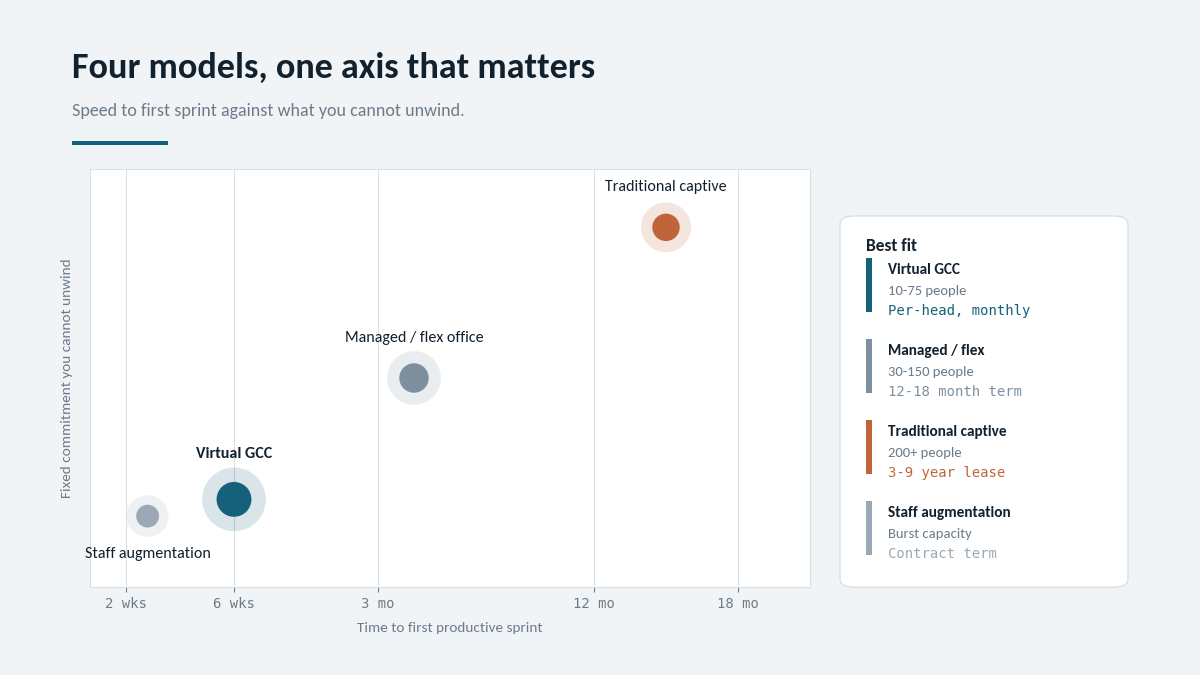
| Model | Time to first sprint | Fixed commitment | IP & control | Best fit |
| Virtual GCC | 6–10 weeks | Per-head, monthly | Full, if contracts are structured correctly | 10–75 people; unvalidated thesis; multi-city talent |
| Managed / flex office GCC | 3–5 months | 12–18 month workspace term | Full | 30–150 people; a function needing colocation |
| Traditional captive | 12–18 months | 3–9 year lease + fit-out capex | Full | 200+ people; permanent, board-level India mandate |
| Staff augmentation | 2–4 weeks | Contract term | Vendor-mediated | Burst capacity; no long-term ownership need |
The honest read: most companies under 150 India heads are buying option two or three when option one would answer the same question for a fraction of the irreversible spend. And the models are sequential, not exclusive; the strongest builds start virtual and graduate.
What Most Teams Get Wrong
Almost none of the failure modes have anything to do with what is a virtual gcc as a structure. They come from how the mandate was written.
The most common failure isn’t infrastructure, it’s mandate design. Teams stand up a virtual GCC with a vague brief to “support engineering,” then wonder why senior hires leave at month seven. Remote teams without owned outcomes decay into ticket queues. The fix is structural: assign the India pod a product surface it owns end-to-end, with its own on-call, before hiring anyone.
Three more patterns worth naming:
Underfunding the leadership hire. Companies will pay ₹35 lakh for a senior IC and refuse ₹55 lakh for the lead who determines whether ten of them are productive. This is the highest-leverage line in the budget and the one most often cut.
Treating the first 90 days as onboarding rather than integration. The friction is never tooling access; it’s that HQ keeps making decisions in meetings the India team isn’t in. Move at least one recurring architecture forum to a slot with three-plus hours of overlap, or the distributed team learns it isn’t in the room.
Confusing the model with outsourcing in the contract. If your agreement is written as a services contract with deliverables and SLAs, you have a vendor relationship, regardless of what the deck calls it. Capability center agreements are written around dedicated headcount, direct management authority, and individual-level IP assignment.
Before You Sign Anything
Anyone who has gotten this far already knows what a virtual gcc is in theory. The harder part is pricing it. If you’re weighing a virtual global capability center against a leased captive build, the decision usually turns on two inputs most teams haven’t priced properly: what your realistic ramp curve looks like, and what it costs to unwind if the thesis is wrong at month nine.
We’ve built and staffed global capability center teams across 527+ engagements, and the modelling conversation takes about 45 minutes mandate design, employment structure, cost bands for your stack, and a ramp plan you can take to a board. No obligation to use our GCC setup services or recruitment process outsourcing at the end of it.
Bring your headcount plan: supersourcing.com/contact-us or mayank@engineerbabu.com
FAQ
What is a virtual GCC in plain terms?
It is your own offshore team, operating without your own office. The people are dedicated to you, managed by you, and working on your roadmap; the desks, the lease, and often the legal entity belong to someone else or don’t exist yet. Everything that defines a capability center stays control, IP, continuity. Only real estate is optional.
Is a virtual GCC the same as outsourcing?
No. Outsourcing transfers a scope of work to a vendor who controls how it gets done and typically retains process IP. A virtual GCC gives you dedicated people under your management, your roadmap, your standups, and your IP assignment. The commercial structure differs too: you pay for capacity and control, not for deliverables against an SLA.
How long does it take to set up a virtual GCC in India?
With an employer of record path, 6–10 weeks from mandate definition to a productive first sprint is realistic roughly 7–10 working days to an interview-ready shortlist, three to four weeks through interview loops and notice-period negotiation, then two weeks for access provisioning and onboarding. Incorporating a subsidiary first typically adds three to five months.
How much does a virtual GCC cost compared to a captive center?
The variable cost per engineer is broadly comparable; the difference is fixed commitment. A virtual build avoids fit-out capex and multi-year lease liability, and defers the ₹8–15 lakh annual entity-compliance overhead until the team justifies it. Expect the crossover point where a subsidiary becomes cheaper than EOR somewhere between 20 and 30 heads.
Can a virtual GCC own intellectual property?
Yes, provided the paperwork is right. You need present-tense IP assignment at the individual employment or contractor level, not only in the master agreement, plus clear invention-assignment and confidentiality terms enforceable in the employee’s jurisdiction. Diligence teams check the individual chain, not the top-level clause.
Which functions work best in a remote GCC?
Product and platform engineering, data engineering, QA, DevOps and SRE, analytics, and most SaaS support functions run well fully distributed. Hardware and lab-dependent R&D, physical-security-cleared workloads, and some regulated BFSI operations still need a controlled site; those are colocation cases, not model failures.
When should we convert a virtual GCC into a physical office?
Watch three triggers: crossing roughly 50–75 heads in one city, a function that measurably degrades without colocation, or a compliance requirement for a controlled environment. Absent one of those, the office is a cultural preference which is a legitimate reason to take one, but should be priced as such.
How do we pressure-test our model before committing?
Run the numbers against a real headcount plan and a real seniority mix, then stress it: what happens at 50% of the forecast, and what does exit cost look like in month nine? If you’d like that modelled against your specific stack and timeline, a scoping conversation is the fastest way to get there.
