

Here’s a number that should give you pause: 68% of offshore software engagements miss their first deadline by more than six weeks. Not because the developers were bad. Not because the technology was wrong. Because the hiring decision was made entirely on hourly rate, and nobody mapped the team structure to the actual product complexity before signing the contract.
And it gets worse when you zoom out. According to recent 2026 data, only 16.2% of software projects actually finish on time and within budget. That means if you’re building an offshore team without a clear operating model, you’re statistically more likely to fail than succeed — regardless of how “good” the developers look on paper.
The Supersourcing team has helped build offshore software development teams for more than 200 companies across fintech, logistics, healthtech, and enterprise SaaS. When we built the core banking and settlement platform for Open Money — now handling transactions across their digital banking infrastructure — the first three weeks weren’t about code.
They were about documentation, access controls, communication protocols, and defining what “done” meant in writing. That’s still the difference between offshore engagements that ship and ones that stall.
This is what I actually know about building offshore software development teams in India, from someone who does it every week.
What “Offshore Software Development Team India” Actually Means in 2025
An offshore software development team in India is a dedicated, remote engineering team — typically 3 to 15 engineers, sometimes larger — operating from India on behalf of a company headquartered in the US, UK, Europe, or the Middle East. The team handles product development, feature work, QA, DevOps, and increasingly, AI/ML implementation.
But the term covers a wide range of models, and conflating them is where most procurement decisions go sideways.
There’s a difference between:
- Staff augmentation — individual developers plugged into your existing team
- Dedicated development team — a self-contained unit with its own project manager, tech lead, and QA
- Managed delivery — a vendor owns the outcome, not just the hours
- GCC (Global Capability Center) — a legally incorporated India entity that is your company
Each has different risk profiles, cost structures, communication overhead, and scalability ceilings. Most content you’ll read online treats these as interchangeable. They are not.
If you’re reading this to decide which model fits your situation, I’ll tell you upfront: for most funded startups and mid-market companies between Series A and Series C, a dedicated offshore software development team structure — not augmentation, not fully managed — is the right call 70% of the time.
 Why India, and Why It’s Still the Right Answer in 2025
 Why India, and Why It’s Still the Right Answer in 2025
I hear this question more often now than I did five years ago. Eastern Europe had its moment. Latin America is growing. Southeast Asia is a real contender for certain profiles.
India’s advantage isn’t cheap labor anymore. That pitch is outdated. India’s advantage in 2025 is talent density at scale.
There are 5.4 million software developers in India — the second-largest developer population in the world after the United States. The IIT and NIT pipeline alone produces 100,000+ engineering graduates annually. The median experience level of a senior developer on a well-assembled offshore team in India is 6–8 years. That’s not junior-augmentation territory. That’s senior product engineering.
The other advantage nobody talks about enough: time zone overlap with structured async. India Standard Time (IST) has a 2–4 hour overlap window with CET (European business hours) and a workable async relationship with US EST/PST. Teams that use that overlap window correctly — daily 30-minute standups at 7:30 AM IST / 5 PM CET, for example — outperform teams that try to force full synchronous work across time zones.
The teams that fail offshore aren’t failing because of India. They’re failing because of process gaps that would cause the same failures with any remote team, anywhere.
The Real Cost of an Offshore Software Development Team in India
Let me give you actual numbers, because most articles in this space are deliberately vague and that vagueness costs companies a lot of money.
Monthly cost by role (2025, blended market rate, mid-to-senior profile):
| Role | Monthly Cost (USD) | Annual Cost (USD) |
| Senior Full-Stack Developer | $3,500–$5,500 | $42,000–$66,000 |
| Tech Lead / Architect | $5,500–$8,500 | $66,000–$102,000 |
| DevOps / Cloud Engineer | $4,000–$6,000 | $48,000–$72,000 |
| QA Engineer (Automation) | $2,500–$3,800 | $30,000–$45,600 |
| Product Manager (Offshore) | $3,000–$5,000 | $36,000–$60,000 |
| Project Manager | $2,500–$4,000 | $30,000–$48,000 |
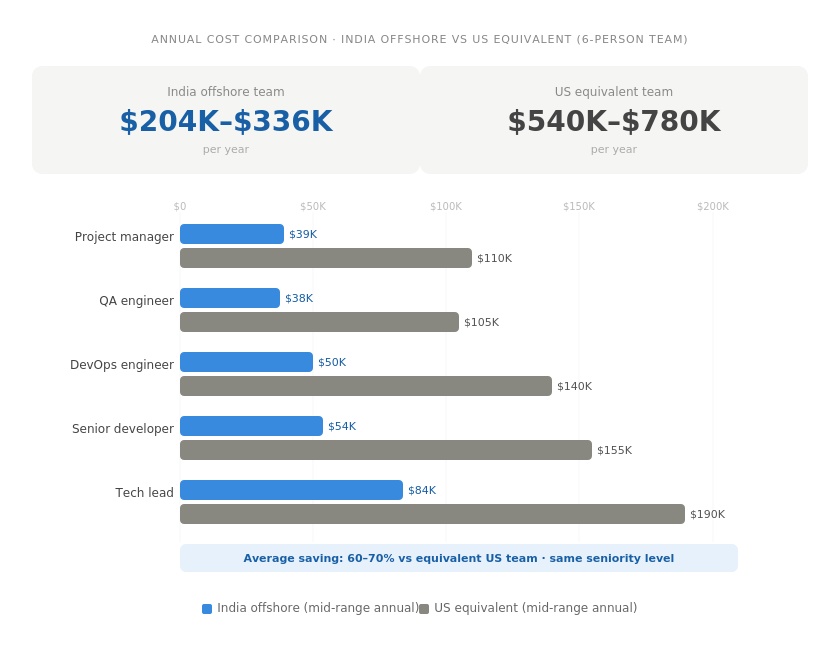
A production-capable team — 3 full-stack developers, 1 tech lead, 1 QA, 1 PM — runs $17,000–$28,000 per month. That’s $200,000–$336,000 annually.
Compared to the US equivalent of the same team: $540,000–$780,000 annually. The savings are real. But the savings are only real if you’re not eating them in rework, coordination overhead, and churn.
- Vendor margins matter. An IT staffing firm charging you $65/hour for a developer they’re paying $28/hour equivalent is not your partner. Transparency on billing structure is a hygiene check — ask for it upfront.
- Setup and onboarding costs are often invisible in pricing comparisons: $5,000–$15,000 in the first 60 days between access provisioning, onboarding documentation, tooling setup, and communication infrastructure. Budget for it.
 How to Structure an Offshore Development Team That Actually Ships
 How to Structure an Offshore Development Team That Actually Ships
The most common structural mistake I see: hiring 4–5 developers with no dedicated technical leadership on the offshore side.
Without a tech lead or architect who owns the codebase and the technical decisions, you get five developers making five sets of local decisions that accumulate into architectural debt. Three months in, the codebase is a tangle and refactoring costs more than the original build.
The minimum viable offshore team structure for a product company:
- Tech Lead / Architect — owns architecture, code reviews, technical decisions. Non-negotiable.
- 2–3 Senior Developers — full-stack or specialized based on your stack (React/Node, Python/Django, Java/Spring, etc.)
- QA Engineer — ideally automation-first (Selenium, Cypress, Playwright depending on your stack)
- Project Manager or Scrum Master — owns delivery, sprint planning, stakeholder communication
For companies running microservices architectures, add a DevOps/SRE from day one. You cannot retrofit infrastructure discipline into a codebase built without it. The Brillio engagement we ran — digital transformation via SAP and DevOps — taught us that lesson early. The teams that tried to add DevOps culture in month four instead of month one had significantly higher integration pain.
The Hiring Process: What to Actually Evaluate
Most companies evaluate offshore developers on coding tests and communication. Those two filters catch the obvious misses. They don’t catch the expensive ones.
Here’s what I evaluate that most clients don’t think to ask:
- System design under constraints. Not “design a URL shortener.” Give them a real constraint: “You’re building a payment processing service that needs to handle 5,000 transactions per minute, maintain ACID compliance, and support rollback. Walk me through the architecture.” Watch how they reason about trade-offs — latency vs. consistency, scalability vs. cost, build vs. vendor.
- Code review on an intentionally flawed codebase. Share 200 lines of code with 5–6 specific problems — a race condition, a SQL injection vulnerability, an N+1 query pattern, a missing error handler. What they find tells you more than anything they write.
- Async communication quality. Send an ambiguous requirement over email. How do they respond? Do they ask clarifying questions? Do they make assumptions and document them? Do they ask everything in one message or come back five times? This predicts 80% of communication friction.
- Previous production system complexity. “What’s the most complex system you’ve maintained in production?” Not built — maintained. Anyone can write greenfield code. Maintaining a system with real users, real bugs, and real deadlines is different.
On the talent sourcing side, we run an AI-powered hiring platform that scores candidates on 60+ parameters before they hit a technical interview. The false-positive rate on traditional hiring — candidates who pass interviews and underperform in production — drops from about 35% to under 12% with structured evaluation. That’s not marketing language. That’s a measurable delta across 200+ placements.
What Most People Get Wrong About Offshore Development Teams
I’ve seen this pattern enough times to say it plainly: the most common reason offshore engagements fail is insufficient specification, not insufficient talent.
Companies with strong in-house product teams assume the offshore team will absorb ambiguity the way a co-located team does — through hallway conversations, quick Slack pings, watching a founder’s face when a prototype lands wrong. That absorption mechanism doesn’t exist offshore.
A requirement that takes 10 minutes to clarify in person takes 24–48 hours of back-and-forth async communication. Multiply that by 20 unclear requirements in a sprint and you’ve lost a week of velocity before a line of code is written.
The fix is not “hire better communicators.” The fix is writing specifications that would make sense to someone who has never heard your product idea. Every user story needs: acceptance criteria, edge cases, error states, performance expectations, and a clear definition of done.
The second thing most people get wrong: measuring offshore team performance by output instead of outcome. Lines of code shipped, velocity points closed, pull requests merged — these are outputs. The metric that matters is: “Does what we shipped work correctly for users in production?” Teams optimized for velocity metrics without quality gates ship fast and break things. Teams with integrated QA, code review standards, and automated testing pipelines ship slightly slower and break far fewer things. The net productivity is higher.
Build vs. Hire vs. GCC: The Decision Framework
If you’re a company evaluating how to staff a technology function in India, these are your three real options:
Option 1: Offshore Dedicated Team via a Vendor
Best for: Product companies that need to move fast, don’t want to manage HR and compliance, and want flexibility to scale up/down. Time to first developer: 3–6 weeks. Fixed overhead: Low (vendor handles payroll, benefits, infrastructure). Control: Medium — you direct work, vendor manages employment.
Option 2: Direct Hiring (Self-Managed Remote Team)
Best for: Companies with strong HR infrastructure, a defined India hiring strategy, and 18+ months runway to build the function. Time to first developer: 8–16 weeks (entity setup, legal, compliance, hiring pipeline). Fixed overhead: High. Control: Full — you own the employment relationship.
Option 3: GCC (Global Capability Center)
Best for: Enterprises with 50+ headcount ambitions in India, 5+ year horizon, and strategic commitment to India as a development hub. Time to operational: 6–12 months. Fixed overhead: Very high (entity incorporation, real estate, HR leadership, compliance). Control: Complete — this is your company in India.
The Supersourcing team has set up GCCs for several enterprise clients. The economics of a GCC only make sense above approximately 40–50 FTE. Below that threshold, the overhead per head is higher than a well-structured vendor engagement. Several companies we’ve worked with started with a dedicated offshore team and transitioned to a GCC at the 50-person mark — that’s usually the right sequence.
 Communication Infrastructure: The Part Nobody Writes About
 Communication Infrastructure: The Part Nobody Writes About
You can have the best developers in the world on your offshore team and still ship slowly if your communication infrastructure is wrong.
Here’s the actual stack that works:
- Asynchronous-first, not async-only. Look for async video reviews of PRs and designs. Notion or Confluence for living documentation. Linear or Jira for sprint management. Slack for communication — but with explicit norms about response time expectations (4-hour response window for non-blocking questions, 30-minute for blocking issues during overlap hours).
- One daily synchronous checkpoint. 30 minutes. The overlap window between IST and your headquarters time zone. Standups that run over 30 minutes are a symptom of unclear requirements, not thorough communication.
- Weekly architecture review. Even 30 minutes. The tech lead presents what architectural decisions were made in the past week and why. This surface drifts before it becomes debt.
- Monthly retrospectives with real data. Not “what went well / what didn’t.” Actual sprint velocity data, defect escape rates, code review cycle times. Teams that look at data improve. Teams that discuss feelings don’t.
When we worked with Kargo.tech on product development and team scaling, the communication structure was defined in writing before the first developer was hired. That documentation became the operating manual for the team. Four months in, they had shipped three major product features with a defect escape rate under 3%.
Technology Stack Considerations for Offshore Teams
Not every technology stack is equally suited for offshore development. Here’s my honest take:
- React + Node.js is the most offshore-friendly full-stack combination in 2025. The talent pool is massive, tooling is mature, and senior developers are reliably available. If you don’t have a strong reason to use something else, default here.
- Python (Django, FastAPI) is excellent for backend-heavy products, data pipelines, and AI/ML integration. Senior Python talent in India is deep and experienced.
- Java/Spring Boot is the dominant stack for enterprise clients — banking, insurance, ERP integrations. If you’re building regulated financial infrastructure or enterprise SaaS, the Java/Spring talent pool in India is exceptional.
- Go and Rust are growing but not mature enough in the offshore talent pool for low-risk hiring. Expect longer sourcing timelines and 20–30% cost premiums for strong Go engineers.
- Mobile (React Native / Flutter): Strong talent available. Native Swift/Kotlin is harder to source but not impossible for senior roles.
For cloud infrastructure: Hire AWS expertise. GCP is solid. Azure is growing, especially in enterprise contexts. Infrastructure-as-code experience (Terraform, Pulumi) separates average DevOps profiles from strong ones — test for it specifically.
Compliance, Security, and IP Protection
This section gets skipped in most offshore development content because it’s not glamorous. It’s also where companies get hurt the most.
IP protection basics:
- Every offshore developer should sign an NDA and IP assignment agreement before accessing your codebase. This sounds obvious. It’s skipped in roughly 40% of early-stage engagements I’ve reviewed.
- Use a separate source control organization with role-based access controls. Developers should have access to the repositories they work in, not your entire codebase.
- Offboarding checklist should include: access revocation within 24 hours, code repository audit, credential rotation. I’ve seen companies discover a departed developer’s API keys were still active 6 months after they left.
Data residency and compliance:
- If your product handles EU user data (GDPR), US healthcare data (HIPAA), or financial data (PCI-DSS), your offshore development team needs documented compliance training and your architecture needs to account for data residency requirements. This is not optional.
- Document which data the offshore team can and cannot access. Development environments should use anonymized or synthetic data, never production user data.
For fintech specifically: When we built the Open Money banking and settlement platform, the compliance layer was scoped in week one. KYC/AML workflows, audit trails, transaction logging, regulatory reporting — these aren’t features you add later. They’re foundational architecture decisions.
How to Evaluate an Offshore Development Vendor: The Real Criteria
The vendors most companies hire are the vendors with the best sales processes. That’s backwards.
Here’s what to actually evaluate:
- Do they have references you can call without them on the line? Not a curated reference list — actual past clients you find independently and can speak with candidly.
- What does their technical interview process look like? Ask to see the technical evaluation rubric they use to hire developers. If they don’t have one, they’re hiring on gut.
- Can they explain their attrition rate honestly? Industry average attrition for IT services firms in India is 18–22% annually. If a vendor claims 5%, ask how they measure it. If they claim 25%, ask what they’re doing about it. High attrition means your team won’t hold institutional knowledge of your product.
- Who is your actual point of contact day-to-day? At Supersourcing, I’m on the calls. There’s no account manager between a client and the people making decisions. That’s by design. Ask any vendor you’re evaluating: if something goes wrong at 2 PM on a Tuesday, who exactly picks up the phone?
- What’s the bench depth for your required skills? Can they backfill a developer who leaves within 2 weeks? What’s their process?
FAQ: Offshore Software Development Team India
1. How long does it take to build an offshore software development team in India?
For a vendor-managed dedicated team, expect 3–6 weeks from contract signing to first developer onboarded. A 5-person team typically reaches full capacity in 6–8 weeks. GCC setup takes 6–12 months. Direct hiring without a vendor takes 8–16 weeks for the first hire, longer for a full team.
2. What’s the typical cost of an offshore development team in India?
A production-capable team of 6 (3 developers, 1 tech lead, 1 QA, 1 PM) runs $17,000–$28,000 per month depending on seniority and specialization. Setup and onboarding costs add $5,000–$15,000 in the first 60 days. Compare this to $45,000–$65,000 per month for the US equivalent.
3. How do you manage time zone differences with an offshore team in India?
IST is UTC+5:30 — 10.5 hours ahead of US Eastern, 5.5 hours ahead of CET. The practical approach: define a 2-hour overlap window for daily synchronous standups, use async-first tooling (Loom, Notion, Slack) for everything else, and establish explicit SLAs for response times on blocking vs. non-blocking issues.
4. What technology stacks work best for offshore development teams in India?
React/Node.js has the deepest talent pool and is the lowest-risk choice for most product companies. Python/Django/FastAPI is strong for backend and AI/ML work. Java/Spring Boot dominates enterprise and fintech. Go and Rust have growing but still shallow senior talent pools — expect longer sourcing timelines.
5. How do you protect IP when working with an offshore software development team?
NDA and IP assignment agreements signed before codebase access. Role-based access controls in source control. Development environments using synthetic/anonymized data only. Documented offboarding checklist including 24-hour access revocation. These are table-stakes, not advanced precautions.
6. Is a dedicated offshore team better than staff augmentation?
For companies building a core product (not supplementing an existing in-house team), a dedicated offshore development team almost always outperforms staff augmentation. Augmented staff inherit your process debt and communication overhead. A dedicated team with its own tech lead and PM can build its own operating rhythm.
7. What’s the difference between an offshore team and a GCC?
An offshore dedicated team is contracted through a vendor — the developers are the vendor’s employees. A GCC (Global Capability Center) is your own legal entity in India, with your own employees, your own leadership, and your own cost structure. GCCs make economic sense at 40–50+ FTE and a 5+ year horizon. Below that, a vendor-managed offshore team has a better cost-to-control ratio.
8. How do offshore development teams handle security and compliance requirements?
This depends entirely on what’s specified in the contract and architecture. Offshore teams building HIPAA, GDPR, or PCI-DSS regulated products need explicit compliance training, documented data handling policies, and architectural controls that match regulatory requirements. This isn’t vendor-dependent — it’s design-dependent. Define it in scope, not as an afterthought.
What This Comes Down To
Building an offshore software development team in India is not inherently risky. Every failed offshore engagement I’ve reviewed had the same root cause: someone made a hiring or vendor decision based on rate, without defining the team structure, communication infrastructure, or specification quality needed to make that rate deliver real output.
The companies that get this right — and there are many of them — treat the first 30 days as infrastructure investment, not as a development sprint. They write things down. They define done. They build the communication layer before they build the product.
The savings are real. The talent is real. The risk is manageable if you structure it correctly.
Let’s Talk Before You Decide
If you’re evaluating offshore software development team options in India and want to work through the team structure, vendor criteria, or technology stack decisions before you commit — I’m usually the person on those calls.
I don’t have a sales team. Every conversation goes through me directly.
