

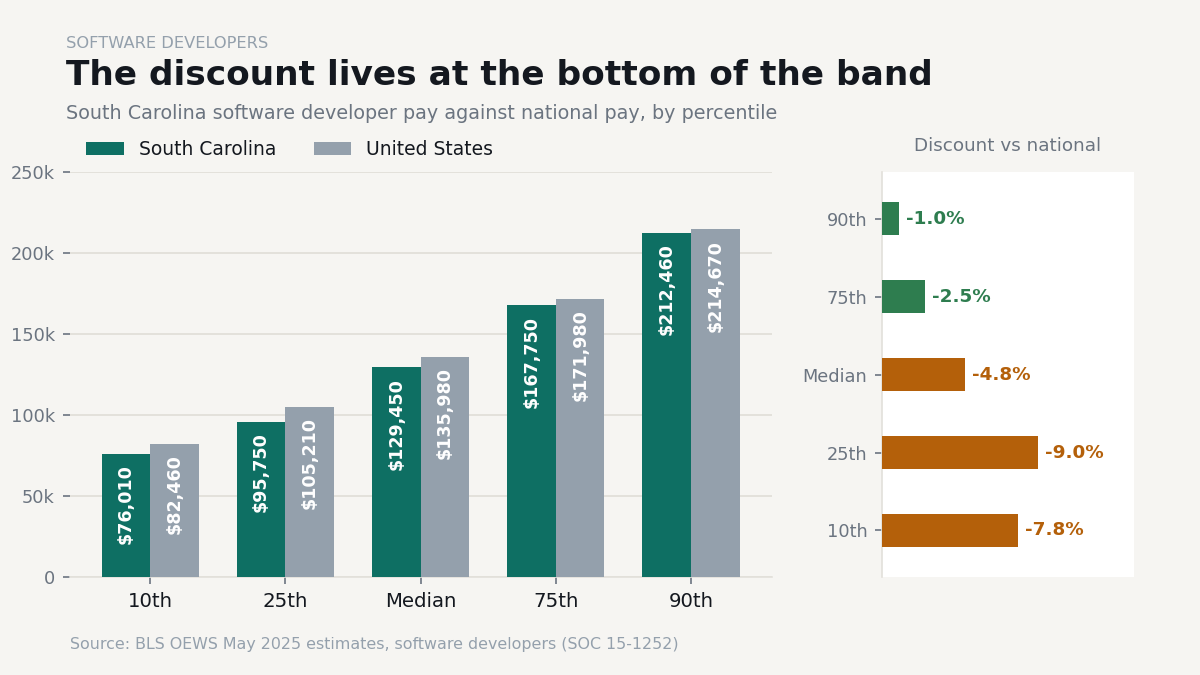
Software developers in South Carolina earn a median of $129,450. The national median is $135,980. That 4.8% gap is the number most talent teams use to write off the state as “cheap but shallow,” and it is the wrong number to be looking at.
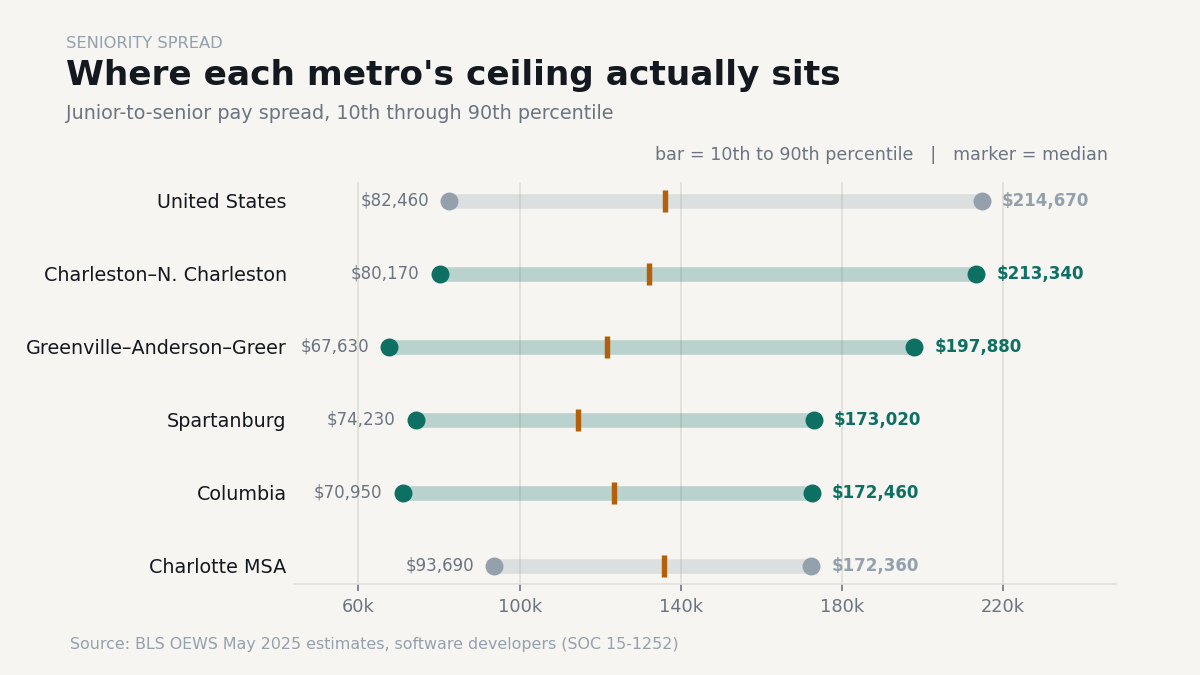
Break the same dataset apart by percentile and the story inverts. At the 90th percentile, South Carolina pays $212,460 against a national $214,670, a gap of roughly 1%. At the 10th percentile, the state pays $76,010 against $82,460 nationally, a gap of 7.8%. In the Greenville-Anderson-Greer metro, the 10th percentile drops to $67,630, which is 18% below the national floor.
Read that distribution honestly and the conclusion is uncomfortable for anyone who budgeted on the headline median: the discount in the south carolina tech talent market is almost entirely concentrated in the junior and lower-mid band. Senior and staff engineers price at near-national parity. Teams that model the state as “15% cheaper across the board,” then open a principal engineer req against that band, do not get a cheaper hire, they get a req that sits open for five months.
That single asymmetry is the most useful thing to understand about the state, and it is why the market stays underrated. Companies that only test it at the senior level conclude the talent isn’t there. Companies that only test it at the junior level conclude it’s a bargain and over-index. Both are reading one slice of a four-metro market that behaves very differently at each end of the seniority curve. The South Carolina tech talent market is not one market with one price.
CompTIA’s State of the Tech Workforce 2026 projects US net tech employment to grow 1.9% in 2026, reaching roughly 9.8 million workers, with all 50 states and the District of Columbia projected to post tech employment gains.
TL;DR
This guide breaks down what the south carolina tech talent market actually costs by metro and by seniority band, and how to run a req there without blowing your timeline. It is written for heads of engineering, talent leads, and founders evaluating a US secondary market against offshore or in-house expansion.
The one number to hold onto: the state's software developer median sits 4.8% under national, but its top decile sits only 1% under. The savings are real at the bottom of the band and close to zero at the top and the four metros are not interchangeable, with medians ranging from $114,460 in Spartanburg to $132,150 in Charleston.
By the end you'll be able to pick the right metro for the workload you're staffing, budget a senior req without a 20% surprise, and know which two compliance steps quietly add days to your start date. This matters for sc it hiring decisions specifically because the cost model most teams import from other Southeast states does not hold here.
What is the South Carolina tech talent market?
The South Carolina tech talent market is the pool of technology workers employed across the state’s four metro clusters Charleston, Greenville, Columbia, and Spartanburg anchored by aerospace, automotive, health insurance, and defense contracting. Software developer wages run 3% to 16% below national medians depending on metro, with top-decile pay at near-national parity.
The real problem: sc it hiring gets budgeted as one market when it is four
Most cost models treat a state as a single wage band. Applied here, that produces a forecasting error most teams underestimate by 3–4x on senior reqs.
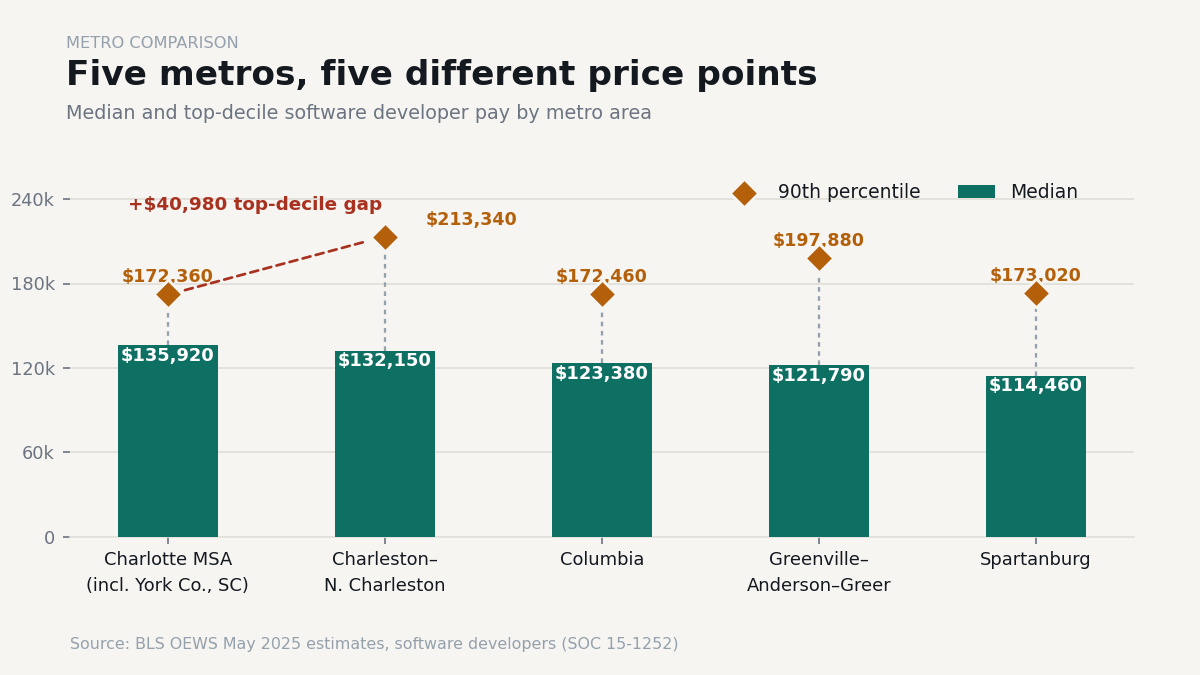
Consider the actual spread. Spartanburg’s software developer median is $114,460. Charleston’s is $132,150. That’s a $17,690 gap 15.5% between two metros 200 miles apart on the same interstate corridor, inside the same state, subject to the same tax code. They also barely compete for the same candidate, because they hire for different work: Charleston is product and cloud, Spartanburg is manufacturing-adjacent systems and support engineering.
The compounding error is the ceiling. Spartanburg’s 75th percentile is $134,280 meaning three-quarters of developers in that metro earn less than what a mid-level engineer costs in Charleston. If you need a staff-level platform engineer, Spartanburg’s entire upper quartile is below your required band. No amount of sourcing volume fixes a distribution problem. Every wage band in the south carolina tech talent market has to be read at metro level to be useful.
This is where regional price parity matters more than the raw wage. BEA data puts the metropolitan portion of South Carolina at a price level of roughly 94.8 relative to the national average in 2024. So a developer earning 4.8% below national median is, in real purchasing-power terms, earning almost exactly the national rate. That’s the retention story: these engineers are not underpaid where they live, which is why time-to-fill here is a sourcing problem rather than a counter-offer problem. Teams running structured IT staffing services engagements in the region see this pattern hold consistently offers close, but only when the band is set against the correct metro.
Mapping the south carolina technology workforce, metro by metro
The charleston developer market: highest cost, deepest senior bench
Charleston-North Charleston posts a $132,150 median, the highest in the state and only 2.8% under national. The number that matters more is the 90th percentile: $213,340. That is the deepest top-decile pool in the state by a wide margin, and it exists because “Silicon Harbor” stacked three demand sources on top of each other: Boeing’s commercial aircraft operation in North Charleston, a dense federal and defense contracting cluster, and a home-grown software and health-tech scene.
That mix is also the trap. A large share of the metro’s senior engineers hold active clearances and sit inside accredited environments. Defense contracting talent is genuinely excellent at systems rigor, security controls, and documentation and often has five years of experience inside one accreditation boundary rather than five years of shipping.
Screen for deployment cadence and rollback experience explicitly. This is the metro where you’ll have the most success if you need to hire DevOps engineers or cloud infrastructure specialists, and the least success if you need someone who has run weekly releases on a consumer product. It is the one metro in the south carolina tech talent market where a staff-level product req is reliably fillable.
Greenville tech jobs: the widest gap between junior and senior pricing
Greenville-Anderson-Greer runs a $121,790 median with a 10th percentile of $67,630 and a 90th of $197,880. That’s the widest usable spread in the state: junior talent at 18% under the national floor, senior talent at 8% under the national top decile.
The industrial base explains the skill profile. BMW, Michelin, and the automotive supply chain built an engineering population fluent in embedded systems, industrial IoT, PLC integration, and manufacturing execution systems, with Clemson’s automotive research campus feeding it.
Recruiting greenville tech jobs for a SaaS product team means competing against employers who pay for a different skill set, which cuts both ways: less direct competition for your req, and more retraining on your side. No other part of the south carolina tech talent market gives you that much room at the junior end.
Columbia: enterprise stacks and the healthcare claims bench
Columbia’s $123,380 median comes with the lowest top decile of the state’s major metros at $172,460. That reflects what the metro actually does: large-employer enterprise engineering health insurance claims platforms, state government systems, and university-adjacent research computing. Deep Java and .NET benches, real regulated-data experience, thin senior product-engineering depth.
Spartanburg and the upstate: right for scope, wrong for seniority
At a $114,460 median and a $134,280 75th percentile, Spartanburg is the state’s genuine cost for QA, support engineering, data operations, and integration work. The location quotient logic is simple: use it where the ceiling doesn’t bind.
The York County anomaly most cost models miss
Here’s the detail that has cost more than one team a signed offer. Rock Hill and the rest of York County are inside the Charlotte-Concord-Gastonia MSA, whose software developer median is $135,920. Those candidates live in South Carolina, pay South Carolina income tax, and show up in your ATS as South Carolina applicants but they anchor their expectations to Charlotte bands, not Greenville bands.
Send a Greenville-benchmarked offer to a Rock Hill candidate and it reads as a 12% lowball. Worth noting in the other direction: Charlotte’s 90th percentile is $172,360, roughly $41,000 below Charleston’s, so for staff and principal roles Charleston is the stronger market of the two despite the lower median. Border metros are the single most common source of banding errors in the south carolina tech talent market.
Whether you’re building an on-site pod or a distributed team, this metro-level precision is what makes it possible to hire remote developers at the right band instead of averaging the state and hoping.
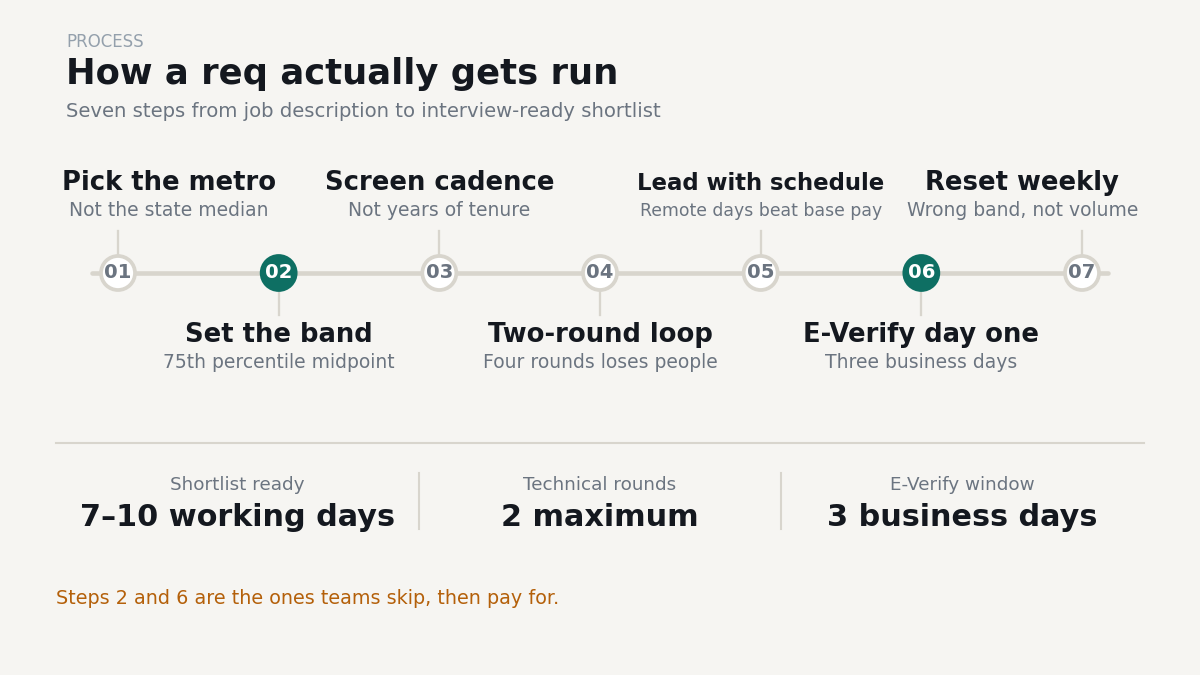
How to run a South Carolina engineering req in 7–10 working days
This is the sequence that holds up across the south carolina tech talent market. Steps 2 and 6 are the ones teams skip and then pay for.
- Fix the metro before the band. Choose Charleston, Greenville, Columbia, or Spartanburg based on the workload, then pull the percentile table for that specific metro. Never benchmark against the state median.
- Set the band by percentile, not by average. For a senior req, budget to the local 75th percentile as your midpoint. For a junior req, the 25th percentile is a real anchor here in a way it isn’t in tier-one markets.
- Screen for release cadence, not years. In clearance-heavy and enterprise-heavy metros, tenure overstates shipping experience. Ask for the last three deploys and what broke.
- Run a two-stage technical loop, maximum. Candidate expectations in secondary metros are set by regional employers with short loops. A four-round process is where drop-off happens.
- Lead the offer with a schedule, not base. Detail below on why this matters more than the number.
- Start E-Verify on day one, not week one. SC Code § 41-8-20 requires every private employer to verify each new hire through E-Verify within three business days of employment. Build it into your day-one checklist.
- Reset the pipeline weekly against the same percentile table. If two weeks of sourcing produces no candidate inside the band, the band is wrong or the metro is wrong. It is almost never the volume.
Where internal talent capacity is the constraint rather than market knowledge, a scoped recruitment process outsourcing engagement covers steps 1 through 4 without adding permanent recruiting headcount.
What this looks like in practice
Pattern 1 the mispriced senior req. A recurring engagement shape: a growth-stage company opens two senior backend roles benchmarked to the state median, sees eight weeks of dead pipeline, and concludes the talent isn’t there. Rebenchmarking to the target metro’s 75th percentile and narrowing the technical loop to two stages typically moves the same req from stalled to an interview-ready shortlist inside a 7–10 working day cycle. The candidates were always in the market; the band was 15% short. Nothing about the South Carolina tech talent market caused that failure.
Pattern 2 the split-tier build. The higher-leverage structure we see work is deliberately splitting the team by band: senior architecture and product ownership placed in the Charleston developer market where the top-decile bench actually exists, with QA, data operations, and integration work placed in the upstate or in an offshore delivery pod. Across 527+ IT projects delivered, this split-tier model consistently outperforms single-location builds on cost per unit of senior capacity and it holds a 98% candidate joining rate and under 1% drop-off on contract roles because each tier is priced against its own market rather than a blended average.
Decision framework: which metro for which workload
| Metro | Median dev wage | 90th percentile | Best-fit workload | Main constraint |
| Charleston–N. Charleston | $132,150 | $213,340 | Product, cloud, cybersecurity, DevOps | Highest in-state cost; clearance-locked seniors |
| Greenville–Anderson–Greer | $121,790 | $197,880 | Embedded, industrial IoT, MES | SaaS retraining load; junior band is the real value |
| Columbia | $123,380 | $172,460 | Enterprise Java/.NET, regulated data | Thinnest senior product bench |
| Spartanburg | $114,460 | $173,020 | QA, support engineering, data ops | 75th percentile caps at $134,280 |
| Charlotte MSA (incl. York County, SC) | $135,920 | $172,360 | Fintech and banking platform work | SC residents anchor to Charlotte bands |
Use the 90th percentile column, not the median column, when the req is senior. It is the only column that tells you whether the talent you need exists at any price, and it is the fastest way to disqualify a metro in the south carolina tech talent market before you spend on it. If the answer is no in all five rows for a given role, the correct next move is an offshore delivery pod or a global capability center, not more sourcing spend in a metro whose distribution doesn’t reach your band.
Before you commit a headcount plan to this state
If you’re evaluating the south carolina tech talent market against an offshore build or a Charlotte-anchored team, the thing worth pressure-testing first is the percentile band on your senior reqs that single assumption is where most plans break, and it’s cheap to fix before an offer goes out.
Supersourcing has run this analysis across US secondary metros and offshore delivery models, with a dedicated account manager per engagement, NDA-backed IP protection, and a 7–10 day replacement commitment if a hire isn’t a fit. Send your open reqs and target bands to mayank@engineerbabu.com, or start at supersourcing.com/contact-us. No pitch deck, just a read on whether your numbers hold.
FAQ
Is South Carolina a good state for tech hiring?
For junior-to-mid engineering roles, yes the 10th percentile sits 7.8% below national and drops to 18% below in Greenville. For staff and principal roles, treat it as a national-parity market with a genuinely deep bench only in Charleston, whose 90th percentile reaches $213,340. The South Carolina tech talent market rewards precision, not blanket assumptions.
How much do software developers earn in South Carolina?
The statewide median is $129,450 per year, against a national median of $135,980, per BLS OEWS May 2025 estimates. Metro medians range from $114,460 in Spartanburg to $132,150 in Charleston. Budget to the metro figure and the relevant percentile, never the state average.
Is it cheaper to hire in South Carolina than in Charlotte?
At the median, yes Charlotte sits at $135,920 versus Greenville’s $121,790, a 10.4% gap. At the top of the band it reverses: Charleston’s 90th percentile of $213,340 exceeds Charlotte’s $172,360 by about $41,000, so Charlotte is the cheaper market for principal-level hires and the more expensive one for mid-level.
What is the cost to hire developers in Greenville SC versus offshore?
Greenville’s median lands at $121,790 fully pre-loaded, before benefits, employer taxes, and equipment. Offshore delivery pods in India typically run materially below that on a fully loaded basis, but carry timezone and context-transfer costs. The honest comparison is cost per unit of senior capacity delivered, not headcount cost.
Do South Carolina developers expect remote work?
Increasingly yes, and it is the highest-leverage lever in an offer here. Because real wages are near national parity after price-parity adjustment, schedule flexibility often outweighs base increases in negotiation. Defense and clearance-linked roles in Charleston and Columbia are the clear exception and remain on-site.
Is Charleston a good place to hire engineers?
It is the strongest single metro in the state for senior product, cloud, and security work, with the deepest top-decile pool. Expect to pay close to national rates and to screen carefully for shipping cadence among candidates whose experience sits inside accredited defense environments.
How long should a South Carolina engineering req take to fill?
A well-benchmarked req should reach an interview-ready shortlist in 7–10 working days. If you’re past four weeks with no in-band candidates, the problem is the band or the metro, not the pipeline. That diagnosis takes about a 30-minute conversation to run worth doing before you spend another sourcing cycle.
