

If you’re a CEO, CTO, or HR leader evaluating how to structure your company’s global operations, you’ve likely come across both terms
Global Capability Center (GCC) and Global Business Services (GBS) are often used interchangeably in vendor pitches and industry reports.
They aren’t the same thing, and the difference matters more than it might seem at first glance.
Get the model wrong, and you end up with a center that’s structurally set up to do one job while your leadership expects it to do another: a GCC built for dedicated, function-specific delivery that’s suddenly expected to behave like a full-service, cross-functional GBS organization, or vice versa.
This guide breaks down the GCC vs GBS comparison across scope, ownership, governance, technology, talent, cost, and strategic role, so you can decide which operating model or which combination of the two actually fits where your company is today.
What Is a Global Capability Center (GCC)?
A Global Capability Center is a wholly owned offshore or nearshore unit set up by a multinational company to build dedicated capability in specific functions: engineering, product development, data and analytics, IT, or specialized business operations.
Unlike a traditional outsourcing vendor, a GCC is not a third party; it’s an extension of the parent company itself, staffed by employees who report into the same corporate structure, follow the same standards, and work as closely with headquarters as any other internal team.
GCCs were traditionally associated with cost-effective back-office support, but that framing is outdated. Today’s GCCs increasingly own strategic, high-value work: core product engineering,
India has become a major hub for Global Capability Centers, with more than 1,800 GCCs employing over 2 million professionals, according to EY India in 2026.
AI and machine learning initiatives, cybersecurity, and R&D functions that companies want built in-house, under direct ownership, rather than delivered through a vendor relationship.
India remains the largest hub for this model.
In short: a GCC is about ownership and depth in a specific set of functions, built as a long-term extension of the parent company.
What Is Global Business Services (GBS)?
Global Business Services is a broader operating model that consolidates multiple support functions finance, HR, IT, procurement, customer service, and more under a single, unified governance structure.
Rather than each function running its own siloed delivery team in its own location, a GBS model brings them together, often blending in-house delivery, outsourcing partnerships, and centers of excellence into one coordinated organization.
Where a GCC typically hosts dedicated teams delivering discrete activities for a specific function, a GBS organization is built to manage and improve full end-to-end processes- procure-to-pay, order-to-cash, record-to-report across the enterprise.
GBS leadership is measured not just on delivery, but on standardization, process improvement, and enterprise-wide efficiency gains, frequently using automation and AI as core enablers rather than optional upgrades.
In short: a GBS is about integration, pulling multiple functions and delivery models together into one enterprise-wide services organization.
GCC vs GBS: Key Differences
The simplest way to frame the GCC and GBS difference: a GCC is a center, while a GBS is a model. A GCC is typically a physical or organizational unit dedicated to specific functions.
A GBS is an operating philosophy that can span multiple centers, multiple countries, and multiple delivery mechanisms, including GCCs themselves.
KPMG research found that Global Business Services (GBS) is expected to expand its strategic role across 17 of 23 key business functions by 2026, showing how GBS is moving beyond traditional back-office support toward broader enterprise transformation.
Where a GCC tends to be built around ownership, control, and depth in select capabilities, a GBS is built around breadth, standardization, and end-to-end process accountability across the entire organization.
This distinction between depth and breadth runs through nearly every other point of comparison between the two models.
GCC vs GBS: Scope and Business Functions
GCC functions are usually concentrated in a defined set of capabilities the parent company wants to build in-house and scale over time, commonly engineering, product development, data science, IT infrastructure, and increasingly AI and digital innovation.
A GCC’s scope can expand over the years, but it typically starts narrow and deep.
GBS functions, by contrast, are deliberately broad from the outset. A GBS organization is designed to run finance and accounting, HR operations, procurement, IT service management, and customer support side by side, under one governance umbrella, often standardizing how each function operates across every region the company does business in.
A useful way to frame it: a GCC answers “how do we build deep capability in engineering and product?”
A GBS answers “how do we run every support function, everywhere, the same efficient way?”
GCC vs GBS: Ownership and Operating Model
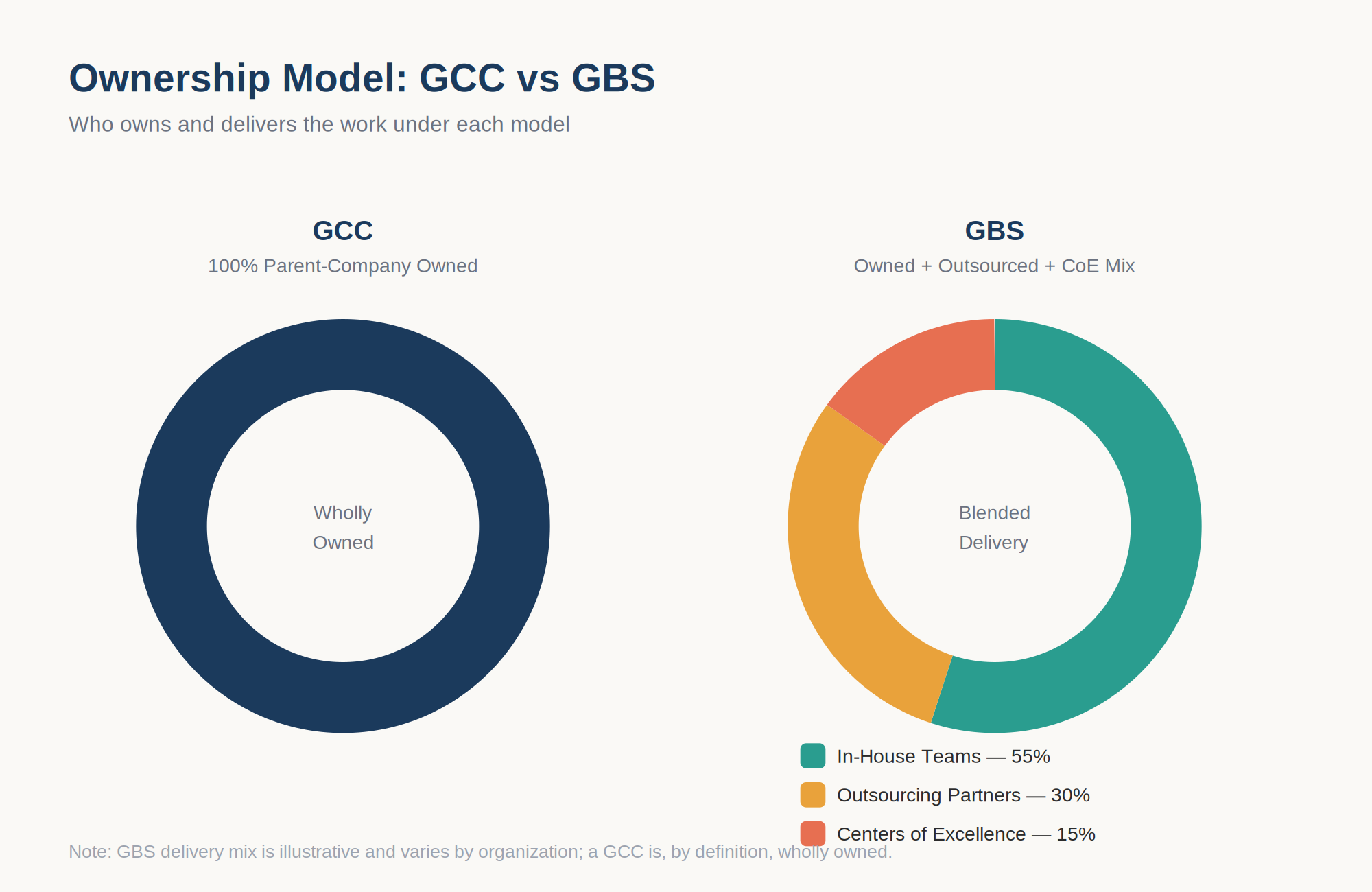
This is one of the clearest points of the GCC vs GBS comparison. A GCC is a wholly owned subsidiary of the parent company, with full equity ownership, full operational control, and employees who are legally and culturally part of the parent organization.
A GBS operating model is more flexible by design. It often blends internally owned teams with third-party outsourcing partners and centers of excellence, all coordinated under a shared governance structure.
This means a GBS organization doesn’t have to own every piece of delivery directly; it can mix insourced and outsourced capability based on what’s most efficient for each function, which is a meaningful departure from the GCC’s typically full-ownership structure.
GCC vs GBS: Technology and Innovation
GCCs have increasingly become innovation hubs in their own right.
Because a GCC is a direct extension of the parent company, it’s well positioned to work on proprietary product development, advanced R&D, and emerging technology AI, machine learning, and digital product innovation are now common mandates for mature GCCs, not just cost-driven support work.
GBS organizations use technology differently, primarily as an enabler of process efficiency at scale.
Automation, robotic process automation (RPA), AI-driven service management, and workflow standardization are core to how a GBS model operates, since the entire value proposition depends on running processes consistently and efficiently across every function and geography it covers.
Put simply: GCCs innovate on products and capabilities; GBS organizations innovate on processes and delivery efficiency.
GCC vs GBS: Talent and Workforce Strategy
A GCC’s talent strategy is built around deep, specialized skill hiring and developing engineers, data scientists, and domain specialists who can eventually take on strategic ownership within their function.
Because GCCs are direct employer entities, they invest heavily in career pathing, technical upskilling, and building long-term institutional knowledge that mirrors what the parent company would build at headquarters.
A GBS workforce strategy skews toward process expertise and cross-functional versatility, with talent that understands how to run standardized operations efficiently across finance, HR, or procurement, often supported by a layered mix of internal staff and outsourced or managed-service talent.
Where GCCs build specialists, GBS organizations build process owners and service managers who can operate consistently at scale.
GCC vs GBS: Cost and Scalability
Both models are, in part, built on the economics of global talent: access to strong talent pools in markets like India at a lower cost base than in headquarters locations. But the scalability pattern differs.
A GCC typically scales function by function, tied closely to the parent company’s specific growth priorities, adding headcount in engineering because the company is investing in a new product line, for example. Because it’s wholly owned, scaling a GCC also means scaling fixed costs and infrastructure directly.
A GBS model scales more flexibly, since it can absorb growth by shifting the mix between in-house teams and outsourced partners rather than only adding headcount.
This gives GBS organizations more room to flex costs up or down in response to demand, without every scaling decision requiring direct headcount expansion.
 GCC vs GBS: Governance and Management
 GCC vs GBS: Governance and Management
GCC governance is usually structured around the specific function or functions it delivers, with reporting lines that often run directly into the corresponding global function head; the GCC’s engineering leadership reports into the parent company’s global CTO organization, for instance. Governance here tends to be closely tied to the mandate of each function operating within the center.
GBS governance is deliberately unified a single governance layer overseeing multiple functions at once, typically led by a GBS or shared services leader who reports into a senior enterprise role such as a Chief Operating Officer or Chief Shared Services Officer.
This centralized governance structure is precisely what allows a GBS organization to standardize service levels and reporting across every function it manages, something a function-specific GCC isn’t designed to do on its own.
GCC vs GBS: Business Value and Strategic Role
A GCC’s strategic value lies in building durable, proprietary capability deep technical expertise, product ownership, and innovation that the parent company keeps entirely in-house rather than accessing through a vendor.
For technology-driven organizations especially, the GCC has become a core part of how global product and engineering roadmaps get built.
A GBS organization’s strategic value lies in enterprise-wide operational excellence, consistent service delivery, standardized processes, and measurable efficiency gains across every support function a company runs.
GBS becomes the operational backbone that keeps a large, multi-region enterprise running consistently, and it’s frequently the engine behind large-scale digital transformation programs precisely because it already touches every function at once.
Can a GCC Operate Within a GBS Model?
Yes and for many large enterprises, this is exactly how the two models coexist.
A GCC can operate as one delivery component inside a broader GBS strategy, particularly for high-value, specialized work like engineering, analytics, or digital product development, while the GBS layer coordinates governance, process standardization, and service delivery across the wider set of enterprise functions.
In this structure, the GCC retains its depth-focused mandate of building and owning specific technical capability, while the GBS transformation effort ensures that capability is integrated into a consistent, enterprise-wide operating rhythm alongside finance, HR, procurement, and other centralized functions.
Many organizations that start with a standalone GCC eventually evolve toward this hybrid structure as their global operations mature and the case for centralized governance across functions becomes clearer.
GCC vs GBS: Which Model Should a Company Choose?
There’s no universally “better” model; the right choice depends on what a company is actually trying to solve for.
A GCC strategy tends to make sense when:
 A GCC strategy tends to make sense when:
- The priority is building deep, proprietary capability in specific functions like engineering, product, or data science
- The company wants full ownership and control over a dedicated talent pool
- The goal is long-term capability building rather than short-term process efficiency
- The company is earlier in its global operations journey and wants to start with a focused, high-value function before expanding scope
A GBS strategy tends to make sense when:
- Operations are already fragmented across multiple regions and functions, with inconsistent processes and limited visibility
- The priority is enterprise-wide standardization, cost efficiency, and centralized governance
- The company wants flexibility to blend in-house teams with outsourcing partners based on what each function needs
- Leadership is planning a broader digital transformation program that requires coordinated execution across finance, HR, IT, and other support functions simultaneously
For many growing companies, the practical path is starting with a GCC in a high-priority function, most commonly engineering or product and evolving toward a broader GBS structure as more functions come online and the case for unified governance grows.
How Supersourcing Can Help Companies Build and Scale GCC Operations
For companies choosing to build or scale a Global Capability Center in India, the operational details hiring the right technical talent, structuring compliant contracts, and building a workforce strategy that supports long-term capability building rather than just headcount growth are where most GCC setups either succeed or stall.
Supersourcing works with global companies on exactly this layer of GCC strategy: sourcing and hiring technology talent, structuring engagement and contract models suited to India’s regulatory environment, and supporting the workforce planning that helps a GCC mature from an early-stage delivery unit into a genuine capability hub.
Whether a company is standing up its first GCC or scaling an existing center toward a broader GBS structure, having a partner who understands both the hiring mechanics and the operating-model context makes the transition considerably smoother.
Conclusion
GCC and GBS are related models built on similar foundations global talent, offshore or nearshore delivery, and the pursuit of efficiency and capability at scale but they are not interchangeable.
A GCC is a wholly owned, function-specific unit built for deep capability and control. A GBS is a broader, integrated operating model built for enterprise-wide standardization and process efficiency, often blending owned and outsourced delivery.
Choosing between them or combining them should come down to where your organization is today: whether you’re trying to build deep, proprietary capability in a specific function, or trying to bring already-fragmented global operations under one consistent, governed structure.
For many companies, the answer isn’t strictly one or the other; it’s starting with a focused GCC and letting it grow into a broader GBS strategy as the business scales.
FAQs
- Can a company have both a GCC and a GBS model?
Yes. A GCC can operate as a specialized delivery component within a larger GBS strategy, particularly for high-value functions like engineering, product development, or analytics.
- Which model is more cost-effective, GCC or GBS?
It depends on the use case. A GCC concentrates cost and control in specific functions, while a GBS model offers more flexibility to shift between in-house and outsourced delivery, which can make cost scaling more adaptable across a wider set of functions.
- Do GCCs only handle back-office work?
No. While GCCs historically focused on back-office support, most modern GCCs especially in India now own strategic work including product engineering, AI and analytics, cybersecurity, and R&D.
- What functions typically sit within a GBS organization?
Common GBS functions include finance and accounting, HR operations, procurement, IT service management, and customer service, all coordinated under a single governance layer.
- How does governance differ between a GCC and a GBS?
GCC governance is usually function-specific, reporting into the corresponding global function head. GBS governance is centralized, typically overseen by a single shared services or GBS leader responsible for multiple functions at once.
- When should a company move from a GCC to a GBS model?
Typically when operations start spanning multiple functions and regions with inconsistent processes, and leadership needs centralized governance and standardization to support a broader digital transformation effort.
