

A US startup hiring two senior engineers locally can spend more than $300,000 a year in fully loaded costs. The same two roles, filled through a vetted offshore team in India, typically land under $90,000. That gap isn’t a rounding error, it’s the reason hire remote software developers India has become one of the most searched hiring queries among CTOs and founders in 2026.
The math used to be the whole story. It isn’t anymore. Companies that hire remote software developers in India today are chasing something harder to replicate elsewhere: a talent pool deep enough to staff specialized roles in AI/ML, platform engineering, cybersecurity within weeks, not quarters.
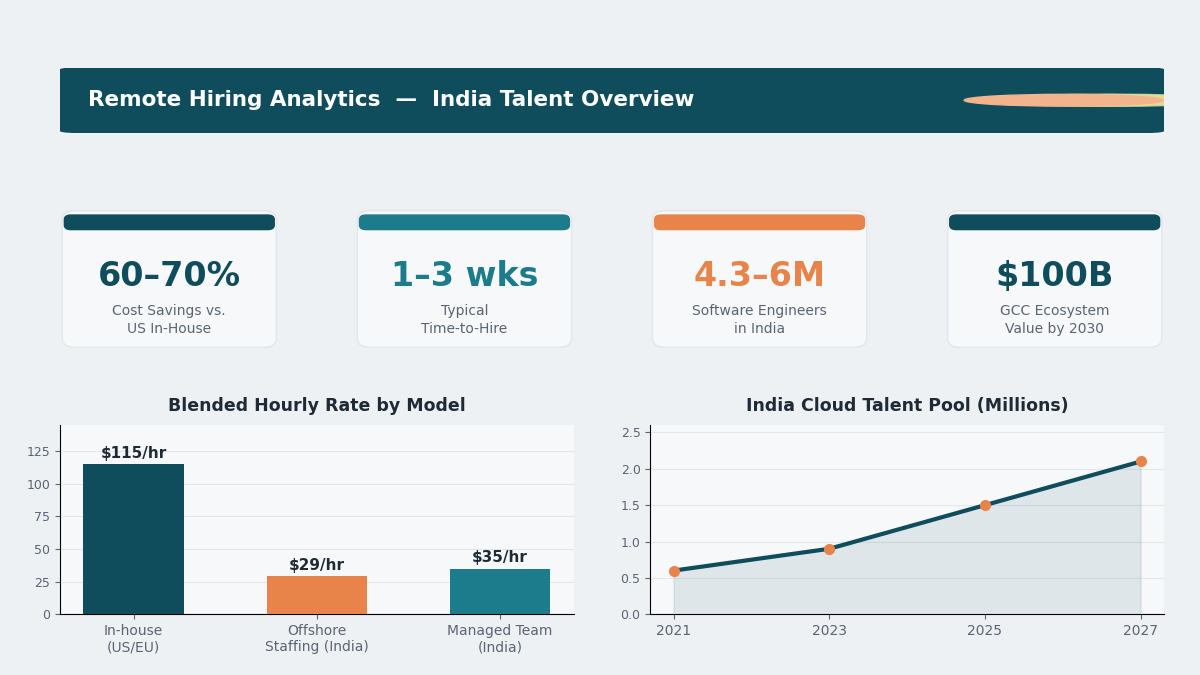
According to the India Brand Equity Foundation (IBEF), India’s pool of cloud professionals is projected to more than double, from 608,000 in 2021 to 1.5 million by 2025, while broader cloud adoption could add nearly $380 billion to India’s GDP by 2026.
That scale is precisely what’s pulling global engineering leaders toward offshore development India models instead of relying solely on local hiring pipelines that simply can’t fill roles fast enough.
This piece breaks down the real numbers behind the trend, the operational challenges teams underestimate, and a practical framework for evaluating vendors before you commit a budget. By the end, you should have enough data to decide whether it makes sense to hire remote software developers india for your next roadmap item, and what to check before signing anything.
What Does It Mean to Hire Remote Software Developers From India?
To hire remote software developers India means engaging engineers based in India through a staffing partner, a dedicated development team, or direct contracting who work as an extension of your in-house team from a different geography and, usually, a different time zone. The arrangement can be project-based, staff augmentation, or a fully managed offshore development India engagement.
The Core Problem: Domestic Hiring Can’t Keep Pace With Demand
Most engineering leaders underestimate their domestic hiring gap by 3–4x. US demand for software developers is projected to grow 22% by 2030, according to the Bureau of Labor Statistics, while domestic graduate output isn’t growing anywhere close to that rate.
The shortage isn’t generic anymore, it’s specific. Roughly 50% of companies report being unprepared for the next wave of skills demanded in AI, data science, and machine learning. A generalist hiring freeze doesn’t fix that; it just delays the roles that were never getting filled locally in the first place.
Three realities are driving budget toward the India IT talent pool:
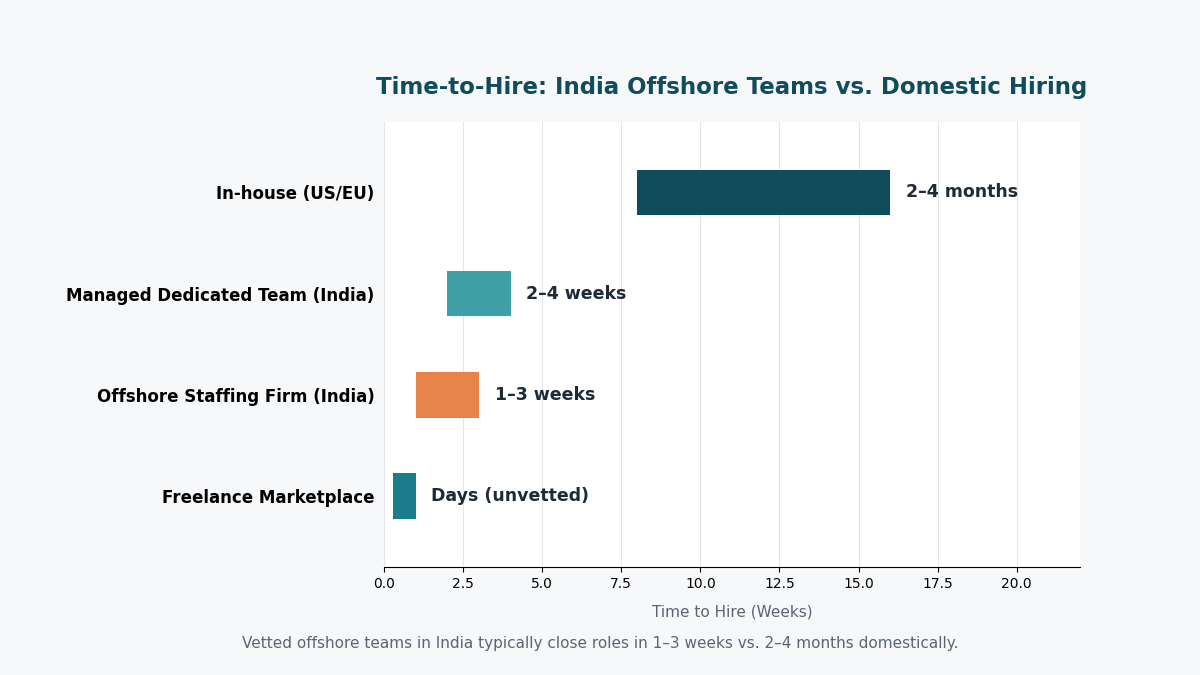
- Time-to-hire. Domestic senior engineering searches now regularly run 3–4 months. Offshore hiring cycles in India frequently close in 1–3 weeks.
- Specialization gaps. AI/ML demand in India grew roughly 170% year-over-year, and the country now holds close to 16% of the global AI talent pool, a base large enough to absorb specialized hiring at volume.
- Budget compression. Engineering budgets are flat or shrinking at most mid-market companies, while headcount needs are not.
Companies that keep treating this as “hire two more locally next quarter” keep losing the quarter.
India Remote Developer Benefits Beyond the Rate Card
Cost is the headline, but it’s rarely the reason a company stays with an offshore partner past year one. The India remote developer benefits that show up in retention data tend to be operational, not financial.
Round-the-Clock Development Cycles
A US team that hands off work at 6 PM Eastern to an India-based team starting its day can effectively run two shifts on the same codebase without paying overtime. Bug fixes and QA passes that would sit idle overnight in a single-timezone team move forward while the US side sleeps shortening release cycles for teams that structure handoffs deliberately.
Depth in Emerging Specializations
Roles that take months to fill domestically DevOps, MLOps, cloud security often have shorter sourcing cycles in India simply because the specialist pool is larger relative to demand. This matters more in 2026 than it did a few years ago, since the constraint companies now hit isn’t generalist headcount, it’s specific, hard-to-find skill sets.
Flexibility to Scale Without Long-Term Fixed Cost
Teams that hire remote software developers India through a IT staffing or managed-team model can typically scale from two engineers to ten, or back down, within a single sprint cycle, a flexibility that’s much harder to replicate with direct US employment contracts, notice periods, and severance obligations.
Deep Dive: How the Economics and Talent Pool Actually Work
The Cost Structure, Broken Down
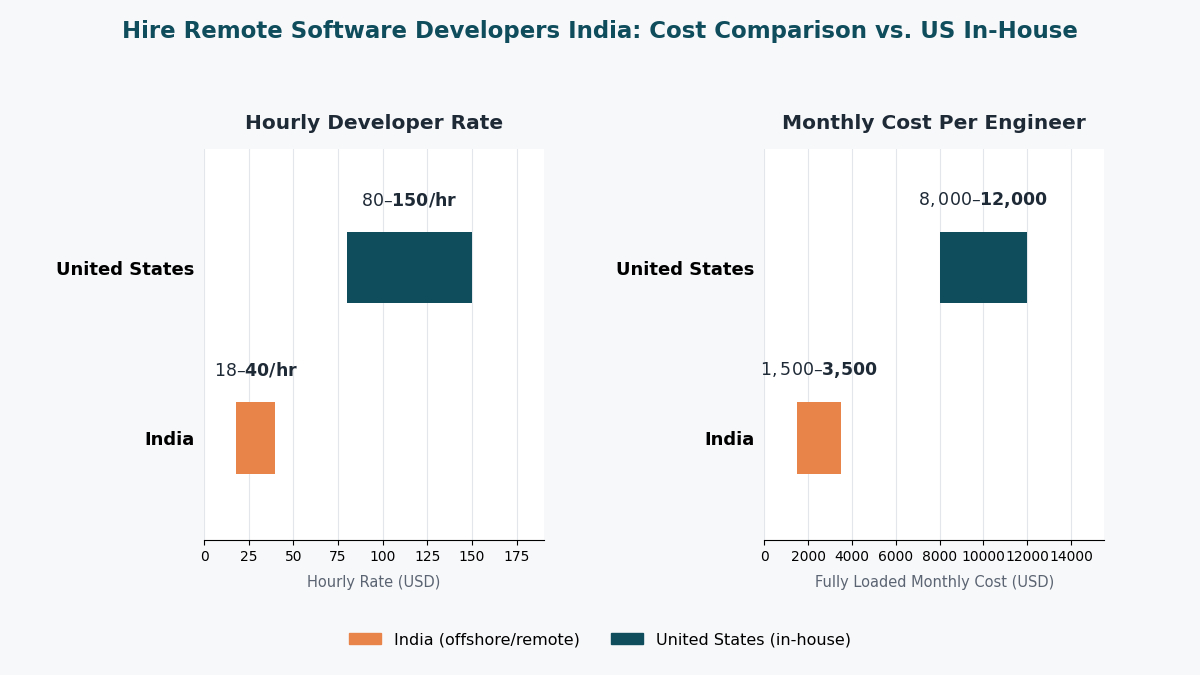
Remote hiring cost savings are real, but the honest number is a range, not a slogan. Offshore software development in India typically runs $18–$40 per hour for mid-level to senior engineers, against $80–$150 per hour for comparable US in-house talent, a 60–70% reduction in direct rate.
On a monthly, fully loaded basis: a mid-level Indian developer costs roughly $1,500–$3,500/month all-in, versus $8,000–$12,000/month for a US-based equivalent. At the loaded-cost level (rate plus benefits, taxes, equipment, and management overhead), expect your true cost to land at 1.4 — 1.8x the quoted hourly figure budget for that multiplier up front rather than discovering it in month three.
Why the Talent Pool Is Genuinely Different, Not Just Cheaper
India now counts an estimated 4.3–6 million software engineers, representing close to 15% of the global developer workforce, with the market’s annual growth rate (around 11%) roughly double that of the US. More than 1,000 engineering colleges graduate over 200,000 engineers annually, and IT majors including TCS, Infosys, HCLTech, and Wipro plan to onboard roughly 82,000 fresh graduates in FY2026 alone.
Global Capability Centers (GCCs) from Google, Microsoft, Amazon, and Apple have already normalized India as a hub for product engineering, not just support work, a shift that matters when you’re evaluating whether a dedicated development team can own architecture decisions, not just execute tickets. India’s GCC ecosystem alone is projected to reach roughly $100 billion in value by 2030, employing an estimated 2.5 million professionals, a scale that keeps pulling senior, product-minded engineers into the same India IT talent pool that staffing firms and agencies also draw from.
Security, Compliance, and Data Handling
Data-handling terms are where offshore contracts most often fall short, not because Indian firms lack the capability, but because clients don’t specify requirements up front. Before onboarding, confirm: which compliance frameworks apply to your data (SOC 2, ISO 27001, HIPAA, GDPR), whether the vendor supports dedicated VPNs and restricted repository access per engineer, and how background verification is handled for anyone touching production systems. None of this is unusual to ask for reputable offshore development India partners already building these controls into onboarding, so a vendor who resists documenting them is itself a signal.
Communication and Time-Zone Management in Practice
The 2–4 hour overlap window between India and US business hours works best when it’s built into process, not left to chance. Teams that succeed typically run one synchronous stand-up during the overlap window, keep async updates in a shared tracker (Jira, Linear, or similar) updated daily, and record architecture decisions in writing rather than relying on verbal context that doesn’t survive a 12-hour gap. Teams that skip this structure are the ones who report “communication problems” which is usually a process gap being mislabeled as a geography problem.
Salary Trends and Talent Competition Inside India
Rates quoted to overseas clients don’t always match what’s happening in India’s domestic salary market, and that gap matters for retention. The average software engineer salary in India sits around ₹12.4 lakhs annually, but entry-level engineers earn ₹3.5–6 lakhs, while senior engineers at top domestic and product companies earn ₹25–40+ lakhs. AI/ML specialists command roughly a 52% premium over general software roles at the same experience level, often reaching ₹18–50+ lakhs at senior levels.
The practical implication: if your offshore rate card sits meaningfully below what a strong engineer could earn directly at an Indian product company or GCC, you’ll compete only for candidates those employers pass on. Vendors and staffing partners who benchmark pay against domestic product-company salaries, not just against other outsourcing agencies, are the ones retaining senior talent past the first project.
A Practical Process for Structuring the Engagement
- Define the engagement model first staff augmentation for a defined role, or a managed dedicated development team for a full workstream. This decision drives every contract term that follows.
- Scope the time zone overlap you actually need. India (IST) overlaps 2–4 hours with US Eastern in the morning window and near-fully with European working hours plan sprint ceremonies around this before hiring, not after.
- Set a technical bar before sourcing begins language, framework, and system-design expectations, written down, so vetting isn’t subjective.
- Run a paid trial sprint (1–2 weeks) before committing to a multi-month contract.
- Establish code-ownership and IP terms in writing, including repository access, security clearance level, and data-handling compliance (SOC 2, GDPR, or HIPAA, depending on your industry).
- Set a communication cadence daily async standups plus one synchronous overlap call rather than defaulting to “we’ll figure it out.”
- Review after 30/60/90 days against defined delivery metrics, not general sentiment.
Skipping steps 3 and 5 is where most offshore development India engagements quietly go wrong, not the time zone, and not the rate.
Case Studies: What This Looks Like in Practice
Case 1 SaaS scale-up. A US-based B2B SaaS company needed to rebuild its data pipeline within one quarter but couldn’t fill two senior backend roles domestically after eight weeks of searching. Shifting the work to a four-person dedicated development team in India cut the timeline to production by roughly six weeks and reduced the annual engineering spend on that workstream by close to 65%, while keeping architecture decisions with the in-house lead.
Case 2 Fintech platform migration. A mid-sized fintech firm needed compliance-aware engineers for a cloud migration under a hard six-month deadline. An offshore team matched for AWS and security-audit experience delivered the migration on schedule, with total project cost roughly 55% below the quoted US-based agency bid, and no missed compliance checkpoints across the engagement.
Case 3 E-commerce platform scaling. A direct-to-consumer retail brand needed to scale its engineering capacity ahead of a seasonal demand spike but had a two-month hiring window and no internal recruiting bandwidth. Bringing on a five-engineer offshore team through a managed staffing model filled the roles in under three weeks, and the brand’s checkout-flow rebuild shipped in time for peak season with roughly 50% lower engineering spend than a comparable US contractor bid would have required.
Comparison: Evaluating Your Hiring Options
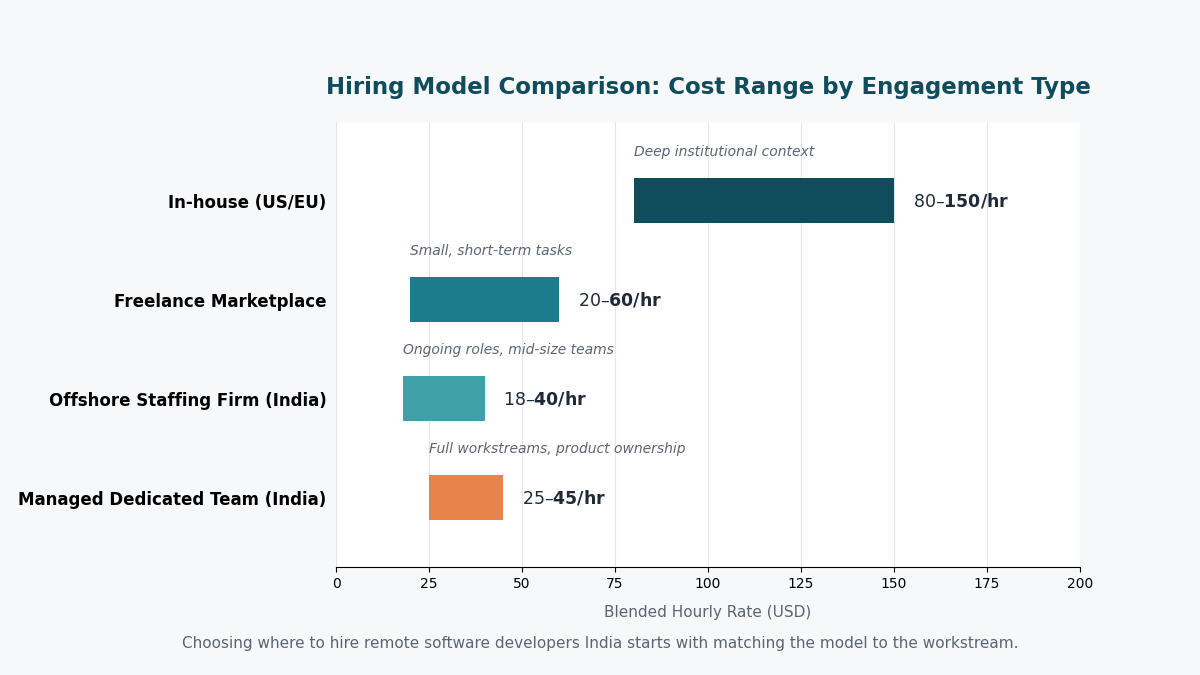
| Model | Best For | Typical Cost Range | Time-to-Hire |
| In-house (US/EU) | Deep institutional context, no time-zone gap | $80–$150/hr loaded | 2–4 months |
| Freelance marketplace | Small, short-term tasks | $20–$60/hr | Days, but unvetted |
| Offshore staffing firm (India) | Ongoing roles, mid-size teams | $18–$40/hr | 1–3 weeks |
| Managed dedicated team (India) | Full workstreams, product ownership | $25–$45/hr blended | 2–4 weeks |
The table only matters if you weigh it against your actual constraint: most teams choosing between rows 2 and 4 aren’t comparing cost, they’re comparing how much ownership they’re willing to hand over.
If your workstream has a defined end date and low architectural complexity, a freelance marketplace or short-term staffing engagement is usually enough. If the work is ongoing a core product surface, a compliance-sensitive system, or anything that needs institutional memory past a single sprint a managed dedicated development team in India typically outperforms both cheaper and more expensive alternatives on total cost of ownership, because the same engineers stay attached to the codebase long enough to stop re-learning it every quarter.
What Most Teams Get Wrong
The most common mistake isn’t underestimating India’s talent pool, it’s overestimating how “self-managing” an offshore team should be on day one. Teams that skip a structured onboarding period, expecting an offshore hire to reverse-engineer undocumented systems, see the highest early attrition and the most rework.
The second mistake is anchoring entirely on the hourly rate. A $18/hour developer who requires 20% more management time and produces code that needs a rework pass isn’t actually cheaper than a $35/hour developer who ships clean, documented work on the first pass. Total cost of ownership, not the rate card, is the number that should drive the decision.
The third, less discussed pattern: companies that treat India purely as a labor-arbitrage play rather than as a genuine extension of engineering capacity tend to churn vendors every 12–18 months and never build the institutional trust that makes distributed teams fast. The companies getting the most value are the ones who invest in a stable, long-term relationship with one vetted team rather than repeatedly re-sourcing on price.
A fourth pattern shows up specifically in technical vetting: teams that rely on a single live-coding interview to hire remote software developers India miss candidates who are strong on system design but underperform under interview pressure, and let through candidates who’ve simply memorized common interview problems. A short paid trial task, reviewed against real project code, screens for both failure modes far more reliably than a 45-minute call.
Choosing a Vetting Partner
If you’re evaluating this hiring model and want a second opinion before signing with a vendor, Supersourcing works with companies to vet and match engineers against a defined technical bar rather than a generic resume pool. You can review the process at supersourcing.com or reach out directly at supersourcing.com/contact-us or mayank@engineerbabu.com to pressure-test your current hiring plan before committing a budget.
Frequently Asked Questions
Why do global companies hire remote software developers from India?
Primarily for a combination of cost efficiency and talent depth India offers rates 60–70% below US in-house costs alongside a large, English-proficient engineering workforce spanning AI/ML, cloud, and platform engineering specializations that are difficult to fill quickly elsewhere.
How much does it cost to hire a remote software developer in India?
Expect $18–$40 per hour or $1,500–$3,500 per month all-in for a mid-level to senior engineer, depending on specialization. AI/ML and DevOps specialists sit toward the higher end, often $40–$60/hour, given the current demand-supply gap in those skills.
Is it safe to hire remote software developers from India?
Yes, when the engagement includes proper IP agreements, NDAs, code-ownership terms, and security compliance clauses (SOC 2, ISO 27001, GDPR, as relevant). The risk isn’t geography, it’s skipping the contract and process rigor that any remote hire, anywhere, would require.
What is the time zone overlap when working with Indian developers?
India (IST) offers a 2–4 hour working overlap with US Eastern mornings and near-complete overlap with European business hours, which is why many teams run one synchronous call daily and manage the rest async.
How do you vet remote developers in India before hiring?
Run a technical assessment against a defined rubric, verify past project outcomes with references, and use a paid trial sprint of 1–2 weeks before signing a longer contract that surfaces communication and code-quality issues faster than interviews alone.
What’s the difference between freelancers and a dedicated offshore team?
Freelancers suit short, discrete tasks with minimal onboarding investment. A dedicated development team is structured for ongoing product ownership, with consistent personnel, shared context over time, and accountability tied to sprint-level delivery rather than single tasks better suited to teams planning to hire remote software developers in India for more than one project cycle.
What size company should hire remote software developers from India?
Startups needing to move fast on limited runways and enterprises running large, parallel workstreams both use this model, but for different reasons. Startups typically prioritize speed and cost, while enterprises lean on India’s GCC ecosystem and larger vendor relationships for scale, compliance maturity, and long-term platform ownership rather than short-term savings alone.
