

The $2.6M Pega Program That Confused BPM with RPA
A US-based insurance company with 4,200 employees, claims processing running on legacy systems, looking to modernise approved a $2.6M digital transformation. The brief: implement Pega Platform for claims workflow automation, Pega Customer Decision Hub (CDH) for next-best-action in customer service, and Pega Robotics (RPA) for legacy system integration. Sixteen months. Ten India-based Pega developers.
The vendor presented a Pega Systems partner. Pega certifications across the team. Implementation experience in insurance.
Hiring Pega Developers from India became a hidden risk factor when the vendor treated Pega BPM and Pega RPA as a single skill set. The result? Fragile bots, unstable integrations, and a costly mid-project correction that added $280K and delayed delivery by four months.
This isn’t an isolated case. According to Statista’s BPM market forecast, the global Business Process Management (BPM) software market is projected to surpass $20 billion by 2026, driven by enterprise automation demand making the cost of hiring the wrong expertise even higher.
The real issue wasn’t technology, it was clarity. Understanding which Pega products you’re implementing, and hiring specialists accordingly, is what separates successful programs from expensive failures.
The developers assigned to both workstreams had Pega Platform BPM depth. They had minimal Pega RPA experience. The RPA bots built to integrate with the legacy claims system were fragile, breaking on minor UI changes in the legacy application. By month eight, three of the six RPA bots were in a constant cycle of break-and-fix.
Remediation: two dedicated Pega RPA specialists sourced mid-program at premium rates, six weeks of bot stabilisation. $280K in additional spend. Timeline extended by 4 months.
The product separation question which Pega products specifically, which developers for which product would have surfaced this capability gap before the first bot was built.
TL;DR 8 Answers Before You Read Further
| Question | Answer |
| What does a Senior Pega Developer cost from India? | $42–68/hr fully loaded. A Pega Certified Lead System Architect (CLSA) runs $88–125/hr. Section 5 has the full rate stack. |
| What's the single most important thing to verify? | Which Pega product Pega Platform BPM, Pega Customer Decision Hub, or Pega Robotics (RPA). Each requires different skills. Pega BPM and Pega RPA are completely different development disciplines. |
| Which Indian city has the deepest Pega talent? | Hyderabad and Bangalore. Hyderabad for Pega Platform BPM (BFSI and insurance programs). Bangalore for Pega CDH and cloud-native Pega deployments. |
| What certification actually matters? | PCSA (Pega Certified Senior System Architect) for senior developers. CLSA (Pega Certified Lead System Architect) for architects. CLSA is Pega's highest credential verifiable and meaningful. |
| How many Pega CLSAs are in India? | Approximately 620 active CLSAs in India. The total Pega-certified pool is larger (~14,000) but CLSA is the meaningful architect filter. |
| What's the most commonly confused Pega product? | Pega BPM vs Pega RPA (Robotics). Both carry the Pega brand. They require completely different skills. CLSA certification is for BPM; it does not validate RPA capability. |
| What's typical attrition for Pega specialists? | 14–18% annually. Pega is a niche platform concentrated in BFSI and insurance. Lateral options are fewer than full-stack developers but the community is active. |
| What's the biggest hiring mistake? | Treating Pega as one skill. Pega Platform BPM, Pega CDH (decisioning), Pega Robotics, and Pega Cloud are different product lines requiring different practitioners. |
Are You Actually Ready for This?
Pega programs fail when product scope is undefined and when the decisioning/BPM/RPA boundaries are blurry. Score yourself.
Score each: 0 (not in place), 2 (partially), 4 (done).
| # | Criterion | Score |
| 1 | Named Pega program owner with Pega domain knowledge | 0/2/4 |
| 2 | Pega product scope confirmed Pega Platform, CDH, Robotics, or combination | 0/2/4 |
| 3 | Pega deployment model confirmed on-premise, Pega Cloud (SaaS), or private cloud | 0/2/4 |
| 4 | Case type hierarchy designed or in progress not left to the offshore team | 0/2/4 |
| 5 | Decisioning strategy defined if CDH is in scope next-best-action, eligibility rules, engagement policies | 0/2/4 |
| 6 | RPA scope defined if Robotics is in scope which legacy systems, which processes | 0/2/4 |
| 7 | Interview panel with Pega product-specific experience available within 5 business days | 0/2/4 |
| 8 | Legal SLA under 15 days for MSA review | 0/2/4 |
| 9 | Pega development environment provisioned for offshore team | 0/2/4 |
| 10 | Guardrails and direct capture of objectives (DCO) approach confirmed | 0/2/4 |
| 11 | KPIs defined: case resolution SLA, process automation rate, decisioning accuracy | 0/2/4 |
| 12 | CISO signed off on offshore access to Pega environment with customer data | 0/2/4 |
| 13 | Escalation path: vendor PM → your Pega Program Lead → your CTO/COO | 0/2/4 |
| 14 | IP ownership for Pega applications, custom components, and decisioning rules in MSA | 0/2/4 |
| 15 | Finance can process USD-denominated invoices within 30 days | 0/2/4 |
What your score means:
| Score | Tier | Reality Check |
| 48–60 | Scaler | Ready. |
| 34–46 | Builder | Product scope and decisioning strategy gaps are the most common Pega program killers. |
| 20–32 | Explorer | Define product scope and case hierarchy before engaging vendors. |
| 0–18 | Pre-Stage | Pega programs require mature internal business process ownership. Build it first. |
The Pega Talent Market in India 2026
Pega is an enterprise low-code platform primarily used in BFSI (banking, financial services, insurance) and healthcare. It is not a general-purpose platform; its market is narrower than Salesforce, SAP, or ServiceNow, but within that market it is deeply embedded in complex business process automation programs.
India has a substantial Pega talent pool historically built through TCS, Cognizant, and Wipro’s Pega practices which have delivered Pega implementations for global BFSI clients for 20+ years.
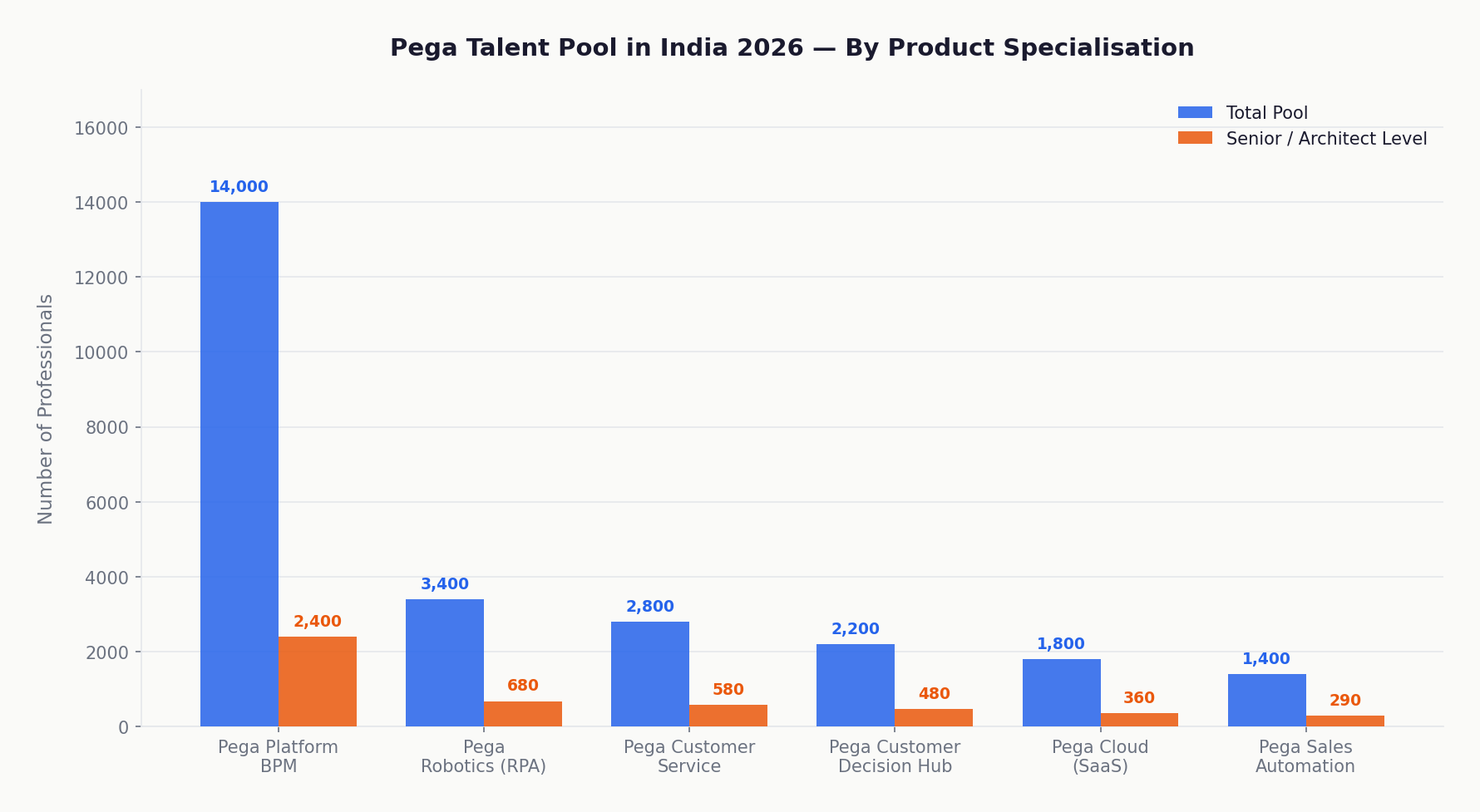
The pool breakdown:
| Product / Certification | Estimated India Pool | Senior/Architect Level |
| Pega Platform BPM (any certification) | ~14,000 | ~2,400 |
| PCSA (Pega Certified Senior System Architect) | ~4,800 | ~2,400 |
| CLSA (Pega Certified Lead System Architect) | ~620 | ~620 |
| Pega Customer Decision Hub (CDH) | ~2,200 | ~480 |
| Pega Robotics (RPA) | ~3,400 | ~680 |
| Pega Cloud (SaaS deployment) | ~1,800 | ~360 |
| Pega Customer Service | ~2,800 | ~580 |
| Pega Sales Automation | ~1,400 | ~290 |
The BPM vs RPA vs CDH product separation:
- Pega Platform BPM / Case Management: The core Pega product. Building case types, process flows, data models, UI using App Studio/Dev Studio, business rules, SLA framework, and Pega’s case management hierarchy. The CLSA certification covers this. The majority of Pega’s India talent pool is in this area.
- Pega Customer Decision Hub (CDH): Pega’s next-best-action decisioning platform real-time AI-driven customer engagement decisions. Building engagement policies, eligibility rules, action hierarchies, and the AI/ML decisioning framework. This is a fundamentally different skill from BPM; it requires understanding of decision management theory, AI model integration, and customer journey orchestration. Approximately 480 senior CDH practitioners in India.
- Pega Robotics (Pega RPA): Building robotic process automation bots UI automation, screen scraping, legacy system integration. This is a software testing and automation engineering skill, not a BPM configuration skill. The Pega RDA (Robotics Desktop Automation) and RSA (Robotics System Automation) certifications are separate from the BPM certification track. Approximately 680 senior RPA practitioners in India.
These three product lines share the Pega brand and some architectural concepts. They require different practitioners. Never assign BPM developers to CDH or RPA workstreams without explicit product training.
The Pega version currency:
Pega releases major versions roughly annually. Pega Infinity (the current product branding) has evolved through Pega 7.x and Pega 8.x versions. Pega Infinity ’23 and ’24 are the current releases. Developers working on legacy Pega 6.x or early 7.x have knowledge gaps on Pega’s modern low-code approach (App Studio vs legacy Dev Studio), Constellation UI framework, and cloud deployment model.
For current Pega programs, require Pega 8.x or Infinity experience. Pega 6.x and early 7.x knowledge, while genuine Pega experience, represents an older development model.
Where the talent lives:
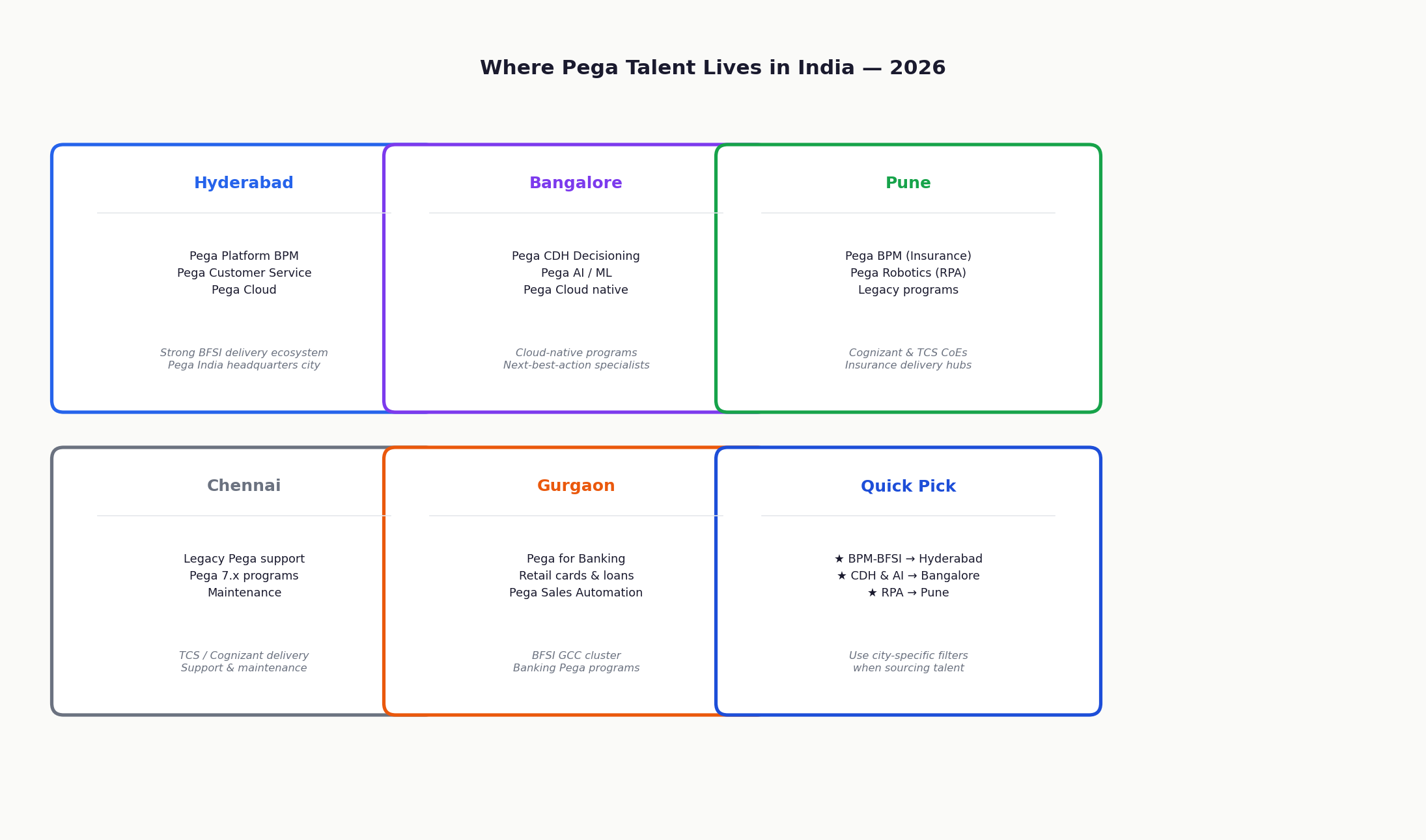
| City | Dominant Pega Specialisations | Why |
| Hyderabad | Pega Platform BPM for BFSI, Pega Customer Service, Pega Cloud | Large BFSI program delivery ecosystem. Pega’s India presence. Strong BPM and case management depth. |
| Bangalore | Pega CDH, Pega AI/ML decisioning, Pega Cloud, modern Pega development | Cloud-native digital engineering. Pega CDH and next-best-action programs. |
| Pune | Pega BPM for insurance, Pega Robotics, legacy Pega programs | SI delivery centers. Insurance industry Pega programs. Cognizant and TCS Pega CoEs. |
| Chennai | Legacy Pega support and maintenance, Pega 7.x programs | TCS/Cognizant legacy delivery. Support programs. |
| Gurgaon | Pega for banking (retail banking, cards), Pega Sales Automation for BFSI | BFSI GCC concentration. Banking Pega programs. |
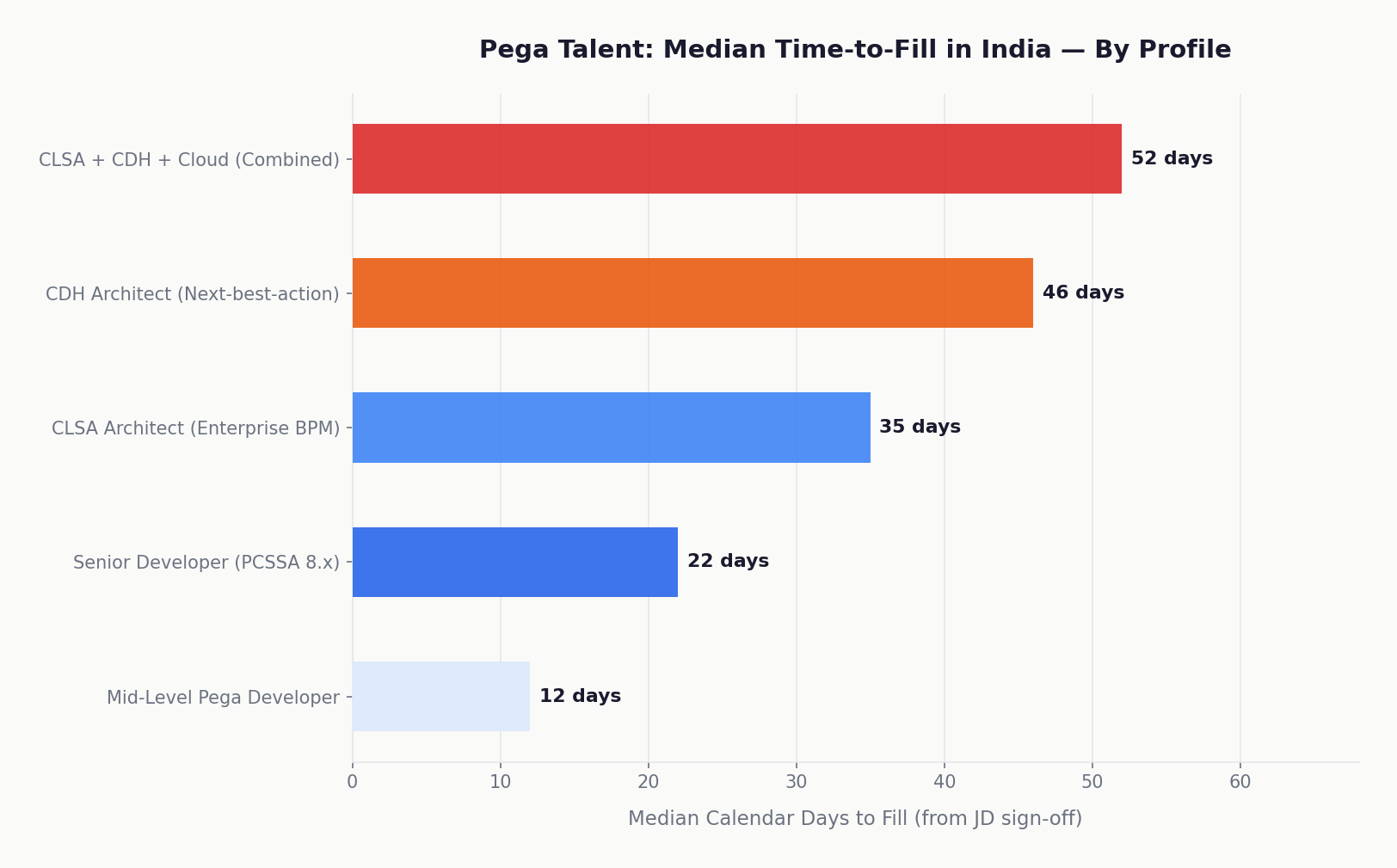
Supersourcing Index: Across 58 Pega placements in the Supersourcing GCC Benchmark 2026, median time-to-fill for a Senior Pega Developer (PCSA certified, Pega 8.x production experience) in Hyderabad was 22 calendar days. For a Pega CLSA with enterprise case management depth: 35 days. For a Pega CDH architect with production next-best-action delivery: 46 days.
Red flag: Any vendor claiming full Pega product coverage BPM, CDH, and RPA equally without specifying separate headcount for each product line. The three product areas require different practitioners. A Pega practice weighted entirely toward BPM presenting as full-stack Pega is the Section 1 pattern.
What You’re Really Paying
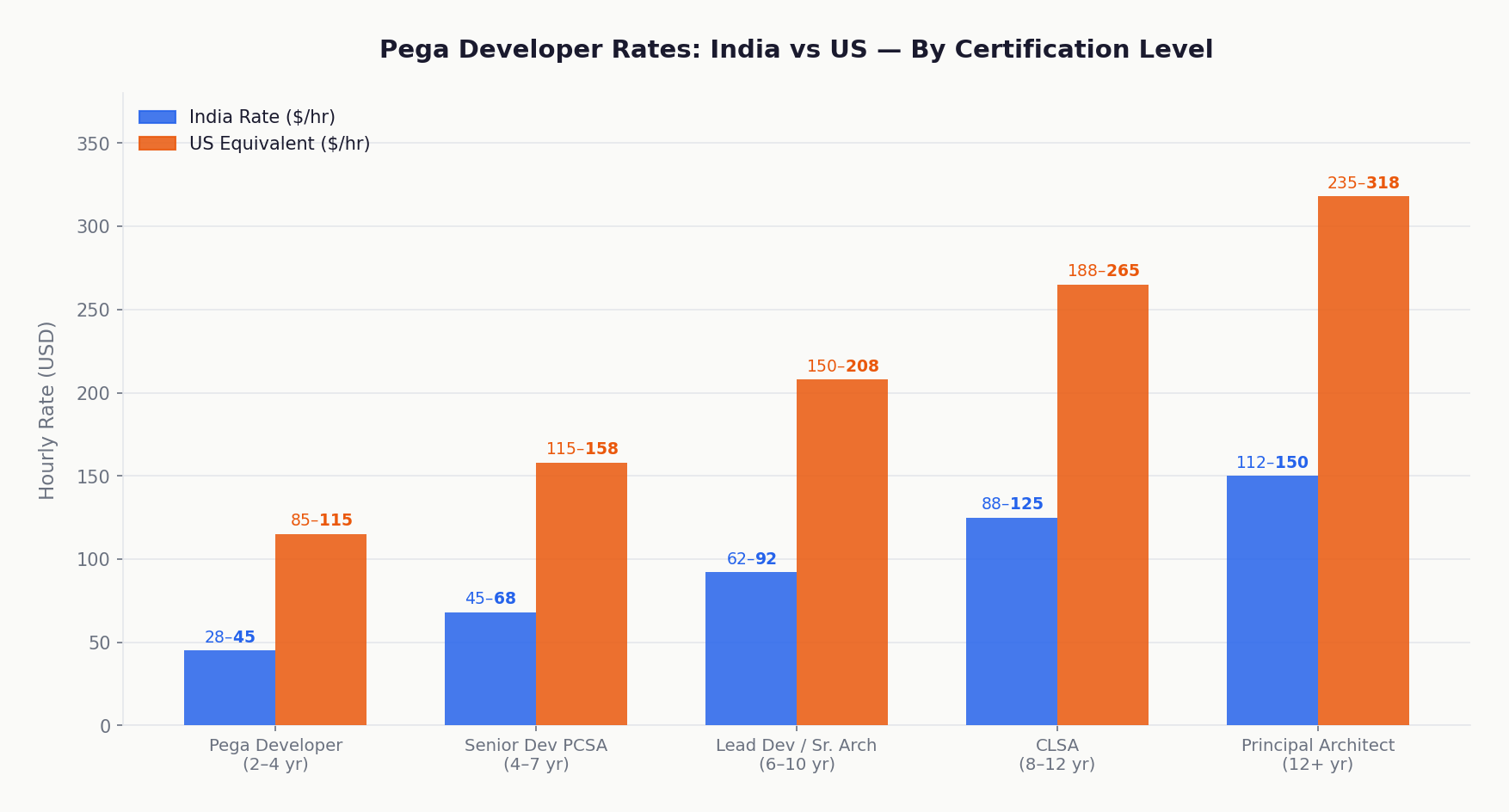
Rate Table by Level
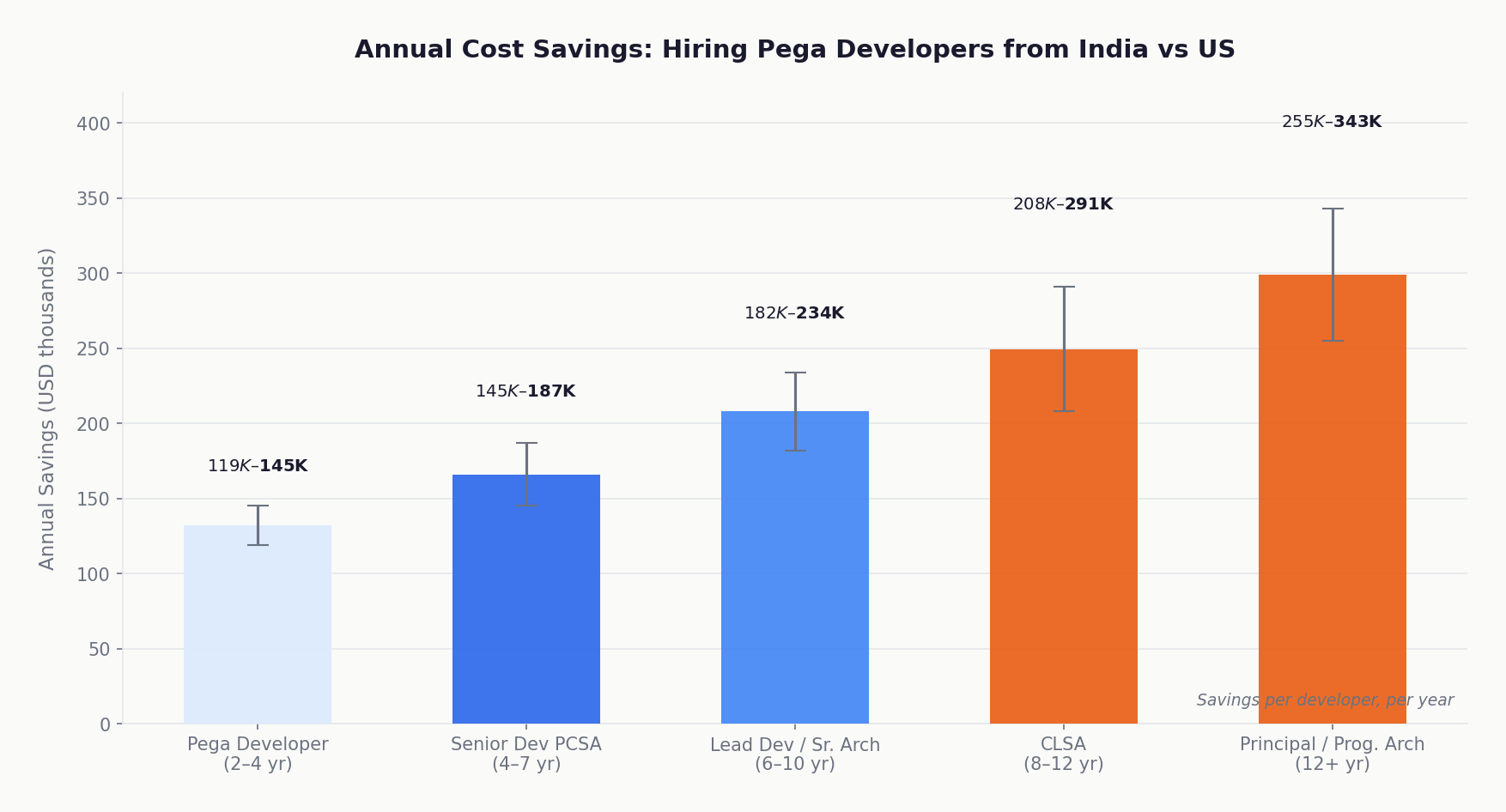
| Level | Experience | India Rate ($/hr) | US Equivalent ($/hr) | Annual Saving ($) |
| Pega Developer | 2–4 yr | $28–45 | $85–115 | $119K–$145K |
| Senior Developer (PCSA) | 4–7 yr | $45–68 | $115–158 | $145K–$187K |
| Lead Developer / Senior Architect | 6–10 yr | $62–92 | $150–208 | $182K–$234K |
| CLSA (Lead System Architect) | 8–12 yr | $88–125 | $188–265 | $208K–$291K |
| Principal / Program Architect | 12+ yr | $112–150 | $235–318 | $255K–$343K |
Product premiums:
- Pega CDH over BPM: 22–30% premium. Decisioning expertise is rarer and more strategic.
- Pega Cloud deployment over on-premise: 18–25% premium. Cloud-native Pega deployment and Pega’s SaaS model require specific knowledge.
- Pega Robotics over BPM: 12–18% premium. RPA is a different technical discipline.
- CLSA over PCSA: 35–45% premium at the same experience level. CLSA is Pega’s highest certification, rare and meaningful.
The 4 Cost Layers
- Layer 1 Gross CTC Senior Pega Developer (PCSA): ₹28–42 LPA. At ₹96.4/$1: $29K–$44K annually.
- Layer 2 Employer Burden: 22–28%.
- Layer 3 Vendor Margin: 20–26%.
- Layer 4 Invoice Rate: $45–68/hr.
At 2,000 hours/year, a 10-developer Pega team at blended $60/hr costs $1.2M annually. US equivalent: $2.9–3.3M. Annual saving: $1.7–2.1M.
The Certification Hierarchy What Actually Matters
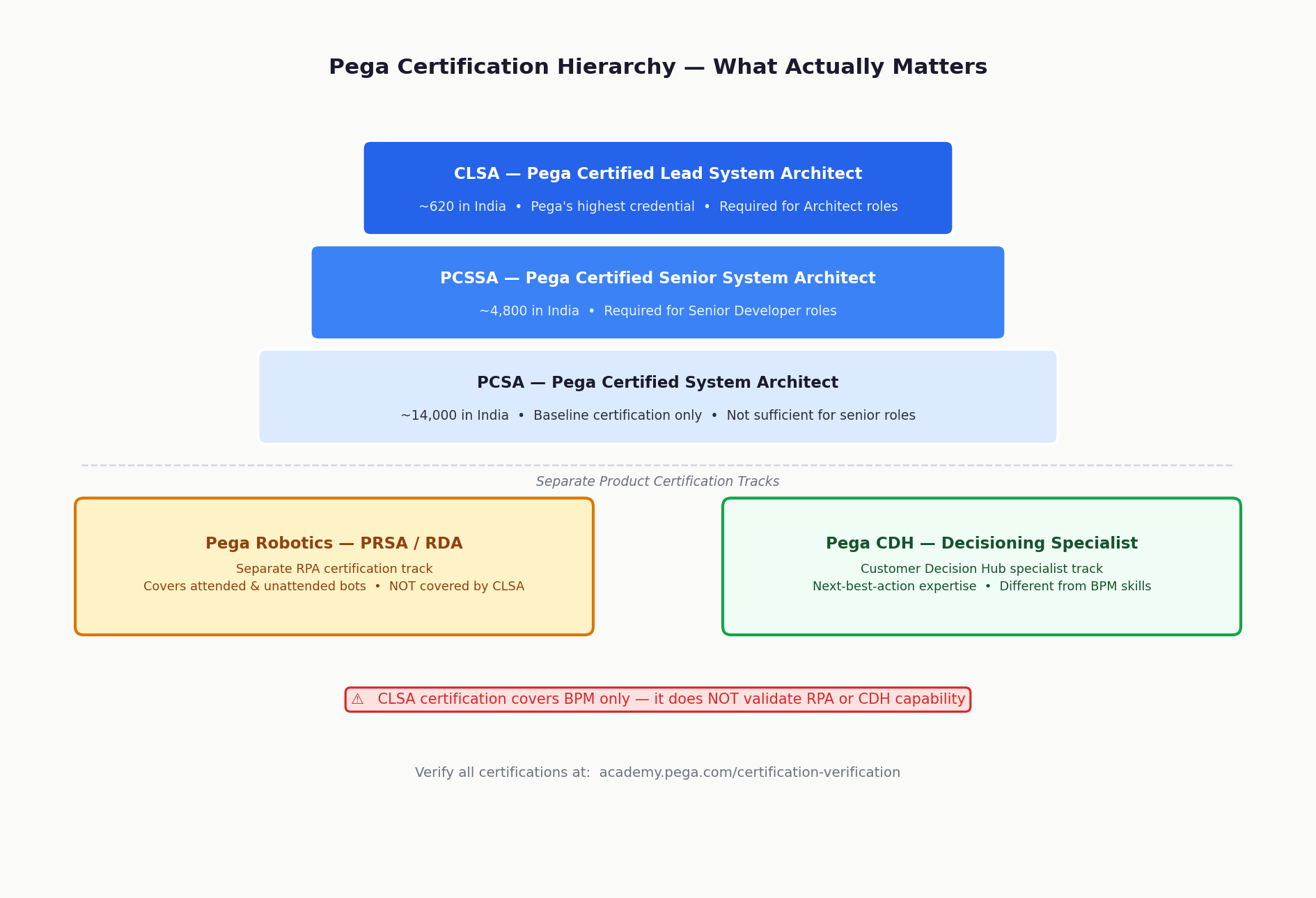
- Pega Certified System Architect (PCSA) The fundamental Pega developer certification. Tests Pega Platform core concepts case management, data design, UI configuration, process design, and security. Every Pega developer should hold PCSA. It is the baseline, not the differentiator. A candidate with PCSA only for a senior role is underqualified.
- Pega Certified Senior System Architect (PCSSA / Senior SA) Advanced developer certification. Tests complex case management design, performance optimisation, integration architecture, and advanced Pega development patterns. Required for senior developer roles. Approximately 4,800 PCSSA holders in India.
- Pega Certified Lead System Architect (CLSA) Pega’s highest technical certification. Tests enterprise architecture application architecture across business tiers, implementation methodology, performance at scale, security design, and complex decisioning. Requires prior PCSSA and significant implementation experience. Approximately 620 CLSAs in India. This is the credential required for architect roles.
Pega Robotics certifications (separate track):
- Pega Certified Robotics System Architect (PRSA): Tests Pega RPA system automation attended and unattended bot development, orchestration, and deployment.
- Pega Certified Robotics Desktop Automation (RDA): Tests desktop automation bot development.
These RPA certifications are separate from the BPM track. A CLSA does not validate Pega RPA capability. Verify product-specific certifications for RPA programs.
How to verify: Pega certifications are verified through Pega’s certification verification portal academy.pega.com/certification-verification. Enter the candidate’s name and certification ID. Every active Pega certification appears with the name, level, and active status. CLSA and PCSSA look different on the certificate the level is clearly stated.
The Pega version in certification: Pega’s certifications are version-specific: “Pega Certified Senior System Architect (8.6)” indicates the version the certification covers. For programs on Pega 8.x or Pega Infinity, require certification on 8.x or later. Certifications on Pega 7.1 or earlier represent an older development model.
The JD That Attracts the Right Candidates
JD 1: Senior Pega Developer Case Management (4–7 years)
Senior Pega Developer Case Management / BPM Remote from India Engagement: Staff Augmentation | Duration: 14 months Rate: ₹28–42 LPA CTC equivalent | Billing: $45–68/hr (vendor-facing)
What you’ll own: Pega Platform case management configuration for a banking loan origination program. You’ll design and build case types, data models, UI in App Studio using Constellation, business rules, SLA framework, and integrations with core banking via REST API. Measured on case processing SLA adherence, guardrail compliance, and configuration quality.
What we require:
- PCSSA certification (Pega 8.x or Infinity, verified at academy.pega.com)
- 4–7 years Pega Platform development, minimum 2 complete Pega go-lives in BFSI
- Case management depth case type hierarchy design, child case relationships, stage and step configuration
- App Studio and Constellation UI can describe the Constellation design system and modern Pega UI development vs legacy Harness-based UI
- Data design data classes, data pages, and data transforms
- Integration experience REST and SOAP connectors in Pega, data transforms for external system responses
- Guardrail awareness can describe why guardrails exist and how to build guardrail-compliant configurations
What disqualifies you:
- Pega 6.x or early 7.x only experience for a modern Pega 8.x/Infinity program
- PCSA only certification for a senior role
- Pega Robotics experience presented as Pega Platform BPM capability
- No Constellation UI experience Harness-only experience indicates outdated development model
Interview process: Technical screen (30 min) → Live Pega case design scenario (90 min) → Data model design discussion (45 min)
JD 2: Pega CLSA / Solution Architect (10+ years)
Pega CLSA / Solution Architect India GCC or BOT Engagement: GCC Build or BOT | Duration: 24+ months CTC: ₹78–112 LPA | Billing: $92–125/hr (vendor-facing)
What you’ll own: End-to-end Pega Platform architecture for an enterprise financial services program application architecture across business tiers, integration architecture (Pega Integration Designer, external REST APIs), security model (operator access, role-based access), decisioning integration with CDH if in scope, performance design (data access patterns, agent strategy), and the development standards for a team of 10–18 Pega developers.
What we require:
- CLSA certification (Pega 8.x or Infinity, verified at academy.pega.com before interview scheduling)
- 10+ years Pega experience, minimum 3 enterprise Pega go-lives as architect of record
- Multi-application architecture Pega’s business/implementation/decision data class separation, class hierarchy design
- Performance architecture data access pattern design, report definition optimisation, agent strategy for background processing
- Security design operator access, access groups, privilege model, data access in multi-tenant Pega programs
- CDH integration awareness for programs with next-best-action requirements
- Pega Cloud deployment experience preferred differences from on-premise deployment model
Interview process: Architecture scenario (60 min) → Live class hierarchy design (45 min) → Performance design discussion (30 min) → Reference call with prior VP Engineering or Digital Transformation Director
What most enterprise JDs get wrong for Pega:
They say “Pega developer required” returning the full pool of BPM, RPA, and CDH practitioners mixed together. They don’t distinguish PCSA from PCSSA from CLSA at three very different levels. They don’t specify the Pega version which returns Pega 6.x and 7.x legacy experience for modern programs.
They treat Pega BPM and Pega RPA as the same skill after the Section 1 failure. And they don’t mention Constellation UI which signals to modern Pega developers that the program may be on a legacy development model.
How to Verify Experience Not Just Credentials
The 3 verification steps before any Pega interview:
Step 1: academy.pega.com certification verification
Go to academy.pega.com/certification-verification, enter the candidate’s name and certification ID. Confirm: PCSSA or CLSA (not PCSA only for senior roles), Pega version of the certification (8.x or Infinity for modern programs), and Active status. CLSA vs PCSSA are clearly labeled to verify the specific level.
Step 2: Product-specific and version specificity
Ask: “Is your primary Pega experience on Pega Platform BPM, Pega CDH, or Pega Robotics? What is the most recent Pega version you’ve worked on in production?” The answer tells you immediately whether the candidate is relevant for your product and whether their version experience matches your program.
Step 3: Go-live count and BFSI context
Ask for specific go-live count, client industry (BFSI or other), and the Pega version at each go-live. Pega is predominantly used in BFSI and insurance. A candidate without BFSI context for a banking or insurance Pega program will have domain knowledge gaps alongside technical capability.
The 5 interview questions that expose fake seniority:
Q1: Case Type Hierarchy Design “Walk me through how you’d design a case type hierarchy for a personal loan origination process: the top-level case, child cases, stages, and the data model that supports them.”
Real answer: describes Pega’s case management model top-level case (Loan Origination), child cases (Credit Assessment, Document Collection, Underwriting Review, Disbursement), stage and step configuration, the data class hierarchy supporting the case (Loan data class extending from the work class), data pages for external data (credit bureau data page using a connector), and the routing logic for assigning cases to different workqueues based on loan amount or product type.
A developer without case management depth describes the loan origination process as a business flow without Pega-specific case design objects. Cannot describe child case relationships, data class hierarchy, or workqueue routing.
Q2: Constellation vs Harness UI “Explain the difference between Pega’s Constellation UI architecture and the legacy Harness-based UI, and what the migration implications are for an existing Pega 7.x application.”
Real answer: describes Constellation Pega’s modern, component-based UI framework introduced in Pega 8.5+. Constellation uses DX API (Digital Engagement architecture) and separates UI from business logic completely; the UI is rendered by a React-based frontend consuming Pega’s DX API. Legacy Harness-based UI is tightly coupled to the Pega application layer, using Pega’s proprietary section/harness/flow action framework. Migration implications: Constellation migration requires rebuilding UI in the Constellation design system, potentially significant effort for complex legacy Harness-based UI. They describe the DX API and the Constellation component model.
A developer with only legacy Pega experience describes Harness-based UI without knowledge of Constellation. Cannot describe the DX API or explain the architectural separation in Constellation.
Q3: Data Design and Data Pages “Describe how you’ve used data pages in Pega for an external credit bureau integration, the data page configuration, the data transform, the caching strategy, and what happens when the external service is unavailable.”
Real answer: describes Pega data pages the data page rule configuration (class, structure, scope, refresh strategy), the connector activity or service call used to populate the data page, the data transform mapping external response fields to the Pega data class, caching strategy (page scope vs thread scope vs requestor scope based on the data freshness requirement), and the exception handling for service unavailability a fallback data transform that populates the data page with default values and a flag indicating data staleness. They describe specific data page configuration objects.
Developers without data page depth describe external integration generically. Cannot describe data page scope, caching strategy, or fallback handling.
Q4: Performance Architecture “A Pega application is experiencing slow case open times 8 seconds to open a case. Walk me through your diagnostic process and the architectural changes you’d make.”
Real answer: describes the Pega performance diagnostic approach checking the tracer (Pega’s debugging tool) for slow steps, identifying report definitions, running expensive database queries on case open, checking data page load times (are data pages being refreshed unnecessarily on case open?), reviewing declare expressions that might be triggering cascading recalculations, and checking agent strategies for background processing that might be competing for database resources. Fixes: report definition query optimisation (index review, result set reduction), data page scope adjustment to avoid unnecessary refreshes, declare expression optimisation, and agent schedule adjustment. They use specific Pega tooling names.
Developers without performance architecture experience describe performance optimization generically. Cannot describe Pega’s tracer, report definition query optimisation, or declare expression performance impact.
Q5: CDH Decisioning Design “Describe how you’ve designed a next-best-action strategy in Pega Customer Decision Hub for a retail banking customer, the action hierarchy, the eligibility rules, and how AI/ML models influence the final action selection.”
Real answer: describes Pega CDH’s hierarchy business issues and groups (Retention > Offers, Sales > Credit Cards), actions (Cashback Offer, Balance Transfer Offer, Credit Card Upgrade), engagement policies (customer eligibility credit score threshold, product holding check), contact policies (suppression rules customer contacted less than X days ago), and AI model integration the Adaptive Models in CDH that learn from customer response patterns and influence the propensity score for each action. The final action selection uses the arbitration framework combining eligibility, suitability, and propensity scores weighted by business priority.
Developers without CDH experience describe customer decisioning conceptually. Cannot describe Pega CDH’s business issue/group/action hierarchy, engagement policy configuration, or adaptive model integration in the arbitration framework.
8 CV red flags:
- PCSA only certification for a senior PCSSA or architect role
- Pega 6.x or early 7.x primary experience for a modern Pega 8.x/Infinity program
- “Pega developer” without specifying BPM, CDH, or RPA product
- “Pega RPA experience” for a BPM architect role different product, different skills
- “Constellation experience” claimed by a developer whose LinkedIn shows only Pega 7.x projects Constellation launched in 8.5
- “Next-best-action experience” without being able to name Pega CDH’s action hierarchy or engagement policy framework
- “Pega architect” with no CLSA certification CLSA is verifiable; claiming architect level without it is a flag
- “Performance optimisation experience” that cannot name Pega’s tracer tool or report definition query analysis
How to Source What’s Working, What Isn’t
What’s working:
Pega partner network.
Pega maintains a partner ecosystem Global Consulting Partners (GCPs) and Technology Partners. Major India GCPs include TCS, Cognizant, Wipro, and Infosys. An inquiry to 2–3 GCPs about available Pega benches with product and version specificity yields verified candidates.
Pega Community and PegaWorld.
Pega’s annual PegaWorld conference and Pega Community (community.pega.com) have active India participation. Community contributors, blog authors, forum answerers are identifiable senior practitioners. The India Pega community has active user groups in Hyderabad and Bangalore.
3 ready-to-use LinkedIn boolean search strings:
- String 1 (CLSA / Senior Architect): “Pega” AND (“CLSA” OR “Lead System Architect”) AND (“Hyderabad” OR “Bangalore”) AND “India”
- String 2 (CDH / Decisioning): “Pega” AND (“Customer Decision Hub” OR “CDH” OR “next-best-action”) AND (“Senior” OR “Lead”) AND “India”
- String 3 (Pega Cloud): “Pega Cloud” AND (“Infinity” OR “8.x”) AND (“Architect” OR “Lead”) AND “India”
Supersourcing pre-vetted bench. Senior Pega Developers (PCSSA, Pega 8.x): 22-day median fill. CLSAs: 35 days with certification verified at academy.pega.com before any CV submission.
What isn’t working:
- “Pega developer” postings without product and version specification. Returns legacy Pega 6.x and 7.x developers alongside modern Pega 8.x/Infinity practitioners, and mixes BPM, CDH, and RPA experience indiscriminately.
- PCSA as the senior developer requirement. PCSA is entry-level. Requiring PCSSA for senior roles and CLSA for architect roles is the right bar. PCSA-only for a lead developer role returns the wrong pool.
- Assuming BPM developers cover RPA. The Section 1 failure. RPA is a separate product, separate certification track, and separate skills. Source separately.
The Contract Stack for Pega Engagements
Clause 1: Individual Resource Approval with Product, Certification Level, and Pega Version
SOW schedule: name, Pega certification name and level (PCSSA or CLSA, not just “Pega certified”), Pega version of certification (8.x or Infinity), and product scope (BPM, CDH, or RPA). Product substitution without client approval is a material scope change.
Clause 2: IP Assignment Pega Applications, Rulesets, and Decisioning Rules
Must cover: Pega application and ruleset definitions (exportable as RAP Pega Archive Package), custom component rules (activities, data transforms, UI sections, connectors), CDH decisioning rules (action hierarchies, engagement policies, adaptive models), and RPA bot definitions if in scope. Pega applications can be exported as archives require export and handover at engagement end.
Clause 3: Guardrail Compliance as Acceptance Criteria
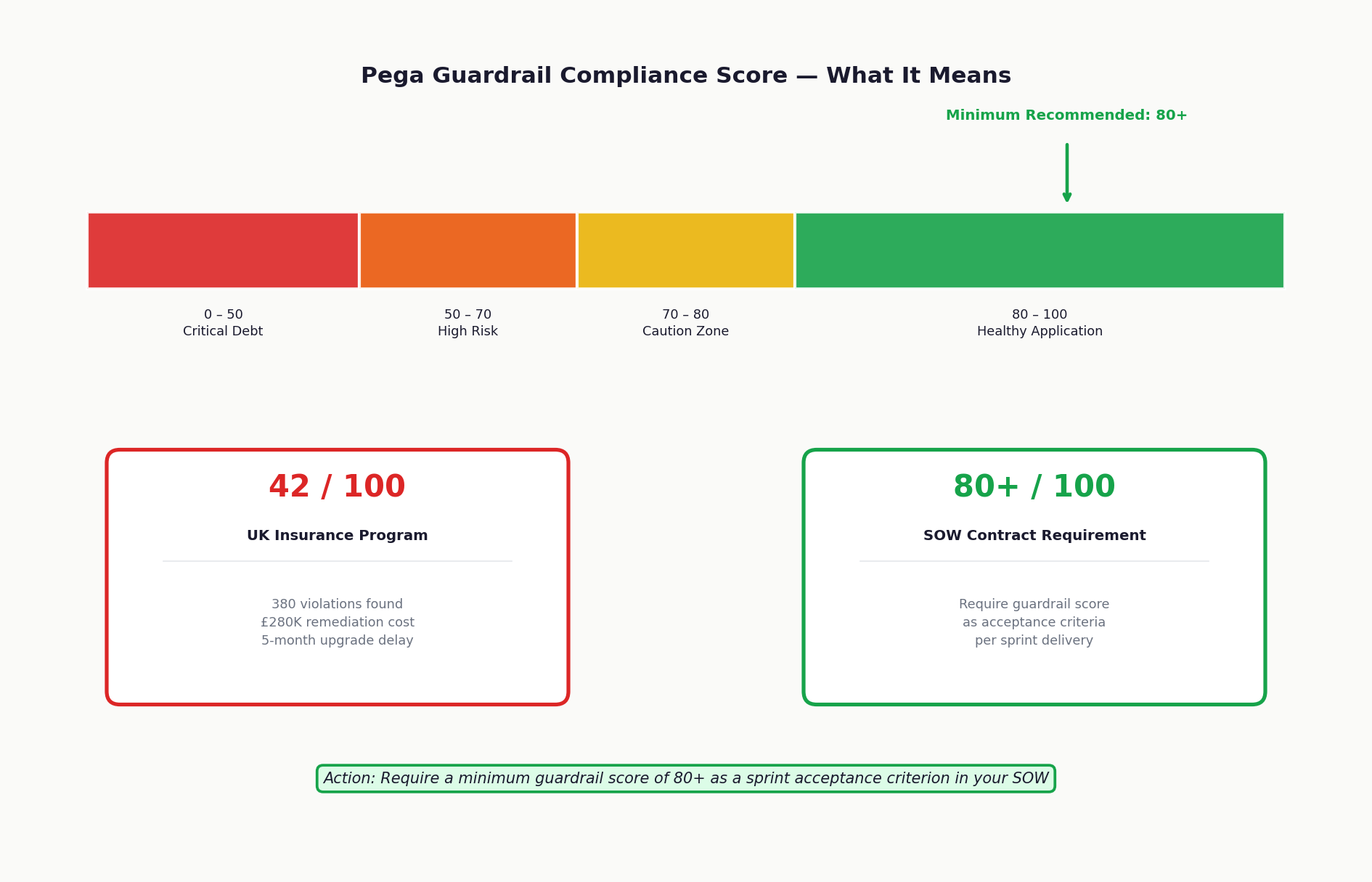
Pega’s guardrail compliance score measures how closely an application follows Pega’s best practices. Require a minimum guardrail score (typically 80+) as an acceptance criterion for each sprint delivery. Guardrail violations accumulate technical debt that becomes expensive to remediate at upgrade time. A team building to guardrail compliance from the start saves significant rework cost.
Clause 4: Pega Application Archive Handover
At engagement end, require a complete Pega Application Archive (RAP file) export of all application rulesets. This is the complete IP export for a Pega program. Without it, the client cannot migrate the application to a new environment, upgrade independently, or bring in a new SI without the original team.
Clause 5: Access Revocation 24 Hours
All vendor developer Pega operator accounts in production, UAT, and development environments must be deactivated within 24 hours of engagement end. Pega operator IDs have rule access deactivation that prevents continued access to the application.
Running a Pega Team at Scale
Guardrail governance from sprint one.
Establish guardrail compliance review as part of every sprint definition of done. Pega’s guardrail checker runs within the development environment; any rule with a guardrail violation is visible in the tracer and rule inspection. A team that reviews guardrail violations weekly avoids the accumulation of technical debt that makes upgrades expensive.
Ruleset version management.
Pega applications are built in rulesets with version numbers. Establish a ruleset versioning strategy before the first rule is created which contains which application layer (data classes vs process rules vs UI), how versions are incremented for releases, and the locking strategy for released ruleset versions. Uncontrolled ruleset proliferation makes Pega applications unmaintainable.
Application architecture documentation.
Pega’s multi-tier application structure framework layer (reusable components), implementation layer (client-specific configuration), and extension layer (future customisation) must be documented. The class hierarchy, ruleset structure, and delegation strategy should be in a living architecture document that the offshore team maintains throughout the engagement.
Performance monitoring.
Use Pega’s built-in performance monitoring the PAS (Pega Application Services) health check and the Performance Analyzer to identify slow rules and database queries. Require a monthly performance review as part of the engagement cadence.
Early warning signals:
- Guardrail compliance score declining sprint-over-sprint
- Ruleset version proliferation without versioning strategy
- Data pages being refreshed on every request due to scope misconfiguration
- Custom activity chains replacing Pega’s built-in case management sign of developers fighting the framework
- LinkedIn activity Pega certifications updated, ServiceNow or Salesforce connections increasing
Retention levers: CLSA certification sponsorship the CLSA exam is expensive and demanding. Sponsoring the preparation and exam for a PCSSA-level developer is a significant retention investment. CDH/decisioning expansion BPM developers who get exposure to Pega CDH on your program are building the highest-value Pega skill in the market. Pega Cloud experience as the market moves from on-premise to Pega Cloud, developers who work on Pega Cloud programs are building current-market credentials.
When Things Go Wrong
Pattern 1: The BPM vs RPA Confusion
Described in Section 1. BPM developers assigned to RPA workstreams. The product separation in the sourcing brief and the separate RPA certification requirement prevent this.
Pattern 2: The Guardrail Debt Crisis
A UK insurance company’s Pega implementation ran for 18 months with no guardrail compliance requirement. By the end of delivery, the application had a guardrail score of 42 below Pega’s recommended minimum of 80. 380 guardrail violations, many of which were performance-critical (unconstrained report definitions, activities with excessive database calls, data pages with thread scope used as requestor scope).
The Pega upgrade to the next major version was delayed by 5 months; the guardrail violations had to be remediated before the upgrade could be safely applied. Remediation: £280K. The guardrail compliance acceptance criterion in Section 10 would have prevented this accumulation.
Pattern 3: The CDH Architecture Mismatch
A US retail bank hired a “Pega CDH architect” at $115/hr. The candidate had CLSA certification for Pega Platform BPM. He had limited CDH experience, one CDH project where he had been a supporting developer, not the architect.
The CDH action hierarchy was designed without understanding Pega CDH’s arbitration framework. The next-best-action logic was implemented using Pega Platform decision rules rather than CDH’s adaptive models and engagement policies, technically possible but bypassing CDH’s AI decisioning framework entirely. The business team’s requirement for AI-driven personalization was not being met.
Remediation: CDH architecture redesign with a genuine CDH specialist brought in for 8 weeks at $125/hr. $80K. The CDH decision design question (Q5 in Section 8) and the product-specific certification check would have surfaced the BPM-vs-CDH gap immediately.
When India Is the Wrong Call
Scenario 1: Pega programs for the US federal or state government.
US federal government Pega implementations (DHS, DOD, federal civilian agencies) often require security clearances, US citizenship, and specific federal compliance certifications. India-based Pega developers cannot hold US security clearances. For government Pega programs, the talent requirement is US-only for cleared roles. Non-classified Pega configuration work can be done by India-based developers with appropriate data access controls.
Scenario 2: Real-time conversational AI programs requiring Pega Infinity 24 CDH features.
Pega’s most recent CDH capabilities Generative AI integration, Pega GenAI features in Infinity ’24 are cutting-edge and have thin production experience globally, including India. For programs at the bleeding edge of Pega’s AI roadmap, the relevant expertise may be more accessible through Pega’s own professional services or US/UK-based CDH specialists.
Scenario 3: Sub-5 developer programs with all three Pega product lines simultaneously.
A 4-developer program requiring BPM, CDH, and RPA simultaneously requires three different specialist profiles. For small multi-product Pega programs, a Pega GCP with a pre-assembled multi-product team is a better fit than enterprise staff augmentation.
The Supersourcing Vendor Scorecard™ Pega Edition
Score your vendor before signing. Maximum 100 points. Minimum threshold: 65.
Category 1: Certification and Product Specificity (0–20 pts)
| Criterion | 0 | 10 | 20 |
| Can produce PCSSA/CLSA certification with Pega version for all claimed bench within 24 hours | Cannot | Some | All bench, level and version confirmed |
| BPM vs CDH vs RPA product distinction acknowledged proactively | Conflates them | Distinguishes when asked | Proactively confirmed with separate headcount |
| Pega 8.x/Infinity experience confirmed (not Pega 6.x/7.x only) | 6.x/7.x only | Mixed | 8.x/Infinity confirmed for all |
Category 2: Technical Vetting (0–20 pts)
| Criterion | 0 | 10 | 20 |
| Product-specific technical screen | Generic Pega | Product-specific written | Live Pega scenario in development environment |
| Guardrail compliance requirement in screen | Not asked | Mentioned | Score threshold and violation types discussed |
| Constellation UI knowledge for modern Pega roles | Not tested | Mentioned | DX API and component model explained |
Category 3: Contract Readiness (0–20 pts)
| Criterion | 0 | 10 | 20 |
| IP Assignment covering RAP archive and CDH decisioning rules | Not available | On request | Standard, RAP export requirement named |
| Guardrail compliance as acceptance criteria | Not present | Best effort | Minimum score in SOW acceptance criteria |
| Pega Application Archive handover at engagement end | Not present | Best effort | Contractual RAP export requirement |
Category 4: Pega Delivery Track Record (0–20 pts)
| Criterion | 0 | 10 | 20 |
| Named Pega go-live clients with product and industry | None | Logo only | Named contact + product + go-live date |
| BFSI or insurance Pega programs verified | None | Claimed | Verified with industry reference |
| Attrition on Pega programs | Unknown / >22% | 15–22% | <15% |
Category 5: Commercial Structure (0–20 pts)
| Criterion | 0 | 10 | 20 |
| Rate card by certification level (PCSSA vs CLSA) and product | Single rate | PCSSA/CLSA distinction | Full product and level matrix |
| Substitution clause with cert level and product equivalence | Not present | Available | Standard, CLSA and product equivalence |
| SLA on replacement 14 days with cert verification | None | Best effort | Contractual 14-day SLA |
Score interpretation: 85–100 shortlist; 65–84 proceed with conditions; 45–64 red flag; below 45 walk.
15 Questions Buyers Actually Ask
Q: What is Pega and what is it used for?
Pega is an enterprise low-code platform specialising in business process management (BPM), case management, customer decisioning, and robotic process automation. It is primarily used in BFSI (banking, financial services, insurance) and healthcare for complex process automation loan origination, claims processing, customer service workflows, and next-best-action decisioning. Pega’s strength is its case management framework and its ability to handle complex, exception-driven business processes. It is not a general-purpose web development tool, it is a specialist platform for business process-intensive industries.
Q: What is the difference between Pega BPM and Pega CDH?
Pega Platform BPM is case management and process orchestration building case types, process flows, data models, and UI for workflow automation. A loan origination workflow, a claims processing system, or a customer service case management system are BPM programs. Pega Customer Decision Hub (CDH) is a real-time AI decisioning platform determining what the next best action or offer is for each customer interaction based on eligibility rules, predictive models, and engagement policies. A personalised customer offer engine or a next-best-action recommendation for a bank branch are CDH programs. The two require different skills and different certifications.
Q: What is Pega CLSA and how many CLSAs are in India? \
CLSA (Pega Certified Lead System Architect) is Pega’s highest technical certification. It requires prior PCSSA certification, significant enterprise implementation experience, and passing Pega’s demanding architecture-level exam covering application architecture across business tiers, performance design, security model, and implementation methodology. Approximately 620 active CLSAs are based in India as of May 2026. For architect roles on enterprise Pega programs, CLSA should be the required certification. Verify at academy.pega.com.
Q: What is the Constellation in Pega?
Constellation is Pega’s modern UI framework introduced in Pega 8.5 and the standard for Pega Infinity programs. It uses a component-based architecture where the UI is a React-based frontend consuming Pega’s DX API (Digital Engagement API). This separates UI from business logic; the Pega application defines the business process, and Constellation renders the UI independently. Constellation replaces the legacy Harness-based UI framework. For programs on Pega 8.5+, require Constellation experience. A developer with only Harness experience will need significant upskilling for modern Pega programs.
Q: How do I verify a Pega certification?
Go to academy.pega.com/certification-verification and enter the candidate’s name and certification ID. Every active Pega certification appears with the specific level (PCSA, PCSSA, CLSA) and the Pega version covered. Verify: the level is PCSSA or CLSA for senior roles (not PCSA), the version is 8.x or Infinity for modern programs, and the status is Active. CLSA and PCSSA are clearly labeled and the level is not ambiguous on the verification result.
Q: What is Pega’s guardrail compliance and why does it matter?
Pega’s guardrail compliance score measures how closely an application follows Pega’s implementation best practices. Guardrails identify anti-patterns that create performance problems, upgrade risk, and maintainability issues unconstrained report definitions that run expensive database queries, data pages with incorrect scope that cause unnecessary refreshes, custom activities that replicate built-in framework functionality. A guardrail score of 80+ indicates a well-built application. A score below 60 indicates significant technical debt. Guardrail violations accumulate silently during development when teams aren’t monitoring them and surface expensively at upgrade time. Require a minimum guardrail score as an acceptance criterion in the SOW.
Q: What is the realistic timeline to build a 10-person Pega team in India?
For a BPM-focused team 1 CLSA architect, 2 lead developers, 5 senior developers (PCSSA), 2 mid-level developers expect 38–52 days from JD sign-off to full team assembled. The CLSA architect (35-day median fill) is the critical path. PCSSA senior developers (22-day median fill) can be sourced in parallel. For a program that includes CDH, add 15–20 days for CDH specialist sourcing (46-day median fill for CDH architects).
Q: Can ServiceNow or Salesforce developers transition to Pega?
With training partially. All three are enterprise platform tools with similar concepts (workflow, case management, UI configuration). But Pega has a distinct development philosophy (model-driven architecture, class hierarchy, ruleset versioning) that requires specific learning. ServiceNow developers transitioning to Pega typically need 3–4 months of focused training before they are productive. For delivery roles requiring current production experience, require Pega-specific experience rather than assuming cross-platform transfer.
Q: Is Pega talent in India comparable to US talent?
For standard BPM case management and BFSI process automation: functionally equivalent for delivery roles. India’s Pega practices through TCS, Cognizant, and Wipro have delivered enterprise Pega programs for global banks and insurers for 20+ years. For Pega CDH at the cutting edge Pega Infinity ’24 generative AI features, complex adaptive model integration the deepest expertise is distributed between the US (Pega’s home market) and India. For standard BPM and established CDH implementations: India talent delivers at global quality standards.
Q: What’s the hardest Pega profile to hire in India?
A Pega CLSA with production Pega CDH next-best-action delivery experience, Pega Cloud deployment knowledge, and Pega Infinity ’24 experience. The combination of CLSA + CDH depth + cloud deployment on the current version narrows the India pool to under 100 active practitioners. Median fill time: 50+ days. Competition from global BFSI programs for the same profiles.
Q: Is Supersourcing the right partner for a 4-developer Pega program?
Not our ideal engagement. For a 4-developer Pega program, a Pega GCP with a staff augmentation capability is a better fit. We’d rather tell you that.
Closing
Pega hiring from India works. The BFSI and insurance delivery track record is deep, the CLSA community is real, and the savings versus US hiring are substantial $119K to $343K per developer per year.
The failure mode is not India. It is “Pega developer required” without “PCSSA or CLSA certified, Pega 8.x/Infinity, BPM vs CDH vs RPA specified.” These filters eliminate the legacy version pool, the entry-level pool, and the cross-product confusion in one pass.
The guardrail compliance acceptance criterion is the single contractual addition that most enterprise Pega programs are missing. Add it. It costs nothing to negotiate and saves hundreds of thousands in upgrade remediation.
Book a 30-minute Pega Talent Discovery Call → No deck. Just the numbers and the bench.
