

The $3.6M ServiceNow Engagement That Unravelled
A $3.6M ServiceNow program failure is not an isolated case; it reflects a deeper hiring gap in enterprise workflow platforms. Implementing ITOM, HRSD, and CSM at scale requires architectural depth, not just basic ITSM experience.
Hiring ServiceNow Engineers from India has become a strategic priority for global enterprises looking to scale efficiently. But the gap between certified developers and true platform architects is where most implementations fail leading to broken CMDBs, flawed workflows, and long-term upgrade risks.
The urgency is clear from platform growth itself. According to ServiceNow’s official 2026 financial results, the company generated $3.67 billion in subscription revenue in Q1 2026 alone, growing 22% year-over-year, reflecting rapid enterprise adoption of workflow automation platforms: ServiceNow Q1 2026 Financial Results
In this environment, success depends not on hiring more engineers but on hiring specialists who can architect scalable ServiceNow ecosystems across ITOM, HRSD, and CSM from day one.
TL;DR 8 Answers Before You Read Further
| Question | Answer |
| What does a Senior ServiceNow Developer cost from India? | $42–65/hr fully loaded. A ServiceNow CTA runs $95–130/hr. Section 5 has the full rate stack. |
| How many ServiceNow CTAs are actually in India? | Fewer than 400 active CTAs in India as of May 2026. Any vendor claiming multiple CTAs on bench should produce all credential IDs immediately. |
| Which Indian city has the deepest ServiceNow talent? | Hyderabad leads for ITSM and ITOM. Bangalore for HRSD, CSM, and modern platform engineering. Pune for large SI delivery programs. |
| What certification actually matters? | CIS (Certified Implementation Specialist) per module for senior developers. CTA (Certified Technical Architect) for architect roles. CSA (Certified System Administrator) is entry-level only. |
| What's the most commonly misrepresented credential? | CIS-ITSM presented as CTA-level capability. CIS is a module credential. CTA is a platform architecture credential requiring all four System Architect credentials plus an oral review board. |
| ServiceNow version currency does it matter? | Yes. ServiceNow releases twice a year. A developer whose last project was in Paris (2020) has missed 4 years of platform evolution including Flow Designer changes, ITOM Visibility architecture, and AI Search. Require current version experience. |
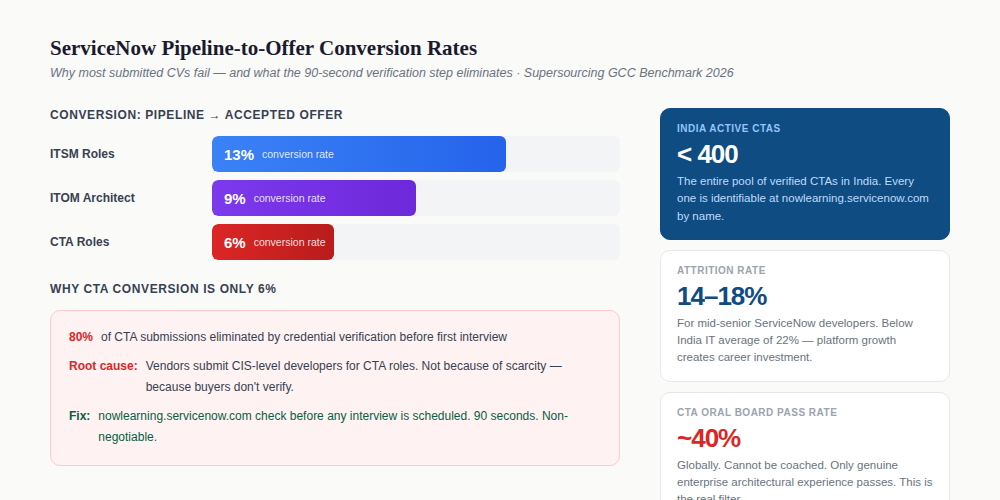
| What's typical attrition for ServiceNow specialists? | 14–18% for mid-senior developers. Lower than the 22% IT average because ServiceNow is a growing platform with a good career trajectory developers want to stay current. |
| What's the single biggest hiring mistake? | Treating ServiceNow as one skill. ITSM, ITOM, HRSD, CSM, SecOps, and GRC are different product lines requiring different architects. A strong ITSM developer is not automatically capable of ITOM Visibility. |
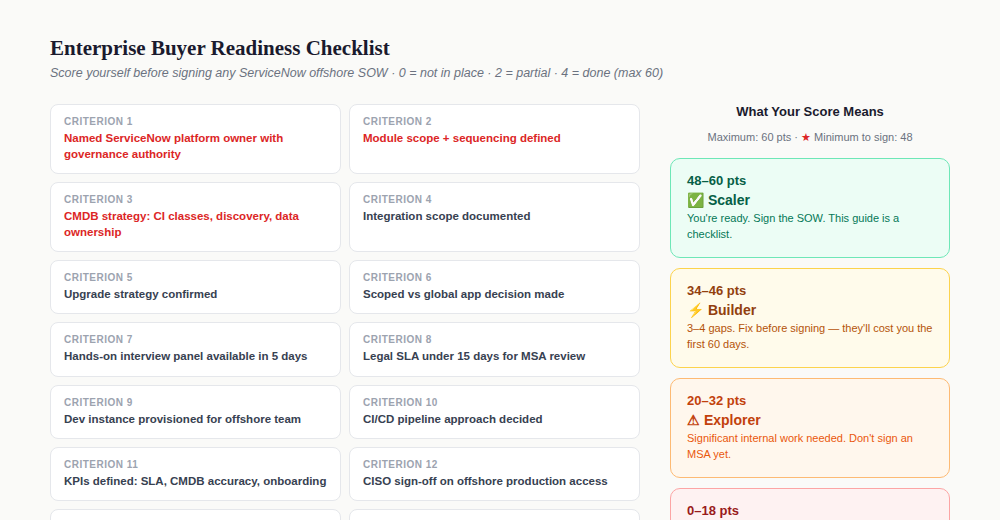
Are You Actually Ready for This?
ServiceNow engagements fail for buyer-readiness reasons at a high rate particularly multi-module programs where scope creep and unclear ownership compound delivery risk. Score yourself before you engage any vendor.
Score each: 0 (not in place), 2 (partially), 4 (done).
| # | Criterion | Score |
| 1 | Named ServiceNow platform owner. One person with authority over platform governance. | 0/2/4 |
| 2 | Module scope defined which ServiceNow products are in scope, in which order | 0/2/4 |
| 3 | CMDB strategy defined CI classes, discovery approach, and data ownership | 0/2/4 |
| 4 | Integration scope documented which source systems connect to ServiceNow | 0/2/4 |
| 5 | Upgrade strategy confirmed are you on a current release, and who owns upgrades | 0/2/4 |
| 6 | Scoped vs global application decision made for custom development | 0/2/4 |
| 7 | Interview panel with hands-on ServiceNow experience available within 5 business days | 0/2/4 |
| 8 | Legal SLA under 15 days for MSA review | 0/2/4 |
| 9 | ServiceNow development instance provisioned for offshore team | 0/2/4 |
| 10 | CI/CD pipeline approach decided ServiceNow DevOps, ATF, update sets | 0/2/4 |
| 11 | KPIs defined: incident resolution SLA, CMDB accuracy rate, onboarding completion rate | 0/2/4 |
| 12 | CISO signed off on offshore access to ServiceNow production instance | 0/2/4 |
| 13 | Escalation path defined: vendor PM → your ServiceNow Platform Lead → your CIO | 0/2/4 |
| 14 | IP ownership for custom applications, workflows, and integrations in MSA | 0/2/4 |
| 15 | Finance can process USD-denominated invoices within 30 days | 0/2/4 |
What your score means:
| Score | Tier | Reality Check |
| 48–60 | Scaler | You’re ready. This guide is a checklist. |
| 34–46 | Builder | 3–4 gaps. They’ll cost you the first 60 days. Fix before signing. |
| 20–32 | Explorer | Significant internal work needed. Don’t sign an MSA yet. |
| 0–18 | Pre-Stage | 90 days of internal platform definition before an offshore engagement makes sense. |
From the deal floor: A European healthcare system with 15,000 employees, ServiceNow ITSM live, planning HRSD and ITOM scored 16 on this checklist. Their CIO signed a 9-person SOW anyway. The CMDB strategy (criterion 3) had never been defined. The offshore team spent the first 10 weeks in discovery, debating CI class ownership with five internal stakeholders who had never agreed on a CMDB model. Ten weeks at €75/hr blended across 9 engineers: €270K spent on internal alignment that should have been complete before the SOW was signed.
The ServiceNow Talent Market in India 2026
ServiceNow is the fastest-growing enterprise platform in India’s technology services market. Every major IT services firm TCS, Infosys, Wipro, HCL, Cognizant has a ServiceNow practice. India produces more ServiceNow-certified professionals annually than any country outside the United States.
The paradox: the platform is growing fast, the certified pool is large, and the gap between “ServiceNow certified” and “ServiceNow architect” is the widest of any enterprise stack in this guide series.
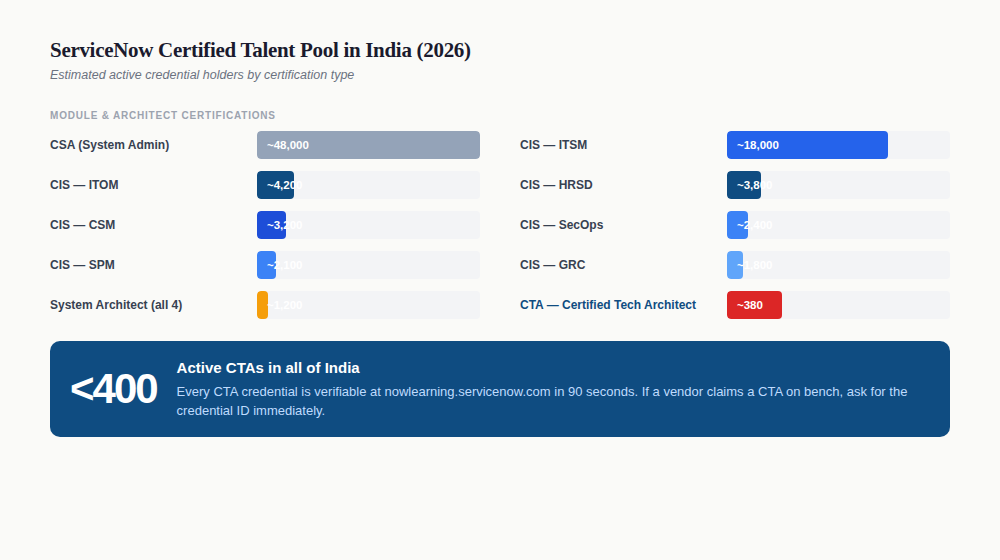
The certified pool:
| Certification | Estimated India Holders | Relevance |
| ServiceNow CSA (Certified System Administrator) | ~48,000 | Entry-level. Tests basic platform navigation and configuration. Required baseline, not a differentiator. |
| CIS (Certified Implementation Specialist) ITSM | ~18,000 | Module-level credential for ITSM. The most widely held CIS in India. |
| CIS ITOM | ~4,200 | ITOM Discovery, Service Mapping, and Visibility. Thinner pool. |
| CIS HRSD | ~3,800 | HR Service Delivery. Growing pool as HRSD adoption accelerates. |
| CIS CSM | ~3,200 | Customer Service Management. B2B and external customer programs. |
| CIS SecOps | ~2,400 | Security Operations. Vulnerability Response and Security Incident Management. |
| CIS GRC | ~1,800 | Governance, Risk, and Compliance. Policy management and audit programs. |
| CIS SPM (Strategic Portfolio) | ~2,100 | Project and portfolio management. Formerly IT Business Management. |
| System Architect credentials (all 4) | ~1,200 | The prerequisite track for CTA. Sharing & Visibility, Data, Integration, Development Lifecycle. |
| CTA (Certified Technical Architect) | ~380 | The highest ServiceNow credential. Oral review board required. Under 400 active in India. |
The number that matters most: 380. That is the real pool for architect roles on enterprise ServiceNow programs. Every vendor who claims a CTA on bench should produce the credential ID in 60 seconds. Under 400 people in India hold this credential. It is verifiable. There is no excuse for not verifying it.
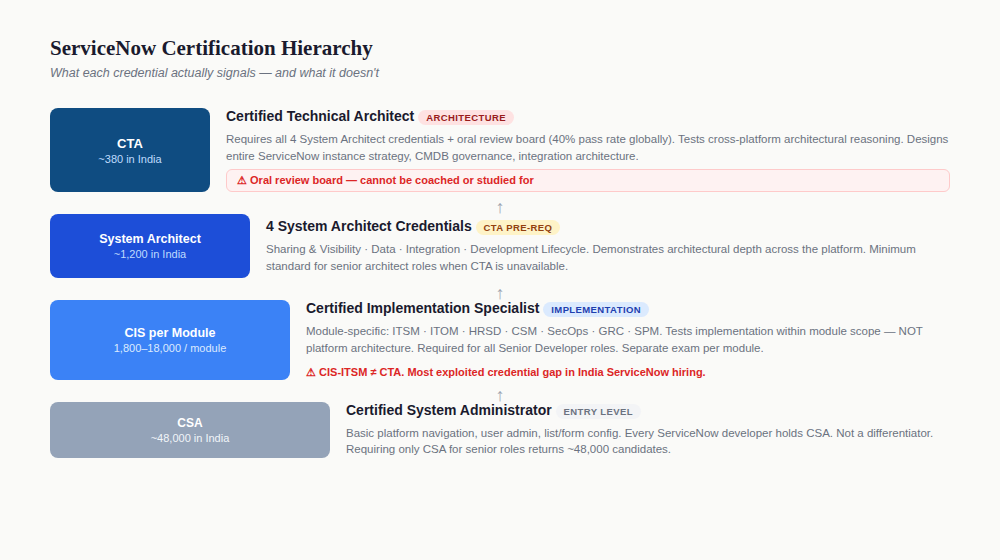
The CIS vs CTA distinction the most exploited gap in ServiceNow hiring:
CIS credentials are module-level implementation certifications. A CIS-ITSM verifies that a developer can implement ServiceNow ITSM incident management, change management, and problem management. It tests configuration within a defined module scope. A developer with CIS-ITSM can implement an ITSM program. They are not architects.
The CTA requires passing all four System Architect credentials: Sharing and Visibility Architect, Technical Architect, Integration Architect, and Development Lifecycle and Deployment Architect plus passing an oral review board examination before a panel of ServiceNow technical leaders. The oral board tests cross-platform architectural reasoning, not module configuration. A CTA can design the entire ServiceNow platform architecture, scoped application strategy, CMDB governance model, integration architecture, and upgrade safety framework.
Vendors routinely present CIS-level developers for architect roles and CTA positions. The distinction is verifiable at nowlearning.servicenow.com in 90 seconds. There is no reason to discover this discrepancy at the architecture review meeting.
The module specialisation problem:
ServiceNow has 26 product lines. Experience on one does not transfer automatically to others. The most common mismatches in India ServiceNow sourcing:
- ITSM experience presented as ITOM capability in a completely different architecture. ITOM requires network discovery knowledge, CI class design expertise, and CMDB governance depth that ITSM developers don’t have.
- HRSD experience presented as CSM capability, different data models, different user personas, different integration patterns.
- Basic CSM presented as Advanced Work Assignment (AWA) and Process Optimisation capability AWA is a sophisticated routing engine that requires specific configuration depth.
- SPM presented as full PPM capability project portfolio management has specific financial management and resource planning modules that basic SPM configuration doesn’t cover.
Where the talent lives:
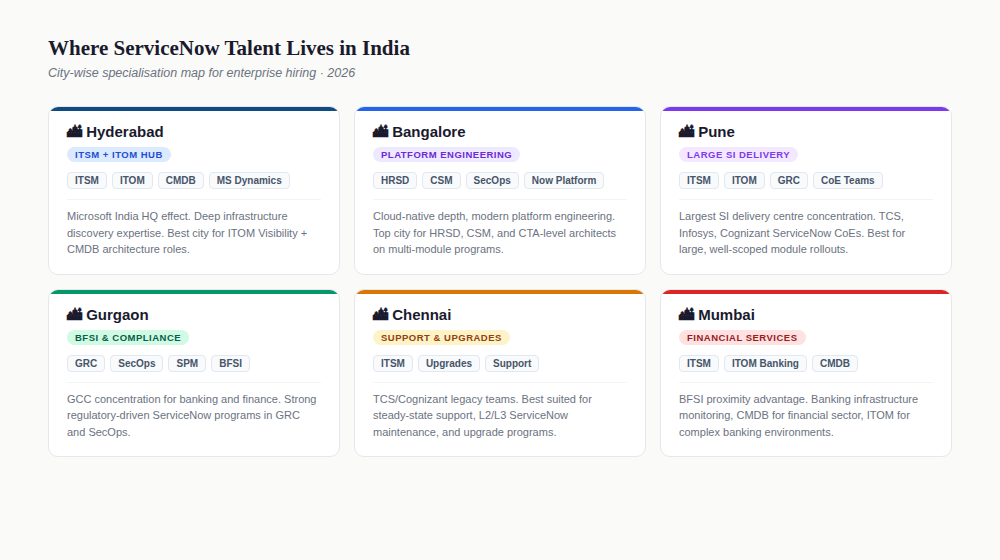
| City | Dominant ServiceNow Specialisations | Why |
| Hyderabad | ITSM, ITOM, CMDB design, Microsoft Dynamics integration | Microsoft India HQ effect. Large IT service management delivery centers. Strong infrastructure discovery background that feeds ITOM. |
| Bangalore | HRSD, CSM, SecOps, Platform Engineering, Now Platform development | Modern platform engineering talent. Cloud-native development depth. HRSD and CSM customer experience focus. |
| Pune | Large SI delivery programs (ITSM, ITOM, GRC), TCS/Infosys/Cognizant ServiceNow CoEs | Biggest SI delivery center concentration. Large program delivery capability. Strong in well-defined module implementations. |
| Gurgaon | BFSI ServiceNow programs, GRC, SecOps, SPM | BFSI GCC concentration. Regulatory and compliance-driven ServiceNow programs. |
| Chennai | Legacy ITSM support and maintenance, upgrade programs | TCS/Cognizant legacy. Strong in support and maintenance. Less in greenfield architecture. |
| Mumbai | Financial services ITSM, ITOM for banking infrastructure | BFSI proximity. Banking infrastructure monitoring and CMDB programs. |
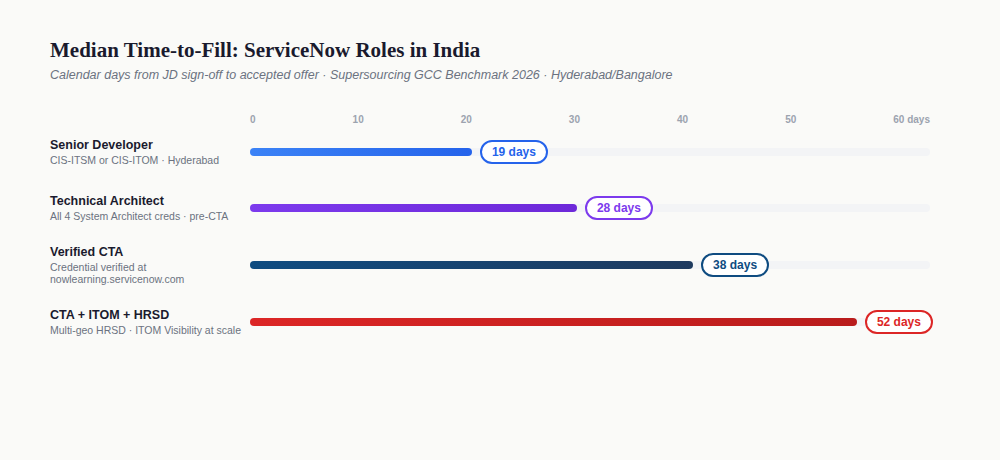
Supersourcing Index: Across 148 ServiceNow placements in the Supersourcing GCC Benchmark 2026, median time-to-fill for a Senior ServiceNow Developer (CIS-ITSM or CIS-ITOM) in Hyderabad was 19 calendar days. For a ServiceNow Technical Architect (System Architect credentials, pre-CTA): 28 days. For a verified ServiceNow CTA: 38 days. For a ServiceNow CTA with ITOM Visibility and HRSD multi-geography experience: 52 days.
The version currency problem:
ServiceNow releases two major versions per year named alphabetically (Tokyo, Utah, Vancouver, Washington, Xanadu, Yokohama as of May 2026). Each release introduces changes to Flow Designer, UI Builder, platform APIs, and product module behaviour. A developer whose last production project ran in Paris (released 2020) has missed Québec, Rome, San Diego, Tokyo, Utah, Vancouver, Washington, Xanadu, and Yokohama 9 releases, approximately 4.5 years of platform evolution.
This is not a minor gap. Flow Designer was overhauled post-Paris. UI Builder replaced the legacy portal framework as the primary UI development tool. ITOM Visibility was architecturally redesigned. AI Search replaced the legacy search framework. A Paris-era developer’s knowledge of these areas is outdated.
Require current version experience within 2 releases of the current platform release. A developer who cannot name the last ServiceNow release they worked on in production is either not current or not honest about their recency.
Red flag: Any vendor claiming a CTA on bench who cannot produce the credential ID from nowlearning.servicenow.com within 60 seconds does not have a CTA. Under 400 people in India hold this credential. It is not misplaced. It is either there or it isn’t.
What You’re Really Paying
Rate Table by Level
| Level | Experience | India Rate ($/hr) | US Equivalent ($/hr) | Annual Saving ($) |
| ServiceNow Developer | 2–4 yr | $25–42 | $80–110 | $114K–$140K |
| Senior Developer | 4–7 yr | $42–65 | $110–150 | $140K–$176K |
| Technical Lead / Sr. Technical Lead | 6–10 yr | $58–88 | $140–195 | $172K–$222K |
| Technical Architect (pre-CTA) | 8–12 yr | $75–110 | $165–230 | $187K–$250K |
| CTA (Certified Technical Architect) | 10–14 yr | $95–130 | $200–275 | $218K–$301K |
| Principal Architect / Platform SME | 14+ yr | $118–155 | $245–320 | $265K–$337K |
The 4 Cost Layers
Layer 1 Gross CTC A Senior ServiceNow Developer with 5 years and CIS certification earns ₹26–40 LPA. At ₹96.4/$1, that’s $27K–$41K annually $13–20/hr at gross level.
Layer 2 Employer Burden PF (12%), ESIC (3.25%), Gratuity (8.33–20%), LWF, performance bonus. Total: 22–28% on top of gross CTC. A ₹32 LPA developer costs the vendor ₹39–41 LPA all-in.
Layer 3 Vendor Margin For ServiceNow specialist staffing: 18–24%. ServiceNow is a growing platform with genuine demand. Vendors with strong ServiceNow bench command higher margins than commodity stacks.
Layer 4 What Hits Your Invoice Senior ServiceNow Developer: $42–65/hr. At 2,000 hours/year, a 10-developer team at blended $55/hr costs $1.1M annually. US equivalent: $2.6–3.0M. Annual saving on a 10-person team: $1.5–1.9M.
The CTA premium: CTAs command 45–60% premium over pre-CTA technical architects at the same experience level. A Technical Architect at $90/hr becomes a CTA at $110–130/hr. The premium is justified under 400 CTAs in India, growing demand, and oral board requirement that cannot be coached. Vendors who quote CTA rates without CTA credentials are charging a premium for a credential the candidate doesn’t hold.
The module complexity premium: Developers with ITOM Visibility, SecOps, or GRC module experience command 15–20% premium over ITSM-only developers at the same level. These modules are genuinely more complex, the pool is thinner, and the verification is easier. Fewer candidates claim ITOM depth because fewer have it.
The multi-module premium: A developer who can deliver across ITSM + ITOM + CMDB or HRSD + CSM commands 10–15% premium over single-module specialists. Multi-module capability reduces the number of developers needed on a program and simplifies governance.
Blended team math: A 10-developer ServiceNow team 1 CTA, 1 technical architect, 3 senior developers, 4 developers, 1 QA at market rates runs approximately $1.0–1.2M annually. The US equivalent: $2.5 — 3.1M. Annual saving: $1.3–1.9M.
The Certification Hierarchy What Actually Matters
ServiceNow CSA (Certified System Administrator) Entry-level. Tests basic platform navigation, list and form configuration, user administration, and fundamental workflow design. Every ServiceNow developer in India has or should have CSA. It is not a differentiator. It is a baseline. Requiring CSA alone filters nothing.
CIS Certified Implementation Specialist (per module) Module-level credentials. Each CIS tests implementation knowledge for a specific ServiceNow product ITSM, ITOM, HRSD, CSM, SecOps, GRC, SPM. A CIS-ITSM developer can implement ITSM. A CIS-ITOM developer can implement ITOM Discovery and Visibility. Each CIS requires separate study and a separate exam. For senior developer roles, require the CIS relevant to your program scope. A Senior HRSD Developer without CIS-HRSD is a developer who has worked on HRSD without passing the module certification either their experience is limited or they haven’t prioritised certification. Either is a flag.
System Architect Credentials (4 required for CTA track) The four System Architect credentials are the pre-requisite track for CTA:
- Certified System Architect Sharing and Visibility: Data access controls, ACLs, user criteria, scoped application security.
- Certified System Architect Data: Data model design, CMDB architecture, table hierarchy, data policies.
- Certified System Architect Integration: REST/SOAP integration design, IntegrationHub, MID Server architecture, third-party integration patterns.
- Certified System Architect Development Lifecycle and Deployment: Update set management, automated testing framework, DevOps toolchain, upgrade safety.
A developer who holds all four System Architect credentials is CTA-track; they have demonstrated architectural depth across the platform. They are not yet a CTA (the oral board remains), but they have the foundation. For senior technical architect roles on complex programs, requiring all four System Architect credentials is a reasonable and verifiable standard.
CTA Certified Technical Architect The highest ServiceNow credential. Requires: all four System Architect credentials, a portfolio of complex enterprise implementations, and passing an oral review board before a panel of ServiceNow technical leaders. The oral board tests architectural reasoning: how would you design a complex multi-domain ServiceNow instance, how would you approach a CMDB governance challenge at a 100,000-seat enterprise, and how would you architect upgrade safety for a heavily customised implementation. Fewer than 400 active CTAs in India. The oral board cannot be coached with study guides. It requires genuine architectural experience.
Verify at: nowlearning.servicenow.com. Search by name. Every active ServiceNow credential appears CSA, each CIS, each System Architect credential, and CTA if held. A CTA appears as a distinct credential separate from the System Architect credentials. If the CTA credential is not present, the candidate does not hold it.
The oral board reality: The CTA oral board has approximately a 40% pass rate globally. Candidates who have studied the platform but haven’t delivered complex enterprise architecture fail it. This is the filter that makes the CTA a genuine signal of capability that cannot be acquired by studying. It requires having made real architectural decisions on real enterprise programs and being able to defend them to a panel of experts.
Version currency in certification: ServiceNow periodically requires certification maintenance module updates and platform changes require certified practitioners to complete maintenance requirements to keep credentials active. An expired credential means the engineer has not maintained their certification. Check not just that the credential exists but that its status is Active.
The JD That Attracts the Right Candidates
JD 1: Senior ServiceNow Developer ITOM Visibility + CMDB (4–7 years)
Senior ServiceNow Developer ITOM / CMDB Remote from India Engagement: Staff Augmentation | Duration: 12 months, renewable Rate: ₹26–40 LPA CTC equivalent | Billing: $42–65/hr (vendor-facing)
What you’ll own: ITOM Visibility configuration and CMDB governance on our ServiceNow Washington/Xanadu instance. You’ll configure Discovery schedules, MID Server topology, CI classification rules, and Service Mapping patterns. You’ll work alongside our platform architect on CMDB health deduplication, relationship accuracy, and class model governance. Measured on CMDB accuracy rate, CI deduplication percentage, and Discovery coverage.
What we require:
- CIS-ITOM certification (active verified at nowlearning.servicenow.com before interview)
- 4–7 years ServiceNow experience, minimum 2 years in ITOM Discovery and Visibility in production
- MID Server topology design horizontal vs vertical scaling, cluster configuration, probe/sensor selection
- CI classification model design class hierarchy decisions, relationship type selection, deduplication rules
- Service Mapping experience application pattern creation, connection tracking, dependency mapping
- Current version experience Washington or Xanadu release production experience required
What disqualifies you:
- ITSM-only experience with no ITOM production exposure
- ITOM experience limited to running pre-built Discovery schedules without classification model design
- Last production ServiceNow project on Paris or earlier release
- No MID Server architecture experience running a single MID Server is not MID Server architecture
Interview process: Technical screen (30 min) → Live ITOM Discovery configuration task in ServiceNow PDI (90 min) → CMDB class model design discussion with Platform Architect (45 min)
JD 2: ServiceNow CTA / Technical Architect Multi-Module Enterprise Program (10+ years)
ServiceNow CTA or Senior Technical Architect India GCC or BOT Engagement: GCC Build or BOT | Duration: 24+ months CTC: ₹75–115 LPA | Billing: $95–130/hr (vendor-facing)
What you’ll own: Platform architecture for a multi-module ServiceNow program ITSM, ITOM, HRSD, and CSM in scope. You will own the instance strategy (single vs multi-instance), scoped application design, CMDB governance model, integration architecture via IntegrationHub, upgrade safety framework, and ATF test strategy. Technical authority for a team of 12–25 ServiceNow developers.
What we require:
- ServiceNow CTA preferred; all four System Architect credentials required as minimum
- 10+ years ServiceNow, minimum 3 multi-module enterprise programs as architect of record
- Single vs multi-instance architectural decision-making experience can defend the decision with specific tradeoffs
- Scoped application design isolation strategy, cross-scope access patterns, upgrade safety implications
- CMDB governance design CI class hierarchy for 50,000+ seat enterprise, ownership model, health metrics
- Integration architecture IntegrationHub spoke design, MID Server topology, REST/GraphQL integration patterns
- Upgrade safety framework customisation classification (supported vs unsupported), ATF coverage requirements, upgrade testing approach
Interview process: Architecture whiteboard (60 min) → Live multi-module design scenario (45 min) → CTA credential verification (nowlearning.servicenow.com, done before scheduling) → Reference call with prior CIO or Enterprise Architect
What most enterprise JDs get wrong for ServiceNow:
They require “ServiceNow experience” without specifying the module which returns 48,000 CSA holders. They list multiple modules at equal depth “ITSM, ITOM, HRSD, CSM, SecOps experience required” which is either impossible at genuine depth in one person or signals the buyer doesn’t know which module matters most. They say “CTA preferred” instead of making it a requirement for architect roles which signals to actual CTAs that the role might go to a CIS-level developer anyway. And they don’t specify the ServiceNow release version which means developers in Paris and Tokyo apply equally for Xanadu programs.
How to Verify Experience Not Just Credentials
The 3 verification steps before any ServiceNow interview:
Step 1: nowlearning.servicenow.com verification
Before scheduling any interview, go to nowlearning.servicenow.com and search by the candidate’s name or credential ID. Every active ServiceNow credential appears CSA, each CIS by module, each System Architect credential, and CTA. Verify:
- CTA credential present and Active if not present, they don’t hold it
- CIS credentials match the modules claimed CIS-ITOM for an ITOM role, CIS-HRSD for HRSD
- System Architect credentials present if claiming architect-level capability
- All credentials Active expired credentials indicate the engineer has not maintained their certification
This takes 90 seconds. Do it before the first interview is scheduled. Discovering a misrepresented CTA claim after a two-hour architecture session wastes time and signals to vendors that you’ll accept unverified talent.
Step 2: Release version specificity
Ask in writing before scheduling: “What is the most recent ServiceNow release you’ve worked on in a production environment, and which modules were in scope?” The answer must name a specific release (Washington, Xanadu, Yokohama). If the candidate names Paris, San Diego, or earlier they are not current. Current means within 2 releases of today’s platform. Outdated version experience on a current platform program adds ramp time that effectively extends your delivery timeline.
Step 3: Instance scale and complexity cross-check
Ask for the number of users, CI records, and active integrations on the largest ServiceNow instance they’ve architected or developed on. Real enterprise developers name specific numbers “42,000 users, 380,000 CI records, 14 IntegrationHub spokes active.” Tutorial or lab-environment candidates describe their experience conceptually without numbers. Scale context is the fastest filter between genuine enterprise experience and lab or demo environment work.
The 5 interview questions that expose fake seniority:
Q1: CMDB Design “Walk me through your CI class hierarchy design for a 60,000-seat enterprise with on-premise, Azure, and AWS infrastructure, your class decisions, relationship type selections, and how you handled deduplication between Discovery sources.”
Real answer: describes the CI class hierarchy decisions (CMDB_CI base, Hardware, Computer, Windows Server, Linux Server, Virtual Machine Instance, Cloud Instance and why they chose the level of specificity they did), the relationship types used (Runs on, Hosted on, Depends on and when each applies), the deduplication rule configuration in ServiceNow’s Identification and Reconciliation Engine (IRE), and how they handled the multi-source problem Discovery finding the same CI that was also imported from an Azure Resource Manager integration.
Tutorial candidate describes the CMDB concept correctly. Cannot describe IRE configuration, deduplication rule design, or multi-source reconciliation. Says “we configured Discovery to populate the CMDB.”
Q2: MID Server Topology “Describe your MID Server topology design for a 30,000-device ITOM Visibility environment with devices across 8 network segments. How did you determine horizontal vs vertical scaling, cluster configuration, and probe/sensor assignments?”
Real answer: describes the MID Server placement decisions (one per network segment for SNMP discovery, shared cluster for API-based cloud discovery), the cluster configuration (worker threads, memory allocation, probe queue depth), how they determined the number of MID Servers needed (device count per MID Server capacity, probe type distribution), and the specific probe/sensor assignments for different device types SNMP probes for network devices, WMI probes for Windows, SSH probes for Unix/Linux.
Tutorial candidate describes MID Servers as “the connection point between ServiceNow and the network.” Cannot describe cluster configuration or probe capacity planning.
Q3: Flow Designer vs Workflow Editor “When do you choose Flow Designer over Workflow Editor, and what are the upgrade safety implications of keeping legacy Workflow Editor workflows in a production instance?”
Real answer: Flow Designer is ServiceNow’s current workflow automation tool upgrade-safe, Action-based, supports reusable subflows, and integrates with IntegrationHub. Workflow Editor is legacy being deprecated by ServiceNow, less upgrade-safe, some workflow activities are not supported in newer releases. Upgrade safety implication: legacy Workflow Editor workflows require review on every ServiceNow upgrade because deprecated activities may break. The correct answer for new development is Flow Designer. Legacy workflows should be migrated on a planned schedule. They describe specific migration considerations and the risk of deferring migration.
The tutorial candidate says “Flow Designer is newer and better.” Cannot describe the deprecation timeline, upgrade safety risks, or migration approach for legacy workflows.
Q4: Scoped Application Design “Explain your scoped application design decisions for a large HRSD implementation, what goes in the scoped application, what stays global, and how you handle cross-scope access for shared data.”
Real answer: describes the isolation rationale for scoped applications (upgrade safety, customisation containment, multi-tenant separation), what belongs in scope (custom tables, business rules, UI policies specific to HRSD extensions), what stays global (shared CMDB tables, core ITSM processes that HRSD integrates with), and how cross-scope access is granted (application Cross-Scope Access privileges, explicit grants for tables and script includes). They describe specific decisions and tradeoffs they’ve made.
Tutorial candidate describes scoped applications conceptually. Cannot describe cross-scope access mechanics or explain why specific components should be in scope vs global.
Q5: Integration Architecture “Walk me through your IntegrationHub architecture for a ServiceNow-to-Workday HRSD integration, the spoke design, trigger approach, error handling, and how you managed the data mapping between Workday’s data model and ServiceNow’s HR Profile.”
Real answer: describes the IntegrationHub spoke structure (custom Workday spoke or use of existing Workday spoke if available), the trigger approach (scheduled data sync vs event-driven via Workday studio notifications), the specific action steps in the Flow (REST API call to Workday, transform to ServiceNow HR Profile schema, upsert logic), error handling (retry logic, dead letter queue approach, notification on persistent failure), and the data mapping decisions which Workday fields map to which ServiceNow HR Profile fields and how they handled the N:1 or 1:N relationships.
Tutorial candidate describes the concept of integrating Workday with ServiceNow. Cannot describe IntegrationHub spoke structure, action step configuration, or specific data mapping decisions.
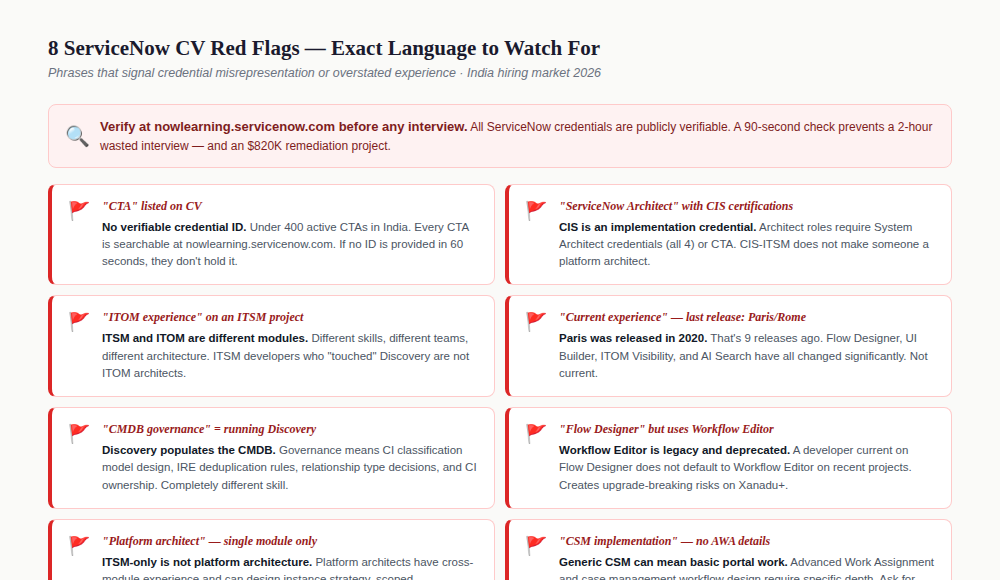
8 CV red flags exact language to watch for:
- “CTA” listed without a verifiable credential ID from nowlearning.servicenow.com
- “ServiceNow Architect” with only CIS-level certifications CIS is implementation, not architecture
- “ITOM experience” on a project that was purely ITSM they are different modules, different teams, different skills
- “Current ServiceNow experience” with the last release named being Paris, Rome, or San Diego those releases are 3–5 years old
- “CMDB governance experience” that is limited to running Discovery without classification model design
- “Flow Designer experience” alongside heavy Workflow Editor usage on recent projects a developer fully current on Flow Designer is not defaulting to Workflow Editor
- “Platform architect” who has only worked on single-module implementations ITSM-only is not platform architecture
- “CSM implementation experience” without Advanced Work Assignment or case management workflow design specifics generic CSM can mean basic portal work
How to Source What’s Working, What Isn’t
What’s working in 2026:
ServiceNow Partner network.
ServiceNow maintains a tiered partner directory Premier, Elite, and Global Elite partners. India has approximately 40 ServiceNow Elite and Global Elite partners. These partners are required to maintain certified headcount as a condition of their partner status which means their developers are, at minimum, currently certified. A direct inquiry to 3–4 Elite partners about available benches yields a curated shortlist with verified certification as a baseline filter already applied.
ServiceNow Community and Knowledge conference network.
ServiceNow’s annual Knowledge conference (Las Vegas) and regional community events have strong India chapter participation. The CTAs and senior Technical Architects in India who attend and present at Knowledge are publicly identifiable. A VP IT who reviews the Knowledge speaker list and India community contributor list before engaging vendors has a shortlist of names worth asking for specifically.
3 ready-to-use LinkedIn boolean search strings:
- String 1 (CTA or System Architect): “ServiceNow” AND (“CTA” OR “Certified Technical Architect” OR “System Architect”) AND (“India” OR “Hyderabad” OR “Bangalore”)
- String 2 (ITOM / CMDB Specialist): “ServiceNow” AND “ITOM” AND (“Discovery” OR “CMDB” OR “Visibility”) AND (“Senior” OR “Lead” OR “Architect”) AND “India”
- String 3 (HRSD Multi-Geography): “ServiceNow” AND “HRSD” AND (“multi-country” OR “global” OR “multi-geography”) AND “India”
ServiceNow User Groups India.
ServiceNow has active user group chapters in Hyderabad, Bangalore, Pune, and Gurgaon. User group leads and frequent contributors are senior practitioners with verifiable community presence. Engagement with user group communities sponsoring events, contributing content creates direct access to the practitioner community that outperforms job boards.
Supersourcing pre-vetted bench. For Senior ServiceNow Developers (CIS-ITSM or CIS-ITOM, current release), Supersourcing’s median fill time is 19 calendar days. For verified CTAs, 38 days with credential verification at nowlearning.servicenow.com completed before the first CV is submitted.
What isn’t working:
Generic “ServiceNow developer” postings on Naukri.
Returns 48,000+ CSA holders. Every ServiceNow developer in India has CSA. The signal-to-noise ratio is the lowest of any enterprise platform. Without module specificity, current version requirement, and certification level in the posting, you’re reviewing the broadest possible pool.
Asking vendors for “ServiceNow CVs” without module and certification specification.
The most common ServiceNow sourcing failure. Without specifying CIS-ITOM for an ITOM role, or System Architect credentials for an architect role, vendors send ITSM developers for every ServiceNow requirement. They have more ITSM developers than any other module. Your brief determines what you get.
Accepting CSA as the only certification requirement for senior roles.
CSA is the minimum baseline, not the senior developer standard. A “Senior ServiceNow Developer” role that requires only CSA is a junior developer role by market definition. Require the relevant CIS for the module in scope. For architect roles, require System Architect credentials or CTA.
Scheduling CTA interviews without credential verification.
The most expensive ServiceNow hiring mistake. A two-hour CTA architecture interview with a candidate who holds CIS-ITSM (not CTA) costs time, signals to vendors that you’ll accept misrepresentation, and produces a hiring decision based on false premises. The 90-second nowlearning.servicenow.com check prevents this entirely.
Supersourcing Index: Pipeline-to-offer conversion rate for ServiceNow roles in the Supersourcing GCC Benchmark 2026: 13% for ITSM roles, 9% for ITOM architect roles, 6% for CTA roles. The CTA conversion rate is low not because CTAs are rare (they are) but because vendors frequently submit non-CTA candidates for CTA roles. The verification step eliminates 80% of CTA submissions before a single interview is scheduled.
The Contract Stack for ServiceNow Engagements
Clause 1: Individual Resource Approval with Certification ID and Module Specification
Every developer approved for the engagement must be listed in the SOW schedule with: name, ServiceNow credential IDs (CSA, relevant CIS, System Architect credentials, CTA if applicable), and module scope of work. Credential IDs must be verifiable at nowlearning.servicenow.com. A developer substituted from ITSM scope to ITOM scope without client approval is a material scope change; the module specification in the SOW makes this contractually clear.
Clause 2: Substitution Notice 14 Days, Certification Equivalence Required
14 days written notice and client approval for any personnel change. The replacement must hold equivalent ServiceNow certifications at the same module and level. A CTA cannot be replaced by a CIS-level developer without client approval. A CIS-ITOM developer cannot be replaced by a CIS-ITSM developer for an ITOM workstream. Certification equivalence must be verified before the replacement begins work.
Clause 3: IP Assignment Custom Applications and Integrations
Executed within 5 business days per developer. Must explicitly cover: custom scoped application code and configuration, Flow Designer flows and subflows created for the engagement, IntegrationHub spoke definitions and action configurations, custom table structures and field configurations, ATF test scripts, and UI Builder page configurations. Standard “software code” IP clauses are insufficient for ServiceNow because many of these artifacts are configuration, not code in the traditional sense. Name them specifically.
Clause 4: Instance Access Revocation 24 Hours
All vendor developer accounts in your ServiceNow instances (production, UAT, and development) must be deactivated within 24 hours of engagement end. ServiceNow user deactivation in production must be confirmed in writing. MID Server service accounts used by vendor engineers must be reviewed and rotated. Update set import access for the production instance must be revoked.
Clause 5: Update Set Governance
All customisations made by vendor engineers must be captured in named update sets following your naming convention, reviewed by your internal platform lead before UAT promotion, and approved by your Platform Owner before production deployment. No direct production changes. No update set imports without dual approval. This clause prevents the most common governance failure in ServiceNow engagements unreviewed customisations accumulating in production that break on the next upgrade.
Running a ServiceNow Team at Scale
Governance model for a 15–25 developer ServiceNow program:
Instance strategy and environment governance.
Production, UAT, and development must be separate ServiceNow instances not separate scopes on the same instance. Development work happens in PDIs (Personal Developer Instances) or a shared development instance. UAT promotion goes through your change control process. Production deployment requires Platform Owner approval and change management record. Offshore developers should not have direct production access except for approved system administrators.
Update set discipline.
The single most important governance decision in a multi-developer ServiceNow program. Every developer works in named update sets. Update sets follow a naming convention: [Module]-[Developer Initials]-[Date]-[Description]. Update sets are reviewed before UAT promotion. No orphaned update set in production. This sounds basic; it is violated on the majority of large offshore ServiceNow programs.
ATF (Automated Testing Framework) as a delivery gate.
Require ATF test coverage for every new feature before UAT promotion. ATF tests run on every update set promotion. A failed ATF test blocks promotion until resolved. This is the most effective quality gate in ServiceNow development and the most commonly skipped step on offshore programs where delivery speed is prioritised over quality.
Upgrade safety classification.
Every customisation delivered by the offshore team should be classified at delivery: supported customisation (using ServiceNow-approved extension points), unsupported customisation (modifying base system records), or technical debt (shortcuts that work now but create upgrade risk). Unsupported customisations must be approved by your Platform Owner with a documented plan for remediation. Technical debt must be logged and scheduled. This classification creates the upgrade safety audit trail that every ServiceNow admin needs for major version upgrades.
Early warning signals that a ServiceNow developer is disengaging:
- Declining ATF test coverage on submitted update sets
- Increasing number of update set conflicts at UAT promotion
- Missing sprint demos no live demonstration of delivered functionality
- Slow response to platform upgrade preparation requests
- LinkedIn activity ServiceNow credentials updated, new connections from SI partners
Retention levers specific to ServiceNow developers in India:
Certification progression is the primary lever. ServiceNow has a clear certification path CSA → CIS (per module) → System Architect credentials → CTA. Developers who are progressing along this path are invested in their ServiceNow career. Sponsor the next certification. A CIS-ITOM developer who is studying for their second System Architect credential is not looking for the door.
Module expansion keeps them. A developer who has worked exclusively on ITSM and gets exposure to ITOM or HRSD on your program is building capability that has direct market value. Module breadth is the ServiceNow career development currency. Engineers who expand their module coverage on your program acknowledge the value and stay.
Platform ownership creates retention. Developers who are the named expert for a specific module on your program “this developer owns our HRSD configuration” have an identity in the engagement that is difficult to leave mid-ownership. Assign module ownership deliberately.
When Things Go Wrong
Pattern 1: The CMDB Collapse
Described in Section 1. The logistics company pattern repeats across enterprises ITOM Discovery deployed without a CI classification model, CMDB populated with thousands of undeduplicated, unclassified CIs, platform rendered unusable for incident routing, change impact analysis, and service mapping.
The root cause in every case: an ITSM developer was assigned to ITOM work. ITSM developers understand ServiceNow. They do not understand CMDB class model design, CI relationship governance, or the Identification and Reconciliation Engine configuration that prevents deduplication failures.
The fix: the module specification in the JD and SOW (CIS-ITOM required, CMDB class model design experience required) and the CMDB design question in Section 8. These two filters prevent the pattern entirely.
Pattern 2: The Upgrade Crisis
A European financial services company with 22,000 employees, ServiceNow in Washington hired an offshore team that delivered 18 months of ITSM and HRSD customisation. The team was skilled and delivered well. The problem surfaced at the Xanadu upgrade.
The offshore dedicated development team had used Workflow Editor extensively, the legacy workflow tool, because they were more comfortable with it than Flow Designer. The upgrade to Xanadu deprecated several Workflow Editor activities used in their HRSD onboarding workflows. Three critical workflows broke on the upgrade. The HRSD platform was unavailable for 4 days during the upgrade window while the workflows were rebuilt in Flow Designer.
The upgrade safety classification clause in Section 10 and the Flow Designer vs Workflow Editor question in Section 8 would have caught this. Unsupported customisations using deprecated tools should have been flagged at delivery and scheduled for remediation before the upgrade window.
Pattern 3: The Fake CTA
A US-based technology company hired a “ServiceNow CTA” at $125/hr for a major platform architecture program. The vendor had presented a CV listing CTA as a credential. The client’s procurement team did not verify at nowlearning.servicenow.com.
The “CTA” was discovered at the first architecture review; the architect could not answer the scoped application cross-scope access question (Q4 in Section 8). The client’s internal ServiceNow admin, who held all four System Architect credentials but not yet CTA, knew more about platform architecture than the claimed CTA.
The credential check at nowlearning.servicenow.com took 90 seconds after the architecture review and confirmed: the candidate held CIS-ITSM and CIS-HRSD. No System Architect credentials. No CTA. The vendor had listed CTA on the CV based on the candidate’s self-representation. Nobody verified.
The engagement was restructured and a genuine CTA was sourced at 38-day median fill, the first 6 weeks of architecture work was reviewed and partially redone, and the vendor refunded 4 weeks of billing. The 90-second check before scheduling would have saved all of it.
When India Is the Wrong Call
Three scenarios where India-based ServiceNow hiring creates more risk than value.
Scenario 1: Real-time ServiceNow SecOps with active SOC integration.
ServiceNow SecOps integrated with an active SOC where security incidents are being triaged, enriched, and responded to in real-time creates a timezone challenge for India-based engineers. If the SOC operates during US business hours and security incidents require real-time ServiceNow configuration changes or workflow adjustments during incident response, the IST timezone gap (US afternoon = India midnight) makes India-based engineers operationally impractical for real-time SOC support. India-based engineers work well for SecOps development and configuration in non-production environments. For live production SOC support during US business hours, consider EMEA or Americas-based engineers.
Scenario 2: Highly regulated single-tenant environments with restricted data access.
Some enterprise ServiceNow implementations handle data classified at a level that cannot be accessed by offshore engineers US government-adjacent programs, certain defence contractor environments, or programs with data residency requirements that specifically prohibit offshore access. For these programs, offshore development in masked or non-production environments with onshore promotion to production is possible, but adds significant governance overhead. If your ServiceNow instance handles genuinely restricted data, assess the offshore access model with your compliance team before signing.
Scenario 3: Sub-5 developer programs with niche module combinations.
A 3-developer program requiring HRSD + Employee Center Pro + Advanced HR Case Management is too small for enterprise staffing economics and too niche for a general IT vendor’s bench. For small programs with niche module requirements, a ServiceNow-specialist boutique partner or an independent contractor with verified credentials is a better fit than enterprise staff augmentation.
The Supersourcing Vendor Scorecard ServiceNow Edition
Score your vendor before you sign. Maximum 100 points. Minimum threshold to proceed: 65.
Category 1: Bench Depth and Certification Accuracy (0–20 pts)
| Criterion | 0 | 10 | 20 |
| Can produce nowlearning.servicenow.com credential IDs for all claimed bench within 60 seconds | Cannot | Some | All bench, all credentials |
| CTA distinction from CIS acknowledged proactively | Conflates them | Distinguishes when asked | Proactively verifies CTA separately |
| Module-specific bench depth (CIS-ITOM, CIS-HRSD separate from CIS-ITSM) | ITSM only | Some module depth | Module-specific verified bench |
Category 2: Vetting Process (0–20 pts)
| Criterion | 0 | 10 | 20 |
| Module-specific technical assessment (not generic ServiceNow questions) | Generic platform questions | Module-specific written | Live PDI assessment required |
| Version currency verification in technical screen | Not checked | Asked verbally | Verified against nowlearning history |
| Architecture-specific questions for architect roles | None | Basic platform questions | Scoped application + CMDB design questions |
Category 3: Contract Readiness (0–20 pts)
| Criterion | 0 | 10 | 20 |
| IP Assignment covering scoped applications, flows, and IntegrationHub spokes | Not available | Available on request | Standard, items named specifically |
| Update set governance clause | Not present | Best effort reference | Contractual requirement with approval gate |
| Instance access revocation 24 hours, all instances named | Not present | Present, vague | Present, production/UAT/dev named |
Category 4: ServiceNow Delivery Track Record (0–20 pts)
| Criterion | 0 | 10 | 20 |
| Named enterprise ServiceNow clients by module delivered | None | Logo only | Named contact + module confirmed |
| Completed multi-module programs verifiable | None claimed | Claimed, unverified | Verified with go-live and module scope |
| Attrition on ServiceNow programs | Unknown / >20% | 15–20% | <15% |
Category 5: Commercial Structure (0–20 pts)
| Criterion | 0 | 10 | 20 |
| Rate card by certification level (CSA/CIS/System Architect/CTA) | Single rate | CSA vs CIS distinction | Full certification level matrix |
| Substitution clause with certification equivalence requirement | Not present | Available | Standard, cert level equivalence specified |
| SLA on replacement 14 days with certification verification | None | Best effort | Contractual 14-day SLA with cert check |
Score interpretation:
- 85–100: Shortlist. Proceed to SOW negotiation.
- 65–84: Proceed with conditions. Close Category 1 and 2 gaps before signing.
- 45–64: Red flag. Negotiate hard on Categories 1, 2, and 3 minimums or find another vendor.
- Below 45: Walk.
15 Questions Buyers Actually Ask
Q: What is the difference between a ServiceNow CTA and a CIS?
CIS (Certified Implementation Specialist) is a module-level credential that verifies that a developer can implement a specific ServiceNow product. CIS-ITSM for ITSM, CIS-ITOM for ITOM, CIS-HRSD for HRSD. It is an implementation credential, not an architecture credential. CTA (Certified Technical Architect) requires all four System Architect credentials plus passing an oral review board before ServiceNow technical leaders. It validates platform-wide architectural capability instance strategy, CMDB governance, integration architecture, and upgrade safety. A CIS developer can implement a module. A CTA can design the entire platform. They are not comparable credentials. For architect roles, require CTA or all four System Architect credentials at minimum.
Q: How do I verify a ServiceNow CTA credential?
Go to nowlearning.servicenow.com and search by the candidate’s name. Every active ServiceNow credential appears in the profile CSA, each CIS, each System Architect credential, and CTA if held. The CTA appears as a distinct credential. If it is not present, the candidate does not hold it. This takes 90 seconds and should be done before scheduling any interview for an architect role.
Q: Can a strong ITSM developer learn ITOM on the job?
With structured training and a 3–4 month ramp period yes, for mid-level ITOM work. For ITOM architecture CI classification model design, CMDB governance, MID Server topology for large environments ITSM-only experience is insufficient without significant ramp time. For senior ITOM roles, require CIS-ITOM and production ITOM experience. For architect roles, do not assume ITSM-to-ITOM transfer without verifying ITOM-specific interview questions.
Q: What’s the realistic timeline to hire a ServiceNow CTA in India?
38 calendar days from JD sign-off to accepted offer with pre-verified bench, per the Supersourcing GCC Benchmark 2026. The pool of active CTAs in India is under 400. Competition for CTA profiles is intense and every major enterprise ServiceNow program is looking for the same profiles. If you need a CTA in under 21 days, expect to pay a bench fee to hold a verified profile while your legal team reviews the MSA.
Q: Should I require all four System Architect credentials or is CTA the only acceptable standard for architect roles?
For architect roles where a CTA is available within your timeline and budget: require CTA. For architect roles where CTA timeline or availability is a constraint: all four System Architect credentials is a defensible standard. A developer who holds all four System Architect credentials has passed the prerequisite track for CTA; they have demonstrated architectural depth across the platform. They have not yet passed the oral board, which tests applied architectural reasoning. The practical difference: System Architect credentials signal architectural knowledge; CTA signals architectural capability demonstrated under examination pressure.
Q: How many ServiceNow modules can one developer realistically cover?
At senior developer level: 2–3 related modules with genuine depth. ITSM + ITOM + CMDB is a coherent combination. HRSD + CSM + Employee Center is coherent. SecOps + GRC + VRM is coherent. Claiming deep expertise across ITSM, ITOM, HRSD, CSM, SecOps, GRC, and SPM simultaneously is implausible; the configuration depth required for each is substantial. For multi-module programs, plan for module specialists with a CTA or senior Technical Architect providing the cross-module architectural coherence.
Q: What’s the biggest CMDB mistake India-based offshore teams make?
Running Discovery without a CI classification model. Discovery is easy to configure. CI classification deciding which CI classes to populate, how to deduplicate CIs from multiple sources, which relationships to create, and how to govern CI ownership requires architectural decisions that Discovery configuration alone doesn’t force. Offshore ITSM developers assigned to ITOM work run Discovery, populate the CMDB with thousands of CIs, and produce a CMDB that looks populated but is architecturally unusable for change impact analysis, service mapping, or incident routing. The CMDB class model design question in Section 8 identifies this gap before the first CI record is created.
Q: How does ServiceNow’s twice-yearly release cycle affect offshore program planning?
Two major releases per year approximately March and September mean your ServiceNow instance is potentially two versions behind within 12 months of a release. Offshore programs must plan for upgrade windows: 1–2 sprint cycles per upgrade for a well-governed instance, 4–6 sprint cycles for an instance with significant technical debt or unsupported customisations. Include upgrade preparation in the offshore team’s scope ATF test maintenance, upgrade safety classification review, deprecated feature remediation. An offshore program that ignores upgrade planning creates a debt that compounds with every release.
Q: Can I use a BOT model for a ServiceNow Centre of Excellence in India?
Yes and it’s an increasingly common model for enterprises that want long-term ServiceNow platform ownership in India. The BOT transfer clause for a ServiceNow CoE must specify: platform documentation (architecture decision records, configuration runbooks, module ownership maps), ATF test library ownership, update set governance process documentation, and the certification sponsorship program for the team (to maintain current certifications post-transfer). A ServiceNow CoE where institutional knowledge lives in the vendor team rather than documented artifacts is a failed BOT regardless of headcount transfer.
Q: What’s the difference between ServiceNow ITSM and ITOM from a hiring perspective?
ITSM (IT Service Management) developers configure the service management layer incident, problem, change, request management, and the service portal. They come from ITIL-trained backgrounds and understand IT service processes. ITOM (IT Operations Management) developers configure the infrastructure discovery and monitoring layer Discovery, CMDB, Service Mapping, Event Management, and ITOM Visibility. They come from infrastructure and network backgrounds and need to understand IP networking, SNMP, WMI, SSH protocols, and CI data models. The skill sets overlap at the ServiceNow platform level but diverge significantly at the domain knowledge level. Hire separately for each and don’t assume one transfers to the other.
Q: Is India-based ServiceNow talent comparable to US talent in quality?
At senior developer level (CIS-certified, current release, 4+ years): functionally equivalent for module implementation. India’s ServiceNow community delivers enterprise ITSM, ITOM, and HRSD programs for Fortune 500 clients at global quality standards. At CTA level: comparable. The 380 Indian CTAs have passed the same oral review board as CTAs globally. For the most complex platform architecture multi-instance global programs with hundreds of integrations and millions of CI records the deepest experience is split fairly evenly between India and the US, reflecting where the largest global enterprise programs are managed from.
Q: What’s the hardest ServiceNow profile to hire in India in 2026?
A ServiceNow CTA with production ITOM Visibility at scale (100,000+ devices), HRSD multi-geography implementation (5+ countries, employment law variations), and CSM Advanced Work Assignment experience all on a current release (Xanadu or Yokohama). The combination of all three module lines at architect depth on a single CTA profile narrows the India pool to under 40 active practitioners. Median fill time: 52+ days. Expect top-of-range CTA rates and competition from global enterprise programs for the same profiles.
Q: Is Supersourcing the right partner for a 4-developer ServiceNow program?
Not our ideal engagement. Our model is built for 10+ developer programs with enterprise governance requirements, verified bench depth, and SOW-level accountability. For 4 developers on a defined ServiceNow scope, a ServiceNow Elite partner with a staff augmentation offering or a boutique ServiceNow specialist is a better fit. We’d rather tell you that than win a deal we’ll underserve.
Closing
ServiceNow hiring from India works. The certified talent is real, the enterprise delivery track record is deep, and the savings versus US hiring are substantial $140K to $337K per developer per year depending on level and certification.
The failure mode is not India. The failure mode is hiring “ServiceNow experience” when you need “CIS-ITOM with CMDB class model design experience on Xanadu.” It is not verifying the CTA credential in 90 seconds before scheduling a two-hour architecture interview. It is signing an MSA without a module specification in the resource approval clause.
Under 400 CTAs in India. Every one of them is verifiable at nowlearning.servicenow.com in 90 seconds. The 13% of submitted CVs that pass the technical bar described in this guide exist. The verification process is how you find them without interviewing the other 87%.
If you want Supersourcing to verify a specific ServiceNow role, bring us the module, the certification level required, the release version, and the program scope. We’ll tell you what the talent pool looks like, what the realistic rate is, and how long it will take to source someone who passes every layer.
Book a 30-minute ServiceNow Talent Discovery Call → No deck. Just the numbers and the bench.
