

Multi-factor authentication is now required for any individual accessing an information system employee, vendor, or contractor, on any system, at any risk level. Asset inventories must be documented under written policy.
That single change turned a recruiting problem into an access-control problem. Fintech engineering hiring in New York is now the only major tech-hiring market in the United States where the identity, registration status, device posture, and access footprint of each engineer is a supervised, examinable artifact not an HR record. Covered entities certified compliance on this for the first time in annual reports due 15 April 2026.
FINRA’s 2026 Annual Regulatory Oversight Report, published 9 December 2025, added an entirely new section on generative AI and expanded its third-party risk guidance, pressing firms to run initial and ongoing due diligence on vendors supporting mission-critical systems and to maintain an inventory of firm data those vendors touch.
Meanwhile, Deloitte’s 2026 Banking and Capital Markets Outlook projects that compensation costs and elevated technology spending will pressure efficiency ratios through 2026. Translation: more scrutiny per engineer, less budget per engineer.
Most hiring guides for this market are useless because they answer the wrong question. They tell you which frameworks to screen for. The expensive failures in New York fintech hiring are almost never about frameworks.
This playbook is the internal version. It covers the skills that separate a fintech engineer from a competent generalist, the regulations that bind them, the cost bands that survive contact with an NYC comp committee, and the full hiring sequence from requirement definition to offboarding.
TL;DR
This guide is for CTOs, VPs of Engineering, and heads of talent building or scaling engineering teams for payments, trading, lending, or banking-infrastructure products in New York. It covers the technical skills that actually predict success, the compliance obligations that attach to specific roles, real cost bands, and a phase-by-phase hiring process you can run yourself.
The number that matters most: hiring for these roles in New York typically takes 10 to 16 weeks end to end when the compliance steps run sequentially, and 4 to 7 weeks when they run in parallel with sourcing. A pre-vetted shortlist can be delivered in 7–10 working days. The gap between those two timelines is almost never talent supply, it is process design.
By the end, you will be able to write a defensible role definition, tell which of your engineering roles trigger individual registration, price an NYC hire against an offshore alternative with real numbers, and structure a contract that survives an examination. NYC fintech developer hiring stops being a bidding war once you know which constraints are real and which ones you inherited from someone else's org chart.
What Is Fintech Engineering Hiring in New York?
Fintech engineering hiring in New York is the process of sourcing, vetting, and onboarding software engineers for financial technology products built or operated in the New York market, where candidates must satisfy both technical requirements low-latency systems, payments infrastructure, data security and regulatory obligations imposed by FINRA, the SEC, and NYDFS.
It is routinely confused with three adjacent things it is not:
- Not general tech hiring with a finance filter. The screening bar differs in kind, not degree: correctness under partial failure, auditability, and reconciliation discipline outrank velocity and feature throughput.
- Not the same as compliance hiring. You are hiring engineers who build inside regulatory constraints, not compliance officers, AML analysts, or regulatory reporting specialists.
- Not a purely local decision. The work is regulated in New York; the labor can legally sit in several places. Deciding where each layer of the stack is built is part of the hiring decision, not a follow-up to it.
Why It Matters: The Business Case
The cost of getting this wrong is not a bad hire. It is a delayed product launch, an examination finding, or a remediation project with a regulator watching. Concrete outcomes this decision drives:
- Speed to revenue. A payments integration blocked for a quarter on an unfilled senior backend role is a quarter of deferred transaction volume. In lending and payments, launch delay compounds partner banks and processors have their own certification windows.
- Regulatory risk. Under an expanded MFA and asset-inventory regime, every unmanaged contractor access grant is a potential finding. NYDFS has pursued governance and documentation failures, not only breaches, with civil penalties in the millions.
- Registration risk. Placing the wrong engineer in the wrong seat can create an unregistered-person problem, a supervision issue, not a staffing one.
- Quality economics. Reconciliation defects in a ledger are discovered by customers or auditors, not by tests. The cost of one production money-movement bug typically exceeds a full year of a senior engineer’s fully loaded cost.
- Retention. Wall Street tech talent moves for total compensation and for interesting problems, in that order. Attrition inside 12 months resets your ramp investment to zero, and ramp in a regulated codebase is 8–12 weeks, not two.
The Core Problem Most Buyers Face
Teams underestimate two things by a wide margin: the time compliance adds, and how thin the genuinely qualified candidate pool is once you filter properly.
The sequencing tax. Most teams run hiring as a pipeline: source, interview, offer, then start the background check, then the registration paperwork, then access provisioning. Each of those tail steps is 1–4 weeks. Run sequentially, a “6-week hire” lands at 12–16 weeks. Run in parallel from the offer-accept moment, the same hire lands in 4–7 weeks. The talent market didn’t change; the critical path did.
The false-positive pool. Search “fintech engineer” in New York and the result set is large. Filter for engineers who have shipped a double-entry ledger, handled idempotent retries against a payment processor, or worked inside a change-management regime with segregated deployment approval, and the pool contracts sharply.
In most searches we run for regulated money-movement roles, the majority of applicants who self-identify as fintech engineers have worked adjacent to finance on marketing surfaces, internal dashboards, or CRM integrations never on the money path.
Where the money leaks. Four patterns account for most blown budgets:
- Rewriting the requirement mid-search because the original spec described a unicorn (low-latency C++ and React and AML domain knowledge). Every rewrite costs 2–3 weeks.
- Losing candidates at week five to a faster-moving competitor. In this market, a two-week decision cycle is a losing cycle.
- Paying a New York premium for work that had no New York-specific requirement internal tooling, batch reporting, test automation.
- Discovering compliance constraints after the offer. The most expensive version: an engineer whose scope turns out to require Series 57 registration, discovered in week two of onboarding.
Red flag: if your job description lists more than eight “required” skills, you do not have a requirement, you have an unresolved internal argument. Resolve it before you post.
The Walkthrough: Hiring a Fintech Engineer in New York, Start to Finish
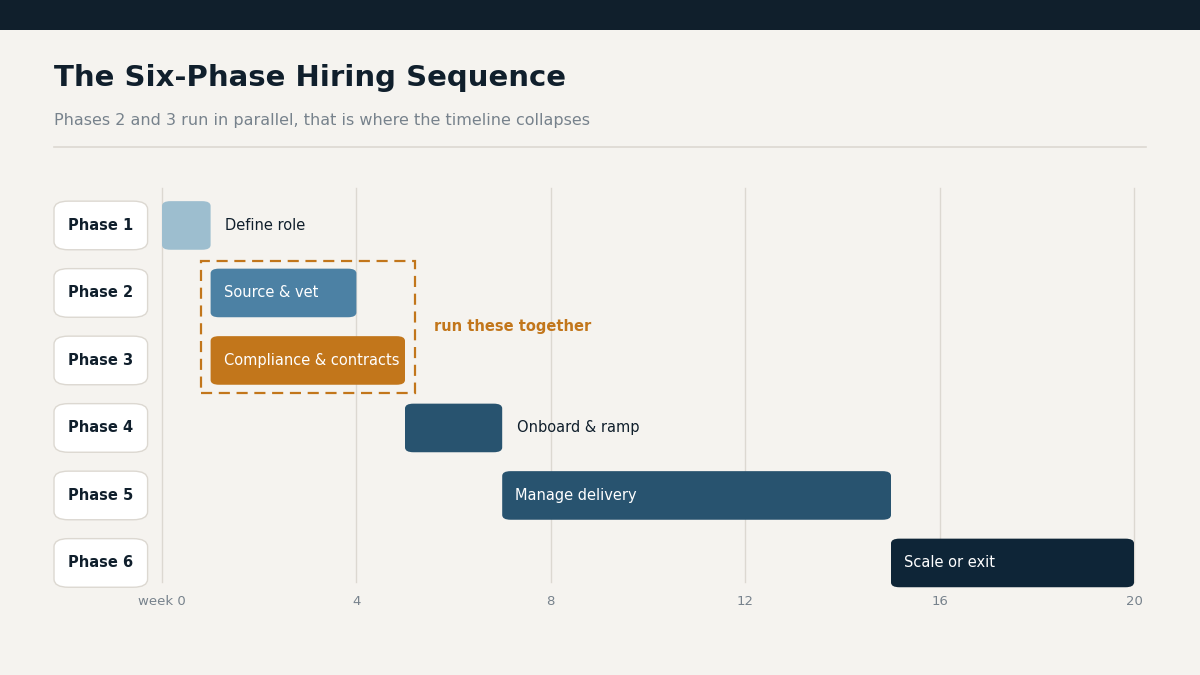
Fintech engineering hiring in New York breaks into six phases. Run them in this order, but overlap Phases 2 and 3 deliberately. The compliance work in Phase 3 is what collapses your timeline if you leave it to the end.
Phase 1 Defining the requirement (Week 0)
Most searches fail here, silently. A requirement is not a skills list; it is a statement of what the engineer will be accountable for, what they will touch, and what they will not.
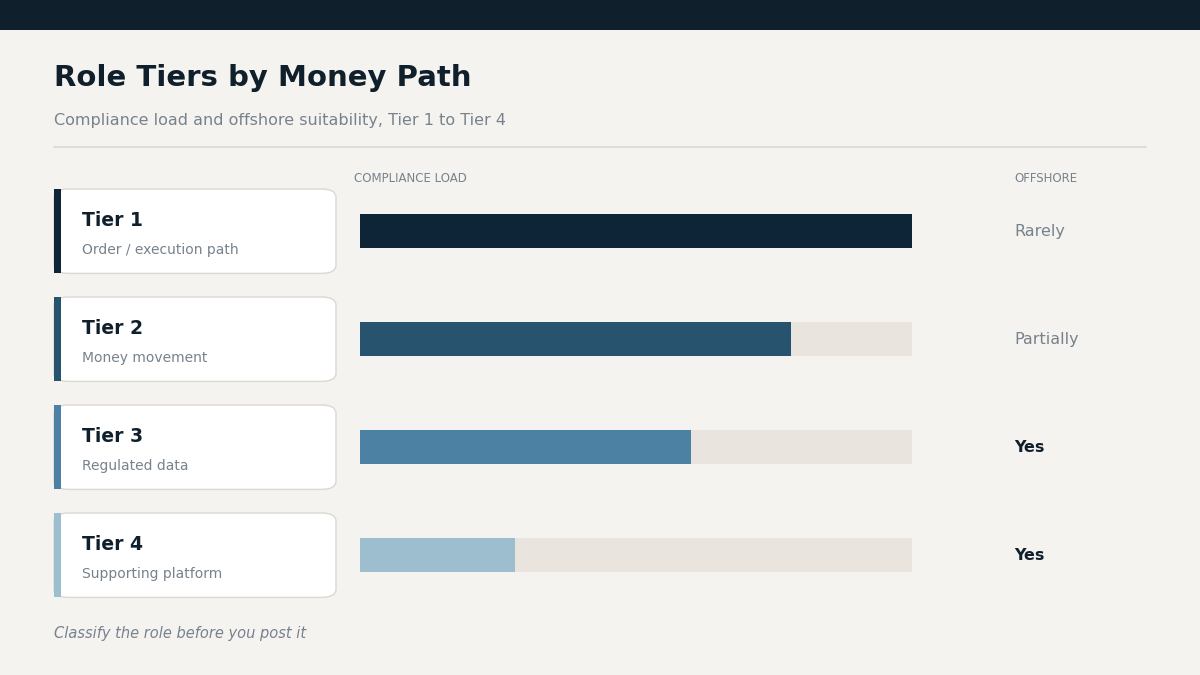
Start by classifying the role against the money path. This single classification drives salary band, compliance load, and whether the work can sit offshore:
| Tier | What it touches | Compliance load | Can it sit offshore? |
| Tier 1 Order/execution path | Order generation, routing, algorithmic strategy, market data | Highest. Potential individual registration; Rule 15c3-5 controls; CAT reporting | Rarely, and never for strategy design |
| Tier 2 Money movement | Ledger, payments rails, settlement, reconciliation, custody | High. Recordkeeping, Part 500 access controls, SOC 2 / PCI scope | Partially, with production access restrictions |
| Tier 3 Regulated data | KYC/AML pipelines, customer PII, credit decisioning | High on privacy (Reg S-P), moderate on market rules | Yes, with data-residency and masking controls |
| Tier 4 Supporting platform | Internal tooling, CI/CD, observability, reporting, QA | Standard vendor controls | Yes, commonly the best offshore candidate |
The role-definition checklist answers all nine before sourcing:
- Which tier does this role sit in? (If two, split the role.)
- What is the first deliverable, and by what date?
- Which systems will this person have write access to in production?
- Does the scope include design, development, or significant modification of an algorithmic trading strategy? (See Phase 3 this is a registration trigger, not a nice-to-know.)
- Which three skills are genuinely non-negotiable? Cap it at three.
- What is the salary band, and is it approved by finance today?
- Who is the single decision-maker on the offer?
- On-site expectation: how many days, in which office, non-negotiable or preferred?
- What is the acceptable outcome if you cannot hire in New York offshore, contract, or wait?
Skills that actually predict success (as distinct from skills that appear on résumés):
- Correctness under partial failure. Idempotency keys, exactly-once semantics, retry and reconciliation logic. Ask for a specific failure they debugged in production.
- Ledger literacy. Double-entry modelling, immutable event logs, why you never update a posted transaction.
- Numeric discipline. Fixed-point and decimal arithmetic, rounding policy, currency minor units. Anyone who reaches for a float on a balance is out.
- Protocol fluency where relevant: FIX for trading, ISO 20022 and NACHA for payments, card-network message formats.
- Auditability instinct. Does the candidate reach for structured, append-only logging unprompted? This is the strongest single behavioural signal in the interview.
- Latency engineering for trading systems engineers specifically: tick-to-trade measurement, kernel-bypass networking, lock-free structures, GC-pause avoidance in JVM shops, and honest reasoning about where FPGAs stop being worth it.
Where the requirement is a conventional backend role on the money path API services, ledger, reconciliation jobs the shortlist is deep enough to move fast; teams that need to hire Nodejs developers with payments experience are usually the ones who can compress a search rather than extend it. For fully role-specific searches, a hire of fintech developers briefly carries the tier classification and compliance scope with it, which is what makes the shortlist usable on arrival.
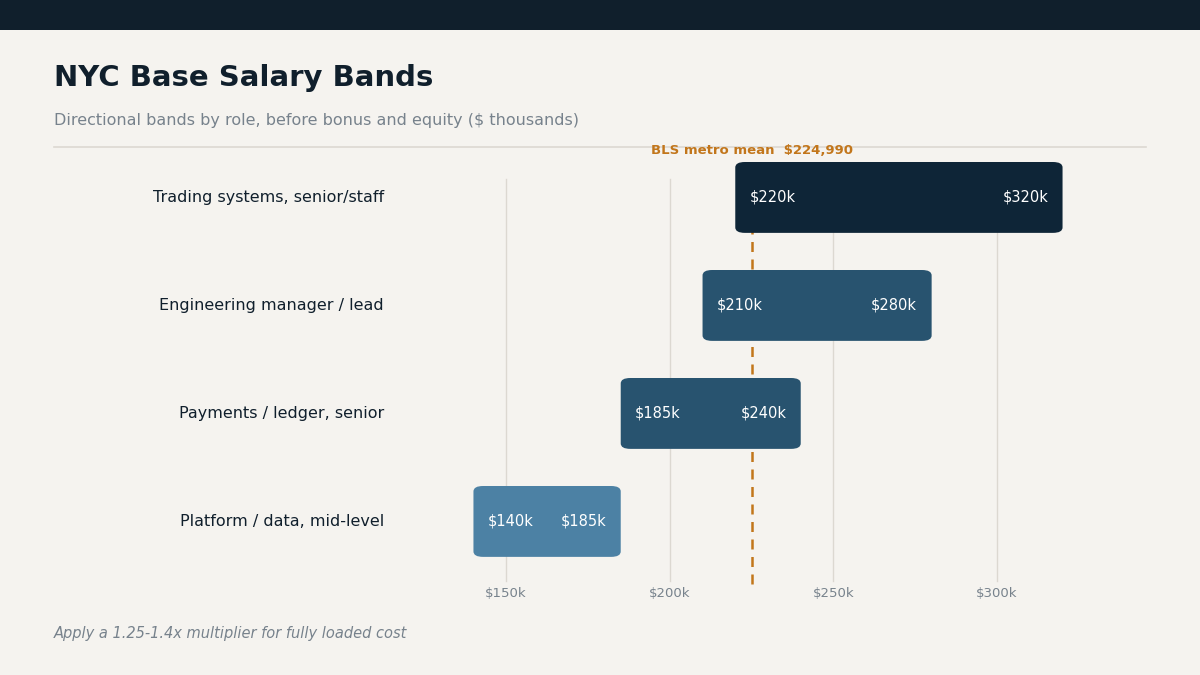
Budget bands to set in Phase 1 (directional; anchored to BLS metro means and loaded for the fintech premium validate against a current comp survey before you commit):
- Mid-level engineer, Tier 3–4: $140k–$185k base
- Senior engineer, Tier 2 money movement: $185k–$240k base
- Senior/staff, Tier 1 trading systems: $220k–$320k base, with bonus often exceeding 50% of base at established firms
- Engineering manager / platform lead: $210k–$280k base; BLS puts the metro mean for computer and information systems managers at $224,990
- Offshore dedicated engineer (India, mid-senior, fintech domain): ₹18–35 lakh/year, typically $3,500–$7,000/month on a dedicated-pod contract
New York rule you cannot skip: state law requires the compensation range to appear in the job advertisement. A posting without a range is a compliance defect before a single candidate applies.
Phase 2 Sourcing and vetting (Weeks 1–3)
Sourcing for final compliance tech hiring is a filtering problem, not a volume problem. The objective is a shortlist of 3–5 candidates who can all do the job, so the decision becomes preference rather than risk.
What good screening looks like, in order:
- Tier-match screen (10 minutes). Has this person worked on the money path, at the tier you defined? One specific system, named.
- Technical deep-dive on a real failure (45–60 minutes). Not algorithm trivia. “Walk me through a production incident on a payment or order flow that you owned.” Follow every answer with “how did you know?” three times.
- Practical exercise, scoped to 90 minutes maximum. Best format: a small, deliberately broken reconciliation or idempotency scenario. Take-homes longer than two hours cost you senior candidates.
- Regulatory-context interview (30 minutes). Not a quiz on rule numbers. Does the candidate understand why deployment approvals are segregated, why logs are immutable, why they cannot pull production data to a laptop? A senior engineer from an unregulated background who bristles at these constraints will churn.
- Reference checks with a specific question: “Would you give this person production write access on day one? Why or why not?”
Red flags, from real interview loops:
- Cannot name a single reconciliation break they investigated.
- Describes compliance as “the blocker” rather than a design constraint.
- Latency claims with no measurement methodology behind them “sub-millisecond” with no percentile, no measurement point.
- Résumé lists a regulated employer, but every project described is internal tooling.
- Cannot explain how they’d handle a duplicate webhook from a payment processor.
- I want to negotiate away background checks or fingerprinting. This is disqualifying, not a discussion.
The 3-day rule: from final interview to offer, three business days maximum. Every day past that, your acceptance probability drops measurably in this market. Build the approval chain before you start sourcing, not after you find someone.
Phase 3 Compliance, registration, and contracts (run in parallel with Phase 2)
This is the phase that separates teams who hire in five weeks from teams who hire in fifteen. Start it the moment you have a shortlist not after the offer.
Two nuances that decide org design, both from FINRA Regulatory Notice 16-21:
- FINRA does not intend the requirement to catch everyone who touches an algorithm. The target is the person who holds both the strategy design and its technical implementation.
- Where design and development were performed solely by a third party, the requirement does not attach to the member firm for that design work. But if in-house associated persons can significantly modify the strategy, those persons must be registered.
That second point has a direct hiring consequence most teams discover too late: the boundary between “vendor builds it” and “our contractor modifies it” is a registration boundary. Decide it in the contract, not in a sprint-planning meeting.
The pre-start compliance checklist:
- Determine associated-person status. Will this individual be an associated person of a broker-dealer? If yes, Form U4 filing and fingerprint submission apply, and processing time is weeks start it at offer-accept.
- Confirm registration scope against the Rule 1220 test above. Document the determination in writing, with the reasoning. Examiners read the reasoning.
- Run background screening proportionate to the tier: identity, employment and education verification, criminal history where permitted, and credit checks only where the role’s access justifies it and law permits.
- Add the engineer’s devices and accounts to the asset inventory covered by written policy, a standing requirement since 1 November 2025, first certified in reports due 15 April 2026.
- Confirm data-handling boundaries before day one: no production data on local machines, masked datasets for development, and documented approval for any exception.
Engagement models and what each is actually good for:
| Model | Best for | Control | Speed to start | Compliance overhead |
| Direct W-2 hire | Tier 1 roles, long-horizon ownership, anything requiring registration | Highest | 10–16 weeks | Full, borne internally |
| Staff augmentation | Tier 2–4 capacity, defined scope, surge work | High on direction, shared on employment | 2–4 weeks | Shared; vendor supervision must be documented |
| Dedicated offshore pod / GCC | Tier 3–4 platform, QA, data engineering at scale | High, with your own tooling and cadence | 3–6 weeks | Structural data residency, access segmentation |
| Project-based / fixed-scope | Discrete builds with clear acceptance criteria | Lowest | 2–5 weeks | Vendor-owned; you still supervise outcomes |
| Freelance / marketplace | Non-regulated peripheral work only | Low | Days | Generally unacceptable on the money path |
Contract terms a regulated buyer should treat as non-negotiable:
- Written supervision framework. FINRA’s 2026 report is explicit that outsourcing does not outsource responsibility: firms must maintain a reasonably designed supervisory system covering all outsourced activities, tied to obligations including Rule 1220 (registration), Rule 3110 (supervision), Rule 4370 (business continuity), and Regulation S-P.
- Vendor due diligence, initial and ongoing plus an inventory of which firm data types the vendor accesses or stores. Both are named effective practices in that report.
- IP assignment and NDA covering work product, models, and data, with named individuals bound.
- Data-handling and residency terms: where data may be stored, whether production data may ever leave the environment, and what happens on termination return or documented secure destruction.
- Right-to-audit and incident-notification clauses, with a defined notification window.
- Named-individual continuity, not just headcount. A “no shared bandwidth” clause prevents your engineer being split across three accounts.
- Replacement terms. Our standard is replacement within 7–10 days if a placement isn’t a fit; whatever the number, get it in writing with a defined trigger.
- Sub-contracting restrictions. Undisclosed sub-contracting is the single most common third-party-risk finding pattern.
Phase 4 Onboarding and ramp-up (Weeks 1–2 post-start)
Ramp in a regulated codebase runs 8–12 weeks to full productivity. The first two weeks decide whether it’s 8 or 12.
Day-one readiness checklist everything on this list before the engineer logs in:
- Laptop imaged with endpoint controls and disk encryption; device recorded in the asset inventory.
- MFA enrolled with a phishing-resistant factor, on every system including SaaS and cloud consoles.
- Least-privilege access grants approved, documented, and dated with a scheduled review.
- Read-only production observability access; write access deferred until the fourth week minimum.
- Masked or synthetic dataset available in the development environment.
- Repo access, CI/CD permissions, and a named deployment approver (four-eyes rule applied from day one).
- Compliance and information-security training completed and evidenced.
- Named onboarding buddy and named escalation path.
Weeks 1–2 delivery expectations that actually work:
- Day 1–3: environment running locally, one trivial PR merged. If this slips past day three, your environment setup is the problem, not the hire.
- Day 4–7: first real bug fix on a non-critical path, shipped through the full change-management flow so the engineer experiences the controls once with low stakes.
- Week 2: a scoped feature slice with a written design note. The note matters more than the code; it reveals whether the engineer is thinking about auditability.
Communication cadence for distributed teams: a daily 15-minute standup with at least a two-hour overlap window, one weekly written status update, and one bi-weekly demo. For the US–India overlap, 8:30–11:00 a.m. ET window is standard and workable.
Onboarding friction nobody warns you about: access approvals expire. In several engagements, we have watched a new engineer lose repository or environment access in week three because the initial grant was issued as a temporary exception pending a review that nobody scheduled. Put the review date in the calendar on day one, owned by a named person.
Phase 5 Managing delivery (Month 1 onward)
Once the engineer is productive, the failure mode changes from “can’t ship” to “ships things that pass tests and fail audits.”
KPIs worth tracking for regulated engineering work:
- Cycle time from ticket start to production, and separately the time spent in approval that split tells you whether your controls or your engineering is the bottleneck.
- Change failure rate and mean time to restore.
- Reconciliation breaks count and age is the single best health metric for a money-movement team.
- Percentage of deployments with complete change-management documentation. Target: 100%. Anything less is an examination finding waiting to happen.
- Test coverage on money-path code specifically, not repository-wide averages.
- Access review completion rate, quarterly.
Reporting cadence that survives scrutiny: weekly written delivery report, monthly metrics review with the engineering lead, and a quarterly access and control review with compliance in the room. A dedicated account manager on the vendor side should be named and reachable, with a defined escalation SLA not a shared inbox.
Quality on the money path is enforced by testing discipline more than by review volume, which is why teams that hire QA engineers with financial-domain experience early tend to catch reconciliation defects in staging rather than in a customer complaint.
Phase 6 Scaling, replacing, or exiting
When to add headcount the honest triggers, in priority order:
- Reconciliation or incident backlog is growing week over week.
- A single named individual is the only person who can safely change a money-path component.
- Approval queues, not engineering effort, are the binding constraint (this one is often a process fix, not a hire).
- A committed roadmap item has no owner with capacity inside the quarter.
The scaling decision at 8–10 engineers. Below roughly eight offshore engineers, staff augmentation is usually the right structure. Above that, per-head coordination cost and the compliance overhead of managing many individual vendor relationships start to dominate, and a global capability center becomes the cheaper and more controllable model: one legal entity, one security perimeter, one asset inventory, and your own employer brand doing the recruiting.
Replacement and offboarding checklist:
- Revoke all access within the same business day including SaaS, cloud consoles, and repository forks. Under an all-systems MFA and asset-inventory regime, a stale credential is a documented control failure.
- Retrieve or remotely wipe devices; record the disposition.
- Confirm return or secure destruction of firm data held by the vendor, per contract.
- Update the asset inventory and access registers.
- Debrief on knowledge transfer before the last day, with a written handover artifact.
- If the exit is a fit failure, invoke the replacement clause immediately with the tier classification and scope documents from Phase 1 attached, a replacement search reuses 80% of the original work.
Case Studies: What Scaled Regulated Engineering Hiring Looks Like
These are drawn from Supersourcing engagements in regulated and high-transaction-volume environments. The pattern transfers directly to a NYDFS-covered entity or a FINRA member firm’s technology group; the constraints differ in name, not in shape.
Paytm 100+ engineers hired for a regulated payments platform. The requirement was volume without a quality drop on a payments codebase where correctness is non-negotiable. The approach: tier-classify every open role, run parallel pipelines per tier rather than one general pipeline, and front-load background and access provisioning at offer-accept. Across engagements of this type our candidate joining rate has held at 98%, which is the metric that actually protects a hiring plan. A 60% joining rate turns a 100-person plan into a 60-person outcome regardless of how many offers went out.
Swiggy engineering hiring scale-up under compounding demand. The binding constraint was decision speed, not sourcing. Restructuring the loop around a fixed three-day offer window and a single named decision-maker removed the week-five drop-off that had been losing senior candidates to faster competitors. The transferable lesson for New York: in a market where payments engineering talent fields multiple approaches a week, your internal approval chain is a competitive variable.
Somnoware recruitment automation in a compliance-sensitive healthcare context. Automating the screening layer while keeping human judgement on final assessment cut manual screening effort substantially without ceding decision authority to a model. That design choice is exactly what Local Law 144 pushes New York employers toward: automation that assists, documented, audited, and disclosed rather than automation that decides.
The Decision Framework: Where Should Each Role Sit?
Every fintech engineering hiring decision in New York eventually reduces to one question: where should this specific role sit? Do not answer it as a company-wide policy. Decide it per role, using the tier classification from Phase 1. Here is the comparison that matters:
The four-question test to place any role:
- Does it touch the order or execution path? If yes, New York, direct hire, and check registration scope. Stop here.
- Does it require write access to production money movement? If yes, direct hire or tightly scoped augmentation with segregated approval. Offshore is possible but rarely worth the control design cost for a single role.
- Does it require same-day, in-person collaboration with regulated business stakeholders, traders, compliance, treasury? If yes, hire locally regardless of tier.
- If none of the above apply, why are you paying a New York premium for it? This is the question that recovers the most budget in the average plan. Internal tooling, QA automation, data pipelines, and reporting almost never survive it.
The blend that works in practice: a small, senior, New York core owning architecture, the money path, and regulatory interface; a larger offshore or nearshore pod owning platform, data, QA, and internal tooling; and a single named lead accountable for the interface between them. Dedicated development teams that fail at this usually fail to name that lead.
What Most Teams Get Wrong
Compliance is treated as a gate at the end instead of a parallel track. This is the single largest source of avoidable delay in fintech engineering hiring in New York. Fingerprinting, U4 processing, background screening, and access provisioning are all wall-clock time, not effort. They can nearly all run concurrently with the interview loop. Almost nobody does it.
Seniority is used as a proxy for domain fit. A staff engineer from a large consumer tech company is not automatically a better fit than a mid-level engineer from a payments processor. On the money path, the mid-level engineer who has debugged a settlement break at 2 a.m. outperforms the staff engineer who has never had to explain a rounding discrepancy to an auditor. Screen for scar tissue, not for level.
Nobody audits their own AI screening tool. Every hiring team in New York has adopted some form of automated candidate scoring. Very few have obtained a bias-audit summary, published it, or issued the 10-business-day candidate notice. With the state comptroller having recommended proactive enforcement, this is a live and cheap-to-fix exposure.
Contractor access is provisioned as a temporary exception and then forgotten. Under the current NYDFS regime, MFA applies to every individual on every system, and asset inventories must be documented under written policy. The “temporary” contractor access grant with no review date is the most common control gap we encounter, and it is entirely self-inflicted.
The offshore decision is made at the wrong altitude. Leadership decides “we’re building in India” or “we keep everything in New York” as a philosophy. Both are wrong. The correct unit of decision is the role, evaluated against the money path. Companies that decide at the company level overpay for Tier 4 work and under-resource Tier 1.
Cost and Timeline Reality Check
Most content on this topic stops before the numbers. Ask about fintech engineer salaries in New York and you get a range wide enough to be useless. Here are usable numbers, with the caveats stated plainly. Validate against a current comp survey before committing a budget.
New York cost tiers (base salary, before bonus and equity):
| Role | Base band | Notes |
| Mid-level engineer, platform/data | $140k–$185k | Tier 3–4; strongest offshore substitution candidate |
| Senior engineer, payments/ledger | $185k–$240k | Tier 2; bonus typically 10–25% |
| Senior/staff, trading systems | $220k–$320k | Tier 1; bonus can exceed 50% of base at established firms |
| Engineering manager / platform lead | $210k–$280k | BLS metro mean for computer & information systems managers: $224,990 |
| Dedicated offshore engineer (India, mid-senior) | ₹18–35 lakh/yr (≈$3,500–$7,000/mo contract) | Tier 3–4; fully managed pod pricing |
Fully loaded cost multiplier: budget 1.25–1.4× base for a New York W-2 hire once payroll taxes, benefits, equipment, software, and office allocation are counted. A $220k base is a $275k–$308k annual commitment before bonus and equity.
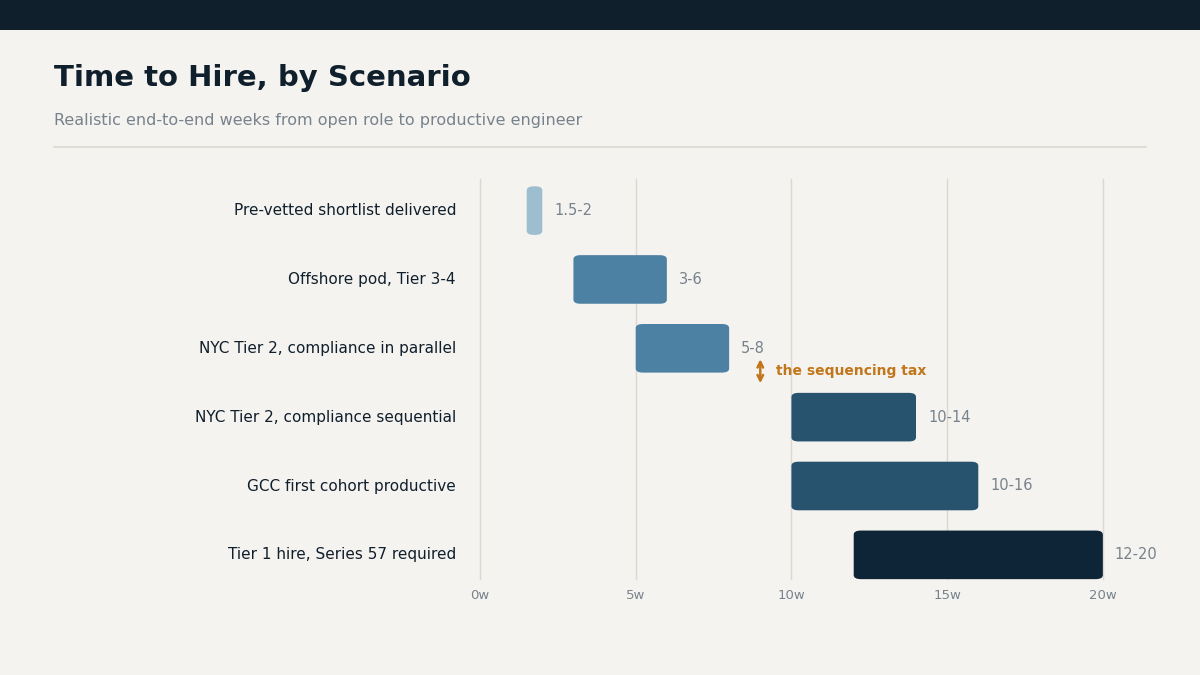
Typical timelines by scenario:
| Scenario | Realistic end-to-end timeline |
| Pre-vetted shortlist delivered | 7–10 working days |
| Offshore/augmented engineer, Tier 3–4, productive | 3–6 weeks |
| Direct NYC hire, Tier 2, compliance run in parallel | 5–8 weeks |
| Direct NYC hire, Tier 2, compliance run sequentially | 10–14 weeks |
| Tier 1 hire requiring Series 57 registration | 12–20 weeks; exam scheduling and U4 processing dominate |
| GCC stand-up, first cohort productive | 10–16 weeks |
What drives cost up:
- Tier 1 classification and any registration requirement
- Narrow protocol requirements (FIX plus a specific venue’s quirks, card-network certification experience)
- Five-day on-site mandates in a market where hybrid is the norm
- Long decision cycles every extra week increases the probability you end up in a counter-offer situation
- Requiring a single person to cover two tiers
What drives cost down:
- Splitting a hybrid role into two correctly-tiered roles
- Moving Tier 3–4 work offshore with a documented control design
- Compressing the offer decision to three days
- Reusing tier classifications and scope documents across searches the second search in a family costs materially less than the first
- Running compliance in parallel, which reduces both elapsed time and candidate drop-off
The most reliable cost lever is not rate negotiation. It is drop-off avoidance: Supersourcing engagements hold candidate drop-off on contract roles below 1%, and every avoided drop-off saves the full cost of a restarted search typically 3–5 weeks of elapsed time plus the sourcing effort already spent.
Where to Take This Next
Fintech engineering hiring in New York rewards teams that fix their own process before they shop for talent. If you are mid-decision, the highest-value next step is not a vendor call. It is tier-classifying your open roles against the money path, because that one exercise usually reveals that a third of what you were planning to hire in New York does not need to be hired in New York and that the roles that do are being slowed by your own approval chain rather than by talent supply.
Do that first. If you then want a pre-vetted shortlist against a tier-classified brief, with the compliance track running in parallel from day one, that is the work: a 7–10 working day shortlist, dedicated account management, NDA-backed IP protection, and replacement within 7–10 days if a placement isn’t right. Supersourcing has run this for regulated payments, lending, and platform teams across 527+ delivered projects.
One next step: bring one open role and its tier classification to a short consultation, and we will tell you whether it should be a New York hire, an augmented seat, or an offshore pod before you spend a dollar on the search.
FAQ
Do software engineers need FINRA registration?
Usually not. The exception matters: an associated person primarily responsible for the design, development, or significant modification of an algorithmic trading strategy in equity, preferred, or convertible debt securities or who supervises that work day to day must register as a Securities Trader and pass the Series 57 exam. Document your determination in writing either way.
What does NYDFS Part 500 require from contractors? \
MFA applies to any individual accessing an information system, including vendors and contractors, on internal and third-party cloud systems alike. Their devices and accounts must appear in a documented asset inventory maintained under written policy. Covered entities certified compliance in annual reports due 15 April 2026.
How much does a fintech engineer cost in New York City?
Base salary bands run roughly $140k–$185k for mid-level platform roles, $185k–$240k for senior payments and ledger engineers, and $220k–$320k for senior trading systems engineers, with bonus loading on top. Apply a 1.25–1.4× multiplier for fully loaded cost. BLS puts the metro mean for computer and mathematical occupations at $67.04/hour.
How long does it take to hire a trading systems engineer?
Plan for 12–20 weeks if the role requires Series 57 registration, since exam scheduling and Form U4 processing dominate the critical path. Non-registered senior roles on the money path close in 5–8 weeks when compliance and sourcing run in parallel, and 10–14 weeks when they run sequentially.
Can I use offshore contractors on a regulated system?
Yes, with design. The workable pattern restricts offshore engineers to Tier 3–4 work, uses masked data in development, keeps production write access with locally supervised staff, and documents the supervisory framework. Outsourcing the work does not outsource supervisory responsibility FINRA’s 2026 report is explicit on that point.
Is staff augmentation compliant for regulated fintech work?
It is, provided you maintain a reasonably designed supervisory system covering the outsourced activity, run initial and ongoing vendor due diligence, keep an inventory of the firm data the vendor touches, and prohibit undisclosed sub-contracting. The compliance failure is almost never the model itself; it is undocumented supervision.
What background checks are required for fintech engineering hires?
Scope them to the role’s tier. Identity, employment, and education verification are baseline. Associated persons of a broker-dealer require fingerprint submission and Form U4 filing. Credit checks apply only where access genuinely justifies them and law permits. Start all of it at the offer-accept, not at the start date.
Why do fintech offers get declined in New York?
Three reasons, in order: a decision cycle slower than a competitor’s, a total-compensation package that omits bonus and equity clarity, and an on-site mandate discovered late in the process. The first is the most common and the easiest to fix. If you want a second opinion on where your loop is leaking candidates, that is a 30-minute conversation with our team to bring your last three closed and lost searches.
