

Worldwide IT spending is projected to hit $6.31 trillion in 2026, a 13.5% jump from 2025 and IT services alone are expected to cross $1.87 trillion of that figure, the single largest category in the forecast, according to Gartner. That growth isn’t abstract. It’s a signal that more capital than ever is flowing toward building and buying software which means more founders are racing to ship a working product before a competitor, or a market window, closes on them.
Most of those founders don’t have an in-house engineering team yet. They have an idea, a spec (maybe), and a deadline that was set before anyone checked whether it was realistic. Building MVP with outsourced development team has become the default path for exactly this reason: it compresses the time between “idea” and “something users can actually touch” without the six-to-nine-month lead time of building an internal team from scratch.
This guide is not a pitch for outsourcing over hiring in-house. It’s a practitioner-level walkthrough of how to do it well if you’ve decided outsourcing is the right call: how to scope the build, how to choose between team models, how to manage delivery without a technical co-founder in the room, and what a clean handover actually looks like. Skip a stage in this process, even one that feels “obvious” and it shows up later as scope creep, a rebuild, or a founder who can’t get their own codebase from a vendor who’s gone quiet.
TL;DR
This guide is for non-technical and semi-technical founders deciding whether and how to build their MVP with an outsourced development team instead of hiring in-house from day one. It walks through the entire process: scoping the build, choosing a team structure, vetting vendors, managing delivery, and handling the handover once the MVP ships.
The single biggest number to know going in: a well-scoped MVP built by an outsourced team typically takes 10–16 weeks from a locked spec to a launchable build, and a competent vendor should be able to hand you an interview-ready shortlist of vetted engineers within 7–10 working days of a clear job description not weeks of back-and-forth.
By the end, you'll be able to write a real MVP scope, pick the engagement model that fits your budget and control needs, spot the contract clauses that protect your IP, and know exactly what "a good outsourced build" looks like versus one that's about to go sideways.
What Is Outsourced MVP Development?
Outsourced MVP development is the practice of engaging an external team, a staffing partner, dedicated development team, or software development agency to design, build, and ship a minimum viable product on a founder’s behalf, typically under a defined scope, timeline, and IP-assignment contract. It is not:
- The same as hiring freelancers piecemeal. A freelancer marketplace hire is transactional and per-task; outsourced MVP development is a structured engagement with a defined team, process, and accountability chain.
- The same as full business process outsourcing. You’re outsourcing the build, not the product decisions, the roadmap, or the company itself.
- A substitute for having a founder who understands the product. Outsourcing removes the need to hire engineers directly; it does not remove the need for someone on your side who owns the “why.”
Why It Matters: The Business Case for Outsourcing Your MVP Build
The decision to outsource an MVP isn’t just about saving money though that’s part of it. The measurable business outcomes break down into four categories:
- Speed to market: An outsourced dedicated team can typically start within 1–2 weeks of contract signature, versus 6–10 weeks to source, interview, and onboard even a lean in-house team of 3–4 engineers.
- Cost control: Outsourced MVP builds in India or similar offshore hubs typically run $15,000–$60,000 for a genuinely minimal, single-platform MVP, compared to $120,000–$250,000+ in fully loaded in-house salary costs for an equivalent team over the same build window in the US or Western Europe.
- Risk transfer on hiring: You’re not carrying the legal, payroll, and severance risk of full-time hires for a product that might pivot or fail within six months of launch.
- Access to a wider skill band: A single outsourced engagement can flex from a backend engineer to a DevOps specialist to a QA engineer as the build phase demands, without four separate hiring cycles.
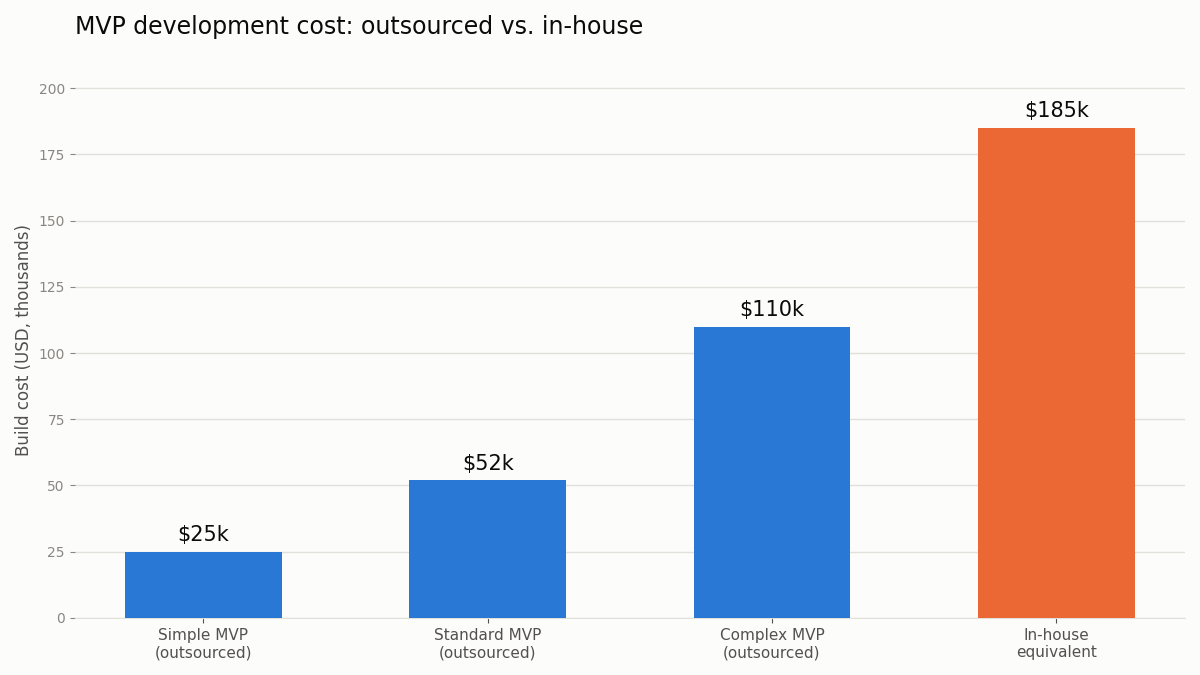
The trade-off and this guide covers it honestly is reduced day-to-day visibility and a real dependency on how well the engagement is structured and managed. Both are solvable. Neither is free.
A fifth outcome worth naming separately, because it’s the one founders underweight most: optionality. An outsourced engagement is contractually bound; you know the exit terms before you start. An in-house hire is an open-ended commitment that’s expensive and awkward to unwind if the product pivots hard after launch, which happens to a large share of first-time MVPs regardless of how the build itself went.
Outsourcing doesn’t remove the risk of building the wrong thing. It does keep your ability to change course cheap.
None of this means outsourcing is the right call for every founder. If your MVP’s core value proposition is a proprietary technical breakthrough, a novel ML model, a hardware-software integration, something where the “how” is the moat, not just the “what” an outsourced team building to spec may not be the right instrument.
Outsourcing works best when the product risk is in the market and the user experience, not in the underlying engineering itself.
The Core Problem Most Founders Face
Here’s the pattern that shows up over and over in failed or stalled MVP builds: the team ships something, but it’s not the thing that proves or disproves the founder’s core assumption. CB Insights’ most recent analysis of 431 VC-backed startups that shut down found that poor product-market fit accounted for 43% of failures, with unsustainable unit economics and bad timing as the next largest causes and “ran out of capital” was almost always the final symptom, not the root cause.
Translate that to an outsourced MVP build and the pattern is specific and avoidable:
- Scope inflation of 2–3x is common when a founder hands over a vague one-page brief instead of a locked PRD every “quick addition” during the build adds 3–5 days and compounds.
- Founders confuse “feature-complete” with “MVP.” Teams get instructed to build the full vision, not the smallest slice that tests the riskiest assumption which is exactly the mismatch CB Insights’ data flags as a root cause of failure, not just a build-quality issue.
- No one on the founder’s side owns technical sign-off, so QA gets rubber-stamped by someone who can’t actually evaluate it, and bugs surface post-launch instead of pre-launch.
- Vetting gets skipped under time pressure. Founders hire the first vendor who quotes the lowest number and the fastest timeline, without checking prior delivered work, code samples, or client references and pay for it in month two when velocity collapses.
A pattern worth naming explicitly, because it only shows up after you’ve run a few of these engagements: the build rarely fails in week one or two, everyone’s motivated, the backlog is fresh, and demos look good. It fails, or starts to wobble, around week four to six, right after the initial scope is exhausted and the first round of “wait, can we also add…” requests starts.
That’s the exact point where a founder without a locked change-request process watches a 10-week timeline quietly become a 16-week timeline, with no corresponding change to the budget conversation. Most dedicated teams underestimate the true build window for a “simple” MVP by roughly 40–60% for precisely this reason not because the vendor was slow, but because the scope was never actually frozen.
The fix isn’t more upfront planning meetings. It’s a formal change-request process, agreed before the first sprint: new requests get logged, estimated, and explicitly traded against the existing backlog or the timeline never silently absorbed.
The Walkthrough: From Scratch to Launched MVP
This is the full lifecycle, broken into six phases. Each phase includes a checklist you can use directly.
Phase 1 Defining Requirements: Scope, Skills, Timeline, Budget
Before you talk to a single vendor, you need four things locked, in writing:
- A one-page problem statement, the specific user problem, the MVP tests, and the one metric that tells you if it worked (signups, activation rate, retention at day 7 pick one primary metric, not five).
- A feature list is split into “must-ship” and “post-launch” if more than 60% of your list is “must-ship,” you haven’t scoped an MVP, you’ve scoped a v1.0 product.
- A rough tech stack preference, even if you’re not technical, ask an advisor or a fractional CTO to weigh in before you brief vendors, since re-platforming mid-build is expensive.
- A budget band, not a fixed number. For a genuinely minimal single-platform MVP (one core user flow, basic auth, one database, no complex integrations), realistic ranges are:
| Build complexity | Typical timeline | Typical cost (outsourced, offshore) |
| Simple MVP (1 core flow, web or single mobile platform) | 8–12 weeks | $15,000 – $35,000 |
| Standard MVP (2–3 flows, basic integrations, admin panel) | 12–18 weeks | $35,000 – $70,000 |
| Complex MVP (multi-platform, payments, real-time features) | 18–26 weeks | $70,000 – $150,000+ |
The 3-day rule: if a vendor gives you a fixed quote within 3 days of a one-paragraph brief, treat it as a red flag, not a win. A real quote requires a scoping call and, ideally, a short discovery sprint.
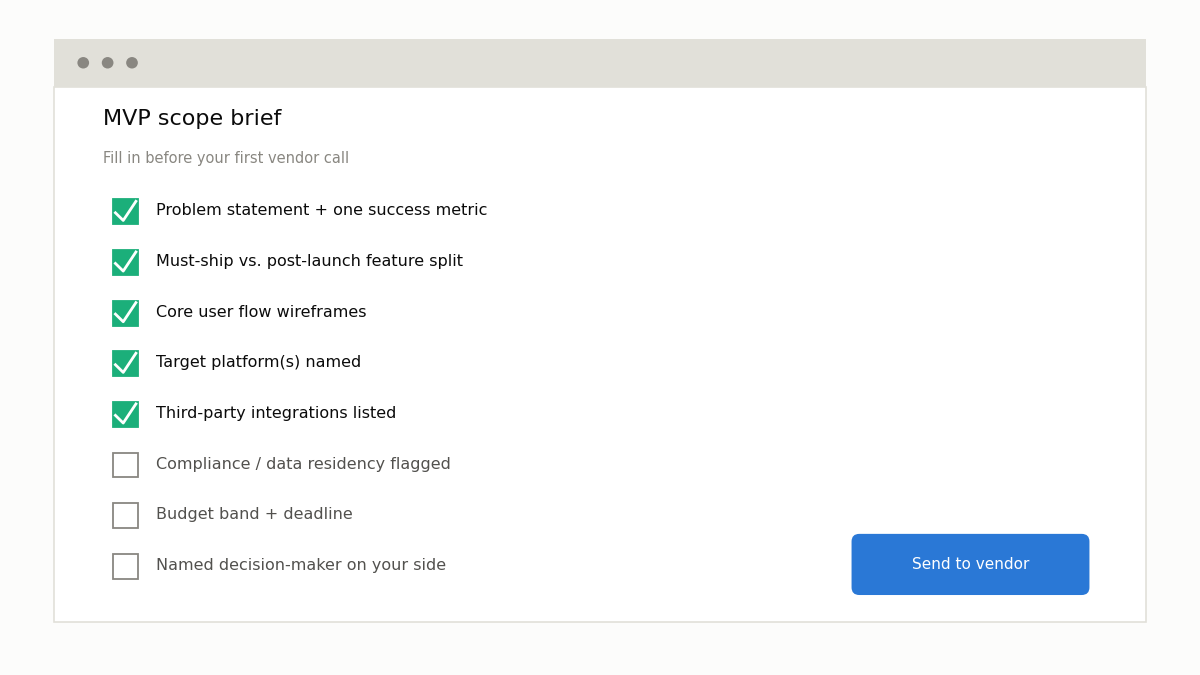
MVP Scoping Checklist have all of these ready before your first vendor call:
- One-page problem statement with a single primary success metric
- Feature list split into must-ship (launch) vs. post-launch (v1.1+)
- User flow diagrams or wireframes for the core flow (even hand-drawn is fine)
- Target platform(s) explicitly named web, iOS, Android, or all three
- Any required third-party integrations listed (payments, auth providers, analytics, messaging)
- Compliance or data-residency requirements flagged upfront (healthtech, fintech developers, EU users)
- Budget band and hard deadline (if one genuinely exists most “hard” deadlines aren’t)
- A named decision-maker on your side who can approve scope trade-offs without a multi-day delay
A founder who walks into the first vendor call with this checklist filled out will get a materially more accurate quote and timeline than one who walks in with an idea and a deck. Vendors quote to the clarity of the brief a vague brief gets a padded, defensive estimate; a tight brief gets a tight, accountable one.
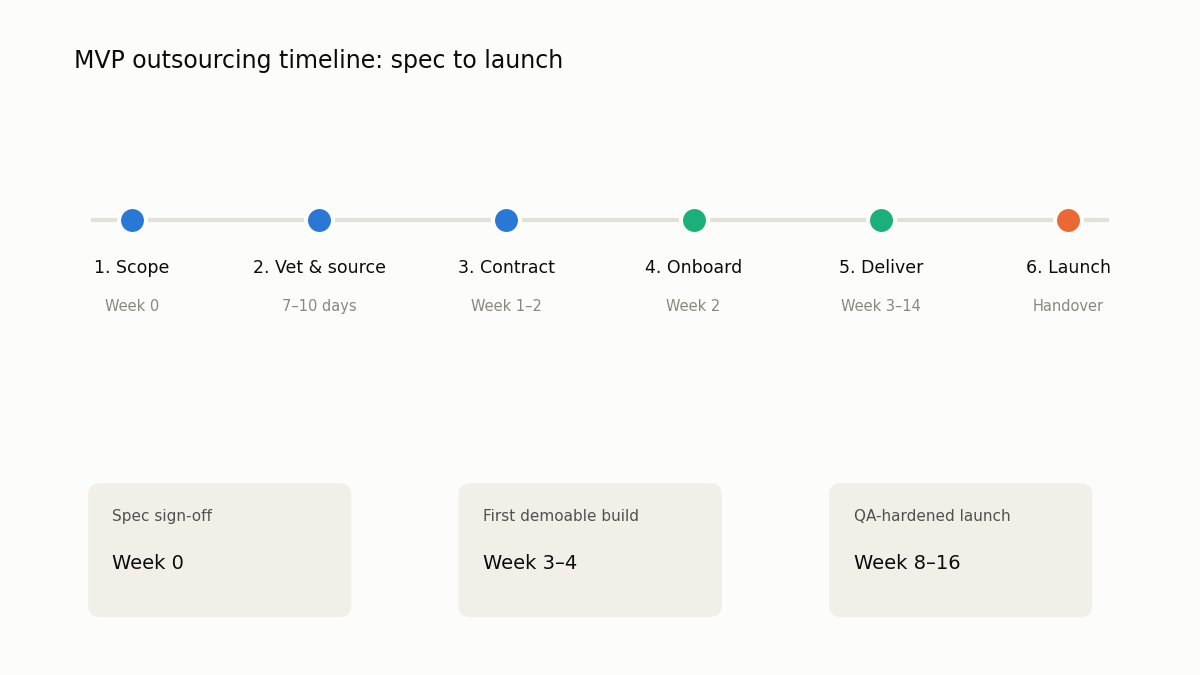
Turning the checklist into a real timeline: once these eight items are locked, the build itself typically runs through four visible milestones spec sign-off (week 0), first doable build (week 3–4), feature-complete internal build (week 7–10 depending on complexity), and QA-hardened launch candidate (week 8–16).
Treat this as the shape of an “MVP outsourcing timeline from spec to launch” a good vendor should be able to plot your specific build against these four checkpoints in the very first scoping call, not after the contract is signed.
Phase 2 Sourcing & Vetting: What Good Screening Looks Like
This is where most founders either overinvest (weeks of interviews for a 10-week build) or underinvest (one call, then a contract). Neither works. A structured vetting process should include:
- A portfolio review asks for 2–3 shipped products in a similar domain or stack, not slide-deck case studies.
- A live technical screen for the lead engineer, not just the sales contact if you’re non-technical, bring in a fractional CTO or technical advisor for this one call.
- A short paid trial task (a few days, scoped narrowly) before committing to the full engagement, if the vendor allows it.
- Reference checks with at least one past client in a comparable industry.
Red flags to walk away from:
- The account manager can’t answer a basic technical question and won’t loop in an engineer.
- No clear answer on who owns IP and source code during and after the engagement.
- Pricing that’s dramatically below the regional market band with no explanation.
- Reluctance to put a replacement clause in writing if an assigned engineer isn’t a fit.
A well-run vetting process, done right, should surface a shortlist of interview-ready candidates or vendor teams within 7–10 working days of a clear job description or brief anything dramatically slower usually points to a thin bench, not thoroughness.
Technical vetting for non-technical founders three practical workarounds:
- Borrow expertise for one call. A single paid hour with a fractional CTO or a developer friend to sit in on the technical screen is cheap insurance against a multi-week mismatch discovered later.
- Ask for a code walkthrough of a past project, not just a demo of the finished product. How the engineer explains their own architecture decisions tells you more than the polish of the UI.
- Score candidates against your must-ship list specifically, not general competence. A team that’s excellent at consumer mobile apps may be a poor fit for a B2B integration-heavy MVP, and vice versa domain-adjacent experience matters more than a generic “5+ years” line on a profile.
Vetting quality compounds. A rigorous first pass even if it costs you an extra 3–5 days upfront routinely saves 3–4 weeks of rework later, which is the entire margin most MVP timelines can’t afford to lose.
This is also where AI-assisted sourcing genuinely earns its place in the process rather than being a buzzword: partners like Supersourcing use it to filter to roughly the top 2% of technically vetted candidates before a founder ever sees a profile, which is what makes a 7–10 working day shortlist realistic instead of aspirational.
Phase 3 Engagement Models & Contracts
Three models dominate MVP outsourcing, and picking the wrong one for your situation is one of the most common early mistakes:
- Dedicated team model: A ring-fenced team (e.g., 1 full-stack, 1 backend, 1 QA) works exclusively on your product for the engagement duration. Best for MVPs where requirements will evolve during the build.
- Staff augmentation: You embed individual outsourced engineers (say, hire dedicated React developers for frontend, or a backend specialist for the API layer) into a process you already control. Best if you have a technical lead in-house who can manage day-to-day work.
- Project-based / fixed-scope: A vendor takes a locked spec and delivers a fixed deliverable for a fixed price. Best only when your requirements are genuinely stable are rare for a true MVP, since MVPs by definition evolve.
Whichever model you choose, the contract needs to cover, explicitly:
- IP and code ownership all code, designs, and documentation assigned to you on payment, not on some later “final delivery” milestone.
- NDA terms covering both the vendor company and named individual engineers.
- Source code escrow or repository access from day one, not just at handover you should be able to see and pull the repo throughout the build, not wait for the end.
- Replacement terms if an assigned engineer underperforms or leaves a 7–10 day replacement window is a reasonable, enforceable standard to ask for.
- Payment milestones tied to sprint deliverables, not calendar dates alone.
Fixed-price vs. time-and-material pick based on scope certainty, not preference. Fixed-price contracts feel safer to a first-time founder because the number is locked, but they only work when the spec genuinely won’t change and MVPs, by nature, evolve once real feedback starts coming in.
Time-and-material (or sprint-based) contracts with a capped budget ceiling and weekly visibility into hours spent give you the flexibility MVPs actually need, without the open-ended risk of uncapped billing.
Most experienced outsourcing partners will recommend time-and-material with milestone checkpoints for exactly this reason not because it’s easier for them, but because it’s the honest match for how MVP requirements actually behave.
One clause founders consistently forget to ask about: what happens to in-progress work if either side terminates early. A well-drafted contract specifies that all completed sprints’ code and documentation transfer to you regardless of why the engagement ends protecting you even in a worst-case scenario where the relationship sours mid-build.
Phase 4 Onboarding & Ramp-Up: The First Two Weeks
The first two weeks determine whether the engagement runs smoothly or fights itself for the next three months. A clean onboarding includes:
- Day 1–2: Access provisioning repo, project management tool, design files, staging environment, communication channels. Nothing should be gated behind “we’ll set that up next week.”
- Day 3–5: Kickoff and technical discovery the team reviews your PRD, flags ambiguities, and proposes a sprint plan. This is where scope gaps surface early, not in week 6.
- Week 2: First sprint begins with a locked backlog for that sprint only, not the whole project so you can course-correct fast if priorities shift.
- Ongoing: A fixed communication cadence, a daily async standup summary and a weekly sync call is the realistic minimum for a founder managing this without a technical co-founder.
Phase 5 Managing Delivery Without a Technical Co-Founder
This is the phase most guides skip, and it’s the one that determines whether you actually get what you paid for. If you’re not technical, you don’t need to learn to code you need three things in place:
- A dedicated account or delivery manager on the vendor side who is your single point of accountability not a rotating cast of contacts.
- Sprint demos, not status reports. Ask to see the working build every sprint (typically every 1–2 weeks), not a slide summarizing progress. If there’s nothing doable, that’s a signal.
- A lightweight external technical advisor even a few hours a month from a fractional CTO or a trusted engineer friend to sanity-check code quality, architecture decisions, and QA rigor at key milestones. This single line item prevents the majority of “we launched and it fell over” stories.
KPIs worth tracking, even as a non-technical founder: sprint completion rate (are planned items actually shipping), bug count trend (should be flat or declining as the build matures, not climbing), and time-to-first-response on blockers.
Communication cadence that actually works for a distributed, possibly offshore team:
- Daily: a short async written update of what shipped yesterday, what’s planned today, any blockers. This should take the team 5 minutes to write and you 2 minutes to read.
- Weekly: a live sync call with screen-share of the actual working build, not slides.
- Bi-weekly (per sprint): a formal sprint review and a short retrospective of what slowed the team down, and what’s changing next sprint as a result.
- Time zone overlap: even with a 9–12 hour offshore gap, insisting on at least a 2-hour daily overlap window for real-time questions a team with zero live overlap will bottleneck every ambiguous decision on a 24-hour reply cycle, which quietly adds days to every sprint.
Red flag during delivery, not just during vetting: if sprint demos start slipping to “next week” more than once, or the same bugs reappear across multiple sprints, that’s a signal to escalate to the account manager immediately not to wait and see if it self-corrects. It rarely does without a direct conversation.
Phase 6 Scaling or Exiting the Engagement
Once the MVP ships, you have three realistic paths, and the contract you signed in Phase 3 should already make each of them possible:
- Scale the same team for post-launch iteration the most common path if the MVP validates and you need to move fast on v1.1.
- Add headcount within the same engagement for example, bringing in hire Node.js developers for backend scaling or a dedicated QA function as usage grows, without restarting vendor vetting from zero.
- Offboard cleanly full source code, documentation, environment credentials, and a knowledge-transfer session handed to your next team (in-house or another vendor). A vendor who resists a clean offboarding process is telling you something about how they’ll behave under any future disagreement.
A clean handover checklist, regardless of which path you take:
- Full source code repository access transferred, not just a final zip export
- Environment credentials (staging, production, third-party API keys) documented and transferred securely
- Architecture and setup documentation enough for a new engineer to onboard without the original team
- Outstanding bug and tech-debt log, prioritized honestly, not hidden
- A recorded or live knowledge-transfer session with the outgoing team
- Post-launch support window and SLA terms confirmed in writing, even if you’re not renewing the engagement
Founders who skip this checklist at the “we’re happy with it, let’s just wrap up” stage are the ones who call a new vendor three months later needing a full code audit just to understand what they own. Budget the handover as its own short phase typically 3–5 days not an afterthought squeezed into the final sprint.
Case Studies: Outsourced Engineering in Practice
Fast-scale hiring under growth pressure. A high-growth food-delivery platform (comparable in profile to Swiggy’s engineering scale-up phase) needed to expand backend and mobile engineering capacity rapidly to keep pace with order volume growth. A structured, AI-assisted sourcing process with technical screening at the top of the funnel compressed the typical multi-week shortlist timeline down to roughly a week and a half per open role, letting the product roadmap move without engineering becoming the bottleneck.
Engineering hiring for a lean fintech team. A fintech company in the OkCredit growth-stage profile needed to build out core engineering without inflating headcount costs prematurely. A dedicated-team engagement model, rather than a scattershot freelance approach, meant the founding team could hold a single account manager accountable for delivery velocity instead of managing five individual contractor relationships.
Recruitment automation for a healthtech scale-up. A healthtech company in the Somnoware profile needed to reduce manual recruiter workload while maintaining a high technical bar for engineering hires. Combining AI-driven sourcing with a structured vetting pipeline reduced the manual screening burden significantly while keeping candidate quality and joining rates high, the kind of pattern that matters just as much when you’re staffing an outsourced MVP team as when you’re hiring in-house.
Comparison Framework: Which Model Fits Your MVP?
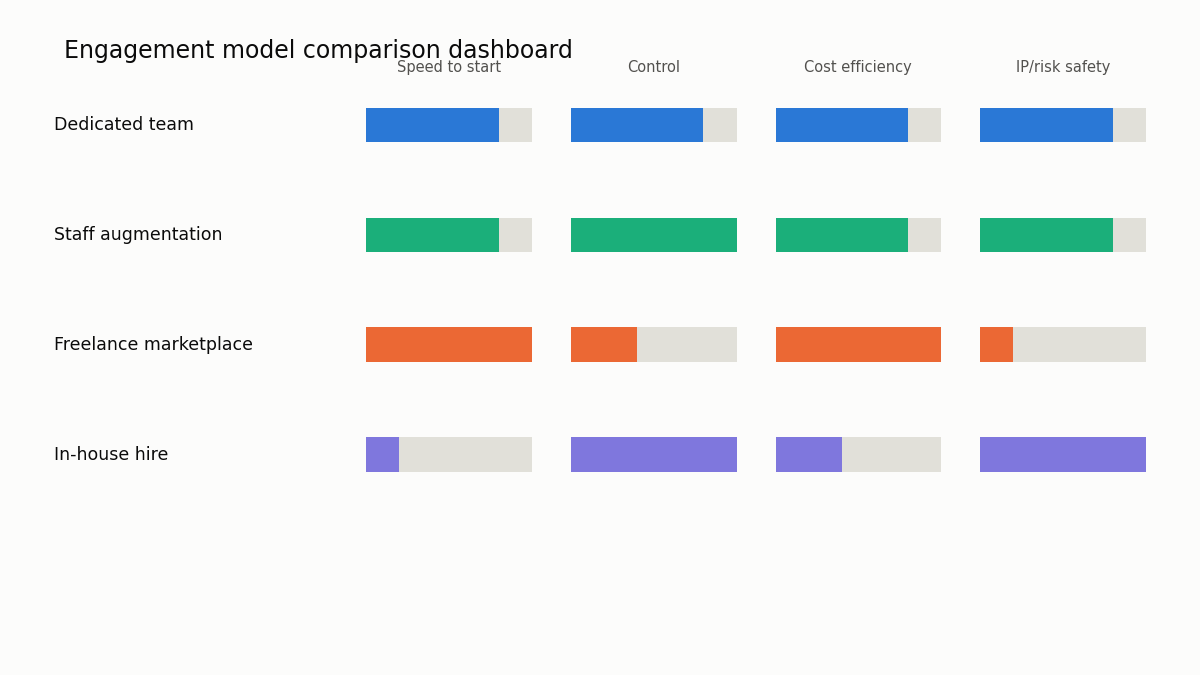
| Model | Cost | Control | Speed to start | IP/Risk profile |
| In-house hire | Highest (salary + benefits + overhead) | Full | Slowest (6–10 weeks to hire) | Lowest risk, full ownership by default |
| Freelance marketplace | Lowest upfront | Low per-task, inconsistent | Fastest (days) | Highest risk inconsistent IP terms, no accountability chain |
| Dedicated outsourced team | Moderate | High with proper process | Fast (1–2 weeks) | Low risk with a solid contract; requires vetting |
| Staff augmentation | Moderate | High, but requires an in-house technical lead | Fast (1–2 weeks) | Low risk; you retain process control |
| Project-based agency | Fixed, often higher for scope changes | Low mid-build | Moderate | Moderate risk scope-change friction is common |
For most first-time founders without a technical co-founder, a dedicated outsourced team with clear contractual IP terms sits in the best zone on this table: enough control to steer the product, without the hiring overhead of building in-house from zero.
How to use this table in a real decision, not just as reference: map your own constraints against the four columns before you talk to a single vendor. If your bottleneck is genuinely capital, not control, freelance marketplaces look tempting but weigh that against the coordination tax of managing 3–4 independent contractors with no shared accountability chain, which is where most freelance-built MVPs actually lose time.
If your bottleneck is trust and you’ve been burned before, staff augmentation with an in-house technical lead gives you the tightest oversight. If your bottleneck is speed and you don’t yet have technical leadership, a dedicated team is almost always the pragmatic default; it’s the model built for exactly that gap.
What Most Teams Get Wrong
- They treat the vendor selection like a price comparison, not a capability match. The cheapest quote almost never accounts for QA time, code review, or DevOps setup; those costs show up later as delays, not line items.
- They skip the paid trial task to “save time,” then lose far more time in week 4 discovering the team’s actual skill level.
- They over-specify the tech stack and under-specify the problem. A vendor can build almost anything you ask for. The risk isn’t technical execution, it’s building the wrong thing efficiently.
- They assume “dedicated team” means the same engineers stay for the whole build. Ask explicitly about staff continuity and what the replacement process looks like if someone rotates off.
- They wait until launch to think about handover. Source code access, documentation standards, and environment ownership should be contract terms from day one, not a post-launch negotiation.
- They pick a team based on the sales call, not the delivery team. The person who sells you the engagement is rarely the person who builds it. Ask specifically who your assigned engineers will be, and vet that team, not the account executive.
- They confuse “fast” with “cheap.” A vendor that’s genuinely fast because they’ve built similar products before is a different thing from a vendor that’s cheap because they’re understaffed and overcommitted. The quote alone won’t tell you which one you’re looking at the discovery call will.
This last pattern is the one most likely to surprise founders coming from a corporate background: the biggest determinant of outsourced MVP success isn’t the vendor’s technical skill; most vetted vendors clear that bar. It’s whether the founder’s side of the process is disciplined enough to give clear, timely decisions.
A vendor can’t move faster than the speed at which you approve scope trade-offs, answer clarifying questions, and sign off on demos. Slow decision-making on the founder’s side is, in practice, one of the most common causes of a “the outsourced team was slow” complaint that actually traces back to a three-day wait on an internal approval.
Cost & Timeline Reality Check
What drives MVP outsourcing costs up:
- Multiple platforms (web + iOS + Android) instead of one
- Third-party integrations payments, real-time chat, video, complex APIs
- Compliance requirements (healthtech, fintech) needing specialized QA and audit trails
- Frequent scope changes mid-sprint
What drives costs down without cutting corners:
- A locked PRD before the first sprint starts
- Choosing one platform to validate first, expanding post-validation
- A dedicated team model over ad hoc freelance hires (fewer handoff and re-onboarding costs)
- Realistic post-launch maintenance budgeting upfront (typically 15–20% of build cost annually), so you’re not caught off guard
Typical timeline by scenario:
- Simple single-flow MVP: 8–12 weeks from locked spec to launch
- Standard MVP with integrations: 12–18 weeks
- Complex, multi-platform, compliance-heavy MVP: 18–26+ weeks
India remains one of the largest offshore engineering talent pools backing these timelines; the broader capability center ecosystem alone now employs 2.36 million technology professionals across more than 2,100 Global Capability Centers generating $98.4 billion in revenue, per the latest NASSCOM–Zinnov data. That depth of specialized supply is part of why offshore and dedicated-team engagement models can staff niche roles (QA, DevOps, mobile) quickly rather than forcing a founder to choose between speed and specialization it’s the same talent density Supersourcing draws on when assembling dedicated MVP teams for founders who don’t have six months to build a bench themselves.
Next Step
If you’re mid-decision on outsourcing your MVP build, scoping it, comparing vendors, or trying to figure out what a fair quote looks like for your specific build the fastest way to get unstuck is a scoping conversation, not another article.
Supersourcing works across IT staffing services, dedicated development teams, and hires QA engineers-level specialist roles for founders building their first outsourced MVP team.
If your requirements are still fuzzy, start there anyway; a real scoping call will sharpen them faster than another round of internal debate. Get in touch with a clear one-paragraph brief of what you’re building, and expect a scoped response, not a generic pitch.
Frequently Asked Questions
How much does it cost to outsource MVP development?
A simple, single-platform MVP typically runs $15,000–$35,000 with an offshore outsourced team; standard builds with basic integrations run $35,000–$70,000, and complex, multi-platform, or compliance-heavy builds can run $70,000–$150,000 or more. Costs scale primarily with platform count, integration complexity, and compliance overhead. Always get a scoped quote after a real discovery call rather than a blind, brief-only estimate, since accurate pricing depends entirely on how tight your spec is.
Is it safe to outsource your MVP to an offshore team?
Yes, when the engagement is structured properly a contract that explicitly covers IP assignment, NDA terms for both the company and named engineers, and ongoing source code access from day one, not just at final delivery. The real risk in outsourcing was never the offshore location itself; it’s an unclear contract combined with a skipped vetting process. Ask for verifiable references and, ideally, a short paid trial task before committing to the full engagement.
How long does it take to build an MVP with an outsourced team?
A well-scoped MVP typically takes 8–18 weeks from a locked spec to a launchable build, depending on platform count, integration complexity, and how disciplined the change-request process is once building starts. Budget an additional 1–2 weeks upfront for vendor vetting and contract finalization before the actual build clock starts running so that vetting time is not wasted time, it’s what protects the timeline that follows.
What’s the difference between a dedicated team and staff augmentation for an MVP?
A dedicated team is a ring-fenced group of engineers managed under the vendor’s own delivery process and account management structure; staff augmentation embeds individual outsourced engineers into a process and reporting structure that you manage yourself. Choose a dedicated team if you lack in-house technical leadership to run day-to-day delivery; choose staff augmentation if you already have a technical lead who can direct the work closely.
How do I manage developers I can’t see if I’m not technical?
Insist on live sprint demos of working software rather than written status reports, a single named account or delivery manager you can always reach, and critically a fractional technical advisor brought in periodically for architecture and code-quality checks. You don’t need to learn to code to manage this well; you need consistent visibility into real, working output on a predictable weekly or bi-weekly cadence.
Who owns the code and IP when you outsource MVP development?
This has to be an explicit, written contract clause, never an assumption based on who paid for the work. Code, designs, and documentation should assign to you as each milestone is paid, with source code repository access maintained continuously throughout the build not withheld until a final handover date, which leaves you with no leverage or visibility if the relationship sours mid-project.
How do I vet an outsourced development team before signing?
Review two to three comparable shipped products with real usage, not just polished demos; run a live technical screen with the actual lead engineer who’ll work on your project, bringing in a technical advisor if you’re not technical yourself; request a short, paid trial task scoped narrowly; and check references directly with a past client in a similar domain or industry before signing anything.
What happens after the MVP is built? Do I need to hire in-house?
Not necessarily, and for most founders it’s premature. You can scale the same outsourced team for post-launch iteration, add specific specialized roles like QA or backend scaling within the existing engagement, or offboard cleanly to a new in-house or vendor team the right path depends mainly on whether the MVP validated your core assumption and how fast you now need to move. A global capability center becomes worth evaluating once you’re scaling well past MVP-stage headcount.
