

Django turned twenty, and by the usual logic of web frameworks, it should be sunsetting by now. The demand curve underneath it says otherwise: over the decade ahead, the market for the engineers who build with it is projected to expand several times faster than the job market as a whole which means the real question for the next ten years isn’t whether Django survives, but how you’ll compete for the people who know it. That coming squeeze is why engineering leaders still hire Django developers for web development in 2026 and why the ones who do it well treat hiring as a process, not a gamble.
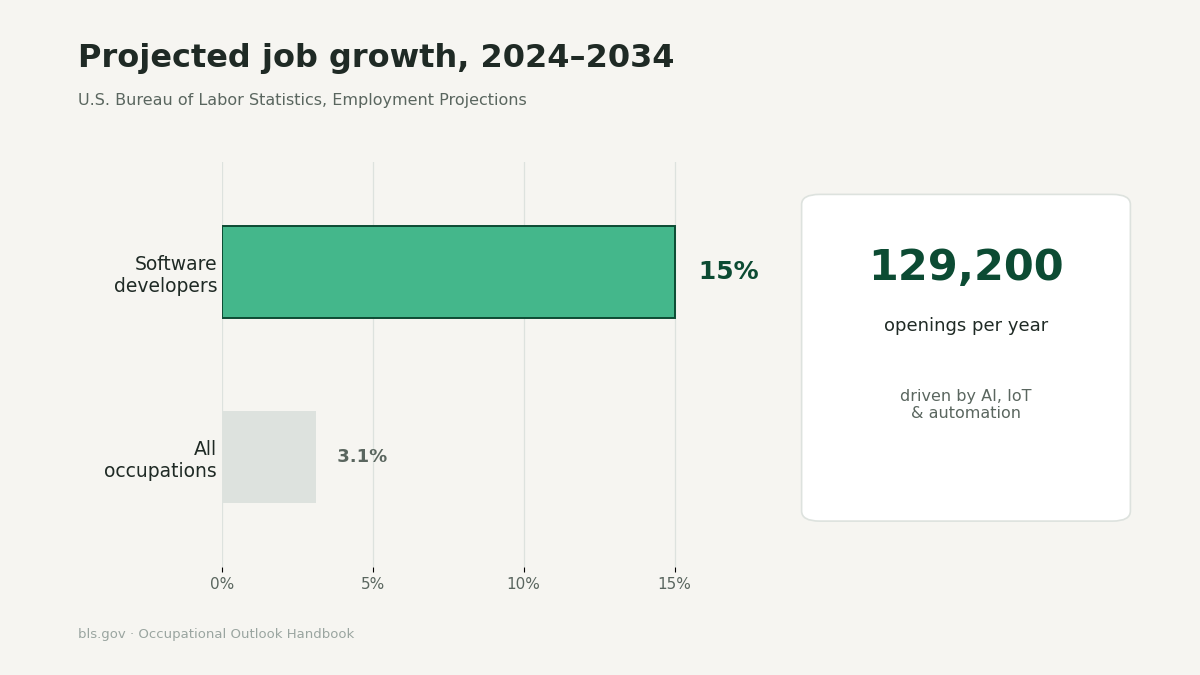
The U.S. The Bureau of Labor Statistics projects software developer employment to grow 15% between 2024 and 2034 much faster than the average across all occupations with roughly 129,200 openings per year over the decade, driven by continued expansion of software for AI, IoT, robotics, and automation. Backend hiring gets more competitive from here, not less.
Two forward-looking forces route a disproportionate share of that demand toward Django specifically. First, AI: the same BLS projections name AI-based systems as a primary growth driver through 2034, and Python is the AI economy’s default language every LLM feature bolted onto a web product pulls hiring pressure toward Python-fluent web engineers, and Django is Python’s production web workhorse.
Second, supply structure: successive Django community surveys consistently show roughly three in four Django developers carrying 3+ years of professional experience, a durably senior-skewed pool that means fewer résumés per opening, but far higher signal-to-noise when you screen properly.
This guide does two jobs. First, it makes the honest case for Django security defaults, the admin panel, development speed including the trade-offs vendors won’t mention. Second, it walks through the entire process of hiring Django developers for a web build: defining the role, vetting candidates, choosing an engagement model, negotiating contracts, onboarding, and managing delivery with real cost bands and timelines at every step. Read it end to end and you should be able to run this process yourself, even if you’ve never hired a backend engineer before.
TL;DR
This guide is for founders, CTOs, and engineering leaders deciding whether Django is the right foundation for a web product and how to staff it once they decide. It covers the framework's genuine strengths, its real limitations, and the full hiring lifecycle from job description to managed delivery.
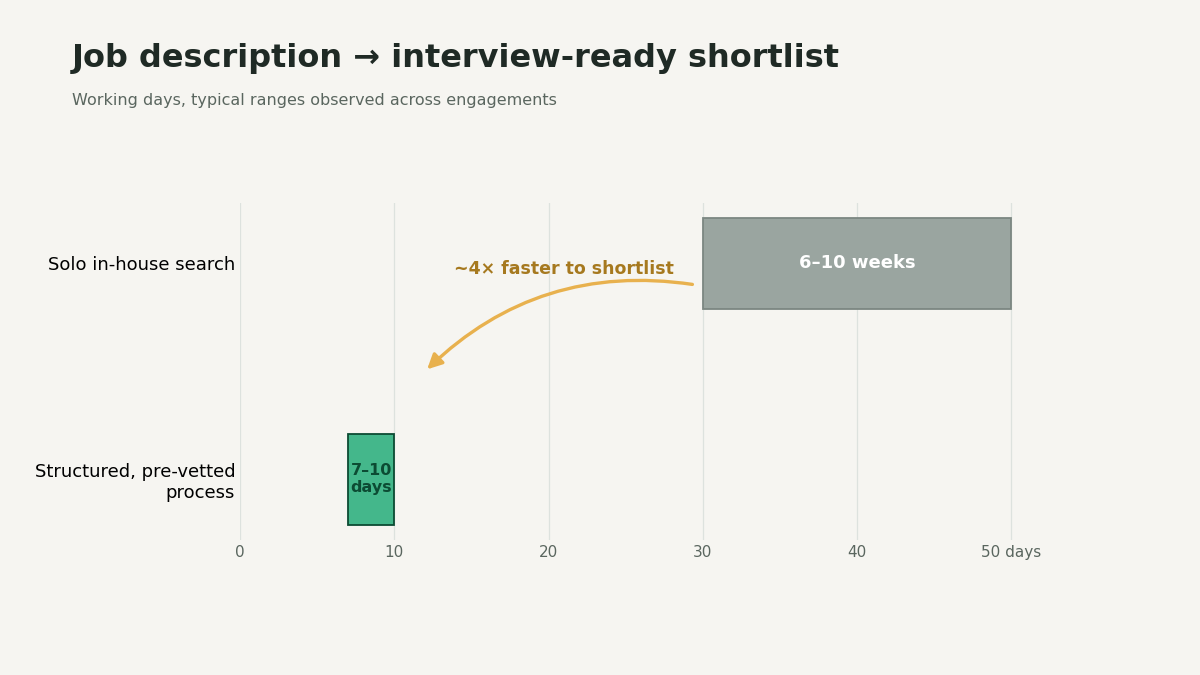
The single most useful number in here: a well-run process to hire Django developers for web development takes 7–10 working days from job description to interview-ready shortlist while the average company doing it alone spends 6–10 weeks and still mis-hires at a meaningful rate. The gap is process, not luck, and the process is reproducible. On the framework side, Django scalability is a solved problem at almost every traffic level a growing product will see, but only if you hire people who know where the four common bottlenecks hide.
By the end, you'll be able to decide whether Django fits your use case, write a role scorecard, run a vetting exercise that filters out tutorial-level candidates, pick the right engagement model for your budget, and know exactly what "good delivery" looks like in the first 90 days.
What Is Django Web Development?
Django is a free, open-source Python web framework that bundles the components most web applications need database ORM, authentication, admin interface, security protections, and URL routing into one integrated, “batteries-included” system, letting teams build production-grade web apps significantly faster than assembling equivalent pieces from separate libraries.
To keep the definition sharp, here’s what Django is not:
- Not a language. Django is written in Python; you hire Python engineers who specialize in Django, not “Django programmers” who can’t work outside it.
- Not a frontend framework. Django renders server-side templates or serves APIs; React, Vue, or html typically handle rich client-side interactivity.
- Not a CMS out of the box. WordPress is a content management product; Django is a toolkit you build products with (though CMSs like Wagtail are built on it).
Why Django Still Wins Business Cases in 2026
Framework debates get religious fast, so anchor on outcomes instead. The strongest Django use cases 2026 all share one profile: data-heavy web applications where speed-to-market, security posture, and long-term maintainability matter more than squeezing out the last millisecond of raw request throughput.
Concrete business outcomes the Django decision affects:
- Speed to first release. Because authentication, admin, ORM, migrations, and form handling ship in the box, a competent two-person Django team typically stands up a working MVP in 6–10 weeks versus 3–5 months for the same scope on a stack where those pieces are assembled from scratch. That’s often one full funding-milestone of a runway saved.
- Security and compliance cost. Django enables CSRF protection, SQL-injection-resistant queries (via the ORM), XSS output escaping, and clickjacking headers by default. Teams that inherit these defaults spend measurably less on remediation before a SOC 2 or penetration-test milestone than teams that bolt security on later.
- Internal tooling for free. The auto-generated Django admin panel replaces what would otherwise be 2–4 weeks of custom back-office UI work order lookups, user management, content moderation on day one. For operations-heavy businesses (marketplaces, healthtech, fintech back offices), this is the single most underrated line item in the business case.
- Hiring depth and longevity. Per Statista’s most-used web frameworks data, Django is used by roughly one in eight developers worldwide, and the framework’s LTS release policy means versions receive fixes for around three years. You are not betting your codebase on a framework that may be abandoned.
- AI-adjacency. Products in 2026 increasingly bolt LLM features onto a core web app. Because Django is Python, your web team and your ML/AI code share a language, a package ecosystem, and often the same engineers have no bilingual team tax.
The honest counterweight: Django is a poor fit for ultra-low-latency services, WebSocket-first realtime products at massive concurrency, or tiny single-endpoint microservices where its structure is overhead. If that’s your core workload, a different tool wins and the comparison section later in this guide says so plainly.
Django for MVP Development: Why Startups Keep Defaulting to It
Founders rarely choose frameworks on ideology; they choose on what gets a fundable v1 live before the runway math turns ugly. Django for MVP development persists as the default because the framework front-loads exactly the work an MVP can’t skip but investors never see:
- Auth, sessions, and password handling days of security-sensitive work reduced to configuration.
- Database schema with migrations the data model can evolve weekly without hand-written SQL surgery.
- An ops back office (the admin) support and founders can inspect and fix data from day one.
- A straight upgrade path, the same codebase that ran the MVP, scales into Series A traffic with caching and workers, avoiding the “throwaway prototype” rewrite tax that quietly costs 2–3 months.
The pattern to copy from successful early-stage builds: one senior Django engineer owning architecture, one mid-level engineer on feature velocity, and a hard 6–10 week scope. Teams that staff an MVP with three juniors “to save money” almost always spend the savings twice on the post-launch stabilization.
Where Django’s Strengths Actually Come From
Every “why Django” listicle names the same features. What matters to a buyer is why those features translate into fewer incidents and faster shipping because that’s what you’re paying developers to convert into a product.
Security defaults, mechanically explained:
- ORM query parameterization. Developers write User.objects.filter(email=x) instead of raw SQL, which eliminates the most common SQL injection paths by construction, not by discipline.
- CSRF middleware on by default. State-changing forms fail without a valid token; a junior developer has to actively work to create a CSRF hole.
- Template auto-escaping. Output is HTML-escaped unless explicitly marked safe, inverting the XSS risk model the dangerous path requires a deliberate opt-out.
- A published security release process. The Django Software Foundation coordinates disclosures and ships patches on a predictable cadence, which your compliance team can cite in vendor questionnaires.
The admin panel, priced correctly: the auto-generated admin is not a customer-facing UI, and pretending otherwise is a classic misuse. Its correct role is internal operations support agents editing records, ops teams approving listings, founders inspecting data before dashboards exist. Priced as “custom internal tool you didn’t have to build,” it’s worth ₹2–6 lakhs / $3k–8k of avoided development in a typical early build.
Rapid development, with the fine print: Django’s speed comes from convention; the MVT structure, migrations, and reusable apps mean any experienced Django engineer can navigate any sane Django codebase within days. The fine print: that speed advantage is realized by people who know the conventions. In inexperienced hands, the same “magic” produces N+1 query storms and 4-second page loads. The framework doesn’t remove the need for senior judgment; it concentrates the value of it.
Trade-offs a vendor won’t volunteer:
- The ORM generates inefficient SQL at scale unless engineers profile queries deliberately.
- Async support (ASGI) is real but younger than the sync core; deeply async workloads are smoother in FastAPI or Node.js.
- The monolith-first shape is a feature for 90% of products and friction for genuine microservice architectures.
Does Django Scale? The Honest Answer
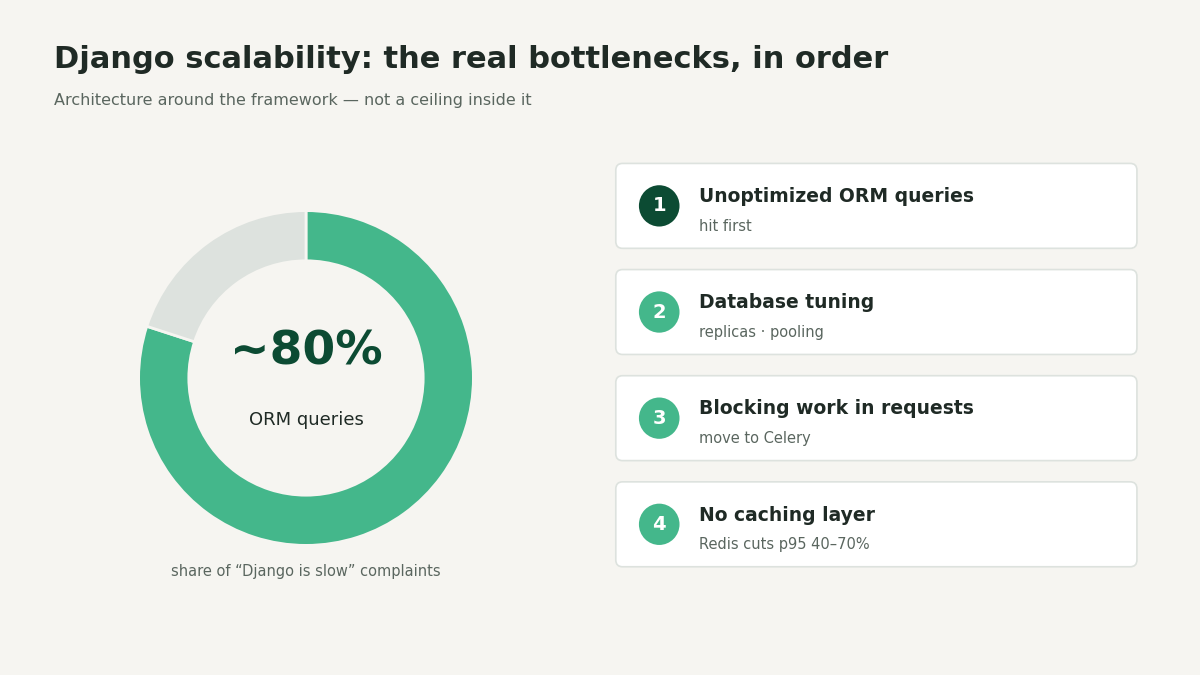
Short version: yes, further than your product will likely need. Django scalability is a question of architecture around the framework, not a ceiling inside it Instagram, Spotify’s web services, and large newsroom platforms have all run Django at extreme volume by scaling horizontally.
What actually limits a Django app, in the order teams usually hit it:
- Unoptimized ORM queries (hit first, ~80% of “Django is slow” complaints). Fix: select_related/prefetch_related, query profiling in code review, and database indexes. This is a hiring filter, not a framework flaw.
- The database, not Django. Past a few hundred requests/second, PostgreSQL tuning, read replicas, and connection pooling matter more than application code.
- Synchronous blocking work. Emails, PDF generation, and third-party API calls belong to Celery workers with Redis or RabbitMQ, not in the request cycle.
- Cache-less architecture. Redis-backed caching of hot queries and rendered fragments routinely cuts p95 latency by 40–70% in mature deployments.
Red flag: a candidate who answers “how would you scale this Django app?” with “rewrite it in microservices” before mentioning query profiling or caching has read blog posts, not production dashboards. Scaling work at this level usually pairs your backend hires with infrastructure specialists; many teams hire DevOps engineers alongside their second or third Django engineer, once deployment and observability become full-time concerns.
The Hiring Problem Nobody Prices In
Choosing Django is the cheap decision; staffing it is where budgets and timelines actually break. The failure patterns are consistent across the hundreds of engineering hiring engagements our delivery team has run:
- Timelines slip 3–4x. Teams budget 2–3 weeks to find a backend engineer and spend 6–10 weeks, because inbound applications for Python roles are dominated by data-science-leaning candidates who’ve never deployed a web app.
- Vetting tests the wrong layer. Generic algorithm rounds pass candidates who can invert a binary tree but have never written a migration, tuned a queryset, or configured Django settings for production. The mis-hire surfaces in week 3, not in the interview.
- The “Python ≠ Django” trap. Résumés listing Python are abundant; engineers with 2+ years of production Django DRF, Celery, deployment, security hardening are a much thinner slice. Screening that doesn’t distinguish the two produces interview funnels with 8–12% pass rates and burned engineering hours.
- Costs balloon quietly. Every week a role stays open, roadmap work either stalls or lands on existing engineers at overtime cost. A conservative internal estimate for a growth-stage team: an unfilled senior backend seat costs 1.5 — 2x its monthly salary in delayed output.
The rest of this guide is the corrective: a phase-by-phase process that compresses that 6–10 week slog into a repeatable 7–10 working day cycle.
How to Hire Django Developers for Web Development: The Complete Walkthrough
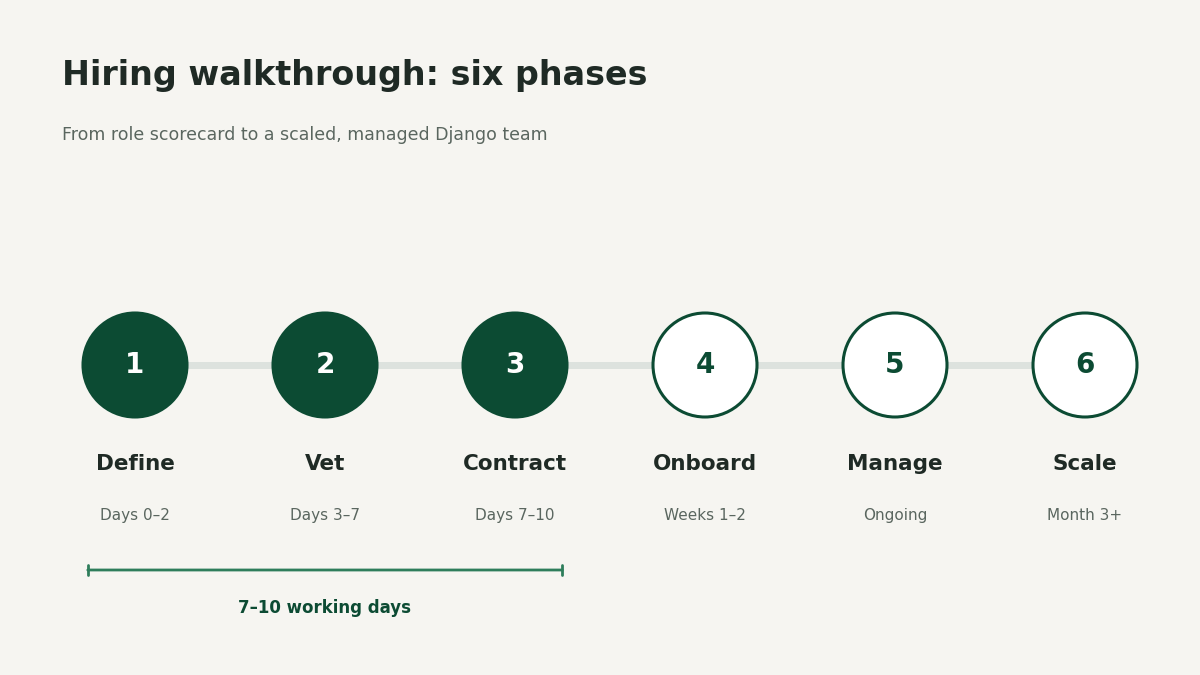
Run these six phases in order. Each one has a checklist you can lift directly into your own process. Together they map cleanly to a HowTo schema to implement it.
Phase 1 Defining Requirements (Days 0–2)
Vague job descriptions produce vague candidates. Before any sourcing, lock four things:
- Scope in product terms. “Build a multi-tenant SaaS billing dashboard with Stripe integration and role-based access” not “Django developer needed.”
- A skills scorecard, weighted. Separate must-haves (Django 4/5, DRF or django-ninja, PostgreSQL, Git, testing) from nice-to-haves (Celery, Docker, htmx, AWS). Score candidates against it; don’t rely on interviewer vibes.
- Seniority mapped to the actual problem. Greenfield MVP → one senior + one mid. Scaling an existing codebase → senior with performance war stories. Maintenance and features → strong mid-level is the cost-efficient pick.
- Budget bands set before outreach. Typical market ranges (label them internally as ranges, not offers):
- India, full-time: junior ₹5–10 LPA · mid ₹12–22 LPA · senior ₹25–45 LPA
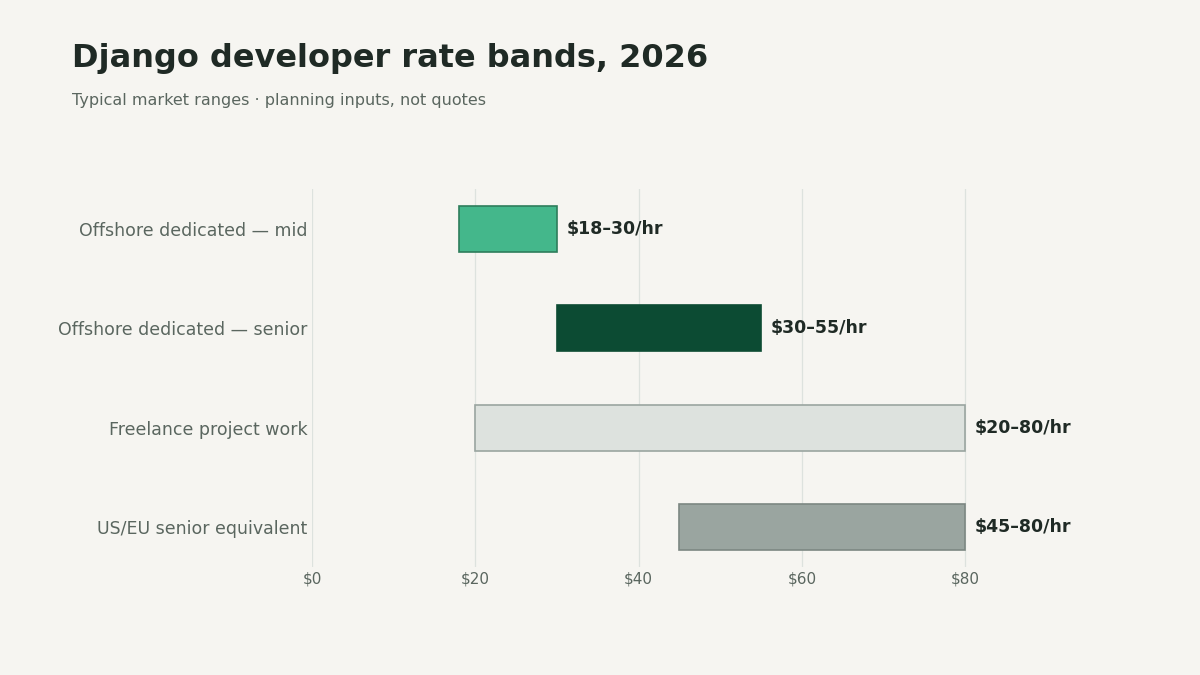
- India, contract/offshore: $18–30/hr mid · $30–55/hr senior
- US/EU, full-time: $90k–160k+ depending on market and seniority
The one-page rule: if your requirements don’t fit on one page with a scorecard, you haven’t finished deciding what you need and every downstream phase will inherit the ambiguity.
Phase 2 Sourcing & Vetting (Days 3–7)
This phase is where outcomes are determined. The goal is not more candidates; it’s a shortlist where every profile has already cleared a Django-specific bar.
What a rigorous funnel looks like:
- Source beyond job boards. Django-specific communities, open-source contributor lists, and pre-vetted talent networks outperform generic postings on signal density. AI-assisted sourcing platforms now surface and rank this pool in days the model behind the top-2%-of-vetted-talent benchmark Supersourcing’s pipeline works to, and the reason mature hire developers networks outperform cold job posts on shortlist quality.
- Screen for production evidence, not keywords. Ask for a deployed app, a repo, or a specific war story (“tell me about a query you made 10x faster”). Tutorial-only candidates can’t fake this.
- Run a 2–4 hour scoped technical exercise. A small DRF API with one tricky requirement (pagination + filtering + a permissions edge case) reveals more than a whiteboard round. Review it live and ask them to extend it; this also filters AI-generated submissions.
- Probe the Django-specific layer. Migrations gone wrong, select_related vs prefetch_related, settings separation for prod, middleware ordering, signal misuse. These questions have no bluffable answers.
- Evaluate collaboration deliberately. Async written communication, code-review tone, and timezone overlap (aim for 3–4 hours with your core team) predict remote success better than any algorithm score.
A Django interview question bank that separates production experience from tutorials:
- “Walk me through a migration that went wrong in production. What did you do?” (tests real deployment scars)
- “When does prefetch_related beat select_related, and how would you prove an N+1 problem exists?” (tests ORM depth)
- “How do you structure settings across local, staging, and production?” (tests operational maturity)
- “You need to send 10,000 emails after a user action. Where does that code live?” (tests Celery/queue instincts)
- “A DRF endpoint returns data the user shouldn’t see. Where are the three places the bug could be?” (tests the permissions/serializer/queryset mental model)
Candidates with genuine production history answer these in specifics project names, numbers, trade-offs. Candidates without it answer in documentation language. The difference is audible within two questions.
Red flags to reject on:
- Cannot explain a single performance fix from their own history
- Portfolio is exclusively tutorials/clones with no deployment story
- Dismisses testing as “something QA does”
- Every past project ended because of “management problems”
Well-run external processes compress this phase dramatically: a benchmark to hold any partner to is a vetted, interview-ready shortlist inside 7–10 working days of sharing the job description, with vetting reports attached not raw résumés.
Phase 3 Engagement Models & Contracts (Days 7–10)
Three viable models, and the right one is a function of duration, control, and management bandwidth:
- Dedicated developer (staff augmentation). Full-time on your roadmap, managed by you, billed monthly. Best for 6+ month horizons and evolving scope. Watch for “shared bandwidth” and insist contractually that the developer is exclusive to your account.
- Project-based / fixed scope. Vendor owns delivery against an SOW. Best for well-specified builds; brittle when requirements shift, because every change becomes a negotiation.
- Freelance. Cheapest entry, highest variance. Reasonable for audits and short bursts; risky as the sole owner of a production codebase (bus factor of one, no replacement mechanism).
Contract terms that protect you regardless of model:
- IP assignment on payment work-for-hire language, all code owned by you, no vendor reuse rights.
- NDA before any code access, covering data and architecture, not just “business information.”
- Replacement clause with a deadline. Mature staffing partners commit to replacing a poor-fit hire within 7–10 days at no extra sourcing cost; absence of this clause tells you how confident the vendor is in their own vetting.
- Notice periods both ways (usually 2–4 weeks) and a source-code escrow/handover obligation on exit.
- No lock-in on conversion if you later want to hire the developer full-time, the buyout terms should be written down now, not negotiated under duress.
If you’re comparing this route against building an internal recruiting function, the structured comparison of IT staffing services versus in-house hiring usually comes down to volume: below ~5 hires a year, external almost always wins on cost-per-hire and speed.
Phase 4 Onboarding & Ramp-Up (Weeks 1–2)
Most “bad hire” verdicts issued in month one are actually onboarding failures. A Django engineer with production experience should be shipping reviewed code by day 5–7 if you’ve built the runway.
The first-two-weeks checklist:
- Day 0 (before start): repo access, environment setup docs, docker-compose or equivalent one-command local setup, staging credentials, and accounts for Slack/Jira/CI provisioned in advance.
- Day 1: a 60-minute architecture walkthrough with a current engineer data model, settings layout, deployment path, and the two or three “here be dragons” areas every codebase has.
- Days 2–3: a deliberately small first ticket (a bug fix or minor endpoint) chosen to force one full loop through the branch → PR → review → CI → deploy.
- Days 4–7: first meaningful feature slice, paired review with your most context-rich engineer, and a written summary from the new hire of what they’ve understood gaps surface fastest in writing.
- Week 2: normal sprint participation, plus a 30-minute two-way feedback session. Course-correct now, not at day 45.
Communication cadence that works for remote Django teams: daily async standup in writing, two synchronous calls per week inside the overlap window, and demos every sprint. More meetings than this usually signals trust problems that meetings won’t fix.
Onboarding friction we see repeatedly: access tickets that take four days, undocumented environment variables, and “the one person who knows deployment” being on leave. Each is trivially preventable and each burns exactly the week you’re paying closest attention to.
Phase 5 Managing Delivery (Ongoing)
You can’t manage what you don’t instrument. Keep the metric set small and inspect it monthly:
- PR cycle time (open → merged): healthy Django teams sit under 24–48 hours; sustained multi-day cycles mean review bottlenecks or oversized tickets.
- Sprint predictability: committed vs. delivered within ±20% is a well-functioning team; wild swings mean estimation or scope discipline problems.
- Escaped defects per release and time-to-restore on incidents the honest quality signals, versus test counts, which are gameable.
- Query performance budget: p95 endpoint latency tracked in APM; regressions caught in staging, not by customers.
Structure matters as much as metrics. If you are engaged through a partner, insist on a named, dedicated account manager, one person accountable for developer performance, replacements, and escalations, reviewed on a fixed monthly cadence. If reporting is ad hoc, quality management is too.
The 30-day honesty checkpoint: at day 30, score the developer against the Phase 1 scorecard you wrote. If the fit is wrong, invoke the replacement clause immediately. Teams that wait until day 90 “to be fair” pay for two more months of the wrong answer and then restart the search anyway.
Phase 6 Scaling or Exiting (Month 3+)
Django teams scale in a predictable order, and hiring against that order avoids both gaps and bloat:
- Second backend engineer once one person is both building and firefighting the point where pull requests wait more than a day for review.
- Frontend specialization when UI complexity outgrows Django templates and htmx; this is typically where teams add a React specialist alongside the API work.
- DevOps/platform capacity once deployed frequency, observability, and infra cost need a real owner rather than a side quest.
- QA automation when manual regression passes exceeds a day per release.
Because Django sits inside the broader Python ecosystem, many teams widen the same pipeline rather than opening a new one; the second hire is often sourced from the same pool used to hire Python developers, with Django depth as the filter on top.
Exiting cleanly is a contract you wrote in Phase 3. A proper offboarding includes: full repo and infrastructure credential handover, a written runbook for deployment and incident response, 2+ weeks of overlap with the successor, and revocation of all access on the final day. If any of these is improvised at exit time, the cost lands on whoever inherits the codebase.
Case Studies: What This Looks Like in Practice
Outcome first, story second three engagements from Supersourcing’s delivery history that map to the patterns above:
Paytm hiring at volume without diluting the bar. Scaling past 100 engineering hires, the fintech major needed funnel throughput that internal recruiting alone couldn’t sustain. A pre-vetted pipeline with role-specific technical screens kept interview panels working only on qualified candidates, holding the company’s pass bar while compressing time-to-shortlist to days rather than weeks, the same 7–10 working day cycle described in Phase 2.
Swiggy speed as the constraint. For a hyper-growth consumer platform, open backend seats translate directly into delayed roadmap items. Structured sourcing plus scorecard-based vetting delivered interview-ready engineering shortlists on a days-not-weeks cadence, with a 98% candidate joining rate across engagements, the metric that matters most when a reneged offer resets a six-week process to zero.
OkCredit early-stage engineering depth. A fintech startup hiring its core engineering team can’t absorb mis-hires; every seat is a meaningful share of the codebase. Weighted skills scorecards and production-evidence screening (Phase 1 and 2 of this guide, applied literally) built out the backend team with sub-1% drop-off on contracted roles, letting founders stay focused on product rather than pipeline.
Django vs Other Frameworks: A Decision Framework
Comparison tables usually hide the real question, so here’s the honest version of Django vs other frameworks organized around what your product actually needs, not feature counts.
| Criterion | Django (Python) | Node.js/Express | Laravel (PHP) | FastAPI (Python) | Ruby on Rails |
| Time to CRUD MVP | Fastest tier (admin + auth built in) | Medium (assemble libraries) | Fast (similar batteries) | Medium (API only, no admin) | Fast |
| Built-in security defaults | Strong, on by default | Depends on library choices | Strong | Good, narrower surface | Strong |
| Realtime / heavy WebSockets | Workable (Channels), not its home turf | Excellent | Workable | Good (async-native) | Workable |
| AI/ML ecosystem adjacency | Excellent (native Python) | Weak–medium | Weak | Excellent | Weak |
| Admin/back-office out of the box | Yes | No | Partial (Nova, paid) | No | Partial |
| Typical talent pool character | Smaller, senior-skewed | Largest, high variance | Large, regional | Growing, API-focused | Shrinking, very senior |
| Long-term maintainability | High (conventions + LTS) | Varies by discipline | High | High for APIs | High |
When to use Django the four-question test; three or more “yes” answers and it’s the default choice:
- Is the product data-model-heavy (marketplace, SaaS, fintech, healthtech, internal platform) rather than realtime-first?
- Do you need internal admin/back-office capability early?
- Will AI/ML features share the codebase or team within 18 months?
- Is speed to a secure, compliant v1 worth more than theoretical peak throughput?
When to choose something else, stated plainly:
- Node.js when the product is realtime-first (collaborative editing, chat, live dashboards) or the team is already JavaScript-native end to end.
- FastAPI when you’re building a pure, high-throughput API service, especially ML model serving with no server-rendered pages and no need for the admin.
- Laravel when the existing team and vendor ecosystem are PHP and the calculus is continuity, not greenfield choice.
Hybrid stacks are common and unremarkable: Django serving a DRF API with a React frontend remains one of the most widely deployed pairings in production SaaS.
What Most Teams Get Wrong
Patterns from real engagements, stated bluntly this is the section to screenshot:
- They hire “Python developers” for Django roles. The overlap is smaller than it looks: data-pipeline Python and production web Python are different jobs. The State of Django data shows the framework’s practitioners skew heavily senior precisely because web production experience compounds screen for it explicitly or inherit the gap.
- They benchmark Django against 2016 complaints. “Django can’t do async” and “Django doesn’t scale” are stale. ASGI support, Channels, and twenty years of horizontal-scaling patterns closed those gaps; the surviving criticisms (ORM query discipline, monolith shape) are narrower and manageable.
- They over-index on hourly rate and under-index on cycle cost. A $25/hr developer who needs 2x the hours and a rewrite in month six is more expensive than a $45/hr developer who ships correctly once. Total cost of delivery, not rate cards.
- They skip the paid trial. A one-week paid pilot ticket costs $800–2,000 and de-risks a $60k+ annual commitment. Almost nobody does it; everybody should.
- They treat the admin panel as the product. Shipping the Django admin to end customers produces support tickets, not revenue. It’s an internal tool; budget a real UI for users.
- They conflate “framework popularity” with “hiring difficulty.” Django’s pool is smaller than JavaScript’s and materially better-filtered. Fewer candidates with higher median quality is an advantage if your vetting can tell the difference.
Cost & Timeline Reality Check
The section most competing guides omit, because ranges invite accountability. All figures are typical market bands observed across engagements; treat them as planning inputs, not quotes.
Developer cost bands (2026, typical):
| Scenario | Typical range |
| India full-time mid-level | ₹12–22 LPA |
| India full-time senior | ₹25–45 LPA |
| Offshore dedicated contract mid | $18–30/hr (~$3k–5k/month) |
| Offshore dedicated contract senior | $30–55/hr (~$5k–9k/month) |
| US/EU full-time mid to senior | $90k–160k+ base |
| Freelance project work | $20–80/hr, extreme variance |
Project timeline bands (competent 1–3 person Django team):
- Internal tool / admin-centric app: 3–6 weeks
- Standard SaaS MVP (auth, billing, dashboard, API): 6–12 weeks
- Marketplace or multi-tenant platform v1: 3–5 months
- Legacy migration onto Django: 2–6 months, dominated by data-model archaeology, not code
Hiring timeline bands:
- Solo in-house search: 6–10 weeks to offer, plus notice periods
- Structured partner-led search: 7–10 working days to interview-ready shortlist; 2–4 weeks to a started developer
- Replacement under a guarantee clause: 7–10 days, versus a full restart of the cycle without one
The arbitrage math, stated once: a senior offshore dedicated developer at $30–55/hr typically delivers 55–70% cost savings against an equivalent US hire after accounting for management overlap time but only when vetting quality is equal. Cost arbitrage with weak vetting isn’t arbitrage; it’s deferred spend. The lever is the screening process, not the geography.
What moves cost up: realtime features, complex third-party integrations (payments, KYC, EHR), compliance regimes (HIPAA, PCI-DSS), and the silent one undecided requirements, which convert directly into billable rework.
What moves cost down: ruthless MVP scoping, using the admin for internal needs instead of custom UI, PostgreSQL over exotic datastores, and senior review over larger junior headcount.
Where to Go From Here
If you’ve read this far, you’re likely past “should we use Django” and into “who builds it.” The highest-leverage next step is small: take the Phase 1 template above, write the one-page role scorecard for your first hire, and pressure-test it against real candidates.
If you’d rather pressure-test it with people who run this process daily 527+ delivered IT projects, a 7–10 day shortlist cycle, and a replacement guarantee behind every placement share that scorecard with the Supersourcing team for a no-obligation review of scope, budget band, and hiring timeline: https://supersourcing.com/contact-us/
One page, one conversation, and you’ll know whether your plan survives contact with the market before you spend a rupee on the wrong hire.
FAQ
Is Django still relevant in 2026?
Yes measurably. Python posted the largest usage growth of any major language in Stack Overflow’s 2025 survey of 49,000+ developers, and Django remains a primary framework carrying Python’s web workload, with an unusually experienced practitioner base and a three-year LTS support policy. Relevance concerns belong to frameworks losing users and maintainers; Django is exhibiting neither.
How much does it cost to hire a Django developer in India?
Typical 2026 bands: ₹12–22 LPA for mid-level and ₹25–45 LPA for senior full-time roles, or $18–55/hr for dedicated offshore contracts depending on seniority. Rates trend upward with DRF depth, Celery/async experience, and production scaling history the exact skills that reduce total delivery cost.
How long does it take to hire a Django developer?
Running the search alone, expect 6–10 weeks from posting to accepted offer. A structured, pre-vetted pipeline compresses the search phase to 7–10 working days from job description to interview-ready shortlist, with your interviews and the candidate’s start date adding 1–3 weeks on top.
Is Django better than Node.js for web application development?
Neither wins in the abstract. Django is the stronger default for data-heavy, security-sensitive products needing fast, maintainable delivery and AI-ecosystem adjacency; Node.js wins realtime-first products and JavaScript-native teams. Apply the four-question test in the comparison section above most products answer it decisively in one direction.
Is FastAPI replacing Django?
It’s replacing Django in one niche: pure API services, especially ML model serving, where FastAPI’s async-native design shines. For full products auth, admin, forms, templates, ORM, migrations Django’s integrated toolkit still has no equivalent in FastAPI, and many teams run both side by side.
Can Django handle high traffic?
Yes, with ordinary horizontal scaling: multiple app servers behind a load balancer, tuned PostgreSQL with read replicas, Redis caching, and Celery for background work. Platforms serving hundreds of millions of users have run on Django. The practical constraint is engineering discipline around ORM queries a hiring problem, not a framework ceiling.
Should I hire freelance or dedicated Django developers?
Freelancers fit audits, short bursts, and well-bounded tasks. For anything owning production code beyond ~3 months, dedicated developers win on continuity, IP protection, and replaceability provided the contract includes exclusivity, IP assignment, and a 7–10 day replacement guarantee. The bus-factor risk of a solo freelancer on a revenue-critical codebase is routinely underpriced.
What should I look for before signing with a Django development partner?
Four things: a vetting process you can inspect (ask to see an actual screening report), a written replacement guarantee with a deadline, contractual exclusivity and IP assignment, and reference checks with two current clients. If a partner hesitates on any of the four, that hesitation is the answer and a short consultation call comparing two or three shortlisted partners against this checklist is usually the fastest way to a safe decision.
