

A food-delivery app that crashes loses an order. A fintech app that crashes mid-transaction can double-charge a customer, break a regulator-mandated audit trail, and trigger a dispute process that costs more than the feature did to build. That asymmetry, the cost of failure, not the difficulty of the code, is the single biggest thing teams misunderstand when they set out to hire fintech app developers for the first time.
The stakes are compounding fast. McKinsey projects fintech will roughly triple into a $2 trillion industry by 2030, accounting for about 9% of the global financial-services value pool. More money flowing through apps means more regulatory scrutiny, more sophisticated fraud, and a wider gap between developers who have shipped regulated software and developers who have merely shipped software.
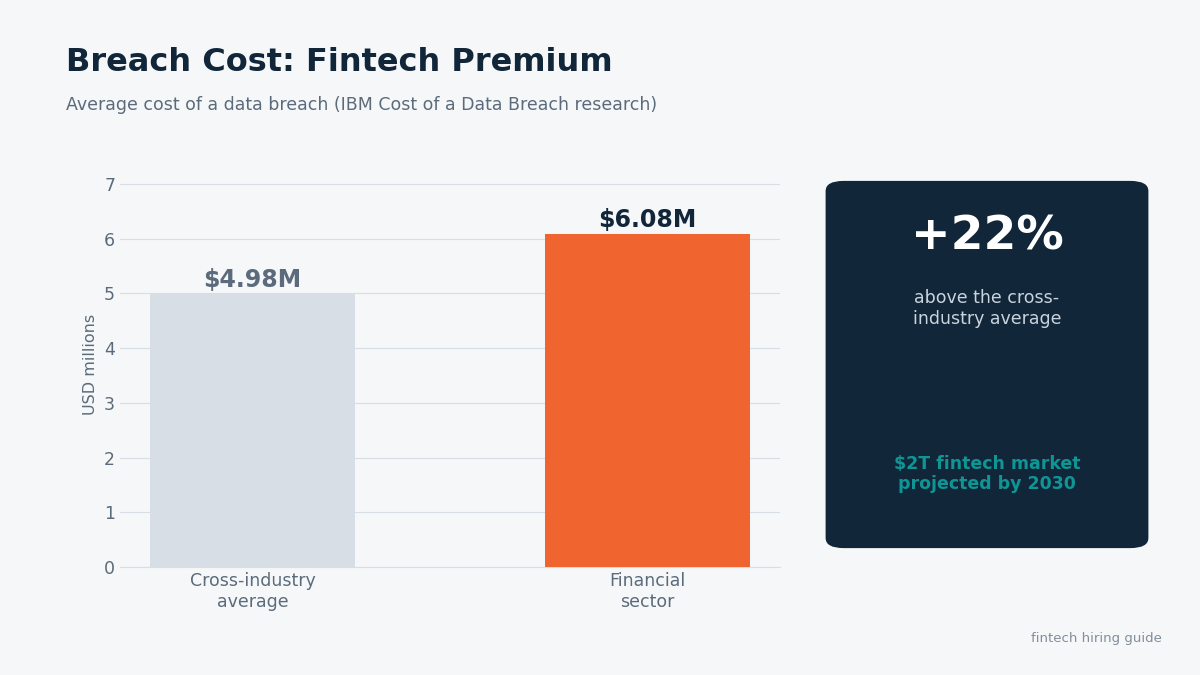
That gap is expensive to discover late. IBM’s Cost of a Data Breach research puts the average financial-sector breach at USD 6.08 million roughly 22% above the cross-industry average. A payments feature built by a generalist team that skipped tokenization or logged card data in plaintext isn’t a code-quality problem; it’s a seven-figure liability sitting in your repo.
This guide is the full walkthrough: what actually changes when an app touches money, which fintech security requirements and compliance layers apply at each stage, how to scope, vet, contract, onboard, and manage a fintech engineering team and what it should cost and how long it should take. It’s written from patterns across hundreds of staffing and delivery engagements in fintech, including builds and hiring scale-ups for payment, lending, and neobanking products.
TL;DR
This guide explains what separates fintech app development from regular app development, and how to hire for it. It's written for founders, CTOs, and engineering leaders planning a build that touches payments, lending, wealth, or banking data.
The short version: compliance and security are not a final-phase checklist. They add roughly 25–40% to timelines and budgets when planned upfront and far more when discovered late. A realistic MVP for a regulated fintech product runs 4–9 months and $60,000–$250,000+, not the 8–12 weeks a generic app quote suggests. When you hire fintech app developers with prior regulated-product experience, most of that overrun risk disappears before the first sprint.
By the end, you'll be able to scope a fintech build correctly, run a fintech app compliance-aware vetting process, choose the right engagement model, and manage delivery against the KPIs that actually matter in financial software.
What Is Fintech App Development?
Fintech app development is the process of designing, building, and maintaining software that moves, stores, or manages money and financial data under regulatory, security, and auditability constraints that ordinary consumer or business apps never face.
It combines standard product engineering with compliance frameworks (KYC/AML, PCI DSS, data-protection law), bank-grade security, and integrations with regulated third parties like payment gateways and identity-verification providers.
What it is not:
- Not just “an app with a payment button.” Accepting a Stripe or Razorpay checkout in an e-commerce app is integration work; building a wallet, ledger, or lending flow is regulated financial engineering.
- Not blockchain/crypto by default. Crypto is one fintech niche with its own rules. Most fintech apps are payments, lending, neobanking, insurtech, and wealth products running on conventional stacks.
- Not something compliance teams handle “later.” In fintech, regulatory requirements shape the architecture itself, data models, logging, storage locations from day one.
Why It Matters: The Business Case for Hiring Right
Getting the hiring decision right on a fintech build isn’t a quality nicety it changes four hard business numbers:
- Cost of rework. Retrofitting compliance into a finished app (re-architecting data storage for residency rules, rebuilding logs into immutable audit trails, replacing plaintext PII handling with tokenization) typically costs 2–3x what building it correctly the first time would have. Teams that discover PCI DSS scope after the build routinely lose an entire quarter.
- Speed to market and to license. Payment aggregator approvals, bank partnerships, and app-store reviews for financial apps all involve technical scrutiny. Experienced fintech engineers produce the documentation, audit logs, and security posture these reviews demand, cutting approval cycles from months of back-and-forth to weeks.
- Breach and penalty exposure. Beyond IBM’s ~$6M average breach figure for the sector, regulators add fines: GDPR penalties reach 4% of global turnover, and India’s DPDP Act 2023 provides for penalties up to ₹250 crore per instance. One engineer who knows not to log card PANs is cheaper than one incident response.
- Fundraising and partnership diligence. Banks, sponsors, and Series A+ investors run technical due diligence on fintech products. SOC 2 readiness, clean access controls, and a defensible ledger design are now table stakes in those reviews and they’re staffing decisions long before they’re audit line items.
The revenue upside is equally concrete: BCG and QED Investors project fintech revenues growing roughly sixfold to $1.5 trillion by 2030. The market rewards teams that ship regulated features fast which is a talent problem before it’s anything else.
The Core Problem: Why Fintech Development Challenges Blindside Regular Teams
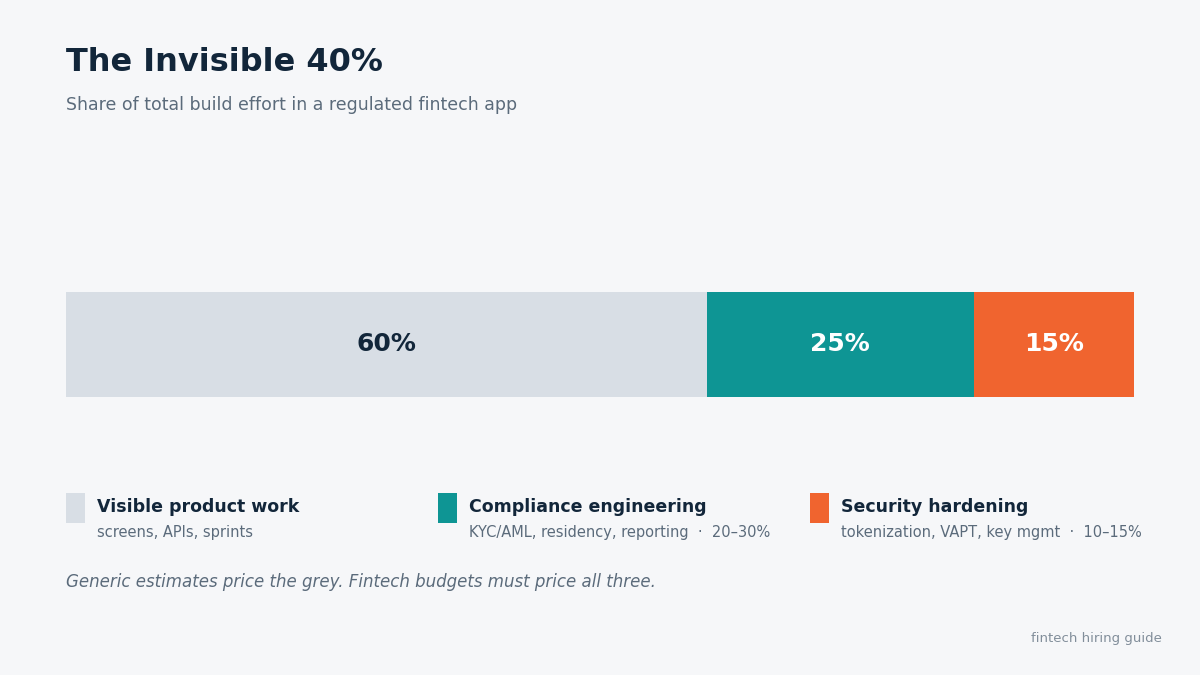
Most failed fintech builds don’t fail on features. They fail on the invisible 40% of the work that generic dedicated teams don’t know exists. The most common fintech development challenges follow a predictable pattern:
The underestimation pattern. Teams scope a fintech MVP the way they’d scope a marketplace app screens, APIs, sprints and underestimate the compliance-and-integration layer by 3–4x. A “simple” P2P payments MVP quoted at 10 weeks routinely becomes 6–7 months once KYC flows, sanction screening, reconciliation, and gateway certification enter the picture.
Where the hidden work lives:
- Compliance engineering KYC/AML flows, consent management, data-residency architecture, regulator-ready reporting. Often 20–30% of total build effort.
- Security hardening tokenization, encryption at rest and in transit, secure key management, VAPT cycles, OWASP MASVS alignment for mobile. Another 10–15%.
- Third-party integration reality payment gateways, KYC vendors, credit bureaus, and banking APIs each come with sandbox quirks, certification steps, webhook edge cases, and settlement-timing rules that only show up in production-like testing.
- Financial correctness double-entry ledgers, idempotent transaction APIs, reconciliation jobs, and rounding rules. Money bugs are silent until they’re catastrophic.
Red flag: if a proposed team’s estimate for a payments product contains no line items for compliance, reconciliation, or penetration testing, the estimate isn’t lean; it’s incomplete. You’ll pay for those items either in the plan or in the post-mortem.
This is exactly why the hiring bar is different. A brilliant generalist can learn all of this on your budget and your timeline. Software developers who’ve already shipped regulated products arrive with the checklist internalized. The rest of this guide shows you how to find, verify, and deploy them.
The Complete Fintech App Development Process: From Scratch to Shipped
This is the full lifecycle of the same sequence whether you’re a founder building a first product or an enterprise spinning up a new financial vertical. The fintech app development process differs from a standard build at every phase, and each difference below is flagged explicitly.
Phase 1 Defining Requirements: Scope, Skills, Budget Bands
Requirements for a fintech product start with a question no regular app asks: what regulated activities does this app perform? The answer determines your compliance surface, your architecture, and who you need to hire.
Step 1: Classify your regulatory exposure.
- Payments/wallets → PCI DSS scope, payment-aggregator rules (in India, RBI’s PA/PG guidelines), settlement and refund regulation.
- Lending → licensing or lending-partner requirements, credit-bureau integration, fair-lending and collections rules, RBI digital-lending guidelines in India.
- Investments/wealth → securities regulation (SEBI/SEC/FCA depending on market), suitability and disclosure requirements.
- Any of the above → KYC/AML obligations, data-protection law (GDPR, DPDP Act), and record-retention mandates.
Step 2: Write requirements in three layers, not one.
- Product layer: user journeys, features, platforms.
- Compliance layer: which regulations apply, what data can be stored where, what must be logged, what reports regulators or bank partners will demand.
- Integration layer: named third parties gateway (Razorpay/Stripe/Adyen), KYC provider, credit bureau, banking-as-a-service partner because each choice changes the engineering plan.
Step 3: Define the skills matrix before the headcount. A typical fintech MVP team: 1 backend engineer with ledger/payments experience, 1–2 mobile or frontend engineers, 1 DevOps/DevSecOps engineer (part-time is fine early), 1 QA engineer with security-testing exposure, plus fractional access to a compliance advisor. If the product is mobile-first, this is where teams typically hire React Native developers or native iOS/Android engineers with prior experience passing financial-app store reviews.
Step 4: Set budget bands with the compliance layer priced in. Directional planning figures:
- India-based dedicated engineers: ₹15–35 lakhs/year per senior fintech-experienced engineer (roughly $40k–$70k/year via a staffing partner, all-in).
- MVP build (regulated scope): $60k–$250k+ depending on licensing surface and integrations.
- Compliance/security overhead: budget an additional 25–40% over an equivalent unregulated app.
The one-page rule: before sourcing anyone, you should be able to state on one page product scope, regulatory classification, named integrations, team matrix, budget band, target launch quarter. If you can’t, the vendors you brief will fill the gaps with assumptions, and every vendor will assume differently.
The Fintech App Compliance Checklist (Pin This)
Before any sourcing begins, run your product concept through this checklist. Every “yes” adds scope, cost, and a screening criterion for the engineers you hire which is why it belongs in Phase 1, not pre-launch.
Data & privacy:
- Do you collect PII (name, address, government IDs)? → Data-protection law applies (GDPR, DPDP Act); consent flows and deletion rights become engineering requirements.
- Do you touch card data anywhere? → PCI DSS scope; the correct engineering answer is usually gateway tokenization so raw card numbers never enter your systems.
- Do any users or partners impose data residency? → Cloud-region architecture must be decided before the first deployment, not after.
Identity & money movement:
- Do users need identity verification? → KYC vendor integration, document handling rules, re-verification triggers, and audit-ready decision logs.
- Do you move money between parties? → AML monitoring, sanction screening, transaction limits, and suspicious-activity reporting hooks.
- Do you hold balances (wallet/stored value)? → Licensing or a banking-as-a-service partner, plus ledger and reconciliation requirements.
Operations & proof:
- Can you reconstruct any transaction’s full history a year later? → Immutable audit trails and append-only event logs are architecture decisions.
- Do bank partners or enterprise customers require SOC 2? → Access controls, change management, and logging need to be audit-shaped from sprint one.
- Will you undergo VAPT before launch? → In most regulated contexts, yes budget 2–4 weeks for testing and remediation in the launch plan.
- Is there an incident-response path? → Breach-notification clocks (72 hours under GDPR) start ticking whether or not you have a plan.
How to use it: every checked item becomes
(a) a line in your requirements’ compliance layer,
(b) a budget line, and
(c) an interview topic in Phase 2.
When you brief a partner to help you hire fintech app developers, hand them this filled-in checklist. It’s the difference between a shortlist screened for your regulatory surface and a shortlist of generically good engineers. Teams that skip this step discover their compliance surface through partner-review comments in month five, at 2–3x the remediation cost.
Phase 2 Sourcing & Vetting: What Good Screening Looks Like
Vetting is where fintech hiring diverges hardest from regular hiring. Résumés in this space are noisy “worked on a banking app” can mean architecting the ledger or changing button colors. Your screening has to separate the two.
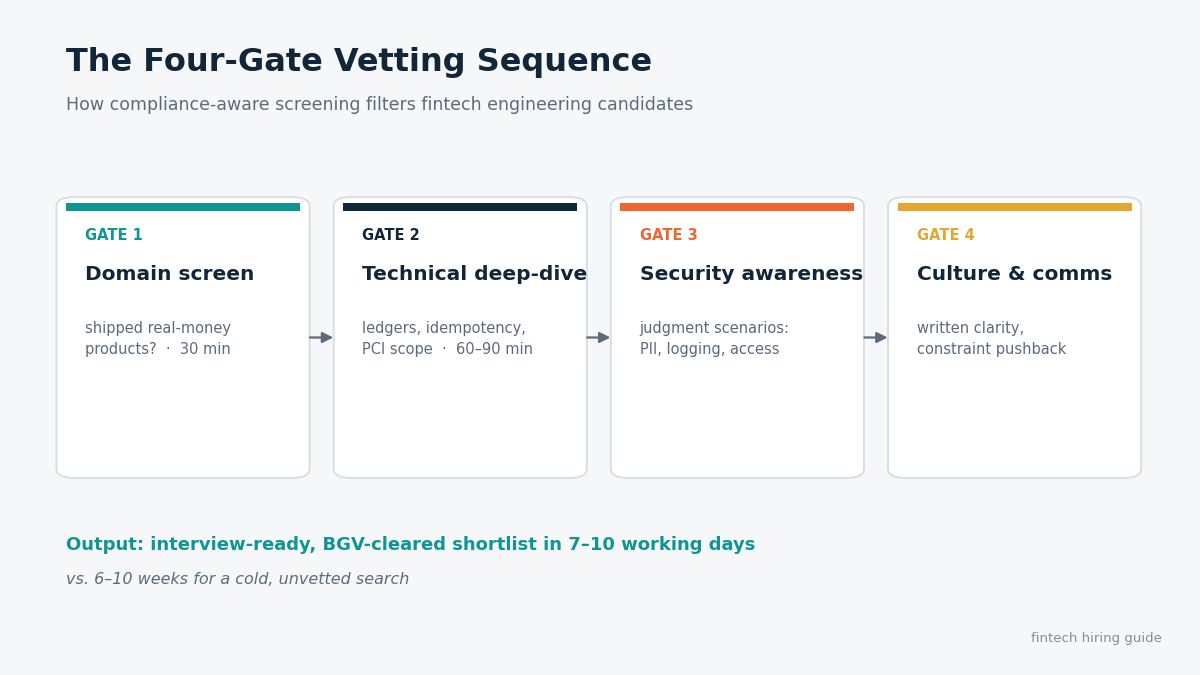
The four-gate vetting sequence:
- Domain screen (30 min). Have they shipped a product that moved real money? Which regulations did it operate under? What did they personally build? Ask for specifics: gateway used, KYC vendor, what the reconciliation process looked like.
- Technical deep-dive (60–90 min). Test fintech-specific engineering, not abstract algorithms. Strong prompts:
- “Design a wallet transfer between two users. Walk me through failure modes.” (Listen for: idempotency keys, double-entry records, atomicity, what happens on gateway timeout.)
- “Where are you allowed to store a card number?” (Correct answer: ideally nowhere tokenized via the gateway; anything else triggers PCI DSS scope discussion.)
- “How would you make transaction history tamper-evident?” (Append-only/audit-log design.)
- Security & compliance awareness screen. Not a certification quiz or a judgment test. Present a scenario: “Product wants to log full request payloads for debugging. What do you push back on?” Engineers with real fintech scars immediately flag PII/PAN leakage into logs.
- Culture and communication. Fintech work involves saying “no, that violates X” to product managers. You need engineers who communicate constraints clearly, in writing, across time zones.
Red flags that predict expensive failures:
- Portfolio full of “fintech UI” work with no ledger, gateway-certification, or KYC-flow experience underneath.
- Cannot name a single compliance framework relevant to their past product.
- Estimates a payment MVP in weeks without asking about your regulatory classification.
- No background-verification (BGV) consent is non-negotiable for anyone touching financial data.
What a compliance-aware vetting partner adds. This screening depth is exactly what most in-house recruiters and generic staffing firms can’t run; they can assess code, but not regulate-product judgment.
It’s the specific gap Supersourcing built its vetting around: AI-powered sourcing surfaces the top 2% of pre-vetted engineers, screening for regulated-domain experience (payments, lending, banking integrations) alongside technical depth, with BGV and NDA-backed IP protection standard.
The practical output: a shortlist of interview-ready candidates in 7–10 working days instead of the 6–10 weeks a cold search typically takes. If you’re staffing a regulated build, start with a partner whose bench already includes engineers you can hire as fintech developers rather than filtering generalists yourself.
Phase 3 Engagement Models & Contracts: Structures and the Clauses That Matter
Three models dominate fintech staffing, and the right one depends on how long the regulated surface will live (hint: forever).
Model selection in one pass:
- Dedicated developers / staff augmentation engineers work exclusively on your product under your process. Best default for fintech: you keep architectural control and institutional knowledge of the compliance decisions. Typical commitment: 3–12 months, monthly billing.
- Project-based / fixed-scope good for well-bounded, lower-risk pieces (a marketing site, an internal dashboard), risky for core financial flows where scope will move as regulators and bank partners weigh in.
- In-house hiring right for the long-term core team, but slow (90–120 days per senior fintech hire in most markets) and expensive to get wrong. Most successful teams blend: a small in-house core plus augmented specialists.
Contract clauses that are uniquely load-bearing in fintech:
- IP assignment, explicitly covering ledger and compliance code. Work-for-hire language must be airtight; your bank partner’s diligence team will read it.
- NDA + data-handling terms. Specify that engineers never receive production financial data without masking, and that any access is logged.
- Audit and security cooperation. The vendor must cooperate with your SOC 2 / PCI DSS audits and VAPT cycles write it now, not during the audit.
- Replacement guarantee with a defined window. A mis-hire on a regulated build burns irreplaceable calendar. A 7–10 day replacement commitment is a reasonable market standard to demand.
- No shared bandwidth. For fintech, insist contractually that engineers are dedicated; an engineer context-switching across three clients is an engineer who forgets which codebase had the PII-logging rule.
Negotiation point from real engagements: vendors resist liability language around data breaches. A workable middle ground is tiered liability uncapped for willful misconduct and data-handling violations, capped at fees for ordinary negligence. Vendors who refuse any breach-related liability are telling you how confident they are in their own engineers.
Phase 4 Onboarding & Ramp-Up: The First Two Weeks
Onboarding a fintech engineer has a security dimension: regular onboarding skips entirely. The first two weeks decide whether your access model is defensible or a future audit finding.
Week 1 access, environment, context:
- Least-privilege access from day one. Role-based access to repos and cloud; no production database access for anyone new; secrets via a vault, never in chat or .env files shared over email.
- Sandbox-first integrations. New engineers work exclusively against gateway/KYC sandbox environments. Production credentials stay with 1–2 named owners.
- The compliance briefing. A 90-minute session covering: which regulations apply, what data classes exist (public / internal / PII / payment data), what may never be logged, and the incident-escalation path. Record it; it becomes onboarding material for every subsequent hire.
- Architecture walkthrough with the “money path” traced end to end from user action through gateway, webhook, ledger write, and reconciliation. Every engineer should be able to draw this from memory by day 5.
Week 2 first commits and cadence:
- First tickets should touch the real stack but not the money path: internal tooling, test coverage, a non-financial feature. You’re validating judgment before granting blast radius.
- Establish the communication cadence that will run the whole engagement: daily async standup, twice-weekly sync calls, a single decision log. Distributed fintech teams live or die on written decision trails; regulators and auditors love them, and so will you.
- Pair the new engineer with your DevOps owner to internalize the deployment and rollback process. If you don’t have that function yet, this is the point where teams hire DevOps engineers with financial-infrastructure experience CI/CD with audit logging, infrastructure-as-code, and environment isolation are compliance controls, not conveniences.
The 3-day rule: a well-run onboarding gets an experienced fintech engineer to a merged (non-critical) pull request within 3 working days. If your setup can’t support that, fix the environment before adding more headcount onboarding friction multiplies by every hire.
Phase 5 Managing Delivery: Cadence, KPIs, and Quality Gates
Managing a fintech build means tracking two scoreboards at once: product velocity and control health. Teams that watch only the first ship fast and fail audits; teams that watch only the second never ship.
The reporting cadence that works in practice:
- Daily: async standup with blockers flagged in writing.
- Weekly: sprint review plus a 15-minute “risk and compliance” slot open security findings, integration blockers, upcoming certification deadlines.
- Monthly: account-level review with the staffing partner or vendor utilization, upcoming ramp needs, replacement or scaling calls. A dedicated account manager on the vendor side, not a rotating pool, is what makes this meeting useful.
KPIs worth tracking (beyond velocity):
- Money-path test coverage targets 90%+ automated coverage on ledger, payment, and refund flows; 70% elsewhere is fine.
- Reconciliation break rate unmatched transactions per 10,000; trending down is the health signal.
- Mean time to resolve security findings critical VAPT findings closed inside 7 days, high inside 30.
- Deployment audit completeness every production change traceable to a ticket, reviewer, and approval. Auditors sample this; 100% is the only passing grade.
- Sprint predictability planned vs. delivered within ±20% is realistic for regulated work; wider variance means scoping or skills gaps.
Quality gates unique to financial software: no release touching the money path ships without (a) a reviewed threat-model delta, (b) passing reconciliation tests, and (c) sign-off from whoever owns compliance. This is also where dedicated QA earns its seat generic manual testing misses idempotency and race-condition bugs, so teams serious about correctness hire QA engineers who can write automated tests against payment sandboxes and simulate gateway failure modes.
Red flag in delivery: a team that’s always 100% “on plan” in a regulated build is usually deferring integration and certification pain into a final-phase cliff. Healthy fintech delivery surfaces third-party friction (gateway certification queues, KYC-vendor sandbox downtime, bank-partner review comments) early and loudly.
Phase 6 Scaling or Exiting: Headcount, Replacements, Offboarding
Fintech products that work get more regulated, not less new markets mean new licenses, and growth means audits. Plan the scaling and exit mechanics at signing, not when you need them.
Scaling up cleanly:
- Add engineers against the same skills matrix from Phase 1, updated quarterly. Each new market or product line (lending on top of payments, a second geography) gets its own compliance-layer addendum before headcount is added.
- Expect 2–3 weeks from request to productive new engineer with a partner who maintains a vetted bench; 10–16 weeks via cold hiring. That delta is often the difference between catching a bank-partnership window and missing it.
Replacement without drama: when a hire isn’t working, invoke the replacement clause fast within the first 2–3 weeks, not month three. The contractual standard to hold vendors to: replacement candidate presented within 7–10 days, with knowledge-transfer overlap included at no extra cost.
Offboarding is a security event. Checklist, executed same-day:
- Revoke all access (repos, cloud, dashboards, gateway/KYC consoles) within hours of the decision not at the end of week.
- Rotate any shared secrets the engineer could have seen.
- Confirm no local copies of data or credentials; collect a signed offboarding attestation (your auditors will ask).
- Transfer ticket and decision-log ownership; hold a recorded handover session.
- Update the access-control matrix the document that proves to an auditor that access equals need.
Done this way, scaling down is as clean as scaling up and your compliance posture survives the churn.
Case Studies: What Compliance-Aware Hiring Looks Like at Scale
Paytm 100+ engineers for a regulated payments giant. Scaling engineering inside one of India’s most heavily regulated fintech environments meant every hire faced both a technical bar and a payments-domain bar. Supersourcing supported the hiring of 100+ engineers, with pre-vetted, domain-screened shortlists compressing time-to-interview to days rather than weeks at a 98% candidate joining rate across the platform, so offers translated into onboarded engineers instead of renege-driven restarts.
OkCredit engineering hiring for a bookkeeping-to-fintech product. OkCredit’s product sits on merchant financial data, so engineering hires needed data-sensitivity judgment alongside stack skills. Domain-aware vetting and dedicated account management let the in-house team spend interview hours only on candidates who had already cleared technical and background screens, cutting internal screening load dramatically while keeping the joining funnel tight (<1% drop-off on contract roles across comparable engagements).
Razorpay & Open Money payments-ecosystem talent pipelines. For companies whose entire product is regulated money movement, the vetting emphasis shifts almost fully to payments-infrastructure experience: gateway internals, settlement logic, merchant onboarding flows. Engagements in this segment consistently show the pattern this guide argues for when the shortlist is pre-filtered for regulated-domain experience, hiring cycles land in the 7–10 working day range and first-90-day performance issues drop sharply.
Decision Framework: Dedicated Developers vs. Freelance vs. In-House vs. Agency
Use this matrix when choosing how to staff a fintech build. Score your situation against the four factors that matter most in regulated work: control, compliance fit, speed, and true cost.
| Factor | Dedicated developers (staff aug) | Freelancers | In-house | Project-based agency |
| Speed to start | 7–10 working days with a vetted bench | Days, but vetting is on you | 90–120 days per senior hire | 2–6 weeks (scoping first) |
| Compliance fit | High screened for domain, dedicated, NDA/BGV standard | Low–medium variable, hard to audit | Highest long-term | Medium depends on agency’s regulated-work history |
| Control & knowledge retention | High your process, your repos | Low | Highest | Low knowledge exits with the agency |
| Monthly cost (senior, India-based) | ~₹1.5–3.5L / $2.5k–6k per engineer | ₹0.8–2.5L, high variance | Salary + 25–35% overhead + recruiting cost | Fixed bids; change requests add 20–50% on evolving scope |
| Risk profile | Replacement guarantees offset mis-hires | Availability and confidentiality risk | Slow to correct a mis-hire | Scope-change risk on regulated products |
| Best for | Core build + scaling regulated products | Isolated, non-money-path tasks | Long-term product core | Bounded, low-regulation deliverables |
The blended default that works for most teams: in-house ownership of architecture and compliance decisions (1–2 people), dedicated augmented engineers for build capacity, freelancers only outside the money path. Pure-freelance fintech builds are where most horror stories come from; pure in-house is where most missed market windows come from.
Three questions that settle the choice:
- Will this codebase still be regulated in 3 years? (Yes → bias toward dedicated/in-house knowledge retention.)
- Can you afford 90+ days before the first commit? (No → augmentation first, convert to in-house later.)
- Does the work touch money movement or PII? (Yes → no shared-bandwidth arrangements, full stop.)
What Most Teams Get Wrong
Patterns repeat across regulated builds. These are the five that cost the most, each one contrarian to how “normal” app projects run, which is exactly why generalist teams walk into them.
- They hire for the stack, not the domain. A React Native expert and a React Native expert who has passed an app-store financial review, integrated a KYC vendor, and debugged a settlement mismatch are different hires at similar rates. Stack skills are searchable; regulated-product judgment is what you’re actually paying for. Interview for the second, filter résumés for the first.
- They treat compliance as a phase instead of a property. “We’ll do the compliance stuff before launch” is the most expensive sentence in fintech. Data residency decides your cloud regions; audit-trail requirements decide your logging architecture; KYC decides your signup funnel. These are foundations. Poured last, they require demolition first.
- They let the demo timeline become the launch timeline. A payments demo takes 8 weeks. A launchable payments product takes 4–9 months, because gateway production certification, VAPT remediation, bank-partner review, and app-store financial-category review are calendar items that parallel-track poorly. Teams that don’t know this pattern quote the demo timeline to their board and spend two quarters explaining the gap.
- They give everyone production access “to move fast.” In regular apps this is sloppy; in fintech it’s disqualifying. The first question in every serious diligence process bank partner, SOC 2 auditor, acquirer is who can touch production data and how you know. Least-privilege from day one is cheaper than the archaeology of retrofitting it.
- They optimize hiring for hourly rate instead of cost-per-shipped-regulated-feature. The ₹1.2L/month generalist who needs four months of domain ramp costs more than the ₹2.5L/month fintech engineer productive in week one before counting the rework the generalist’s early architectural guesses create. Rate-card shopping is how teams end up paying twice.
The through-line: fintech punishes optimism at exactly the points where regular development rewards it. The correction isn’t pessimism, it’s hiring people who have already paid this tuition on someone else’s product.
Cost & Timeline Reality Check
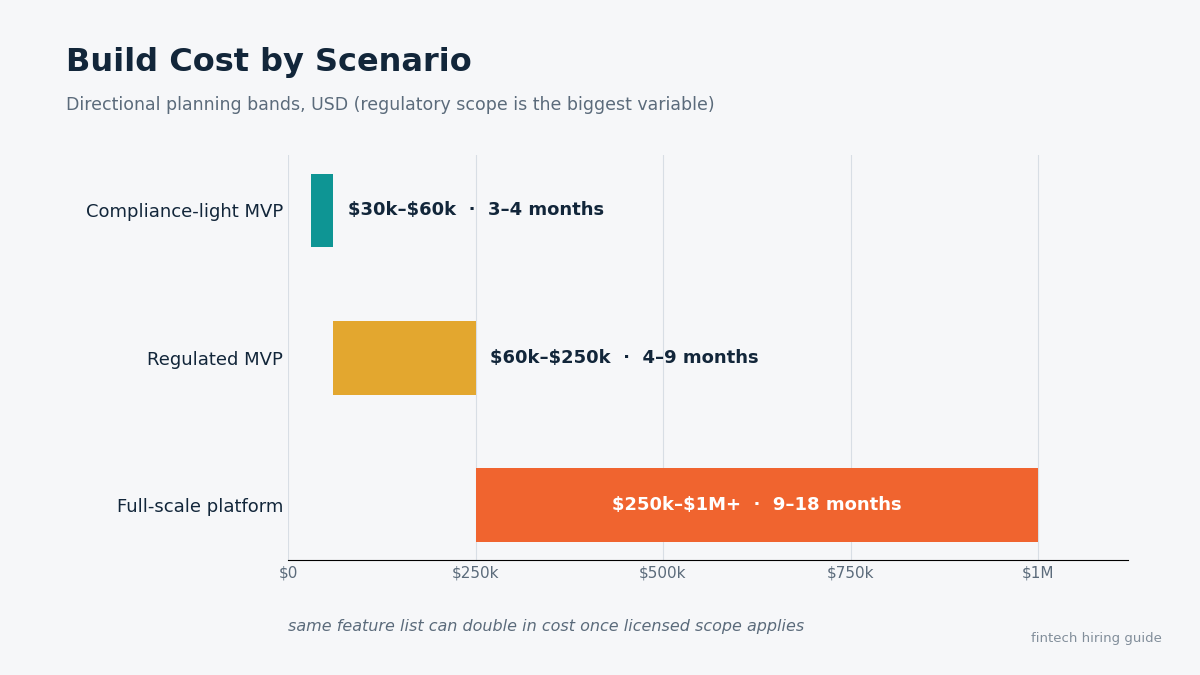
The section most content skips, with the caveat that matters: figures below are directional planning bands from real engagement patterns, not quotes. Regulatory scope is the single biggest variable; the same feature list can double in cost between an unregulated and a licensed context.
Team cost bands (dedicated, India-based, via a staffing partner all-in):
| Role | Experience | Monthly (₹) | Annual (~$) |
| Backend engineer (payments/ledger) | 4–8 yrs | ₹1.8–3.5L | $45k–70k |
| Mobile engineer (fintech apps shipped) | 3–7 yrs | ₹1.5–3L | $38k–60k |
| DevOps/DevSecOps engineer | 4–8 yrs | ₹1.8–3.2L | $45k–65k |
| QA engineer (security/API testing) | 3–6 yrs | ₹1–2L | $25k–45k |
Typical fintech app development cost by scenario:
- Compliance-light MVP (expense tracker, financial dashboard no money movement): $30k–60k, 3–4 months.
- Regulated MVP (wallet, P2P payments, basic lending): $60k–250k, 4–9 months including certification cycles.
- Full-scale platform (neobank, multi-product lending): $250k–1M+, 9–18 months, ongoing compliance staffing thereafter.
What drives costs up: number of regulated activities (each license or partner adds review cycles), multi-market data residency, real-time settlement requirements, legacy core-banking integrations, and the quiet one vague requirements, which convert directly into paid rework.
What drives cost down: using gateway tokenization instead of touching card data (slashes PCI DSS scope), banking-as-a-service partners instead of direct licenses at MVP stage, a single market at launch, and hiring engineers who’ve built the same category before.
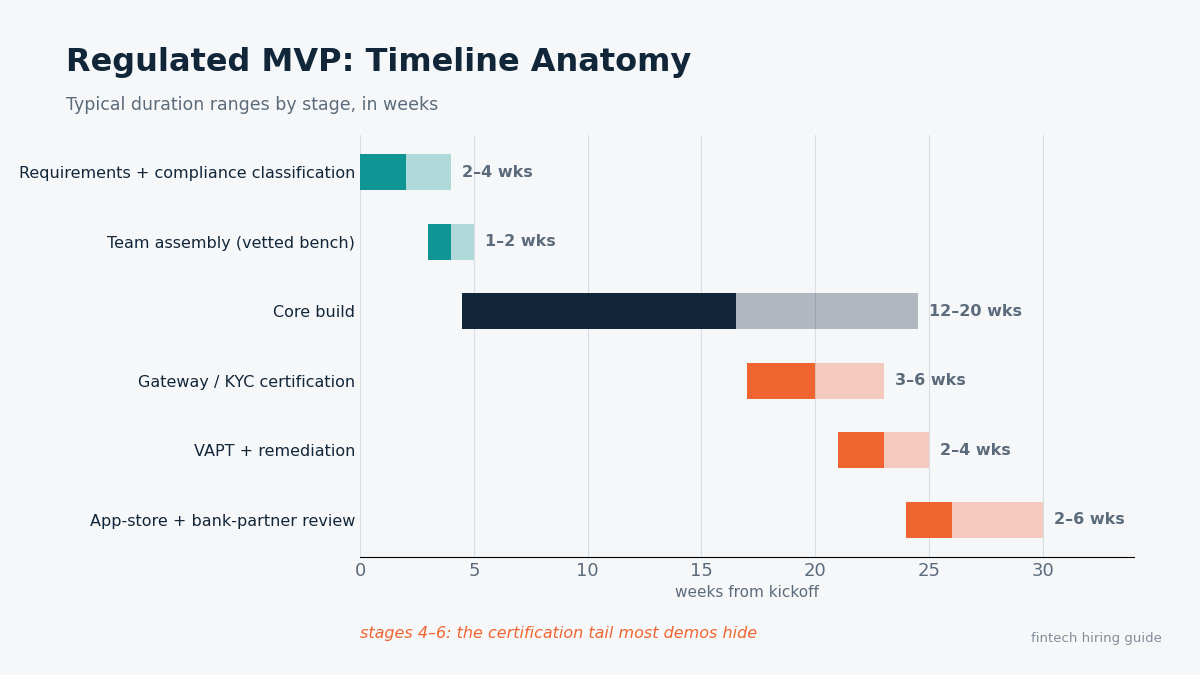
Timeline anatomy for a regulated MVP (the part demos hide):
- Requirements + compliance classification: 2–4 weeks
- Team assembly: 1–2 weeks with a vetted bench; 6–10+ weeks cold
- Core build: 12–20 weeks
- Integration certification (gateway production approval, KYC go-live): 3–6 weeks, partially parallel
- VAPT + remediation: 2–4 weeks
- App-store financial review + bank-partner sign-off: 2–6 weeks
Items 4–6 are the invisible 30% schedule them from day one and the plan holds; discover them in month four and it doesn’t.
Next Step: Pressure-Test Your Hiring Plan Before You Commit
If you’ve read this far, you likely have a build in motion or a decision pending. The highest-leverage 30 minutes you can spend now: take your Phase 1 one-pager regulatory classification, integrations, skills matrix, budget band and have it challenged by people who staff regulated builds weekly.
That’s a conversation Supersourcing’s team runs routinely: they’ll tell you if your team shape is wrong, if your timeline is a demo timeline, or if you’re over-hiring for your actual compliance surface and if the plan holds, you’ll see a vetted, fintech-screened shortlist within 7–10 working days, backed by a replacement guarantee.
Book a scoping conversation: https://supersourcing.com/contact-us/
FAQ: Hiring Fintech App Developers
What is the difference between fintech app development and regular app development?
Regular apps optimize for features and user experience; fintech apps must additionally satisfy regulators, auditors, and banking partners. That adds compliance engineering (KYC/AML, data-protection law), bank-grade security (tokenization, encryption, audit trails), financial correctness (ledgers, reconciliation, idempotency), and certified third-party integrations. In practice it means 25–40% more scope and a different hiring bar domain judgment, not just stack skills.
What fintech developer skills should I screen for?
Beyond the stack: hands-on experience with a payment gateway’s production certification, KYC/identity-vendor integration, double-entry ledger or transaction-system design, secure data handling (what never gets logged or stored), and familiarity with at least one framework PCI DSS, SOC 2, GDPR/DPDP, or RBI digital-lending guidelines. Verify by asking for specific war stories, not framework name-drops.
How much does it cost to hire fintech app developers?
Via dedicated staffing from India, senior fintech-experienced engineers typically run ₹15–35 lakhs/year ($40k–70k all-in) roughly 40–60% below equivalent US/EU rates. Freelancers look cheaper hourly but carry vetting, availability, and confidentiality risk that regulated products absorb badly. Budget team cost against shipped-and-certified features, not rate cards.
How long does it take to build a fintech app?
Compliance-light products: 3–4 months. Regulated MVPs (payments, wallets, lending): 4–9 months including gateway certification, penetration testing, and partner reviews. Full platforms: 9–18 months. Any quote for a regulated product measured in weeks is quoting the demo, not the launch.
Do fintech developers need to know regulations, or is that the compliance team’s job?
Both. Compliance teams interpret regulation; engineers implement it in architecture and dozens of daily engineering decisions (what to log, where to store data, how to design an API) are compliance decisions in disguise. Developers don’t need to be lawyers, but they need enough regulatory awareness to know when to stop and ask.
What compliance certifications matter for a fintech app?
Depends on scope: PCI DSS for card data (minimize it via tokenization), SOC 2 Type II for enterprise and bank-partner trust, GDPR/DPDP compliance for user data, plus jurisdiction rules RBI guidelines in India, PSD2/open-banking rules in the EU, state money-transmitter licensing in the US. Classify your regulated activities first; the certification list falls out of that.
Is staff augmentation safe for a regulated product?
Yes, if the arrangement is fintech-grade: dedicated engineers (no shared bandwidth), NDA and IP assignment covering all work product, background verification, least-privilege access, and contractual audit cooperation. Where it goes wrong is loosely managed freelance arrangements with shared credentials; the model isn’t the risk; the controls are.
How do I find pre-vetted fintech developers quickly?
Work backward from the vetting, not the résumé pile. A partner that already screens for regulated-domain experience payments, lending, banking integrations plus BGV and technical depth can put an interview-ready shortlist in front of you in 7–10 working days. If you’re mid-decision, a short scoping conversation (your regulatory classification + skills matrix from Phase 1) is enough to pressure-test whether that speed is realistic for your stack.
