

A Profisee implementation rarely fails because of the software. It fails because the person hired to build it was scoped against a job description copied from a generic ETL or SQL developer posting. Master data management is a discipline, not a tooling line item, and the distance between those two ideas is exactly where budgets quietly disappear.
That distance is expensive in a measurable way. Gartner estimates that poor data quality costs organizations an average of $12.9 million per year.
The teams that decide to hire MDM Profisee developer India resources usually treat it as a commodity staffing task: match the tool name on a CV, count years of experience, make an offer. What they get is someone who can navigate the Profisee interface but cannot model a customer domain, design survivorship logic, or defend a matching strategy in front of a data governance committee. The platform gets installed. The trusted data never arrives.
The job descriptions are the root of it. Most read like an integration developer posting with the word “Profisee” pasted into the requirements. They ask for SQL, SSIS, and “experience with MDM tools,” then go quiet on the parts of the role that actually decide whether the project produces a golden record or an expensive duplicate-tracking spreadsheet. A data governance lead at a pharma, retail, or BFSI firm reading those postings will attract the wrong shortlist and screen on the wrong signals.
This guide breaks down what the role really involves, what to pay, and the specific gaps in standard postings that quietly sink projects. It is written for the data governance and platform leads who own these programs at pharma, retail, and BFSI firms, the people who feel the rework when the wrong hire ships the wrong matching rules.
One framing to hold onto throughout: you are not buying tool operation, you are buying domain judgment. Tool operation is cheap and learnable in a few weeks. Judgment about how to model a domain and resolve identity is rare, and it is the entire reason the role exists.
What Is Profisee MDM?
Profisee is a cloud-based master data management (MDM) platform that creates a single, trusted version of core business data: customers, products, suppliers, and locations by matching, merging, and governing records pulled from multiple source systems. Built on the Microsoft data stack, it centralizes data quality, stewardship, and golden record management in one place.
In April 2026, Gartner named Profisee a Leader in its Magic Quadrant for Master Data Management Solutions, its first such report in five years. That recognition matters for hiring: it tells you the platform is now a long-term enterprise bet, not a tactical tool, so the people you put on it should be hired with the same horizon.
The Core Problem: Generic Postings Cost You Two Quarters
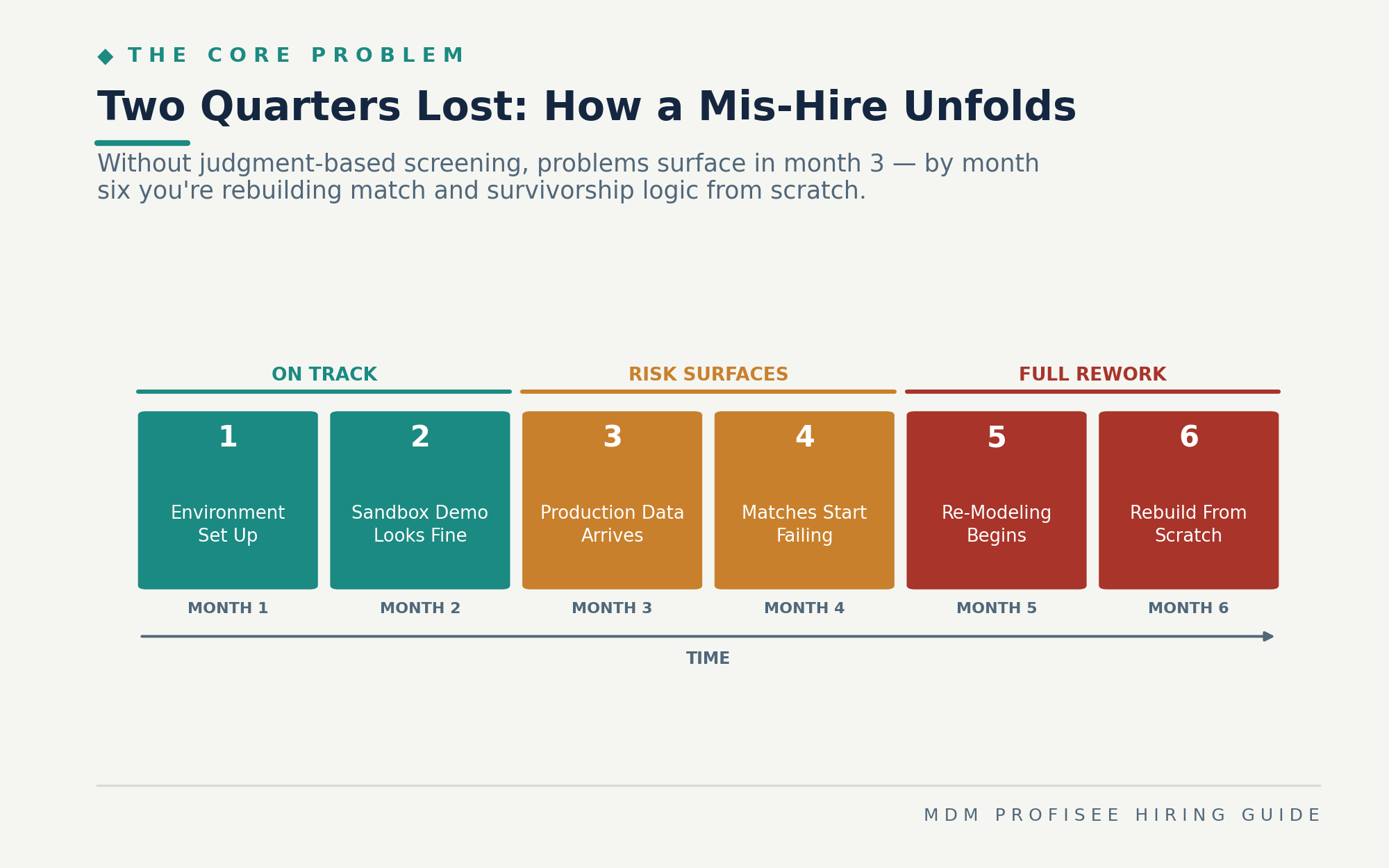
When master data management hiring India decisions go wrong, the damage is rarely visible in the first month. The developer onboards, gets the environment running, and demos a working entity in a sandbox. Everyone relaxes. The trouble surfaces in months three and four, when real source data starts flowing and the matching rules begin merging records that should stay separate or worse, leaving obvious duplicates untouched.
By then you have lost a quarter, and recovering takes another one. The fix usually requires re-modeling the data domains and rebuilding the match and survivorship logic from scratch, because those decisions were made by someone who knew the tool but not the discipline. Most leaders underestimate this rework by three to four times when they budget the hire.
The cost is concrete. A mis-scoped hire on a six-month Profisee MDM implementation typically burns two months of contractor time at ₹1.5–3 lakhs per month, plus the opportunity cost of a delayed go-live that downstream analytics and AI teams were waiting on. For a regulated firm, a botched survivorship rule that merges two patients or two account holders is not a delay, it is a compliance incident.
The contrarian truth is that the platform is the easy part. Profisee is deliberately built so business users and stewards can operate it. The hard part is the part your job description has to screen for is the modeling and rule design that no interface can do for you.
There is a timing trap underneath all of this. Source data in a demo is curated and well-behaved; production data is not. The duplicates that matter are the near-misses the same supplier spelled three ways across two ERPs, the customer who appears once with a maiden name and once without. A developer who only tested against clean sample data has never met the cases that break naive matching, and you will not discover the gap until those records arrive in month three. Hiring for the judgment to anticipate that, rather than the ability to demo a happy path, is the whole game.
Profisee MDM Developer Skills That Actually Matter
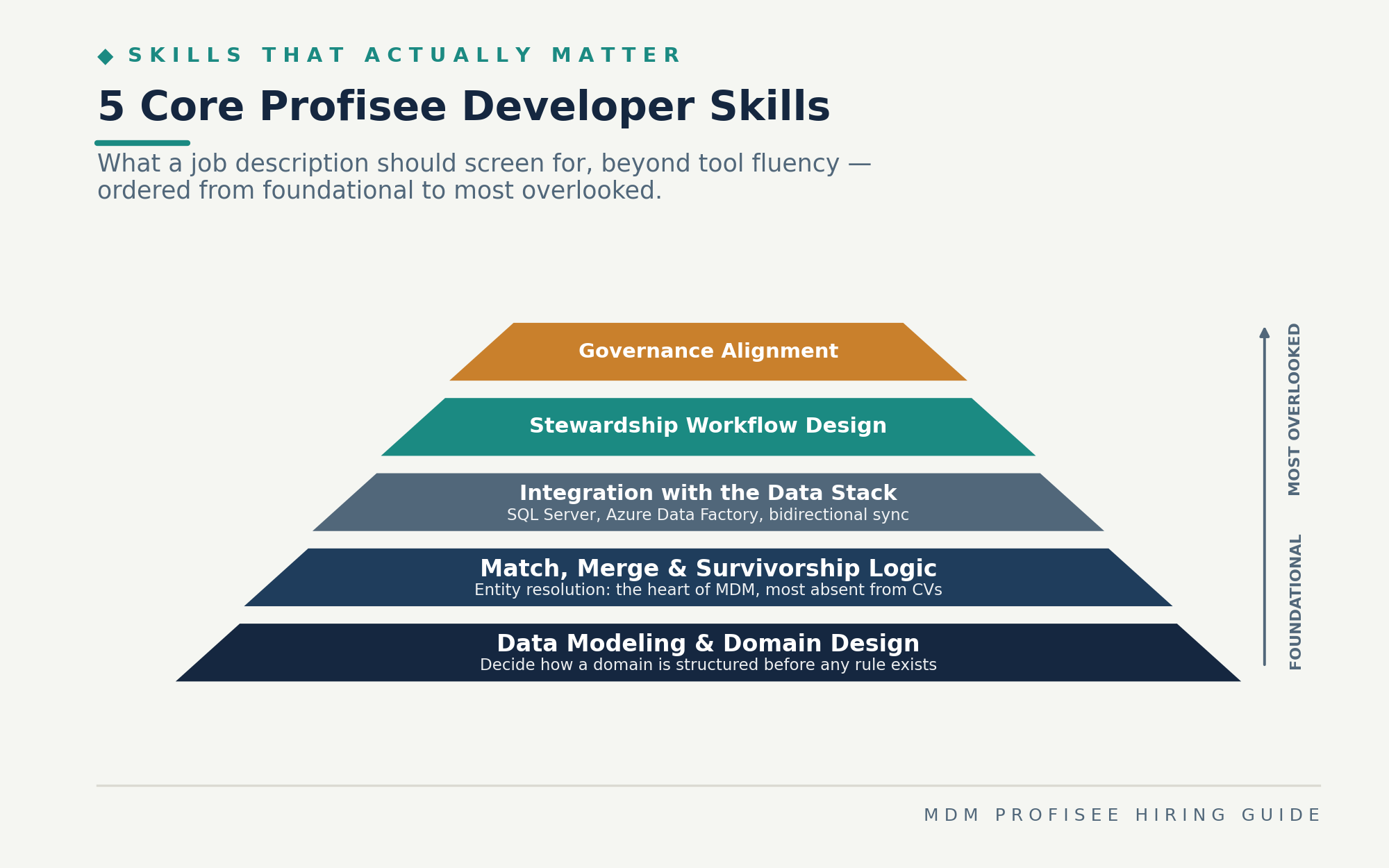
This is where standard postings collapse. They list tools; they should list judgment. The strongest Profisee MDM developer skills are about data modeling and rule design, with the platform as the medium. Below are the five capability areas a real MDM developer job description should screen for, in rough order of how often they are missed.
Data Modeling and Domain Design
Before a single match rule exists, someone has to decide how a “customer” or “product” is structured: which attributes are mastered, which are reference data, how hierarchies roll up, and where the domain boundaries sit. A developer who has only configured pre-built models has never made these calls. Ask candidates to model a domain on a whiteboard. The ones who ask about your source systems and survivorship intent before drawing anything are the ones to keep.
Match, Merge, and Survivorship Logic
This is the heart of MDM and the skill most absent from generic CVs. Entity resolution deciding when two records are the same real-world thing is part statistics, part business rules, part tuning. Strong candidates can explain the trade-off between false merges and missed matches, and how they would tune match thresholds for a high-stakes domain versus a tolerant one. Survivorship rules (which source wins for which field) require the same judgment. Weak candidates talk only about the configuration screens.
Integration with the Data Stack
Profisee lives on the Microsoft and Azure ecosystem, so real fluency in SQL Server, Azure Data Factory, and modern data integration and ETL patterns is non-negotiable. The developer has to land source data cleanly, publish golden records back to consuming systems, and keep both directions in sync. This is the part most overlapping with a traditional ETL role, which is precisely why hiring teams over-index on it and neglect everything above.
Stewardship Workflow and Business Rules
Golden records are not set-and-forget. Someone has to design the data stewardship workflows, the screens, alerts, and approval steps that let business users resolve matches the rules cannot decide automatically. A developer who designs workflows that stewards actually adopt has a different skill from one who simply enables the feature. Adoption is a design problem, not a toggle.
Governance Alignment
The best developers translate between a data governance framework and what the platform can enforce. They know which policies become validation rules, which become workflow gates, and which stay as documentation. In pharma and BFSI, this fluency is the difference between an auditable system and a liability.

Architecture and Cost Implications
The architecture decisions a developer makes in week one shape the cost of the whole program. Choosing a registry style versus a consolidation or centralized style of MDM changes how much source data is physically mastered, how heavy the integration footprint becomes, and how much Azure compute the platform consumes month over month. A developer who picks a heavyweight centralized model for a problem that needs a lightweight registry can double your run-rate without improving a single golden record.
Hierarchy management is another quiet cost driver. Product and organizational hierarchies that are modeled cleanly stay cheap to maintain; ones that are bolted on later force expensive re-publishing across every downstream system. The same logic applies to reference data currency codes, country lists, status values which is mundane to model early and painful to retrofit.
This is why architecture judgment belongs in the screening conversation, not just in the technical onboarding. When dedicated teams scope the budget to hire MDM Profisee developer India resources, they price the salary and forget the multiplier a poor architecture choice puts on infrastructure and rework. A senior modeler who saves you from a wrong architecture pattern pays for the premium over a junior hire several times over in the first year alone. The cheap line item on the spreadsheet is rarely the cheap outcome.
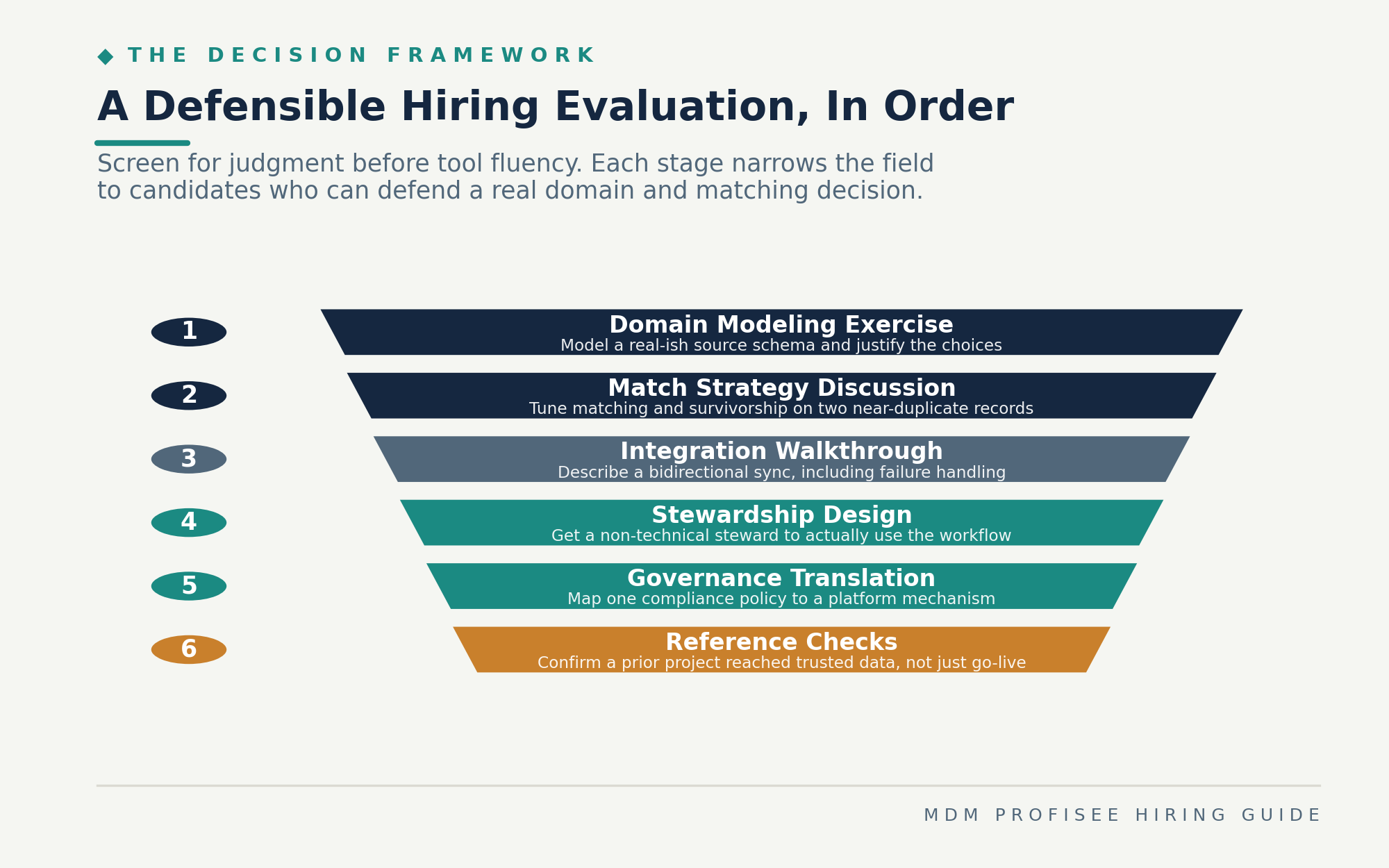
A defensible hiring evaluation runs in this order:
- Domain modeling exercises give a real-ish source schema and ask the candidate to model one domain and justify the choices.
- Match strategy discussion presents two near-duplicate records and asks how they would tune matching and survivorship, and what they would risk either way.
- Integration walkthroughs have them describe a bidirectional sync between Profisee and a source system, including failure handling.
- Stewardship design asks how they would get a non-technical steward to actually use the workflow.
- Governance translation gives one compliance policy and asks which platform mechanism enforces it.
- Reference checks on outcomes confirm a prior project reached a measurable trusted-data outcome, not just go-live.
A candidate who handles steps one, two, and four well is rarer and more valuable than one who only shines on step three.
What Profisee Hiring Looks Like in Practice
A mid-size pharmaceutical distributor spent five months and two contractors trying to de-duplicate a supplier domain before realizing both hires were integration developers, not modelers. After re-scoping the role around match and survivorship judgment and bringing in one developer with genuine domain-design experience, the supplier’s golden records stabilized in roughly seven weeks, cutting duplicate supplier payments that had been running into the tens of lakhs annually.
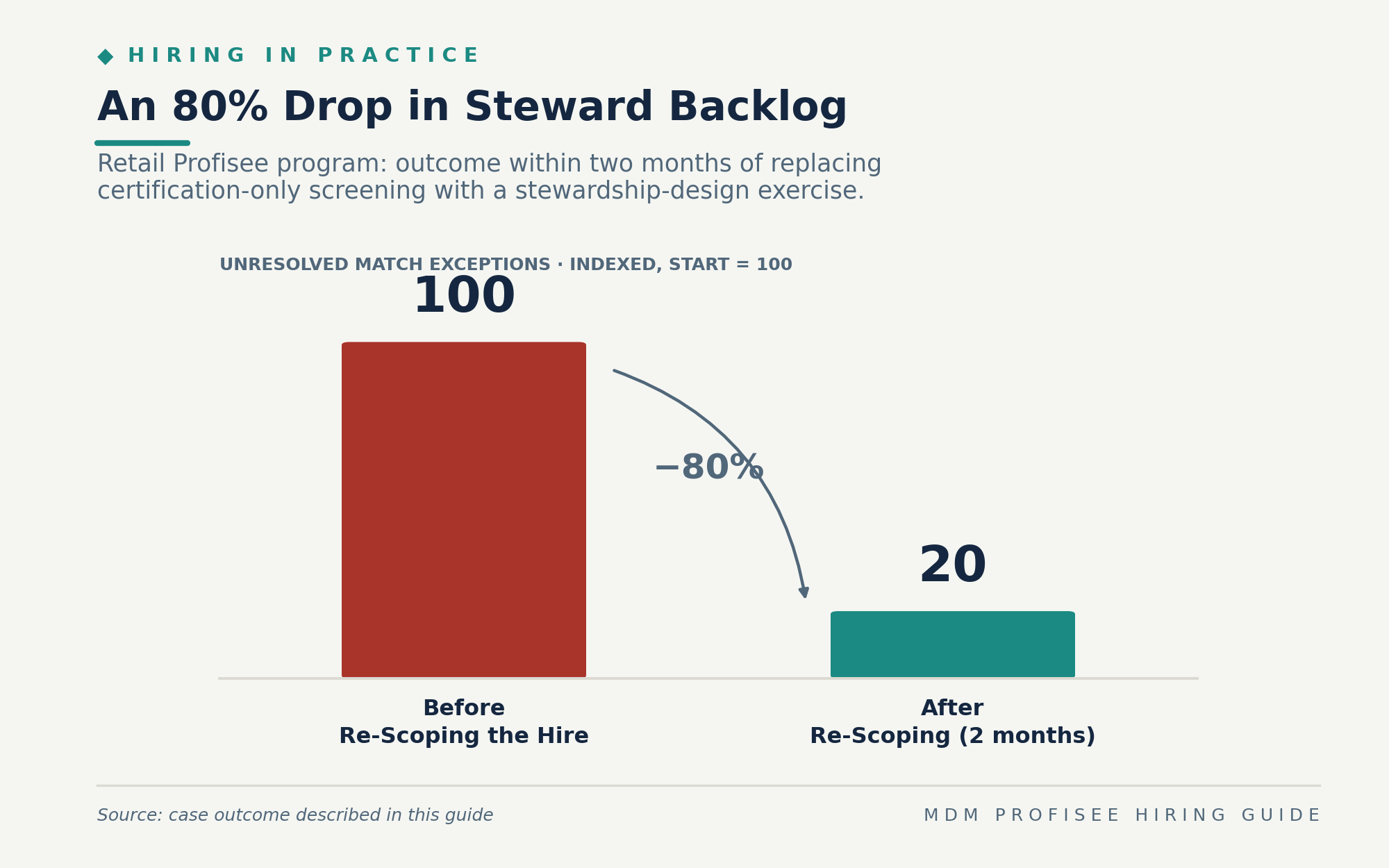
A retail group running a customer Profisee MDM implementation made the opposite mistake first: it hired purely on certification and years of experience. The developer could configure everything but designed stewardship screens no one used, so match exceptions piled up unresolved. Replacing the screening criteria with a stewardship-design exercise produced a hire whose workflows reached real adoption, and the steward backlog dropped by an estimated 80% within two months.
A third pattern shows up at BFSI firms. A bank consolidating customer records across three legacy systems set its match threshold too aggressively to “clean up duplicates fast,” and the system merged distinct account holders who shared a name and city a reportable data-integrity event, not a cosmetic bug. The recovery required unwinding merges record by record and re-tuning survivorship under audit scrutiny, adding roughly three months to a program that had looked on track. The developer was technically capable; what was missing was the judgment to treat a high-stakes domain conservatively. The lesson across all three cases is identical: scope for judgment, not for tool familiarity.
A Decision Framework for the Hire
Once you know the role is about judgment, the next question is the engagement model. The choice between a permanent hire, a contractor, or an implementation partner depends on project length, internal maturity, and how much you intend to evolve the platform after go-live. The table below is a starting frame, not a verdict.
| Engagement model | Best when | Typical cost (India) | Main risk |
| Permanent developer | You will keep evolving MDM for 2+ years | ₹8–20 lakhs/year | Slow to hire; hard to find true modelers |
| Independent contractor | Defined 4–9 month build | ₹1.5–3 lakhs/month | Knowledge leaves with them at handoff |
| Implementation partner | First MDM project, low internal maturity | Project-based | Less in-house capability built |
| Hybrid (partner + 1 internal) | You want speed now and capability later | Blended | Requires active knowledge transfer |
For most first-time programs at pharma, retail, and BFSI firms, the hybrid model carries the least risk: a partner brings the matching and governance patterns, and one permanent internal developer absorbs them so the capability stays after the engagement ends. Whichever model you choose, the evaluation criteria stay constant domain judgment first, tool fluency second. Teams that hire MDM Profisee developer India resources against that standard, regardless of engagement type, are the ones that avoid the rework loop entirely.
Red Flags When You Screen a Profisee Developer CV
The fastest way to improve master data management hiring India outcomes is to learn what to discount on a resume, not just what to look for. A few patterns reliably predict a mis-hire.
The first is a CV where every line is a tool and none is an outcome. “Configured Profisee, built SSIS packages, used Azure Data Factory” describes activity, not results. Strong candidates can name a domain they mastered and the measurable change it produced duplicates removed, a steward backlog cleared, a downstream report that finally reconciled. If outcomes are absent, the projects probably never reached trusted data.
The second is fluency in matching language without any discussion of trade-offs. A candidate who talks confidently about match rules but cannot describe a time they tuned a threshold and got it wrong has likely never owned a high-stakes domain. Entity resolution is learned through the mistakes; someone who has made none has not gone deep.
The third red flag is the absence of stewardship and governance vocabulary entirely. If a candidate never mentions stewards, approval workflows, or how policy becomes a rule, they have operated as an isolated builder, which is exactly the failure mode described earlier. Watch for these signals before you ever schedule a technical round:
- Tool list with no measurable outcome attached to any project.
- No mention of survivorship or match tuning trade-offs, only of the configuration screens.
- No stewardship or governance language, suggesting a solo-builder history.
- Tenure framed in years, not domains “5 years Profisee” tells you less than “mastered customer and supplier domains.”
- No questions back to you about source systems or governance maturity during the interview.
When you set out to hire MDM Profisee developer India candidates, treat the CV as a filter for judgment signals, then let a modeling exercise do the real selection. A polished resume and a weak whiteboard performance is the most common and most expensive combination.
The single most common error is screening on tool experience and ignoring domain judgment. A CV that says “four years Profisee” tells you the candidate can find the buttons. It tells you nothing about whether they can model a customer domain or defend a survivorship rule, and those are the skills that decide the outcome. Years-of-tool is a weak proxy; a modeling exercise is a strong signal.
The second error is treating the developer as a solo function. MDM only works when the developer, the data stewards, and the governance owners operate as a unit. Postings that describe a lone “Profisee resource” with no mention of stewardship collaboration are quietly setting that person up to fail, because the matching rules they write will need business sign-off the org structure never gave them.
The third error is underpaying for the rare skill and overpaying for the common one. Plenty of integration developers will list MDM on a CV at a mid-tier rate, and teams hire them because the number looks reasonable. The genuine modeler-plus-steward-designer costs more and is worth several times the difference, because they are the ones who prevent the two-quarter rework loop. When organizations decide to hire MDM Profisee developer India talent, the cheapest CV is almost always the most expensive hire.
The fourth, and most overlooked, is hiring before the data governance framework exists. A developer cannot turn policies into rules if no one has decided the policies. The strongest programs settle ownership, definitions, and survivorship intent first, then hire someone to operationalize them.
A fifth mistake is optimizing the MDM developer salary line in isolation. Leaders benchmark the number against generic developer pay, see a premium for the specialist profile, and trim it back toward the median to protect the budget. The premium is not a markup; it is the price of the judgment that prevents the rework loop. Saving two lakhs on the hire to spend twenty on a re-modeling exercise six months later is not a saving. Price the role against the cost of getting matching and survivorship wrong, and the premium looks obvious.
Frequently Asked Questions
What does a Profisee MDM developer do?
A Profisee MDM developer designs and builds the models, matching rules, and stewardship workflows that turn messy records from many source systems into a single trusted golden record. The role spans data modeling, entity resolution, integration across the Microsoft data stack, and translating governance policy into platform rules. It is closer to a data-discipline role than to pure ETL development, which is why scoping it correctly matters so much.
How much does an MDM developer earn in India?
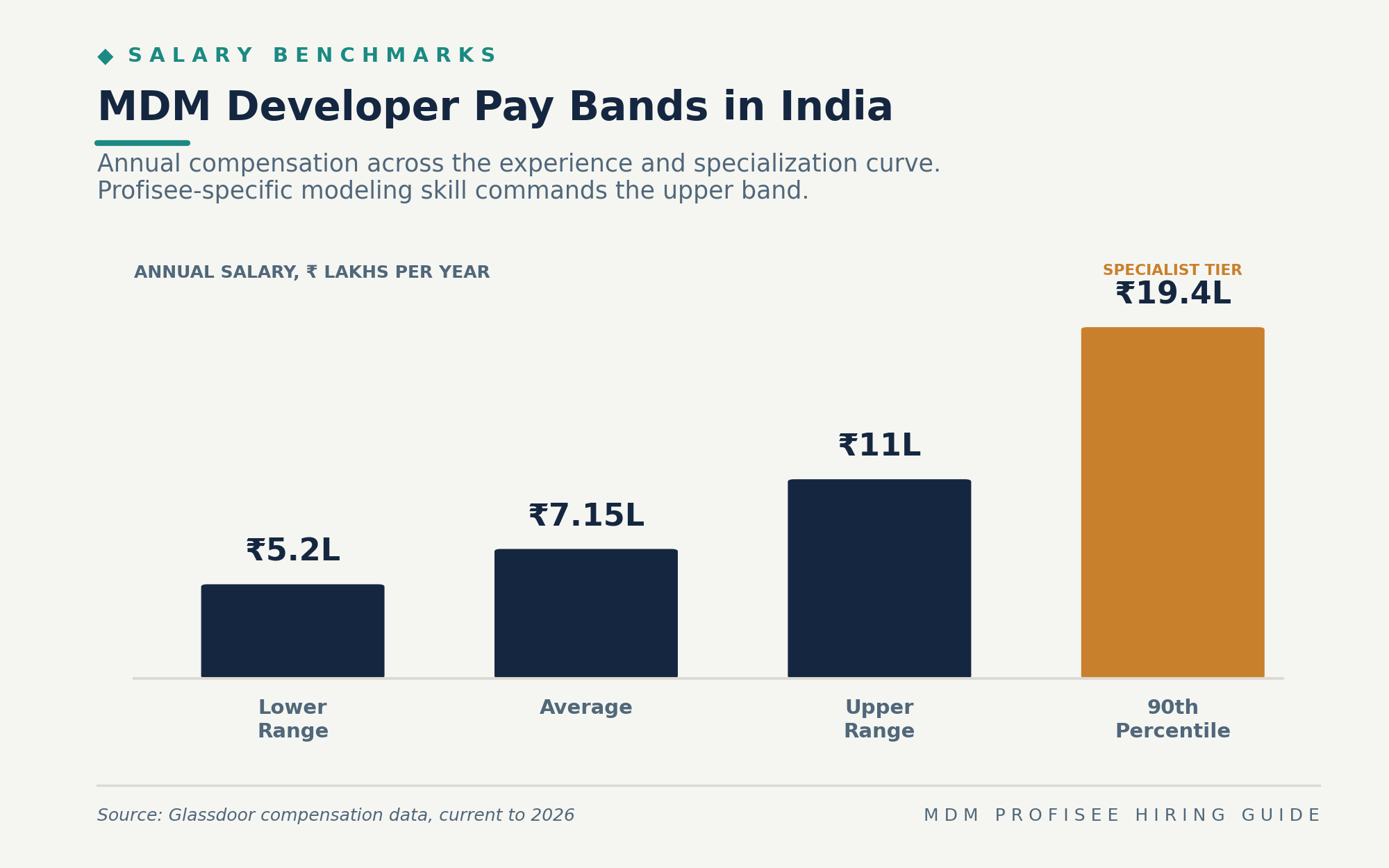
The MDM developer salary in India averages around ₹7.15 lakhs per year, with a typical range of roughly ₹5.2–11 lakhs and top earners (90th percentile) reaching about ₹19.4 lakhs, according to Glassdoor data current to 2026. Profisee-specific and senior modeling roles sit at the upper end, and Hyderabad concentrates much of the demand. Treat these as benchmarks; the true modeler-plus-governance profile commands a premium over the median.
What skills should a Profisee developer have?
Beyond knowing the platform, a strong candidate brings data modeling, match and survivorship design, fluency in SQL Server and Azure data integration, stewardship workflow design, and the ability to align the build with a data governance framework. The differentiator is judgment in entity resolution and domain modeling, not familiarity with the configuration screens, which any competent developer learns quickly.
Is Profisee better than Informatica MDM?
Both sit in the Gartner Leaders quadrant, so it is less about better and more about fit. Profisee is built on the Microsoft and Azure stack and is positioned for faster adoption by business users, which suits teams already in that ecosystem and those wanting stewards operating the platform directly. Informatica often appeals to organizations with large, heterogeneous estates and existing Informatica investments. The honest answer depends on your stack, maturity, and budget.
How long does a Profisee implementation take?
A focused single-domain build typically runs three to six months from kickoff to a stable golden record, assuming the data governance decisions are made up front. Multi-domain or heavily regulated programs run longer. The biggest variable is not the tool but whether modeling, matching, and survivorship were designed by someone with real judgment, get that wrong and you add the two-quarter rework loop described above.
Should you hire a permanent developer or use an implementation partner?
It depends on the horizon and internal maturity. A defined three-to-nine-month build suits a contractor; a multi-year program that will keep adding domains justifies a permanent hire. First-time programs with low internal MDM maturity usually do best with a hybrid: an implementation partner supplies the matching and governance patterns while one permanent internal developer absorbs them, so capability stays in-house after the engagement closes. Match the model to how much you will evolve the platform, not just to the build itself.
What certifications matter for a Profisee MDM developer?
Platform certification confirms a candidate can operate the tool, which is necessary but not sufficient. It says nothing about modeling judgment or match-strategy instinct, the skills that decide the project. Treat certification as a floor, not a differentiator, and weight a strong domain-modeling exercise far more heavily. A certified developer who fails the whiteboard is a more common and more costly hire than an uncertified one who reasons cleanly about domains and survivorship.
How do you hire a Profisee MDM developer in India without a false start?
Screen for judgment over tool tenure. Run a domain-modeling exercise and a match-strategy discussion before you ever check certifications, settle your governance ownership first, and budget for the higher-end candidate rather than the cheapest CV. If you are unsure how to structure the evaluation, pressure-testing your MDM developer job description against a specialist before you post it saves the most expensive mistakes.
Closing: Pressure-Test the Role Before You Post It
If you are about to hire MDM Profisee developer India talent for a pharma, retail, or BFSI program, the highest-leverage hour you can spend is on the job description, not the job boards. A posting scoped around modeling, matching, and stewardship judgment attracts a fundamentally different shortlist than one scoped around tools and tenure and that difference is the two quarters of rework you either spend or avoid.
The practical move is to treat the role definition as a design artifact, not a formality. Decide which domains you are mastering first, settle who owns survivorship before anyone writes a rule, and build your evaluation around a live modeling exercise rather than a checklist of acronyms. Get those three things right and the shortlist tends to sort itself; get them wrong and even a strong developer inherits an unwinnable brief. The same discipline applies whether you hire permanently, bring in a contractor, or lean on an implementation partner the criteria do not change, only who applies them.
It also helps to define what “done” means before you start. A role scoped to “implement Profisee” has no finish line; a role scoped to “produce a governed customer golden record that two named downstream systems consume” gives both you and the candidate something concrete to aim at, and it makes the eventual reference check far easier to run.
If a second set of eyes would help, that review is worth doing before you commit to a hire or a vendor. Supersourcing has scoped and staffed Profisee builds across regulated data environments, and a short look at a role definition and evaluation plan usually surfaces the gaps that quietly cost a project its first two quarters. You can send your current MDM developer job description to mayank@engineerbabu.com for a candid read, or see how these engagements are structured at supersourcing.com. No pitch, just a sharper brief before you post it.
