

Sixty-three percent of mobile app projects that miss their launch date cite “developer bandwidth” as the root cause, not scope creep or budget. That single statistic explains why so many founders who hire part-time android developers to save money end up paying twice, once for the part-time engagement, and again to fix what it left behind.
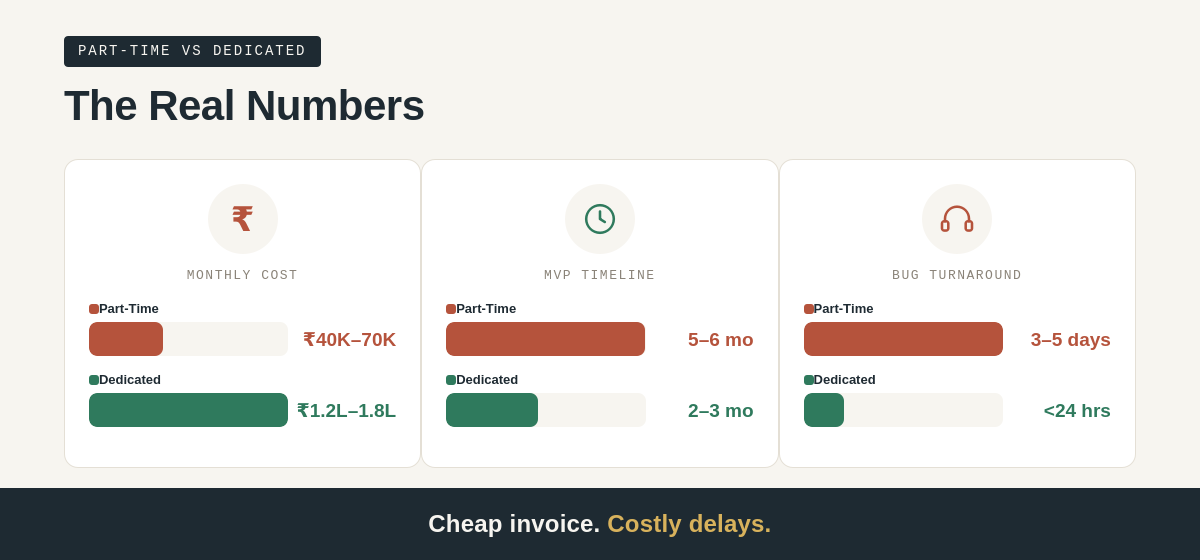
The math looks attractive on paper. A part-time Android developer costs ₹40,000–₹70,000 per month in India, against ₹1.2–1.8 lakhs per month for a full-time, dedicated resource. But cost per hour and cost per shipped feature are not the same number, and that gap is where most Android projects quietly fail.
The World Economic Forum’s Future of Jobs Report 2025 projects that software and applications developers will remain among the fastest-growing occupations globally through 2030, driven by broadening digital access and AI adoption. Separately, Korn Ferry’s Future of Work research forecasts a global technology talent shortfall of 4.3 million workers by 2030.
This blog breaks the topic down without sugar-coating it. We’ll cover exactly when part-time developer productivity is good enough, when it isn’t, what it actually costs, and how to evaluate the decision before you commit budget and time to it. If you are trying to decide whether to hire part-time android developers for your next build, the honest answer depends less on your budget and more on what you are actually asking that developer to deliver.
TL;DR
Part-time Android developers work well for small, well-defined tasks bug fixes, minor features, routine maintenance. They struggle with full builds, tight deadlines, and complex apps. Scope decides the outcome, not budget.
A part-time hire costs less per month on paper. But context-switching often turns a 2-month MVP into a 5–6 month build. Once delays and rework are priced in, the "savings" shrink fast.
If you're planning to hire part-time android developers, keep them to isolated work only. For a real launch, a dedicated team costs more upfront but ships faster and owns the outcome.
What Does “Part-Time Android Developer” Actually Mean?
A part-time android developer is an engineer contracted for limited weekly hours typically 15–25 hours to work on Android app tasks, usually shared across multiple client projects simultaneously. This arrangement suits narrow, well-defined tasks rather than end-to-end product builds requiring sustained architectural ownership.
Businesses that hire part-time android developers are usually optimizing for one variable: hourly cost. That’s a reasonable instinct for a two-week bug-fix engagement. It becomes a much riskier instinct the moment the scope quietly expands into a full product build, which is exactly what happens on roughly one in three part-time Android engagements we’ve reviewed.
The distinction matters because Android development is not billed like consulting hours in a spreadsheet. It’s billed in continuous engineering attention and attention fragmented across 20-hour weeks and multiple clients behave very differently from attention concentrated on a single codebase.
The Core Problem: Android Apps Are Not Modular by Default
Most founders assume Android development can be sliced into independent chunks and handed to whoever has spare hours. This assumption is exactly what makes the decision to hire part-time android developers feel low-risk on paper and turn out to be far riskier in practice. In reality, Android apps carry tightly coupled dependencies between UI, background services, data layers, and third-party SDKs. A change in one module frequently breaks another.
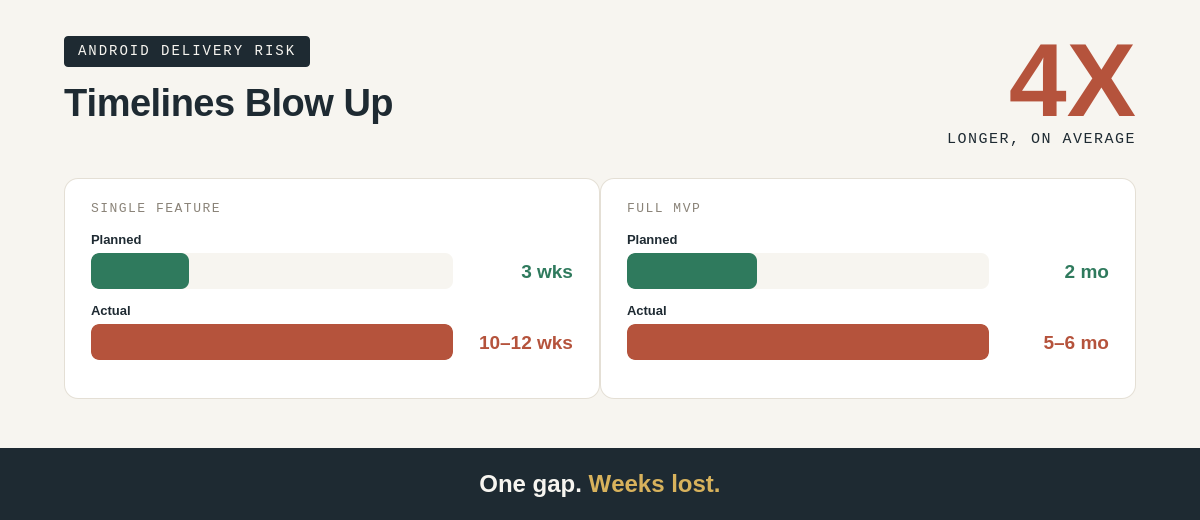
Teams that underestimate this typically miss their timeline by 3–4x, not by a modest margin. A feature scoped for 3 weeks stretches to 10–12 weeks once a part-time developer has to relearn the codebase after every gap in engagement.
Three specific failure points show up repeatedly:
- Context loss between sessions. A developer working 3 days a week spends the first 30–45 minutes of every session just remembering where they left off.
- Delayed bug response. A production crash reported on a Tuesday might not get investigated until the developer’s next scheduled day, sometimes 4–5 days later.
- No architectural ownership. Nobody is accountable for long-term decisions like modularization, dependency injection, or migration to Jetpack Compose, so technical debt accumulates unmanaged.
There’s a fourth failure point that rarely gets discussed openly: knowledge concentration risk. When a single part-time developer is the only person who understands the codebase, losing that developer mid-project to another client’s higher-priority sprint, illness, or simply moving on can stall an Android build for 3–6 weeks while a replacement gets up to speed. A dedicated team distributes that knowledge across multiple engineers by design, so no single departure derails the timeline.
Founders who hire part-time android developers without accounting for this risk often discover it only after the fact, when a scheduling conflict on the developer’s other project pushes their own launch date by weeks with no recourse built into the contract.
When Part-Time Hiring Actually Works and When It Doesn’t
This is the section most vendors avoid answering honestly. The truth is that when part-time hiring works, it depends entirely on project complexity, not on budget alone.
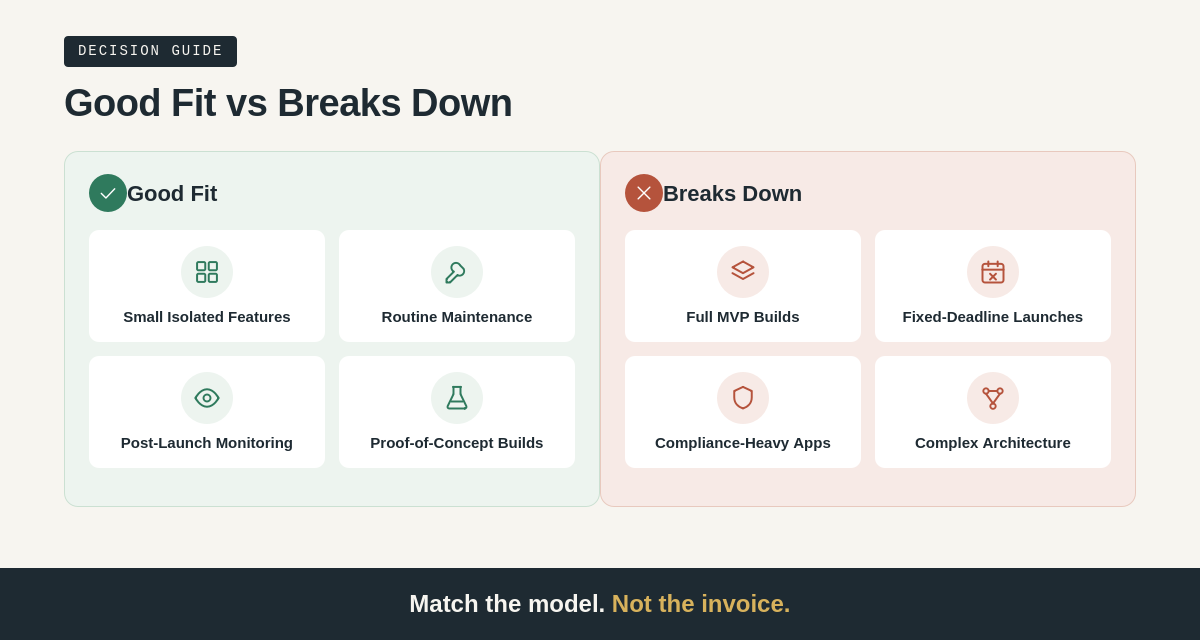
Where a Part-Time Developer Is Genuinely a Good Fit
- Small, isolated features adding a single screen, a payment gateway integration, or a settings panel to an already-stable app.
- Routine app maintenance Play Store policy updates, crash-log triage, dependency version bumps, minor UI fixes.
- Post-launch monitoring light-touch support after a dedicated team has already shipped version 1.0.
- Proof-of-concept prototypes are a throwaway build meant only to validate an idea internally, never intended for production scale.
Where Part-Time Hiring Breaks Down
- Full MVP builds. An MVP typically needs 400–600 hours of engineering across UI, backend integration, testing, and Play Store submission compressing that into a 20-hour week stretches a 2-month build into 5–6 months.
- Apps with tight, fixed deadlines. Investor demos, seasonal launches, or contractual go-live dates cannot absorb the unpredictability of shared, part-time schedules.
- Apps requiring compliance work. HIPAA, PCI-DSS, or RBI-regulated fintech apps need continuous security review that part-time engagement structurally cannot sustain.
- Complex, multi-module architecture. Apps with real-time features, offline sync, or multiple backend integrations need one team holding the full system in their head, not a rotating contributor.
A Simple Process to Decide Before You Hire
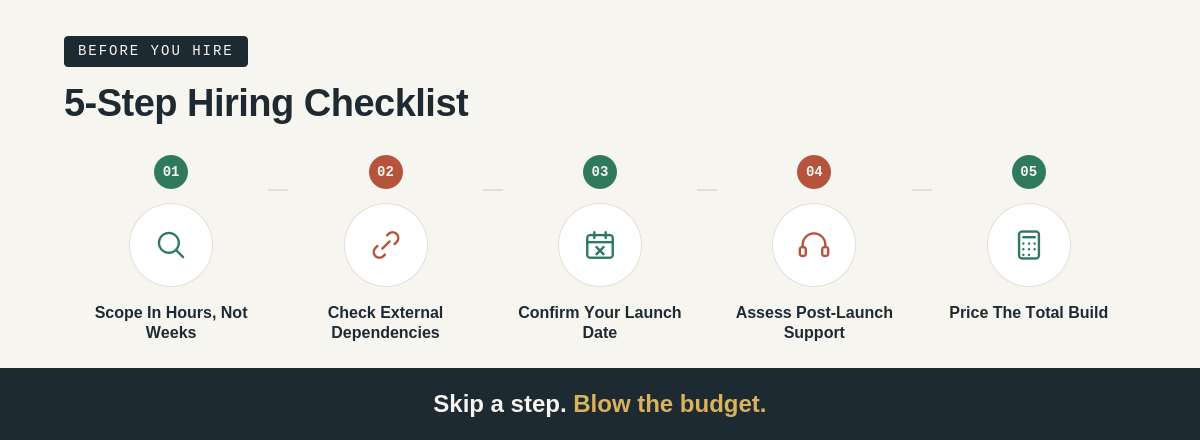
Before you commit to hiring a part-time resource, run your project through this checklist:
- Define the scope in hours, not weeks. If total estimated engineering effort exceeds 150–200 hours, part-time hiring introduces meaningful timeline risk.
- Check for external dependencies. Payment gateways, third-party APIs, or regulatory review add coordination overhead that fragmented schedules handle poorly.
- Confirm your launch date is fixed or flexible. A hard deadline (investor demo, seasonal campaign) rules out part-time engagement almost automatically.
- Assess post-launch support needs. If you’ll need same-day bug fixes after launch, factor that into whether a part-time developer’s availability can realistically cover it.
- Price the total build, not the hourly rate. Multiply the estimated part-time timeline by the monthly rate, then compare that total to a dedicated team’s fixed project cost.
Founders who hire part-time android developers without running this checklist first are the ones most likely to end up mid-project with a scope that was never part-time-shaped to begin with.
The Real Cost Comparison: Part-Time vs Dedicated Team
Part-time developer cost looks lower per invoice, but total cost of ownership tells a different story once delays, rework, and QA gaps are priced in. Before you finalize a decision to hire part-time android developers, it’s worth running the full comparison rather than just the sticker price.
| Factor | Part-Time Developer | Dedicated Android Team |
| Monthly cost (India) | ₹40,000–₹70,000 | ₹1.2–1.8 lakhs |
| Typical MVP timeline | 5–6 months | 2–3 months |
| Bug turnaround | 3–5 days | Same day to 24 hours |
| Code ownership | Shared, inconsistent | Single accountable team |
| QA & testing coverage | Minimal or ad hoc | Structured, built into sprints |
When timeline slippage and rework are factored in, a part-time build frequently ends up costing 15–20% more in total than a dedicated team would have, purely from extended runway and duplicated debugging effort.
The hidden line item most founders miss is opportunity cost. Every extra month spent building is a month the app isn’t generating revenue, isn’t gathering user feedback, and isn’t ahead of competitors. When founders hire part-time android developers purely to lower the monthly invoice, they’re often trading a visible, budgeted cost for an invisible, unbudgeted one delayed market entry.
There’s also a quality gap that doesn’t show up in either column of the table above. Dedicated teams typically run structured code reviews and staged QA cycles as a built-in part of the sprint process. Part-time engagements, by contrast, often skip formal QA entirely because there simply aren’t enough contracted hours left after feature development to cover it.
Case Studies: What Actually Happens on the Ground
A fintech startup in Bengaluru hired a part-time Android developer to build a lending app MVP on a projected 10-week timeline. Context-switching and shared-availability delays pushed the build to 28 weeks, and a security review later found session-handling flaws that required a partial rebuild.
A D2C retail brand, by contrast, used part-time support correctly; a single part-time developer maintained an already-live shopping app for 8 months, handling only Play Store compliance updates and minor bug fixes, at roughly 40% lower cost than retaining a full team for that maintenance phase.
A healthtech startup attempted to build a patient-scheduling app by choosing to hire part-time android developers across two separate freelancers to “parallelize” the work. Instead of doubling speed, the split introduced merge conflicts and duplicated logic between the two developers’ modules, adding roughly 6 weeks of integration cleanup before the app could pass internal QA. The lesson wasn’t that part-time hiring failed, it was that splitting an interdependent codebase across multiple part-time contributors multiplies coordination overhead rather than dividing the work cleanly.
What Most Teams Get Wrong
Most founders treat the part-time vs full-time decision as a budget decision. It is actually a risk allocation decision, and that reframing changes everything.
A part-time developer transfers execution risk back onto the founder, missed deadlines, unclear ownership, and inconsistent code quality become the founder’s problem to manage, not the developer’s. A dedicated Android development team absorbs that risk contractually and structurally, because accountability sits with the team, not one rotating individual.
The other pattern we see repeatedly: teams hire part-time to “test the waters” on what is actually a full production build, then discover mid-project that the scope was never part-time-shaped to begin with. By that point, switching costs re-onboarding a new team, auditing existing code often exceed what a dedicated team would have cost from day one.
There’s a subtler version of this mistake too. Some founders hire part-time android developers specifically because it feels like a lower-commitment, easier-to-exit arrangement. In practice, exiting a part-time engagement mid-build is just as disruptive as exiting a full-time one; the codebase still needs to be handed off, documented, and re-learned by whoever picks it up next. The perceived flexibility of part-time hiring rarely materializes when it actually matters.
If You Need More Bandwidth
If your Android project has outgrown what a part-time arrangement can realistically support, a dedicated Android development team removes the context-switching, ownership gaps, and timeline risk described above. Supersourcing has scaled founders from a single part-time resource to a full dedicated team across dozens of Android engagements. Reach out at mayank@engineerbabu.com or visit supersourcing.com/contact-us to pressure-test your current setup before your next sprint.
FAQ
Can a part-time developer build a full Android app?
Yes, for very simple, single-purpose apps with minimal integrations. For anything involving backend APIs, payment processing, or multi-screen navigation, choosing to hire part-time android developers for the full build makes a 3–4x timeline overrun common rather than exceptional.
Is it cheaper to hire part-time android developers?
On a monthly invoice basis, yes roughly 40–60% less than a full-time resource. Once delays, rework, and QA gaps are priced into total cost of ownership, the savings often shrink or disappear entirely for anything beyond basic maintenance work.
What is the difference between part-time and full-time developer engagement?
A part-time developer typically works 15–25 hours weekly, often split across multiple clients, while a full-time or dedicated resource works 40 hours weekly on a single project with continuous context and accountability for outcomes.
How many hours does a part-time Android developer typically work?
Most part-time engagements range from 15 to 25 hours per week, though this varies by contract. Fewer hours generally mean longer calendar timelines, since Android development requires sustained focus to avoid re-onboarding overhead each session.
Is a dedicated team better than a part-time developer for a startup?
For an MVP or any app with a real launch deadline, yes a dedicated Android development team provides consistent ownership, faster bug turnaround, and structured QA that a part-time arrangement structurally cannot match. Part-time support fits better once the app is already stable.
How long does it take to build an Android app with a part-time developer?
A build that would take 2–3 months with a dedicated team commonly stretches to 5–6 months part-time, due to context-switching, delayed bug response, and inconsistent availability across the project.
When should I switch from part-time to a dedicated team?
The moment your app moves from prototype to something with real users, revenue, or a fixed launch date, part-time support stops being sufficient. That transition point is exactly where most teams underestimate the risk of staying part-time too long.
