

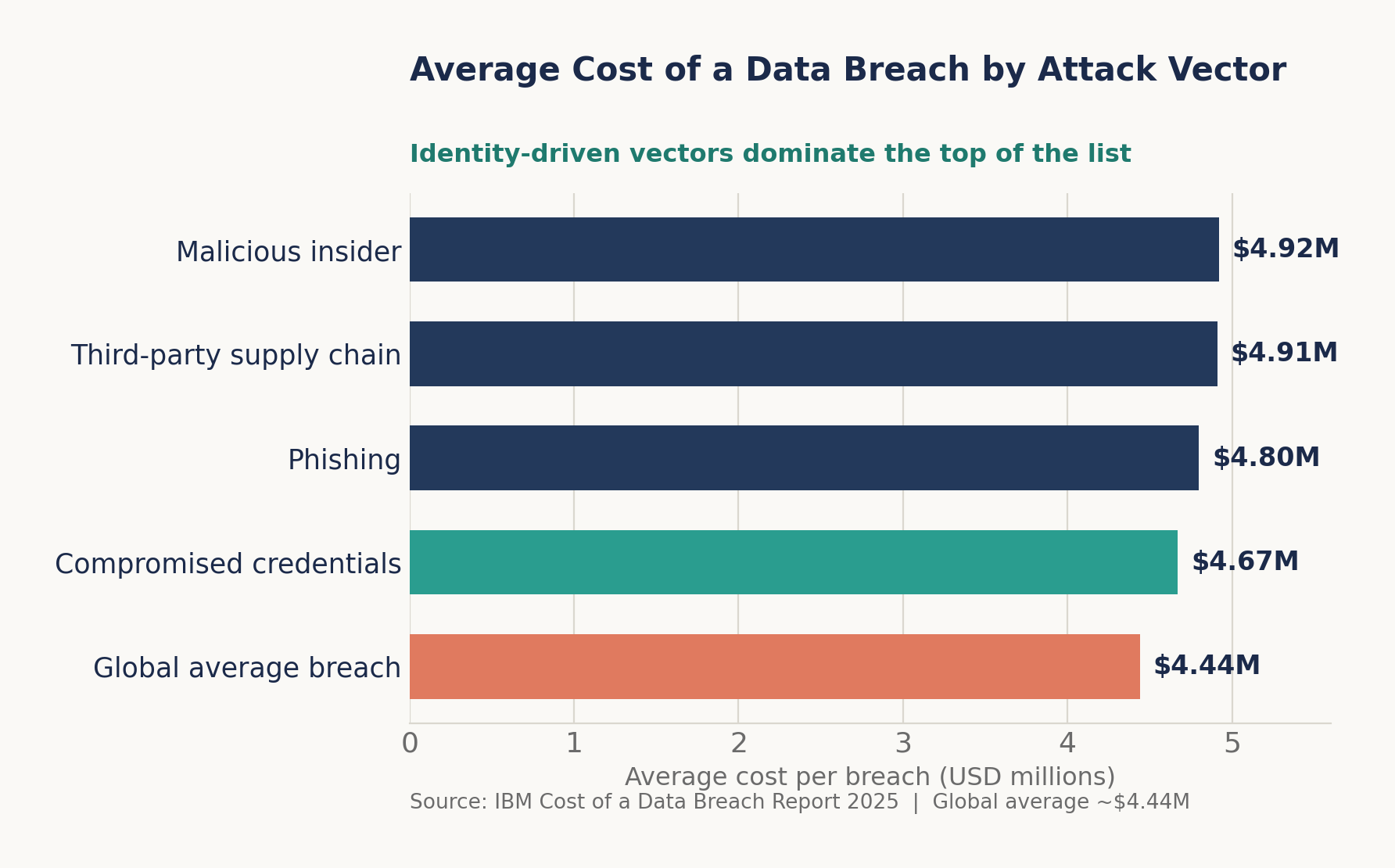
A single set of compromised credentials now costs enterprises an average of $4.67 million per breach and runs undetected for roughly 246 days before anyone notices. That figure should change how you think about who configures your identity platform, not just which platform you buy.
Most identity programmes fail on people, not products. When teams set out to hire SailPoint developer India talent, the real risk is rarely whether SailPoint works; it is whether the engineer understands access certification, connector logic, and joiner-mover-leaver workflows well enough to ship without quietly creating audit gaps.
That is the downside an identity engineer exists to prevent. Getting the hire wrong does not just slow a project it leaves the exact gap attackers look for. The checklist below is built for IT security leads who would rather vet correctly once than re-hire in twelve months.
Identity security failures rarely come from the platform they come from how it is implemented. In SailPoint environments, gaps in access certification, connector logic, or lifecycle workflows can quietly introduce the exact vulnerabilities attackers exploit.
Hire SailPoint developer India is where many enterprises gain scale and cost efficiency but only when hiring focuses on deep IAM expertise, not just surface-level platform familiarity.
The current global average cost of a data breach is $4.44 million, reflecting a slight stabilization but remaining firmly within the multimillion-dollar baseline as analysts project long-term figures to hover between $4.44 million and $4.88 million.
The takeaway: in SailPoint IAM projects, hiring the right developer is not just a staffing decision it is a core security control.
What Is a SailPoint Developer?
A SailPoint developer is an identity and access management engineer who designs, configures, and maintains SailPoint IdentityIQ or IdentityNow to automate user provisioning, access reviews, and policy enforcement. The role blends Java or BeanShell scripting, connector development, and identity governance knowledge to keep access correct, compliant, and auditable across enterprise systems.
That definition matters because it sets the bar. Anyone can click through a console; far fewer can debug a failed aggregation or model roles that survive an audit. Before you hire SailPoint developer India candidates, separate console familiarity from genuine engineering depth.
The Real Cost of a Wrong Hire
Identity projects slip for predictable reasons. A misconfigured certification campaign or a broken provisioning connector does not announce itself; it surfaces months later during an audit, when orphaned accounts and excess entitlements have already piled up.
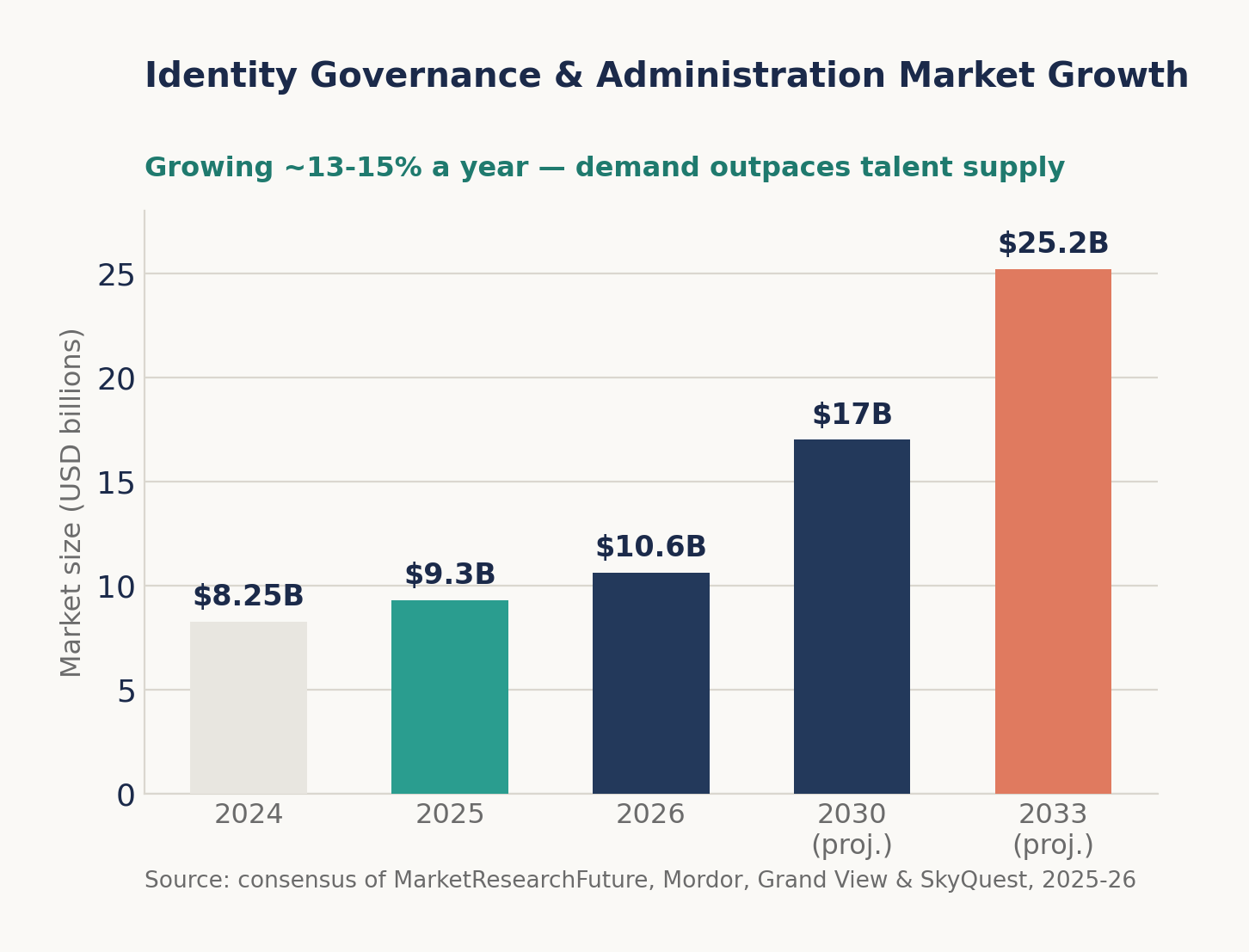
The numbers underneath this demand are not small. The identity governance and administration (IGA) market sat at roughly $9.3 billion in 2025 and is growing 13–15% a year, with Asia-Pacific the fastest-expanding region. Demand for skilled engineers is outpacing supply, which is precisely why a rushed decision to hire SailPoint developer India resources gets expensive.
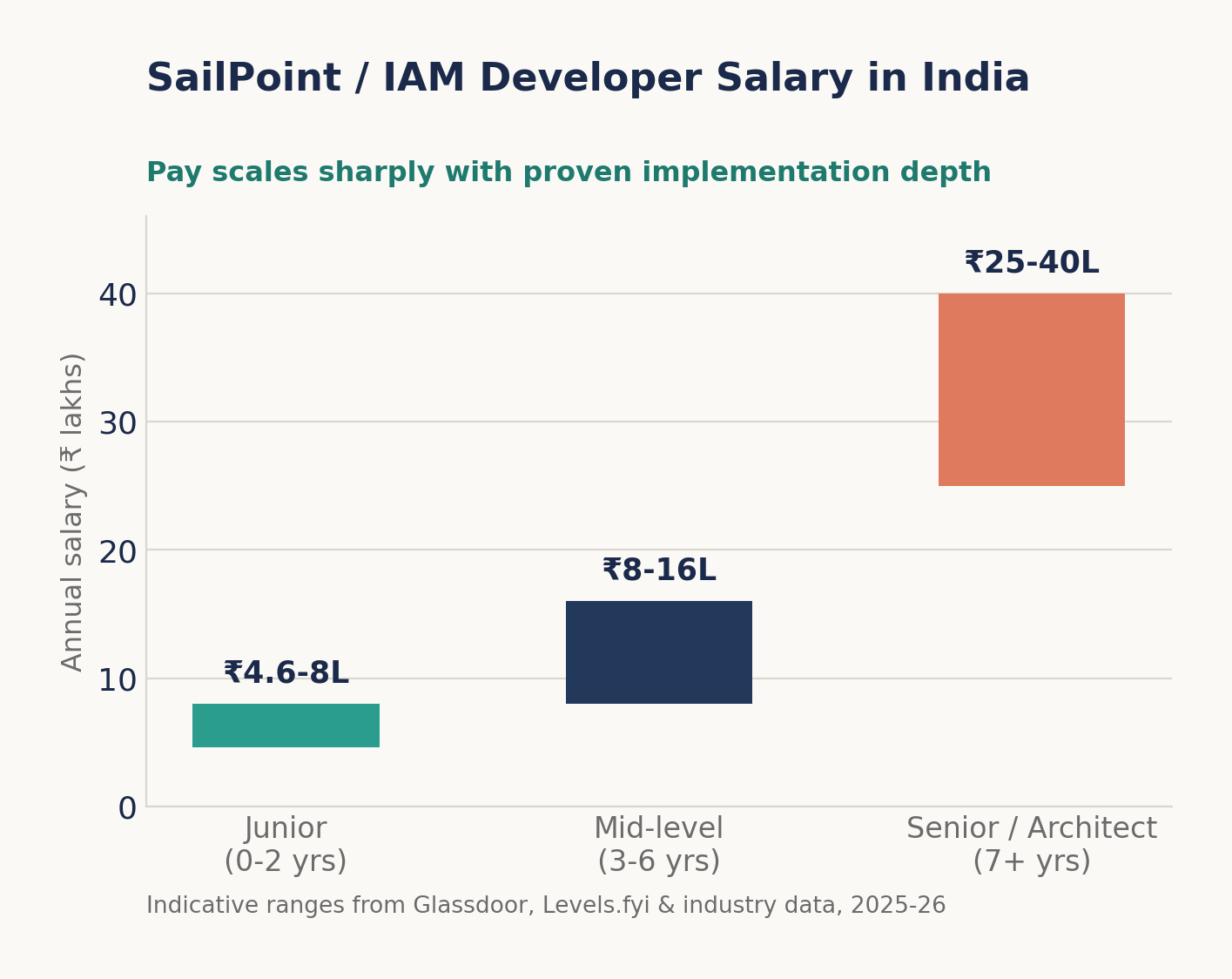
That scarcity shows up directly in pay. A mid-level SailPoint engineer in India averages ₹8–10 lakhs, while a developer with deep implementation experience commands ₹25–40 lakhs. Underpay and you get someone who can run the GUI but cannot fix a rule; overpay for a junior and your true cost-per-outcome triples without anyone tracking it.
The Checklist to Hire SailPoint Developer India Teams Can Trust
This is the longest part for a reason most hiring mistakes happen here, in the gap between a polished résumé and demonstrable skill. Work through these five filters in order before you hire SailPoint developer India professionals for any programme.
Match the Hire to the Platform: IdentityNow vs IdentityIQ
This is the decision most job descriptions get wrong. A SailPoint IdentityIQ developer and a SailPoint IdentityNow developer are not interchangeable, even though both sit under the same brand.
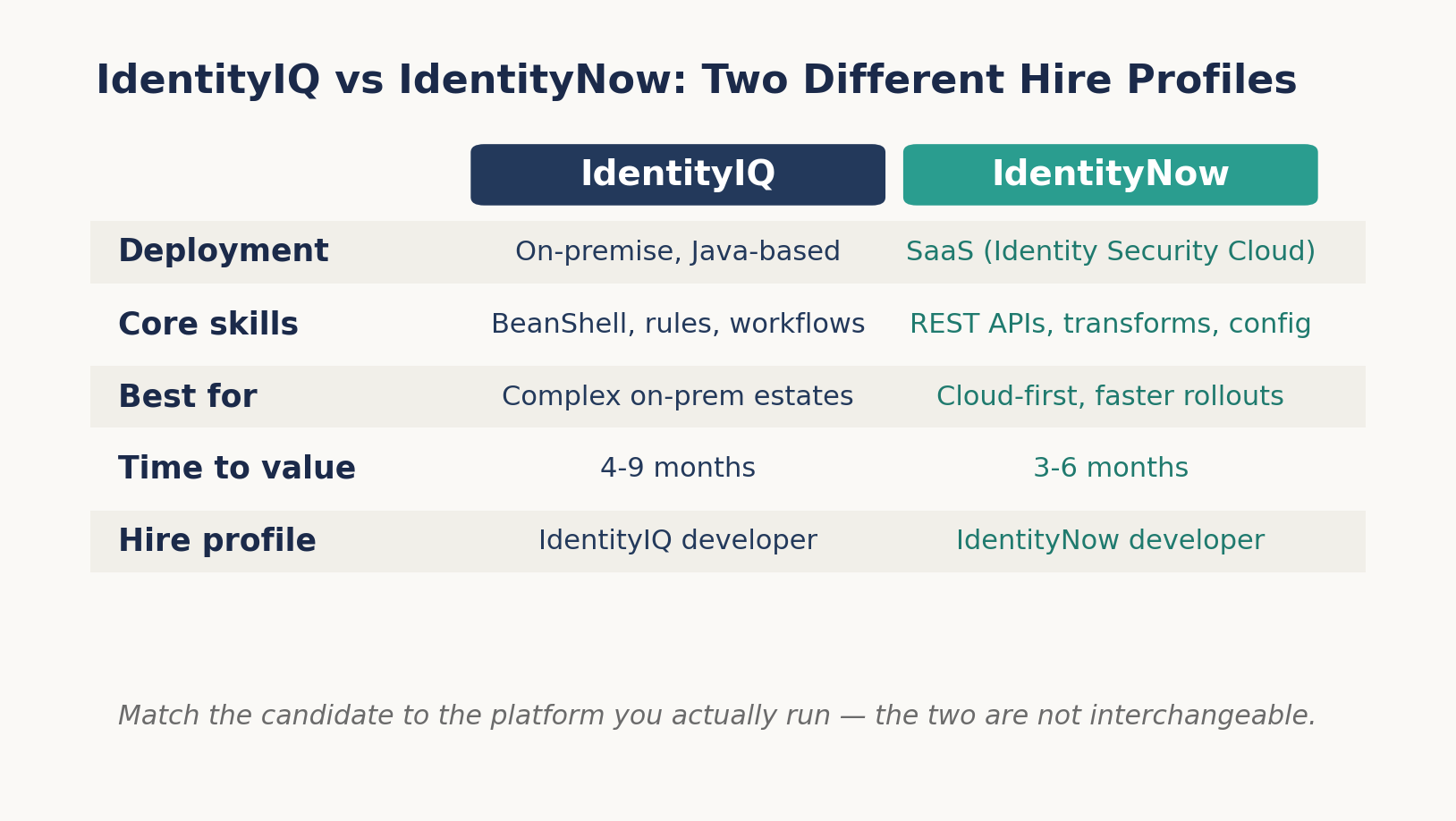
IdentityIQ is the on-premise, Java-heavy platform except BeanShell, rule writing, custom workflows, and connector-based application onboarding. IdentityNow (now part of Identity Security Cloud) is SaaS and configuration-first, leaning on REST APIs, transforms, and virtual appliances rather than deep server-side code.
Hiring an IdentityIQ specialist for an IdentityNow rollout or the reverse is the most common and most avoidable mismatch in identity governance hiring. Name the platform in the job spec, then test against it.
The Technical Skills That Actually Matter
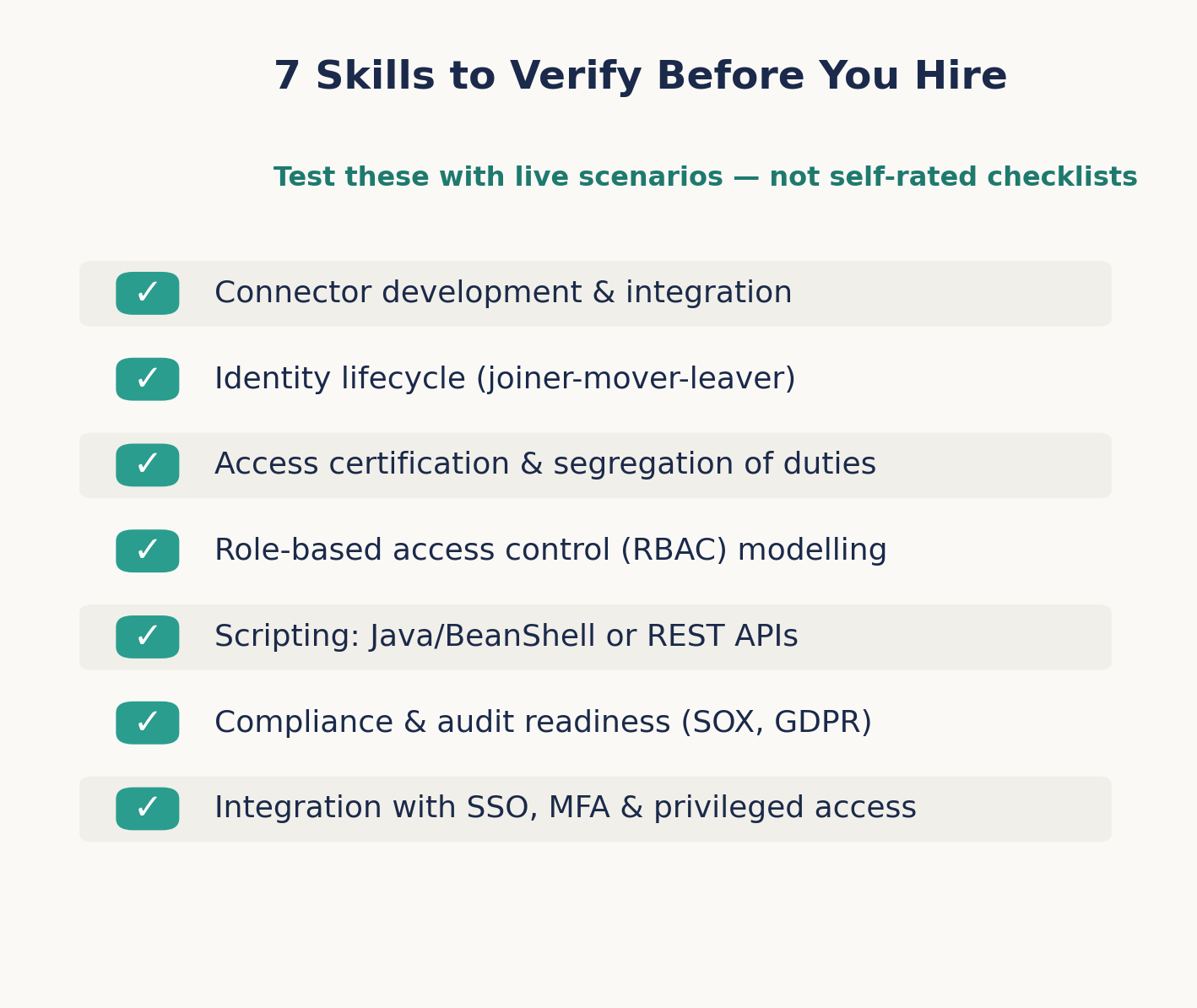
When you screen for a SailPoint IAM developer, verify these capabilities with live or scenario-based tasks rather than self-rated checklists:
- Connector development and integration building and debugging connectors for AD, LDAP, databases, SaaS apps, and custom endpoints.
- Identity lifecycle management automates joiner-mover-leaver events so provisioning and deprovisioning happen without manual tickets.
- Access certification and segregation of duties (SoD) designing review campaigns and policy rules auditors will accept.
- Role-based access control (RBAC) modelling engineering roles that reduce entitlements rather than multiplying them.
- Scripting Java/BeanShell for IdentityIQ, or REST APIs and transforms for IdentityNow.
- Compliance and audit readiness mapping controls to SOX, GDPR, or sector mandates with clean audit logging.
- Integration with SSO, MFA, and privileged access tooling making the identity layer cooperate with the wider security stack.
A candidate who can speak fluently to five of these and demonstrate two under pressure is worth more than one who lists all seven on paper.
Decide the Engagement Model: Contract vs Full-Time
Whether to hire SailPoint developer India specialists on contract or as full-time staff depends on programme stage, not preference. During an implementation push typically 4–9 months for a greenfield IdentityIQ build or 3–6 months for an IdentityNow rollout contract or consulting talent is often faster and cheaper.
For steady-state operations, full-time hires retain platform knowledge that contractors take with them. Many enterprises run a hybrid: contractors to implement, a smaller full-time team to operate and extend.
Budget Against Real IAM Developer Salary India Benchmarks
Set the band before you interview, not after a candidate names a number. Current IAM developer salary India ranges run roughly ₹4.6–8 lakhs for juniors, ₹8–16 lakhs for mid-level engineers, and ₹25–40 lakhs for senior developers and architects, with contract day rates priced accordingly.
Anchoring to these benchmarks stops two failure modes: lowballing genuine talent into walking, and overpaying a junior because the requisition lacked a ceiling.
Real-World Application
A BFSI enterprise running IdentityIQ had let a generalist own its access reviews. After bringing in a certified developer, it compressed its access certification cycle from six weeks to nine days and cut orphaned accounts by roughly 80% within two quarters the audit findings followed.
A healthcare SaaS company migrating to IdentityNow took the contract route, engaging two developers for four months. Automated provisioning dropped account creation from three days to under two hours, and the team avoided a permanent headcount it did not yet need. Both outcomes trace back to one thing: the choice to hire SailPoint developer India engineers who fit the platform and the phase.
IdentityNow vs IdentityIQ: A Quick Decision Framework
| Dimension | IdentityIQ | IdentityNow |
| Deployment | On-premise / hosted, Java-based | SaaS (Identity Security Cloud) |
| Core skills | BeanShell, rules, workflows, connectors | REST APIs, transforms, configuration |
| Best for | Complex, customised, on-prem estates | Cloud-first, faster standardised rollouts |
| Typical time to value | 4–9 months | 3–6 months |
| Hire profile | IdentityIQ developer | IdentityNow developer |
Use the right-hand column to write the job description. If your estate is moving cloud-first, the engineer you hire SailPoint developer India dedicated teams will rely on should be API-fluent, not just rule-fluent.
What Most Teams Get Wrong
The recurring mistake is hiring for tool familiarity instead of identity reasoning. A certification proves someone passed an exam; it does not prove they can model a role hierarchy that reduces risk or debug an aggregation that silently fails at 2 a.m.
Three patterns show up again and again: over-indexing on certification count, never testing live rule-writing or connector debugging, and treating IAM as a one-time project rather than a living system. Teams that hire SailPoint developer India resources purely on credentials, with no demonstrated problem-solving, almost always re-hire within a year.
The fix is unglamorous. Give a real, small, broken scenario and watch how the candidate reasons toward a fix. That single exercise predicts on-the-job performance better than any résumé line.
Frequently Asked Questions
What does a SailPoint developer actually do?
A SailPoint developer configures and maintains the identity platform that controls who can access what across an organisation. Day to day that means building connectors, automating provisioning and deprovisioning, designing access certification campaigns, writing rules or API integrations, and keeping the whole system audit-ready against compliance mandates.
How much does it cost to hire a SailPoint developer in India?
Costs vary sharply by experience. Expect ₹4.6–8 lakhs for juniors, ₹8–16 lakhs for mid-level engineers, and ₹25–40 lakhs for senior developers and architects, with contractors priced on day rates. Because the IGA market is growing 13–15% a year, strong candidates field multiple offers realistically before you hire SailPoint developer India talent.
Is a SailPoint IdentityNow developer different from an IdentityIQ developer?
Yes, meaningfully. IdentityIQ work is Java- and rule-heavy and usually on-premise, while IdentityNow is SaaS and configuration-first, built around REST APIs and transforms. A strong IdentityIQ engineer is not automatically productive in IdentityNow, so match the candidate to the platform you actually run.
Should I hire a contract or full-time SailPoint developer?
Contract talent suits time-boxed implementations where speed matters; full-time hires suit steady-state operations where retaining platform knowledge is the priority. Many enterprises combine both contractors to deliver the rollout, a lean internal team to operate and extend it afterward.
What certifications should a SailPoint IAM developer have?
SailPoint Certified IdentityIQ Engineer or IdentityNow/Identity Security Cloud credentials are useful signals, often paired with broader IAM or cloud-security certifications. Treat them as a filter, not a verdict pair any certification with a hands-on technical exercise before deciding.
How long does a SailPoint implementation take?
A greenfield IdentityIQ implementation typically runs 4–9 months depending on the number of applications and customisation; an IdentityNow rollout often lands in 3–6 months for a mid-size scope. Phased delivery, clear connector priorities, and an experienced lead developer are the biggest levers on the timeline.
How do I know a candidate can actually do the job?
The most reliable test is a small, realistic, broken scenario: a failed aggregation, a flawed certification rule and watching how they diagnose it. If you would rather not design that exercise alone, it is worth pressure-testing your shortlist with a partner who has run identity governance hiring before.
Before You Commit to a Hire
If you are about to hire SailPoint developer India talent and want to pressure-test a shortlist before signing, this is the moment to do it not after onboarding, when a mis-hire is already touching production access and the cost of unwinding it climbs by the week.
The pattern behind most failed identity hires is consistent: the distance between a candidate who interviews well and one who can debug a broken aggregation at 2 a.m. only reveals itself months in. A short, structured technical screen closes most of that gap. So does an honest conversation about whether the role even needs the profile you have written plenty of teams over-spec for an architect when a strong mid-level developer would deliver the rollout faster and at a fraction of the cost.
Supersourcing has run identity governance hiring and SailPoint implementations across dozens of engagements, on both IdentityIQ and IdentityNow. If it is useful, send through your role brief and target platform and we will help you separate the configurators from the engineers what to test for, what the band should be, and which engagement model fits the phase you are in. The aim is a hire that holds for years, not one you are re-running in twelve months.
No pitch and no obligation, just a second set of eyes from a team that has made this call many times. You can reach me directly at mayank@engineerbabu.com, or start at supersourcing.com whenever the timing is right.
