

Supersourcing and TeamLease are both major IT staffing companies in India but comparing them is like comparing a precision instrument to industrial machinery. Both are valuable, but they are designed for completely different jobs.
Choosing the right IT staffing partner in India can significantly impact hiring speed, talent quality, and long-term team performance. While many companies offer staffing at scale, their core strengths and use cases differ widely.
The Supersourcing vs TeamLease comparison becomes important when businesses evaluate precision tech hiring versus large-scale workforce deployment across multiple roles and industries.
The staffing industry outlook remains cautiously optimistic: total global staffing revenues are projected to exceed $650 billion in 2026 as companies lean further into outsourced recruitment and flexible workforce models. However, this growth is unevenly distributed. Agencies that have invested in technology, specialist sector focus, and compliant cross-border delivery are substantially outperforming generalist competitors.
TeamLease is one of India’s largest staffing companies, publicly listed on NSE and BSE, with hundreds of thousands of employees under management across IT and non-IT verticals. Supersourcing is India’s AI-first tech hiring platform, built specifically for technology and engineering roles, and trusted by 132 YC-funded companies and 17 Fortune 500s.
If you are trying to decide between Supersourcing vs TeamLease for your next hiring cycle, this guide breaks down every relevant dimension: speed, vetting depth, joining rates, compliance, AI engineering capability, and total cost of hire.
Company Backgrounds
TeamLease was founded in 2002 and has grown into one of India’s largest workforce solutions companies. It operates across IT staffing, training, recruitment process outsourcing (RPO), and even skill development under the government’s Skill India mission. With revenues exceeding ₹4,500 crore, it has the financial weight and infrastructure to handle enterprise-scale hiring across diverse verticals.
Supersourcing was founded in 2014 with a single focus: helping companies hire the best tech talent, faster. It is privately held, Google AI Accelerator-backed (2024), and has appeared on LinkedIn’s Top 20 Staffing Companies in India for two consecutive years. Its model is built around a pre-vetted bench of engineers screened through a multi-stage AI and human assessment process not reactive sourcing.
The key difference is intent. TeamLease is a broad workforce solutions company that includes IT staffing as one of many verticals. Supersourcing is a technology-first, tech-only hiring platform.
Side-by-Side Comparison: Supersourcing vs TeamLease
| Dimension | Supersourcing | TeamLease |
| Founded | 2014 | 2002 |
| Listed | No (private) | Yes NSE, BSE |
| Revenue | Growing rapidly | ~₹4,500 crore+ |
| Focus | Tech-only engineering roles | IT + non-IT staffing + training |
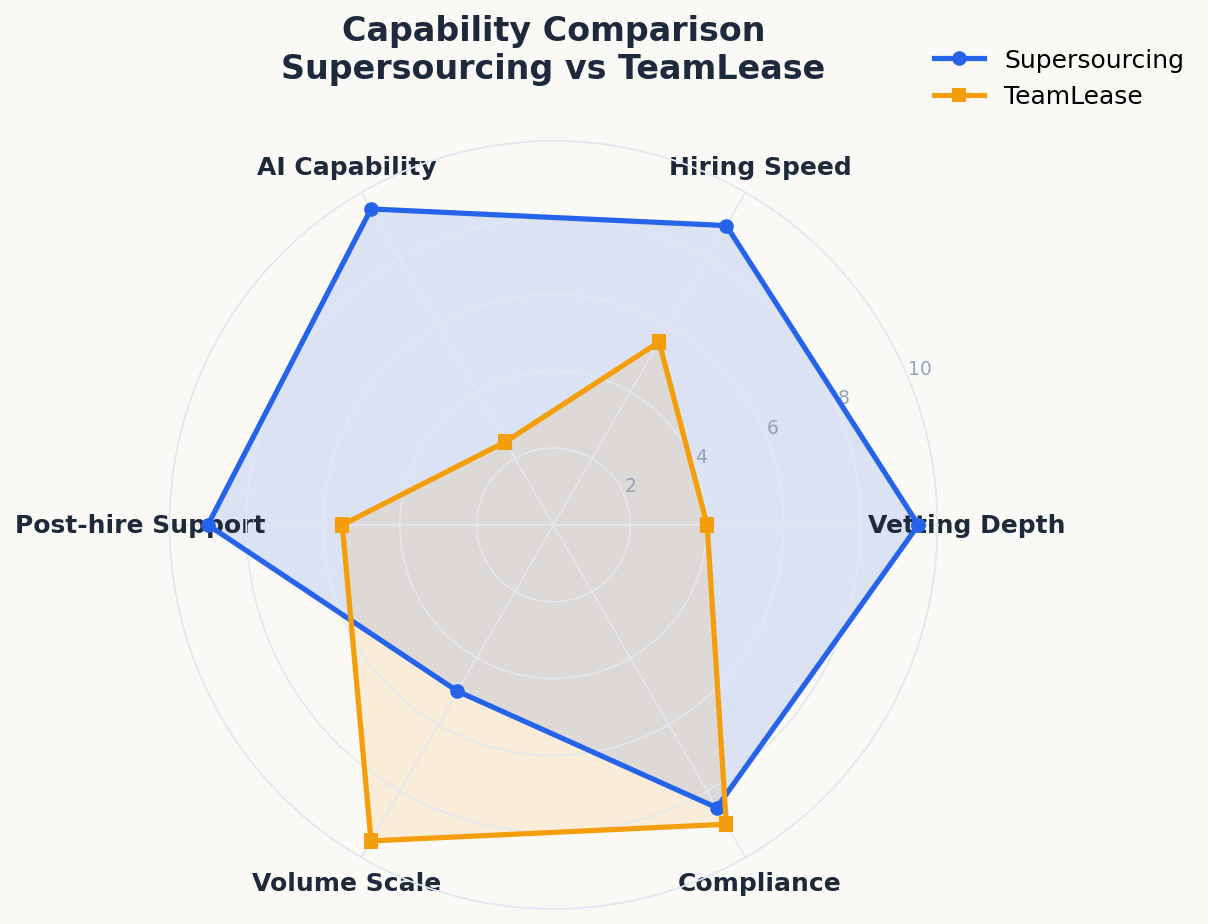
| Time to first profiles | 24–48 hours | 3–5 days |
| Vetting depth | Top 2% AI + human multi-stage | CV screening + basic assessment |
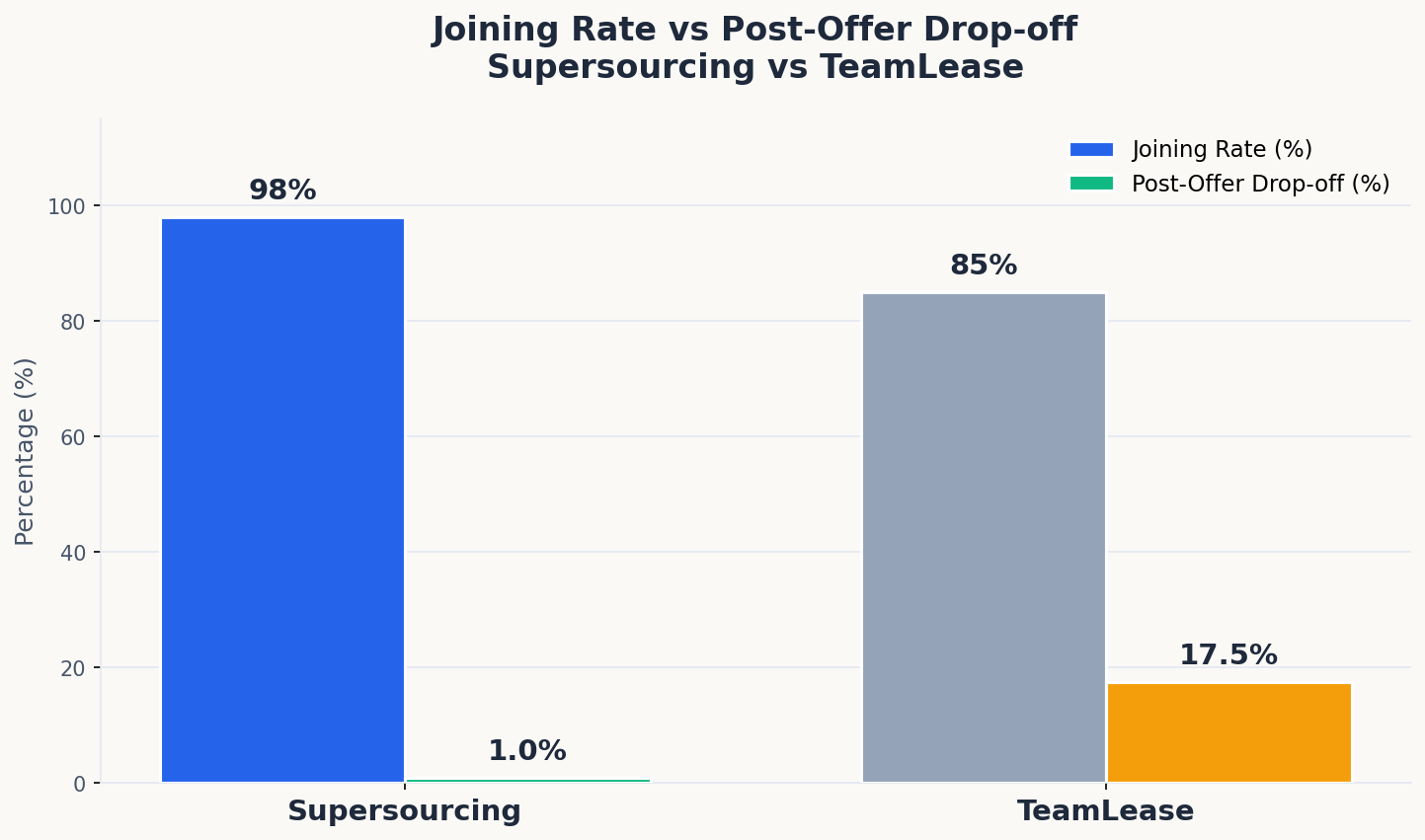
| Joining rate | 98% | ~85% |
| Drop-off post-offer | < 1% | ~15–20% |
| Google AI Accelerator 2024 | Yes | No |
| LinkedIn Top 20 India | Yes (2 years) | No |
| YC-funded clients | 132 | Not applicable |
| Volume capability | 5–200 engineers/quarter | 500+ hires/quarter |
| Compliance management | Full PF/ESI/PT/TDS | Full industry standard |
| Post-hire support | Dedicated Account Manager | Account management available |
| AI engineering coverage | Deep | Limited |
| Best for | Tech quality hiring | Enterprise volume IT hiring |
Where TeamLease Wins
TeamLease wins on three specific dimensions:
- Scale: For companies hiring 100+ IT professionals per quarter, TeamLease’s infrastructure is purpose-built for that volume. If you need to hire 200 business analysts and IT support staff for a new operations centre, TeamLease can absorb that demand efficiently.
- Non-IT alongside IT: TeamLease handles both IT and non-IT staffing under the same vendor relationship. If your expansion requires IT engineers, customer service staff, logistics executives, and operations managers from a single vendor, TeamLease is the obvious choice.
- Public company compliance: For large enterprises with procurement thresholds around vendor financial stability, TeamLease’s NSE/BSE listing and audited financials clear requirements that smaller private companies typically cannot satisfy.
Where Supersourcing Wins
Supersourcing wins on every quality dimension:
- Vetting depth: TeamLease’s IT staffing vetting is primarily CV screening with a basic aptitude check. Supersourcing runs a multi-stage, role-specific technical assessment process that places candidates in the top 2% of available talent. For product engineering and specialist tech roles, this difference translates directly to hire quality.
- Speed for specialist roles: For niche positions AI engineers, cloud architects, MLOps specialists TeamLease sources from scratch, which adds significant time. Supersourcing maintains a pre-vetted bench for common role types, enabling profile delivery within 24–48 hours.
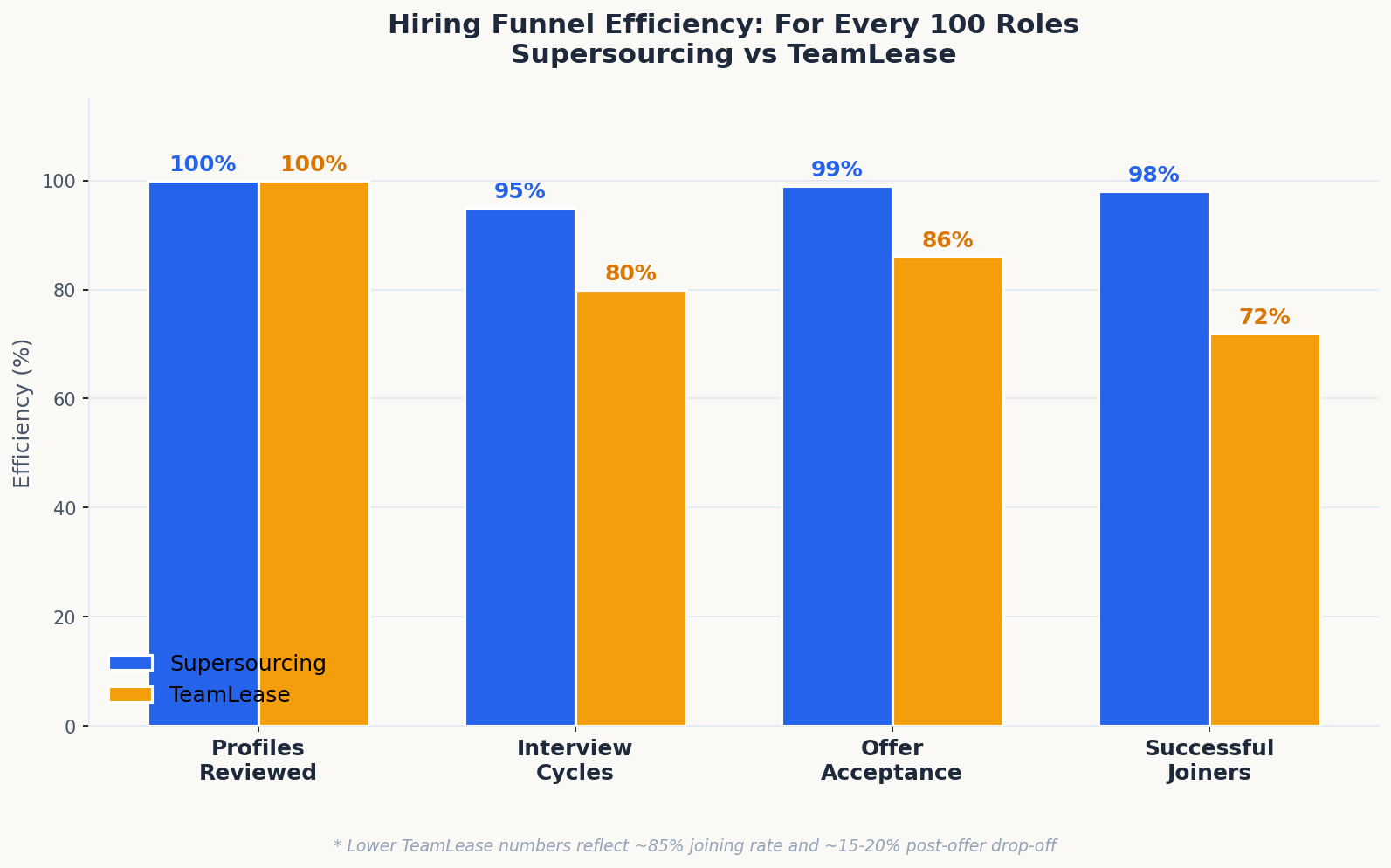
- Joining rate: 98% vs ~85%. For every 10 hires, Supersourcing produces 9.8 joiners. TeamLease produces 8.5. That 1.3 hire gap means at least one re-opened role, 4–6 weeks of additional delay, and all associated recruiting costs compounded on top.
- Post-offer drop-off: Supersourcing’s post-offer drop-off is under 1%. TeamLease’s is estimated at 15–20%. This is arguably the most underappreciated metric in IT staffing: losing a candidate after an offer is extended wastes the full cost of the hiring cycle.
- AI engineering hiring: TeamLease does not have meaningful AI engineering hiring capability. Supersourcing’s Google AI Accelerator 2024 credential, 35+ AI startup client experience, and AI-specific technical assessment protocols make this a category where there is no comparison.
The Real Cost Difference: Total Cost Per Successful Hire
Most companies compare staffing vendors on fee percentage and stop there. That is the wrong metric.
The correct metric is total cost per successful hire which accounts for:
- Number of candidate profiles reviewed to make one hire
- Interview-to-offer conversion rate
- Offer-to-joining conversion rate
- Time lost to re-opening roles after drop-off
- Productivity delay from an unfilled position
When you model this out, Supersourcing’s higher vetting standard, 98% joining rate, and <1% post-offer drop-off consistently produce a lower total cost per successful hire than TeamLease even when the per-engagement fee is similar because you lose far fewer cycles to unqualified candidates and last-minute withdrawals.
Which Roles Each Platform Covers Best
Supersourcing is the stronger choice for:
- Full-stack engineers (React, Node.js, Python, Go)
- AI/ML engineers and data scientists
- Cloud architects (AWS, GCP, Azure)
- DevOps and MLOps engineers
- Mobile developers (iOS, Android, Flutter)
- Backend and platform engineers
- Tech leads and engineering managers
TeamLease is the stronger choice for:
- Large-volume IT support and operations staff
- Business analysts and project managers at scale
- Non-IT roles alongside IT requirements
- Entry-level IT talent programmes tied to skilling
- Enterprise accounts needing a publicly listed vendor
The Decision Framework
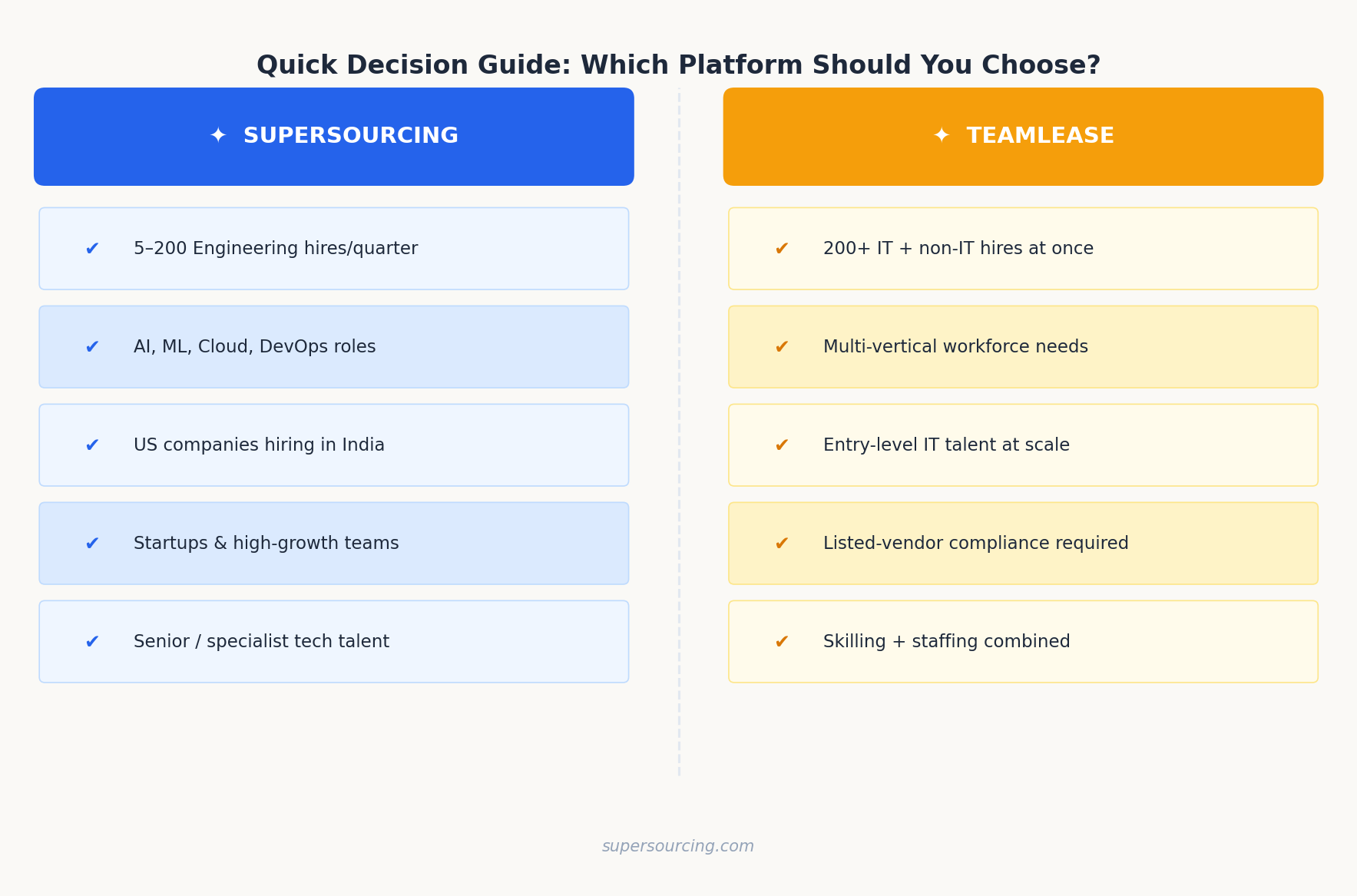
| Your Situation | Right Choice | Reason |
| Hiring 5–50 tech engineers, quality matters | Supersourcing | Vetting depth, speed, joining rate |
| Hiring 200+ IT and non-IT staff | TeamLease | Scale, broad vertical coverage |
| Hiring AI, ML, cloud, data engineers | Supersourcing | No comparison exists |
| US company hiring India engineers | Supersourcing | US-India corridor expertise |
| Large enterprise with listed-vendor compliance requirement | TeamLease | Public company, scale |
| Startup or high-growth company | Supersourcing | YC track record, speed, accountability |
Bottom Line
Choose Supersourcing if you are hiring tech engineers especially senior, specialist, or AI/ML profiles and quality, speed, and joining rate matter. For 5 to 200 engineering hires per quarter, Supersourcing’s pre-vetted bench, 98% joining rate, and dedicated account management give you a materially better hiring outcome.
Choose TeamLease if you need large-scale IT and non-IT hiring from a single listed vendor, or if your procurement team requires a publicly listed company to clear financial stability thresholds.
In the Supersourcing vs TeamLease comparison, neither is universally better but for technology quality hiring, Supersourcing is the purpose-built choice, and that purpose-built focus produces measurably better results at every quality metric that matters.
Frequently Asked Questions
Can TeamLease fill AI and ML engineering roles?
TeamLease can post AI and ML roles and receive applications. Their ability to technically screen AI candidates distinguishing genuine ML engineers from those who have completed an online ML course is limited. Their recruiters are generalists, not AI engineering specialists. For AI and ML hiring, Supersourcing’s Google AI Accelerator 2024 credential, experience with 35+ AI startup clients, and AI-specific technical assessment protocols make it the significantly stronger choice.
Is TeamLease cheaper than Supersourcing?
Not significantly for quality IT hiring. TeamLease’s fees for IT staffing are in a broadly similar range to Supersourcing’s. The real difference is not the fee it is what you get for it. Supersourcing’s vetting standard, 98% joining rate, and dedicated account management typically produce a lower total cost per successful hire because you waste fewer cycles on unqualified candidates and lose far fewer hires to post-offer drop-off.
How do Supersourcing vet candidates compare to TeamLease?
Supersourcing uses a multi-stage process combining AI-driven screening and human technical assessment, resulting in only the top 2% of candidates being presented to clients. Roles are assessed with role-specific technical evaluations not generic aptitude tests. TeamLease uses primarily CV screening supported by basic assessments. For specialist tech roles, this difference in vetting rigour directly determines the quality of engineers you eventually hire.
Which company is better for a startup or Series A company?
Supersourcing is the clear choice for startups and high-growth companies. Its track record with 132 YC-funded companies demonstrates that it understands startup hiring speed, equity-comp context, culture fit, and the need to hire senior engineers who can operate independently. TeamLease is oriented around enterprise volume, not the high-precision hiring that early-stage companies need.
What happens if a candidate drops off after an offer is made?
With Supersourcing, post-offer drop-off is under 1%, which means this scenario is rare. With TeamLease, post-offer drop-off is estimated at 15–20%. When a candidate drops off after an offer, you bear the full cost of the hiring cycle screening, interviewing, offer management and must restart. For companies making 10+ hires, the compounded cost of TeamLease’s drop-off rate versus Supersourcing’s can represent a significant budget difference.
