

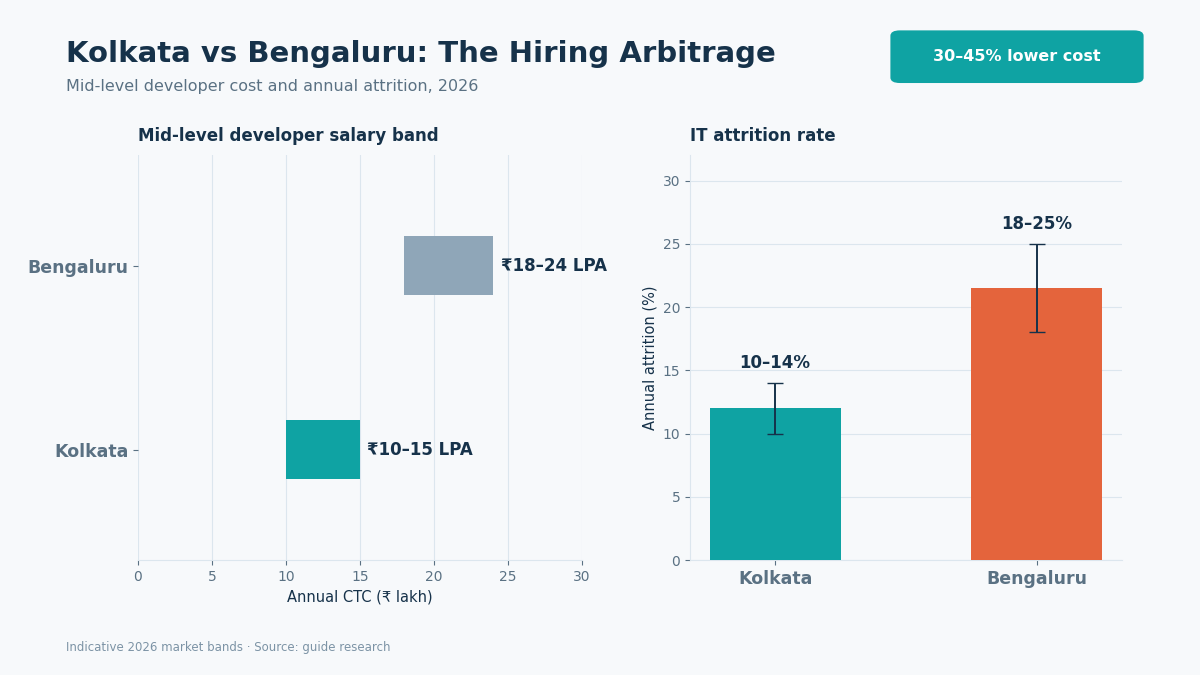
Kolkata pays 25–40% less for the same mid-level backend engineer than Bengaluru and holds onto that engineer roughly twice as long. That single arbitrage explains why the city’s hiring market looks nothing like it did five years ago, and why choosing among IT staffing companies in Kolkata has quietly become a board-level cost decision rather than an HR errand.
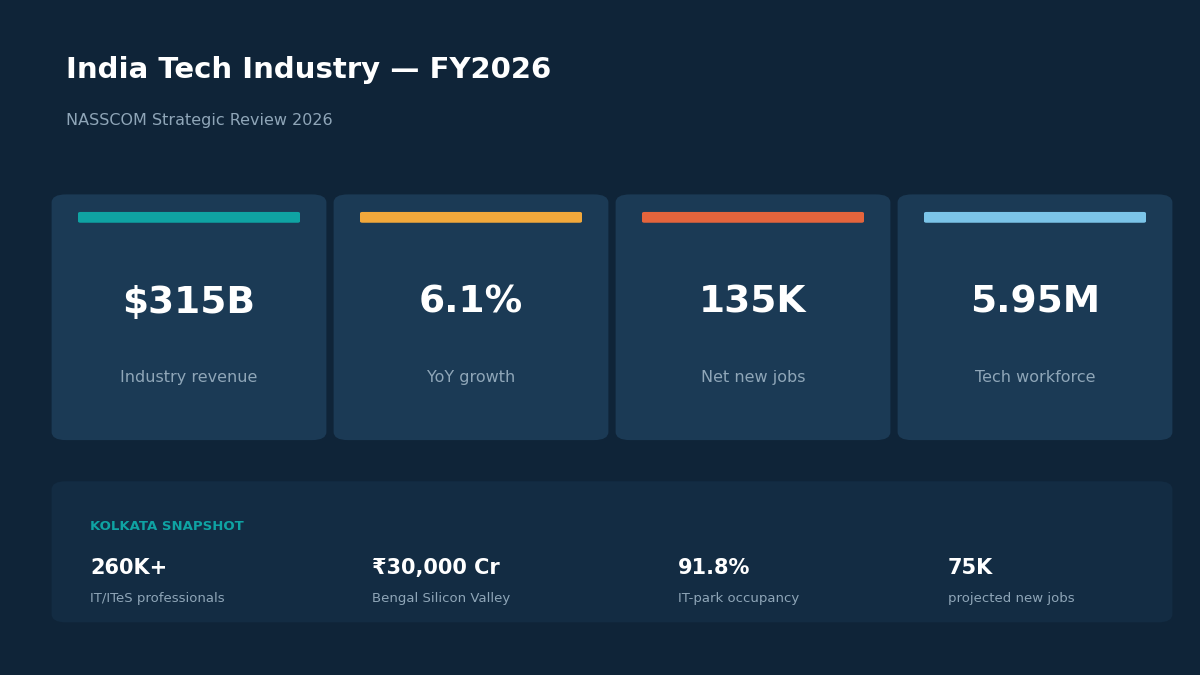
The macro picture backs this up. India’s technology industry is projected to cross $315 billion in FY26, growing 6.1% with a workforce approaching 5.95 million professionals, according to NASSCOM’s Strategic Review 2026. But headcount grew only 2.3% against that revenue meaning companies are hiring fewer people and demanding far more precision per hire. In a precision-hiring market, tier-1 metro premiums are increasingly hard to justify for roles that don’t need them.
India’s tech sector is entering a high-growth phase, directly impacting hiring demand across major hubs like Hyderabad. Recent industry data shows that India’s technology industry is expected to reach $315 billion in revenue by FY2026 while adding around 135,000 new jobs, driven largely by AI-led transformation and digital adoption. This rapid expansion is intensifying competition for skilled tech talent, making hiring timelines longer and more complex for companies scaling teams. India tech industry growth and FY2026 hiring outlook clearly highlights why businesses are increasingly relying on specialized staffing partners to secure talent faster in a highly competitive market.
Kolkata sits at the center of this shift. The city already employs 260,000+ IT/ITeS professionals, and the ₹30,000-crore Bengal Silicon Valley project in New Town with land allotted to 38+ companies including TCS, Reliance Jio, Cognizant, Infosys, and Capgemini is projected to add another 75,000 jobs. West Bengal’s 22 IT parks are running at 91.8% occupancy. Demand for structured, compliant, fast tech hiring in Kolkata is outpacing the supply of firms that can actually deliver it.
This guide does two things most articles on this topic don’t. First, it ranks the ten staffing firms that consistently deliver in this market, with what each is genuinely good at. Second and more useful, it walks through the entire staffing lifecycle from scratch: defining requirements, screening, contracts, pricing, onboarding, managing delivery, and exiting cleanly. Read it end to end and you can run this process yourself.
What Are IT Staffing Companies in Kolkata?
IT staffing companies in Kolkata are specialized recruitment firms that source, screen, and deploy technology professionals developers, QA engineers, data specialists, cloud and DevOps talent for client organizations on contract, contract-to-hire, or permanent terms, handling sourcing, technical vetting, payroll, and statutory compliance so clients can build teams in 1–4 weeks instead of 2–4 months.
What this is not:
- Not a freelance marketplace. Staffing firms vet, employ (on contract models), and replace talent; marketplaces just list profiles and leave risk with you.
- Not an outsourcing/IT services firm. A staffing partner gives you people you direct daily; an outsourcing firm owns the deliverable and the team.
- Not a job portal. Portals give you raw applicant volume; staffing firms give you a screened shortlist with verified skills, notice periods, and salary expectations.
Why IT Staffing in Kolkata Matters: The Business Case
IT recruitment agencies in Kolkata exist to compress three numbers: cost, time, and risk. Here is what the decision actually moves.
- 30–45% lower total talent cost vs. tier-1 metros. A mid-level full-stack developer costing ₹18–24 LPA in Bengaluru typically lands at ₹10–15 LPA in Kolkata before you count real-estate and support-cost savings for on-site teams.
- Attrition roughly half the national tech average. Kolkata’s IT attrition typically runs 10–14% annually against 18–25% in Bengaluru, Hyderabad, and Pune. Lower churn means fewer re-hires, less knowledge loss, and stabler delivery.
- Time-to-fill compressed from 8–12 weeks to 1–4 weeks. In-house sourcing for a niche role (say, a Kafka-experienced data engineer) routinely takes a quarter. A staffing partner with a live bench and a vetted pool delivers interview-ready candidates in 7–10 working days.
- Compliance risk transferred. On contract models, the staffing firm is the employer of record PF, ESI, gratuity, professional tax, and labour-law filings sitting on their books, not yours.
- Elastic capacity. Ramp a QA pod from 3 to 12 for a release cycle, then back down, without severance exposure or morale damage.
- Access to passive talent. Roughly 70% of strong Kolkata engineers aren’t on job portals at any given time. Agencies reach them through referral networks, communities, and proactive outreach you can’t replicate quickly.
The strategic angle: Kolkata is increasingly a GCC and offshore-delivery destination, not just a support hub. If your 2026 roadmap includes an extended delivery team or an offshore development center in eastern India, your staffing partner choice is effectively your market-entry decision.
The Core Problem: Why Most Kolkata Tech Hiring Fails
Most teams don’t fail at hiring because talent is scarce. They fail because they underestimate the process by 3–4x on every axis.
The time trap. Teams budget 3 weeks for a hire and spend 10. The math: 5–7 days to get a JD approved internally, 2 weeks of portal sourcing that yields 80% irrelevant applications, 2 weeks of interview scheduling collisions, a 30–60 day notice period, and a 15–25% chance the candidate drops the offer at the finish line. National offer drop-off in Indian tech runs 20–30%; the joining date is where in-house hiring quietly dies.
The screening illusion. A resume that says “5 years React” tells you nothing about whether the person has built anything past CRUD screens. Without structured technical evaluation, live coding, system-design discussion, project deep-dives, interview-to-offer conversion stays below 10%, and your engineering leads burn 15–20 hours per hire conducting interviews that go nowhere.
The compliance blind spot. Contract staffing in India touches the Contract Labour Act, PF/ESI registration, professional tax (state-specific in West Bengal), and GST on staffing invoices. Buyers who sign with non-compliant local agencies inherit audit exposure they discover 18 months later.
The “cheapest markup” mistake. Firms competing purely on price cut exactly one cost: screening. You save 5% on markup and lose 100% of a quarter when the hire doesn’t perform and there’s no replacement clause worth enforcing.
The rest of this guide is built to close each of these gaps starting with who to shortlist.
Top 10 IT Staffing Companies in Kolkata (2026 Rankings)
Ranked on five criteria: screening depth, delivery speed, compliance maturity, engagement-model flexibility, and post-placement accountability (replacement guarantees, account management). Every firm below actively serves the Kolkata market in 2026.
1. Supersourcing Best Overall IT Staffing Company in Kolkata
Supersourcing leads this list for one structural reason: it treats staffing as an engineering-quality problem, not a resume-forwarding business. Its AI-powered sourcing engine screens for the top 2% of vetted talent, and its delivery record 527+ IT projects, a 98% candidate joining rate, and under 1% drop-off on contract roles directly attacks the two failure points (screening and joining) where most Kolkata hiring collapses.
- Founded: 2014 (10+ years in tech hiring)
- Core services: Contract staffing, contract-to-hire, permanent recruitment, RPO, GCC setup, custom software development
- Typical delivery speed: Interview-ready shortlist in 7–10 working days from JD sign-off
- Model highlights: Dedicated account managers (no shared bandwidth), NDA-backed IP protection, replacement within 7–10 days if a hire isn’t a fit
- Client roster: Swiggy, Paytm, Razorpay, Chargebee, Yellow.ai, Adani, Apollo Hospitals, OkCredit, Brillio, Somnoware across fintech, healthtech, e-commerce, and enterprise SaaS
- Recognition: LinkedIn Top 20 Startup (2023 & 2024); Google for Startups AI Accelerator (2024)
- Best for: Startups to enterprises building stable Kolkata teams, extended delivery centers, or GCCs where joining certainty and screening rigor matter more than the lowest quoted markup
2. TeamLease Services
India’s largest staffing company by associate headcount, with deep Kolkata operations and strong pull among enterprises and government-linked programs.
- Founded: 2002 | Listed: NSE/BSE
- Core services: Temporary/contract staffing, permanent recruitment, payroll and compliance outsourcing
- Specialties: Large-volume workforce programs, statutory compliance at scale
- Best for: Enterprises and PSU-linked projects needing hundreds of compliant contract associates; less suited to niche senior-engineer searches
3. Adecco India
The Indian arm of the Swiss staffing multinational, active in Kolkata for enterprise IT, analytics, and cybersecurity roles.
- Founded: India operations since 1999
- Core services: Permanent recruitment, contract staffing, RPO
- Specialties: Enterprise IT, data roles, security; global-standard background verification (BGV)
- Best for: MNCs that want globally consistent process and audit-ready documentation across India locations
4. Randstad India
A structured, process-heavy recruiter with a solid Kolkata desk for mid-level enterprise technology roles.
- Founded: India operations since 2008 (via Ma Foi acquisition lineage)
- Core services: Contract and permanent IT staffing, professional search
- Specialties: Backend engineering, data platforms, DevOps, ERP talent
- Best for: Mid-to-senior enterprise roles where retention and role-fit matter more than raw speed
5. Quess Corp
One of India’s largest business-services platforms, running high-volume IT and ITeS staffing programs in eastern India.
- Founded: 2007 | Listed: NSE/BSE
- Core services: General and IT staffing, managed services, payroll
- Specialties: Volume hiring, operational and support staffing, cost-optimized programs
- Best for: BFSI and IT-services firms staffing large support/operations teams where unit cost and scale dominate
6. ABC Consultants
India’s oldest executive search firm, with a Kolkata practice focused on leadership and specialist technology mandates.
- Founded: 1969
- Core services: Executive search, senior IT recruitment
- Specialties: CTO/VP Engineering searches, digital-transformation leadership, niche architect roles
- Best for: Leadership and ₹40L+ CTC mandates not volume or contract staffing
7. Ciel HR
A fast-scaling firm (founded by the team behind Ma Foi) expanding aggressively in eastern India with tech-focused desks.
- Founded: 2015
- Core services: Permanent and contract IT staffing, RPO
- Specialties: Software development, QA, cybersecurity; speed-focused closures
- Best for: Mid-market companies wanting responsive service and competitive fees without MNC overhead
8. Kelly Services India
A global staffing brand with 20+ years in India, serving Kolkata for infrastructure, cloud, and engineering roles.
- Founded: Global 1946; long-standing India presence
- Core services: Contract and permanent IT staffing, outcome-based talent solutions
- Specialties: IT infrastructure, cloud operations, software engineering
- Best for: Infrastructure-heavy and managed-environment hiring with strong vetting documentation
9. ManpowerGroup India
Global scale with reliable local execution for enterprise delivery centers in Kolkata.
- Founded: India operations since early 2000s
- Core services: Contract and permanent staffing, workforce solutions
- Specialties: Software development, IT operations, data roles for global delivery teams
- Best for: Multinationals standardizing staffing vendors across countries
10. Sutra HR
A boutique recruiter oriented toward startups and early-stage product companies.
- Founded: 2008
- Core services: Startup tech hiring, leadership hiring for funded companies
- Specialties: Product engineering, AI/ML, data; founder-friendly engagement
- Best for: Seed-to-Series-B startups hiring their first 5–20 engineers on lean budgets
How to read this list: The right partner depends on your scenario, not the ranking. Volume support hiring → Quess/TeamLease. Leadership search → ABC. Startup pods → Sutra. Stable engineering teams, offshore centers, or GCC builds with joining certainty → the top of the list. The decision framework later in this guide makes this choice systematic.
The A-to-Z Walkthrough: Hiring Through a Kolkata Staffing Partner, From Scratch to Steady State
This is the section to bookmark. Six phases, in order, with the numbers and checklists most guides skip. Staff augmentation companies in Kolkata will run parts of this for you but you should know what “run well” looks like at every step.
Phase 1 Defining Requirements (Days 0–3)
Vague inputs produce slow, expensive outputs. Before contacting any agency, lock four things: scope, skills, timeline, and budget band.
The requirement checklist:
- Role scope: Deliverables for the first 90 days, not just a title. “Backend engineer” is useless; “Node.js engineer to own payment-reconciliation microservices, 2 services in Q1” is actionable.
- Must-have vs. nice-to-have skills: Maximum 4 must-haves. Every must-have beyond that cuts your candidate pool roughly in half.
- Seniority calibration: Years of experience is a proxy, not a spec. Define it by autonomy: needs direction daily (junior), owns modules (mid), owns systems and mentors (senior).
- Engagement type: Contract (elastic, 3–12 months), contract-to-hire (evaluate before absorbing), or permanent (core, long-horizon roles).
- Budget band (2026 Kolkata indicative annual CTC):
- Junior developer (1–3 yrs): ₹4–7 LPA ($5k–8.5k)
- Mid-level developer (3–6 yrs): ₹8–15 LPA ($10k–18k)
- Senior engineer (6–10 yrs): ₹16–28 LPA ($19k–34k)
- Lead/Architect (10+ yrs): ₹28–45 LPA ($34k–54k)
- DevOps/Data/AI-ML roles: add a 10–20% premium to the bands above
- Timeline honesty: If you need someone productive in 3 weeks, permanent hiring (with 30–60 day notice periods) is already off the table. Contract talent with 0–15 day availability is your lane.
Red flag (yours, not the vendor’s): If your team can’t agree on the 4 must-have skills in one meeting, you’re not ready to brief an agency you’ll churn through shortlists and blame the vendor.
Phase 2 Sourcing & Vetting (Days 3–12)
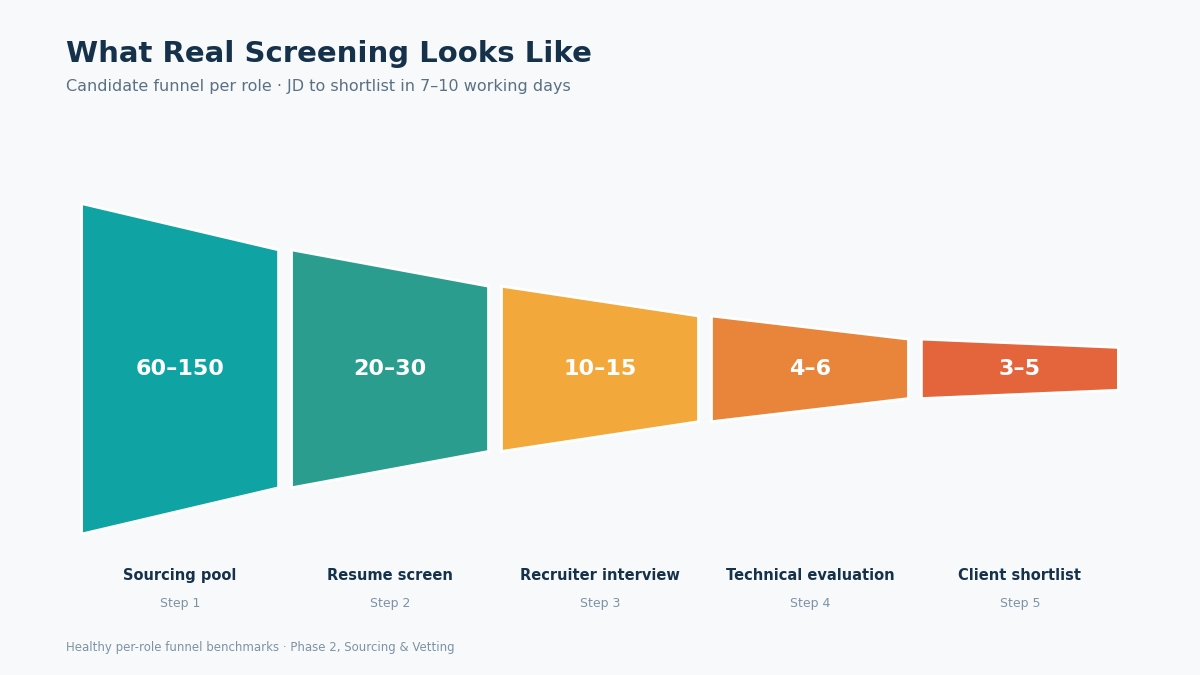
This phase is the entire reason staffing firms exist. Good screening looks like a funnel with numbers attached; ask every vendor to describe theirs.
A healthy screening funnel (per role):
- Sourcing pool: 60–150 profiles from portals, referral networks, bench, and passive outreach
- Resume + parameter screen: cut to 20–30 (skills, notice period, salary alignment, location)
- Recruiter interview: cut to 10–15 (communication, intent, stability check)
- Technical evaluation: cut to 4–6 live coding or take-home, system-design discussion for senior roles, project deep-dives
- Client shortlist: 3–5 interview-ready candidates with verified notice periods and salary expectations, in 7–10 working days
What genuine technical vetting includes:
- Live problem-solving, not multiple-choice quizzes
- Codebase or project walk-through can the candidate explain trade-offs they made?
- Reference and background verification (BGV) initiated before offer, not after
- A written evaluation summary you can read in 3 minutes
Vendor red flags at this stage:
- Shortlist arrives within 24 hours of your JD that’s a keyword-matched database dump, not screening
- No named technical evaluator; “our team assessed” with no artifacts
- Resumes with overlapping formatting quirks (a sign of resume “polishing”)
- Refusal to share funnel numbers (“how many did you screen to get these five?”)
Cultural evaluation matters more in Kolkata than buyers expect: the market rewards stability, so candidates self-select for teams that offer clear growth paths. Ask agencies how they assess intent-to-stay a good one checks reasons for every past switch.
Phase 3 Engagement Models & Contracts (Days 10–15)
Three models dominate; pick by ownership and horizon.
| Model | Do you control daily work? | Typical term | Pricing structure | Best when |
| Contract / staff augmentation | Yes | 3–12 months | Monthly billing: candidate cost + 15–30% markup | Elastic capacity, project spikes |
| Contract-to-hire | Yes | 3–6 months, then convert | Markup during contract + reduced conversion fee | You want to evaluate before absorbing |
| Permanent recruitment | Yes (your employee) | Ongoing | One-time fee: 6–12% of annual CTC (senior/exec: up to 16–20%) | Core, long-horizon roles |
Contract clauses to insist on (the 8-point MSA checklist):
- Replacement guarantee: free replacement within 30–90 days for permanent hires; 7–15 days for contract roles. Get the replacement timeline in writing, not just the promise.
- NDA + IP assignment: all work product assignments to you from day one; the staffing firm’s contract with the engineer must mirror this.
- Compliance warranty: vendor warrants PF, ESI, professional tax (West Bengal slab), and Contract Labour Act compliance, with audit rights.
- GST-compliant invoicing: staffing services attract 18% GST; confirm registration and invoice format up front.
- Notice and exit terms: 15–30 days’ notice to release a contractor; no lock-ins beyond 3 months without cause.
- Non-solicitation symmetry: if you can’t poach their bench, they can’t poach your employees. Cap conversion (buyout) fees for absorbing contract staff typically 1–2 months of billing.
- Data protection: align with India’s DPDP Act obligations if engineers touch personal data.
- Rate lock: billing rates fixed for the contract term; renewals renegotiated with 30 days’ notice, not mid-stream.
Red flag: Any vendor who resists the compliance-warranty clause is telling you where their margin comes from.
Phase 4 Onboarding & Ramp-Up (Weeks 1–2 After Joining)
Most productivity loss happens here, and almost nobody plans for it. Treat contract engineers exactly like employees for onboarding purposes; the “they’re just contractors” mindset is why augmented teams underperform.
The 10-day ramp plan:
- Before day 1: laptop/VDI provisioned, repo and VPN access requested, email/Slack created, NDA countersigned. Access delays are the #1 ramp killer every idle day on a contract role costs you ₹3,000–8,000 in billed time.
- Day 1: codebase walkthrough by a named buddy; architecture doc shared; environments running locally by end of day.
- Days 2–3: first “starter ticket” small, real, shippable. Not documentation reading.
- Days 4–7: first code review cycle completed; standup cadence locked (daily 15 min recommended for the first month).
- Days 8–10: first meaningful merge to main. If this hasn’t happened by day 10 on a mid/senior role, escalate to the account manager. It’s either an access problem or a fit problem, and both are fixable faster in week 2 than week 6.
Communication cadence to set on day 1:
- Daily standup with the delivery team
- Weekly 30-minute check-in with the staffing firm’s account manager (yes, weekly, for the first month)
- A named escalation contact on both sides
The 2-week rule: You’ll know by the end of week 2 whether a hire will work. Fit issues visible at day 10 do not self-correct at day 45. Good vendors expect early flags and replace fast; that’s what the replacement clause is for.
Phase 5 Managing Ongoing Delivery (Month 1 Onward)
A staffing engagement isn’t “set and forget.” The teams that extract full value manage three layers: the individual, the vendor, and the metrics.
KPIs worth tracking (monthly):
- Utilization: billed hours vs. productive hours investigate below 85%
- Sprint contribution: story points or tickets closed vs. team baseline after month 1
- Code quality proxies: review rework rate, defect escape rate
- Attrition/replacement events: any mid-contract exit gets a root-cause conversation with the vendor
- Invoice accuracy: billing errors are a leading indicator of vendor back-office health
Account management structure that works:
- Your side: one delivery owner (EM/PM) + one commercial owner (procurement/HR)
- Vendor side: a dedicated account manager not a shared helpdesk queue
- Monthly business review (MBR) for engagements of 5+ people: utilization, upcoming renewals, pipeline for planned roles, market salary movement
Micro-header the renewal trap: Contract renewals sneak up. Calendar a decision point 45 days before every contract end date. Deciding at day −10 means you either overpay to retain in a hurry or lose context you can’t replace for a quarter.
Phase 6 Scaling, Converting, or Exiting (Month 3+)
Every engagement ends in one of three moves. Plan the move at month 3, not month 11.
Scaling up:
- Use your existing funnel data: if the vendor’s shortlist-to-join ratio is above 60%, scale with them; below 40%, add a second vendor before you’re dependent.
- Batch roles: briefing 4 similar roles at once cuts per-role sourcing time by 30–40%.
- For 15+ seat expansions, shift the conversation from staffing to an offshore development center or GCC structure dedicated space, your branding, your processes, vendor-managed employment. This changes unit economics: management overhead amortizes and per-seat cost typically drops 10–20% at scale.
Converting contract-to-permanent:
- Trigger the conversion clause (this is why you capped the buyout fee in Phase 3)
- Typical conversion cost: 1–2 months of billing rate, or a pre-agreed placement fee
- Match or slightly better the engineer’s contract take-home in the CTC offer conversions fail on pay-cut math, not loyalty
Exiting cleanly:
- 15–30 days’ written notice per contract
- Knowledge-transfer checklist: documentation updated, credentials rotated, repo access revoked on last day, handover session recorded
- Exit interview with the engineer even though they’re not your employee it’s free intelligence on your delivery environment
- Settle final invoices within terms; the Kolkata staffing market is small and reference-driven in both directions
Case Studies: What Good Looks Like
100+ engineers for a fintech leader, without drop-offs. Paytm needed to scale engineering hiring at a pace its internal TA team couldn’t sustain, in a market where offer drop-off routinely kills 20–30% of closures. A structured RPO-style engagement dedicated sourcing pods, pre-verified notice periods, and joining-date management delivered 100+ engineers with joining rates far above market norms. The lesson: at volume, joining certainty beats shortlist speed.
Startup engineering pod in under two weeks. OkCredit, a fast-growing fintech, needed vetted backend and mobile engineers on startup timelines. AI-assisted sourcing against a pre-vetted talent pool produced interview-ready shortlists in 7–10 working days, compressing what a portal-driven process delivers in 6–8 weeks. The pattern repeats across Supersourcing’s startup roster Dunzo, Chargebee, Yellow.ai where the binding constraint is calendar time, not budget.
Recruitment automation for a healthtech platform. Somnoware needed specialized engineers where every mis-hire delayed a regulated product roadmap. Deep technical screening live evaluation plus project walk-throughs rather than resume matching cut client-side interview load and lifted interview-to-offer conversion well above the sub-10% industry norm. The takeaway for Kolkata buyers: pay for screening depth; it’s the cheapest line item in the whole engagement.
(More outcome detail is available in the client case studies library.)
Decision Framework: Which Hiring Route Fits Your Situation?
Before comparing vendors, compare routes. This is the table to screenshot.
| Criteria | In-house TA | Freelance platforms | Staff augmentation (Kolkata) | Dedicated team / ODC |
| Time to productive hire | 8–12 weeks | 1–2 weeks | 1–4 weeks | 4–8 weeks (team) |
| Monthly cost, mid-level dev | ₹0.9–1.4L CTC + TA overhead | $2k–5k, variable quality | ₹1.1–1.8L all-in billing | ₹1–1.5L/seat at scale |
| Screening depth | Depends on your bandwidth | Self-serve, minimal | Vendor-run, verifiable funnel | Vendor-run + your process |
| Control over daily work | Full | Low–medium | Full | Full |
| Compliance/payroll burden | Yours | Grey zone | Vendor’s | Vendor’s |
| Replacement risk coverage | None | None | 7–30 day replacement clauses | Built-in bench |
| Best horizon | Permanent core roles | Tasks < 1 month | 3–12 month needs, elastic teams | 12+ months, 10+ seats |
The 4-question shortcut:
- Horizon under 12 months or headcount elastic? → Staff augmentation.
- Core product role you’ll keep for years? → Permanent recruitment (agency-assisted if speed matters).
- Unsure the role is permanent? → Contract-to-hire.
- Planning 10+ seats in Kolkata over 12+ months? → Skip role-by-role staffing; evaluate a dedicated team or Global Capability Center setup directly; the unit economics flip at that scale.
Choosing among vendors once you’ve picked a route the 7-point scorecard (rate 1–5 each):
- Verifiable joining rate and drop-off numbers (ask; a real firm knows them)
- Named screening process with funnel metrics
- Replacement guarantee terms in writing
- Compliance documentation offered proactively (PF/ESI/GST registrations)
- Dedicated account manager vs. shared servicing
- Relevant client references in your industry (BFSI, SaaS, healthtech)
- Transparent pricing markup or fee % stated before you ask twice
Anything scoring below 25/35 goes to the “backup vendor” pile.
What Most Teams Get Wrong About Hiring in Kolkata
Pattern-based observations from hundreds of engagements the opinionated section, because this is where money is actually lost.
- They import Bengaluru assumptions into a stability market. Bengaluru hiring optimizes for speed because candidates hold 3–4 competing offers and 25% attrition is priced in. Kolkata inverts this: candidates optimize for stability and growth clarity. Teams that run aggressive, transactional processes here get worse candidates, because the best Kolkata engineers, the ones with 4+ year tenures, simply opt out of chaotic funnels. Sell the role’s trajectory, not just the CTC.
- They treat low cost as the goal instead of the byproduct. Buyers who open vendor conversations with “what’s your cheapest rate?” get exactly that: the vendor’s cheapest screening. The correct order is quality bar first, speed second, rate third. Kolkata’s 30–40% cost advantage over tier-1 metros exists before you squeeze anyone; squeezing further only degrades the funnel.
- They confuse a fast shortlist with a good one. A 24-hour shortlist is a database query. A 7–10 working-day shortlist with funnel numbers, technical evaluation notes, and verified notice periods is a hiring asset. Teams routinely reward the wrong behavior by praising speed in week 1 and then taking a failed probation in month 3.
- They skip the joining-risk conversation entirely. Everyone plans the interview; almost nobody plans the 30–60 day window between offer and joining, which is where 20–30% of Indian tech hires evaporate. Ask every vendor one question: “What do you do between offer acceptance and joining date?” Firms with sub-1% drop-off run structured engagement in that window document collection in week 1, counter-offer counseling, manager introduction calls. Firms without an answer are quoting you a joining rate they can’t defend.
- They under-manage the first 30 days and over-manage the next 300. The productivity of a staffed engineer is mostly determined by weeks 1–4 (access, context, first merge). Teams that skip the ramp plan and then install heavy oversight at month 3 have it exactly backwards.
- They run one vendor with no benchmark. Even a great partner should be benchmarked. Keep a second, smaller vendor relationship warm not to play games on price, but because funnel quality drifts and you want to see it in data, not in a failed quarter.
Cost & Timeline Reality Check (Kolkata, 2026)
The numbers most competing articles won’t publish. Treat these as planning bands actual quotes vary by role scarcity and vendor.
What staffing services cost:
| Service | Typical pricing (2026) | Notes |
| Permanent placement | 6–12% of annual CTC (senior/leadership 16–20%) | One-time fee; 30–90 day free replacement standard |
| Contract staffing | Candidate cost + 15–30% markup | All-in monthly billing incl. statutory costs |
| Contract-to-hire conversion | 1–2 months of billing rate | Negotiate the cap before signing, not at conversion |
| RPO (embedded recruiting) | Monthly retainer ₹1.5–5L + per-hire success fee | Economical above ~4–5 hires/month |
| Dedicated team / ODC seat | ₹1–1.5L per seat/month at 10+ seats | Includes infrastructure, employment, management layer |
All-in monthly billing bands for contract roles (Kolkata):
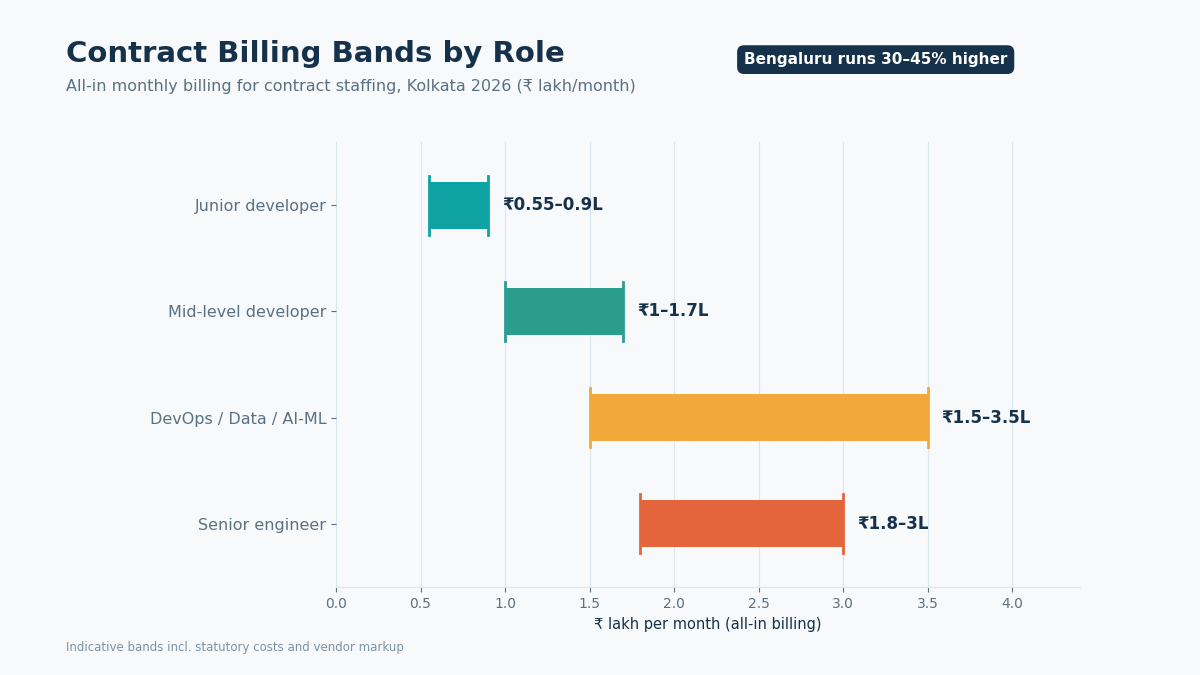
- Junior developer: ₹55,000–90,000/month ($650–1,100)
- Mid-level developer: ₹1.0–1.7L/month ($1,200–2,000)
- Senior engineer: ₹1.8–3.0L/month ($2,100–3,600)
- DevOps / Data / AI-ML specialists: ₹1.5–3.5L/month depending on stack depth
For context, comparable Bengaluru contract billing runs 30–45% higher across every band, the arbitrage that makes hiring developers in Kolkata a CFO conversation, not just a TA one.
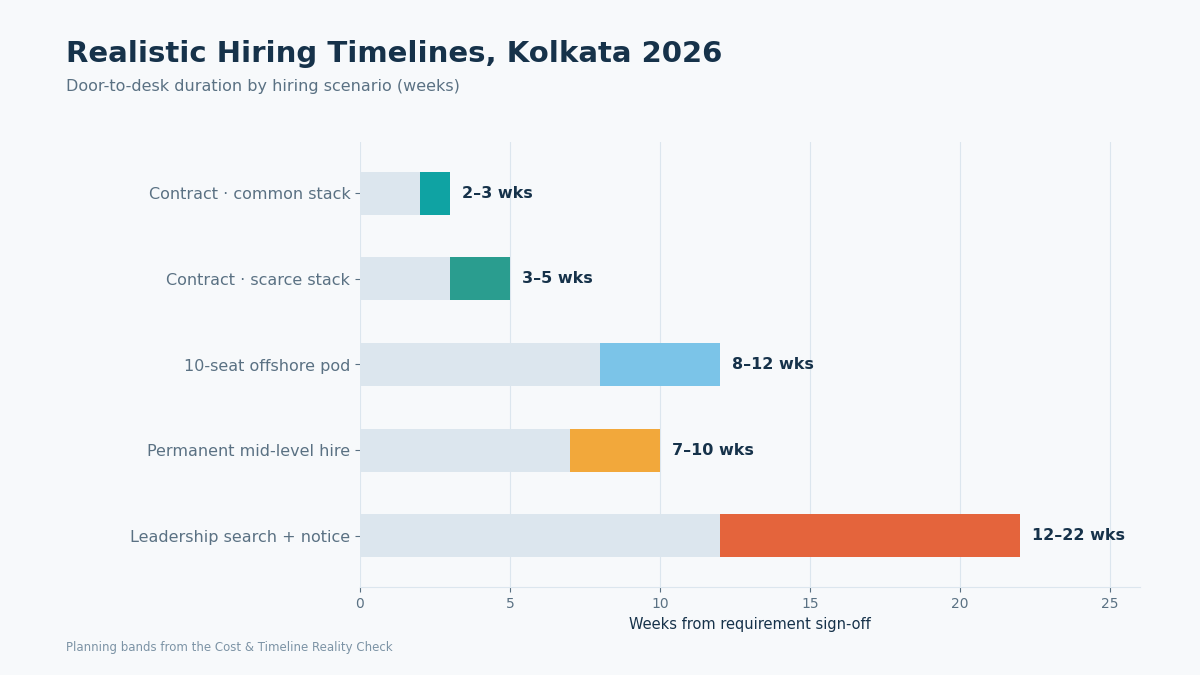
Realistic timelines by scenario:
- Contract engineer, common stack (Java/Node/React/QA): shortlist in 5–10 working days; onboard in 2–3 weeks total
- Contract engineer, scarce stack (Golang, Rust, MLOps, Kafka-heavy data): shortlist in 10–15 working days; 3–5 weeks total
- Permanent mid-level hire: offer in 3–4 weeks; joining +30–60 days (notice period); ~7–10 weeks door to desk
- Leadership search: 6–10 weeks to offer; 60–90 day notice periods common
- 10-seat offshore pod: first 4–5 seats productive in 4–6 weeks; full pod in 8–12 weeks
What pushes costs up: more than 4 must-have skills, sub-15-day joining demands on permanent roles, night-shift overlap requirements beyond 3–4 hours with US time zones, and niche compliance contexts (core banking, healthcare data).
What pulls costs down: batching similar roles, 12-month contract terms, flexibility on 0–30 day notice periods, and clear tech-stack definitions that let vendors reuse vetted pipelines.
Next Step: Turn This Guide Into a Shortlist
If you’ve read this far, you’re likely mid-decision a role open too long, a delivery deadline approaching, or a 2026 plan that includes an eastern-India team. Here’s the lowest-friction way to move:
- Define the brief using Phase 1 above four must-have skills, budget band, engagement model. Twenty minutes.
- Score 2–3 vendors on the 7-point scorecard from the decision framework.
- Ask each for one thing: an interview-ready shortlist timeline, with their funnel numbers and joining-rate data in writing.
If you want to benchmark against a partner that publishes its numbers 98% joining rate, sub-1% contract drop-off, 7–10 working days to shortlist share your requirement and get a scoped hiring plan (roles, timeline, cost band) within 48 hours: https://supersourcing.com/contact-us/
No retainer to see the plan. Bring your hardest role first, that’s the honest test of any staffing partner.
FAQs: IT Staffing Companies in Kolkata
Which are the best IT staffing companies in Kolkata in 2026?
The strongest options by scenario: Supersourcing for vetted tech teams, offshore delivery centers, and joining-rate certainty; TeamLease and Quess Corp for high-volume compliant contract programs; Adecco, Randstad, ManpowerGroup, and Kelly for MNC-standard enterprise hiring; ABC Consultants for leadership search; Ciel HR for responsive mid-market hiring; Sutra HR for early-stage startups.
How much do IT recruitment agencies in Kolkata charge?
Permanent placements typically cost 6–12% of annual CTC (leadership roles up to 16–20%), payable on joining. Contract staffing is billed monthly at the candidate’s cost plus a 15–30% markup covering payroll, PF/ESI, and compliance. RPO engagements combine a monthly retainer of roughly ₹1.5–5 lakh with per-hire fees. Always confirm 18% GST is itemized on invoices.
Is Kolkata cheaper than Bengaluru for hiring developers?
Yes typically 30–45% cheaper on comparable roles. A mid-level full-stack developer at ₹18–24 LPA in Bengaluru generally maps to ₹10–15 LPA in Kolkata, and attrition runs roughly half of tier-1 rates (10–14% vs. 18–25%), which compounds the savings by cutting re-hiring and knowledge-loss costs.
How fast can an IT role be filled in Kolkata?
With a capable staffing partner, common-stack contract roles reach an interview-ready shortlist in 5–10 working days and onboard within 2–3 weeks. Scarce stacks add a week or two. Permanent hires take 7–10 weeks door to desk, mostly consumed by 30–60 day notice periods rather than sourcing.
What is contract-to-hire, and when should I use it?
Contract-to-hire places an engineer on the staffing firm’s payroll for 3–6 months, after which you can absorb them as a permanent employee for a pre-agreed conversion fee (typically 1–2 months of billing). Use it when the role’s permanence is uncertain or when you want real delivery evidence before committing a permanent headcount.
Do Kolkata staffing agencies offer replacement guarantees?
Reputable ones do 30–90 days free replacement on permanent hires, and 7–15 day replacement on contract roles. The differentiator isn’t the promise; it’s the written replacement timeline and whether the vendor holds bench strength to honor it. Get both in the MSA.
Can I set up a full offshore development team or GCC in Kolkata?
Yes, and 2026 is arguably the best window yet: Bengal Silicon Valley land is allotted to 38+ companies, IT-park occupancy across the state exceeds 91%, and seat costs run well below Bengaluru, Pune, or Hyderabad. Above ~10 seats, evaluate a dedicated-team or Global Capability Center model rather than role-by-role staffing; a structured GCC setup partner can handle entity, infrastructure, hiring, and compliance in one program. If you’re weighing this decision, a 30-minute scoping conversation will tell you whether staffing or a GCC structure fits your roadmap better.
What compliance items should I verify before signing with a staffing agency in India?
Five documents: GST registration, PF and ESI registration certificates, professional-tax registration (West Bengal slab applies), Contract Labour Act licence where applicable, and a sample compliant invoice. Add an audit-rights clause in the MSA. A compliant vendor produces all five within a day; hesitation is your answer.
