

A job description that reads “5+ years, data integration, immediate joiner” sounds like a two-week fill. For roles like Ab Initio or ForgeRock, that same description routinely sits open for four to six months. The gap between how a role looks on paper and how it behaves in a live pipeline is where most hiring plans quietly break.
This is the central trap in niche tech skills India hiring: the requirement is legible, the title is familiar, and the salary band looks reasonable so leadership assumes supply exists. It usually doesn’t. India produces an enormous volume of generalist engineers, but the specialists who keep enterprise systems running are a fraction of a fraction of that number, and they are rarely on the open market.
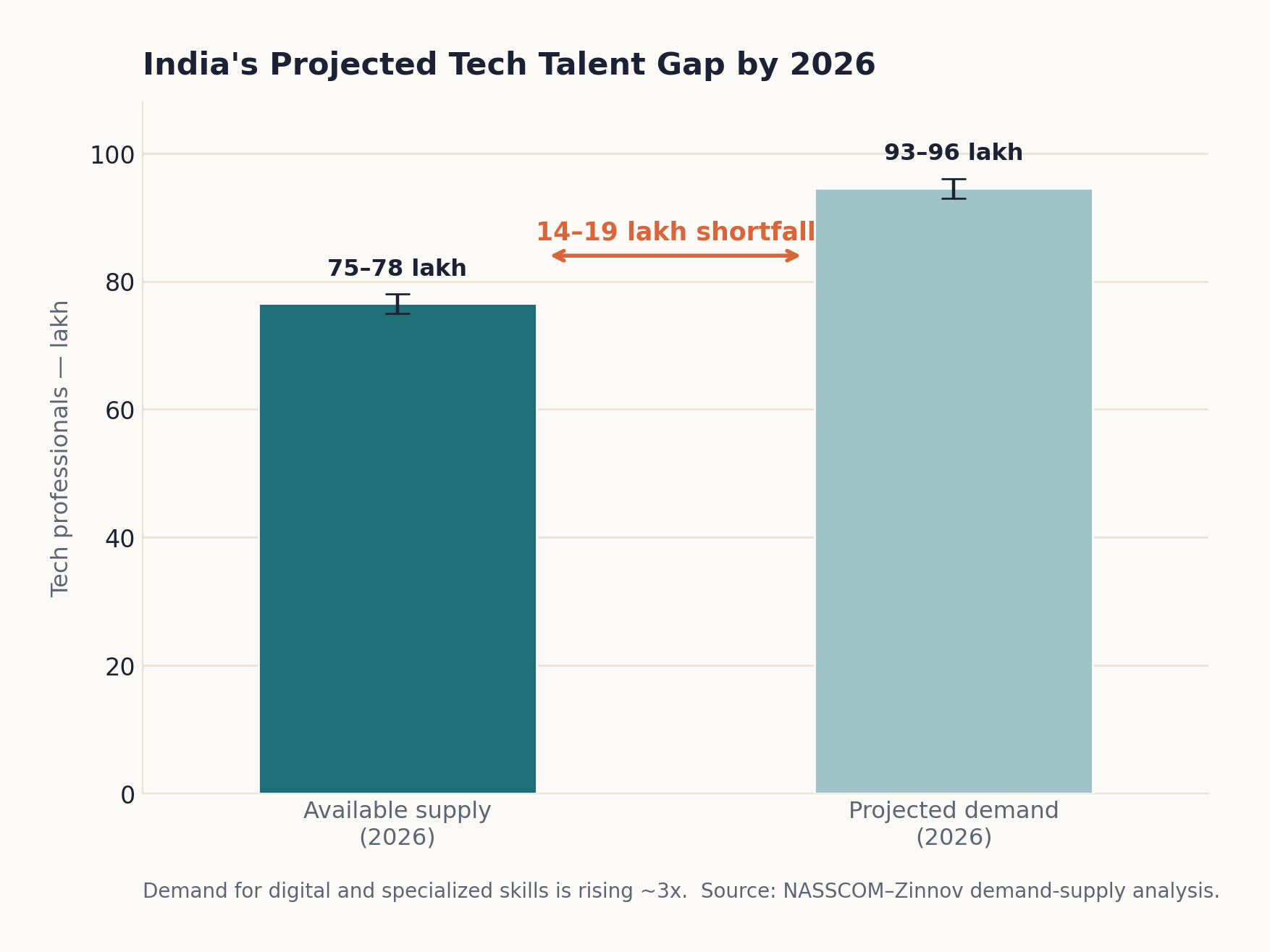
India is projected to face a shortfall of 14–19 lakh tech professionals by 2026, with demand for digital and specialized skills rising roughly 3x over the period, according to the NASSCOM–Zinnov demand-supply analysis.
That headline number hides a sharper reality. The shortage is not evenly spread. A company can fill ten React or Java seats in the time it takes to find one engineer who has genuinely shipped on a proprietary platform like Incorta or Oracle EPM. The roles below are not exoticthey run payroll, identity, analytics, and customer support for some of the largest firms in the country but each one has a talent pool measured in hundreds, not lakhs.
The pattern repeats across every name on this list. The skill looks adjacent to something common, so hiring managers benchmark it against the common thing. Then the timeline triples, the offer gets rejected twice, and the project slips a quarter. Understanding why these ten roles resist normal recruiting is the first step to filling them on a realistic schedule.
What Niche Tech Hiring Actually Means
Niche tech hiring is the process of sourcing engineers for proprietary, specialized, or low-supply technologies/platforms where formal training is scarce, the skill is learned mostly on live projects, and the qualified candidate pool numbers in the hundreds rather than the lakhs. These roles carry long time-to-fill cycles and premium compensation because supply cannot be manufactured quickly.
That definition matters because it separates “senior” from “scarce.” A senior backend engineer is expensive but abundant. A specialist is something else entirely: the constraint isn’t seniority or cost, it’s that very few people on earth have done the work at all.
The Core Problem: Supply That Can’t Be Scaled on Demand
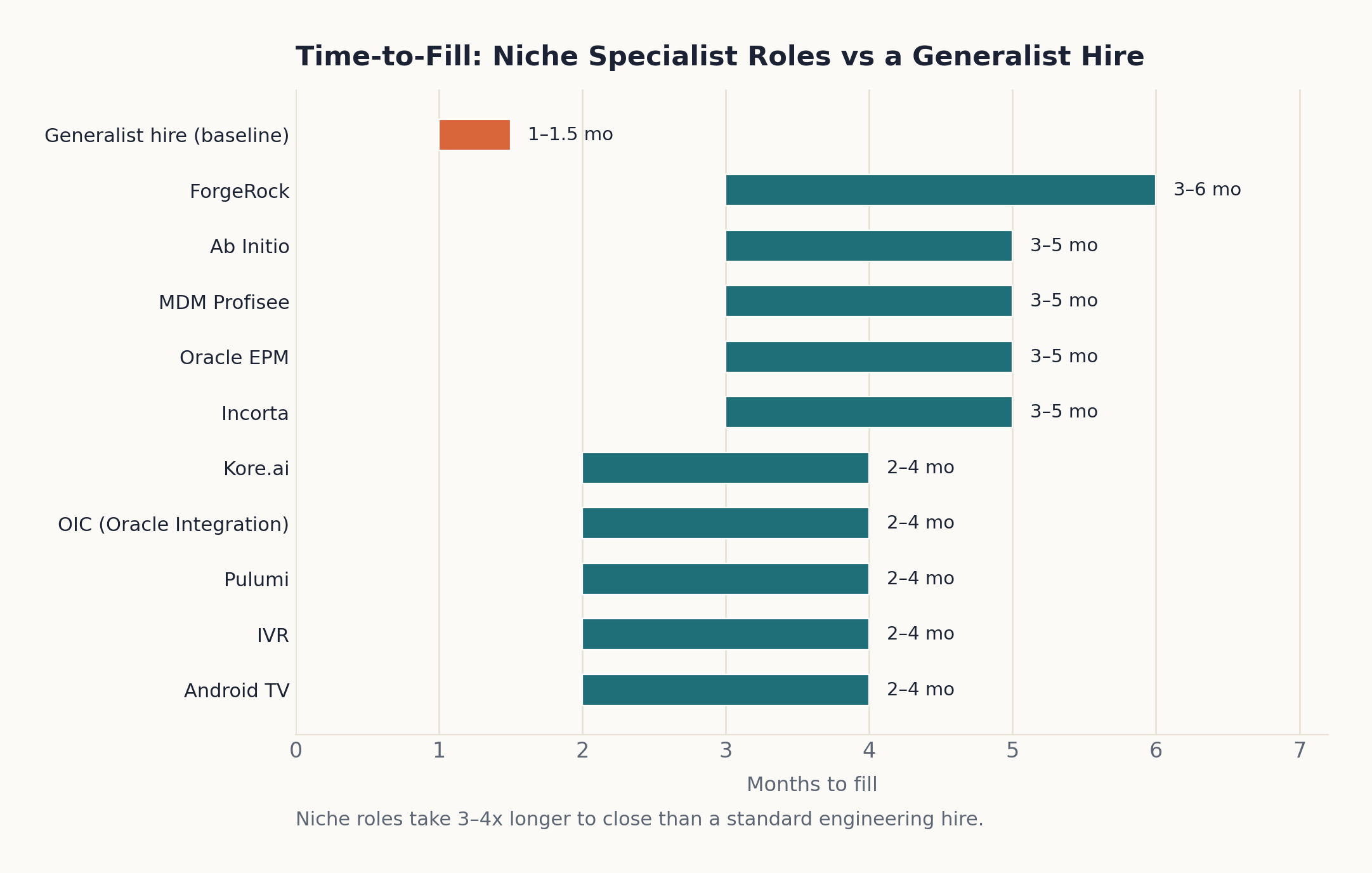
Most teams plan specialist tech hiring in India as if it follows the same curve as generalist hiring post the role, screen a funnel, close in 30–45 days. For the roles in this article, that assumption is wrong by a factor of three to four.
The mechanics are different. Generalist supply is fed by lakhs of fresh graduates and bootcamp output every year. Niche supply is fed almost entirely by the small number of firms already running that technology, which means the pool grows only as fast as those firms hire and train often a few hundred new practitioners a year nationwide.
Three structural forces compound the problem. First, no public training pipeline: you cannot self-learn most enterprise platforms on YouTube because the software is licensed and runs only inside paying customers. Second, counter-offer gravity: specialists are mission-critical to their current employer, who fights hard to retain them. Third, resume invisibility: the best people aren’t applying anywhere, so inbound sourcing returns almost nothing.
The financial cost of getting this wrong is rarely a line item, which is why it goes unmanaged. A delayed integration go-live, a stalled identity migration, or an analytics platform that ships two quarters late can quietly cost more than the entire annual salary of the person who would have prevented it. The roles below show exactly where these delays originate.
There’s a timing trap, too. Because the India IT talent shortage is loudest in headline categories like AI and cloud, leaders assume the niche platform roles are easier by comparisonplenty of supply, just less hype. The opposite is true. A scarce AI skill at least has thousands of people actively training into it; a proprietary enterprise platform has a fixed pool that barely grows year over year. The quiet roles are often the harder ones, and they’re the ones that hold up production systems.
The 10 Roles That Look Easy to Fill But Aren’t
What unites the following list of hard to hire tech roles India teams chronically underestimate is a single optical illusion: each skill sits next to something common. Ab Initio looks like “just ETL.” Pulumi looks like “just DevOps.” Android TV looks like “just Android.” That adjacency is exactly what makes the hiring plan fail.
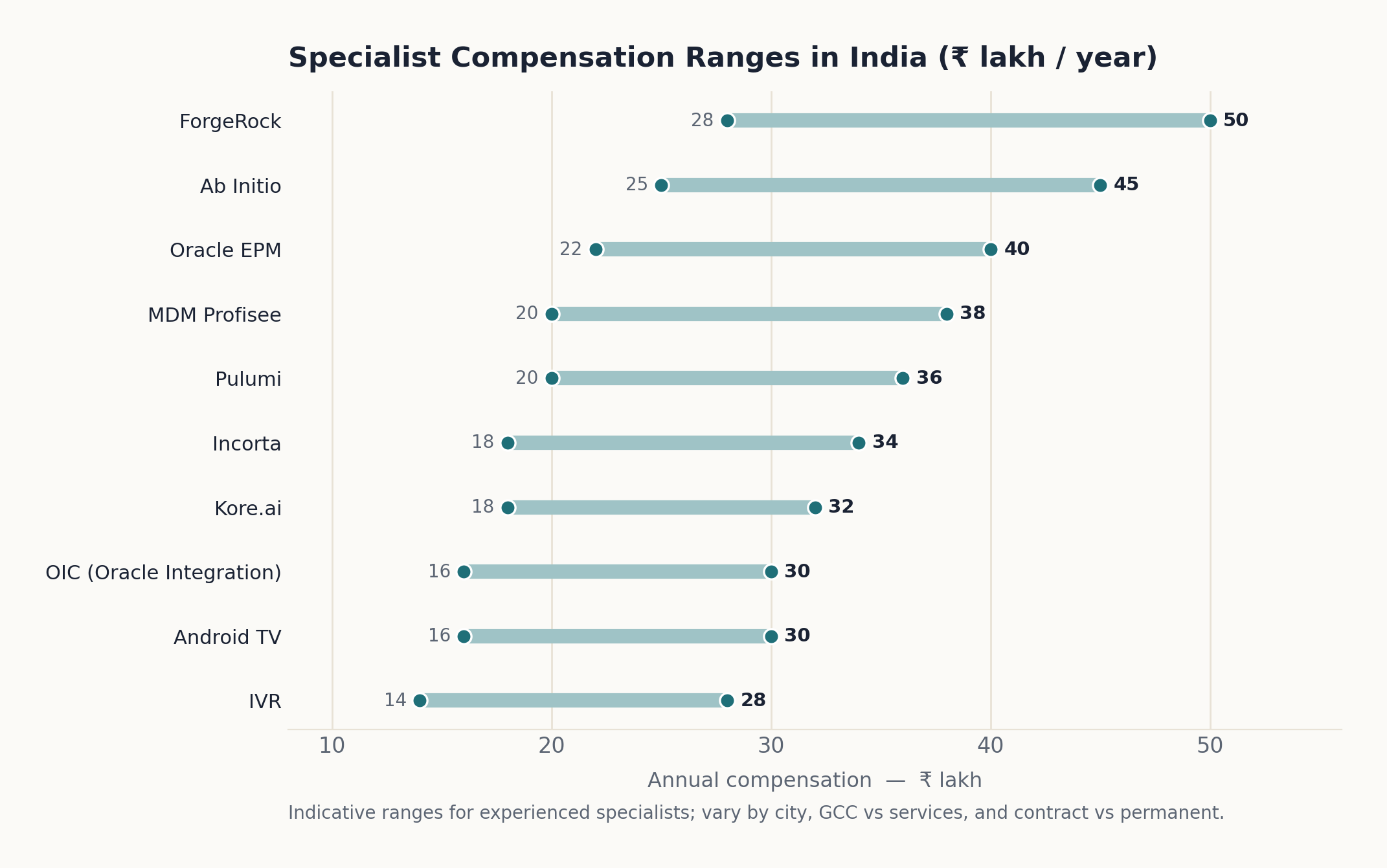
Below, each role includes what it is, why it looks easy, why it actually isn’t, and the realistic market picture for talent pool depth, time-to-fill, and compensation. Salary figures are indicative ranges for experienced specialists and vary by city, GCC vs. services, and contract vs. permanent.
1. Ab Initio Why Is It So Hard to Hire Ab Initio Developers in India?
Ab Initio is a high-performance ETL and data integration platform used by large banks, telecoms, and insurers for mission-critical batch processing. It looks like any other data-pipeline tool on a JD.
It isn’t, because Ab Initio sells no public licenses, runs no open certification, and provides no training to non-customers. You can only learn it by working at a company that already owns it. That single fact caps the talent pool at a few thousand people in India, most of them locked into long tenures at a handful of large enterprises.
Realistic picture: time-to-fill of 3–5 months for a genuine senior, with compensation typically in the ₹25–45 lakh range. Candidates who merely “attended a session” rarely survive a hands-on screen.
2. Kore.ai The Conversational AI Specialist Shortage
Koreai is an enterprise conversational AI platform for building virtual assistants and voice bots, widely adopted in banking and customer service. Because every team now wants a chatbot, leaders assume the talent is everywhere.
The reality is that building a production-grade assistant on Korean dialog design, NLU tuning, channel integration, and fallback handling is a distinct discipline that very few engineers have shipped end to end. Generic “chatbot developers” cannot operate the platform at depth.
Expect 2–4 months to fill and compensation around ₹18–32 lakh for someone who has launched live assistants, not just prototypes.
3. OIC (Oracle Integration Cloud) Enterprise Integration That Bites Back
OIC is Oracle’s iPaaS for connecting Fusion applications, on-prem systems, and third-party SaaScore to any large Oracle estate. On paper it reads like generic integration work.
In practice, effective OIC delivery requires layered knowledge of Oracle Fusion, SOA heritage, adapters, and error-handling patterns that generalist integration engineers don’t carry. The enterprise integration context is what’s scarce, not the tool’s syntax.
Time-to-fill runs 2–4 months, with pay typically ₹16–30 lakh depending on Fusion depth.
4. MDM Profisee Master Data Management’s Hidden Bottleneck
MDM Profisee is a master data management platform built on the Microsoft data stack, used to create a single trusted version of customer, product, or vendor data. “Data quality work” sounds staffable.
It rarely is. Profisee combines data modeling, matching/survivorship logic, and SQL Server-level depth, and the certified-consultant community in India is genuinely small, often a few hundred people who have run real implementations.
Plan for 3–5 months and ₹20–38 lakh for an implementation-grade specialist.
5. ForgeRock Identity Is a Specialism, Not a Feature
ForgeRock (now part of Ping Identity) is an enterprise identity and access management platform handling authentication, authorization, and customer IAM at scale. Security teams assume any IAM engineer can run it.
They can’t. ForgeRock involves AM, IDM, DS, and directory architecture, plus security-critical configuration where mistakes are expensive and public. The pool of engineers who have deployed it in production is among the thinnest on this list.
Realistic: 3–6 months to fill, compensation ₹28–50 lakh, and counter-offers are aggressive.
6. Oracle EPM Where Finance Meets Engineering
Oracle EPM (Enterprise Performance Management, the Hyperion lineagePBCS, FCCS, ARCS) powers planning, consolidation, and closure for finance functions. It’s mislabeled as “an Oracle reporting role.”
The difficulty is the hybrid: a strong EPM consultant understands both financial processes (budgeting, consolidation, account reconciliation) and the technical platform. People fluent in both are rare, and finance-critical timelines make a bad hire costly.
Time-to-fill 3–5 months; compensation ₹22–40 lakh.
7. Pulumi The Infrastructure-as-Code Trap
Pulumi is an infrastructure as code tool that defines cloud infrastructure using general-purpose languages like TypeScript, Python, and Gounlike Terraform’s domain-specific language. The JD says “IaC,” so recruiters source Terraform engineers.
The mismatch is real. Pulumi expects genuine software-engineering practice applied to infrastructure (testing, abstractions, package design), and the cohort that has run it in production is far smaller than the Terraform world. Adjacent does not mean transferable on day one.
Expect 2–4 months and ₹20–36 lakh, with strong overlap onto general DevOps comp.
8. IVR The Shrinking-Pool Problem
IVR (Interactive Voice Response) covers telephony platformsGenesys, Avaya, Cisco, VoiceXMLthat route and automate inbound calls for contact centers. It looks like legacy, easily filled work.
The twist is the opposite of the others: the pool isn’t just small, it’s shrinking, as experienced engineers retire or move to cloud contact-center stacks and few newcomers enter. Scarcity through attrition is as binding as scarcity through novelty.
Time-to-fill 2–4 months; compensation ₹14–28 lakh, higher for Genesys cloud migration experience.
9. Incorta Analytics Without the ETL Detour
Incorta is a unified data and analytics platform that maps source data directly for query without traditional ETLpopular for Oracle ERP analytics. “It’s a BI tool” is a common misread.
Incorta’s direct-data-mapping model is architecturally unusual, the ecosystem is small, and practitioners who understand both the platform and the ERP data behind it are scarce. Generic BI developers stall on the modeling layer.
Realistic: 3–5 months, compensation ₹18–34 lakh.
10. Android TV Not the Same as Android
Android TV development targets the 10-foot UI, Leanback components, remote-control navigation, and media playback on TV hardware. Hiring managers assume any Android developer qualifies.
Mobile Android skills transfer only partially. TV apps demand different UX patterns, focus handling, performance constraints on low-power TV chips, and media-pipeline knowledge that mobile work never exercises. The specialist pool is small because few products need it.
Expect 2–4 months and ₹16–30 lakh for shipped TV-app experience.
A Repeatable Way to Source These Roles
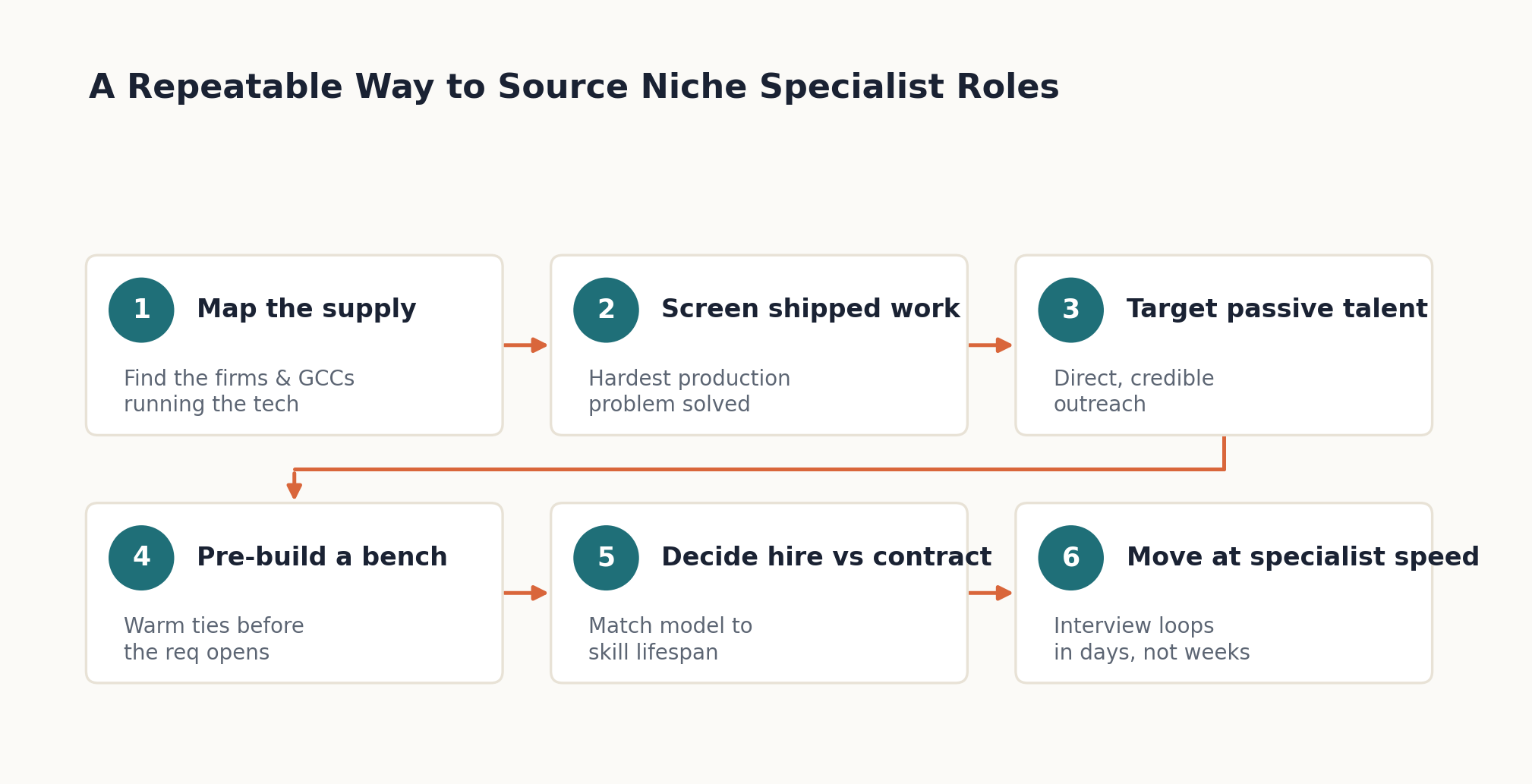
When inbound sourcing returns nothing, the process has to change. The following sequence is what consistently works for rare developer skills India teams struggle to surface:
- Map the supply, not the demand. Identify the specific companies and GCCs that actually run the technology; the talent lives there, not on job boards.
- Screen for shipped work, not keywords. Ask for the hardest production problem they solved on the platform prototypes and “exposure” fails here.
- Target passive candidates directly. The best specialists are employed and not applying; outreach must be personal and credible.
- Pre-build a bench. Maintain warm relationships with specialists before the requisition opens, so the search starts at week zero, not week one.
- Decide hire-vs-contract early. For one-time migrations, a contract specialist often beats a 5-month permanent search.
- Move at specialist speed. Compress interview loops to days; slow processes lose scarce candidates to counter-offers.
Case Studies: What the Delay Actually Costs
A mid-sized fintech needed a single ForgeRock specialist for a customer-identity migration tied to a regulatory deadline. After three months of internal recruiting returned no viable candidate, a targeted specialist search placed an engineer in under five weeks; the migration shipped on schedule, avoiding a compliance penalty that dwarfed the salary.
In a second case, an analytics team treated an Incorta opening as a standard BI hire and screened generalist candidates for two months with no closes. Reframing it as a specialist searchsourcing only practitioners with production Incorta and Oracle ERP exposure filled the seat in six weeks and recovered a slipping reporting roadmap. The lesson in both: the role wasn’t unfillable, it was misclassified.
A third pattern shows up constantly in niche tech skills India hiring engagements: a role that looks like a single hire is actually a sequence. A global capability center opening an Oracle EPM seat often discovers, halfway through, that it also needs OIC integration support and an MDM layer, three scarce skills, three separate pools, one deadline. Treated as one generalist requisition, it stalls indefinitely. Mapped as three parallel specialist searches from the start, the same scope closes in roughly the time a single permanent search would have taken. Sequencing the supply problem correctly is often worth more than the budget allocated to it.
How to Decide: Hire, Train, or Contract
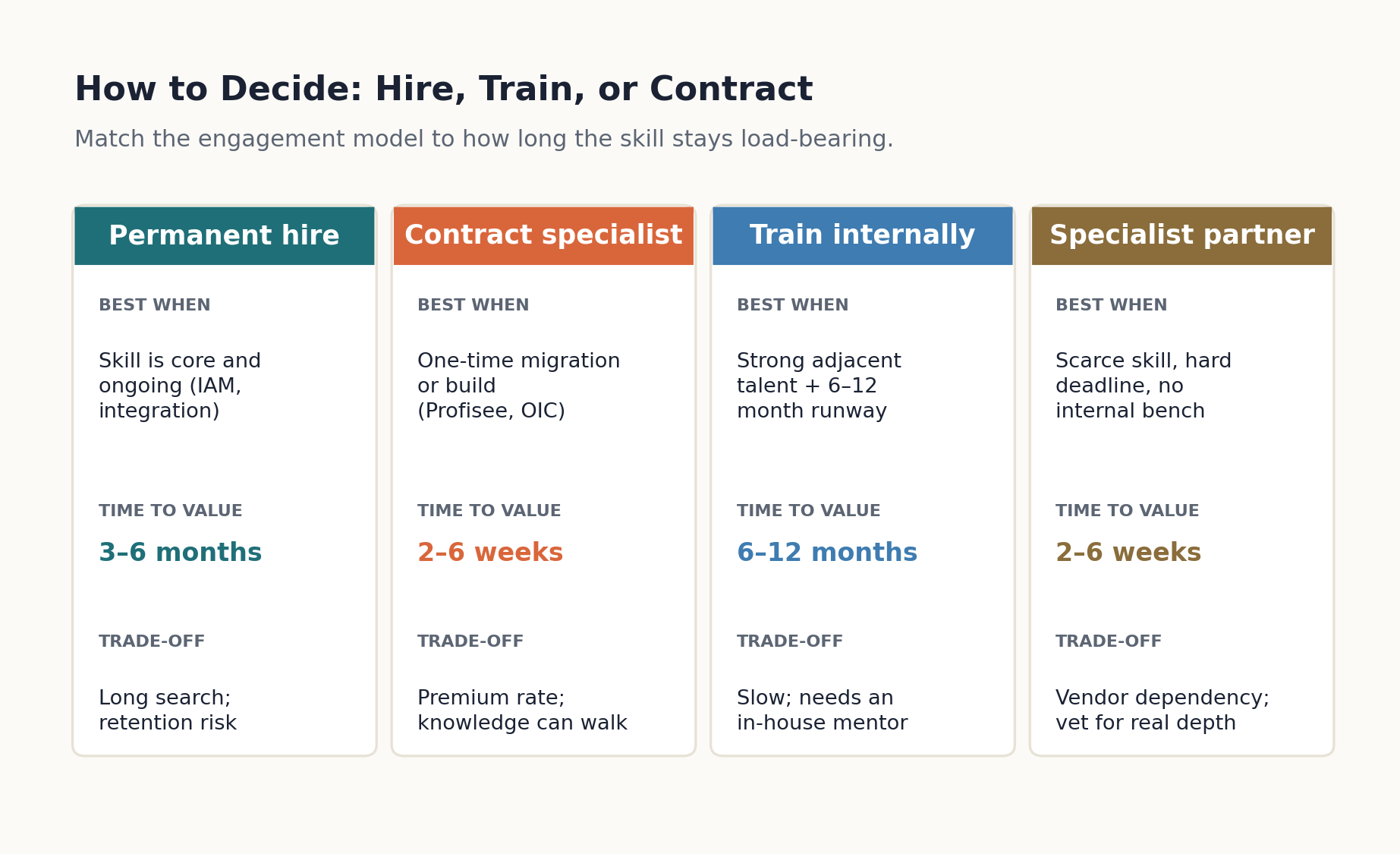
Not every niche requirement should become a permanent hire. The right path depends on how long you’ll need the skill and how fast you need it to live. This framework covers the specialized tech talent India decision most teams face.
| Approach | Best when | Time to value | Trade-off |
| Permanent hire | Skill is core and ongoing (IAM, integration) | 3–6 months | Long search; high retention risk |
| Contract specialist | One-time migration or build (Profisee, OIC) | 2–6 weeks | Premium day rate; knowledge can walk |
| Train internally | Strong adjacent talent + 6–12 month runway | 6–12 months | Slow; needs a mentor who already knows it |
| Specialist partner | Scarce skill, hard deadline, no internal bench | 2–6 weeks | Vendor dependency; vet for real depth |
The fastest expensive mistake is defaulting to “permanent hire” for a skill you’ll need for ten weeks. The slowest expensive mistake is “we’ll train someone” with no in-house expert to learn from.
A useful test: ask how the skill behaves after the current project ends. If it stays load-bearing identity, integration, master data owns it permanently and invests in retention. If it spikes for a migration and then goes quiet, rent it. Most teams get this backwards, hiring permanently for short-lived needs and improvising for the skills they’ll depend on for years. Matching the engagement model to the skill’s lifespan saves more money and time than negotiating the rate ever will.
What Most Teams Get Wrong
The single most common error in niche tech skills India hiring is benchmarking the role against its nearest familiar neighbor. Pulumi gets priced and timed like Terraform. Android TV gets sourced like mobile Android. Ab Initio gets treated like Informatica. Every one of those comparisons sets the plan up to miss by a quarter.
The second error is believing the funnel exists. With generalist roles, a stalled search means the JD or the comp is off. With these roles, a stalled search usually means the search method is wrong; you’re fishing in a pond with no fish. No amount of reposting fixes a supply problem.
The third, and most expensive, is treating these requisitions as low-priority because the title sounds routine. The org sees “Android developer” or “integration engineer” and assigns it a generalist’s urgency. Meanwhile a release date depends on it. The teams that win at rare developer skills India flip this: they treat scarcity, not seniority, as the signal for how aggressively to staff a search.
One contrarian note worth holding onto: a higher salary band rarely solves a scarcity problem on its own. If only a few hundred people in the country can do the work, the constraint is reach and speed, not budget. Paying more without changing the sourcing method just means waiting longer to overpay.
There’s a final blind spot around retention. Teams pour months into closing a scarce specialist, then manage them like any other engineer and lose them inside a year to a competitor who understands their leverage. For these roles, retention is part of the hiring cost, not a separate problem. The same forces that made the person hard to find make them easy for someone else to poach. Planning the offer, the growth path, and the counter-offer response before the search closes is what turns a hard-won hire into a durable one.
FAQ
Why are some tech roles so much harder to fill than others?
Difficulty tracks supply, not seniority or salary. Roles built on proprietary or low-adoption platforms have tiny talent pools because the skill can only be learned on live projects inside paying customers. There’s no public training pipeline feeding new practitioners, so the pool grows slowly and most qualified people are already employed and not job-hunting.
What are the most in-demand niche tech skills in India right now?
Across enterprise estates, the persistently scarce skills include data integration platforms like Ab Initio and Incorta, identity systems like ForgeRock, master data management on Profisee, Oracle’s OIC and EPM, conversational AI on Kore.ai, infrastructure-as-code with Pulumi, and specialized delivery skills like IVR telephony and Android TV. All combine small pools with high business criticality.
How long does it take to hire niche tech talent in India?
Realistically, 3–6 months for the scarcest permanent roles is roughly three to four times longer than a generalist hire. Time-to-fill is driven by how few qualified people exist and how hard their current employers fight to keep them, not by how attractive your offer is. A targeted specialist search can compress this to weeks.
How much do specialist developers cost in India?
Experienced specialists in these roles typically command ₹14–50 lakh depending on the technology, depth of production experience, and whether the hire is permanent or contract. The premium reflects scarcity and business criticality, not just seniority. Contract day rates for one-time migrations run higher pro-rata but avoid a long permanent search.
Should you hire, train, or outsource niche tech skills?
Use a permanent hire for core, ongoing skills; a contract specialist for one-time builds or migrations; internal training only when you have strong adjacent talent, a 6–12 month runway, and an in-house expert to mentor. When the skill is scarce and the deadline is fixed, a specialist partner with a pre-vetted bench is usually fastest.
Are niche skills worth the premium they command?
Almost always, when the role sits on a critical path. A delayed identity migration, a missed compliance deadline, or an analytics platform that ships two quarters late typically costs far more than the salary premium. The risk isn’t overpaying for a specialist, it’s under-resourcing a search and discovering the cost of the gap later.
What’s the best way to source rare tech skills in India?
Stop relying on inbound applications. Map the specific companies running the technology, target passive specialists with credible direct outreach, screen for shipped production work rather than keywords, and move through interviews in days, not weeks. If no internal bench exists and the deadline is hard, a specialist sourcing partner shortens the path considerably.
Before You Open the Requisition
If you’re staffing any of these ten roles, the highest-leverage move is to reclassify them before the search begins/scarcity-first, not title-first so the timeline, comp, and sourcing method match reality from day one. The teams that do this fill specialist seats in weeks; the teams that don’t spend a quarter learning the pool were never there.
Treat the requisition the way you’d treat the project it supports. Get clear on whether the skill is load-bearing or one-time, decide hire-vs-contract on that basis, map the real supply before you write the JD, and move at specialist speed once a candidate surfaces. Those four decisions made in the first week rather than the second month are what separate a six-week fill from a six-month stall. None of them require a bigger budget; they require classifying the role honestly from the outset.
Supersourcing has placed talent in all 10 of these roles. If you’re pressure-testing a niche hiring plan or watching a requisition stall past the 60-day mark it’s worth a short conversation to map the real supply before you commit to a vendor or a long internal search. A useful starting point is a single role you’re struggling with right now: bring the JD, the timeline, and where the search currently stands, and the supply picture usually becomes clear quickly.
You can see how the team approaches specialist sourcing at supersourcing.com, or reach Mayank directly at mayank@engineerbabu.com to walk through which approach fits the specific skill you’re chasing, no pitch, just a read on whether the role is fillable on your timeline and how.
