

Most teams that search to hire dedicated android developers don’t actually know what “dedicated” is supposed to buy them. They assume it means a good developer. It doesn’t. It means a specific contractual and operational arrangement and the gap between that arrangement and a freelance gig is where projects either ship on schedule or quietly stall for months.
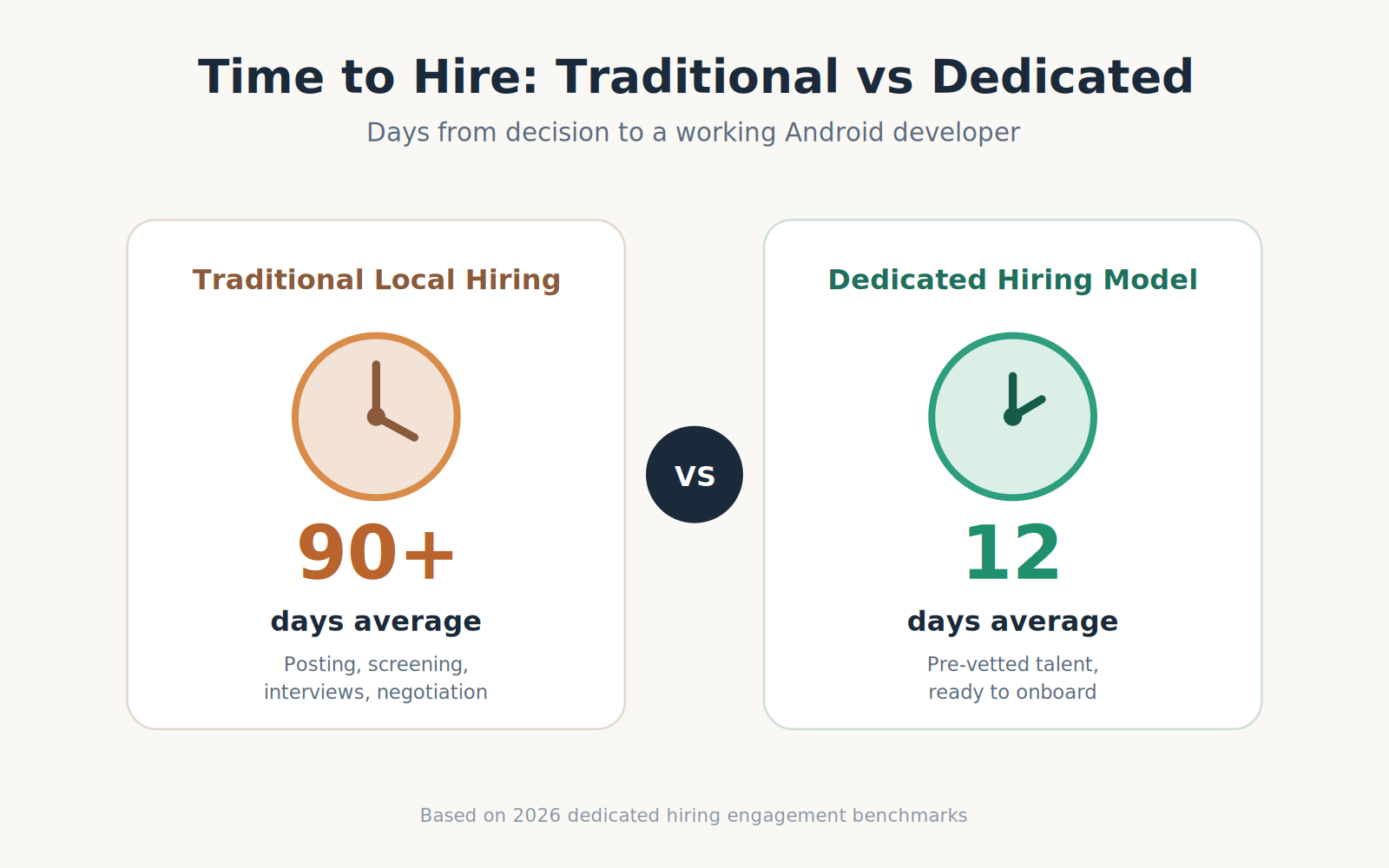
A senior Android developer in the US now costs $45–$82 an hour, and average time-to-hire for a senior engineer has stretched to over 90 days in 2026, up from roughly 52 days two years earlier. That single number explains why so many product teams are shifting from local, full-time hiring toward dedicated offshore or nearshore models instead of waiting out a broken pipeline.
The U.S. The Bureau of Labor Statistics projects software developer employment to grow 15% between 2024 and 2034 nearly five times faster than the average occupation with roughly 129,200 openings projected each year.
That growth curve is exactly why “dedicated” has become a loaded word. Vendors use it loosely, clients assume it automatically, and the actual difference in output between a dedicated hire and a shared-bandwidth freelancer can run into months of delay on a real product roadmap. This piece breaks down what the term is contractually supposed to mean, what it costs, where it goes wrong, and how to evaluate it before you sign anything.
What Does “Dedicated” Mean When You Hire Android Developers?
Hire dedicated android developers means engaging a developer (or team) who works exclusively on your project for agreed hours, reports into your workflow and tools, and carries no other client workload during that engagement. It differs from freelance or marketplace hiring, where the same developer splits attention across multiple unrelated projects at once.
That 40-60 word definition is the whole concept in miniature. Everything past this point is about the mechanics, pricing, process, and where teams get it wrong when they assume “dedicated” is a marketing label rather than an operational commitment.
The Core Problem: Shared Bandwidth Costs More Than It Looks Like It Saves
Most teams underestimate the true cost of a shared-bandwidth developer by 3–4x. A freelancer billing $25/hour looks cheaper on a rate card than a dedicated developer at $35–$45/hour. But the freelancer is usually running two to four other contracts simultaneously, which means your sprint gets whatever hours are left over after their other clients’ deadlines are handled.
The real cost shows up as calendar time, not invoice totals. A feature that should take 3–4 weeks with a fully dedicated Android developer often stretches to 8–10 weeks with a split-attention freelancer, because context-switching between codebases, Gradle configurations, and unrelated client requirements eats 20–30% of usable focus time, according to widely cited context-switching research in software engineering teams.
There’s a second, quieter problem: continuity. Freelance marketplaces have high churn. A developer who built your onboarding flow in March may not be available in June. With dedicated Android developers, the same person (or a small, stable pod) owns the codebase from architecture through App Store submission, which matters enormously for apps with active Play Store compliance requirements, Jetpack Compose migrations, or ongoing Kotlin Multiplatform (KMP) adoption.
Three things typically go wrong before teams even get to the technical evaluation stage:
- The job requirement bundles two or three distinct skill sets (Compose UI, native performance tuning, backend integration) into one posting no single hire can realistically cover.
- Budget expectations are set against last year’s rate card, not 2026 senior Android compensation.
- There’s no clarity on whether the engagement needs a dedicated Android team (multiple roles) or a single dedicated developer which changes both cost and timeline dramatically.
The Dedicated Hiring Model, Explained
This is the section worth reading twice if you’re comparing vendors. The dedicated developer model is not just “we’ll assign someone full-time.” It’s a specific structure with defined inputs on cost, process, and technology decisions.
How the Dedicated Model Actually Works
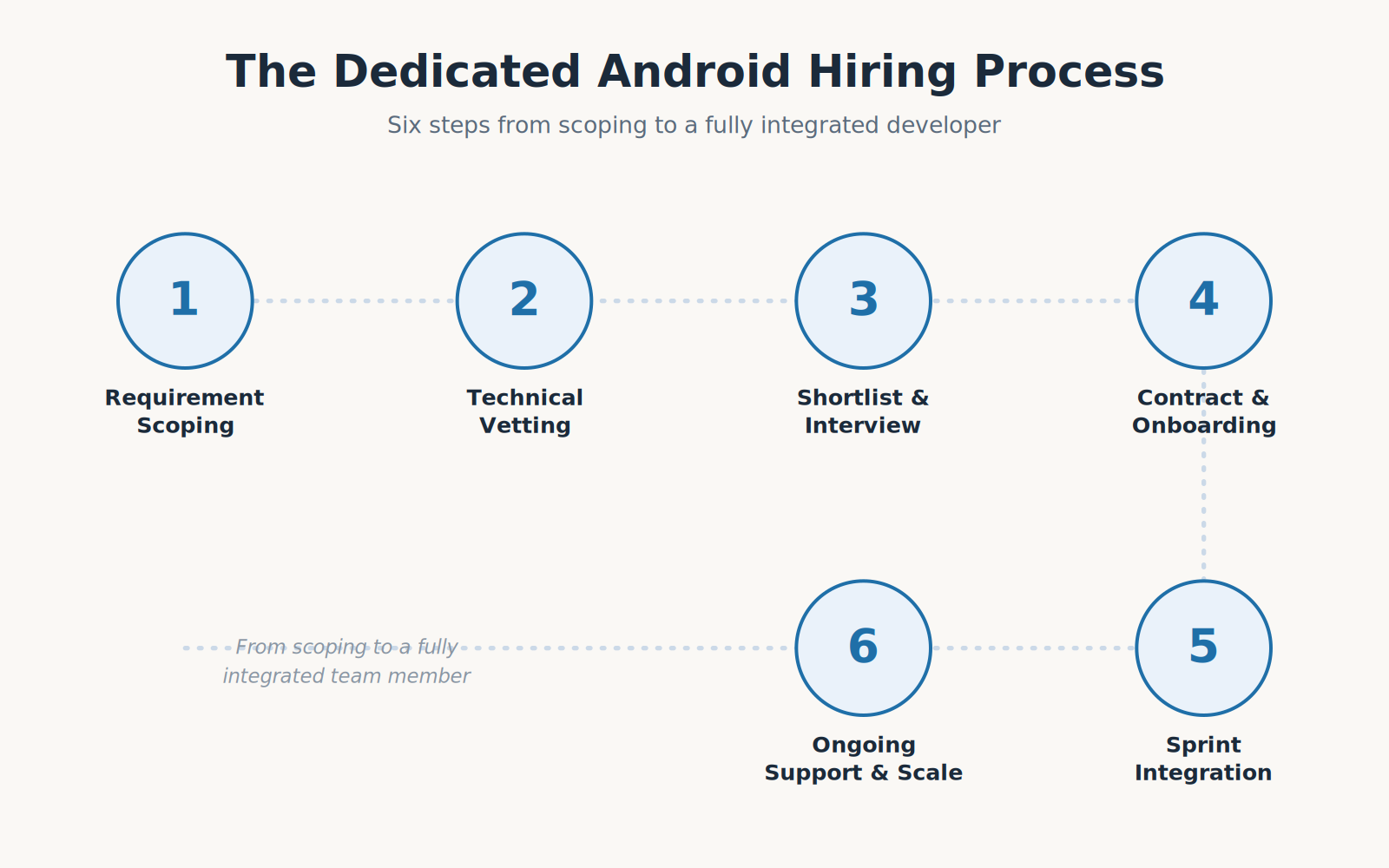
A dedicated hiring engagement typically follows this sequence:
- Requirement scoping the vendor maps your product stage (MVP, scale-up, enterprise) against required skills (Kotlin, Jetpack Compose, Room, Retrofit, CI/CD pipelines).
- Technical vetting candidates are screened against real shipped-app criteria, not resume keywords. This typically includes a live coding round and a code-review exercise against production-style code.
- Shortlist and interview you interview 2–4 pre-vetted candidates directly, the same way you would an in-house hire.
- Contract and onboarding a dedicated hire signs an exclusivity clause for your engagement hours, gets added to your Slack/Jira/GitHub, and attends your standups.
- Sprint integration the developer works inside your existing sprint cadence, not a separate vendor-managed process.
- Ongoing support and scaling you can add a second or third dedicated developer to the same pod without re-running the entire hiring cycle.
Architecture and Technology Decisions That Change the Cost Equation
Whether you need a Kotlin-first native build, a Kotlin Multiplatform setup sharing logic with iOS, or a Jetpack Compose rebuild of a legacy XML-based UI changes both the seniority level required and the hourly rate. Native Android work demanding deep hardware access or platform-specific performance tuning requires senior talent in the $45–$82/hour range domestically, or $25–$45/hour for equivalent seniority through nearshore or offshore dedicated hiring.
Compliance considerations also shift cost. Apps handling health data, financial transactions, or children’s content need developers experienced with Play Console policy requirements and data-handling audits; this typically adds 10–15% to the standard dedicated hiring cost due to the narrower talent pool.
Native vs Cross-Platform: A Decision That Comes Before Hiring
Before scoping a dedicated hire, decide whether the product actually needs native Android development. Go native when performance, deep hardware access, background processing, or platform-specific polish drives the user experience camera-heavy apps, offline-first tools, or anything leaning on Bluetooth or sensor APIs. Cross-platform frameworks earn their place when the app is mostly forms and screens shared across Android and iOS on a tight budget.
Kotlin Multiplatform (KMP) has become the middle path many teams choose in 2026 sharing business logic across platforms while keeping a fully native UI on each side. This decision changes what “dedicated” should mean for your hire: a KMP engagement often needs one dedicated Android developer working alongside an existing iOS developer rather than two fully separate native teams, which changes both the headcount and the total cost of the engagement.
Integration and Tooling Considerations
A dedicated developer should slot into your existing CI/CD pipeline, not build a parallel one. Before onboarding, confirm the vendor’s developers are fluent in your specific toolchain Gradle version management, Firebase or custom backend integration, and your existing crash-reporting and analytics stack. Mismatched tooling assumptions are a common source of the “ramp-up delay” that later gets blamed on the developer rather than the onboarding process itself.
Cost to Hire Dedicated Android Developers
A realistic 2026 range for a dedicated Android developer, depending on region and seniority:
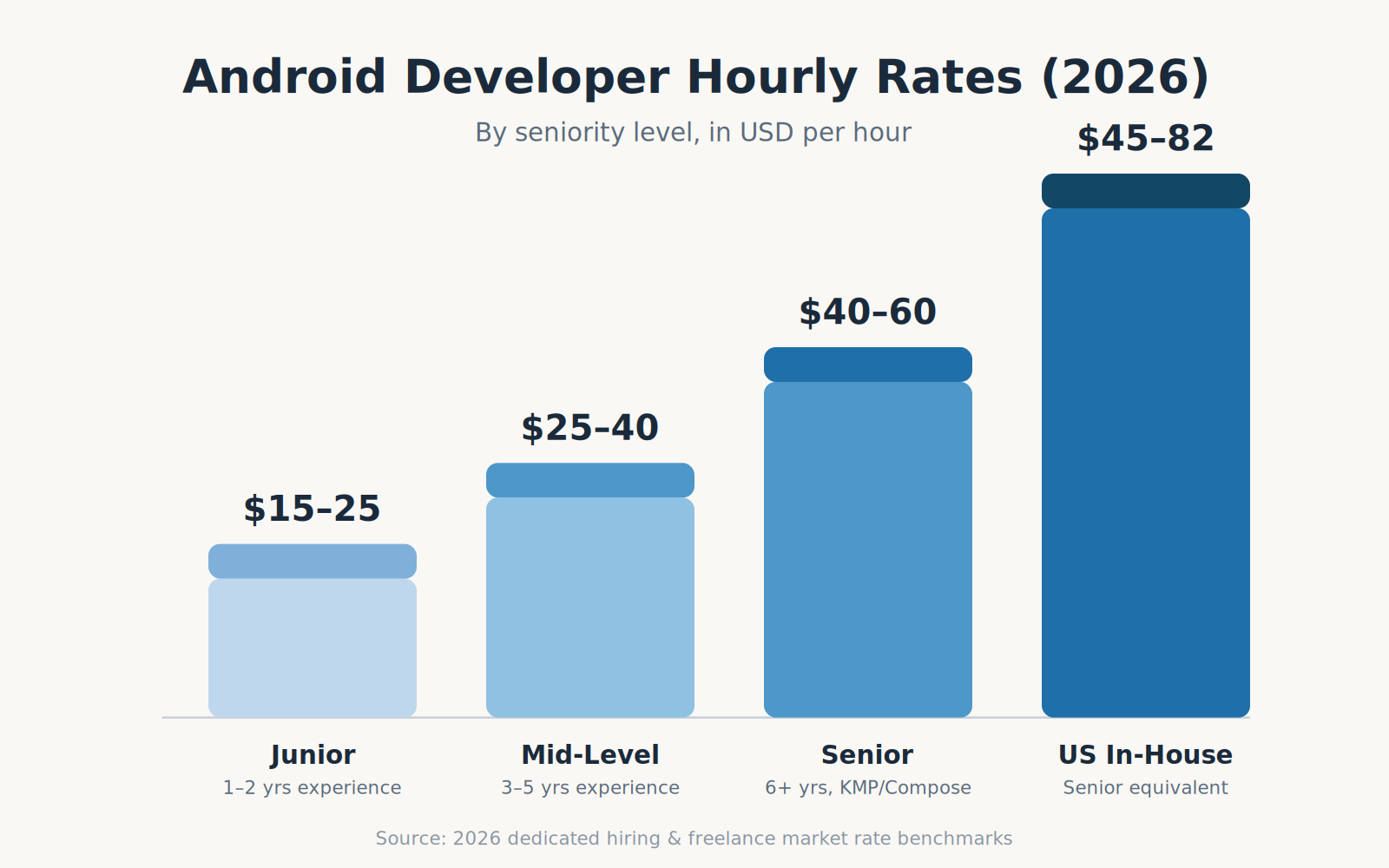
- Junior (1–2 years): $15–$25/hour
- Mid-level (3–5 years): $25–$40/hour
- Senior (6+ years, KMP/Compose expertise): $40–$60/hour
- US-based senior (in-house equivalent): $45–$82/hour
For a mid-size project needing one senior developer for six months, that puts total engagement cost in the ₹18–32 lakh range through an offshore hiring model, versus significantly higher for an equivalent US-based full-time hire once benefits and overhead are added.
Real-World Application: Two Engagement Patterns
A fintech app team needed to migrate a legacy XML-based UI to Jetpack Compose while continuing feature work. A single freelancer had been assigned the migration for four months with minimal progress, largely because the same freelancer was splitting time across two other unrelated contracts. Moving to a dedicated Android developer working full-time inside the existing sprint cycle closed the migration in 9 weeks, with the same developer then absorbing ongoing feature requests without a handoff gap or repeated onboarding cost.
A healthcare scheduling app needed Play Console compliance work alongside a KMP adoption to share logic with an iOS build already in progress. A two-person dedicated pod (one senior Android developer, one QA engineer) was onboarded in 12 days and delivered compliance sign-off plus the first shared-logic module within a single quarter work that had stalled for five months under a project-outsourcing arrangement where requirements passed through an intermediary project manager before reaching an actual developer.
Dedicated Developer vs Freelancer vs Agency: A Decision Framework
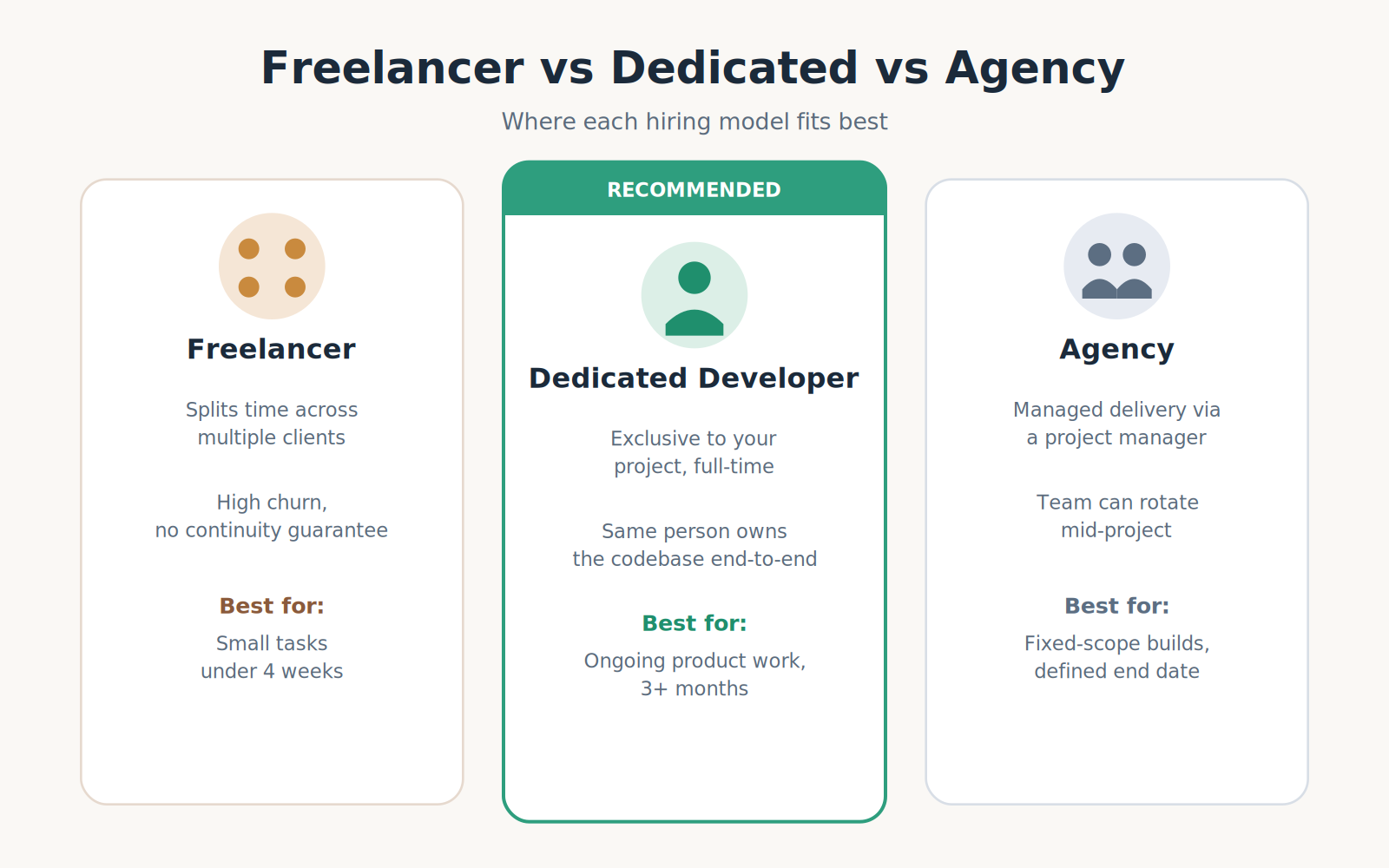
| Factor | Freelancer / Marketplace | Dedicated Developer | Project-Based Agency |
| Attention split | Multiple concurrent clients | Exclusive to your project | Shared across agency’s project queue |
| Continuity | High churn, no guarantee | Same developer/pod for engagement duration | Team can rotate mid-project |
| Communication | Direct, but inconsistent availability | Direct, integrated into your daily standups | Often filtered through a project manager |
| Best fit | Small, isolated tasks under 4 weeks | Ongoing product development, 3+ months | Fixed-scope builds with a defined end date |
| Cost predictability | Variable, rate-shops per task | Fixed monthly/hourly rate, predictable | Fixed project quote, scope-change risk |
Use this table as a filter, not a verdict. A two-week bug-fix task doesn’t justify a dedicated hiring engagement. A product roadmap running 6+ months almost always does, purely on the math of context-switching losses outlined earlier.
What Most Teams Get Wrong About Dedicated Hiring
The most common mistake isn’t picking the wrong vendor, it’s treating “dedicated” as a marketing adjective rather than a contract term. Ask directly: is this developer contractually barred from taking on other clients during my engagement hours? If a vendor can’t answer that in one sentence, the word “dedicated” is doing decorative work, not structural work.
The second mistake is under-scoping the handoff period. Teams assume a dedicated developer becomes productive on day one. In practice, even a strong senior Android developer needs 5–10 business days to get fluent in an existing codebase’s architecture decisions, dependency versions, and internal tooling budget for that ramp, so don’t treat it as wasted time.
The third pattern: companies compare dedicated hiring costs only against freelance hourly rates, never against the compounding cost of delay. A $10/hour rate difference is irrelevant next to a feature that ships eight weeks late because of split attention. Pattern recognition across real engagements consistently shows that benefits of dedicated team hiring show up in calendar time and defect rates long before they show up in the invoice.
If You’re Weighing This Decision
If you’re evaluating whether to hire dedicated android developers and want to pressure-test the cost and timeline math against your specific product stage before committing to a vendor, Supersourcing has run this evaluation process across dozens of Android engagements from single-developer migrations to multi-role pods. You can start that conversation at supersourcing.com/contact-us or reach out directly at mayank@engineerbabu.com.
Frequently Asked Questions
What does “dedicated” actually mean when hiring a developer?
It means the developer works exclusively on your project for the contracted hours, with no concurrent client work during that time. It’s a contractual exclusivity clause, not a description of skill level or effort a dedicated junior developer still works only on your codebase.
How is a dedicated Android developer different from a freelancer?
A freelancer typically juggles multiple clients simultaneously and bills per task, while a dedicated Android developer commits full-time (or agreed fixed hours) to one project, integrates into your existing tools and standups, and stays on the project across its lifecycle rather than per-task.
How much does it cost to hire dedicated Android developers?
Rates in 2026 range from $15–$25/hour for junior talent to $40–$82/hour for senior developers, depending on region and specialization. Offshore and nearshore dedicated hiring typically runs 40–60% below equivalent US-based full-time costs once benefits and overhead are factored in.
How long does it take to onboard a dedicated Android team?
Pre-vetted dedicated hiring models typically place a developer or small pod within 10–14 days of a signed agreement, compared to 60–90+ days for traditional local full-time hiring through job postings and internal screening.
Is a dedicated Android developer better than an in-house hire?
It depends on duration and continuity needs. In-house hires make sense for permanent, multi-year product ownership. Dedicated hiring works better for defined project windows, faster onboarding needs, or when local senior talent is scarce or priced out of budget.
What is the dedicated hiring model in software outsourcing?
The dedicated hiring model is an engagement structure where a vendor supplies a developer or team that works exclusively for the client, integrated into the client’s own workflows and reporting lines, as opposed to a project-based agency model where a vendor manages delivery independently against a fixed scope.
