

Two vendors quote you for the same senior backend engineer in Jersey City. One says $92 an hour. The other says $148. Same résumé, same start date, same 12-month term. Nothing about the candidate explains a $56 gap but something about the structure does, and if you can’t name it, you are not negotiating. You are guessing.
That gap is the single most expensive blind spot in contract technology budgets, and it exists because contractor rates in New Jersey are quoted as bill rates while almost every internal budget is built from salary data. Those are two different numbers measuring two different things, and the distance between them is where six-figure overruns live.
The pressure is not easing. Gartner projects worldwide IT spending will reach $6.37 trillion in 2026, a 14.2% increase over 2025, with data centre systems and infrastructure-as-a-service leading growth which means the same cloud, data and platform engineers your project needs are being bid on by every AI infrastructure programme in the tri-state area.
Gartner, July 2026 worldwide IT spending forecast to grow 14.2% in 2026 to $6.37 trillion, led by data centre systems and IaaS.
New Jersey sits inside that squeeze with unusual specifics. It carries a large pharma, insurance and financial-services base that buys contract engineering continuously, and it competes directly with Manhattan salary bands across the Hudson without the Manhattan cost-of-living premium fully priced in. CompTIA’s State of the Tech Workforce 2026 puts the state’s tech workforce at roughly 298,000 jobs about 6.6% of total employment and $61 billion in economic impact with net tech employment projected to grow 1.4% in 2026.
This guide is the rate card, the arithmetic behind it, and the process that turns a number into a working contractor.
TL;DR
This is a practical budgeting guide to its contractor rates in New Jersey for 2026. It is written for engineering leaders, procurement teams and founders who have to defend a contract technology line item and need defensible numbers rather than a scraped average.
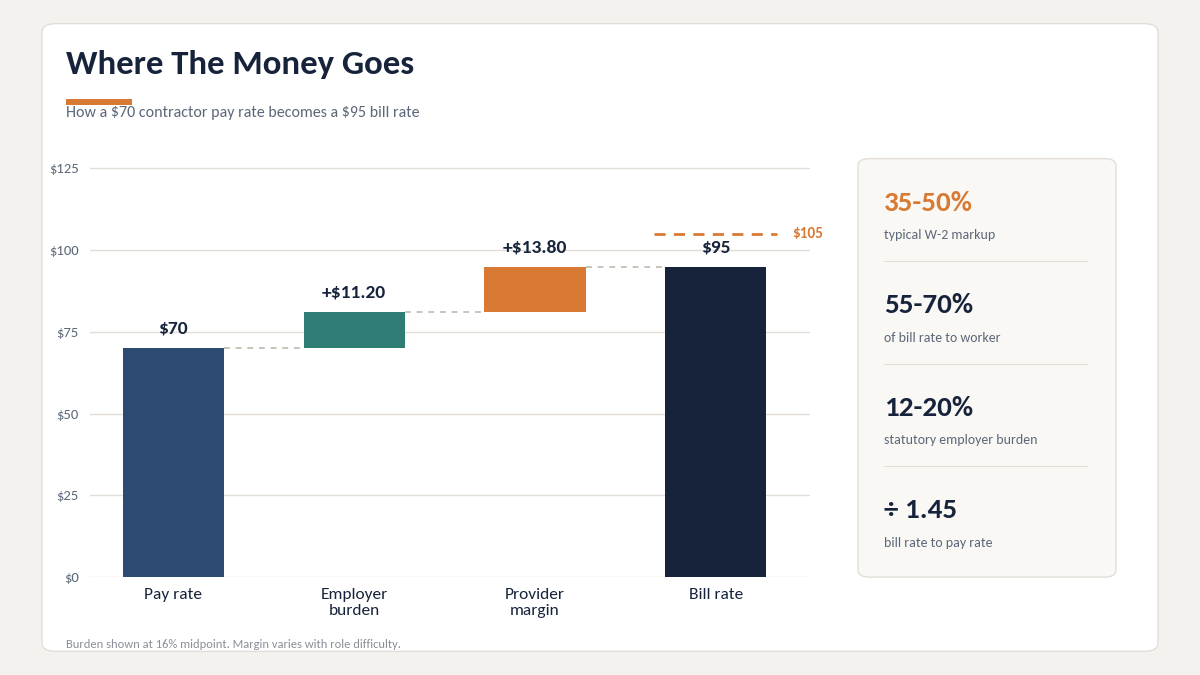
Here is the number that matters most: the New Jersey developer hourly rate you pay a staffing partner is typically 35% to 50% higher than what the contractor actually receives. A developer earning $70 an hour costs you $95 to $105. Across a 2,000-hour year, that spread is $50,000 to $70,000 on a single seat and it is not padding. Most of it is legally mandated employer cost.
By the end of this guide you will be able to build a rate band for any technical role in New Jersey from public wage data, read a vendor quote well enough to know which line is margin and which is burden, choose between W-2, corp-to-corp and offshore models on evidence rather than instinct, and set contract terms that protect you when a placement does not work out.
What Are IT Contractor Rates in New Jersey?
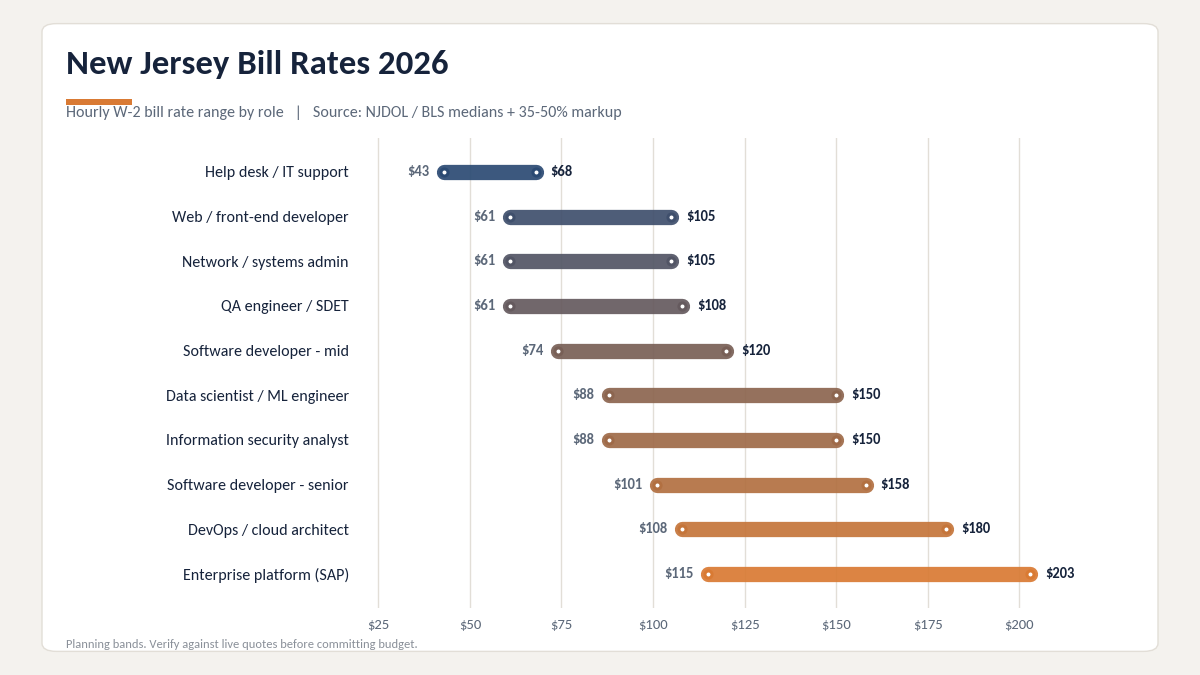
IT contractor rates in New Jersey are the hourly amounts businesses pay for temporary technology talent in the state most often quoted as a bill rate that bundles the worker’s pay, mandatory employer taxes and insurance, and the staffing provider’s margin into one figure. In 2026 they typically run between $43 and $203 per hour depending on role and seniority.
Because nj it consultant rates get conflated with several adjacent numbers, it’s worth naming what they are not:
- Not the contractor’s take-home pay. The worker typically receives 55–70% of the bill rate. The remainder covers employer-side FICA, unemployment insurance, workers’ compensation, any benefits, recruiting cost, and provider margin.
- Not an annualised salary divided by 2,080. A salaried engineer’s hourly equivalent excludes benefits load and assumes paid time off. A contractor bills only hours worked, at a rate that must self-fund the gaps.
- Not the same as a project or SOW price. A fixed-fee statement of work prices a deliverable and shifts scope risk to the vendor. An hourly bill rate under contract IT staffing prices capacity and leaves scope risk with you.
Why the Rate You Set Determines the Team You Get
Rate is not a procurement detail that gets optimised at the end. It is the first constraint that decides which candidates ever reach your inbox, and it moves four business outcomes at once.
- Access to the shortlist. Set a bill rate below the market band for a role and you do not receive a cheaper version of that engineer you receive a different, weaker candidate pool. In New Jersey, where the tech workforce sits near 298,000 and Manhattan employers bid on the same people, a rate 15% under market typically removes the top third of available candidates before screening begins.
- Total programme cost, not hourly cost. A $95/hour engineer who is productive in week two costs less over a six-month engagement than an $80/hour engineer who needs six weeks to become useful. At 40 hours a week, four extra ramp weeks is $12,800 of spend against zero output.
- Attrition and continuity risk. Under-rated contractors leave mid-engagement for better-paying assignments. Every replacement costs the sourcing cycle again plus a fresh ramp period typically three to six weeks of lost velocity per swap.
- Compliance exposure. How you structure the rate W-2, corp-to-corp, or 1099 determines your liability under New Jersey’s classification rules. A cheaper structure that fails the ABC test is not a saving; it is a deferred penalty.
- Budget credibility. Finance teams that underestimate contract rates by 40% once tend to have their next contractor request scrutinised line by line. Getting the band right the first time buys you speed on the second hire.
The Core Problem: Almost Every Budget Is Built on the Wrong Number
Here is the pattern we see repeatedly in first conversations with New Jersey clients. A hiring manager looks up what a software developer earns in the state, finds a median around $108,660 a year, divides by 2,080 hours, gets roughly $52 an hour, and builds a budget at $55 to $60 to leave headroom. Then the first quote arrives at $110 and the project stalls for a month while the number is re-approved.
The budget wasn’t wrong by a little. It was wrong by roughly 2x, and predictably so.
The reason is that contract developer cost new jersey budgets almost always start from a salaried employee wage figure and then apply a small buffer, when the correct starting point is the contractor’s pay rate which is already higher than the salaried hourly equivalent because it must absorb unpaid time off, self-funded gaps between assignments, and no benefits. On top of that sits employer burden and provider margin.
The three-layer stack:
- Layer 1 Pay rate. What the contractor receives per hour worked. For a mid-level developer in New Jersey, typically 55–80.
- Layer 2 Employer burden. Employer-side FICA at 7.65%, state unemployment and disability contributions, workers’ compensation, general and professional liability insurance, plus any benefits. Together this commonly adds 12–20% before anyone earns a dollar of margin.
- Layer 3 Provider margin. Recruiting cost, account management, payroll administration, replacement risk and profit. Typically 8–20% depending on how hard the role is to fill.
Published industry benchmarks put total IT staffing markup at roughly 25% to 75%, with W-2 placements most often landing in the 35% to 50% band and hard-to-fill or short-duration roles pushing toward the top. That is why a $70 pay rate becomes a 95–105 bill rate.
The practical shortcut: to estimate a contractor’s approximate pay rate from a quoted bill rate, divide by 1.45. It will not be exact. It gets you close enough to know whether the quote is disciplined or padded and close enough to ask a much better second question.
The Complete Walkthrough: From Requirement to Renewal
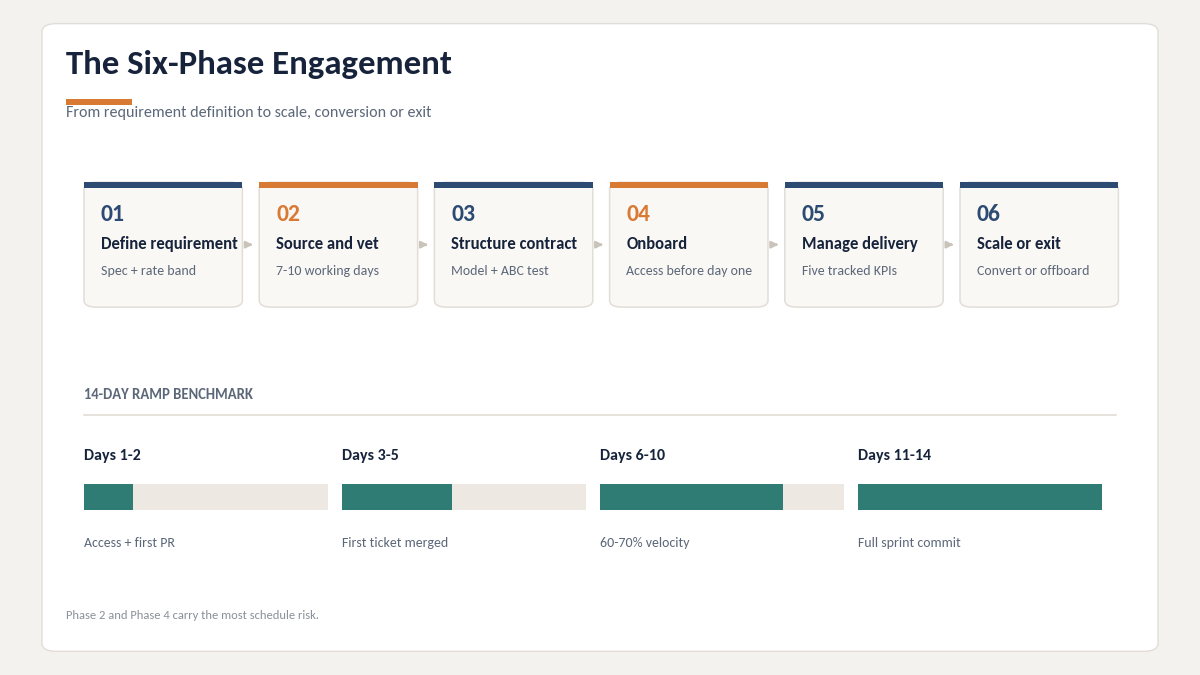
This is the operational core of the guide. Six phases, in sequence, with the checklist for each. If you have never run a contract engagement before, working through these in order will get you from “we think we need someone” to a productive, governed contractor without improvising the parts that matter.
Phase 1 Define the requirement and set the budget band
Rate conversations go badly when the requirement is vague, because vagueness gets priced as risk. Before you speak to any provider, convert the need into a specification tight enough that two different vendors would shortlist similar people.
Setting realistic nj tech bill rates starts with public wage data, not vendor quotes. Anchor to the New Jersey median for the occupation, convert to an hourly equivalent, then apply the contract uplift and markup band.
The five-step budget calculation:
- Find the NJ occupational median. Use NJDOL/BLS occupational data for the specific SOC code software developers, information security analysts, data scientists and network administrators all sit at materially different medians.
- Convert to a salaried hourly equivalent. Divide the annual median by 2,080.
- Apply the contract uplift. Multiply by 1.1–1.3 to reach a realistic contractor pay rate. Seniority sits at the top of that range; junior and support roles at the bottom.
- Apply the markup band. Multiply by 1.35–1.50 for a W-2 placement to reach an expected bill rate.
- Add a scarcity adjustment. For roles with a genuinely thin local pool cloud security, senior data engineering, regulated-industry platform work add 10–20%. For roles with deep supply, do not.
The requirement spec checklist complete every line before you brief a vendor:
- Primary stack and version (e.g. “Node.js 20, Postgres, AWS ECS” not “backend”)
- Seniority defined by scope, not years (“owns a service end to end” beats “5+ years”)
- Engagement length and expected weekly hours
- Onsite, hybrid or fully remote and if hybrid, which office and how many days
- Must-have versus nice-to-have skills, split into two explicit lists
- Domain or compliance requirements (HIPAA, PCI-DSS, SOX, GxP)
- Interview panel named, with calendar availability held in advance
- Approved rate band with a documented ceiling
- Named internal owner for onboarding
The red flag we look for first: a must-have list with more than six items. In practice, a nine-item must-have list is not a requirement; it is an unresolved internal disagreement about what the role is. It reliably adds two to three weeks to the search and pushes the rate up, because you are now describing a rarer person than the work actually needs. When a backend requirement is genuinely Node-centric, brief it that way and hire Nodejs developers rather than a generalist who happens to list it eighth.
Phase 2 Sourcing and vetting
Vetting quality is the largest uncontrolled variable in contract hiring, and it is where cheap providers save money you later spend.
What a defensible screening process contains:
- Requirement calibration call the recruiter demonstrates they can distinguish a strong résumé from a keyword-matched one in your stack.
- Structured technical screen is a live problem in the actual language and framework, not a generic algorithm puzzle.
- Code or architecture review reviewing existing work, or a short scoped exercise with a clear time box.
- Practical scenario interview how the candidate handles a production incident, an ambiguous ticket, or a disagreement with a tech lead.
- Reference verification two references from the last two engagements, including at least one direct manager.
- Right-to-work and background verification completed before submission, not after you select.
- Availability and competing-offer check confirmed in writing within 48 hours of submission.
A rigorous IT staffing agency vetting process is what makes a 7–10 working day turnaround from job description to interview-ready shortlist realistic rather than aspirational. At Supersourcing, AI-assisted sourcing narrows the pool to roughly the top 2% before any human screen, which is what compresses the front end of that cycle without cutting the technical evaluation.
Red flags in the sourcing stage:
- Volume without commentary. Twelve résumés in 24 hours with no submittal notes means keyword matching, not screening. Four with reasoning attached is a better signal.
- Rate quoted before the requirement is understood. A provider who prices the role before the calibration call is pricing a title, not a job.
- Candidates who cannot discuss their own listed work. The most common tell in a technical screen is a candidate who describes a project in the passive voice throughout.
- Refusal to name the pay rate split. A provider unwilling to discuss how the bill rate divides is usually hiding rate compression on the worker which becomes your attrition problem in month four.
- “Available immediately” on every profile. Genuinely strong contractors in New Jersey are rarely on the bench with no notice period.
Phase 3 Engagement models, rate structures and contracts
The engagement model determines the rate structure, the compliance exposure and who owns the risk when scope moves. Choose deliberately.
The four structures you will be offered:
- W-2 contract (staff augmentation). The provider employs the contractor; you receive an hourly bill rate. Highest markup, lowest classification risk to you. The default for ongoing capacity work in New Jersey.
- Corp-to-corp (C2C). The contractor operates through their own entity. Nominally cheaper, often 10–15% below the equivalent W-2 bill rate because employer burden shifts away. This is also where New Jersey gets dangerous, and it is covered below.
- Fixed-fee SOW. A priced deliverable with acceptance criteria. Best when scope is genuinely stable. Vendors price scope risk into the fee, so a fixed-fee SOW on unstable scope is usually the most expensive option available.
- Contract-to-hire. Hourly for a defined trial period, then a conversion fee to bring the person onto your payroll. Strong risk management for a permanent seat you are unsure about.
The New Jersey compliance point most rate guides omit: New Jersey applies the ABC test to determine whether a worker is an employee or an independent contractor, and it is one of the more demanding standards in the country the burden sits with the hiring entity, and all three prongs must be satisfied.
NJDOL has expanded enforcement powers, including stop-work orders that can be issued across an employer’s worksites and civil penalties assessed per day, per misclassified worker; the department has issued well over a hundred such orders since those powers were widened. High-value assessments against national platform companies have run into the hundreds of millions of dollars.
The budgeting consequence is direct: a corp-to-corp structure that saves 12% on the bill rate is not a saving if the engagement looks like employment under the ABC test. If the contractor works your hours, uses your systems, reports to your manager and performs work that is central to your business, that arrangement deserves legal review before it deserves a purchase order.
Contract terms to negotiate before signature not after:
- Conversion fee schedule. Should decline with hours worked and reach zero, commonly between 1,000 and 2,080 hours. A flat fee that never decays is a red flag.
- Replacement guarantee. A defined window and a defined replacement timeline. Ours is a replacement within 7–10 days if a hire isn’t a fit; hold any provider to something specific.
- Rate lock and escalation terms. Fix the rate for the initial term and cap any annual escalator explicitly.
- IP assignment. Must assign to your entity, and must survive termination. Check that it flows through from the provider’s contract with the worker ; there is a gap for you.
- NDA and data handling. Named systems, defined access levels, defined return-of-materials process.
- Notice period both ways. Two weeks is standard; anything longer than 30 days on your side is unbalanced.
- Overtime and holiday treatment. Define the threshold and the multiplier in writing.
- Termination for convenience. With a clear notice period and no exit penalty.
Phase 4 Onboarding and the first two weeks
Ramp-up is an unbudgeted spend. A contractor billing from day one who cannot commit code until day twelve has cost you eleven days at full rate. The fix is boring and entirely within your control: have access ready before the start date.
The pre-start checklist complete before day one:
- Laptop or VDI provisioned and tested, with admin rights resolved
- SSO, VPN and MFA enrolment completed
- Repository access at the correct permission level
- Ticketing, documentation and chat accounts created and added to the right channels
- Environment variables, secrets access and local build verified by someone else on the team
- Named buddy assigned a specific engineer, not “the team”
- First-week ticket queue prepared: two or three genuinely small, genuinely shippable items
- Standup, sprint ceremony and one-to-one invitations already on the calendar
The 14-day ramp benchmark:
| Days | Expected state |
| 1–2 | Access confirmed, environment running locally, first PR opened on a trivial change |
| 3–5 | First small ticket merged; architecture walkthrough completed with the buddy |
| 6–10 | Working at roughly 60–70% of expected velocity on standard tickets |
| 11–14 | Full sprint commitment taken; contributing in code review |
Where this actually breaks: the most common cause of a blown ramp period in our engagements is not the contractor. It is a security or IT access approval that nobody started until the contractor’s first morning, because the requisition and the access request live in different systems owned by different teams.
Raise access tickets the day the offer is accepted, and name one person accountable for confirming they cleared. This single habit routinely saves five to seven billable days per placement.
Phase 5 Managing delivery
A contractor who reports to nobody in particular produces work that satisfies nobody in particular. Governance for contract staff should be lighter than for employees but never absent.
The delivery governance model:
- Daily: contractor joins the same standup as the rest of the team. No separate contractor ceremony that creates a second-class dynamic and degrades output.
- Weekly: written status against committed work shipped, in progress, blocked. Fifteen minutes, five bullets.
- Bi-weekly: thirty-minute check-in between your engineering manager and the contractor, without the vendor present.
- Monthly: account review with the provider covering delivery quality, timesheet accuracy, upcoming capacity and any rate or scope changes.
- Quarterly: formal engagement review continues, adjust scope, expand, or wind down.
Five KPIs worth tracking (and none more):
- Sprint commitment accuracy committed versus delivered story points, tracked as a trend, not a single sprint.
- Cycle time first commits to production for a standard ticket.
- Change failure rate proportion of the contractor’s merged changes requiring a fix or rollback.
- Review responsiveness means time to respond to a code review request, in both directions.
- Timesheet-to-output correlation hours billed against work visibly shipped. Investigate divergence early and directly.
The escalation path should be written down before you need it. Three named people: your engineering manager, the provider’s dedicated account manager, and one executive sponsor on each side. Where account managers carry too many clients at once, response times slip precisely when a delivery issue is most solvable, which is the argument for a dedicated account structure rather than a shared pool.
Phase 6 Scaling, converting or exiting
Every engagement ends one of four ways. Decide which one you are heading toward before month three, not month eleven.
Scaling up. Adding headcount to a working engagement is the cheapest hiring you will do all year. The requirement is proven, the onboarding path is tested, and the provider knows your bar. Expect a shorter sourcing cycle on the second and third seats. Negotiate a volume-based rate adjustment at three or more concurrent contractors; most providers will move on margin for guaranteed utilisation.
Converting to permanent. Contract to hire rates typically include a conversion fee that declines with hours worked. Before converting, model the fully loaded employee cost base salary plus 25–35% for benefits, payroll taxes and equipment against the annualised bill rate. Conversion frequently makes sense; it just as frequently does not, and the arithmetic decides.
Replacing a poor fit. Act in week three, not month three. The signals are consistent: repeated missed sprint commitments without flagged blockers, code review comments that go unaddressed, and a widening gap between hours logged and work shipped. A replacement guarantee is worthless if you exercise it in month five.
Offboarding cleanly. This is the phase teams treat as an afterthought and then regret.
- Knowledge transfer session, recorded, with a written handover document
- All work merged or explicitly abandoned no orphaned branches
- Documentation updated for anything the contractor owned solo
- Credentials and access revoked on the final day, verified by a second person
- Equipment returned and logged
- Final timesheet approved and reconciled against the purchase order
- Written exit debrief captured for the next engagement
Case Studies
Three engagements from Supersourcing’s delivery history that illustrate how rate, speed and vetting interact at different scales.
Swiggy hiring velocity under hypergrowth. Swiggy needed engineering capacity faster than a conventional recruiting funnel could supply during a period of aggressive scale-up. The engagement combined AI-assisted sourcing with a structured technical screen to compress the front end of the funnel, delivering interview-ready shortlists within the 7–10 working day window rather than the four-to-six weeks typical of open-market search. The operative lesson: shortlist speed, not offer speed, is the constraint that actually determines time-to-productive.
Paytm 100+ engineers without a quality drop. Scaling past a hundred engineering hires is where most staffing relationships fail, because the bar quietly falls as volume rises. The programme held a 98% candidate joining rate across the engagement by front-loading vetting rigour and maintaining dedicated account management rather than pooling the work across a shared bench. At that volume, a 10-point drop in joining rate translates directly into ten repeated searches.
OkCredit and Somnoware small teams, high stakes per seat. For a fintech and a healthtech operating at much smaller headcount, every individual hire carried disproportionate weight; a single poor fit would have consumed a meaningful share of the engineering roadmap. Sustained under-1% candidate drop-off on contract roles and a replacement commitment inside 7–10 days meant neither team absorbed a multi-month hole from a bad placement. For a team of twelve, that guarantee is worth more than a few dollars of hourly rate.
Decision Framework: Which Model Should You Actually Use?
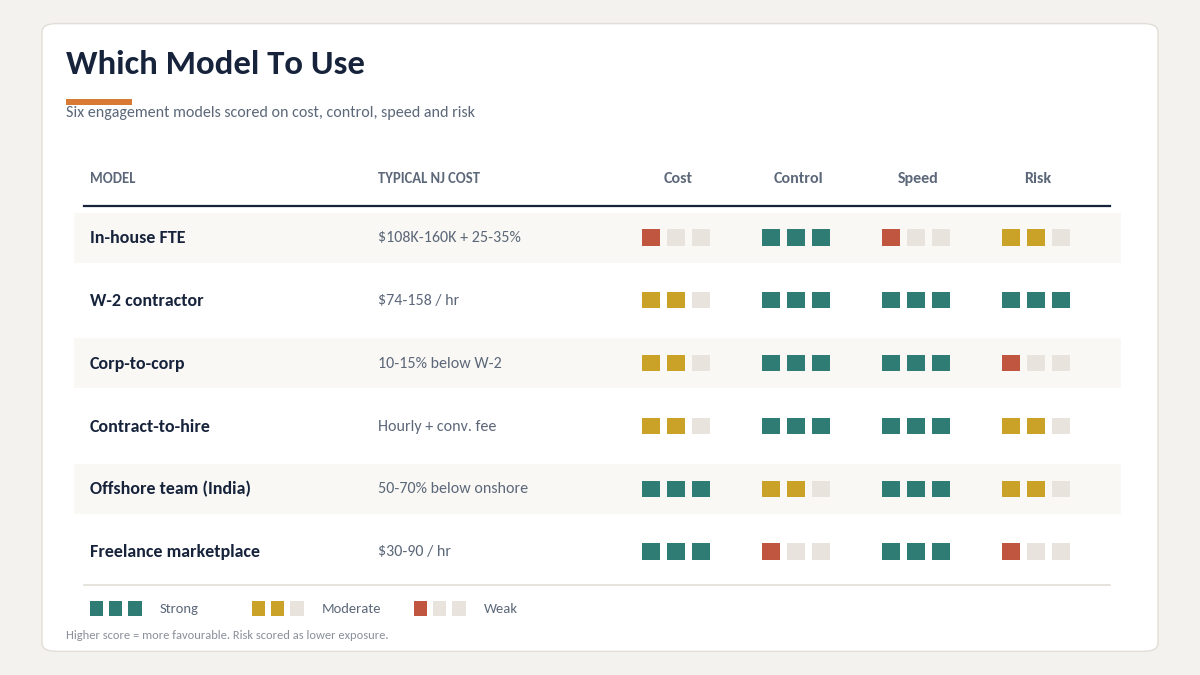
Compare new jersey staffing rates across models on four axes cost, control, speed and risk rather than on headline hourly rate alone. The cheapest hourly number is regularly the most expensive total.
| Model | Typical NJ cost | Control | Time to productive | Primary risk |
| In-house FTE | 108K–160K salary + 25–35% burden | Highest | 8–16 weeks (search + notice + ramp) | Slow to hire, slow to unwind |
| W-2 contractor (staff aug) | 74–158/hr bill rate | High | 2–4 weeks | Rate premium; needs internal management |
| Corp-to-corp contractor | 10–15% below W-2 equivalent | High | 2–4 weeks | ABC test / misclassification exposure |
| Contract-to-hire | Hourly + declining conversion fee | High | 2–4 weeks | Conversion fee if you convert early |
| Offshore dedicated team (India) | Roughly 50–70% below onshore | Medium | 2–4 weeks | Time-zone overlap; requires real management investment |
| Freelance marketplace | 30–90/hr | Lowest | Days | No vetting guarantee, no replacement cover, IP terms vary |
Use this decision sequence:
- Is the work permanent, core and ongoing? → In-house FTE. Contract rates are not designed for indefinite core capacity.
- Is it a defined 3–18 month need for scarce skills? → W-2 staff augmentation.
- Are you unsure whether the seat is permanent? → Contract-to-hire with a declining conversion fee.
- Is scope genuinely fixed and independently verifiable? → Fixed-fee SOW.
- Is the work parallelisable, well-specified, and are you willing to run real management overhead? → Offshore dedicated team. The cost to hire offshore developers in India is materially lower, but only converts to savings when there is overlap time, clear specifications and an accountable owner on your side.
- Is it a small, self-contained, low-IP task? → Freelance marketplace, with expectations set accordingly.
What Most Teams Get Wrong
The recurring failure with its contractor rates in New Jersey is not paying too much. It is optimising the hourly rate while ignoring the three variables that actually move total cost: time-to-productive, retention through the engagement, and rework. A contractor at $95 an hour who ships in week two and stays twelve months is cheaper than one at $78 who ships in week six and leaves in month five by a wide margin, every time.
Five specific patterns we see repeatedly:
Benchmarking against the wrong geography. Teams in Princeton or Cherry Hill benchmark against Manhattan bill rates and conclude they are being overcharged, or benchmark against national averages and conclude New Jersey is expensive. Neither comparison is useful. New Jersey competes for the same labour pool as New York City across the river, so its staff augmentation rates New Jersey track NYC more closely than they track the national median but with genuine variation by county, and a meaningful discount in the southern part of the state.
Treating markup as pure profit. Most of a 40% markup is not margin. Employer-side payroll taxes, unemployment and disability contributions, workers’ compensation and insurance consume the majority of it before the provider earns anything. Negotiating markup to a level that cannot cover statutory burden does not produce a cheaper contractor; it produces a provider cutting corners on vetting, or compressing the worker’s pay rate until they leave.
Buying the résumé instead of the bench. Teams evaluate the individual candidate and never ask what happens if that person leaves in month four. Replacement terms, notice provisions and bench depth are worth more than two dollars an hour, and they are the terms most often skipped in the rush to onboard.
Choosing corp-to-corp purely on price. In New Jersey specifically, this is the highest-consequence mistake in the list. The 10–15% saving is real. So is the ABC test, and so are stop-work orders and per-day penalties. Structure that decision on legal advice, not on the quote comparison.
Skipping the ramp budget entirely. Almost no contract budget includes the first two weeks as a distinct cost line, even though those weeks are billed at full rate for partial output. Budget them explicitly roughly 30–40% of the first two weeks’ cost is realistically ramp and the rest of the forecast stops drifting.
Cost and Timeline Reality Check
This is the section competing content skips. Below are 2026 rate bands for New Jersey, the method used to build them, and realistic timelines by scenario.
How these bands were built
Every figure below is derived, not asserted. Method: take the New Jersey occupational median wage published by NJDOL/BLS, convert to a salaried hourly equivalent at 2,080 hours, apply a 1.1–1.3x contract uplift to reach a contractor pay rate, then apply a 35–50% W-2 markup to reach the bill rate.
Where a role has no distinct SOC code cloud architect, SDET, platform engineer the band reflects rates observed in our own New Jersey placements and is labelled as such. Verify against live quotes before committing a budget; these are planning bands, not a price list.
IT contractor rates in New Jersey by role 2026
| Role | NJ median salary (NJDOL/BLS) | Salaried hourly equiv. | Typical contract pay rate | Expected W-2 bill rate |
| Help desk / IT support (Tier 1–2) | $65,180 | ~$31 | 32–45 | 43–68 |
| Web / front-end developer | $79,590 | ~$38 | 45–70 | 61–105 |
| QA engineer / SDET | $106,000 | ~$51 | 45–72 | 61–108 |
| Network / systems administrator | $97,420 | ~$47 | 45–70 | 61–105 |
| Software developer mid level | $108,660 | ~$52 | 55–80 | 74–120 |
| Software developer senior | 75–105 | 101–158 | ||
| Data scientist / ML engineer | $111,360 | ~$54 | 65–100 | 88–150 |
| Information security analyst | $118,670 | ~$57 | 65–100 | 88–150 |
| DevOps / cloud architect (AWS, Azure) | 80–120 | 108–180 | ||
| Enterprise platform (SAP, Salesforce, Guidewire) | 85–135 | 115–203 |
Infrastructure roles sit at the top of that table for a reason: the same AI and data-centre build-out driving Gartner’s 14.2% spending forecast is bidding for exactly these people. If your programme needs to hire DevOps engineers in 2026, budget at the upper half of the band and plan the search earlier than you would for application development.
What moves a rate up or down
Pushes rates up (+10–30%):
- Onsite requirement in Hudson, Bergen or Essex county
- Regulated-domain experience: pharma GxP, insurance, banking compliance
- Security clearance or extensive background-check requirements
- Engagements under three months
- Niche or legacy platform expertise with a thin local pool
- Urgent start under two weeks from brief to onboarding
Pulls rates down (−10–25%):
- Fully remote with no geographic constraint
- Engagement length of twelve months or more
- Three or more concurrent contractors with one provider
- Flexible start date, four or more weeks out
- Well-documented codebase and a clean, tested onboarding path
- Southern New Jersey location versus the northern corridor
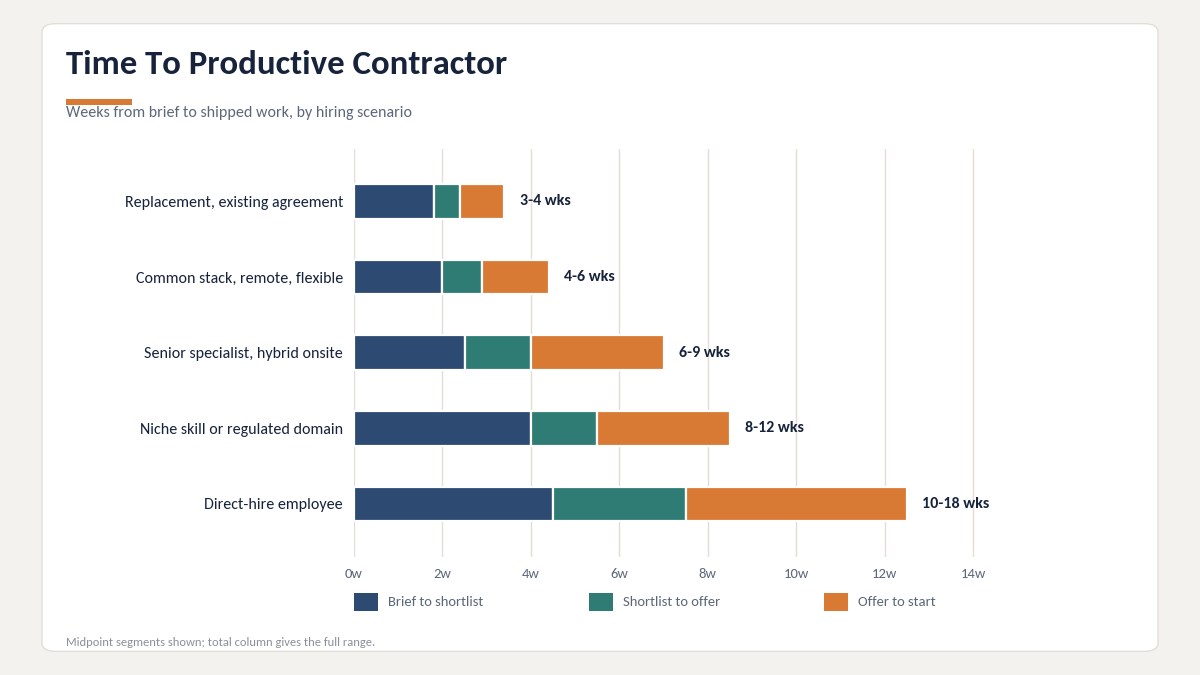
Realistic timelines
| Scenario | Brief → shortlist | Shortlist → offer | Offer → start | Total to productive |
| Common stack, remote, flexible start | 7–10 working days | 3–5 days | 1–2 weeks | 4–6 weeks |
| Senior specialist, hybrid onsite | 10–15 working days | 5–10 days | 2–4 weeks | 6–9 weeks |
| Niche skill or regulated domain | 3–5 weeks | 1–2 weeks | 2–4 weeks | 8–12 weeks |
| Replacement under an existing agreement | 7–10 days | 2–4 days | 1 week | 3–4 weeks |
| Direct-hire employee (comparison) | 3–6 weeks | 2–4 weeks | 2–8 weeks notice | 10–18 weeks |
Budget the total, not the rate. A twelve-month engagement for one senior developer at $130 an hour is approximately $260,000 at 2,000 billable hours before ramp inefficiency, equipment, and the internal management time the engagement consumes. Model that full figure against the fully loaded cost of an equivalent employee before deciding which one you actually want.
Where to Go From Here
If you are mid-decision a budget due next quarter, two quotes on the table with an unexplained gap between them, or a headcount plan you are not yet confident in defending, the useful next step is a rate check against live New Jersey market data for your specific roles, stack and engagement length.
That is a 30-minute conversation, not a pitch. You bring the role definitions and the numbers you have been quoted; the Supersourcing team brings current IT contractor rates in New Jersey by role, the markup structure behind them, the markup structure behind them, and a realistic timeline from brief to productive contractor. If the numbers you already have are sound, you will hear that, and you will have a benchmark to defend them with.
Book a rate check: https://supersourcing.com/contact-us/
FAQ
What is a normal hourly rate for an IT contractor in New Jersey?
IT contractor rates in New Jersey mostly fall between $43 and $203 per hour in 2026. Support and helpdesk sit at the low end, mid-level developers around 74–120, and specialised cloud, security and enterprise platform work at the top. The band for any specific role depends on seniority, onsite requirement, engagement length and how scarce the skill is locally.
Why is the bill rate so much higher than the contractor’s pay rate?
The bill rate covers three things: the worker’s pay, mandatory employer costs, and the provider’s margin. Employer-side FICA, unemployment and disability contributions, workers’ compensation and insurance typically consume 12–20% before any margin is earned. Contractors generally receive 55–70% of the bill rate.
What markup do IT staffing agencies charge?
Published benchmarks place IT staffing markup between roughly 25% and 75%. W-2 placements most commonly land between 35% and 50%. Higher markups usually reflect hard-to-fill roles, short engagements, or heavier compliance and screening requirements rather than excess profit.
Is corp-to-corp cheaper than W-2 in New Jersey?
On paper, usually by 10–15%. In practice, New Jersey applies the ABC test to worker classification, and the burden of proof sits with the hiring entity. If the engagement resembles employment in hours, supervision and integration, the structure invites misclassification exposure. Get legal advice before choosing C2C on price alone.
Are New Jersey contractor rates lower than New York City rates?
Somewhat, but less than most teams expect. New Jersey employers compete for the same labour pool across the Hudson, so northern-county rates track NYC closely. The discount is more visible in central and southern New Jersey and on fully remote roles with no commute requirement.
How long does it take to onboard a contract developer?
A common-stack remote role typically runs 7–10 working days from brief to interview-ready shortlist, then three to five days to offer and one to two weeks to start roughly four to six weeks to productive output. Niche or regulated roles run eight to twelve weeks.
What is a fair conversion fee for contract-to-hire?
A fee that declines as hours accumulate and reaches zero, commonly between 1,000 and 2,080 hours worked. Flat fees that never decay, or fees calculated as a fixed percentage of first-year salary with no time decay, are worth negotiating before you sign rather than at conversion.
How do I know whether a quoted rate is fair for my role?
Build the band yourself from the NJ occupational median using the five-step method in Phase 1, then compare it to the quote. If the quote sits more than 20% above your calculated band, ask the provider to explain the difference in terms of pay rate, burden and margin. If they will not break it down, that is your answer. If you would rather have someone run that comparison against live New Jersey market data for your specific roles, that is a short conversation see below.
