

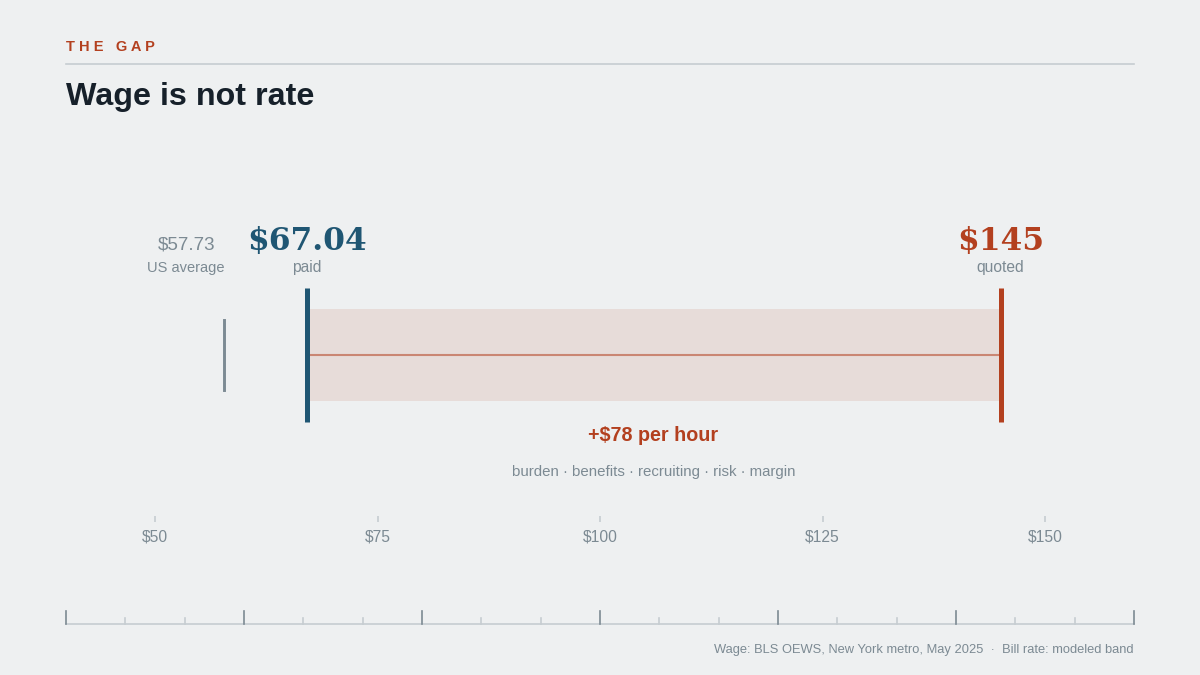
A W-2 technologist in the New York metro area earned an average of $67.04 an hour in the most recent federal wage release about 16% above the national average of $57.73 for the same occupational group. That is the wage. It is not the rate you pay.
The gap between those two numbers is where most New York technology budgets quietly break. A hiring manager benchmarks against salary data, plans around $70 an hour, and receives a quote for $145. Nothing dishonest has happened: payroll taxes, unemployment insurance, workers’ comp, benefits eligibility, recruiter cost, and agency margin all sit between the pay rate and the bill rate, and in New York State that stack is heavier than almost anywhere else in the country.
Gartner forecasts worldwide IT spending will reach $6.37 trillion in 2026, up 14.2% year over year, with data center systems and IaaS as the fastest-growing segments. That spending has to be staffed, and it is landing in a market where 78% of technology leaders plan to increase headcount while 65% say skilled talent is harder to find than a year ago (Robert Half, 2026). Rate pressure in New York is a supply story, not an inflation story.
So the useful question is not what a developer earns. It is what a fully loaded hour costs, who captures the difference, and which line items are actually negotiable. IT contractor rates in New York City in 2026 sit roughly between $80 and $275 an hour depending on role, seniority, contract vehicle, and how much compliance risk the buyer is offloading and the spread inside a single job title is wider than the spread between titles.
This guide runs the way a procurement conversation does: what the bands are, how a bill rate is assembled line by line, what pushes a quote 30% above the band, and what to strike from an agreement before signing.
TL;DR
This is a buyer's reference for anyone budgeting contract engineering headcount in New York engineering leaders, procurement, and finance partners who have to defend a number. It covers how IT contractor rates in New York City are assembled, the markup mechanics, the contract structures, and the compliance exposure.
The single number worth remembering: the difference between what a contractor is paid and what you are billed usually runs 40% to 65% in technology roles, and on hard-to-fill or short-duration work it can reach 75%. On a 12-month engagement, that spread is worth $60,000 to $130,000 per seat.
By the end you will be able to reverse-engineer any quote you receive into pay rate, burden, and margin, decide whether a role belongs onsite in Manhattan or in a distributed model, and know which three clauses in a staffing agreement cost the most money over a year.
What are IT contractor rates in New York City?
IT contractor rates in New York City are the hourly bill rates employers pay for contingent technology talent in the New York metro market, inclusive of the contractor’s pay rate, statutory employment burden, and the supplier’s margin. In 2026 they typically range from roughly $80 an hour for QA automation to $275 an hour for senior advisory work.
Why the number you budgeted is not the number you get quoted
Most rate confusion traces to one mistake: treating salary benchmarks as a proxy for contract cost. Convert a $160,000 New York engineering salary to hourly and you get about $77 a figure that ignores everything making a contractor a contractor.
Start with the burden rate. Employer-side FICA, federal and New York State unemployment insurance, New York’s disability and Paid Family Leave contributions, workers’ compensation, and any benefits the worker is eligible for typically add 18% to 28% on top of the pay rate before a supplier has earned a cent. New York’s unemployment insurance and disability requirements land at the upper half of that band.
Then add the cost of finding the person. Recruiters in this market are expensive, sourcing cycles for specialized skills run weeks, and every open requisition carries a carrying cost 71% of technology leaders told Robert Half that skills shortages caused project delays last year, and 49% saw projects cancelled outright.
The result is a staffing markup that in technology roles commonly runs 40% to 65% over the pay rate, stretching toward 75% for niche skills, short engagements, or roles requiring onsite presence in Manhattan. That is the industry-standard band across published IT staffing benchmarks, and it is the single largest controllable variable in IT contractor rates in New York City.
Where this becomes a budgeting failure rather than a pricing quirk: teams model 12 months of contract engineering at salary-equivalent rates, then discover at month three that they have committed 45% more than plan. The fully loaded cost was always going to be higher; it just was not in the spreadsheet.
What NYC developer hourly rates look like by role in 2026
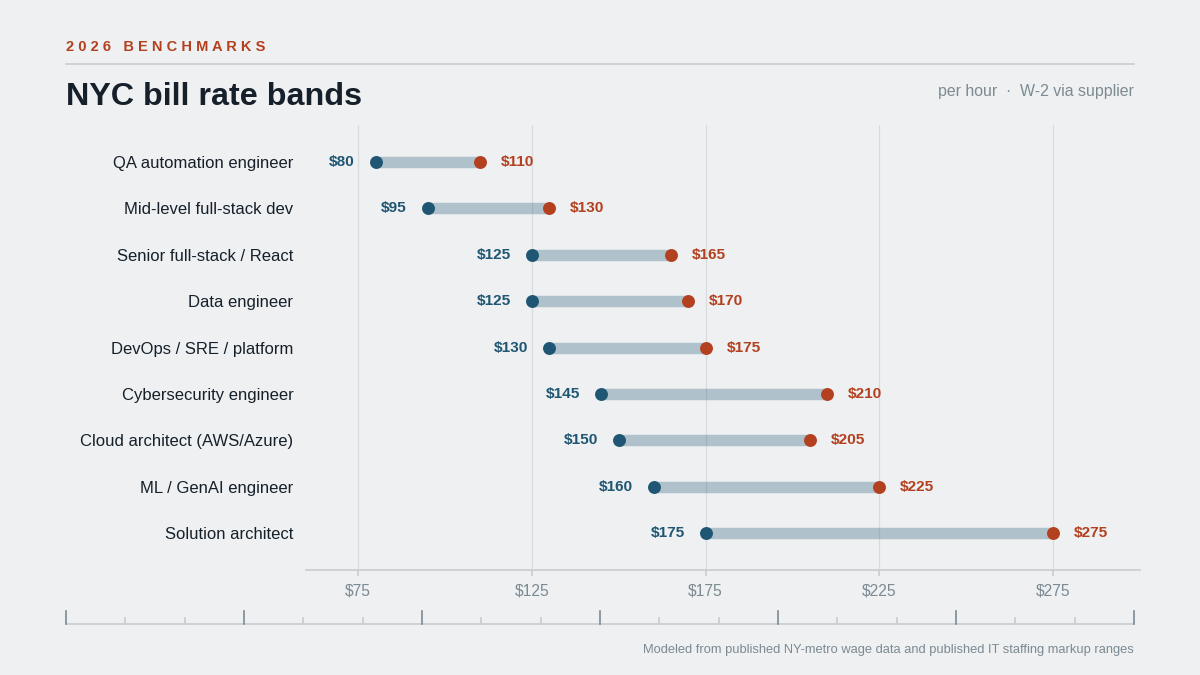
The bands below are modeled, not quoted. They combine published New York metro wage data for computer occupations with published technology staffing markup ranges, and they assume a W-2 contractor placed through a supplier acting as employer of record, available for hybrid onsite work in Manhattan.
Every figure describes IT contractor rates in New York City as a client-side bill rate, not a contractor take-home, so treat them as a benchmark to test quotes against rather than a price list.
| Role (contract, W-2 via supplier) | Typical 2026 bill rate band |
| QA automation engineer | $80–$110/hr |
| Mid-level full-stack developer (3–6 yrs) | $95–$130/hr |
| Senior full-stack / React / Node developer (7+ yrs) | $125–$165/hr |
| Data engineer | $125–$170/hr |
| DevOps / SRE / platform engineer | $130–$175/hr |
| Cloud architect (AWS / Azure) | $150–$205/hr |
| Cybersecurity engineer or security architect | $145–$210/hr |
| ML / GenAI engineer | $160–$225/hr |
| Solution architect or advisory consultant | $175–$275/hr |
Two patterns matter more than the absolute numbers. The band inside a title runs 30% to 40% wide, which makes title-based benchmarking nearly useless for a “senior backend engineer” who has run a payments migration under regulatory review prices differently from one who has not.
And the premium attaches to production experience in regulated environments, which is why New York’s financial services concentration pulls the whole market up.
How Manhattan tech bill rates are actually constructed
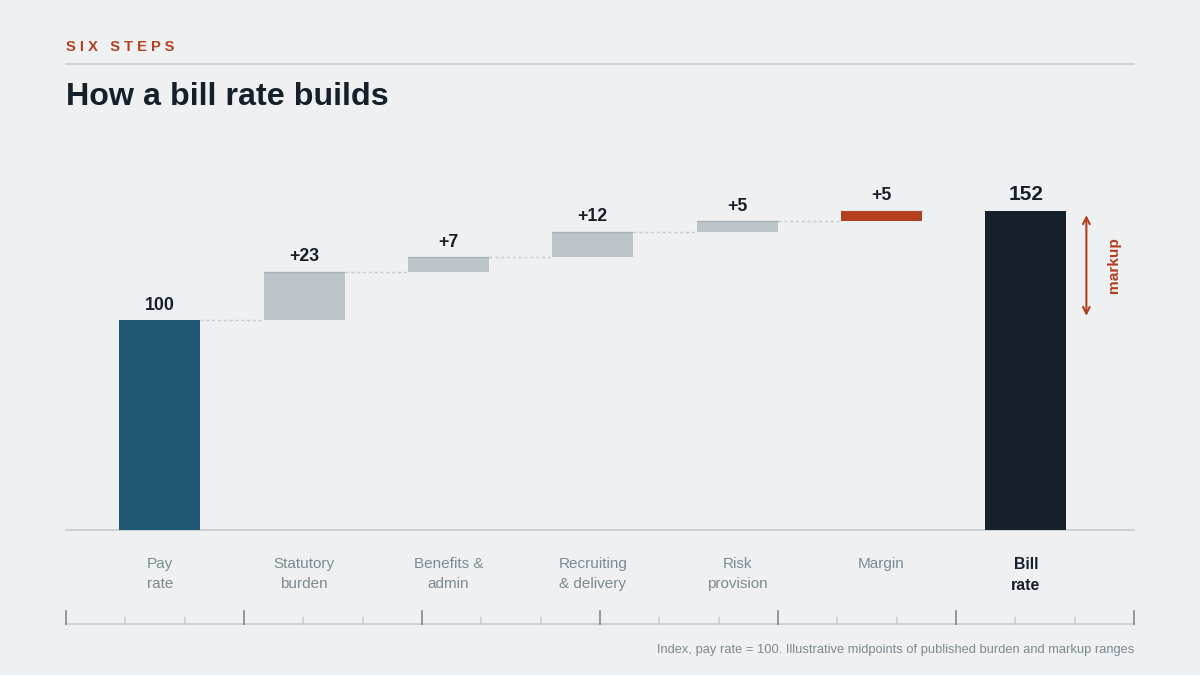
Ask any supplier to walk the stack and you will learn more in five minutes than from three rounds of rate negotiation. Manhattan tech bill rates are built in the same six steps every time:
- Establish the pay rate. What the contractor actually takes home per hour, before any employer-side cost.
- Add statutory burden. FICA, FUTA, New York SUTA, disability, Paid Family Leave, and workers’ compensation commonly 18% to 28% of pay rate in New York State.
- Add benefits and administration. Health coverage if the worker is eligible, payroll processing, timekeeping, and insurance certificates.
- Add recruiting and delivery cost. Sourcing, screening, technical vetting, and account management amortized over the expected engagement length.
- Add risk provision. Bench time, early termination exposure, and replacement cost if the placement fails.
- Add margin. What the supplier keeps. In technology contract staffing this is usually the smallest line in the stack, and the one buyers spend the most time attacking.
The leverage is in steps 4 and 5, not step 6. Squeezing margin to the bone on a scarce skill produces the same outcome every time: the supplier stops sending its best candidates to your requisitions and starts sending them to accounts with healthier economics.
What pushes a quote 25–40% above band
Four factors do most of the work. Engagement duration is the biggest: anything under three months carries a premium because recruiting cost cannot be amortized. Five days a week onsite in Manhattan narrows the candidate pool sharply and adds another.
Regulated-environment requirements are the third: clients needing contractors cleared through vendor risk review, enhanced background screening, and named-individual approval are paying for a much smaller pool.
Scarcity is the fourth and least negotiable. If you need someone who has shipped production LLM inference at scale and can pass a bank’s model risk review, you are not buying an hour of labor. You are buying an option on a person with maybe forty peers in the metro area.
This is also where hourly rates for AWS architects diverge most sharply from generalist infrastructure rates. A certified architect who has only built greenfield environments prices in one band; one who has migrated a regulated workload off-premises without a compliance finding prices in another.
Contract vehicles and what each one does to the rate
The commercial structure changes the number as much as the skill does. Time-and-materials engagements are the default for staff augmentation and give you the cleanest visibility into rate. A statement of work with fixed deliverables shifts delivery risk to the supplier and prices 15% to 30% higher for it, sometimes worth every dollar, sometimes just an expensive way to buy the same people.
Corp-to-corp arrangements, where the contractor operates through their own entity, strip the employer-of-record burden out of the stack and typically land 10% to 20% below an equivalent W-2 bill rate. The tradeoff is that worker classification risk moves toward you, and New York enforces aggressively on misclassification. Contract-to-hire usually prices at the standard band with a conversion fee that should decay to zero by month nine or twelve; if a supplier proposes a flat conversion fee that never amortizes, that is a negotiation point, not a policy.
For teams weighing structures across a whole program rather than one seat, this is the decision that contract IT staffing partners should be modeling before you commit to a single requisition structure, not skill, is often the largest single lever on IT contractor rates in New York City.
Compliance costs specific to New York
Two things surprise out-of-state buyers. First, New York City’s Freelance Isn’t Free Act requires a written contract for independent contractor engagements above a modest threshold, with defined payment terms and statutory penalties for late payment. If you are engaging 1099 independent contractor talent directly to save on markup, the paperwork discipline is not optional.
Second, New York’s wage and hour enforcement combined with joint-employer exposure means a poorly papered contingent program creates liability that dwarfs the markup you saved. None of that appears on a rate card, but it is priced into IT contractor rates in New York City all the same. Ask any supplier for their IT staffing agency vetting process documentation and their certificate of insurance in the same email the response time tells you a lot.
What this looks like in practice
Across 527+ delivered IT projects, the pattern that repeats in New York engagements is not price sensitivity it is speed sensitivity. Supersourcing’s typical cycle from job description to interview-ready shortlist runs 7 to 10 working days, and the reason that matters commercially is that every week a New York requisition sits open costs more than the rate difference teams spend weeks negotiating.
In enterprise SaaS and fintech engagements the segments most of our client roster sits in, including Razorpay, Chargebee, and Paytm the metric that moves budgets most is retention on contract roles.
A sub-1% drop-off rate and a 98% joining rate mean the replacement-cost line in the bill-rate stack is not theoretical padding: when placements hold, the effective cost per delivered hour falls even at an unchanged rate.
Neither number changes IT contractor rates in New York City on paper; both change what a delivered hour actually costs. That is the arbitrage most buyers never measure.
How to decide where a role actually belongs
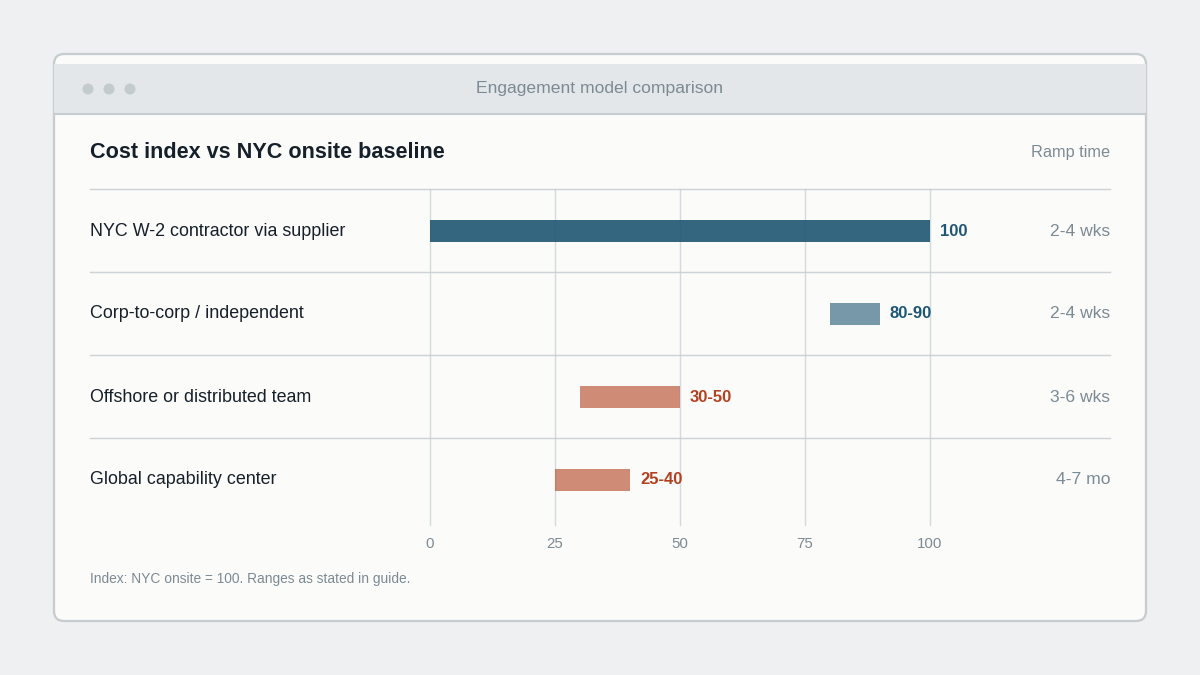
Before benchmarking nyc contract rates tech buyers should settle a prior question: does this role need to be in New York at all? Four models, four cost and control profiles.
| Model | Effective cost vs NYC onsite | Ramp time | Best fit |
| NYC W-2 contractor via supplier | Baseline | 2–4 weeks | Regulated work, onsite stakeholder access, short bursts |
| Corp-to-corp / independent | 10–20% lower | 2–4 weeks | Senior specialists, defined scope, classification discipline in place |
| Offshore or distributed team | 50–70% lower | 3–6 weeks | Sustained engineering capacity, async-tolerant workstreams |
| Global capability center | 60–75% lower at scale | 4–7 months | 25+ seats, multi-year roadmap, IP consolidation |
The decision rule is simpler than the table suggests: pay Manhattan rates for proximity, judgment, and regulatory exposure not for throughput. A team that needs to hire DevOps engineers for a two-year platform migration is solving a capacity problem, and capacity is the one thing IT contractor rates in New York City are worst at buying. Past 25 seats, a global capability center changes the unit economics permanently rather than incrementally.
What most teams get wrong about IT contractor rates in New York City
They negotiate the bill rate and ignore the pay rate. A supplier that cuts a quote from $150 to $132 has three ways to absorb it, and only one is margin. The other two are lowering the contractor’s pay rate which quietly guarantees you the person who could not get $150 elsewhere or downgrading the profile while keeping the title. Rate concessions not sourced from margin are quality concessions with a delay built in.
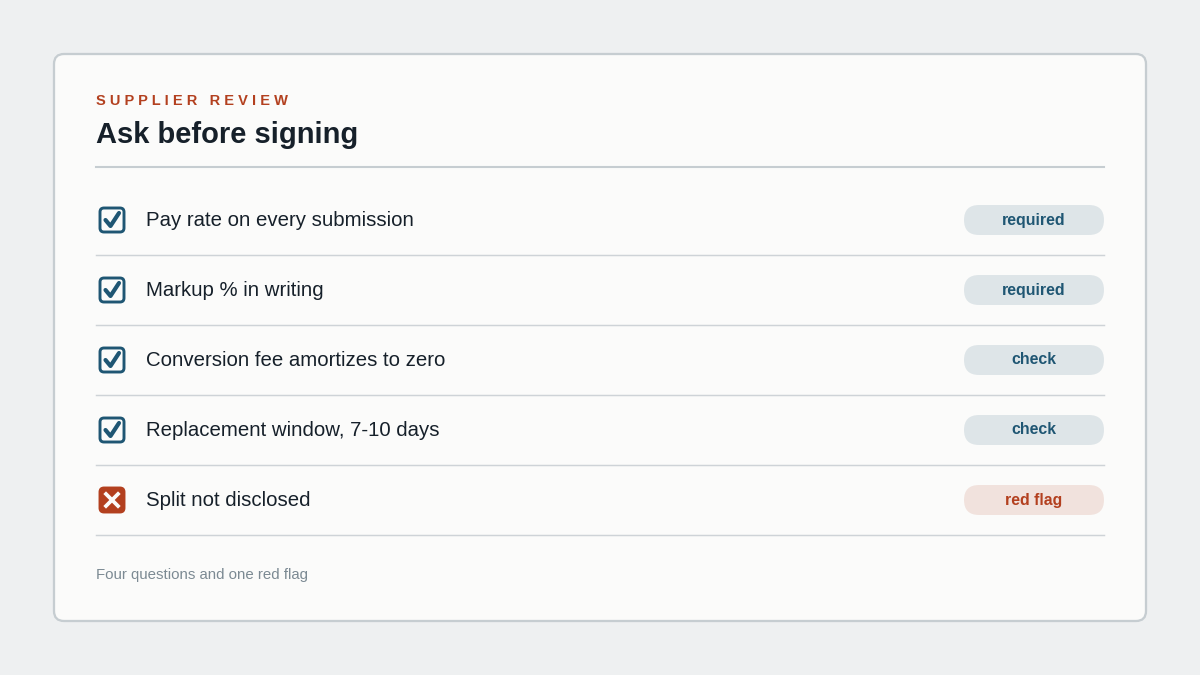
The fix is a rate transparency clause: require the pay rate be disclosed on every submission, and negotiate the markup percentage rather than the bill rate. A supplier that will not disclose the split on a W-2 placement is the clearest red flag in this market. The second-clearest is a supplier who re-papers the pay rate downward after the contractor starts.
Two more patterns worth naming. Onboarding friction is a cost line: background screening, New York employment paperwork, vendor risk review, and device provisioning regularly add five to nine business days after offer acceptance. Budget the ramp, or your 12-month engagement is really 11.5 months of output at 12 months of price. And almost nobody negotiates the replacement provision, which is where the real risk sits: a guaranteed replacement window of 7 to 10 days is worth more over a year than three dollars an hour.
Pressure-test your rate card before you commit
If you are benchmarking IT contractor rates in New York City for a 2026 engineering budget and want a second read before you sign a master services agreement, it is worth having someone model the stack against your actual roles, durations, and onsite requirements. We have run this process across 527+ IT engagements and can tell you within a call whether a quote is priced on scarcity or on opacity.
Send the role list and target rates to mayank@engineerbabu.com, or start a conversation here. No pitch deck, no obligation, just the arithmetic.
FAQs
How much do IT contractors charge per hour in New York City?
Most technology contract roles in the New York metro bill between $95 and $205 an hour in 2026, with QA automation at the low end near $80 and senior advisory work reaching $275. Mid-level developers cluster at $95–$130 and cloud or security specialists at $145–$210. The band inside a single title is usually 30–40% wide, so benchmark by seniority and domain rather than by job title.
What is a typical staffing markup for IT contractors in New York?
Technology contract staffing markups commonly run 40% to 65% over the contractor’s pay rate, reaching 75% for niche skills, sub-three-month engagements, or fully onsite Manhattan roles. That markup covers the statutory employment burden of roughly 18–28% in New York State, benefits, recruiting cost, replacement risk, and supplier margin. Negotiate the markup percentage rather than the bill rate so you can see what you are actually cutting.
Are IT contractor rates in New York City higher than remote or offshore rates?
Substantially. A distributed or offshore engineering team typically delivers the same role at 50–70% below a New York onsite equivalent, and a captive center at scale can go further. The rate premium is worth paying for regulatory proximity, stakeholder access, and short high-stakes engagements. It is rarely worth paying for sustained delivery capacity on async-tolerant workstreams.
Should I hire a W-2 contractor or corp-to-corp in New York?
Corp-to-corp usually prices 10–20% below an equivalent W-2 bill rate because the employer-of-record burden leaves the stack. That saving comes with worker classification exposure, and New York enforces misclassification aggressively. Use corp-to-corp for genuinely independent senior specialists with defined scope; use W-2 through a supplier when you need the classification risk, insurance, and indemnification held by someone else.
How long does it take to onboard a contract DevOps engineer in NYC?
Plan on four to seven weeks from approved requisition to first productive day. Sourcing and shortlisting a specialized infrastructure profile takes 7 to 10 working days with a well-run pipeline; interviews add one to two weeks; and post-offer background screening, vendor risk review, and device provisioning add another five to nine business days. Teams that budget only for the search consistently miss their start dates.
Does the Freelance Isn’t Free Act apply to IT contractors?
Yes, for independent contractors engaged directly in New York City above a modest contract value, the law requires a written agreement with defined scope and payment terms, and imposes statutory penalties for late payment. It does not apply to W-2 contractors placed through a staffing supplier, since the supplier is the employer of record. If you are contracting engineers directly to avoid markup, the compliance obligation is yours.
What should I ask a staffing supplier before signing?
Four things: the pay rate on every submission, the markup percentage in writing, the conversion fee schedule and whether it amortizes to zero, and the replacement window if a placement fails. A supplier that answers all four in one email is running a transparent desk. One that deflects on the first is pricing you on information asymmetry.
