

Only 25% of Gen Z professionals now want fast promotions. That single number should reorganise how you think about reducing attrition in offshore development teams, because almost every retention plan written in the last decade was built on the opposite assumption that offshore engineers leave for the next title, and the answer is a faster ladder.
Deloitte’s Global 2026 Gen Z and Millennial Survey, covering 22,595 respondents across 44 countries and fielded between 2025 and 2026, found that just 25% of Gen Zs and 21% of millennials prefer rapid-promotion career paths. Most now favour gradual growth or lateral moves that build durable skills.
Put the two together and you get the actual mechanism behind most offshore churn. Your engineers are not leaving because someone dangled a bigger title. They are sitting in a state of quiet disengagement, doing acceptable work on tickets they did not scope, until a recruiter calls at a moment when the work has stopped teaching them anything. The resignation is the last event in the chain, not the first.
Which is why retention plans built on perks and recognition fail in contact with reality, while retention plans built on ownership, documented context, and a credible skills path hold. This guide is the operational version of that argument: benchmarks, root causes, contract clauses, a knowledge-transfer checklist, cost maths, and a six-phase walkthrough you can run yourself.
TL;DR
This is a practitioner guide to reducing attrition in offshore development teams, written for engineering leaders, CTOs, and delivery heads who already run an offshore pod, an offshore development centre, or a vendor-supplied squad and who cannot afford to rebuild context every six months.
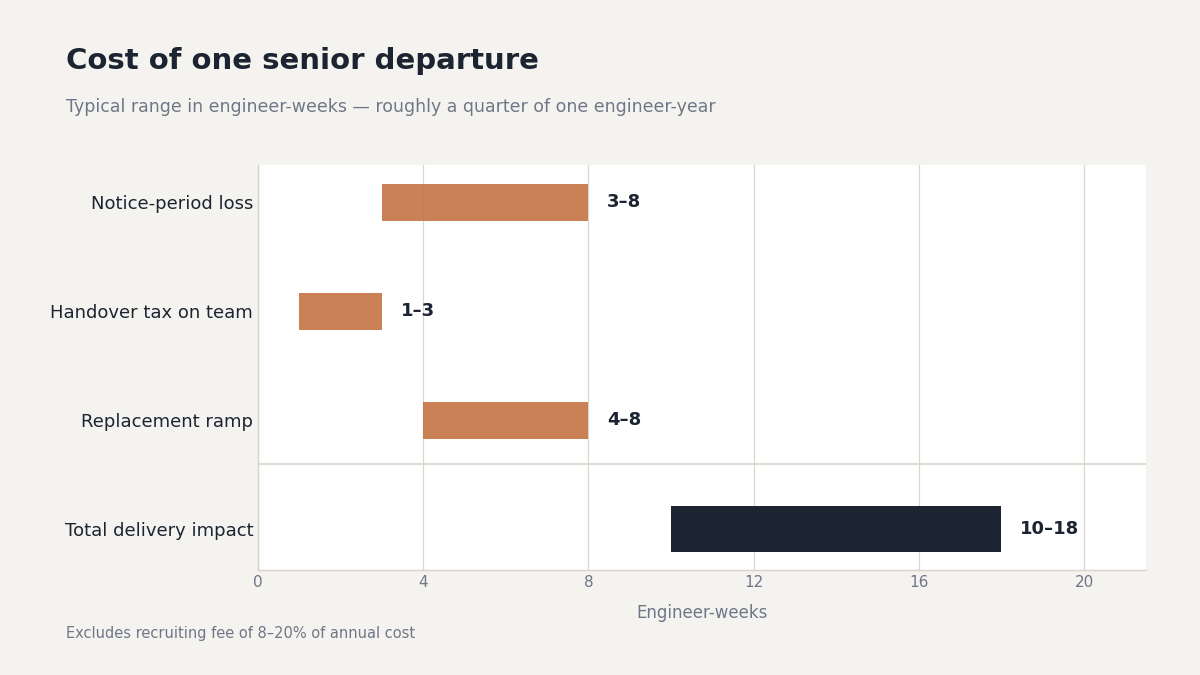
The number to hold onto: a single senior engineer leaving typically costs you 10 to 18 engineer-weeks of lost delivery capacity once you add notice-period disengagement, hiring lead time, ramp, and the tax on the teammates who absorb the handover. That is roughly a quarter of one person's year, and it does not appear on any invoice.
By the end, you will be able to calculate your own attrition rate correctly, separate the exits you should have prevented from the ones you should not care about, run a knowledge-transfer handover that survives the departure, write attrition and replacement terms into a contract instead of hoping, and decide whether your churn problem is a pay problem, a career-ceiling problem, or a management problem. Those three require completely different fixes, and misdiagnosing them is the most expensive mistake in this category.
What Is Offshore Development Team Attrition?
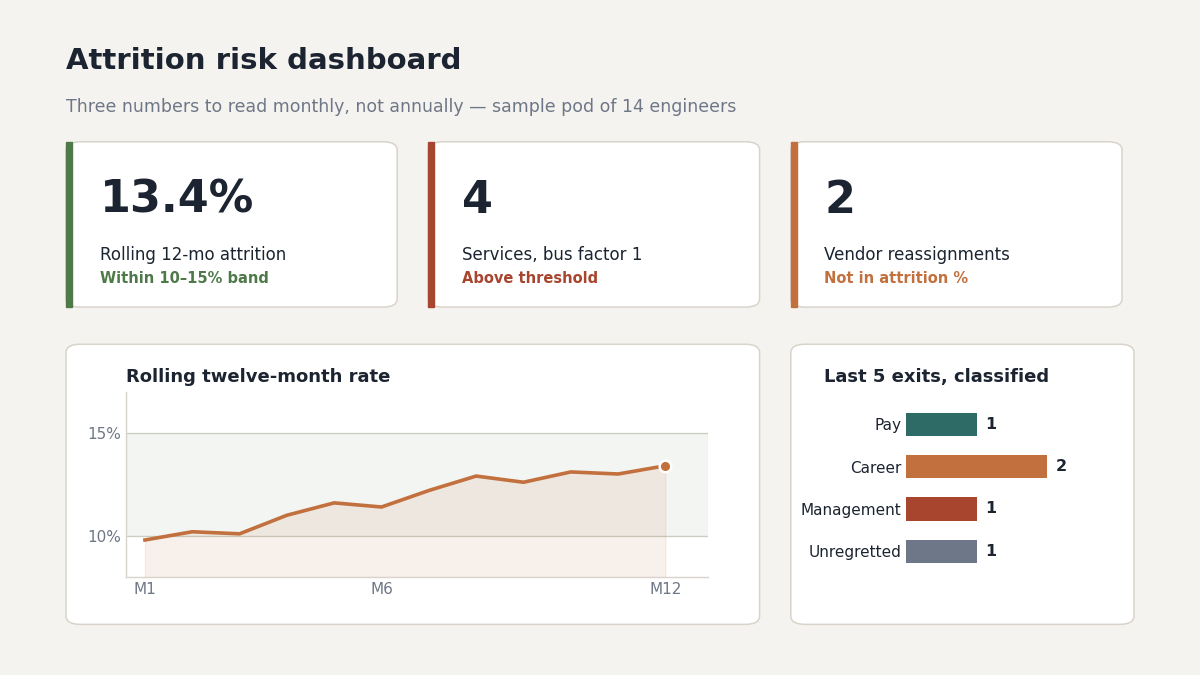
Offshore development team attrition is the rate at which engineers leave a distributed team based in a different country from the parent business, measured over a rolling twelve-month period and expressed as a percentage of average headcount. It covers voluntary resignations, involuntary exits, and vendor-side reassignments that remove a named engineer from your project.
Three things it is routinely confused with:
- It is not the same as vendor bench rotation. If your partner moves an engineer to another client and supplies a replacement, that is a reassignment. It damages your delivery continuity identically, but it will never show up in the vendor’s published attrition figure. Ask for both numbers separately.
- It is not the same as your onshore attrition rate. Offshore markets have different notice-period norms, different counter-offer cultures, and a far denser employer market within commuting distance of the same talent pool. Benchmarking an India- or Poland-based pod against your San Francisco team produces a false alarm or false comfort.
- It is not all bad. Unregretted attrition the exit of someone you would not rehire is a healthy signal. A team with 0% attrition over three years is usually a team where nobody is being stretched and nobody is being managed out.
Why Reducing Attrition in Offshore Development Teams Is a Delivery Problem, Not an HR One
Churn in a distributed engineering function is not an HR line item; it is a delivery risk with a direct revenue shadow. The concrete outcomes it moves:
- Delivery slippage of 15–25% per departure quarter. When a senior engineer with exclusive ownership of a service leaves mid-quarter, the affected squad’s throughput drops for two to three sprints not because of the missing headcount alone, but because two other engineers become part-time archaeologists.
- A cost-arbitrage advantage that quietly evaporates. Offshore engineering is bought for a 40–60% fully loaded cost saving against equivalent onshore hiring. Rebuild that team twice in eighteen months and the rework, re-ramp, and management overhead consume most of the differential.
- Compounding architectural debt. Every unplanned exit leaves a decision nobody can explain. Three exits later, the team is afraid of a module. Fear of a module becomes a rewrite request in the next planning cycle.
- Roadmap credibility with your own board. Offshore capacity is usually justified with a velocity promise. Missed commitments traced to churn make the next capacity request harder to win, regardless of the underlying economics.
- Security and compliance exposure. Each offboarding is an access-revocation event across repositories, cloud consoles, CI systems, and third-party tools. Rushed exits are where orphaned credentials are born.
- Recruiting drag on the remaining team. Interview panels, referral chasing, and onboarding buddies come out of your senior engineers’ calendars. In most engagements we have run, a backfill consumes 12–20 hours of existing team time before the new hire writes a line of production code.
There is a market-level reason this has become sharper. India now hosts 2,117 Global Capability Centers employing 2.36 million professionals and generating USD 98.4 billion in FY26 revenue, up 32% since FY21, according to the Nasscom–Zinnov India GCC Landscape 2026. Every one of those centres is a well-funded, brand-name competitor for the exact engineer sitting in your offshore pod often in the same city, frequently in the same building complex.
The Core Problem Most Buyers Face
Most teams discover their offshore attrition problem two quarters too late, because they are measuring the wrong thing and comparing it to the wrong benchmark. The pattern repeats with uncomfortable consistency across engagements.
The measurement error: A headcount-based offshore team attrition rate understates the damage. A ten-person pod that loses two engineers reports 20% attrition. But if those two were the only people who understood the payments service and the deployment pipeline, the capability loss is closer to 50%. Attrition is a headcount metric measuring a knowledge problem, which is why it consistently under-alarms.
The benchmark error: Teams anchor on published tier-1 IT services figures, which have moderated into the low-to-mid teens, and conclude that 15% is fine. For a five-to-fifteen-person product pod, it is not comparable maths. A 15% annual rate on a six-person team means one departure a year, and on a small team a single departure of the wrong person is a quarter-long event.
The three underestimations we see most often:
- Time-to-productive-replacement is underestimated by 3–4x. Leaders budget “a month.” The honest sequence is 30–90 days of notice period, 7–10 working days to an interview-ready shortlist if the process is already running, one to two weeks of interviewing and offer, and then four to eight weeks to independent contribution. Real elapsed time from resignation to full replacement productivity is commonly 12–20 weeks.
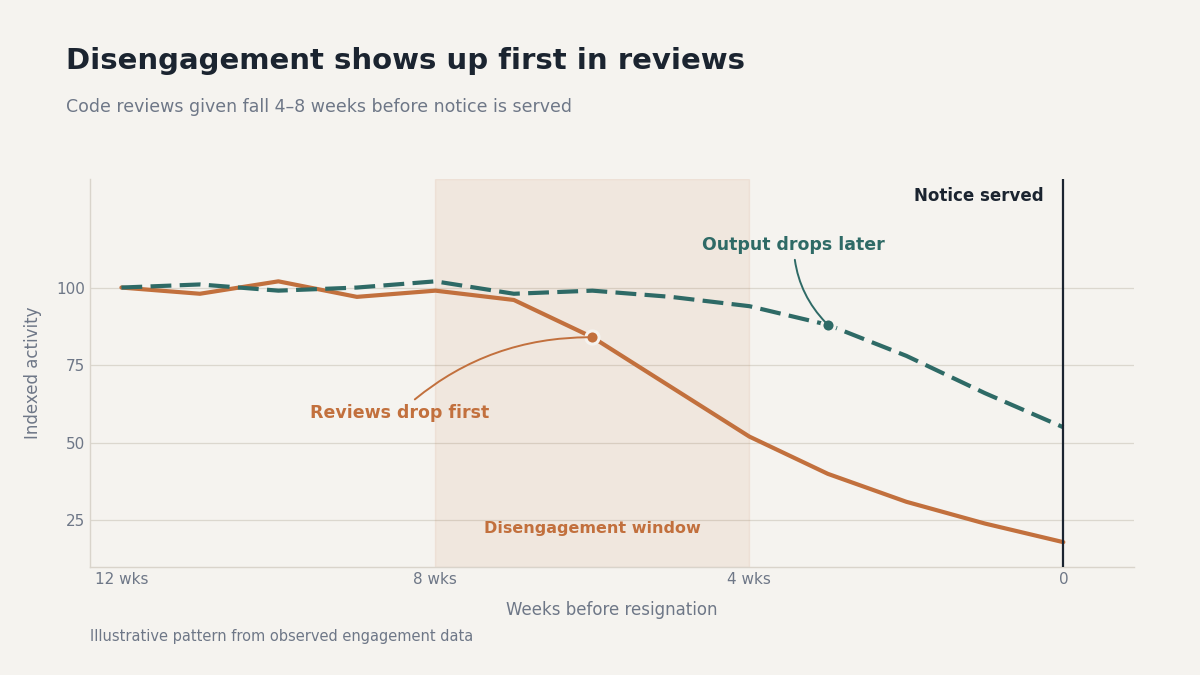
- The disengagement window before the resignation is invisible. By the time notice is served, most engineers have been mentally out for 4–8 weeks. Velocity data usually shows it before the manager does fewer code reviews given, no participation in design discussions, PRs that solve the ticket and nothing beyond it.
- Knowledge transfer is treated as a document, not a process. A retiring engineer is asked to “write up what they own.” What arrives is a wiki page nobody can execute from, because the transferable part was never the file paths, it was the reasoning behind the choices.
Red flag: if your vendor cannot tell you, without preparation, which engineers on your pod are single points of failure for which services, nobody is managing this. That question is the fastest audit in this guide.
The Walkthrough: Building an Offshore Team That Stays
Nothing below requires a bigger budget than you already have. Effective offshore team retention strategies for reducing attrition in offshore dedicated development teams are almost entirely design decisions made early on how you scope the role, what you write into the contract, who owns what, and what the first two weeks look like. Retrofitting them after the third resignation is possible but expensive.
Run these six phases in order. Each one has a failure mode that shows up as attrition two quarters later.
Phase 1 Designing the team so departures are survivable
Team design is the highest-leverage retention lever you have, and it happens before a single interview. The goal is not zero attrition; it is a team where any one person leaving is an inconvenience rather than an incident.
The design checklist:
- Set a bus-factor floor of two for every production service. No service, pipeline, or third-party integration should have exactly one person who can safely change it. Write this down as a constraint, then staff it.
- Split scope into ownership areas, not ticket queues. An engineer who owns “the notifications service” behaves differently from one who is assigned notification tickets. The first builds context worth staying for; the second is interchangeable and knows it.
- Budget for 10–15% capacity overhead. Documentation, pairing, and cross-training are not slack; they are the insurance premium. Teams run at 100% allocation have no capacity to transfer knowledge, which is precisely why their departures hurt most.
- Benchmark pay against the local market, not against your onshore band. Set an explicit pay-parity band: target the 60th–75th percentile of the local market for the role and seniority, and revisit it every 6–9 months in high-inflation talent markets. Underpaying by 15% against local median is the single most reliable predictor of a 12-month exit.
- Define the career ladder before you hire. Two tracks, published: an individual-contributor track with real senior and staff levels, and a lead track. Deloitte’s 2026 finding matters here; most engineers now want lateral skill growth over rapid promotion, so a ladder with visible scope increases beats one with faster titles.
Budget bands to plan against (2026 market ranges, India-based dedicated engagements): junior engineers commonly land at ₹6–12 lakh per year (roughly USD 15–25/hour on a vendor rate card), mid-level at ₹12–25 lakh (USD 25–45/hour), and senior at ₹25–45 lakh (USD 45–65/hour). Specialised stacks AI/ML, senior DevOps, data engineering carry a 20–35% premium. Treat these as bands to negotiate within, not quotes; city, stack, and contract length move them materially.
The 15% rule: if your offer sits more than 15% below the local band for that seniority, you are not hiring an engineer, you are renting one until their market value catches up.
Phase 2 Sourcing and vetting for tenure, not just skill
Vetting for retention is a distinct evaluation from vetting for capability, and most processes only run the second one. A candidate who can pass your system-design round and will still be there in eighteen months are two different assessments.
What good retention screening looks like:
- Read the tenure pattern, not the tenure length. Three 14-month stints is not automatically a red flag; three 14-month stints where each move was lateral and same-stack is. Ask what they learned in each role that they could not have learned by staying.
- Ask the counterfactual question: “What would have kept you at your last company?” Vague answers (“better growth”) tell you nothing. Specific answers (“I asked to move to the platform team twice and it never happened”) tell you exactly what will make them leave you.
- Screen for the work, not the brand. Engineers who join because the client logo is impressive leave when the logo stops being impressive. Engineers who join because the problem is interesting stay through a bad quarter.
- Test collaboration under ambiguity. Give a deliberately underspecified problem and watch whether they ask questions. Offshore roles punish engineers who wait to be told; those engineers disengage first.
- Verify notice-period and counter-offer reality upfront. Ask directly what their current notice period is and whether their employer counters. In markets with 60–90 day notice periods, a candidate who has not thought this through is a 30% chance of a drop-off at the offer stage.
Red flag pattern from real engagements: the candidate who negotiates hardest on title and softest on scope. In our experience, that combination correlates far more strongly with an early exit than a modest salary gap does; the title is portable to their next employer; the scope is not.
Role-specific screening matters here too. The signals that predict a stable backend hire are different from a mobile or infrastructure hire, so when you hire Nodejs developers the technical round should include reading and safely modifying unfamiliar code, because that is the actual job in an inherited codebase and the ability to do it without a rewrite request is what makes an engineer resilient to the departure of the person before them.
The 2% principle: narrow shortlists beat wide ones for retention. AI-assisted sourcing that surfaces the top 2% of vetted candidates produces fewer interviews and better matches, and match quality is the earliest retention lever in the funnel. Our own engagements run a 7–10 working-day cycle from job description to interview-ready shortlist with a 98% candidate joining rate. The joining rate is the number to watch, because a broken offer-to-join stage is attrition before day one.
Phase 3 Engagement models and the contract clauses that matter
Contract structure determines who absorbs the cost of churn, and most buyers sign agreements where the answer is “entirely you.” A properly written offshore attrition SLA shifts part of that risk back to the party that controls hiring and retention.
Clauses to negotiate before signing:
- Named-resource commitment. Specific engineers named in the statement of work, with written notice required before any reassignment. Without this, your team can change without a single resignation.
- Replacement window, in working days. Define the maximum time to a vetted replacement: a 7–10 working-day commitment to an interview-ready shortlist is achievable and worth insisting on. Specify that the replacement is your accept-or-reject decision, not an automatic substitution.
- Transition SLA with paid overlap. Require a minimum 10–15 working-day overlap between the outgoing and incoming engineer, and specify who pays for it. If the vendor pays, they are incentivised to prevent the exit; if you pay, they are not.
- Attrition reporting as a contractual obligation. Monthly disclosure of pod-level attrition and reassignment counts, separated. Vendors who resist this line are telling you something.
- Non-solicit that runs both ways, with a defined conversion path. Rather than a blanket ban, negotiate an agreed buyout for converting a vendor engineer to your direct payroll or GCC entity. A blocked path is a resignation waiting to happen; a priced path is a retention tool.
- IP assignment and NDA coverage per individual, not per entity. Confirm that assignment clauses bind each engineer directly, so a departure does not create an ownership question about the code they wrote.
- Access-revocation obligations on exit. A contractual 24-hour revocation window across repositories, cloud consoles, and CI systems, with confirmation in writing.
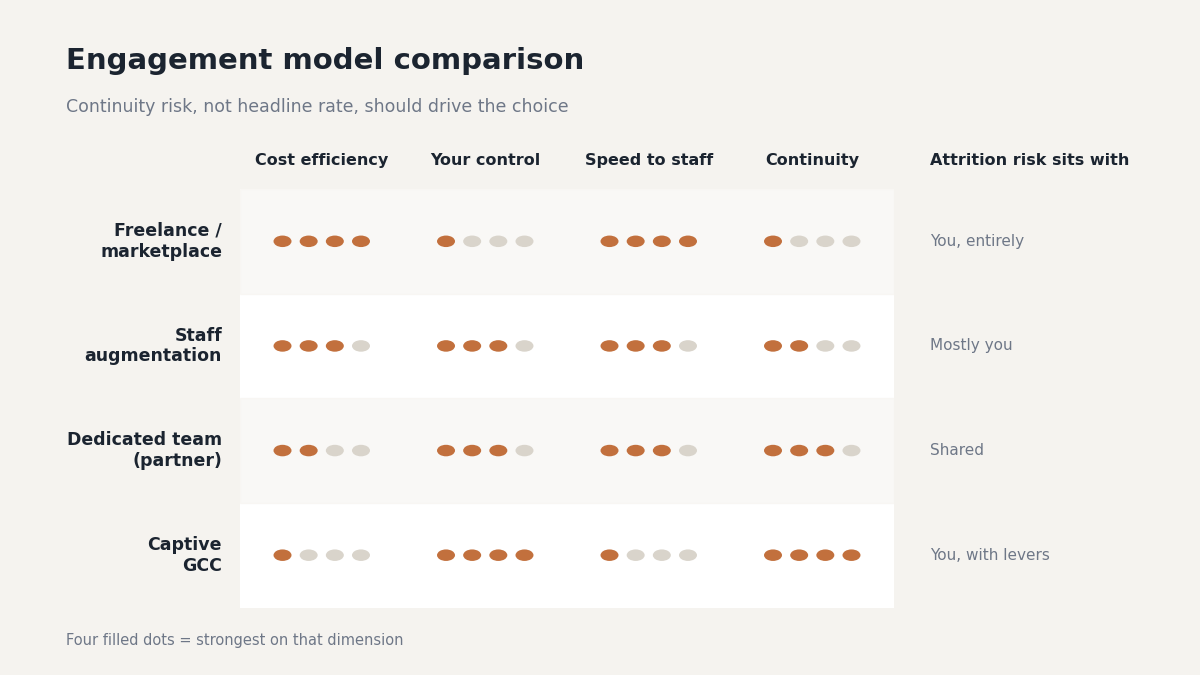
Model comparison at a glance:
| Engagement model | Who carries attrition risk | Continuity strength | Best fit |
| Staff augmentation | Mostly you | Low–medium | Filling defined skill gaps in an existing team you manage |
| Dedicated team via a partner | Shared, if the contract says so | Medium–high | A product squad you want to own outcomes with, without entity setup |
| Project-based / fixed scope | Vendor | Low for you, invisible to you | Bounded deliverables where team identity does not matter |
| Captive GCC | Entirely you | Highest, once mature | 50+ headcount, multi-year horizon, strategic capability |
The engagement model you pick should follow your continuity requirement, not your procurement preference. Well-structured IT staffing services agreements with no shared bandwidth, dedicated account management, and a defined 7–10 day replacement guarantee behave very differently under stress than a per-hour body-shop contract, even at a similar headline rate.
Phase 4 Onboarding, ramp-up, and knowledge transfer discipline
Onboarding quality predicts 12-month retention better than compensation does, and the window is narrow. Managing knowledge transfer offshore turnover risk is not a task you run when someone resigns; it is a habit you build from day one, because a team that documents continuously has nothing to scramble for later.
First-fortnight targets:
- Day 1: all access provisioned before the engineer logs in repository, CI, cloud console, ticketing, observability, communication channels. Chasing access on day three is the most common and most avoidable disengagement trigger.
- Day 2–3: first commit merged, however trivial. Time-to-first-commit is a diagnostic, not a vanity metric; anything past five points at an environmental problem the whole team is quietly absorbing.
- Day 5: a named onboarding buddy in the same timezone, with 45 minutes a day blocked for the first two weeks.
- Day 10: first independent pull request on a real ticket, reviewed by their designated owner.
- Day 14: written scope confirmation which services they own, which they contribute to, and who they escalate to. Ambiguity at day 14 becomes resentment at day 90.
The knowledge-transfer checklist (run it quarterly, not at resignation):
- Service ownership map maintained in-repo (CODEOWNERS or equivalent), reviewed monthly
- One-page runbook per service: how to deploy, how to roll back, how to tell it is broken
- Architecture decision records for every non-obvious choice, including the options rejected
- Credentials and secrets in a shared vault, never in an individual’s local environment
- Environment setup reproducible from a single documented command or script
- Third-party account ownership recorded with a named backup owner
- Recurring cron jobs, scheduled tasks, and manual processes listed in one place
- Open technical debt and known-fragile areas written down, not carried in someone’s head
- Client and stakeholder context documented who cares about what, and why
- Shadow rotation: every service has a secondary engineer who has shipped to it in the last 90 days
- Recorded 30-minute walkthrough per critical service, refreshed on major change
- Handover dry run once a quarter: a random engineer takes a colleague’s on-call rotation
The 90-day rule: if a secondary owner has not touched a service in 90 days, treat the bus factor as one regardless of what the ownership map says. Documented knowledge decays; exercised knowledge does not.
Infrastructure is where this bites hardest, because access, pipeline, and cloud configuration are the least documented and the most person-dependent parts of most stacks. Teams that hire DevOps engineers into offshore pods should insist on paired ownership of the deployment path from the first week, not the first incident.
Phase 5 Managing delivery and reading the early signals
Delivery management is where retention is actually won or lost, and the useful part of managing offshore team stability is that the warning signals are already in your data. You do not need a survey to see disengagement; you need to look at behaviour that changes 4–8 weeks before a resignation.
Leading indicators, in rough order of reliability:
- Code reviews given drops before code written drops. An engineer who stops reviewing others’ PRs has stopped investing in the team. This is the earliest signal and the most consistently ignored.
- Withdrawal from design discussions. Present but silent in planning and architecture conversations for three consecutive sprints.
- Scope compliance without scope challenge. PRs that do exactly the ticket and never flag the adjacent problem. Good engineers argue; disengaged engineers comply.
- Meeting camera and calendar patterns change. Declining optional sessions, arriving late to standups they used to run.
- A sudden interest in documentation. Occasionally a genuinely conscientious engineer tidying up. More often, someone builds an exit ramp.
Cadence that actually holds a distributed team together:
- Weekly 1:1 between engineer and their direct lead, 30 minutes, agenda owned by the engineer
- Fortnightly technical review with the onshore counterpart the engineer presents, nobody presents for them
- Monthly delivery review with a dedicated account manager, covering throughput, blockers, and attrition risk explicitly
- Quarterly stay interview: three questions what would make you leave, what would make you stay, what do you want to be doing in a year
- A minimum 3–4 hour daily timezone overlap window, protected and non-negotiable
- Rotating meeting times when the timezone gap exceeds six hours, so the offshore team is not always the one taking the 9pm call
Red flag: an offshore engineer who has never spoken directly to the person who uses what they build. Isolation from the customer is a stronger predictor of exit than isolation from the team, and it is far easier to fix.
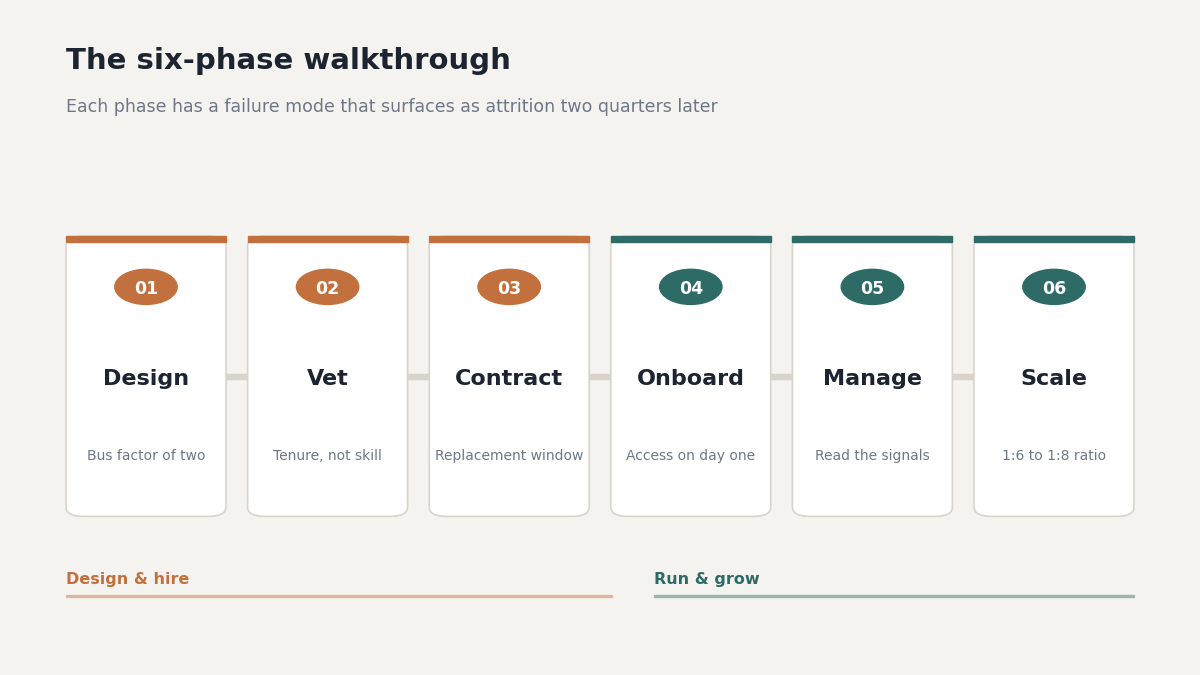
Phase 6 Scaling, replacing, and exiting cleanly
Scaling multiplies whatever retention design you already have, so fix ratios before adding headcount. Growth is where a fragile team becomes an unmanageable one.
Rules for scaling without importing churn:
- Hold a 1:6 to 1:8 lead-to-engineer ratio. Beyond eight direct reports across a timezone gap, 1:1 quality collapses and so does early-warning detection.
- Add in pairs where possible. A single new joiner in an established offshore pod ramps slower and leaves earlier than two who joined together.
- Cap growth at 30–40% headcount per quarter. Faster than that and onboarding quality degrades, which shows up as attrition two quarters later.
- Plan rotations deliberately. Move one engineer between services every 6–9 months. It raises the bus factor, breaks silo formation, and satisfies the lateral-growth preference that the 2026 generational data points to.
- Use structured outsourcing for volume hiring. Sustained multi-role hiring is where an in-house recruiter breaks; recruitment process outsourcing exists to keep pipeline quality constant while headcount grows.
Offboarding checklist, executed in every exit:
- Written handover plan agreed on day one of the notice period, not week three
- Named receiving engineer per owned service, with overlap time formally booked
- Recorded walkthrough session per critical service before the last two weeks
- Access revocation across all systems within 24 hours of the final day
- Exit interview conducted by someone other than their direct manager
- Root-cause classification of the exit: pay, career, management, personal, or unregretted
The exit-classification discipline: if you cannot put each departure into one of those six buckets within a week, you will keep treating a management problem with a salary correction. That misdiagnosis is why some teams raise pay twice and still lose people.
Infographic block: attrition risk factors and countermeasures
| Risk factor | What it looks like in your data | Countermeasure |
| Pay drift below local market | Voluntary exits clustered at 10–14 months of tenure | Local-market band review every 6–9 months; compa-ratio audit |
| Career ceiling | Exits by your strongest engineers to same-level roles elsewhere | Published IC and lead ladders; scope-based progression |
| Isolation from the core team | Zero direct contact with product or end users; onshore always presents | Engineer-led demos; protected overlap window; customer exposure |
| Single-point-of-failure ownership | One name on every PR for a service | Bus-factor floor of two; 90-day shadow rotation rule |
| Ticket-queue work design | High throughput, no design participation | Ownership areas instead of queues; scope challenge expected |
| Onboarding friction | Time-to-first-commit past day five | Pre-provisioned access; named buddy; day-14 scope confirmation |
| No documentation habit | Handovers written only at resignation | Quarterly knowledge-transfer checklist; ADRs as standard practice |
| Weak vendor contract | Silent reassignments; no attrition reporting | Named-resource clause; replacement window; transition SLA |
| Manager span too wide | 1:1s cancelled; surprises at resignation | 1:6–1:8 ratio ceiling; monthly attrition-risk review |
| Counter-offer blindness | Offer-stage drop-offs and 30-day regrets | Notice-period and counter-offer discussion before offer |
Case Studies: What Stability Looked Like in Practice
Three engagement patterns from Supersourcing’s delivery history, each chosen because the retention mechanism is visible rather than anecdotal. Metrics first.
Paytm 100+ engineers hired without a pipeline collapse. Scaling past a hundred engineering hires is the point at which most in-house recruiting functions break and quality drops, which produces mis-hires, and mis-hires produce first-year attrition. The lever here was funnel discipline rather than volume: a narrow, pre-vetted shortlist per role instead of a wide one, which keeps interviewer fatigue down and match quality constant across the whole hiring wave. Match quality at intake is the cheapest retention intervention available, because every alternative happens after someone has already decided to leave.
Swiggy sustained hiring velocity through a high-growth phase. Fast-growth product companies fail at offshore retention in a specific way: they hire ahead of their onboarding capacity, and the engineers who join during the sprint receive the worst first fortnight. The countermeasure applied across this engagement was keeping time-to-shortlist inside a 7–10 working-day window so hiring could stay in step with, rather than ahead of, ramp capacity. Predictable intake is what lets onboarding stay a process instead of becoming an improvisation.
OkCredit and Somnoware a 98% candidate joining rate and under 1% drop-off on contract roles. These two figures are worth separating out because they measure pre-day-one attrition, which almost nobody tracks. An accepted offer that never converts, or a contract hire who leaves inside the first month, costs the full recruiting cycle and delivers nothing. Closing that gap came from handling notice-period and counter-offer reality during the offer stage rather than after it the least glamorous part of the process and the one with the highest return.
The common thread across all three is unremarkable and worth stating plainly: none of the retention gains came from a perk, a bonus, or an engagement programme. They came from intake quality, predictable timing, and finishing the offer stage properly.
The Decision Framework: Which Model Fits Your Continuity Needs
Choose your operating model by asking what happens on the day your best offshore engineer resigns, then working backwards. That single question separates the four common options faster than any cost comparison.
Published offshore developer attrition benchmarks are model-specific, so compare across the four options rather than in isolation:
How to apply it four questions, in order:
- How long is the horizon? Under 12 months, continuity barely matters and speed wins. Over 36 months with a strategic capability, entity ownership starts to pay. A global capability center becomes economically rational somewhere around 50+ sustained headcount, not before below that, the compliance, real-estate, and HR overhead outweighs the retention advantage.
- Do you have engineering management capacity onshore? If nobody onshore has room for weekly 1:1s with offshore engineers, a captive centre will not save you; it will just move the attrition inside your own entity, where you now own the severance.
- How specialised is the knowledge? Deep domain knowledge that takes six months to build argues for models with contractual continuity. Commodity implementation work does not.
- What is your tolerance for a two-week gap? Be honest. If a two-week absence in a critical service is unacceptable, you need a bus factor of two and a contracted transition overlap which rules out freelance and most fixed-scope arrangements regardless of price.
The mixed-model reality: most mature setups run two models simultaneously with a dedicated core team holding domain knowledge and continuity, plus flexible staff augmentation around the edges for surge capacity. Attrition in the flexible layer is expected and cheap. Attrition in the core layer is the thing this entire guide exists to prevent. Confusing the two, and applying core-team retention investment to surge capacity, wastes money in both directions.
Cost and Timeline Reality Check
Here is the arithmetic almost nobody runs before signing an offshore contract, expressed in engineer-weeks because that is the currency your roadmap is actually denominated in.
What one senior departure costs, broken down:
| Cost component | Typical range | Notes |
| Notice-period productivity loss | 3–8 engineer-weeks | Assumes 60–90 day notice at 40–60% effective output |
| Handover and overlap tax on teammates | 1–3 engineer-weeks | Two colleagues, part-time, across the transition |
| Hiring cycle (shortlist to accepted offer) | 3–6 calendar weeks | 7–10 working days to shortlist is achievable; interviews and offer add the rest |
| Replacement ramp to independent delivery | 4–8 engineer-weeks | Longer for domain-heavy or undocumented services |
| Recruiting fee or internal recruiting cost | 8–20% of annual cost | Zero only if you already have surplus pipeline |
| Total delivery impact | 10–18 engineer-weeks | Roughly a quarter of one engineer-year, invisible on any invoice |
Timeline by scenario:
- Planned exit, documented service, bus factor of two: 2–4 weeks to full continuity. This is the target state.
- Planned exit, single owner, thin documentation: 10–16 weeks to full continuity, with elevated incident risk throughout.
- Sudden exit (absconding or immediate resignation), single owner: 16–24 weeks, plus at least one production incident caused by a gap nobody knew existed.
- Vendor-side reassignment with no notice clause: effectively the same as a sudden exit, except you also had no chance to prepare.
What drives the cost up:
- Undocumented services and environment setup that lives on one laptop
- Specialised stacks where the local hiring pool is genuinely thin (senior ML, embedded, niche legacy)
- Departures clustered in the same quarter, which compound rather than add
- No contracted overlap, forcing a cold handover
- Onshore management bandwidth already at capacity, delaying interview loops
What drives it down:
- A standing pipeline rather than a from-scratch search this is the difference between a 3-week and an 8-week replacement
- Contracted transition overlap paid for by the vendor
- The 90-day shadow rotation rule, consistently enforced
- Ownership documented as a habit, not an event
- A replacement guarantee with a defined window, so the clock is not negotiated during a crisis
The honest benchmark: for a product-focused offshore pod of 5–20 engineers, sustained annual attrition in the 10–15% range is normal and manageable. Under 10% is strong. Above 20% sustained across two consecutive years is a structural problem in pay banding, career design, or management span not bad luck, and not fixable with a retention bonus.
FAQ
What is a good attrition rate for an offshore development team?
For a dedicated product pod of 5–20 engineers, 10–15% annually is a reasonable working range and under 10% is strong. Judge it against the local market rather than your onshore team, and always separate regrets from unregretted exits. A 12% rate made up entirely of your best engineers is worse than an 18% rate that is mostly performance-driven.
Why do offshore developers quit?
Three causes dominate: pay drifting below the local market band, a visible career ceiling where growth requires leaving, and isolation from the core team and end users. Compensation is usually the stated reason and rarely the whole one. The 2025 developer data showing autonomy and trust as the top satisfaction driver matches what exit interviews consistently surface.
How do I calculate my offshore team’s attrition rate?
Divide the number of exits over the last twelve months by average headcount across that period, then multiply by 100. Report it monthly on a rolling basis rather than annually. Track two figures beside it: vendor reassignments, which never appear in attrition numbers, and your count of services with a bus factor of one.
How much does it cost when one offshore engineer leaves?
Budget 10–18 engineer-weeks of lost delivery capacity for a senior departure once you include notice-period disengagement, the handover tax on teammates, hiring lead time, and ramp to independent contribution. Recruiting fees add 8–20% of annual cost. The figure roughly doubles when the departing engineer was the sole owner of a production service.
Can attrition targets be written into a vendor contract?
Yes, and they should be. Negotiate named-resource commitments, a defined replacement window in working days, a paid transition overlap of 10–15 working days, monthly attrition and reassignment reporting, and a priced conversion path if you later want the engineer on your own payroll. A partner unwilling to report pod-level attrition monthly is worth questioning further.
How long does it take to replace an offshore developer?
With a standing pipeline, 7–10 working days to an interview-ready shortlist is achievable, plus 1–2 weeks for interviews and offers, plus 4–8 weeks to independent delivery. From a cold start with no pipeline, expect 12–20 weeks end to end. Notice periods of 60–90 days run in parallel, which is why starting the handover early matters so much.
Should offshore developers be paid at onshore parity?
Full onshore parity is rarely necessary and distorts your local band. What matters is sitting at the 60th–75th percentile of the local market for that role and seniority, reviewed every 6–9 months. Pay is a hygiene factor: getting it wrong reliably causes exits, but getting it generous does not reliably prevent them.
How do I stop knowledge walking out with a resignation?
Treat documentation as a continuous habit rather than an exit task. Maintain an in-repo ownership map, a one-page runbook per service, and architecture decision records that capture rejected options. Then enforce the 90-day rule: if a secondary owner has not shipped to a service in 90 days, the bus factor is one no matter what the documentation claims.
Does a captive GCC have lower attrition than a vendor team?
Usually yes once mature, because you control pay bands, career ladders, and management quality directly. But the crossover point sits around 50+ sustained headcount and a multi-year horizon. Below that, entity, compliance, and HR overhead outweigh the retention gain and any management-capacity problem you have onshore simply moves inside your own payroll. If you are weighing the two paths specifically for continuity reasons, a modelling conversation is usually faster than a build-versus-buy spreadsheet.
What are the early warning signs an offshore developer is about to quit?
Code reviews are given drops before code written drops, which makes it the most reliable early signal. Add withdrawal from design discussions, pull requests that solve the ticket and never flag the adjacent problem, and declining optional sessions. Most disengagement begins 4–8 weeks before notice is served, and it is visible in behaviour long before it is visible in output.
