

Ninety-six percent of the global capability centres set up in India since FY21 launched with a product or portfolio mandate from day one. Not a support function. Not a crawl-walk-run pilot. Real ownership, from the first quarter.
That single number quietly rewrote the staffing problem for every company now planning a centre, and it is why gcc rpo vs internal ta has become a first-quarter decision rather than a second-year one. The old model gave you room: stand up a small team, hire a couple of recruiters, let the function find its feet over eighteen months. The new model does not. If the India centre owns a product line in quarter one, it needs senior engineers in quarter one and senior engineers in Bengaluru, Hyderabad or Pune are not a resource you can summon on a two-week notice.
India now hosts 2,117 GCCs across 3,728 units, employing roughly 2.36 million professionals and generating $98.4 billion in revenue as of FY26 32% growth since FY21.
So the question arrives early and it arrives loaded: do you build an internal talent acquisition team, or bring in a recruitment process outsourcing partner to carry the ramp?
Most companies answer it philosophically “we want to own our hiring” and then discover nine months later that owning it and being able to do it are different things. The choice is not a value question. It is a capacity question with a time dimension, and it has a defensible answer once you model two curves against each other: how fast you need people, and how fast your own recruiting function can physically produce them.
TL;DR
This is a decision guide for anyone standing up a new capability centre in India. It settles gcc rpo vs internal ta with numbers instead of instinct, and covers the full lifecycle headcount modelling, partner selection, pricing structures, contract clauses, onboarding, delivery governance, and the eventual handover.
The number that decides most of these cases: a competent in-house tech recruiter at a brand nobody has heard of closes roughly one to two hires a month, not the three to four they would close at a known employer. Run that against a 100-hire year and the gap becomes obvious before you have even signed an office lease. A mature gcc talent acquisition model almost never starts as pure build or pure buy.
By the end you will be able to size your own recruiter requirement, price both options against each other on a like-for-like basis, write the contract terms that protect you, and set the trigger conditions for moving hiring back in-house with numbers you can put in front of a CFO.
What Is the GCC RPO vs Internal TA Decision?
GCC RPO vs internal TA is the choice between outsourcing a capability centre’s hiring to a recruitment process outsourcing provider that operates as an embedded extension of your team, or building a salaried in-house talent acquisition function on your own payroll. The decision is governed by ramp velocity, hiring scale, and how long the demand lasts.
Three things it is routinely confused with and is not:
- It is not staff augmentation. Staff augmentation places contractors on your projects who remain on the vendor’s payroll. RPO recruits people onto your payroll. The output of RPO is your own employee.
- It is not headhunting or contingency search. A contingency recruiter is paid per placement and works your requisition alongside twenty others. An RPO owns a defined scope of your funnel, often sourcing, screening, scheduling, offer management and onboarding coordination against SLAs, and reports into your hiring managers.
- It is not a permanent replacement for a TA function. In most well-run centres it is a phase, or a permanently retained surge layer sitting underneath a small internal core.
Why Your GCC Talent Acquisition Model Decides the Ramp
Location, entity structure and real estate get the board attention. They are also the most reversible decisions you will make. Getting gcc rpo vs internal ta wrong is not reversible in the same way a hiring model that under-delivers for three quarters costs you time you cannot buy back, and the business case for the centre was written on the assumption that the team existed.
McKinsey’s framing of global centres is useful here: they have shifted from cost-efficiency vehicles to talent headquarters and genuine sources of competitive advantage. A talent headquarters that cannot acquire talent is an expensive lease.
What the model actually moves:
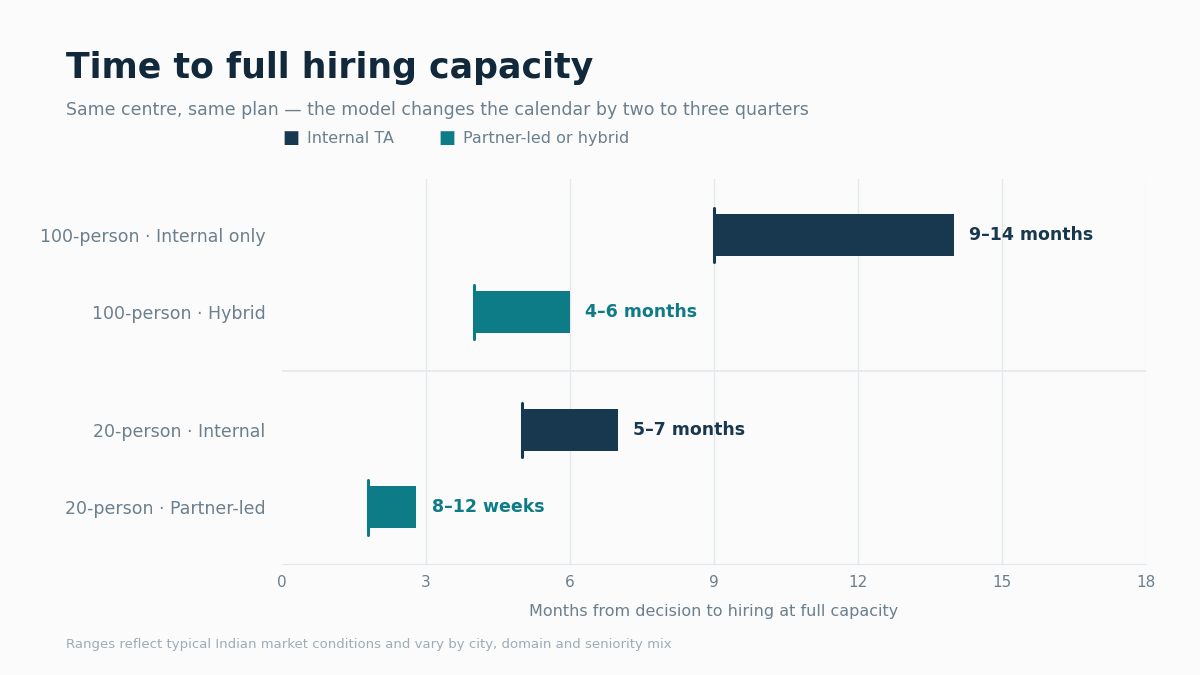
- Time for the first productive team. The gap between a well-executed ramp and a struggling one is typically two to three quarters on a 100-person plan. On a centre costing ₹12–20 crore a year fully loaded, a two-quarter delay is a real number, not a rounding error.
- Cost per hire, honestly measured. In-house looks cheaper on a spreadsheet because the recruiter salary sits in a different cost line from the agency invoice. Loaded correctly salary, tooling, management overhead, and the cost of unfilled requisitions the comparison usually narrows to within 20–30% either way, and flips depending on volume.
- Quality of the first fifteen hires. These people become your interview panel, your hiring bar and your referral engine. Get them wrong and every subsequent hire is calibrated against a lower standard. This is the most under-priced risk in the entire exercise.
- Offer-to-join conversion. In India, an accepted offer is not a hire. With 60–90 day notice periods standard, the window between acceptance and joining is where counter-offers land and candidates quietly disappear. Teams that do not actively manage this window routinely lose 20–30% of accepted offers.
- Employer brand from a standing start. Your first hundred candidate conversations are your brand. Whoever runs their internal recruiter or partner is defining how your company is described in engineering WhatsApp groups in Bengaluru.
- Leadership risk. The centre head, engineering leads and first architects are search problems, not funnel problems. They need a different motion entirely.
The Core Problem: The Recruiter Capacity Gap Nobody Models
Here is the failure pattern, and it repeats with remarkable consistency.
A company approves a 100-person India centre with a twelve-month build. Leadership decides to hire in-house because they want ownership of culture. They budget for a TA lead and four recruiters. The plan looks fine on a slide.
Then the sequencing hits.
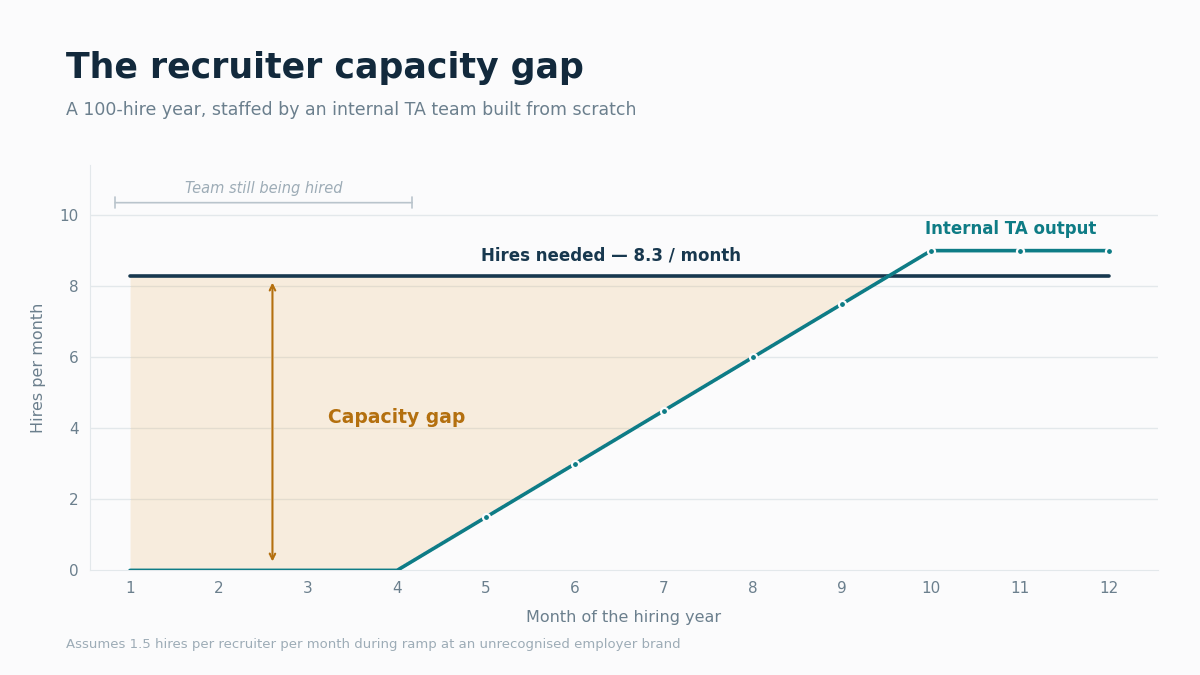
The chicken-and-egg problem: your first hire is a recruiter, and recruiters have to be recruited. A capable TA lead who has actually built a function in a global capability centre is itself a scarce, competitively-bid profile. Finding one, closing one, and waiting out a 60–90 day notice period consumes three to four months before a single engineering requisition is opened. Then that person hires their own team for another two to three months, plus their notice periods.
The productivity lag: a strong in-house tech recruiter at an established brand can reasonably run 8–12 open requisitions and close three to four hires a month. That same recruiter at a company with zero name recognition in the local market, no employer brand, no referral base, no calibrated interview loop and no candidate CRM will close one to two a month for the first two quarters. The individual did not get worse. The infrastructure they normally stand on does not exist yet.
Do the arithmetic on a 100-hire year:
- 100 hires ÷ 12 months = 8.3 hires needed per month.
- At 1.5 hires/recruiter/month during ramp, that requires 5–6 recruiters producing from month one.
- Building a 5–6 person TA team internally takes 5–7 months end to end.
- Therefore roughly half the hiring year passes before you have the capacity to hit the monthly number and you now have to hire 100 people in six months, which needs 9–11 recruiters, which you did not budget for.
The compounding effect: every month of shortfall pushes work back to headquarters teams who were supposed to be handing it off. Project timelines slip. The business case gets questioned. And the reflexive fix throwing three contingency agencies at the problem in month seven produces duplicate candidate submissions, inconsistent screening quality, and a bidding war against yourself.
The one-line version: most teams underestimate the time to reach full internal recruiting capacity by a factor of two to three, and they underestimate it in exactly the window where the hiring plan is at its steepest.
The Full Walkthrough: How to Staff a GCC From Zero to Steady State
Six phases, in order. Each ends with something you can actually execute, and the gcc rpo vs internal ta question is settled inside Phase 2 rather than assumed at the start.
Phase 1 Build the demand curve before you pick a model
Nobody can tell you whether to build or buy until they can see the shape of your hiring. A gcc recruitment strategy starts as a spreadsheet, not a vendor conversation.
Build these five columns before anything else:
- Role, seniority and function. Not “10 engineers.” Break it to “2 staff backend, 4 senior backend, 3 SDE-2 frontend, 1 SRE.”
- Month of required productivity. Work backwards from the project date, then subtract the notice period. A person needed to be productive in June must accept an offer in March.
- Scarcity tier. Tag each role: abundant (mid-level full-stack, QA, support engineering), competitive (senior backend, DevOps, data engineering), or scarce (ML/GenAI, security architecture, principal-level, niche domain).
- Compensation band, benchmarked locally. Benchmark against the alternatives your candidate is actually holding peer GCCs and funded product startups not against your home-country band converted at spot rate.
- Replaceability. If this person leaves in month nine, how long to backfill? That number belongs in the plan from the start.
The 3-day rule: if your hiring managers cannot agree on the definition of a role within three days, that requisition is not ready to open. Ambiguous requisitions are the single largest source of wasted recruiter capacity internal or outsourced. Every week a badly-defined req stays open, it burns sourcing hours that produce rejections.
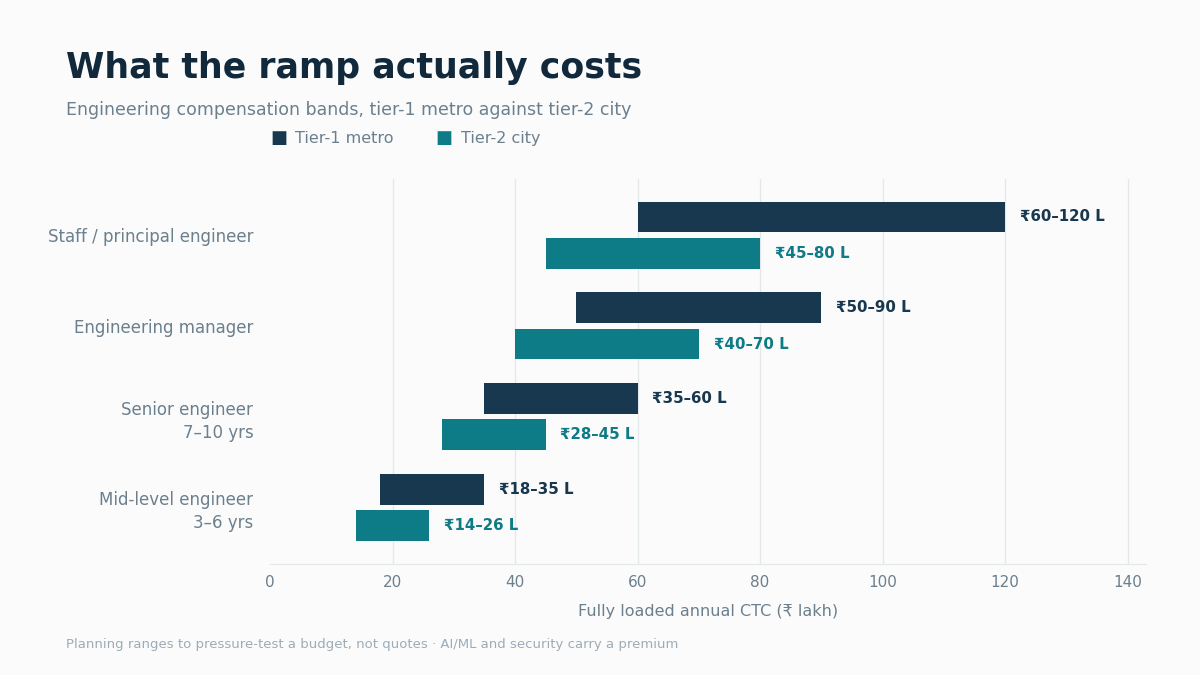
Budget bands to plan against (typical India market ranges, fully loaded CTC):
| Profile | Tier-1 metro band | Tier-2 city band |
| Mid-level engineer (3–6 yrs) | ₹18–35 L | ₹14–26 L |
| Senior engineer (7–10 yrs) | ₹35–60 L | ₹28–45 L |
| Staff / principal engineer | ₹60 L–1.2 Cr | ₹45–80 L |
| Engineering manager | ₹50–90 L | ₹40–70 L |
| Site / centre head | ₹1.2–2.5 Cr+ |
Treat these as planning ranges to pressure-test a budget, not quotes. Bands move materially by domain AI/ML and security carry a premium over general application engineering, and BFSI-adjacent roles carry their own.
Red flag: a headcount plan with no month-by-month distribution. “100 people in year one” is not a plan; it is a total. The distribution is the whole decision.
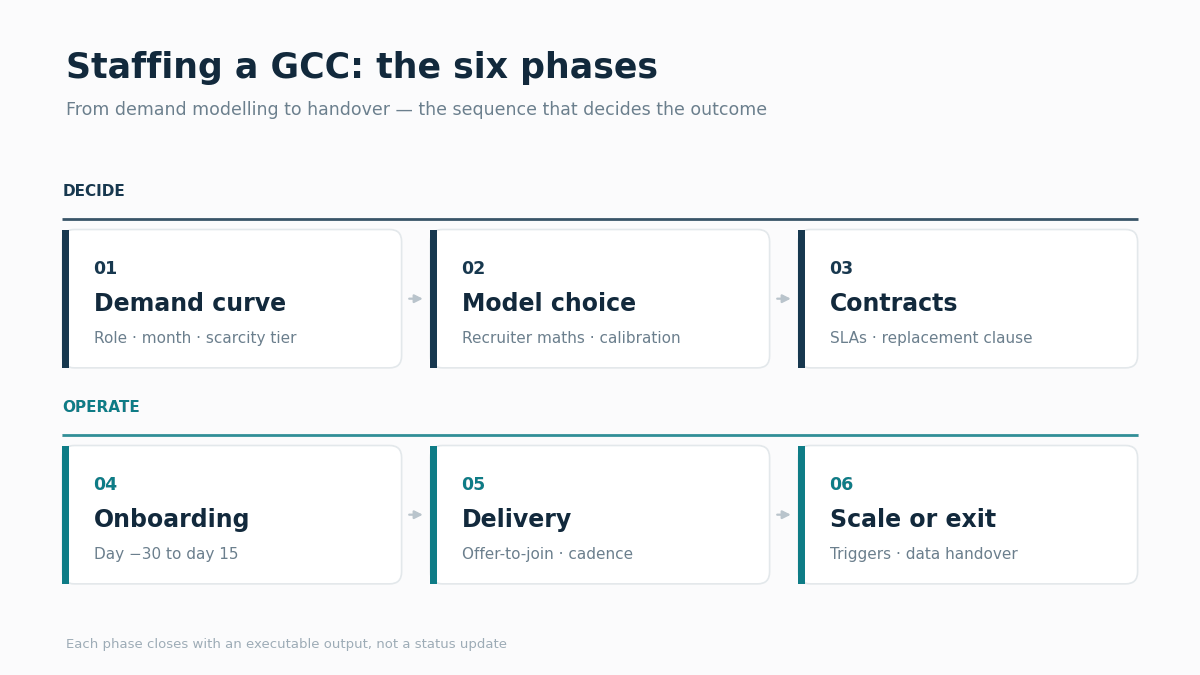
Phase 2 Choose the model, then define what good screening looks like
With the curve built, apply one test. Divide the hires you need in the first twelve months by twelve, then divide that by 1.5 (realistic ramp-phase output per recruiter at an unknown brand). That gives your required recruiter headcount from month one.
- Result under 2 recruiters → build internally. The volume does not justify a partner and you have time to hire properly.
- Result 2–4 recruiters → hybrid. Hire a TA lead, outsource the funnel volume.
- Result above 4 recruiters → lead with a partner. You cannot build that capacity fast enough, and attempting to hire recruiters means you will have to redeploy or exit in eighteen months.
Whichever model you land on, the screening standard is identical. This is where most engagements quietly fail not at sourcing, but at the definition of “qualified.”
What good technical screening actually looks like:
- A calibration session before the first CV. Your hiring manager and the recruiting team review 8–10 real profiles together and argue about them. Disagreement here is the point it surfaces the unwritten bar.
- A written scorecard per role with 4–6 weighted signals. “Strong Python” is not a signal. “Has owned a service handling >10k RPS in production” is.
- A live technical screen by an engineer, not a keyword match by a recruiter. AI-assisted sourcing is excellent at surfacing the top slice of a market; it does not replace an engineer’s twenty-minute judgement call.
- Cultural and context evaluation that tests for the specific thing GCC roles demand: working async with a headquarters team eight time zones away, and operating with ambiguity that a services background may not have trained for.
- Reference and stability checks run before the offer, not after including a candid read on notice period and counter-offer risk.
Red flags in a shortlist, in order of severity:
- Volume without conversion. Forty profiles submitted and two interviews scheduled means the screen is not working, regardless of how impressive the top-of-funnel number looks.
- Identical formatting across candidate summaries is a sign of templated submission rather than genuine evaluation.
- Candidates who have not been briefed on your company. If a candidate arrives at a first-round not knowing what you build, nobody sold the role; they filled a slot.
- Any partner who will not tell you their offer-to-join ratio for the last twelve months.
When your requirement includes infrastructure or platform work, that is the point in the plan where you decide whether to hire DevOps engineers through the same funnel as your product engineers or run a separate, specialist search. They are different markets with different scarcity profiles.
The benchmark to hold anyone to: a mature sourcing operation should return a first interview-ready shortlist within 7–10 working days of a properly defined job description. If a partner is quoting three to four weeks to first shortlist, they are running a queue, not a dedicated pod.
Phase 3 Engagement models, pricing structures and contract terms
This is the section competing content skips, and it is where money is won or lost.
The four commercial structures you will be offered:
| Structure | How it is priced | Best for | Watch out for |
| Percentage of CTC | Typically 8.33%–16.67% per hire; 20%+ for leadership | Low volume, unpredictable demand | Cost scales with salary, so the partner is not incentivised to negotiate your offer down |
| Dedicated FTE / pod retainer | Monthly fee per embedded recruiter | Sustained volume over 6+ months | Verify the recruiter is genuinely dedicated, not split across accounts |
| Fixed cost-per-hire | Flat fee per role band | Predictable, repeatable roles | Scarce roles get deprioritised for easy ones under the same fee |
| Hybrid (retainer + success fee) | Reduced monthly + smaller per-hire | Most GCC ramps | Complexity model total cost at three volume scenarios before signing |
The clauses that actually matter:
- Trigger the replacement guarantee on joining date, not offer acceptance. This is the single most valuable edit you will make to a draft contract. An offer accepted in March and reneged in May has cost you the entire quarter, and under an acceptance-triggered clause you may have no remedy.
- Define “dedicated” numerically. Write into the SOW the maximum number of concurrent accounts a recruiter on your pod may serve. Shared bandwidth is the most common quiet failure in outsourced hiring. You are told you have three recruiters and you have three people each giving you a third of their attention.
- IP and data protection, NDA-backed. Your requisitions reveal your roadmap. A JD for a “senior engineer, real-time payments ledger” tells a competitor exactly what you are building. Confidentiality here is commercial, not procedural.
- Non-solicit, both directions. Including a clause preventing the partner from recruiting out of your centre once hires are placed.
- Candidate ownership and data portability. Every profile sourced against your requisitions, with full interaction history, must be exportable to your ATS on exit. Without this clause, the transition in Phase 6 starts from zero.
- SLA definitions with actual numbers. Time to first shortlist, shortlist-to-interview ratio, offer-to-join ratio, and replacement turnaround each with a remedy attached.
- A defined transition-out plan written at signature, not negotiated at exit.
The negotiation point most buyers miss: ask for the replacement window to be expressed in days to the replacement shortlist, not “we will replace free of charge.” A free replacement that takes eleven weeks is not a remedy. Contractual language such as a replacement shortlist within 7–10 days is what makes the guarantee operationally meaningful.
For companies running this alongside entity setup, the sequencing of hiring against a global capability center setup timeline matters more than either workstream in isolation offers cannot be issued before the legal entity and payroll infrastructure exist, and that dependency has derailed more ramps than sourcing ever has.
Phase 4 Onboarding and the first 60 days of the ramp
The hire is not the finish line. In a new centre, onboarding is where the ramp quietly loses weeks.
The first two weeks, sequenced:
- Day −30 to Day 0 (the notice-period window). This is active work, not waiting. Fortnightly contact, team introductions, a pre-read on the product, a named buddy assigned. Silence during notice period is the leading cause of no-shows.
- Day 0. Laptop in hand, email provisioned, VPN working. In practice this fails constantly at new centres because asset procurement was scoped for the month-six headcount and not the month-two headcount.
- Days 1–3. Background verification initiated and tracked. BGV delays in India routinely run two to four weeks, and a hire who cannot get production access because BGV is pending is a salaried person watching videos.
- Days 1–5. Codebase walkthrough, architecture context, and one small merged pull request. The first commit inside week one is the single best predictor of ninety-day engagement.
- Days 5–15. First real deliverable with a named reviewer at headquarters. This establishes the working relationship that the entire centre model depends on.
The onboarding friction nobody warns you about: time-zone handover design. A Bengaluru team paired with a US West Coast team has roughly a two-hour genuine overlap. If that overlap is entirely consumed by status meetings, your engineers have no window to unblock themselves and productivity collapses in month two. Design the overlap as unblocking time and move status to written updates before the first hire joins not after the first complaint.
Communication cadence to set from week one:
- Daily async written standup, headquarters-readable
- Twice-weekly live overlap for blockers only
- Weekly 1:1 between each hire and their headquarters counterpart for the first six weeks
- A thirty-day and ninety-day structured check-in, with the recruiting owner in the room for the thirty-day
Phase 5 Managing delivery: KPIs, cadence and governance
Whether the function is internal or outsourced, you manage it with the same instrument panel. The difference is only who is on the other side of the table.
The seven metrics that matter, in priority order:
- Offer-to-join ratio. The truest quality signal in Indian hiring. Below 80% means something is wrong upstream, usually role misrepresentation or a compensation band that is not competitive.
- Time to first shortlist. Measures sourcing capacity. Benchmark: 7–10 working days from a finalised JD.
- Shortlist-to-interview conversion. Measures screening quality. Below 30% means the screen is a filter in name only.
- Interview-to-offer conversion. Measures calibration between the recruiting team and hiring managers.
- Time to fill, by scarcity tier. Track abundant, competitive and scarce roles separately or the average tells you nothing.
- Ninety-day retention of new hires. Early attrition is a hiring defect, not an HR problem.
- Cost per hire, fully loaded. Include recruiter cost, tooling, referral payouts and the amortised cost of unfilled time.
Governance cadence:
- Weekly: pipeline review by requisition. Thirty minutes. Blockers and dead requisitions only.
- Fortnightly: conversion metrics against SLA, with variance explanations.
- Monthly: compensation-band reality check. If offers are being declined on comp, the band is wrong and no amount of recruiting effort fixes it.
- Quarterly: headcount plan re-forecast against actual business demand.
Red flag in governance: a partner or internal lead who reports activity metrics (calls made, profiles sourced, CVs sent) rather than conversion metrics. Activity reporting is what you get when conversion is bad.
Whoever holds this function should have a single named account owner accountable for the numbers. Diffused ownership across a rotating pool is how SLAs become suggestions which is why dedicated account management, rather than a shared service desk, is the structural difference worth insisting on in any partner arrangement Supersourcing or anyone else proposes.
Phase 6 Scaling, transitioning and exiting
Most GCC RPO vs internal TA debates treat the choice as permanent. It is not. The mature pattern is a planned migration, and it works best when the trigger conditions are written down at the start rather than discovered through frustration.
Trigger conditions for moving hiring in-house:
- Monthly hiring volume has stabilised below your internal team’s sustainable capacity typically once you drop under 4–6 hires a month.
- The employer brand is producing inbound. When 20–30% of your qualified pipeline is referral or inbound rather than outbound-sourced, the hardest part of the job has changed character.
- Your interview loop is calibrated and your hiring managers are trained. The bar now lives inside the organisation.
- You have a TA lead who was hired deliberately, not promoted by default.
- Remaining demand is predominantly backfill and steady-state growth rather than net-new capability building.
The transition, sequenced over 90 days:
- Days 1–30: internal TA lead shadows the partner’s calibration sessions and pipeline reviews. Full ATS and candidate-data export executed and verified.
- Days 31–60: internal team takes primary ownership of abundant-tier roles. The partner retains competitive and scarce tiers.
- Days 61–90: internal team owns all recurring roles. Partner scope reduces to surge and specialist search, on a retainer or on-demand basis.
- Post-90: quarterly review of whether the retained surge layer is still earning its cost.
Scaling in the other direction. If demand spikes a new product line, an acquisition, an AI mandate landing on the centre an existing partner relationship is the fastest lever you have, provided the MSA already contemplates scope expansion. This is precisely why capability centres increasingly retain a small partner relationship even at steady state: a specialist search motion for scarce roles is much easier to reactivate than to rebuild. When the mandate is to hire machine learning engineers at pace, a cold-start search adds six to eight weeks that a warm relationship does not.
Offboarding a partner cleanly:
- Written notice per contract, with the transition-out plan already agreed
- Full candidate database export, verified as complete before final invoice
- Handover of active pipelines with candidate consent
- A defined cut-off for in-flight offers and who owns each
- Replacement guarantees on hires already placed must survive termination check this clause specifically
Case Studies: What the Ramp Actually Looks Like
Metric first, story second.
Consumer tech scale-up, 100+ engineers hired. Paytm’s engineering expansion required simultaneous hiring across backend, mobile and data functions, the classic profile where internal capacity cannot be built fast enough to meet the curve. The engagement ran as a dedicated pod against a defined role scorecard rather than open contingency search, which kept the screening bar consistent across three concurrent functional tracks. The determining factor was not sourcing volume; it was maintaining a single calibrated standard across all three.
High-growth marketplace, sustained multi-quarter ramp. Swiggy’s hiring scale-up ran across an extended period with rolling requisitions rather than a single burst. The operational lesson from engagements of this shape is that pipeline density beats reactive sourcing: profiles mapped, contacted and warmed three to four weeks before a requisition formally opens are what compress time-to-fill, because the sourcing work has already happened when the req arrives.
Healthtech product company, specialist roles. Somnoware’s recruitment ran against a narrower, deeper talent pool where a generic funnel produces almost nothing usable. Engagements against scarce-tier roles are won on the quality of the technical screen and the credibility of the first candidate conversation, not on top-of-funnel volume, a lesson that transfers directly to GCCs building AI or domain-specialist teams.
Across these engagements, Supersourcing’s operating benchmarks have held consistently: a 98% candidate joining rate, under 1% drop-off on contract roles, and interview-ready shortlists within 7–10 working days of a finalised job description. The joining-rate number is the one worth interrogating in any partner conversation, because it measures the part of the process everyone else lets slip.
The Decision Framework: Four Variables That Settle It
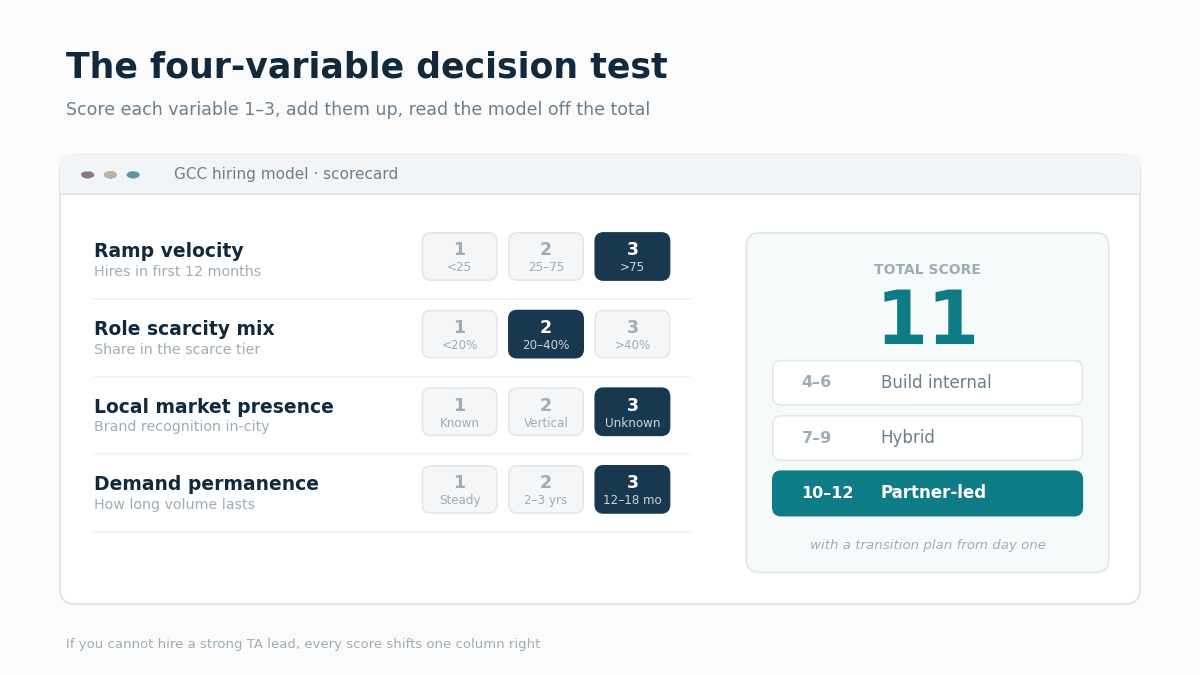
Score your situation on each variable from 1 to 3. Add the four scores.
Variable 1 Ramp velocity. Hires required in the first twelve months.
- 1: Under 25
- 2: 25–75
- 3: Over 75
Variable 2 Role scarcity mix. Share of roles in the scarce tier (ML/GenAI, security, principal-level, niche domain).
- 1: Under 20%
- 2: 20–40%
- 3: Over 40%
Variable 3 Local market presence. Your brand recognition among engineers in your target city.
- 1: Established you already employ people there or are a known consumer brand
- 2: Known in your vertical only
- 3: Unknown
Variable 4 Demand permanence. How long the hiring volume lasts.
- 1: Ongoing, steady, indefinite
- 2: 2–3 years of elevated hiring
- 3: An intense 12–18 month build, then steady state
Anyone can argue gcc rpo vs internal ta indefinitely on principle. A score forces the argument to resolve against your actual situation.
Reading your score:
| Total | Recommended model |
| 4–6 | Build internally. Hire a TA lead and one or two recruiters. A partner adds cost without adding speed you need. |
| 7–9 | Hybrid. Internal TA lead owning strategy, employer brand and hiring-manager calibration; partner carrying funnel volume. |
| 10–12 | Partner-led. Engage an RPO for the build phase with a contractual transition plan from day one. Building internal capacity fast enough is not achievable. |
Model comparison across the dimensions that decide budget:
| Dimension | Internal TA | RPO / partner-led | Hybrid |
| Time to first hire | 4–6 months (incl. hiring the recruiters) | 3–6 weeks | 6–10 weeks |
| Cost at low volume (<20 hires/yr) | Lower | Higher | Comparable |
| Cost at high volume (>75 hires/yr) | Higher (fixed cost of idle capacity) | Lower per hire | Lowest total |
| Elasticity when demand drops | Poor you own the salaries | High scope down | High |
| Employer brand ownership | Full | Requires deliberate management | Full, with internal lead owning it |
| Access to scarce-tier talent | Limited early | Strong existing networks | Strong |
| Institutional knowledge retention | Full | Requires contractual data portability | Full |
| Control over hiring bar | Full | Full, if calibration is done properly | Full |
The honest caveat on this framework: it assumes you can hire a good TA lead. If you cannot and in a competitive market you may spend two quarters trying every score shifts one column right.
What Most Teams Get Wrong About RPO for Capability Centers
The most expensive mistake in rpo for capability centers is not choosing wrong. It is treating the choice as ideological “we own our culture, so we own our hiring” and then defending that position for three quarters past the point where the data disagreed. Ownership of culture is established by who defines the bar and who runs the final interview. It is not established by whose payroll the recruiter sits on.
Four patterns that recur:
- Confusing the interview bar with the hiring function. Companies worry that an outside partner will lower their standard. In practice the bar is set by your scorecard and your final-round interviewers, both of which stay internal in any competent engagement. What actually lowers the bar is a stretched internal team under pressure to hit a monthly number with no surge capacity. Desperation lowers bars far more reliably than outsourcing does.
- Hiring recruiters before hiring hiring-managers. A recruiter without a calibrated hiring manager is generating rejections at scale. The first engineering leader should be in place or at minimum, a headquarters engineering leader formally assigned to own the loop before requisitions open. Reversing this order is the most common sequencing error we see.
- Optimising cost-per-hire in isolation. Cost-per-hire is a denominator metric and it is trivially gamed by hiring easier people. A partner who delivers 40 hires at ₹1.2 lakh each, of whom eight leave within ninety days, has delivered 32 hires at ₹1.5 lakh each and cost you a quarter. Track cost per retained hire at ninety days or the number is decorative.
- Treating the offer-to-join window as administrative. This is where India ramps actually break. A 60–90 day notice period is a nine-week window in which your competitor, the candidate’s current employer, and two other offers are all working on the same person. Teams that treat this window as a paperwork phase lose a fifth to a third of accepted offers and then blame sourcing. The fix is unglamorous: structured contact through the notice period, an assigned buddy, and an escalation path the day a counter-offer surfaces.
The contrarian position, stated plainly: for a genuinely new capability centre with an aggressive first-year plan, pure internal TA is usually the wrong answer even when the company is fully capable of executing it because the constraint is not competence, it is calendar. You are being asked to build the machine and operate it at full output simultaneously. Most of the centres that ramp cleanly do not choose between models at all; they run a partner-led funnel underneath an internal leader from month one, and migrate on a schedule they wrote before they signed anything.
Cost and Timeline Reality Check
Numbers you can put in a budget. Ranges reflect typical Indian market conditions and vary by city, domain and seniority mix.
Internal TA function annual fully-loaded cost
| Component | Typical annual range |
| TA lead / head of talent | ₹25–50 L |
| Senior tech recruiter (each) | ₹12–22 L |
| Recruiter / sourcer (each) | ₹6–12 L |
| ATS + sourcing licences (per recruiter) | ₹4–9 L |
| Employer branding, events, job boards | ₹5–15 L |
| Loaded overhead (facilities, benefits, management) | +25–35% on salary |
A five-person internal function therefore lands roughly in the ₹90 L–1.6 Cr per year range before overhead, a fixed cost that does not scale down when hiring pauses.
Partner-led engagement typical commercial ranges
| Structure | Typical range |
| Percentage of CTC (standard tech roles) | 8.33%–16.67% of annual CTC |
| Percentage of CTC (leadership / scarce) | 18%–25%, often part-retained |
| Dedicated recruiter pod (monthly retainer) | ₹1.5–3.5 L per embedded recruiter per month |
| Fixed cost-per-hire | ₹80,000–2.5 L depending on band |
The break-even logic: below roughly 20–25 hires a year, an internal function is usually cheaper. Between 25 and 75, the two converge and gcc rpo vs internal ta turns on speed rather than cost. Above 75, per-hire economics favour a partner and the timeline argument becomes decisive which is why high-volume ramps rarely come down to a cost debate at all.
Timelines by scenario, from decision to first hire joining
| Scenario | Model | Realistic elapsed time |
| 20-person centre, mostly mid-level | Internal | 5–7 months to first joins at volume |
| 20-person centre, mostly mid-level | Partner-led | 8–12 weeks to first joins |
| 100-person centre, mixed seniority | Internal only | 9–14 months to full capacity |
| 100-person centre, mixed seniority | Hybrid | 4–6 months to full capacity |
| Scarce-tier only (AI/ML, security, principal) | Either | 10–16 weeks per role, consistently |
What drives cost up:
- Scarce-tier concentration above 40% of the plan
- Tier-1 metro-only sourcing when tier-2 cities would serve
- Compensation bands set below local market, which inflates every downstream conversion metric
- Poorly defined requisitions burning sourcing hours
- Replacing early attrition, which costs roughly the full original cost-per-hire again plus the lost ramp time
What drives cost down:
- Batching similar roles into a single sourcing sprint
- Tier-2 city hiring, typically 15–25% below metro bands with structurally lower attrition
- Referral programmes activated from your first fifteen hires
- Realistic bands set at the start, which lift offer-to-join and remove the most expensive failure mode in the funnel
For teams comparing this against a contract-based approach for parts of the plan, the economics of IT staffing services differ meaningfully from recruitment outsourcing. Staffing carries an ongoing margin on a contractor’s rate, while RPO is priced against a permanent hire. They solve different problems and are worth modelling separately rather than collapsing into one line item.
Where to Take This Next
If you are mid-decision, the useful next step is not a vendor call. It is finishing the demand curve from Phase 1 role by role, month by month, with a scarcity tag on each line. That single artefact answers the build-versus-buy question more reliably than any framework, including this one, because it makes the capacity gap visible in numbers rather than in argument.
Once you have it, the conversation worth having is a specific one: here is our month-by-month plan, here is the seniority mix, here is the city where our internal capacity falls short, and what would it cost to cover only that gap?
That is the conversation Supersourcing’s GCC and recruitment process outsourcing teams have with capability centre leaders most weeks, and it usually takes about forty minutes. No pitch deck required to bring the spreadsheet.
Book a working session on your GCC hiring plan →
Frequently Asked Questions
Should a new GCC hire an internal TA team first or use an RPO?
Neither, exclusively. In most centres with a first-year plan above 40 hires, the effective sequence is to hire one internal TA leader immediately, engage a partner to carry funnel volume from month one, and migrate roles in-house as the internal function builds. The leader owns strategy and the bar; the partner owns throughput.
How long does it take to build an internal TA team for a GCC?
Plan for five to seven months from decision to a functioning team. That covers searching for and closing a TA lead, their 60–90 day notice period, then their own hiring of two to four recruiters with the same notice-period constraint. Full productivity typically arrives two quarters after the last recruiter joins.
What does RPO cost for a GCC in India?
Three common structures: a percentage of annual CTC, typically 8.33%–16.67% for standard tech roles and 18–25% for leadership; a dedicated recruiter retainer, roughly ₹1.5–3.5 lakh per embedded recruiter per month; or a fixed cost-per-hire between ₹80,000 and ₹2.5 lakh by band. High-volume engagements usually blend a retainer with a reduced success fee.
Can an RPO handle leadership and niche AI hiring, or only volume roles?
Both, but they are different motions priced differently. Volume roles run through a funnel; leadership and scarce-tier roles run as mapped search, often part-retained, at 10–16 weeks per role. Ask specifically about the search methodology for scarce roles if the answer sounds like the funnel answer, it will not work.
When should a GCC transition from RPO to internal TA?
When four conditions hold together: monthly hiring drops below your internal team’s sustainable capacity, 20–30% of qualified pipeline arrives inbound or by referral, your interview loop is calibrated with trained hiring managers, and remaining demand is mostly backfill. Run the migration over ninety days in tiers, starting with abundant roles.
Does using an RPO damage a GCC’s employer brand?
Only when the partner is treated as a black box. Candidates experience your brand through the conversation they have, so the controllable factors are whether the recruiter can credibly describe your product, whether feedback is delivered within 48 hours, and whether your own leaders appear early in the process. Managed properly, a dedicated partner improves brand consistency over an overloaded internal team.
How many recruiters does a GCC need per 100 hires?
Assume 1–2 hires per recruiter per month during the ramp phase at an unrecognised brand, rising to 3–4 once employer brand and referral flow are established. For 100 hires across twelve months, that means five to six recruiters producing from month one, or a partner pod of equivalent capacity. If you are still building the team, model the lower number.
Can a GCC run RPO and internal TA at the same time?
Yes, and it is the most common mature configuration. The split that works is by role tier rather than by function: internal owns abundant and recurring roles plus all final-round interviews, the partner owns scarce-tier search and surge volume. Split by function instead internal does screening, partner does sourcing and accountability for outcomes disappears.
